Performance of Ad-Hoc Network Routing Protocols in Different Network Sizes- Sudheer Kumar, Akhilesh Yadav
Page 375
Performance of Ad-Hoc Network Routing
Protocols in Different Network Sizes
Sudheer Kumar
1, Akhilesh Yadav
2Department of Computer Science and Engineering
Kanpur Institute of Technology, Kanpur
[email protected]
1, [email protected]
2Abstract-
A Mobile Ad-Hoc Network (MANET) is a temporary network that is composed of the mobile devices which communicates through wireless links without any pre-existing infrastructure. Routing is one of the major concerns in the MANET due to its frequent changing topology and the absence of centralized administrator. In this paper, we evaluate the performance of Mobile Hoc Network Routing Protocols Dynamic Source Routing (DSR), Ad-Hoc On Demand Distance Vector (AODV) and LAR1 under different performance metrics like Packet Delivery Ratio, Average End-to- End delay and Drop Ratio The performance evaluation is done in different network sizes using Glomosim simulator. The comparison result shows that L A R 1 a n d AODV gives b e t t e r PDR while DSR gives lowest PDR and AODV, DSR gives lowest End to End Delay while LAR1 gives higher Delay.
K
eywords-
AODV, DSR, LAR1, MANET.
Performance of Ad-Hoc Network Routing Protocols in Different Network Sizes- Sudheer Kumar, Akhilesh Yadav
Page 376
I. INTRODUCTION
A Mobile Ad-hoc Network (MANET) is an autonomous system of mobile routers (and associated hosts) communicating with each other without the use of a fixed infrastructure or any centralized administration. One of the distinguishing features in this network is that each mobile node must be able to act as a router to find out the optimal path for forwarding packets. Thus, nodes must discover and maintain routes to other nodes. Therefore, Routing in Ad- Networks is one of the major challenging task. A number of routing protocols have been developed so far for accomplishing this task. There are many ways to classify the MANET routing protocols, depending on how the protocols handle the packet to deliver from source to destination. Routing protocols in MANETs are broadly classified into two types: Proactive and Reactive protocols.
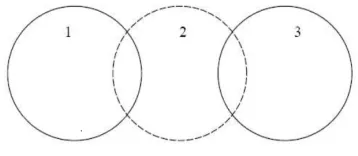
Figure 1: A MANET of 3 Nodes
Table Driven or Proactive Protocols: These protocols maintain consistent, upto-date routing information from each node to every other node in the network. These protocols require each node to maintain one or more tables to store routing information.
On Demand or Reactive Protocols: These protocols create routes only when desired by the source node.
II. DESCRIPTION OF THE
PROTOCOLS
This section briefly explains the AODV, DSR and L A R 1 routing protocol that are being studied in this paper.
Ad-Hoc On Demand Distance Vector (AODV) Routing Protocol
The Ad hoc On-Demand Distance Vector (AODV) is an on-demand routing protocol that enables dynamic, self- starting, multihop routing between participating mobile nodes wishing to establish and maintain an ad hoc network. AODV allows mobile nodes to obtain routes quickly for new destinations, and does not require nodes to maintain routes to destinations that are not in active communication. This protocol performs Route Discovery using control messages route request (RREQ) and route reply (RREP), whenever node wishes to send packet to destination. To control network wide broadcast of RREQs, the source node uses an expanding ring search technique. The forward path sets up in intermediate nodes in its route table with a lifetime association using RREP. AODV allows mobile nodes to respond to link breakages and changes in network topology in a timely manner. When either destination or intermediate node moves, a route error (RERR) is sent to the affected source nodes. When a source node receives the (RERR), it can reinitiate the route discovery if the route is still needed. Neighborhood information is obtained from broadcast Hello packet.
Dynamic Source Routing (DSR) Protocol
The Dynamic Source Routing protocol (DSR) is an on demand routing protocol. DSR is a simple and efficient routing protocol designed specifically for use in multi-hop wireless ad hoc networks of mobile nodes. The DSR protocol is composed of two main mechanisms that work together to allow the discovery and maintenance of source routes in the ad hoc network:
Route Discovery is the mechanism by which a node S wishing to send a packet to a destination node D obtains a source route to D using ROUTE REQUEST and ROUTE REPLY messages. It is used only when S attempts to send a packet to D and does not already know a route to D.
Performance of Ad-Hoc Network Routing Protocols in Different Network Sizes- Sudheer Kumar, Akhilesh Yadav
Page 377
Discovery again to find a new route for subsequent packets to D.
Location-Aided Routing (LAR1) Protocol Ad hoc on-demand distance vector routing (AODV) and distance vector routing (DSR) that have been previously described are both based on different variations of flooding. The goal of Location-Aided Routing (LAR1) described in is to reduce the routing overhead by the use of location information. Position information will be used by LAR1 for restricting the flooding to a certain area.
In the LAR1 routing technique, route request and route reply packets similar to DSR and AODV are being proposed. The implementation in the simulator follows the LAR1 algorithm similar to DSR.
Location Information When using LAR1, any node needs to know its physical location. This can be achieved by using the Global Positioning System (GPS). Since the position information always includes a small error, GPS is currently not capable of determining a node’s exact position. However, differential GPS5 offers accuracies within only a few meters.
III. RELATED WORK
Several researchers have done the qualitative and quantitative analysis of Ad-Hoc Network Routing Protocols. For this purpose, they have used different simulators and evaluated them by means of different performance metrics under different network conditions.
♦ Sapna S. Kaushik & P.R. Deshmukh in [12] studied & compared the performance of DSDV, AODV and DSR routing protocols for ad hoc networks. They have compared the three routing protocols in Ad hoc network with respect to packet delivery fraction, packet loss and end-to-end time delay by varying number of nodes. The authors have observed that for packet delivery and packet loss ratio, DSR/AODV performs better than DSDV with large number of nodes. Hence for real time traffic AODV is preferred over DSR and DSDV. For less number of nodes and less mobility, DSDV‟s performance is superior.
♦ P. Manickam1, T. Guru Baskar in [9] studied & analyzed three protocols AODV, DSDV and DSR &
were simulated using NS-2 simulator and were compared in terms of throughput, packet delivery ratio and average end-to-end delay in different environment; varying number of nodes and pause time. Simulation results show that DSR shows better performance with respect to throughput among these three protocols. in view of packet delivery ratio, reliability of AODV and DSR protocols is greater than DSDV protocol. For End-to-End delay, DSDV has high reliability than AODV and DSR.
♦ Santosh Kumar, S C Sharma in [11] have evaluated the three routing protocols (AODV, DSR and DSDV) with respect to packet delivery fraction and end-to-end time delay and NRL using NS-2. For the simulation the number of traffic sources was fixed at 10, 30 and 50 and the pause time was varied as 0, 10, 20, 30 40, 50, 60, 70, 100s. They have observed that The average end-to-end delay of packet delivery was higher in both DSR and AODV as compared to DSDV. In low network size, DSR has the highest PDF among the three protocols. In high network size, AODV gives the highest PDF. DSDV perform well with respect to all included performance matrices as compared to AODV and DSR.
♦ Mohamad Usop, Azizol Abdullah in [7] have compared DSDV, AODV and DSR Routing Protocols in Grid Environment. The results were obtained for the metrics: PDF, End to End Delay and Packet Loss for 50 nodes at pause time of 0, 100, 200, 300, 400, 500, 600, 700, 800, 900s. DSDV gives the lowest End-to-End delay. When the pause time is low, AODV gives the highest PDF and when the pause time is high, DSDV gives the highest PDF. AODV has the lowest packet loss. ♦ Akshai Aggarwal, Savita Gandhi in [1] have compared DSDV, DSR and AODV Protocols using NS-2. The simulation was done by varying number of nodes and taking different number of connection. The results were obtained for PDF, NRL, average end-to-end delay and Throughput. It is observed that DSDV gives the lowest end-to-end delay. DSR gives the lowest NRL. AODV gives the highest PDF and Throughput.
IV. SIMULATION SETUP
Performance of Ad-Hoc Network Routing Protocols in Different Network Sizes- Sudheer Kumar, Akhilesh Yadav
Page 378
sources are Constant Bit Rate (CBR). The mobility model uses random waypoint model in a rectangular field of varying sizes and varying number of nodes. The experiments use a fixed number of packet sizes 512-bytes.
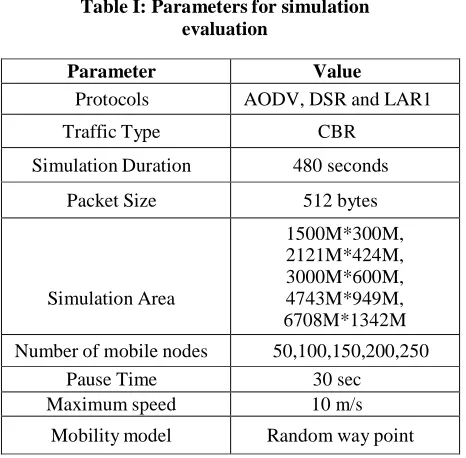
The parameters which have been considered for the performance evaluation of the Ad-Hoc Network routing protocols is given below in Table I.
Table I: Parameters for simulation evaluation
Parameter Value
Protocols AODV, DSR and LAR1
Traffic Type CBR
Simulation Duration 480 seconds
Packet Size 512 bytes
Simulation Area
1500M*300M, 2121M*424M, 3000M*600M, 4743M*949M, 6708M*1342M
Number of mobile nodes 50,100,150,200,250
Pause Time 30 sec
Maximum speed 10 m/s
Mobility model Random way point
V. PERFORMANCE METRICS
AND RESULT
In order to evaluate the performance of ad hoc network routing protocols, the following metrics were considered:
A. Packet delivery Ratio (PDR)
PDR is the ratio of the number of data packets successfully delivered to the destinations to those generated by CBR sources.
From figure 2, we find that when the number of nodes are minimum i.e. 50, LAR1 has highest PDR; while DSR has lowest PDR among the three routing
protocols. When the number of nodes are between 100 and 150; the PDR for LAR1 increases, for DSR it decreases while it almost remains constant for AODV.
In case of high network size, LAR1 gives the highest PDR. Overall, AODV performs better than DSR.
Figure 2: Packet Delivery Fraction vs. Number of Nodes
B. Average End-to-End delay
It is the average time from the beginning of a packet transmission at a source node until packet delivery to a destination. This includes delays caused by buffering of data packets during route discovery, queuing at the interface queue, retransmission delays at the MAC, and propagation and transfer times.
We observe from the figure 3 that DSR has the shortest End-to-End delay than AODV and LAR1. Hence, it consumes lesser time than others.
However, LAR1 has highest End-to-End delay than AODV and DSR.
C. Packet loss
It is the difference between the total numbers of packets send by source and received by sink.
It is observed from the figure 4 when the number of
0 20 40 60 80 100 120
50 100 150 200 250
P
D
R
No. of Nodes
Packet Delivery Ratio
AODV
DSR
Performance of Ad-Hoc Network Routing Protocols in Different Network Sizes- Sudheer Kumar, Akhilesh Yadav
Page 379
nodes is varied from 50 to 100, Packet Loss for DSR is highest; while it is lowest for AODV and LAR1. Overall, L A R1 performs better in terms of packet loss as it has least packet loss throughout.
V. CONCLUSION
Here, we have evaluated the performance comparison of the routing protocols LAR1, AODV and DSR with increasing number of nodes using Glomosim Simulator. The performance metrics taken are Average End-to-End delay, Packet Delivery Ratio and Packet Loss.
From the performance evaluation and results obtained, we conclude that in low network size; DSR gives the lowest PDR and the shortest End-to-End delay while LAR1 gives highest PDR and gives lowest packet loss.
In case of high network size; LAR1 gives the highest PDR and shortest End-to-End delay and gives highest throughput.
Overall, LAR1 performs better than AODV and DSR in terms of PDR and Throughput. LAR1 gives the gives shortest End-to-End delay than AODV and DSR.
VI. FUTURE SCOPE
We have analyzed the performance evaluation of the three routing protocols (AODV, DSR and LAR1) in this paper. For the future work, we will try to cover up other routing protocols and compare them by taking different simulation scenarios. And we will try to simulate these protocols using different simulation setups. Also in order to judge their performance, we will try to implement these protocols in real life as well.
Figure 3: Average End-to-End Delay vs. Number of Nodes
Figure 4: Drop Ratio vs. Number of Nodes
VII. REFERENCES
[1] Akshai Aggarwal, Savita Gandhi; “PERFORMANCE ANALYSIS OF AODV, DSDV AND DSR IN MANETS” International Journal of Distributed and Parallel Systems (IJDPS), November 2011 ,pp: 167-177.
0 0.1 0.2 0.3 0.4
50 100 150 200 250
E
n
d
t
o
E
n
d
D
el
a
y
(
S
ec
.)
No. of Nodes
Average End to End
Delay
AODV
DSR
LAR1
0 20 40 60 80 100
50 100 150 200 250
D
ro
p
R
a
ti
o
No. of nodes
Drop Ratio
AODV
DSR
Performance of Ad-Hoc Network Routing Protocols in Different Network Sizes- Sudheer Kumar, Akhilesh Yadav
Page 380
[2] C. E. Perkins and E. M. Royer, “Ad-hoc on demand distance vector routing,” in Proceedings of the 2nd IEEE Workshop on Mobile Computing Systems and Applications (WMCSA’99),vol. 3, New Orleans, LA, USA, February 1999, pp. 90–100.
[3] C. E. Perkins, E. M. Royer, I. D. Chakeres, “Ad hoc On-Demand Distance Vector (AODV) Routing Protocol”, draft-perkins-manet- aodvbis-00.txt, October 2003.
[4] Dynamic Source routing in wireless Ad hoc Networks by David B. Johnson, David A. Maltz, computer science department, Carnegie Mellon University, Pittsburgh Mobile computing conference in year 1996, pages 153- 181 volume 353
[5] J. Broch, D. A. Maltz, D. B. Johnson, Y.-C. Hu, and J. Jetcheva, “A performance comparison of multi-hop wireless ad hoc network routing protocols,” in Proceeedings of the 4th Annual ACM/IEEE International
Conference on Mobile Computing and Networking (MOBICOM’98), October 1998, pp. 85–97.
[6] M. Lakshmi, P. E. Sankaranarayanan, Performance Analysis of Three routing protocols in wireless Mobile Ad Hoc Network. Information technology Journal 5 (1), 114-120,2006.
[7] Mohamad Usop, Azizol Abdullah; “Performance Evaluation of AODV, DSDV & DSR Routing Protocol in Grid Environment” IJCSNS International Journal of Computer Science and Network Security, July 2009, pp: 261-268
[8] Nadia Qasim, Fatin Said, Hamid Aghvami ,” Mobile Ad Hoc Networks Simulations Using Routing Protocols for Performance Comparisons”, Proceedings of the World Congress on Engineering 2008 Vol I WCE 2008, July 2 - 4, 2008, London, U.K.
[9] P. Manickam, T. Guru Baskar; “PERFORMANCE COMPARISONS OF ROUTING PROTOCOLS IN MOBILE AD HOC NETWORKS” International Journal of Wireless & Mobile Networks (IJWMN), February 2011, pp. 98-106
[10] S. R. Das, R. Castaneda, J. Yan, R. Sengupta, “Comparative Performance Evaluation of Routing Protocols for Mobile Ad hoc Networks”, Proceedings of the International Conference on Computer
Communications and Networks, pp.153-161, 1998.
[11] Santosh Kumar, S C Sharma; “Simulation Based Performance Analysis of Routing Protocols Using Random Waypoint Mobility Model in Mobile Ad Hoc Network” Global Journal of Computer Science and Technology February 2011, pp: 16-22. [12] Sapna S. Kaushik & P.R. Deshmukh; “COMPARISON OF EFFECTIVENESS OF AODV, DSDV AND DSR ROUTING