Haptic Technology :- A Comprehensive Review of
its Applications and Future Prospects
Anupam Alur,Pratik Shrivastav,Aditya Jumde
Computer Engineering, Electronics and Telecommunication Engineering, Computer Engineering, Pune University,Maharashtra India
Abstract-- Computer Science finds a wide range of applications in a variety of fields. In this modern world, the use of different human senses in the field of computers is becoming more and more common and the sense of touch is no exception. In this paper, we have given an overview of haptic technology, which is entirely related to the sense of touch. Haptic technology is a field which is yet to be completely explored. People are unaware that they are a part of the haptics paradigm and that they are using haptics in their day to day life. We have explained in brief how haptics functions and how it is implemented in various fields of study. We have also tried to shed light on the future applications of haptics and a few limitations which have arised in the evolution of haptics.
Keywords— Haptics, Phantom, 3d modelling, haptic applications.
1. INTRODUCTION
The word “haptics” comes from a greek word haptikos
means pertaining to sense of touch and greek verb “haptesthai” meaning to contact or to touch . It deals with manual sensing and manipulation of surroundings through touch .The touching process can be made by humans ,machines, or a combination of both .This interaction may also include sensory modalities like vision .Haptics has brought biomechanics ,psychology ,neurology ,engineering and computer together in study of human touch and force feedback .Touch is bidirectional energy and information flow between real ,or virtual ,environment and the end user .Such a kind of touch is called active touch .To perceive and develop mental image of an object, we need to grasp and manipulate the object .The dependence between sensing and manipulation dictates how humans perceive and then interact with the physical world .In short haptic technology deals with tactile feedback which recreates sense of touch by applying force ,vibrations ,or motion to the user .Using mechanical simulation virtual objects in computer can be created and can also be used to carry telerobotics .It does for the sense of touch what graphics has done for vision .Haptic feedback also provides measure of force exerted by the user on an interface .Thus it provides a crucial insight to how human sense of touch works .
Human haptics is sensing and manipulation through tactile and kinesthetic sensation .On touching an object interaction forces are imposed on skin .These forces convey the information and lead to perception of the physical world .In response to perception, the brain activates the muscles which in turn, result in movement .Thus human haptics
pertain to this closed loop between humans and the physical environment and all aspects related to sense of touch .The human haptic system is made up of mechanical ,sensory , motor and cognitive components .The mechanical components include the body parts which work as per the brain response .Sensory components include nervous system receptors which get activated to a physical stimulus and then convey messages to the brain .The cognitive components includes the brain which analyzes and perceives the conveyed information and then activates motor components thereby completing the loop .Machine haptics includes the mechanical devices that are put into physical contact with humans for exchanging information .The main functions of haptics are to measure forces on any part of the body and to find the information indicated by these forces .Computer haptics includes developing algorithms to generate and render touch of virtual environment and objects .The two important criteria involved are haptics rendering and visual rendering that indicate the virtual environment's information to the human user .Haptics rendering includes softwares based on algorithms to find where the point of contact has taken place and the forces between the virtual environment and the user .Visual rendering uses algorithms to compute real time behavior of virtual environment graphics using mathematical modeling techniques .Multimedia haptics is the acquisition of data through human touch sensory system and coordinating with other sensory displays in a multimedia system . They are also called as Haptic audio visual environment (HAVE).It thus deals with coordinating presentation of haptic data and other types of media in HAVE for gesture recognition and tactile sensing [1].
2. DESIGN HISTORY
generation provides touch coordinate specific response that are fully customizable .Low latency control chips have been used. This technology allows for customization of audio and electrostatic haptics .Even reverse electro vibration has been used where a weak current from the device to the user creates a sensation effect by interacting with oscillating electric field around the skin on the finger tips .The fourth generation contains the most advanced haptic technology concepts and it also incorporates pressure sensitivity, thereby enabling the response effect to be proportional to the amount of force applied..KDDI and Kyocera are recently working on this technology .
3. WORKING OF HAPTICS
To understand the basic working of haptics, consider the following diagram :
Fig 1. Working of Haptics
The brain controls our body. It gives various instructions to different parts of our body. The brain tells the muscles to give specific input to the end effector (as shown in figure ).The end effector is a sensitive haptic device .It has various sensors which sense the change in angle, amount of force applied etc and gives this information to the computer. The computer then processes this information and gives specific instructions to an actuator. The actuator is a device that puts something in an automatic action. The actuator then applies force to haptic device, which , is perceived as feedback force by the user. The feedback force is felt on the surface of the skin and this feeling is interpreted by the brain. This is the basic working cycle of haptics.
Haptics refers to two kinds of information :
1)Tactile information : This refers to the information acquired by the sensors connected to the user's body. 2)Kinesthetic information : This refers to the information acquired by the sensors in the joints.
Haptics also introduces us to the concept of virtual reality. Virtual Reality allows a user to interact with a computer-simulated environment [3]. Users interact with VR either through input devices or through multimodal devices. Such a simulated environment can either be similar to or different from reality. Virtual reality is used to describe a wide variety of applications. However ,it is very difficult to create a high fidelity virtual reality experience due to technical limitations.
4. HAPTICS RENDERING
Haptic rendering is the process of generating and computing forces in response to the user’s interaction with
the virtual object. The process of interacting with the virtual object has been of great interest to many researchers worldwide. Rendering refers to a process by which desired stimuli are imposed on a user to convey the information about the virtual object. New technology always amazes people and just as the people were amazed to see the computers a few decades back, people are amazed to feel the virtual objects today. Haptic rendering is one of the most important part of the haptic interfaces as, better the haptic rendering better the virtual feel. To enhance the haptic rendering various rendering algorithms are implemented. In this section we will study the approach of designing and implementing a haptic rendering algorithm.
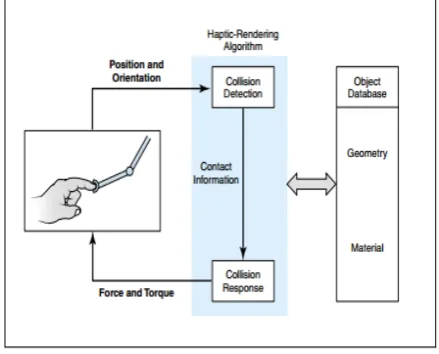
Fig 2. Haptic Rendering
As shown in the above figure, the haptic rendering algorithm forms the most important integral part of the haptic system[2]. The haptic rendering algorithm generally consists of two sub-algorithms, collision detection algorithm and collision response algorithm. As the user changes his position or the force feedback (shown in Fig 2- a fingertip) the change in position or orientation is acquired and the Collision Detection algorithm detects the collision between the fingertip and the virtual environment. If a collision is detected, then the Collision Response algorithm calculates the force of interaction between the user and the virtual environment and then instructs the response device to generate the required force, thus generating the actual representation of the virtual object. The update rate of the haptic feedback loop must be at least 1KHz, in order to maintain the feel of the virtual object. The Object Database should be maintained so that all the physical properties of the object can be replicated correctly in the virtual environment. Moreover calculation of the contact forces is equally important than just calculating the collisions. Thus, better the haptic rendering algorithm, better the imitation of the real environment. Further we will see the applications of haptic interfaces which constitute the rendering algorithms to give accurate results for the respective application.
5. 3D MODELLING
as we progress , it is has become necessary to look into applications that incorporate interactive life-like 3D computer graphics.
Human-Computer interaction is greatly influenced by the sense of touch. This is because touch is bidirectional and allows us to perceive as well as change objects simultaneously in the same location. Various devices with upto seven degrees of freedom are used to simulate touch, one of the most common being the Phantom Haptic Device having 3 degrees of freedom. Users interact with the Phantom interface with their finger in a thimble or by holding a stylus. As explained in the working earlier, various sensors calculate important data and feed the information to the computer. The computer then gives necessary output to the actuator. The actuator, in turn, provides the data to haptic device which gives the user the necessary haptic feedback.
Initial efforts to sculpt clay using the Phantom haptic interface was an encouraging experiment carried out by Thomas Massie, founder of SensAble technologies. If force was exerted above a certain threshold value, the clay terrain would deform, and continuing pressure would result in larger deformations. Although this seems to be a very simple observation, some important results were discovered. It was found that cutting straight lines and circular grooves in the clay surface was very intuitive. In fact, it was also found that hemispheres could be cut from a flat surface by carefully tracing a circle while exerting some pressure on the surface. After making the initial groove, completing the hemisphere was trivial and could be done quickly even without visual feedback. A finger was used to trace the groove to complete each deeper cut and Massie found that the groove left from the previous groove guided each subsequent cut. A natural property of real clay, this could not be duplicated without haptic feedback. Today, there are many devices like Haptic 2000 using which, anyone can be creative and easily model and construct 3D objects, especially free-form shapes, which can then be directly 3D printed. For designers and artists, Cloud9 is a sketch and modelling software which enables easy and fluid conceptualisation and visualisation of ideas directly in 3D.
Haptic 2000 uses new touch enabling technology, a ’haptic’ device, to replace the 2D mouse. The device gives more natural interaction within the 3 dimensional virtual space, making Haptic 2000 significantly more intuitive for working in 3D.
5.1 Limitations of 3D Modelling
Although surprisingly realistic to casual users, Thomas Massie and his colleagues concluded that current haptic interfaces are limited in their ability to faithfully reproduce all the subtle sensations that we feel when interacting with the real world. For instance, the Phantom haptic interface can only produce a force vector at a single point. Realistically, this means that designers using one of the proposed touch-enabled modeling systems could not have the sensation of clay touching their palms or feel subtle texture variations across their fingertips. Given this fundamental limitation, a very useful modeling system can still be built. In fact, most physical modeling interactions
occur through a tool, and even today’s haptic interfaces can accurately duplicate the feel of a tool tip interacting with a model [4].
6. APPLICATIONS OF HAPTICS
6.1 Use Of Haptic Feedbacks In Graphical User Interfaces
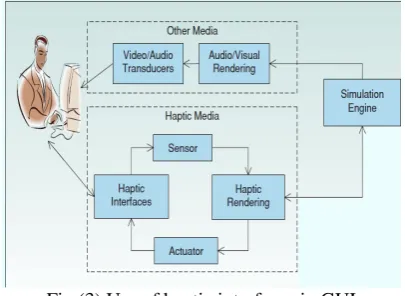
Graphical User Interface (GUI) forms an integral part of any electronic system if human interaction is involved. GUI allows the user to interact with the system through graphical icons, visual indications on the screen, text based interfaces etc. If a third dimension is added to the graphical user interface, the interaction of the user with the electronic system can be more realistic. This third dimension that can be added to a GUI is haptics. The working of a haptic interface can be seen in the below diagram [5].
Fig (3) Use of haptic interfaces in GUI
As in Fig (3), the user interacts with the computer in the form of audio or text inputs. The simulation engine simulates the inputs from the system, processes it and transfers the results to the haptic media. The haptic hardware gives outputs to the user in various formats such as touch sensations, force feedbacks, vibrations etc. This will enhance the user’s experience of operating the system and will result in more efficiency in performing various functions. Real time experiences can be provided to the user in a GUI augmenting haptic feedback. Thus the modification of GUIs can be done in following ways to provide an enhanced experience to the user. Consider a scenario in which there is a graphical interface with buttons augmented with textures, friction and gravity-like effects. This graphical interface without a haptic feedback would just be a visual effect. Using Haptic devices such as the FEELit mouse, Phantom the graphical user interfaces in a Desktop can be used to provide real time effects of all the above properties. For example the friction effect can be implemented by damping the user’s effect using the FEELit mouse (Immersion Corporation).
6.2 Haptics For Medical And Visual Disabilities
Haptic interfaces for medical simulation have proved very useful .Touch and kinesthesis are subtle , effortless senses which are important for fast ,accurate interaction with our environment .These prove to be very crucial for minimal invasive procedures .These include laproscopy ,interventional radiology and remote surgery .In open surgery , surgeons rely heavily on touch to distinguish healthy tissue from disease infected tissue [7]. The advantage of using haptics technique is that surgeons can perform large number of similar operation with less fatigue .Also in opthalmology , the supporting springs that hold artificial lens within lens capsule after removal of cataract are done via haptics .Furthermore the virtual haptic feedback is useful for palpatory diagnosis that means detection of medical problem through touch .Recent technology based on haptics is also utilised in fields of prosthetics .Haptics are also used to provide a feedback from prosthetic limb to its wearer .
Haptics are widely used to help the visually impaired .The feeling of colour can be obtained through a haptic feedback device .A glove consisting of short range optical colour sensors on the fingertips and a belt with haptic feedback actuators constitute the system .The information of colour is provided through vibrations at different location and different modulation .With a small amount of training the person can recognize which vibration associates to the respective colour [8].
Volumetric data from computer tomography , haptic and visual feedback can be created from the dataset .This helps for patient specific simulation .In case of hip fracture this technique is particularly helpful .To simulate the drilling process repositioning is done first with help of segmentation .Then using visual and haptic feedback the simulation can be carried out .This provides the surgeons with a greater insight to the surgery [9].
Haptics has a very large future scope in the field of medical application .It will be possible to construct a central work station which will be used by surgeons to perform operations remotely .Thus the surgeon will become a telepresence .This will lead to an increased availability of expert medical care . Haptics provide a tactile and resistance feedback to surgeons operating on robotic devices .As surgery is carried on the ligaments are felt as if being directly worked on patient .Haptics can also develop technology to simulate surgery .Simulated surgery can be used for training .Haptics aids in simulation by creating realistic environment of touch .Similar to telepresence surgery , surgeons can feel simulated ligaments or pressure of virtual incision as if real .This will help in training of surgeons.
6.3 Haptics In Teleoperation-
Teleoperation means operation of a machine situated at a distance .It is very similar to a remote control but is usually seen in research ,academics ,and technical environment .Although it is usually associated with robotics and mobile robots, it can still be applied to a machine or a device which a person is operating from a distance .The origin of teleoperation can be traced back to the beginning of radio
communication and Nikola Tesla .He developed the fundamental principle and system for teleoperation in 1880’s
Usually scenes are perceived by 3D vision .Hence visual modality is a predominant source of perception, but material as well as surface characteristics are also necessary .Hence haptic exploration is required .Also in telerobotics manipulation is required .Manipulation requires closed human –environment interaction .Thus, exploration and manipulation are necessary for telerobotics .
Haptics has led to an increase in precision of teleoperation by force and surface information feedback .Force feedback is obtained by sending back pressure and force through haptic devices at the point of interest .Such applications find use in assistive surgical robotics .They are also used in simulators to train medical and military personnel .In assistive robotic surgery it is possible to carry a precise surgical procedure that will improve and hence shorten the healing process [10].
Also teleopearted robotic system can be used for avoiding hazardous environments .Dangerous environments can be monitored from a remote location .However a large number of problems are associated with remote monitoring .The use of haptics enable us to improve telepresence at such locations .At times even fuzzy expert systems are used to provide the teleoperator with haptic improvisation to improve task performance .Thus haptics are widely used in telerobotics applications ranging from surgery ,simulation ,space ,maintenance and manufacturing [11].
6.4 Data Visualisation
Use of graphics and animation to analyze or solve problems is data visualisation .They are used in scientific analysis and also for visually impaired people .Using haptics a high quality and accurate data visualisation is possible .For example SCIRun is scientific data visualisation for problem solving .Scientific data visualisation is also used for fluid flow model ,molecular interaction ,force field analysis .For visually impaired people touch is used as a channel to provide information .Using graphical model made from haptic feedback, even a real city can be explored for the blind people .
6.5 Arts And Design
Haptics also enables virtual modelling and sculpting .Sculpting and modelling are based on tactile feedback model .Hence with haptic feedback and touch virtual sculpting becomes easier .
7.LIMITATIONS
There are some of limitations associated with haptics ,which, if overcome, can cause haptics to bring about a revolution .Some of the limitations are:
Haptics being a new technology requires a very high initial investment and hence is very costly .
The haptic devices are usually bulky .These devices are large in size and greater in weight which become a big problem in case of wearable haptic devices . Haptic interfaces exert forces with limited magnitude
Haptic rendering algorithm which provides the virtual environment operate in discrete time whereas the real-time users operate in continuous real-time .
Bandwidth limitation is a major problem associated with haptics .Data transmission has limited bandwidth .Haptic data is usually heavy which requires greater bandwidth .If this bandwidth is not available this may lead to wrong interpretation .
Universal operability of haptic interfaces : Haptic interfaces are developed for specific applications .For a new task ,some new implementations are required .This adaptation can be tedious .Hence a uniform universally accepted interface is required .
Instability and vibration : Graphic rendering requires updates at the rate of 60 Hz .But haptic update rates must be of 1000Hz .If the required updates rates are not met, this may lead to instability .Thus the system may become unstable .
8. FUTURE APPLICATIONS
8.1 Holographic Interaction :
Research is carried on by adding haptic feedback to holographic projection .Using this feedback, the user receives tactile response from holograph as if it were a real object .It is based on using ultrasound waves thereby creating acoustic radiation pressure .It is through tactile response that user percieves the object .
8.2 Biometric Haptics:
Haptics can also be used for biometric .Conventional biometrics require a unique ID and password .These can be tedious to remember and hence are inconvenient .Further these passwords are less secure .These can be hacked without being known and hence are not very safe and reliable .The haptic based biometeric measure the position ,velocity and force .After these measurements using algorithms ,unique physical patterns can be developed which can be used for identification .
8.3 E-Commerce:
Using haptic feedback in electronic commerce enables consumers to physically interact with the commodity .The product can be felt by touching and properties such as texture ,roughness can be determined .Consumers usually like to feel and touch the object before buying .For example: while buying a fabric, the roughness ,friction and softness can be actually felt by the customer and hence aids in their decision making .
8.4 Education :
Haptics can allow for visualisation of geometric problems in actual 3-D space .This allows a better and clear understanding of the problem which is beneficial in the field of education.
9. CONCLUSION
Haptics is still in its nascent stage. It has immense potential to bring about drastic improvements in our interactions with the virtual world. However, it does have a few limitations in hardware ,development cost ,and its implementation. Day by day, the cost of technology is decreasing . Haptics is finding applications in every possible field such as education ,entertainment ,art ,medical ,teleoperation .Haptics has a very large future scope in every possible field .With an increase in investments in terms of money, time, dedication and space haptics is bound to revolutionize the world.
REFERENCES
[1] Abdulmotaleb El Saddik)The potential of Haptics TechnologyIEEE Instrumentation & Measurement Magazine February 2007 1094-6969/07/IEEE
[2]- Nasa Tech Brief,2003 ,"Algorithm for Haptic Rendering of 3D Objects"
[3] Wael Abdelrahman, Lei Wei, James Mullins, and Saeid Nahavandi Center for Intelligent Systems Research (CISR) Deakin University, Australia, " Wireless haptic rendering for mobile platforms"2012 IEEE International Conference on Systems, Man, and Cybernetics October 14-17, 2012, COEX, Seoul, Kore.
[4] Thomas Massie SensAble Technologies "A Tangible Goal for 3D modelling"
[5] -"The Potential of Haptics", IEEE Instrumentation and Magazine, Feb 2007, 1094-6969/07/2007IEEE
[6]- Amani Albraikan, Hawazin Badawi , Abdelwahab Hamam1 and Abdulmotaleb El Saddik1, "HAPTIBASIC: LEARNING BASIC CONCEPTS OF A HAPTIC TECHNOLOGY THROUGH EDUTAINMENT GAMES ", DOI: 10.1109/ICMEW.2013.6618288 [7]- E.B. Vander Poorten ,E.Demester ,P.Lammertse) Haptic feedback
for medical applications ,a survey Systems Proceedings of the 2009 IEEE International Conference on Systems, Man, and Cybernetics San Antonio, TX, USA - October 2009
[8] Jonathan Tapson , Javier Diaz ,David Sander ,Netta Gurari ,Elisabetta Chicca ,Phillippe Pouliquen and Ralph Etienne-Cummings)The Feeling of Color : A Haptic Feedback Device for the Visually Disabled .2008 IEEE 978-1-4244-2879-3/08
[9] Johanna Pettersson, Karljohan Lundin Palmerius, Hans Knutsson, Ola Wahlström, Bo Tillander, and Magnus Borga) Simulation of Patient Specific Cervical Hip Fracture Surgery With a Volume Haptic Interface IEEE TRANSACTIONS ON BIOMEDICAL ENGINEERING, VOL. 55, NO. 4, APRIL 2008
[10] Mehmet smet Can Dede, Özgün Selvi, Tunç, Yalkın Kant)Design of a Haptic Device for Teleoperation and Virtual Reality Systems Proceedings of the 2009 IEEE International Conference on Systems, Man, and Cybernetics San Antonio, TX, USA - October 2009 [11] B. Horan, S. Nahavandi, D. Creighton and E. Tunstel)Fuzzy Haptic