Zero-Correlation Linear Cryptanalysis of Reduced-Round
LBlock
Hadi Soleimany and Kaisa Nyberg
Aalto University School of Science, Department of Information and Computer Science
Abstract. Zero-correlation linear attack is a new method for cryptanalysis of block ciphers developed by Bogdanov et al. in 2012. In this paper we adapt the matrix method to find zero-correlation linear approximations. Then we present several zero-zero-correlation linear approximations for 14 rounds of LBlock and describe a cryptanalysis for 22 rounds of the reduced LBlock. Af-ter biclique attacks on LBlock revealed weaknesses in its key schedule, its designers presented a new version of the cipher with a revised key schedule. The attack presented in this paper is applicable to LBlock structure independently of the key scheduling. The attack needs distinct known plaintexts which is a more realistic attack model in comparison with impossible differen-tial cryptanalysis which uses chosen plaintext pairs. Moreover, we performed simulations on a small variant LBlock and present the first experimental results on the theoretical model of the multidimensional zero-correlation linear cryptanalysis method.
Keywords: block cipher, zero-correlation linear cryptanalysis, LBlock, matrix method
1
Introduction
Linear cryptanalysis is one of the most prominent cryptanalysis methods against block ciphers. Several extensions of linear cryptanalysis have been introduced which usually exploit several linear approxima-tions with high correlation simultaneously. Kaliski and Robshaw used multiple linear approximaapproxima-tions with the same key mask [7]. The concept of linear hull presented by Nyberg which uses several linear approximation with the same input and output masks [13]. Multiple linear approximations cryptanaly-sis and multidimensional linear cryptanalycryptanaly-sis are proposed in [2] and [6] respectively. Recently, a novel extension of linear cryptanalysis was proposed which uses zero-correlation linear approximations [4]. It can be seen as the counterpart of impossible differential cryptanalysis. The original proposal had the disadvantage to require almost the full codebook of data. Bogdanov et.al. proposed a framework which uses several independent zero-correlation linear approximations to reduce data complexity [5]. Based on the multidimensional linear attack, a new distinguisher was recently proposed to eliminate the independence assumption [3]. The distinguisher is supposed to use distinct known plaintexts.
In this paper the multidimensional zero-correlation linear method is applied to attack 22 rounds of LBlock [16]. LBlock is a lightweight block cipher with semi-Feistel structure. The security of the cipher has been evaluated in [8, 11, 16]. The designers proposed integral and impossible differential cryptanalysis up to 20 rounds of LBlock. Using low diffusion of key schedule, an improved impossible differential cryptanalysis has been applied up to 22 rounds of LBlock [8]. The attack uses 258 chosen plaintexts and the time complexity is 279.28 which is almost equivalent to the exhaustive search. Since LBlock had been designed before biclique cryptanalysis introduction, the designers re-evaluate the security of LBlock and showed that the cipher is vulnerable against biclique cryptanalysis. They proposed a modified key schedule algorithm to improve the security of LBlock [15] such that the previous attacks are not applicable. In this paper, we show how to use the matrix method [9, 10] to find 8×8 different classes of zero-correlation linear approximations for 14 rounds which each one includes 28−1 different zero-correlation approximations. Based on 28−1 zero-correlation approximations we
present an attack on 22 rounds of the reduced LBlock. This attack does not depend on the key schedule and it is applicable to both versions of LBlock. It exploits weaknesses in the permutation layer of LBlock to decrease the time complexity. The attack uses distinct known plaintexts. As depicted in Table 1, there is a trade-off between the time complexity and the data complexity of the attack.
Table 1.Summary of the Attacks on LBlock
Attack Rounds Data Time Memory (Bytes) Source
Integral Attack (CP) 20 263.7 263.7 Not Specified [16]
Impossible Differential (CP) 20 263 272.7 260 [16] Impossible Differential†(CP) 21 262.5 273.7 264 [11] Impossible Differential†(CP) 21 263 269.5 268 [8] Impossible Differential†(CP) 22 258 279.28 268 [8]
Zero Correlation (DKP) 22 264 270.54 264 This paper
Zero Correlation (DKP) 22 262.1 271.27 264 This paper
Zero Correlation (DKP) 22 260 279 264 This paper
Biclique (KP)† Full 252 278.4 Negligible [15]
†– this attack is applicable just on old version of the cipher, CP – Chosen Plaintexts, DKP – Distinct Known Plaintexts, KP – Known Plaintext
2
A Brief Description of LBlock
2.1 Notation
Throughout this paper we use the following notations: – Ski: 32-bit round key
– ≪i:i-bit left cyclic shift
– X(i) :i-th nibble ofX where the right most one is 0
– X(i−j) : concatenation ofi, i−1,· · ·, j-th nibble ofX where i≥j
– |: concatenation of two binary strings – Li|Ri: the output of thei-round of LBlock
2.2 LBlock Description
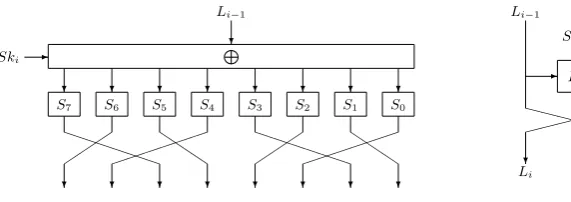
LBlock is a variant Feistel block cipher with 32 rounds. It supports 80 secret key bits and the block size isb= 64 bits. Each round includes 8 different 4×4 S-boxes and simple nibble-wise permutation. One round of LBlock and the round function are depicted in Figure 1.
? ? S7 ? ? S6 ? ? S5 ? ? S4 ? ? S3 ? ? S2 ? ? S1 ? ? S0 P P P P PP Q Q Q P P P P PP Q Q Q ?
Li−1
-Ski L
- F
-? Ski ? ? X X X X X X
Li Ri
Li−1 Ri−1
≪8
Fig. 1.One round of LBlock
Encryption Algorithm Let P = L0|R0 be a 64-bit plaintext. Then encryption process is as
follows:
– Fori= 1,2,· · · ,31,do • Ri=Li−1
• Li=F(Li−1, SKi)⊕(Ri−1≪8)
– L32=L31,R32=F(L31, SK32)⊕(R31≪8)
– C=L32|R32.
In our attacks on reduced-round LBlock we also consider the last round to be without swapping the halves as in the original LBlock.
3
Zero-Correlation Linear Approximation
Consider a functionf :Fn2 7→F
m
2 and let the input of the function be x∈F
n
2. A linear approximation
with an input maskuand an output maskv is the following function:
x7→u·x⊕v·f(x).
The linear approximation has probability
p(u;v) =P r(u·x⊕v·f(x) = 0)
and its correlation is defined as follows:
cf(u;v) = 2p(u;v)−1.
In linear cryptanalysis we are interested in the linear approximation with correlation far from zero. The number of known plaintexts needed in the linear cryptanalysis is inversely proportional to the squared correlation. Zero-correlation linear cryptanalysis uses linear approximations such that the correlation is equal to zero for all keys. If the number of zero-correlation approximations is 2m, then by [3] the number of required distinct plaintexts is about 2n+2−m/2. The key recovery can be done
with the same method utilized by Matsui’s Algorithm 2 [12].
To describe this process in more detail, let us describe a cipher E as a cascadeE=Ef◦Ez◦Eb. Assume there exists m independent linear approximations for Ez such that all ` = 2m−1 nonzero linear combinations of them have correlation zero. For each key candidate, the adversary encrypts the plaintexts for the beginning roundsEb and decrypts the corresponding ciphertexts for the final rounds
Ef.
For each of i∈Fm2 he allocates a counterTi and computes the number of times which the corre-sponding data value is equal toi. Then the adversary computes the statisticT value
T =
2m−1 X
i=0
(Ti−N2−m)2
N2−m(1−2−m). (1)
The value T for right key guess follows a χ2−distribution with mean µ 0 =`2
n−N
2n−1 and variance
σ02= 2`(2
n−N
2n−1)
2while for the wrong key the distribution is a χ2−distribution with meanµ
1=`and
varianceσ21= 2`.
Let show error probability type I asαand error probability type II asβ. If we consider the decision thresholdt=µ0+σ0z1−α=µ1+σ1z1−β then the amount of distinct known plaintexts is as follows:
N= 2 n(z
1−α+z1−β) p
`/2−z1−β
(2)
wherezp=Φ−1(p) for 0< p <1 whereΦis the cumulative function of the standard normal distribu-tion. For more details we refer to [3].
4
The Matrix Method
4.1 Matrix Method for Finding Linear Approximation with Correlation Zero
The state is partitioned into n words (usually of the same length). In the linear approximation, the linear masks applied to the words can be of the following five types:
1. zero mask, denoted by 0,
2. an arbitrary non-zero mask, denoted by 0, 3. non-zero mask with a fixed valuea, denoted bya,
4. the exclusive-or of a fixed non-zero maskaand an arbitrary non-zero mask, denoted bya, 5. any mask, denoted by∗.
After that we describe the encryption round as a matrixMn×n. The matrix shows how a linear mask of each output word is affected by the linear mask of an input word. Let show the input and the output of the round by two bit stringsAandB respectively. IfB(j) is not affected by a linear mask ofA(i) the value (i, j) set to 0. If a linear mask ofA(i) affectsB(j) directly the value (i, j) set to 1. Finally if B(j) is affected by a linear mask of A(i) after the round function the value (i, j) set to 1F. For decryption of the round, another matrix is defined similarly. To define the matrices we can use lemmas in Appendix A which are introduced in [4] (see also [1]).
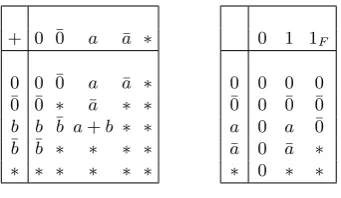
We can apply the exclusive-or operation to the five types of masks defined above resulting in arithmetic rules. These rules are given in the table on the left of Table 2. On the right hand side of Table 2 we show how certain operations will modify the five types of masks. The operations are: multiplication by 0, multiplication by 1 and multiplication by 1F. The last operation means that, given a bijectionF and a type τ of masks,τ·1F is the type of masksv for which there isuof typeτ such that the linear approximationu·x+v·F(x) = 0 holds with non-zero correlation.
Table 2.Arithmetic rules. The table of the left gives the addition rules between two mask types. The table on the right shows the operation rules of multiplication by 0, 1 and 1F.
+ 0 ¯0 a ¯a ∗
0 0 ¯0 a ¯a ∗ ¯
0 ¯0 ∗ ¯a ∗ ∗
b b ¯b a+b ∗ ∗ ¯b ¯b ∗ ∗ ∗ ∗ ∗ ∗ ∗ ∗ ∗ ∗
0 1 1F
0 0 0 0 ¯
0 0 ¯0 ¯0
a 0 a ¯0 ¯
a 0 a¯ ∗ ∗ 0 ∗ ∗
For a given state, we use the matrix iteratively to obtain the new state over multiple rounds. To find the longest zero-correlation linear approximation we compute the new states in both forward and backward directions just before the values of all words become only∗. Finally, we scan intermediate values and check the incoherence of events.
For example the encryption matrix of Feistel structure is 01 11F
. If we assume the initial mask type as (a,0) the mask type of the third round can be obtained as follows:
a,0·
0 1 1 1F
= a·0 + 0·1, a·1 + 0·1F
= 0 + 0, a+ 0= 0, a
0, a ·
0 1 1 1F
= 0·0 +a·1,0·1 +a·1F
= 0 +a,0 + 0
= a,0
a,1 ·
0 1 1 1F
= a·0 + 0·1, a·1 + 0·1F= 0 + 0, a+ 0= 0, a
4.2 Zero-Correlation Linear Approximation for 14-rounds of LBlock
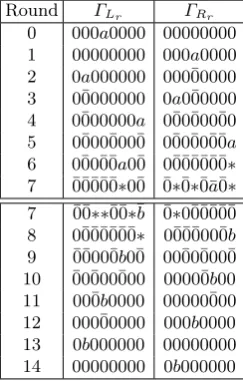
rounds would be one non-zero nibble inRr+14, then the linear approximation has correlation zero. For
example (000a0000|00000000) → (00000000|0b000000) has correlation exactly zero which the values
a and b are non zero. The development of the states of mask types as encryption proceeds from round to round is depicted in Table 3. The contradiction occurs inR7(5). We note there exists 8×8
different classes of zero-correlation linear approximations for 14 rounds each of which includes 28−1
different zero-correlation approximations. We will use this observation to build a multidimensional linear approximation to minimize the data complexity as described in Section 3.
Table 3.Zero-correlation linear approximation for 14-round LBlock
Round ΓLr ΓRr 0 000a0000 00000000 1 00000000 000a0000 2 0a000000 000¯00000 3 0¯0000000 0a0¯00000 4 0¯000000a 0¯00¯000¯00 5 0¯000¯000¯0 0¯00¯00¯0¯0a
6 0¯00¯0¯0a0¯0 0¯0¯0¯0¯0¯0¯0∗ 7 ¯0¯0¯0¯0¯0∗0¯0 0¯∗¯0∗¯0¯a¯0∗ 7 ¯0¯0∗∗¯0¯0∗b¯ ¯0∗0¯0¯0¯0¯0¯0 8 0¯0¯0¯0¯0¯0¯0∗ 0¯0¯0¯000¯0b
9 ¯0¯000¯0b0¯0 00¯00¯000¯0 10 ¯00¯000¯000 0000¯0b00 11 00¯0b0000 00000¯000 12 000¯00000 000b0000 13 0b000000 00000000 14 00000000 0b000000
5
Zero-Correlation Linear Cryptanalysis of 22 Reduced-Round LBlock
In this section, we propose a zero-correlation linear attack on 22-round LBlock. The attack utilizes the 14-round zero-correlation linear approximations described in Table 3 from round 5 to 18. After collecting sufficient plaintext-ciphertext pairs, we guess corresponding subkeys for the first four rounds and the last four rounds and estimate the correlation of approximations as described in Algorithm 1 in Appendix C.
Based on the error probabilitiesαand β, the number of pairs N in Algorithm 1 and the decision threshold t are determined. The time complexity of the Algorithm 1 is N ·228·228 where N is the
number of plaintexts used in the cryptanalysis. So the time complexity is much more than exhaustive search. To overcome this restriction we note L4(4) and R18(6) are not affected by all bits in rounds
1−4 and 19−22. So Algorithm 1 is not optimal and it repeats the same procedure for different pairs. We show that it is possible to remove repetitions and reduce time complexity significantly.
The nibble L4(4) is affected by 32 bits of plaintext L0|R0, 20 bits of L1|R1, 12 bits of L2|R2 and
8 bits of L3|R3. Also L18(6) is affected by 32 bits of ciphertextL22|R22, 20 bits of L21|R21, 12 bits
ofL20|R20 and 8 bits ofL19|R19. We call these bits “active” and other ones “neutral”. The idea is to
ignore neutral bits and instead of encrypting and decrypting all plaintex-ciphertext pairs, do it only once and count the number of pairs, which have the same value in active bits. In each step, for each subkey candidate, we encrypt (decrypt) active bits in roundr over one round and count the number of pairs which give the same value in active bits in roundr+ 1 (r−1).
The attack procedure is as follows:
1. CollectN plaintexts with corresponding ciphertexs.
2. Allocate a 8-bit counter N0[x0, x22] for each of 264 possible values of (x0|x22) where x0 =
L0(5,4,2,1,0)|R0(6,4,1) and x22 =L22(7,6,4,2,0)|R22(7,5,2) and set them zero. Calculate the
number of pairs of plaintext-ciphertext with given values x0 andx22 and save it inN0[x0, x22]. In
3. Guess the 3 nibbles SK1(4,2,1). Allocate a counter N1[x1, x22] for each of 252 possible values of
(x1|x22) wherex1=L1(6,3,0)|R1(5,0) and set them zero. For all 232possible values ofx0, encrypt
x0 one round to obtainx1and update the valueN1[x1, x22] =N1[x1, x22] +N0[x0, x22] for all 232
values ofx22
4. Guess 2 nibblesSK2(6,0). Allocate a counterN2[x2, x22] for each of 244possible values of (x2|x22)
where x2 = L2(7,2)|R2(3) and set them zero. For all 220 possible values of x1, encrypt x1 one
round to obtainx2and update the value N2[x2, x22] =N2[x2, x22] +N1[x1, x22] for all 232 values
ofx22.
5. Guess the nibbleSK3(7). Allocate a counterN3[x3, x22] for each of 240 possible values of (x3|x22)
wherex3=L3(5)|R3(2) and set them zero. For all 212 possible values ofx2, encryptx2 one round
to obtainx3and update the valueN3[x3, x22] =N3[x3, x22] +N2[x2, x22] for all 232 values ofx22.
6. Guess the nibbleSK4(5). Allocate a counterN4[x4, x22] for each of 236 possible values of (x4|x22)
where x4 = L4(4) and set them zero. For all 28 possible values of x3, encrypt x3 one round to
obtainx4 and update the valueN4[x4, x22] =N3[x4, x22] +N3[x3, x22] for all 232 values ofx22.
7. Guess the 3 nibblesSK22(7,6,0). Allocate a counterN5[x4, x21] for each of 224 possible values of
(x4|x21) where x21 = L21(4,2)|R21(5,3,0) and set them zero. For all 232 possible values of x22,
decrypt x22 one round to obtain x21 and update the value N5[x4, x21] =N5[x4, x21] +N4[x4, x22]
for all 24 values ofx4.
8. Guess 2 nibblesSK21(5,0). Allocate a counterN6[x4, x20] for each of 216possible values of (x4|x20)
wherex20=L20(3)|R20(2,0) and set them zero. For all 220possible values ofx21, decryptx21 one
round to obtainx20and update the value N6[x4, x20] =N6[x4, x20] +N5[x4, x21] for all 24 values
ofx4.
9. Guess the nibbleSK20(2). Allocate a counterN7[x4, x19] for each of 212possible values of (x4|x19)
where x19 =L19(0)|R19(1) and set them zero. For all 212 possible values of x20 decrypt x20 one
round to obtainx19and update the value N7[x4, x19] =N7[x4, x19] +N6[x4, x20] for all 24 values
ofx4.
10. Guess the nibbleSK19(1). Allocate a counterN8[x4, x18] for each of 28 possible values of (x4|x18)
wherex18=R18(6) and set them zero. For all 28 possible values ofx19, decryptx19one round to
obtainx18 and update the valueN8[x4, x18] =N8[x4, x18] +N7[x4, x19] for all 24 values ofx4.
11. Compute the statistic valueT =N ·28P24−1 x4=0
P24−1 x18=0(
N8[x4,x18]
N −
1
28). IfT < t, then the guess key is a possible candidate.
12. Do exhaustive search for all keys which corresponds to the guess subkey bits. Attack complexity
The memory complexity of the attack is dominated by step 2 which needs 264bytes. Time complex-ity of step 1 and 2 is equal to the number of needed plaintext-ciphertext pairsN. The time complexity in each step between 3 and 11 depends on the number of accesses to the memory. The time complexity for each round is listed seperately in Appendix D. Also step 12 requires 280·β full encryption because
we expect a wrong subkey survives with probabilityβ.
The time complexity is dominated by step 3 and step 12. The time complexity of round 3 is 276
memory accesses. If we consider one memory accesses as a half round, the time complexity of step 3 is 276×1
2× 1 22 = 2
70.54 of 22-round LBlock. Based on the error probability type Iαand error probability
type IIβ, the number of plaintexts-ciphetexts pairs needed, time complexity of step 12 and success probability are determined.
There is a trade-off between the time complexity and the data complexity of the attack, as depicted in Table 1. To reduce the time complexity as much as possible, we assume to have access the full codebook. In this case, the error probabilities and time complexity of step 12 is negligible compared to the complexity of step 3. To have a lowest data complexity, we can setα = 2−2.7 and β = 2−1. In this case data complexity decreases to N = 260 in cost of increasing time complexity. The time complexity is dominated by step 12 which needs 280·2−1= 27922-round LBlock encryption. The more realistic assumption is the state between these cases. For example, if we setα= 2−2.7 and β = 2−10 then z1−α = 1 and z1−β = 3.09. Equation (2) determines the data complexity N = 262.1. The time complexity is dominated by step 3 and 12 270.5+ 270= 271.27. The success probability is 1−α= 0.84.
6
Experimental Results
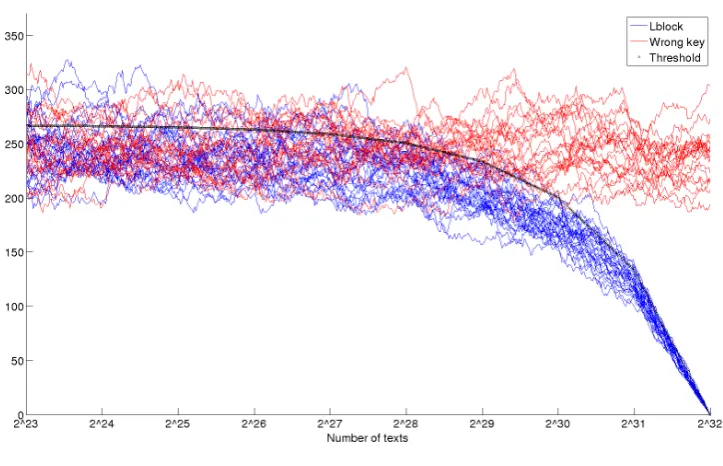
proposed in [14]. To verify the theoretical model of zero-correlation attacks [3] we implement the described attack on a small variant of LBlock with block length 32-bit. Two optimal word-wise permu-tations for improved Type II GFC with 8 branches were suggested in [14]. To make the small variant cipher similar as much as possible to the original one, we choose the permutation which is not based on the Bruijn graph. We consider the key schedule like original LBlock and choose the leftmost 16 bits of the register K as the round key. Matrix method produces a similar multidimensional linear approximation with correlation zero for 10 rounds of the small variant of LBlock cipher. This linear approximation has exactly one non-zero nibble in the input mask and one non-zero nibble in the output mask.
To evaluate a 10-round distinguisher from round 2 to 12, we consider 14 rounds of the small LBlock. The distinguisher depends on 2-nibbles of subkeys in the first two rounds and 2-nibbles of subkeys in the last two rounds. We consider 30 different sets of distinct known plaintexts with different secret keys. In each experiment the behavior of the statisticT in Equation 1 is studied for the right key and also for (just) one wrong key. The results of the implementation is shown in Figure 2. As predicted by the theoretical model, when more than 230.2 distinct known plaintexts are used, the correct key is
very likely to pass the test, while the wrong keys would fail. Access to the full codebook leads to the key recovery with negligible error probability. When using 228 distinct known plaintexts, the right key
survives with high probability but several wrong keys remain too.
Fig. 2.Experimental results for small variant of LBlock
7
Conclusion
Acknowledgments. The authors would like to thank C´eline Blondeau and Risto Hakala for helpful comments and suggestions.
References
1. Biham, E.: On Matsui’s Linear Cryptanalysis. In: Santis, A.D. (ed.) EUROCRYPT 1994. LNCS, vol. 950, pp. 341–355. Springer (1994)
2. Biryukov, A., Canni`ere, C.D., Quisquater, M.: On Multiple Linear Approximations. In: Franklin, M.K. (ed.) CRYPTO 2004. LNCS, vol. 3152, pp. 1–22. Springer (2004)
3. Bogdanov, A., Leander, G., Nyberg, K., Wang, M.: Integral and Multidimensional Linear Distinguishers with Correlation Zero. In: Wang, X., Sako, K. (eds.) ASIACRYPT 2012. LNCS, vol. 7658, pp. 244–261. Springer (2012)
4. Bogdanov, A., Rijmen, V.: Zero-correlation linear cryptanalysis of block ciphers. vol. 2011, p. 123 (2011) 5. Bogdanov, A., Wang, M.: Zero Correlation Linear Cryptanalysis with Reduced Data Complexity. In:
Canteaut, A. (ed.) FSE 2012. LNCS, vol. 7549, pp. 29–48. Springer (2012)
6. Hermelin, M., Cho, J.Y., Nyberg, K.: Multidimensional Extension of Matsui’s Algorithm 2. In: Dunkelman, O. (ed.) FSE 2009. LNCS, vol. 5665, pp. 209–227. Springer (2009)
7. Jr., B.S.K., Robshaw, M.J.B.: Linear Cryptanalysis Using Multiple Approximations. In: Desmedt, Y. (ed.) CRYPTO 1994. LNCS, vol. 839, pp. 26–39. Springer (1994)
8. Karako¸c, F., Demirci, H., Harmanci, A.E.: Impossible Differential Cryptanalysis of Reduced-Round LBlock. In: Askoxylakis, I.G., P¨ohls, H.C., Posegga, J. (eds.) WISTP 2012. LNCS, vol. 7322, pp. 179–188. Springer (2012)
9. Kim, J., Hong, S., Lim, J.: Impossible differential cryptanalysis using matrix method. Discrete Mathematics 310(5), 988–1002 (2010)
10. Kim, J., Hong, S., Sung, J., Lee, C., Lee, S.: Impossible Differential Cryptanalysis for Block Cipher Struc-tures. In: Johansson, T., Maitra, S. (eds.) INDOCRYPT 2003. LNCS, vol. 2904, pp. 82–96. Springer (2003) 11. Liu, Y., Gu, D., Liu, Z., Li, W.: Impossible Differential Attacks on Reduced-Round LBlock. In: Ryan,
M.D., Smyth, B., Wang, G. (eds.) ISPEC 2012. LNCS, vol. 7232, pp. 97–108. Springer (2012)
12. Matsui, M.: Linear Cryptoanalysis Method for DES Cipher. In: Helleseth, T. (ed.) EUROCRYPT 1993. LNCS, vol. 765, pp. 386–397. Springer (1994)
13. Nyberg, K.: Linear Approximation of Block Ciphers. In: Helleseth, T. (ed.) EUROCRYPT 1994. LNCS, vol. 950, pp. 439–444. Springer (1995)
14. Suzaki, T., Minematsu, K.: Improving the Generalized Feistel. In: Hong, S., Iwata, T. (eds.) FSE 2010. LNCS, vol. 6147, pp. 19–39. Springer (2010)
15. Wang, Y., Wu, W., Yu, X., Zhang, L.: Security on LBlock against Biclique Cryptanalysis. In: Lopez, J., Tsudik, G. (eds.) WISA 2012. LNCS, vol. 7690, pp. 1–14. Springer (2012)
16. Wu, W., Zhang, L.: LBlock: A Lightweight Block Cipher. In: Lopez, J., Tsudik, G. (eds.) ACNS 2011. LNCS, vol. 6715, pp. 327–344. Springer (2011)
A
Lemmas
To describe the encryption or decryption round, we can use the following lemmas:
Lemma 1. XOR operation:Let f(x1, x2) = x1⊕x2 then the correlation of linear approximation
u1·x1+u2·x2=v·f(x1, x2)is non-zero if and only ifu1=u2=v.
Lemma 2. Branching operation: Let f(x) = (x, x) then the correlation of linear approximation u1·x+u2·x=v·f(x)is non-zero if and only ifu=v1+v2.
B
LBlock Matrices
MEncryption=
0 0 0 0 0 0 0 0 1 0 0 0 0 0 0 0 0 0 0 0 0 0 0 0 0 1 0 0 0 0 0 0 0 0 0 0 0 0 0 0 0 0 1 0 0 0 0 0 0 0 0 0 0 0 0 0 0 0 0 1 0 0 0 0 0 0 0 0 0 0 0 0 0 0 0 0 1 0 0 0 0 0 0 0 0 0 0 0 0 0 0 0 0 1 0 0 0 0 0 0 0 0 0 0 0 0 0 0 0 0 1 0 0 0 0 0 0 0 0 0 0 0 0 0 0 0 0 1 0 0 0 0 0 0 1 0 0 0 0 0 1F 0 0 0 0 0 0 0 0 0 0 1 0 0 0 0 0 0 1F 0 1 0 0 0 0 0 0 0 0 1F 0 0 0 0 0 0 0 1 0 0 0 0 0 0 0 0 0 1F 0 0 0 0 0 0 1 0 0 0 0 0 1F 0 0 0 0 0 0 0 0 0 0 1 0 0 0 0 0 0 1F 0 0 0 0 0 0 0 0 0 1 0 0 0 0 0 0 0 0 1F 0 0 0 0 0 0 0 1 0 0 0 0 0 0 0 0 0 1F
MDecryption=
0 1F 0 0 0 0 0 0 0 0 1 0 0 0 0 0 0 0 0 1F 0 0 0 0 0 0 0 1 0 0 0 0 1F 0 0 0 0 0 0 0 0 0 0 0 1 0 0 0 0 0 1F 0 0 0 0 0 0 0 0 0 0 1 0 0 0 0 0 0 0 1F 0 0 0 0 0 0 0 0 1 0 0 0 0 0 0 0 0 1F 0 0 0 0 0 0 0 1 0 0 0 0 1F 0 0 0 1 0 0 0 0 0 0 0 0 0 0 0 0 0 1F 0 0 1 0 0 0 0 0 0 1 0 0 0 0 0 0 0 0 0 0 0 0 0 0 0 0 1 0 0 0 0 0 0 0 0 0 0 0 0 0 0 0 0 1 0 0 0 0 0 0 0 0 0 0 0 0 0 0 0 0 1 0 0 0 0 0 0 0 0 0 0 0 0 0 0 0 0 1 0 0 0 0 0 0 0 0 0 0 0 0 0 0 0 0 1 0 0 0 0 0 0 0 0 0 0 0 0 0 0 0 0 1 0 0 0 0 0 0 0 0 0 0 0 0 0 0 0 0 1 0 0 0 0 0 0 0 0
C
Basic Key Recovery Attack on 22 Reduced-Round LBlock
Algorithm 1Attack procedure
for all228 subkey nibblesSK1(4,2,1), SK2(6,0), SK3(7), SK4(5) in rounds 1−4do
for all228 subkey nibblesSK
19(1), SK20(2), SK21(5,0), SK22(7,6,0) in rounds 19−22do
for all28 possible valuesi= 0,· · ·,28−1do
allocate the counterTiand set them zero
end for
for allN plaintext-ciphertext pairsdo
encrypt plaintext to obtain the nibbleL4(4); decrypt ciphertext to obtain the nibbleR18(6);
for correpondingi= (L4(4)|R18(6)) increase the counterTi by one.
end for
compute the statistic valueT =N·28P28−1 i=0 (
Ti N −
1 28) IfT < t, then the guess key is a possible candidate.
end for end for
Do exhaustive search for all keys which corresponds to the guess subkey bits
D
Attack Complexity
Step 3 requires 212×232×232= 276memory accesses, because we should guess 12 bits forSK
1, and for 232values encryptx0 one round and then updateN1 for 232 times.
Step 4 requires 212×28×220×232= 272memory accesses, because for all of guessed 212keys in previous step, we should guess 8 bits forSK2, and for 220 values encrypt x1 one round and then updateN2 for 232 times.
Step 5 requires 220×24×212×232= 268memory accesses, because for all of guessed 220keys in previous steps, we should guess 4 bits forSK3 and for 212 values encryptx2 one round and then update N3 for 232 times.
Step 6 requires 224×24×28×232= 268 memory accesses, because for all of guessed 224 keys in previous steps, we should guess 4 bits forSK4 and for 28values encryptx3one round and then updateN4for 232times. Step 7 requires 228×212×232×24= 272memory accesses, because for all of guessed 228keys in previous steps, we should guess 12 bits forSK22and for 232 values decryptx22one round and then updateN5 for 24 times.
Step 8 requires 240×28×220×24= 272 memory accesses, because for all of guessed 240 keys in previous steps, we should guess 8 bits forSK21 and for 220 values decryptx21 one round and then update N6 for 24 times.
Step 9 requires 248×24×212×24= 268 memory accesses, because for all of guessed 248 keys in previous steps, we should guess 4 bits forSK20 and for 212 values decryptx20 one round and then update N7 for 24 times.
Step 10 requires 252×24×28×24= 268memory accesses, because for all of guessed 252keys in previous steps, we should guess 24forSK