ISSN (Print) : 2320 – 3765 ISSN (Online): 2278 – 8875
I
nternational
J
ournal of
A
dvanced
R
esearch in
E
lectrical,
E
lectronics and
I
nstrumentation
E
ngineering
(An ISO 3297: 2007 Certified Organization)
Vol. 5, Issue 4, April 2016
Generation of Three Phase Power from Single
Phase by Indent of Converter Using
Automatic Solar Tracking
P.Mercy1, S.Ashok2, A.Ramkumar3, G.Sathishkumar4, K.Venkatesan5
Assistant Professor, Dept. of EEE, Info Institute of Engineering, Coimbatore, Tamilnadu, India1
UG Student [EEE], Dept. of EEE, Info Institute of Engineering, Coimbatore, Tamilnadu, India2
UG Student [EEE], Dept. of EEE, Info Institute of Engineering, Coimbatore, Tamilnadu, India3
UG Student [EEE], Dept. of EEE, Info Institute of Engineering, Coimbatore, Tamilnadu, India4
UG Student [EEE], Dept. of EEE, Info Institute of Engineering, Coimbatore, Tamilnadu, India5
ABSTRACT: The main aim of this project is tobuild a single phase to three phase converter with the intent of converting single phase electric power to three phase power and to develop an automatic solar tracking system which will keep the solar panels aligned with the Sun in order to maximize in reaping solar power. The mainstream of the suburban area does not have the embrace right of entry to three phase electric power on a rational cost. Generating three phase power commissioning solar module leads to hike in cost when compared to generating single phase power. The main objective of our project is to shrink cost and three-phase power from single-phase power by dint of converter besides exploit the maximum solar energy through solar panel via automatic rotation of solar panel depends upon maximum intensity of light.
KEYWORDS: Solar panel, LDR,Inverter,Three phase Induction motor
I.INTRODUCTION
ISSN (Print) : 2320 – 3765 ISSN (Online): 2278 – 8875
I
nternational
J
ournal of
A
dvanced
R
esearch in
E
lectrical,
E
lectronics and
I
nstrumentation
E
ngineering
(An ISO 3297: 2007 Certified Organization)
Vol. 5, Issue 4, April 2016
II.SYSTEM MODEL
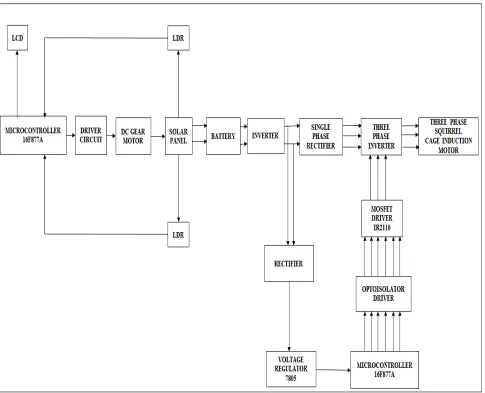
The proposed Solar system tracks the extreme intensity of light. When the intensity of light is diminishing, this system automatically changes its direction to get maximum intensity of light. LDR (Light Dependent Resistor) light detector is used to track the coordinate of the Sun. While to rotate the appropriate position of the panel, a DC geared motor is used. The system is controlled by two relays as a driver and a microcontroller as a main processor. This project is covered for a single axis and is designed for residential usage. This project is able to track and follow the Sun intensity in order to get maximum power at the output for the purpose of battery charging. Battery power presents a simple converter topology
Figure 1: Overall Block Diagram
ISSN (Print) : 2320 – 3765 ISSN (Online): 2278 – 8875
I
nternational
J
ournal of
A
dvanced
R
esearch in
E
lectrical,
E
lectronics and
I
nstrumentation
E
ngineering
(An ISO 3297: 2007 Certified Organization)
Vol. 5, Issue 4, April 2016
III.OVERALL HARDWARE SETUP
Fig 2: Overall hardware arrangement for generation of 3∅ power from 1∅ by means of converter using automatic solar tracking
IV. SIMULATION AND HARDWARE ANALYSIS
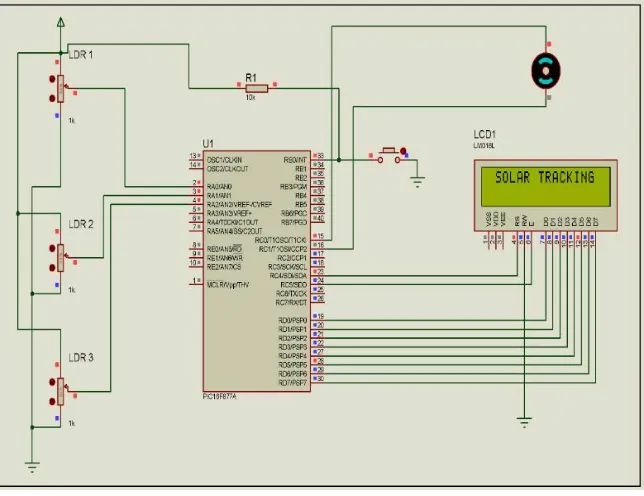
The simulation circuit was designed using proteus professional software version 7.0. The components were picked from the library and connected appropriately as represented in fig 4.1. The outputs from pins 5 and 6 are connected to input port, pins 15 and 16 of motor driver which controls the direction of motor movement through the output ports. The compiled program was transferred to the microcontroller after the design completion by right clicking and selecting the program file. Closing and opening the switches cause the motor to change direction while increasing and decreasing the voltage assumed from the panel give different values of power and voltage on the LCD.
ISSN (Print) : 2320 – 3765 ISSN (Online): 2278 – 8875
I
nternational
J
ournal of
A
dvanced
R
esearch in
E
lectrical,
E
lectronics and
I
nstrumentation
E
ngineering
(An ISO 3297: 2007 Certified Organization)
Vol. 5, Issue 4, April 2016
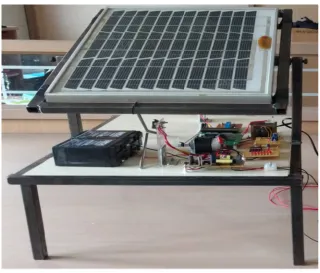
The hardware setup of the automatic rotation of solar panel is shown in below figure. Which consists of Solar panel, LDR’s, Microprocessor (16F877A), Driver circuit, DC gear motor, Inverter, LCD.
Fig 4: Hardware arrangement for automatic rotation of solar panel
LDR (Light Dependent Resistor) light detector is used to track the maximum intensity of the Sunlight. A DC geared motor is used to rotate the solar panel depends upon extreme intensity of sunlight. . The system is controlled by two relays as a driver and a microcontroller (16F877A) as a main processor.
ISSN (Print) : 2320 – 3765 ISSN (Online): 2278 – 8875
I
nternational
J
ournal of
A
dvanced
R
esearch in
E
lectrical,
E
lectronics and
I
nstrumentation
E
ngineering
(An ISO 3297: 2007 Certified Organization)
Vol. 5, Issue 4, April 2016
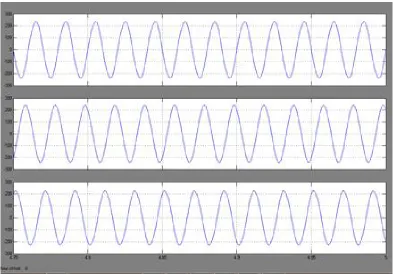
Single phase ac voltage (230V, 50Hz) with peak amplitude of Vm=325.27V is converted into dc voltage by diode bridge rectifier. The output voltage of the rectifier circuit is 205V. This output voltage is given as input to the inverter circuit. DC voltage is converted into three phase ac voltage by the inverter. The output line voltage of the inverter is 415V. This voltage is used to drive the three phase induction motor load.
Fig 5: Simulated output waveform of single phase to three phase converter
The hardware setup of Single phase to three phase converter is shown in below figure. Which consists of Power supply, Transformer, MOSFET, Microprocessor (16F877A), Three phase Induction motor.
ISSN (Print) : 2320 – 3765 ISSN (Online): 2278 – 8875
I
nternational
J
ournal of
A
dvanced
R
esearch in
E
lectrical,
E
lectronics and
I
nstrumentation
E
ngineering
(An ISO 3297: 2007 Certified Organization)
Vol. 5, Issue 4, April 2016
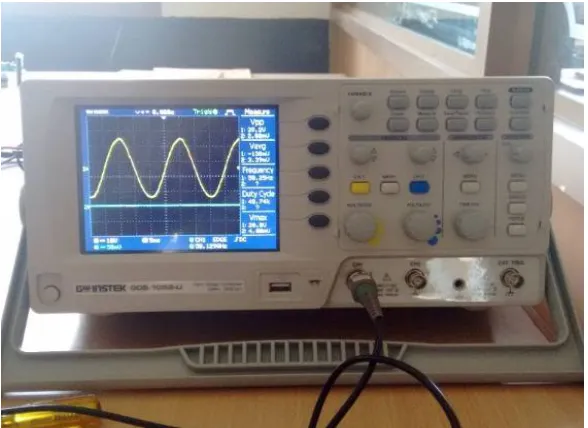
Converter consists of six MOSFET’s. This converter takes single phase supply and converts it into three phase supply with the help of MOSFETS. Microprocessor powered by power supply circuit which consists of bridge rectifier, capacitor, voltage regulator. The PWM (Pulse width modulation) given to the MOSFET’s gate from microprocessor.The single phase supply is first converted into dc supply by using rectifier again dc supply of rectifier is given to inverter where MOSFETS are used and converts the dc supply again into three phase ac supply. Which is used to drive the Induction motor. Thus we converted three phase supply from single phase using converter.The hardware output for the Single phase to three phase converter is shown in below figure. The result has been seen through the Digital Storage oscilloscope. From which we can know the source voltage.
Fig 7: Output waveform of one phase observed through DSO
V.CONCLUSION
Three-phase systems are not available in every location particularly in remote rural areas, hill stations, low voltage distribution homes and so forth. Single phase to three phase converter reduce a higher tariff for a three phase service because of the spare apparatuses for transformers, metering and the extra transmission wire. This converter efficiently operate for any three phase equipment. Solar trackers gain more power than their stationary counterparts due to an increased direct disclosure to solar rays, however this trackers are slightly more costly than their stationary counterparts, due to moving parts in the proposed system. Applications such ascompressors, pumps, welders, computer controlled machines.
REFERENCES
[1] H. S. Patel and R. G. Hoft, “Generalized techniques of harmonic elimination and voltage control in thyristor inverters: Part I – Harmonic elimination,” IEEE Trans. Ind. Applicat., vol. IA-9, no.3, pp. 310-317, May/June 1973.
[2] HurNamho, Jung Junhwan, Nam K wanghee. “Fast Dynamic DC-link Power balancing Scheme for a PWM converter-inverter System [A]. IECON’ 99 Proceedings[C]. The 25th Annual conference of the IEEE, 1999, 2:767~772.
[3] Z Yang and P C Sen. “Recent Developments in High Power Factor Switchmode Converters”, IEEE Proceedings CCECE.98, 1998, pp 477-480.
[4] W. A. Moncrief, "Practical Application and Selection of Single-Phase to Three-Phase Converters", 39th IEEE Rural Electric Power Conference, April 1996, pp. D3-1 to D3-9.
[5] H Endo, T Yamashita and T Sugiura. .”A High Power-factor Buck Converter”, Proceedings IEEE PESC.92, 1992, pp 1071-1076.
[6] H. Fujimoto, K. Kuroki, T. Kagotani, and H. Kidoguchi, “Photovoltaic inverter with a novel cycloconverter for interconnection to a utility line,” in Conf. Rec. IEEE IAS Annu. Meeting, 1995, pp. 2461–2467.
[7] A. Konar and A. K. Mandal , "Microprocessor based automatic Sun tracker" , IEEE Proceedings A, vol. 138 , no. 4 , pp.237 -241 , 1991.
[8] M. A. Green, "Clean Electricity from Photovoltaics," Ed. Mary D. Archer and R. Hill, Series on Photoconversion of Solar Energy, V. 1, Imperial College Press, UK.
[9] K. Saxena and V. Dutta, "A versatile microprocessor based controller for solar tracking," Photovoltaic Specialists Conference, vol. 2, pp. 1105-1109, 1990. [10] N. Mohan, T. M. Undeland, and R. J. Ferraro "Sinusoidal Line Current Rectification with a 100 kHz B-SIT Step-Up Converter", in Proc. I5"'Annual IEEEPESC.