An Improved ESP Algorithm for Main Lobe Interference in SLF
Communication
Ning Zhang1, Yu Zhong Jiang1, *, and Yang Liu2
Abstract—Because traditional eigen-subspace projection (ESP) methods cannot cancel the main lobe interference, an improved ESP algorithm and an orthogonal array of antenna are proposed to overcome this problem. Based on the orthogonal antenna array, the proposed algorithm combines ESP with ICA and signal blocking methods, which implements the extraction of part of the main lobe interference and optimized the estimation of the interference subspace. Both simulation and experiment results show that the improved ESP algorithm provides robust cancellation capability of main lobe and sidelobe interference for super low frequency (SLF) communication.
1. INTRODUCTION
The attenuation of electromagnetic wave propagating in conductive medium decreases with the decrease of frequency, so SLF electromagnetic waves are often used in through-the-earth (TTE) communication and underwater unmanned vehicle (UUV) communication. However, the interferences in the band of the SLF are complex, such as 50 Hz power frequency harmonic interference and radio interference (RF) radiated by many electrical equipment. These interferences seriously affect the receiver performance. In addition, the radiation efficiency of the SLF transmitting antenna is very low which leads to limited power of the desired signal received. Therefore, the receiving antennas should have high performance. High sensitivity magnetic antennas and smart antennas proposed by [1] and [2], respectively, are helpful. At the same time, an effective method of interference cancellation is urgently needed to improve the SLF communication quality.
In general, the bandpass filter can effectively prevent out-of-band interference [3], but the frequency domain processing method is invalid for the in-band interference. Therefore, some scholars suggest processing interference in the spatial domain [4–6]. In the signal processing of high frequency ground wave radar, Eigen-Subspace Projection (ESP) is a common interference cancellation method [7–9]. According to the range cell without targets, ESP algorithm uses the spatial information of the radar reflection waves to estimate the energy characteristics of the interference and solve its subspace. Although no radar reflection waves can be used in communication system, the interference can also be estimated realtime by setting up the reference antenna orthogonal to the main antenna. However, if the reference antenna signal is used as the reference signal in the traditional ESP algorithm to estimate the subspace, once interference comes from the direction of main lobe, this method is invalid.
Therefore, based on the characteristics of the ESP algorithm, this paper proposes a method of using orthogonal antenna array in SLF communication and improves the traditional ESP algorithm. The improved algorithm combines ESP with the idea of independent component analysis (ICA) and signal blocking. Based on the statistical characteristics of the main antenna signal, the active jamming signal will be extracted by the ICA method [10, 11], and then the interferences with strong coherence between
Received 23 July 2018, Accepted 11 September 2018, Scheduled 25 September 2018
* Corresponding author: Yu Zhong Jiang ([email protected]).
1 College of Electronic Engineering, Naval University of Engineering, Wuhan, Hubei 430033, China. 2 College of Electrical
each other will be obtained by signal blocking according to the spatial distribution characteristics of the main antenna signal [12]. A new reference signal array is composed of two extracted signals and reference antenna signals, and a more accurate interference subspace can be estimated. Finally, the projection method is used to cancel the interference linearly, and higher signal to noise ratio (SNR) can be obtained. In Section 2 the receiving signal and receiving antenna are modeled. The principle of the improved ESP algorithm is introduced. Section 3 verifies the interference cancellation scheme by simulation and experiment. Section 4 summarizes the content of the paper.
2. METHOD
2.1. Array Signal Model
The antenna model proposed in this paper is shown in Fig. 1. The main antennas M1, M2 and reference antennas N1 and N2 are set orthogonally. When the cores of the main antennas M1 and M2 aim at the direction of the transmitter, the power of the desired signal received by reference antennas will be the least. Theoretically, the reference antennas N1 and N2 can receive interference from any direction except where desired signal comes, but they are not sufficient to characterize the main lobe interference. Because the projection of the main lobe interference on the reference antenna is very small, the estimation of the interference subspace will be inaccurate, so it is necessary to fully utilize the main antenna signal. However, the main antenna signal cannot be used directly because the main antenna signal contains the desired signal component. Therefore, the proposed antenna array has two main antennas M1 and M2, because using ICA and signal blocking algorithm can extract the interference information contained in the main antenna. Combining them with the reference antenna signal to estimate the interference subspace can make the result more accurate.
Z-axis
M2 M1 N2
N1
X-axis
Y-axis
Desired Signal
Interference
Figure 1. Schematic diagram of antenna arrays.
According to the proposed model, the signal received by a certain main antenna at a certain time after through a narrowband filter can be modeled as
xm(n) =s(n) + L
∑
k=1
PX(φrk, θrk)rk(n) +nw(n) (1)
where
PX(φrk, θrk) = sinφrkcosθrk (2)
In formula (2), (φ, θ) is the angle between interference and desired signal, and PX(·) represents the operator of interference projection to X axis. s(n) is the desired signal, rk(n) thekth radio frequency interference (RF) signal, andnw(n) the background noise which can be considered as white noise. nα(n) is the atmospheric noise mainly caused by lighting, but it is not the focus of this paper, so it can be regarded as white noise as well.
Assuming that the reference antenna’s structure is the same as the main antenna, the signal received by reference antenna on the Z axis at a certain time can be expressed as:
xref(n−l) = L
∑
k=1
where
PZ(φrk) = cosφrk (4)
where l is the signal delay time relative to main antenna signal. However, because the wavelength of SLF electromagnetic wave is far greater than the spacing between magnetic antennas,lcan be neglected theoretically. So
xref(n−l)≈xref(n) (5)
In addition, the antenna and amplification circuits of each two channels cannot be the same, so the superscript in ˆrkand ˆnw in formula (3) represents that it can be approximated by multiplying a random factor. However, the component is unknown in fact, so the signal received by the antenna array can be regarded as a linear combination of the desired signal and interference signals, that is
X=AS (6)
where X is a 2-dimensional observed signal, andX = [xm,1 xm,2].S is an n-dimensional signals which composed by desired signal and interference. Astands for the mixed matrix. The work of this paper is to cancel the interference, which is equivalent to solving the separation matrixesW, makingY=WX
the optimal approximation ofS. It can be considered as a typical ICA problem, and each column of Y
is called Independent Components (ICs). More details on principal of ICA refer to [10].
It can be known from [7] that to extract all the ICs, the dimension of the observed signal must be more than the dimension of the source signal, that is, the number of the antennas must more than the number of source signals. However, the purpose of this paper is to cancel interference, so there is no need to separate all ICs. Because the number of interference source is unknown, it is impractical to isolate all the ICs by setting lots of antennas. In addition, the target matrix may converge to an error value when the mixed matrix is iterated with the criterion of independence of signals, which will affect the extraction of the desired signal. For these reasons, an improved algorithm with robustness based on the ESP is proposed.
2.2. Traditional ESP Algorithm
ESP is an algorithm based on linear algebra. The algorithm uses the eigenvalue decomposition (EVD) technology to decomposes the covariance matrix constructed by the noisy signal into the signal subspace and the noise subspace. In fact, the reference antenna signal can also be considered as noisy signals. Therefore, by decomposing the covariance matrix constructed by reference antenna, the subspace of the interference and its orthogonal subspace (including the desired signal and noise) can be solved by EVD. Finally, the projection of the main antenna signal to the orthogonal subspace can cancel the interference.
Suppose that the number of the reference signal vectors isNref, and theith of them with a length of M at timencan be expressed as
Xref,i= [xref,i(n), xref,i(n−1), . . . , xref,i(n−M)]T (7)
T represents matrix transposing. Because the covariance matrix cannot be obtained directly, it can only be estimated with limited sampling data, so the covariance matrix is calculated by formula (8).
ˆ Rref =
1
Nref N∑ref
i=1
Xref,iXHref,i (8)
H represents conjugated transposed Next, decomposingRˆref to get its eigenvalues λ1, λ2, . . . , λM and eigenvectors V1,V2, . . . ,VM. It can be found that after descending the eigenvalues r eigenvalues are obviously larger than the others. These eigenvalues and their eigenvectors represent the main components of the signal, which correspond to the strong interference in the space. These eigenvectors can construct the interference subspace S = [V1,V2, . . . ,Vr], and the remaining eigenvectors can construct the orthogonal subspaces. Finally, projection of the main antenna signal to the orthogonal subspace as
Xout=XM −SSHxM =
(
can cancel the interference. The PS in formula (9) is the projection operator. However, this method is difficult to cancel the main lobe interference because the component of the main lobe interference contained in the reference antenna is not dominant. Therefore, ICA and signal blocking algorithm are proposed to extract the main lobe interference.
2.3. Proposed Improved ESP Algorithm
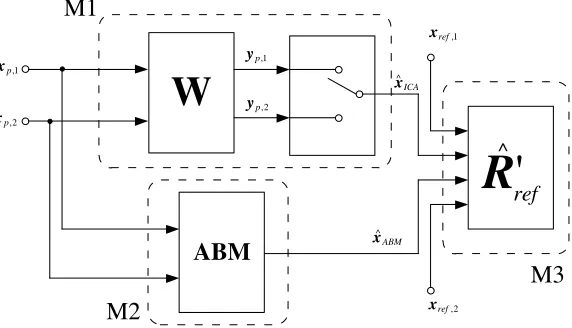
Although some ICA algorithms have a good performance on decomposed signal with noise, the SLF band includes complex interference, and the desired signal is very weak. It is rather difficult to extract the desired signal by ICA. However, using ICA to extract the interference which is the main components is easy to operate. At the same time, blocking the main antenna signal is necessary. After the desired signal is blocked, the residual signal can also be used for the estimation of interference. The proposed algorithm named IB-ESP and its structure is shown in Fig. 2.
W
M1
,1 p x
,2 p x
,1 p y
,2 p y
ICA x
ABM x
ABM
,1 ref x
,2 ref x
M2
M3
refR
'
^
^
^
Figure 2. Structure of the IB-ESP algorithm.
2.3.1. M1: Extract and Select ICs
The function of M1 is to solve the separation matrix to extract the IC which represents the interference. The fast fixedpoint algorithm (Fast-ICA) used in this paper is a fast numerical stability ICA method based on kurtosis and negative entropy proposed by Hyv¨arinen and Oja. It uses negative entropy to measure the Non-Gaussian property of signals and uses the stochastic gradient method to adjust the separation matrix, so as to optimize the convergence speed of traditional ICA algorithm [13]. Many researches have been done on the algorithm of Fast-ICA. The detailed contents of the algorithm refer to [13]. This paper mainly focuses on whether the separated IC can optimize the estimation of interference subspace, so a selection system needs to be designed to select an IC that can represent the interference as much as possible, or that the IC should contain the least component of the desired signal. Therefore, the signal-to-interference ratio (SIR) can be used as a measure of availability. It can be expressed as
SIR= 10 lgPs
Pi
(dB) (10)
Ps is the power of desired signal, and Pi is the power of interference, which is the average power in bandwidth B around its center frequency. The IC with the smallest SIR is marked asxˆref.
2.3.2. M2: Signal Blocking
which is described as
BAM =
1 β1 0 . . . 0
0 1 β2 . .. 0
..
. . .. ... ... ... 0 . . . 0 1 βK−1
(11)
Suppose thatbi represents theith row ofBAM, and the iterative formula for solvingβi is given directly:
y(n) =SIRF[bi(n)XM, f]
e(n) =d−y(n)
bi(n+ 1) =bi(n) +εe(n)XM
(12)
where SIRF[x, f] represents the SIR of signal xat frequency f, which can be solved by formula (10).
d is a threshold for judging whether the blocking output accord with the expectation. ε and e(n) are the step length and errors, respectively. Finally, the ABM output is
ˆ
XAM B=BTAMXM (13)
2.3.3. M3: Joint Estimation of Subspace
The interference subspace can be jointly estimated by combining the outputs of M1 and M2 with reference antenna signals. Therefore, the formula (8) is modified to
ˆ
R′ref = 1 1 +Nref
N∑ref
i=1
Xref,iXHref,i+xˆICAxˆHICA+XˆABMXˆHABM
(14)
Next, eigenvalues and eigenvectors can be solved by EVD, and the interference subspace and orthogonal subspace can be obtained. By substituting the new subspace into the formula (9), the new interference cancellation output can be obtained.
The complete steps of IB-ESP algorithm are summarized as follows:
Step 1. Using Fast-ICA algorithm to extract the main lobe interference components ˆxICA from the main antenna signals.
Step 2. ABM to process the main antenna signals and get the output signalXˆABM.
Step 3. CombinedxˆICA and XˆABM with reference antenna arrayXref to form a new reference signal array, and the optimized covariance matrix Rˆ′ref is estimated.
Step 4. Using EVD to decompose Rˆ′ref and the interference subspace can be constructed, then a projection operatorP′S is obtained.
Step 5. The main antenna signal is projected to the orthogonal subspace by y′out = P′Sxp, and the output is the result of interference cancellation.
3. EXPERIMENTAL RESULTS AND DISCUSSIONS
The effectiveness of the algorithm is verified by simulation and experiment.
3.1. Simulation
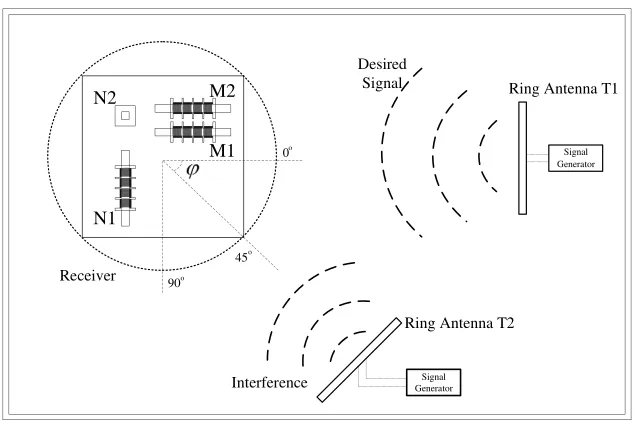
According to the signal and antenna model proposed in Section 2.1, the vision of experimental scene as shown in Fig. 3 is proposed, and the software MATLAB is used to simulate the algorithm.
Signal Generator
Signal Generator
M1 M2
N1 N2
90
45 0
Desired
Signal Ring Antenna T1
Ring Antenna T2
Interference Receiver o
o o
Figure 3. Experimental scene.
signal, steering vector of the interference is (φ,0). The sampling frequency is 1000 Hz, and the received signals of each antenna are delayed 2, 4 and 6 sample points, respectively.
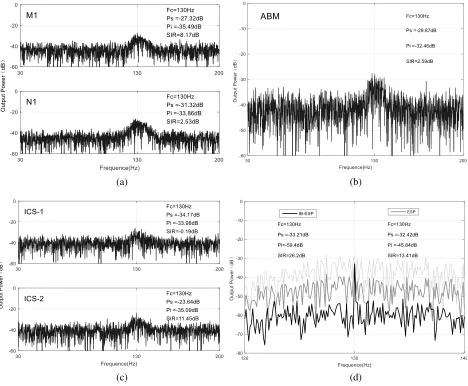
Figure 4(a) is the power spectra of the simulation signals of main antenna M1 and reference antenna N1. Fig. 4(b) shows that most of the interference remains in the blocking output. Fig. 4(c) is the power spectrum of the ICs extracted from the main antenna signal by the Fast-ICA algorithm, and the available components can be selected by adjusting the decision system. The performance indicators of the two ICs are labeled on it. By comparing the SIR, it can be confirmed that ICs-1 is the component which satisfies the requirements.
In Fig. 4(d) the lightest line represents the original signal of the main antenna. It can be seen that after being processed by ESP and IB-ESP, SIR of the received signal is improved, and the performance of the IB-ESP is better than ESP. The IB-ESP algorithm restores the desired signal and cancelled MSK signal effectively. Compared to the performance of the ESP, the SIR is improved by 12.79 dB.
3.2. Experiment
The interference of the SLF band is far more complex than imaginary, so the proposed algorithm still needs to be verified in experimental environment. As shown in Fig. 5, the experiment is set up based on Fig. 3. Keep T1 stationary but move T2 to change the parameter φ.
The interference cancellation performances of ESP and IB-ESP algorithms are summarized in Table 1. In the experiment, two algorithms based on the antenna array are both effective, and IB-ESP still has performance better than ESP.
No matter the parameterφis different, or the type of interference is different, the performance of IB-ESP is better than ESP as shown in Table 1. Whenφ= 15◦, the performances of the two algorithms are close because the main component of interference is in the reference antenna. With the increase of
(a) (b)
(c) (d)
Figure 4. Input signal and output of each module in the simulation (φ= 45◦).
(a) (b)
Table 1. Comparing the performance of IB-ESP and ESP in different interference environments.
Real environment Interference
type
Interference steering vector
Main antenna
input SINR improvement (dB) (φ, θ) SIR (dB) ESP IB-ESP
Single-tone interference
(15◦,0◦) 6.71 22.1 23.38
(45◦,0◦) 5.25 17.94 21.56
(75◦,0◦) 3.18 9.59 16.81
Phase modulation interference
(15◦,0◦) 4.95 16.5 17.69
(45◦,0◦) 2.98 15.53 22.91
(75◦,0◦) 0.29 8.04 19.12
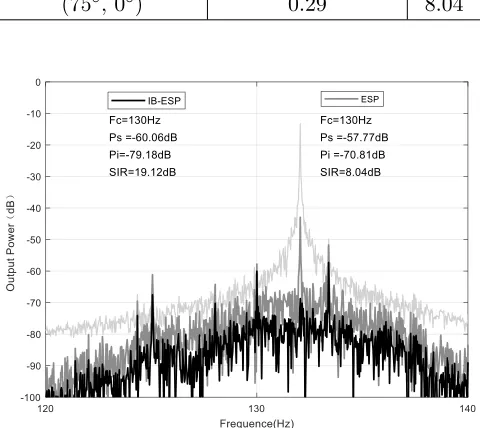
Figure 6. Comparison of the performance of two algorithms in experiment (φ= 75◦).
4. CONCLUSION
In this paper, the interference environment of SLF band is analyzed. A cancellation scheme by using antenna array and improved ESP algorithm are proposed and verified both in simulation and experiment. Experiment has verified that the IB-ESP algorithm can cancel the single-tone and phase modulation interferences near the direction of the main lobe. However, Fig. 6 also reflects a problem. Although the phase modulation interference of the center frequency 132 Hz has been canceled, there are still many interferences in the environment at other frequencies. The main reason is that there are only 2 main antennas, which leads to limited available ICs. In the next step, the number of main antennas will be increased to improve the effect of interference cancelation, but this will also increase the complexity of the selection system, so further research is needed.
REFERENCES
1. S´eran, H. C. and P. Fergeau, “An optimized low-frequency three-axis search coil magnetometer for space research,” Review of Scientific Instruments, Vol. 76, No. 4, 57–65, 2005.
3. Lin, W.-J., C.-S. Chang, J.-Y. Li, D.-B. Lin, L.-S. Chen, and M.-P. Houng, “Improved compact broadband bandpass filter using branch stubs Co-via structure with wide stopband characteristic,”
Progress In Electromagnetics Research C, Vol. 5, 45–55, 2008.
4. Thiergart, O., M. Taseska, and E. A. P. Habets, “An informed parametric spatial filter based on instantaneous direction-of-arrival estimates,” IEEE/ACM Transactions on Audio Speech &
Language Processing, Vol. 22, No. 12, 2182–2196, 2014.
5. Chakrabarty, S., O. Thiergart, and E. A. P. Habets, “A Bayesian approach to spatial filtering and diffuse power estimation for joint dereverberation and noise reduction,” IEEE International Conference on Acoustics, Speech and Signal Processing, 753–757, IEEE, 2015.
6. Thiergart, O., M. Taseska, and E. A. P. Habets, “An informed MMSE filter based on multiple instantaneous direction-of-arrival estimates,”Signal Processing Conference, 659–663, IEEE, 2014. 7. Wang, W. and L. R. Wyatt, “Radio frequency interference cancellation for sea-state remote sensing
by high-frequency radar,” Radar Sonar& Navigation, Vol. 5, No. 4, 405–415, IET, 2011.
8. Tian, Z., et al., “Radio frequency interference suppression algorithm in spatial domain for compact high-frequency radar,” IEEE Geoscience & Remote Sensing Letters, 1–5, 99, 2017.
9. Stankovic, L., T. Thayaparan, and M. Dakovic, “Signal decomposition by using the S-method with application to the analysis of HF radar signals in sea-clutter,” IEEE Transactions on Signal Processing, Vol. 54, No. 11, 4332–4342, 2006.
10. Moragues, J., L. Vergara, and J. Gosalbez, “Generalized matched subspace filter for nonindependent noise based on ICA,” IEEE Transactions on Signal Processing, Vol. 59, No. 7, 3430–3434, 2011.
11. Gruber, P., et al., “Denoising using local ICA and a generalized eigendecomposition with time-delayed signals,”Lecture Notes in Computer Science, Vol. 3195, 993–1000, 2004.
12. Hua, T. P., et al, “A new adaptation mode controller for adaptive microphone arrays based on nested and symmetric leaky blocking matrices,”European Signal Processing Conference, 1–5, IEEE, 2006.
13. Hyv¨arinen, A. and E. Oja, “A fast fixed-point algorithm for independent component analysis,”