Anomalous Extinction Efficiency of Two Dimensional Particles
in the Visible
Sharhabeel Alyones1, 2, *, Charles W. Bruce2, and Michael Granado2
Abstract—In this article we theoretically investigate the visible extinction efficiency that can be obtained using a two dimensional particle. We show that extinction efficiencies up to the upper limit can be obtained from two dimensional particles (thin circular disks or flakes) compared with one dimensional (fibers) and three dimensional particles (spheres). Features of the theory of electromagnetic extinction by thin circular disks are thoroughly investigated for wide size and material contents parameters in the visible. The results of this article are of importance for the search of efficient aerosol attenuative candidates in the visible spectral region.
1. INTRODUCTION
Manufactured high efficiency attenuative particles across the electromagnetic spectrum have been investigated for decades. Particle’s shape, size, and material contents effects on the attenuation efficiency have been investigated theoretically and experimentally across the electromagnetic spectrum in search for the best attenuation particle candidate. Theoretical and experimental research on particles that are essentially one dimensional (i.e., fibers) and can have high mass or volume normalized attenuative properties at either long (centimeter) or short (visible and infrared) wavelengths have been reported in recent decades [1–12], where both analytical [1] and numerical [2, 3] solutions of the problem of electromagnetic scattering and absorption by fibers have been developed and verified experimentally [7– 12]. Two dimensional particles (i.e., thin discs) have been extensively studied across the electromagnetic spectrum [13–21]. For two dimensional circular thin disks, an exact, modified, and improved version of a moment method code (CWW code) was developed by Willis and Weil for the calculation of electromagnetic scattering and absorption by thin circular disks [13]. CWW code has restrictions of use to be accurate, and these restrictions as reported by Willis and Weil are: kt <0.5, kd/2 < 12, and 1 < d/2t <10000, where k is the free space wave number, t the thickness of the disk, and d the diameter. The first and third restrictions are intrinsic consequences of approximations made in the analytic evaluation of certain integrals in the moment method matrix element calculations, while the second restriction is not intrinsic to the method but depends on the number of discretizations made over the size parameter kd/2, and the larger the discretization number made the larger kd/2 values are covered by the code. Two dimensional thin disks show promising candidates for aerosol attenuative particles, while three dimensional particles (i.e., spheres), on the other hand, tend to produce lower extinction efficiency due to their mass [14–17, 22–26]. For three dimensional spherical particles, the problem of electromagnetic scattering has been solved exactly using Mie scattering theory [22–24].
Fundamental theoretical upper limits of the extinction, scattering, and absorption efficiencies regardless of shape and size at any given wavelength have been reported by Miller et al. [27, 28] and verified experimentally for randomly oriented silver nanodisks in the visible and near infrared spectral
Received 10 October 2019, Accepted 17 December 2019, Scheduled 1 January 2020 * Corresponding author: Sharhabeel Alyones ([email protected]).
1 Physics Department, Hashemite University, Zarqa 13115, Jordan.2Physics Department, New Mexico State University, Las Cruces,
reported in [28]. To date, the reported highest orientational average extinction efficiency (extinction cross section per unit mass), up to 10 m2/g, in the visible spectral region (at Wavelengthλ= 500 nm), can be obtained from one dimensional graphite particles (i.e., fibers) [8] and two dimensional nanodisks silver particles [17]. Hlaing et al. [29] reported that a 10 nm diameter silver sphere would produce an extinction per unit volume of 150 (µm)−1 which corresponds to about 27 m2/g at 423 nm wavelength, but using the exact Mie theory or the quasistatic approximation, the calculated efficiency would be in the order of 1 m2/g regardless of the source of silver refractive indices used in the calculation, which contradicts the reported value by Hlaing et al.
In this study we introduce a comprehensive theoretical investigation of the potential of two dimensional (i.e., flake or circular disk) options for attenuative particles and provide comparison with fibers and spheres specifically for the visible spectral region. This study is not limited to quasistatic disks where the wavelength is much greater than the disk, and the CWW code applies to disks larger than the wavelength. What makes this issue of particular scientific interest is the difference in mechanisms: In the IR, conducting disks are used to carry currents to resonant dimensions, among many other currents while in the visible multiple mechanisms produce the optical absorption and scattering. In the visible, surface currents are produced by plasmonics and quantum activity from available states. This paper examines the net optical properties in the visible and encounters results such as the existence of sharp resonances for dielectrics with high values of refractive index [30], which, for example, enables the use of thin disks as building blocks for meta-structure designs.
2. NUMERICAL CALCULATIONS
The input parameters in our calculations are the complex refractive index and the dimensions of the disk (i.e., thickness and diameter). We have not investigated non-circular geometries and it is worth mentioning that the induced currents would be different around other form affecting, especially, the frequencies higher than the dominant resonant mode. But for flakes with minor deviations from the circular, the effects would not be significant. This has been shown for cylindrical fibers, as fibers with small surface irregularities produce the same spectra as those with perfect smoothness [9]. In this study we did not limit ourselves to existing natural materials: our first objective will be to determine the optimal combination of refractive index, diameter and thickness that can achieve the maximum extinction disk particle. Then we will restrict the indices to those known to exist in solids or liquids. Also we will test the fundamental upper limits reported by Miller et al. [27, 28] for the nanodisks material and extend the theoretical work by Langhammer et al. [16] to nanodisks beyond the quasistatic approximation (i.e., for disks comparable or larger than the wavelength). CWW code has been used to perform the calculations in this study along with the Mie scattering theory for spheres [13, 22] and our developed and tested code for fibers [3].
3. RESULTS AND DISCUSSION
0.001 0.1 10 1000
0 200 400 600
k=12.0 k=6.0 k=3.0 k=2.0 k=1.5 k=0.5 k=0.001
n = 0.1
d (nm)
Extinction cross sectio
n
per unit volume
( μμ m -1) 0.001 0.1 10 1000
0 200 400 600
k=0.001 k=0.5 k=1.5 k=2.0 k=3.0 k=6.0 k=12.0
n = 0.5
d (nm)
Extinction cross sectio
n
per unit volume
( μ m -1) 0.001 0.1 10 1000
0 200 400 600
k=0.001 k=0.5 k=1.5 k=2.0 k=3.0 k=6.0 k=12.0
n = 1.5
d (nm)
Extinction cross sectio
n
per unit volume
( μ m -1) 0.001 0.1 10 1000
0 200 400 600
k=0.001 k=0.5 k=1.5 k=2.0 k=3.0 k=6.0 k=12.0
n = 3
d (nm)
Extinction cross sectio
n
per unit volume
( μ m -1) 0.001 0.1 10 1000
0 200 400 600
k=0.001
k=0.1
k=0.5
k=3.0
k=12.0
n = 6
d (nm)
Extinction cross sectio
n
per unit volume (
μ m -1) 0.01 0.1 1 10 100 1000
0 200 400 600
k=0.001
k=0.5
k=1.5
k=3.0
k=12
n = 12
d (nm)
Extinction cross sectio
n
per unit volume
(
μ
m
-1)
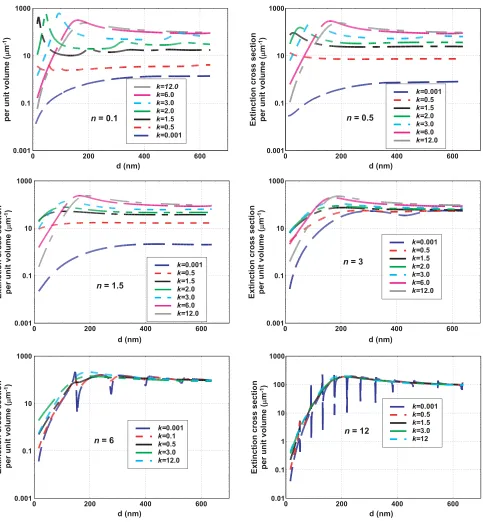
Figure 1. Extinction cross section per unit volume versus diameter for a circular disk with t= 20 nm and different values of the complex index of refraction at 500 nm wavelength broadside incidence.
need to be manufactured. Also we see from Figure 1 that a combination of n∼0.1, k∼3, t= 20 mm at the resonant diameter would produce an efficient particle at λ= 500 nm that is much larger than what fibers or spheres would produce as we will see later. Overall, a wide range ofnandkvalues would produce higher efficient particles in the visible compared with spheres and fibers.
0.1 1 10 100 1000
0 200 400 600
t=5nm t=10nm t=15nm t=20nm t=30nm t=40nm
k = 3
d (nm)
Extinction cross sectio
n
per unit volume
(
μμ
m
-1)
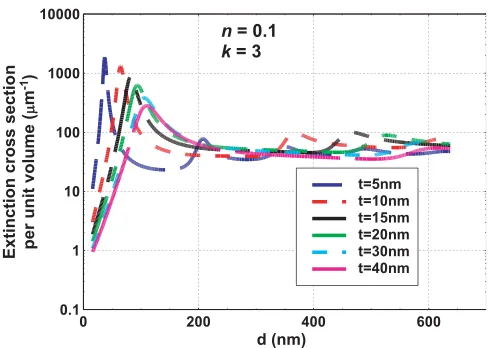
Figure 2. Extinction cross section per unit volume versus diameter for a circular disk with different values of thicknesses at 500 nm wavelength broadside incidence.
decrease the thickness. Also we notice that the extinction per unit volume increases with the decrease of thickness. This feature of resonant shift was also shown for fibers [2], and the reason for such a behavior was attributed to the sudden decrease in the surface impedance. To test the percentage of the upper limit that a nanodisk (withn= 0.1,k= 3) can achieve at 500 nm, the fundamental upper limit of this disk at 500 nm is calculated according to [27, 28], and we get: extinction cross section/volume≤1700 (µm)−1. Now from Figure 2, a 5 nm silver disk achieves 1841 (µm)−1 which is greater slightly than the predicted upper limit. The results of Figure 2 indicate that nanodisks can perform up to their extinction upper limit. The slight increase above the upper limit may be attributed to the inaccuracy of the CWW code calculations, as an up to 5% inaccuracy was reported by Willis and Weil [13].
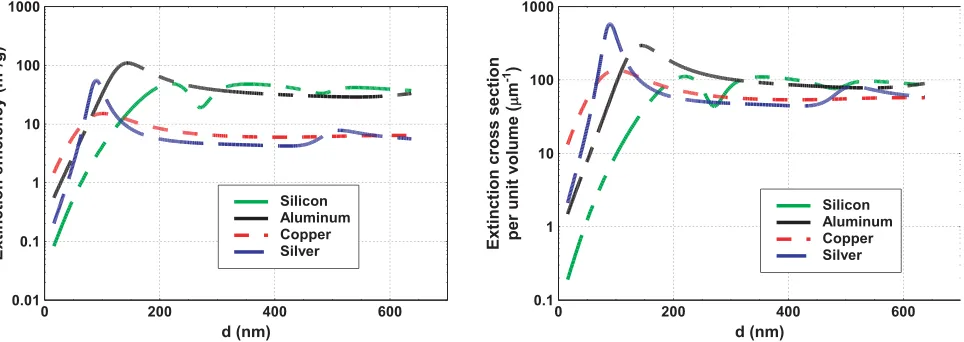
In the second portion of the study, we apply the same type of calculations for parameters as those used in Figures 1 and 2 for natural existing material. We chose three of the top conductors: Silver with mass density 10.5 g/cm3, copper with mass density 9.0 g/cm3, and aluminum with mass density 2.7 g/cm3. Silver has an index that is very close to the index we just saw as ideal, i.e., n∼0.1,k∼3, the index for silver at λ= 500 nm isn= 0.13,k= 2.9; for coppern= 1.15, k= 2.67 and for aluminum
n= 0.62, k= 4.8 [31, 32]. We also chose silicon that has a low mass density 2.33 g/cm3 and an index
n= 4.3,k= 0.07 [33]. Figure 3 shows the extinction cross sections per unit volume and the extinction cross section per unit mass (extinction efficiency) for the three metals and silicon at broadside incidence fort = 20 nm. It is clear from Figure 3 that regardless of the mass density, silver is the most efficient of the group, but because mass density of silver is very large compared with aluminum, aluminum has larger efficiency if an appropriate diameter is picked. Also one can see that the efficiency is very large (it reaches above 100 m2/g at the peak for aluminum). While for silicon, large diameter disks are required to get the highest possible efficiency at the first resonant peak, which is at d = 221 nm, and this corresponds to a size parameter kd/2 = 1.39, this size is not in the quasistatic region as the case with metals.
0.01 0.1 1 10 100 1000
0 200 400 600
Silicon Aluminum Copper Silver
d (nm)
Extinction efficiency (m
2/g)
0.1 1 10 100 1000
0 200 400 600
Silicon Aluminum Copper Silver
d (nm)
Extinction cross sectio
n
per unit volume
(
μμ
m
-1 )
Figure 3. Extinction cross section per unit volume and extinction efficiency versus diameter for a circular disk with t = 20 nm at 500 nm wavelength broadside incidence, for three metals (silver, aluminum and copper) and silicon.
0.1 1 10 100
0 200 400 600
Orientational average
Edge-on incidence (perpendicular polarization) Edge-on incidence (parallel polarization) Broadside incidence
d (nm)
Extinction efficiency (m
2 /g)
Figure 4. Extinction efficiency versus diameter for a silver disk witht= 20 nm at 500 nm wavelength incidence.
silver, but with the same refractive index, still higher values would be achieved. For example, aluminum would produce efficiency above 50 at 500 nm for its orientational average at the peak.
Another feature of two dimensional particles is shown in Figure 5. Figure 5 shows the extinction efficiency for a silver disk with thickness 20 nm at λ = 500 nm for broadside incidence and incidence angles 25, 45, and 65 degrees at parallel polarization. We notice that extra resonances occur for oblique incidence between the two main resonances of the broadside incidence, and a similar behavior was also seen for fibers [3].
0.1 1 10
0 200 400 600
Incident angle θ=65
Incident angle θ=45
Incident angle θ=25
Broadside incidence θ=0
d (nm)
Extinction efficiency (m
2 /g)
Figure 5. Extinction efficiency versus diameter for Silver disk with t = 20 nm at 500 nm wavelength incidence with parallel polarization.
0.1 1 10 100
400 500 600 700
Disk Fiber Sphere
λ (nm)
Extinction efficiency (m
2/g)
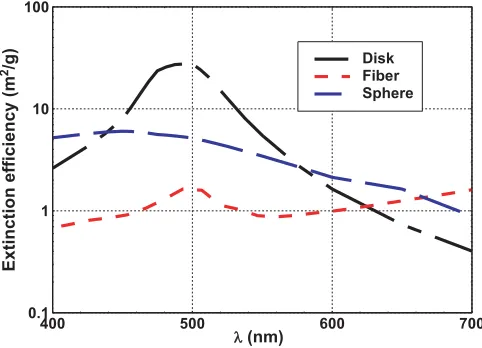
Figure 6. Orientational average extinction efficiency versus wavelength for a silver disk (t = 20 nm,
d= 88 nm), silver fiber (d= 20 nm) and a silver sphere (d= 20 nm) at 500 nm wavelength incidence.
4. CONCLUSIONS
In conclusion, we have shown that two dimensional particles exhibit very high attenuative efficiencies and perform up to the extinction upper limit compared with one or three dimensional particles in the visible spectral region. Extra ordinary attenuative properties can be obtained from two dimensional particles for specific combination of size and complex index of refraction. Such properties would guide and motivate experimentalists toward fabrication of two dimensional aerosolized particles, to be used for attenuation of the electromagnetic radiations in the atmosphere for many applications.
ACKNOWLEDGMENT
REFERENCES
1. Waterman, P. C., “Scattering, absorption, and extinction by thin fibers,” J. Opt. Soc. Am. A, Vol. 22, 2430, 2005.
2. Alyones, S., C. W. Bruce, and A. K. Buin, “Numerical methods for solving the problem of electromagnetic scattering by a thin finite conducting wire,” IEEE Trans. Antennas Propag., Vol. 55, 1856, 2007.
3. Alyones, S. and C. W. Bruce, “Electromagnetic scattering and absorption by randomly oriented fibers,”J. Opt. Soc. A, Vol. 32, 6, 2015.
4. Jain, P. K., K. S. Lee, I. H. El-Sayed, and M. A. El-Sayed, “Plasmon coupling in nanorod assemblies: Optical absorption, discrete dipole approximation simulation, and exciton-coupling model,” J. Phys. Chem. B, Vol. 110, 7238, 2006.
5. Lee, K. S. and M. A. El-Sayed, “Dependence of the enhanced optical scattering efficiency relative to that of absorption for gold metal nanorods on aspect ratio, size, end-cap shape, and medium refractive index,”J. Phys. Chem. B, Vol. 109, 20331, 2005.
6. Chang, W. S., J. W. Ha, L. S. Slaughter, and S. Link, “Plasmonic nanorod absorbers as orientation sensors,”Proc. Natl. Acad. Sci., Vol. 107, 2781, USA, 2010.
7. Bruce, C. W. and S. Alyones, “Extinction efficiencies for metallic fibers in the infrared,” Appl. Opt., Vol. 48, 5095, 2009.
8. Bruce, C. W. and S. Alyones, “Visible and infrared optical properties of stacked cone graphite microtubes,”Appl. Opt., Vol. 51, 3250, 2012.
9. Bruce, C. W., A. V. Jelinek, S. Wu, S. Alyones, and Q. S. Wang, “Millimeter-wavelength investigation of fibrous aerosol absorption and scattering properties,” Appl. Opt., Vol. 43, 6648, 2004.
10. Gurton, K. P. and C. W. Bruce, “Parametric study of the absorption cross-section for a moderately conducting thin cylinder,”Appl. Opt., Vol. 34, 2822, 1995.
11. Jelinek, A. V. and C. W. Bruce, “Extinction spectra of high-conductivity fibrous aerosols,”J. Appl. Phys., Vol. 78, 2675, 1995.
12. Hart, M. and C. W. Bruce, “Backscatter measurements of thin nickel-coated graphite fibers,”IEEE Trans. Antennas Propag., Vol. 48, 842, 2000.
13. Willis, T. M. and H. Weil, “Disk scattering and absorption by an improved computational method,” Appl. Opt., Vol. 26, 18, 1987.
14. Hanarp, P., M. K¨all, and D. S. Sutherland, “Optical properties of short range ordered arrays of nanometer gold disks prepared by colloidal lithography,”J. Phys. Chem. B, Vol. 107, 5768, 2003. 15. Li, N., Q. Zhang, S. Quinlivan, J. Goebl, Y. Gan, and Y. Yin, “H2O2-aided seed-mediated synthesis
of silver nanoplates with improved yield and efficiency,”Chem. Phys. Chem., Vol. 13, No. 10, 2526– 2530, 2012.
16. Langhammer, C., Z. Yuan, I. Zori´c and B. Kasemo, “Plasmonic properties of supported Pt and Pd nanostructures,”Nano Lett., Vol. 6, 833, 2006.
17. Anquillare, E. L., O. D. Miller, C. W. Hsu, B. G. DeLacy, J. D. Joannopoulos, S. G. Johnson, and M. Soljaˇci´c, “Efficient, designable, and broad-bandwidth optical extinction via aspect-ratio-tailored silver nanodisks,”Optics Express, Vol. 24, No. 10, 10806, 2016.
18. Shepherd, J. W. and A. R. Holt, “The scattering of electromagnetic-radiation from finite dielectric circular-cylinder,”J. Phys. A, Vol. 16, 65, 1983.
19. DeVore, R., D. B. Hodge, and R. G. Kouyoumjian, “Backscattering cross sections of circular disks for arbitrary incidence,”J. Appl. Phys., Vol. 42, 3075, 1971.
20. Le Vine, D. M., A. Schneider, R. H. Lang, and H. G. Carter, “Scattering from thin dielectric disks,” IEEE Trans. Antennas. Propag., Vol. 33, 1410, 1985.
21. Venner, M. J. and C. W. Bruce, “Absorption cross section of moderately conducting disks at 35 GHz,” Appl. Opt., Vol. 37, No. 30, 7143, 1998.
24. Van de Hulst, H. C., Light Scattering by Small Particles, John Wiley and Sons, New York, 1957. 25. Gustafsson, M., C. Sohl, and G. Kristensson, “On the spectral efficiency of a sphere,” Proc. R.
Soc. A, Vol. 463, 2589, 2007.
26. Qiu, W., B. G. Delacy, S. G. Johnson, J. D. Joannopoulos, and M. Soljaˇci´c, “Optimization of broadband optical response of multilayer nanospheres,”Opt. Express, Vol. 20, 18494, 2012.
27. Miller, O. D., A. G. Polimeridis, M. T. H. Reid, C. W. Hsu, B. G. Delacy, J. D. Joannopoulos, M. Soljaˇci´c, and S. G. Johnson, “Fundamental limits to optical response in absorptive systems,” Optics Express, Vol. 24, 4, 2016.
28. Miller, O. D., C. W. Hsu, M. T. H. Reid, W. Qiu, B. G. DeLacy, J. D. Joannopoulos, M. Soljaˇci´c, and S. G. Johnson, “Fundamental limits to extinction by metallic nanoparticles,” Physical Review Letters, Vol. 112, 123903, 2014.
29. Hlaing, M., B. Gebear-Eigzabher, A. Roa, A. Marcano, D. Radu, and C.-Y. Lai, “Absorption and scattering cross-section extinction values of silver nanoparticles,” Optical Materials, Vol. 58, 439–444, 2016.
30. Kuznetsov, A. I., A. E. Miroshnichenko, M. L. Brongersma, Y. S. Kivshar, and B. Luk’yanchuk, “Optically resonant dielectric nanostructures,”Science, Vol. 354, 2472, 2016.
31. Ward, L., Optical Constants of Bulk Materials and Films, Adam Hilger, 1988.
32. Ordal, M. A., L. L. Long, R. J. Bell, S. E. Bell, R. R. Bell, R. W. Alexander, Jr., and C. A. Ward, “Optical properties of the metals Al, Co, Cu, Au, Fe, Pb, Ni, Pd, Pt, Ag, Ti, and W in the infrared and far infrared,”Applied Optics, Vol. 22, No. 7, 1099, 1983.