Efficient Sparse Algorithm for Solving Multi-Objects Scattering
Based on Compressive Sensing
Doudou Chai1, 2, * and Yiying Wang1, 2
Abstract—To improve computational efficiency of traditional method for solving separable multi-objects scattering problems, each subdomain impedance matrix is sparsified by biorthogonal lifting wavelet transform(BLWT) without allocating auxiliary memory, and a sparse underdetermined equation is constructed by enjoying the prior knowledge from known excitation in wavelet domain, then orthogonal matching pursuit (OMP) is employed to fast and accurately solve the sparse underdetermined equation under compressive sensing (CS) framework. Numerical results of separable perfectly electric conduct (PEC) multi-objects are presented to show the efficiency of the proposed method.
1. INTRODUCTION
Owing to the requirement of engineering, electromagnetic scattering analysis of multi-objects is always an interesting topic in computational electromagnetics(CEM). As one of the most popular tools for solving the aforementioned problems, the domain decomposition method (DDM) [1, 2] incorporated into integral equation method [3] has been applied widely due to its high accuracy and stability. In [4], a non-overlapping DDM is proposed to efficiently calculate the scattering from non-penetrable objects. Afterwards, some troublesome problems from complex targets have been solved by employing integral equation domain decomposition method(IE-DDM) [5, 6]. For multi-objects, DDM divides the original problem into many separable subdomains to improve the computational efficiency [7, 8]. However, IE-DDM must solve full dimension impedance matrix equations, which is a expensive operation.
Recently, Compressive Sensing (CS) has been successfully introduced to CEM for improving computational efficiency, which is mainly reflected in the following two aspects: one is used to fast solve monostatic scattering problems, and the other is used as an efficient solver for matrix equation. In the former aspect, a new incident source model is constructed based on CS [9], which can fast analyze scattering over a wide incident angle and avoid repeatedly solving the problems in all finer angle increment. After that, some complex targets have been analyzed by optimizing key technology of the model [10, 11]. In the latter aspect, CS has been used to calculate electromagnetic integral equations by constructing undetermined equations model that can be fast solved by optimization algorithm [12, 13]. Based on CS, a stabilized undetermined model is proposed in discrete wavelet transformation (DWT) and applied for analyzing scattering problems of bodies of revolution (BOR) [14]. However, auxiliary memory must be allocated by wavelet matrix transform (WMT) in the method, and the efficiency of WMT may also influence the total computational efficiency.
To overcome these drawbacks, for scattering problems of multiple objects, biorthogonal lifting wavelet transform(BLWT) is employed to thin impedance matrices of separable subdomains generated by DDM, then an undetermined matrix equation is constructed by extracting only a few rows from the sparse impedance matrices under CS framework. Finally, the small size undetermined equations
Received 12 May 2019, Accepted 26 July 2019, Scheduled 20 August 2019
* Corresponding author: Doudou Chai ([email protected]).
1 Anhui Province Key Laboratory of Simulation and Design for Electronic Information System, Hefei Normal University, Hefei
can be accurately solved by orthogonal matching pursuit (OMP) [15]. Different from existing methods, the proposed technique introduces BLWT to form sparse transform matrices for separable subdomains without sacrificing additional memory, which can fast construct accurate undetermined equations model to further improve computing efficiency for solving Multi-Objects scattering based on CS.
2. FORMULATION
2.1. Decomposition Method for Multi-Objects Scattering Analysis by BLWT
Consider PEC multi-objects in free space illuminated by an incident field (Ei), the electric-field integral equation (EFIE) can be expressed as
n×L(Js) =n×Ei (1)
whereJs denotes the surface current density, and the integral operator Lis given by
L(Js) =−jkη
s
Js+ 1
k2∇(∇·Js)
GdS (2)
in which η denotes the free-space wave impedance, and k and G are the wave number and Green’s function in free-space, respectively.
Applying moment of method (MoM) to Equation (1) will result in a matrix equation as
ZnN×nNInN×1=VnN×1 (3)
where n denotes the number of separable objects, and each object is discretized into N fragments. I
and V are unknown current coefficients vector and known excitation vector, respectively, and Zis the impedance matrix that can be shown as
ZnN×nN =
⎡ ⎢ ⎢ ⎢ ⎢ ⎢ ⎢ ⎣ Z11
N×N Z12N×N . . . Z1Nn×N
Z21
N×N . .
. . .
. . .
. . .
ZnN1×N . . . . ZnnN×N ⎤ ⎥ ⎥ ⎥ ⎥ ⎥ ⎥ ⎦
nN×nN
(4)
in which ZijN×N(i, j= 1,2, . . . , n) is the subdomain impedance matrix denoting the excitation from the ith separable object which has an impact onjth separable object.
To speed up matrix-vector multiplication (MVM) of matrix equation, Equation (3) can be transformed by WMT method as
WnN×nNZnN×nNWHnN×nNWnN×nNInN×1=WnN×nNVnN×1 (5)
where W and WH are wavelet matrices and WHW = WWH=U (U denotes identity matrix),
respectively. Consider that the characteristic subdomain impedance matrices of ZnN×nN are derived from each separable objects, we definedWnN×nN as diagonal matrices
WnN×nN =
⎡ ⎢ ⎢ ⎢ ⎢ ⎢ ⎣
WN×N
WN×N
. . . . . .
. . .
WN×N ⎤ ⎥ ⎥ ⎥ ⎥ ⎥ ⎦
nN×nN
(6)
By setting ˜ZnN×nN=WnN×nNZnN×nNWHnN×nN and ˜InN×1=WnN×nNInN×1, ˜VnN×1=WnN×nNVnN×1,
(5) can be reduced to
˜
In ˜ZnN×nN and ˜VnN×1, the elements with small values are below thresholds σZ, and σV will be
set to zero respectively, in which the thresholds can be defined as
σZ = τ||Z˜||1/nN =τ ·max
m
n
|Z˜(nN, nN)|/nN (8)
σV = τ||V˜||1/nN =τ ·max
m
n
|V˜(nN,1)|/nN (9)
wherenN is the dimension of the matrices, andτ ∈[0.01, 0.1] is a coefficient to control the sparsity of the matrices and the solution accuracy of unknown ˜InN×1, so that Equation (7) is transformed into a
sparse matrix equation, in which ˜InN×1 can be solved by iterative solution algorithms, thenInN×1 can
be obtained by inverse transform
InN×1 = ˜WnN×nN˜InN×1 (10)
However, the above method must construct transform matrices W and W˜ by allocating additional memory. In this paper, for eliminating the pitfall, BLWT is introduced to implement the left-hand forward transform (WnN×nNZnN×nN, WnN×nNInN×nN, WnN×nNVnN×nN) and the right-hand forward transform (ZnN×nNW˜ nN×nN) as in-space matrix transform [16], which can be directly operated by the polyphase matrixP(z) and its dual matrix ˜P(z), defined as
P(z) =
m
i=1
1 si(z)
0 1
1 0 ti(z) 1
F 0
0 F1
(11)
˜
P(z) =
m
i=1
1 0
−si(z−1) 1
1 −ti(z−1)
0 1
F 0
0 F1
(12)
in which si(z) and ti(z) are Laurent polynomials, andF denotes a nonzero constant.
2.2. Compressive Sensing Theory
Consider a discrete signal [X]N×1, which can be transformed to a sparse signal [α]N×1 by
[α]N×1 = [Ψ]N×N[X]N×1 (13)
in which [Ψ]N×N is the sparse transformed matrix, and [X]N×1 is so-called K-spares signal if [α]N×1
contains K non-zero elements.
Based on CS [17], the sparse signal [α]N×1 can be compressed to [Y]M×1 by
[Y]M×1 = [Φ]M×N[α]N×1
= [Φ]M×N[Ψ]N×N[X]N×1(M << N) (14)
where [Φ]M×N denotes the measurement matrix, and [Y]M×1 is the measurements.
To reconstruct [X]N×1, the underdetermined Equation(14) can obtain unique solution by solving
optimization problems as follows:
min||ΨX||1 s.t.ΦΨX=Y (15)
2.3. The Application of CS in Multi-Objects Scattering Analysis
To further improve the analysis efficiency of multi-objects scattering, the sparse matrix in Equation (7) can be transformed into an underdetermined equation under the CS theory framework, in which unknown signal can be obtained by OMP with fewer resources occupied. The detailed implementation steps are as follows:
Firstly, Equation (7) can be rewritten as a matrix form
⎡ ⎢ ⎢ ⎢ ⎢ ⎢ ⎢ ⎣ ˜ Z11
N×N Z˜12N×N . . . Z˜1Nn×N
˜
Z21
N×N . .
. . .
. . .
. . .
˜
ZnN1×N . . . . Z˜nnN×N ⎤ ⎥ ⎥ ⎥ ⎥ ⎥ ⎥ ⎦
nN×nN
× ⎡ ⎢ ⎢ ⎢ ⎢ ⎢ ⎢ ⎣
˜I1
N×1
˜I2
N×1
. . . ˜In
N×1 ⎤ ⎥ ⎥ ⎥ ⎥ ⎥ ⎥ ⎦
nN×1
= ⎡ ⎢ ⎢ ⎢ ⎢ ⎢ ⎢ ⎣ ˜ V1
N×1
˜
V2
N×1
. . . ˜
VNn×1 ⎤ ⎥ ⎥ ⎥ ⎥ ⎥ ⎥ ⎦
nN×1
in which
˜
Z1Ni×nN˜InN×1= ˜V1N×1 (i=1,2, . . . , n) (17)
In CS frame, Equation (17) can be transformed as
˜
Z1MCS1×nN˜InN×1= ˜V1MCS1×1 (M1<< N) (18)
where ˜Z1MCS
1×nN and ˜VM1CS1×1 can be seen as the measurement matrix and known measurements of ˜InN×1,
respectively; ˜V1CS
M1×1 is constructed by extractingM1 nonzero elements in known ˜V1N×1; and the row
index of nonzero elements can use a priori knowledge to construct ˜Z1CS
M1×nN that is formed by extracting
the sameM1 rows from ˜Z1Ni×nN.
Similarly, for Equation (16), the above method can be operated ntimes for each linear equation, respectively. Hence, the impedance matrix is transformed into an underdetermined equation as
⎡ ⎢ ⎢ ⎢ ⎢ ⎢ ⎢ ⎢ ⎣ ˜
Z1MCS
1×nN
˜
Z2MCS
2×nN
. . . ˜
ZnCSMn×nN ⎤ ⎥ ⎥ ⎥ ⎥ ⎥ ⎥ ⎥ ⎦
M×nN
× ⎡ ⎢ ⎢ ⎢ ⎢ ⎢ ⎢ ⎢ ⎣
˜I1
N×1
˜I2
N×1
. . . ˜In
N×1 ⎤ ⎥ ⎥ ⎥ ⎥ ⎥ ⎥ ⎥ ⎦
nN×1
= ⎡ ⎢ ⎢ ⎢ ⎢ ⎢ ⎢ ⎢ ⎣ ˜
V1MCS1×1
˜
V2MCS2×1
. . . ˜
VnCSMn×1 ⎤ ⎥ ⎥ ⎥ ⎥ ⎥ ⎥ ⎥ ⎦
M×1
(19)
whereM =M1+M2+. . .+Mn(M nN).
To solve the underdetermined Equation (19), OMP method is used to reconstruct ˜InN×1, and the
unknownInN×1 can be solved by Equation (10).
For multi-objects scattering, compared with the traditional DWT method, the proposed method does not require allocating additional memory, and the computational complexity for solving matrix equation is reduced. It should be pointed out that we select db8 wavelet as the sparse transform matrix
W in this paper, so the proposed method is limited to solving 2n-dimension matrix for obtaining well sparsity. For DWT method, the traditional iterative solver has a complexity of O(P(nN)2) to Equation (7), where P is the number of iteration steps. In the proposed method, the complexity of OMP is O(SM(nN)) [17], whereSP,M nN, and the small scale measurement matrix will further reduce the complexity of OMP.
3. RESULT AND DISCUSSION
The surface current distributions of various multi-objects are calculated by the proposed method, traditional DWT-CS method, and DWT-MoM method, respectively. It should be pointed out that we select db97 wavelet as the sparse transform matrix, and the GMRES iterative technology is applied to solve the sparse matrix equations formed by traditional DWT-MoM. Meanwhile, to analyze the accuracy of the new method, the relative root mean square error (R-RMSE) is defined as
R−RM SE = ||IN ew−method−IDW T−M OM||2 ||IDW T−M OM||2
(20)
All examples are analyzed on the personal computer with Intel core [email protected] GHz, RAM 8.0 GB.
Firstly, consider that multiple objects consist of four infinite PEC square cylinders with sides of 2 m around the coordinate origin, which are illuminated by a 300 MHz TM plane wave, as shown in Fig. 1, and every side of each square cylinder is divided into 128 segments.
Sparse excitation vectors ˜V2048×1 = [ ˜V1512×1; ˜V2512×1; ˜V5123 ×1; ˜V4512×1] are obtained by setting a
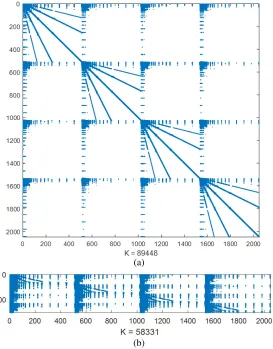
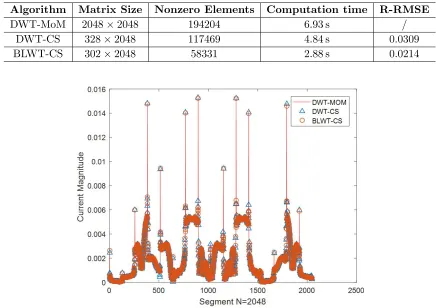
small threshold (σV =0.027) in each independent region, in which K = 302 nonzero elements are extracted to form ˜VCS302×1. Fig. 2(a) shows the sparse structure of impedance matrix ˜Z2048×2048
Figure 1. Four infinite PEC square cylinders (λ= 2 m) is illuminated by TM plane wave.
(b) (a)
Figure 2. Spares matrix for four infinite PEC square cylinders with sides of 2λ by BLWT. (a) Impedance matrix. (b) The small matrix obtained after extracting M = 302 nonzero rows of ˜V2048×1
from (a).
Table 1. Calculation data comparison for the four infinite PEC square cylinders.
Algorithm Matrix Size Nonzero Elements Computation time R-RMSE
DWT-MoM 2048×2048 194204 6.93 s /
DWT-CS 328×2048 117469 4.84 s 0.0309
BLWT-CS 302×2048 58331 2.88 s 0.0214
Figure 3. Currents distribution of four infinite PEC square cylinders with sides of 2λ at different segments.
Figure 4. The PEC sphere (r= 0.2 m) and cone-sphere (r = 0.2 m,α= 20◦) was illuminated by plane wave.
and R-RMSE dropped by about 50% and 30%, respectively.
(a)
(b)
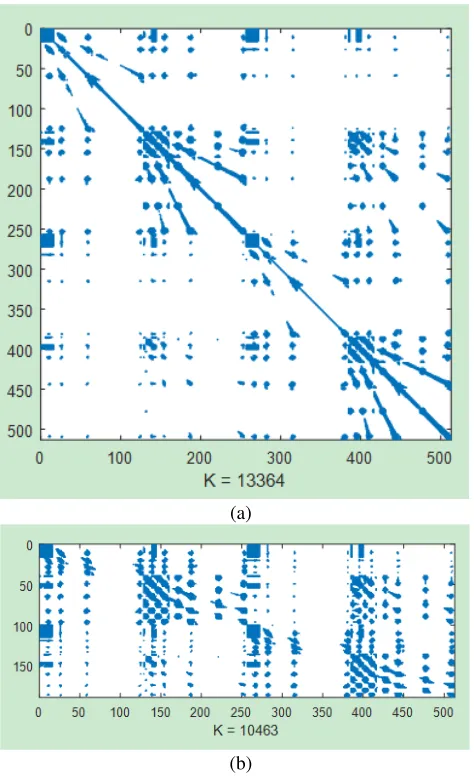
Figure 5. Spares matrix for PEC sphere and cone-sphere by sub-regional BLWT. (a) Impedance matrix. (b) The small matrix obtained after extracting M=188 nonzero rows of ˜V512×1 from (a).
Table 2. Calculation data comparison for the PEC sphere and cone-sphere.
Algorithm Matrix Size Nonzero Elements Computation time R-RMSE
DWT-MoM 512×512 38605 282.75s /
DWT-CS 95×512 26442 172.38s 0.0415(ϕ= 0◦-plane) 0.017(ϕ= 90◦-plane)
BLWT -CS 188×512 10436 118.42s 0.028(ϕ= 0◦-plane) 0.011(ϕ= 90◦-plane)
and two generators are divided into 128 segments, respectively.
For the multiple BOR scattering, BOR-MoM [14] is employed to decompose the vector MoM equations into two scalar linear integral equations in τ and ϕ directions, respectively, so the size of sparse impedance matrix is 512×512 (σZ= 0.021) in sub-regional BLWT, as shown in Fig. 5(a), thus a 188×512 (σV= 0.003) small matrix is constructed based on the prior knowledge provided by incident vector ˜VCS
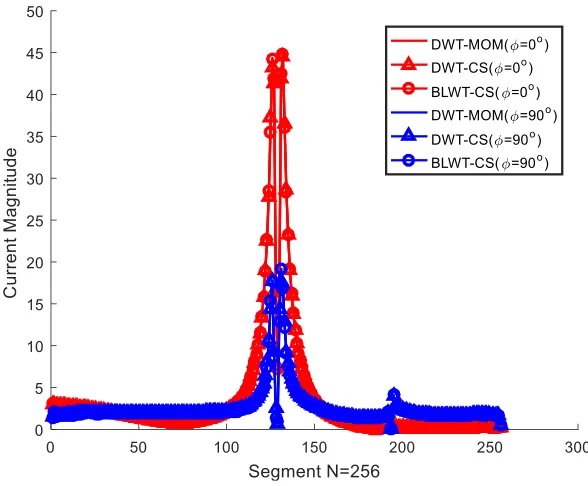
Figure 6. Currents distributions of PEC sphere and cone-sphere at different segments.
and ϕ= 90◦-plane for the multiple BOR by BLWT-CS, and the results obtained by DWT-MoM and DWT-CS are also shown as reference. Table 2 shows the calculation information.
4. CONCLUSION
For scattering of separable multi-objects, BLWT is employed to accelerate the sparse transformation of subdomain impedance matrices by in-space operations, and CS system is introduced to construct and solve sparse underdetermined equation with the help of prior knowledge. The simulation results show that the proposed method can reduce the computational time and nonzero elements of impedance matrix with high computational accuracy.
REFERENCES
1. Stupfel, B., “A fast-domain decomposition method for the solution of electromagnetic scattering by large objects,” IEEE Transactions on Antennas & Propagation, Vol. 44, No. 10, 1375–1385, 1996. 2. Li, M. K. and C. C. Weng, “Multiscale simulation of complex structures using equivalence principle algorithm with high-order field point sampling scheme,” IEEE Transactions on Antennas &
Propagation, Vol. 56, No. 8, 2389–2397, 2008.
3. Chew, W. C., E. Michielssen, J. M. Song, et al., Fast and Efficient Algorithms in Computational Electromagnetics, Artech House, 2002.
4. Peng, Z., X. C. Wang, and J. F. Lee, “Integral equation based domain decomposition method for solving electromagnetic wave scattering from non-penetrable objects,” IEEE Transactions on Antennas & Propagation, Vol. 59, No. 9, 3328–3338, 2011.
5. Hu, J., R. Zhao, M. Tian, et al., “Domain decomposition method based on integral equation for solution of scattering from very thin conducting cavity,” IEEE Transactions on Antennas &
Propagation, Vol. 62, No. 10, 5344–5348, 2014.
6. Zhao, R., J. Hu, P. Zhao, et al., “EFIE-PMCHWT based domain decomposition method for solving electromagnetic scattering from complex dielectric/metallic composite objects,”IEEE Antennas &
7. Chen, M., X. Wu, W. Sha, and Z. Huang, “Fast frequency sweep scattering analysis for multiple PEC objects,” Applied Computational Electromagnetics Society Journal, Vol. 22, No. 2, 250–253, 2007.
8. Cui, Z., Y. Han, X. Ai, et al., “A domain decomposition of the finite element-boundary integral method for scattering by multiple objects,” Electromagnetics, Vol. 31, No. 7, 469–482, 2011. 9. Chen, M. S., F. L. Liu, H. M. Du, and X. L. Wu, “Compressive sensing for fast analysis of
wide-angle monostatic scattering problems,” IEEE Antennas & Wireless Propagation Letters, Vol. 10, No. 3, 1243–1246, 2011.
10. Chai, S. R. and L. X. Guo, “Compressive sensing for monostatic scattering from 3-D NURBS geometries,” IEEE Transactions on Antennas & Propagation, Vol. 64, No. 8, 3545–3553, 2016. 11. Cao, X. Y., M. S. Chen, X. Wu, et al., “Bilateral sparse transform for fast solving EM scattering
problems by compressed sensing,”IET Microwaves Antennas&Propagation, Vol. 11, No. 14, 2017. 12. Kong, M., M. S. Chen, L. Zhang, and X. L. Wu, “ Efficient solution to electromagnetic scattering problems of bodies of revolution by compressive sensing,”Chinese Physics Letters, Vol. 33, No. 1, 136–139, 2016.
13. Chai, S. R. and L. X. Guo, “Integration of CS into MoM for efficiently solving of bistatic scattering problems,” IEEE Antennas& Wireless Propagation Letters, No. 15, 1771–1774, 2016.
14. Kong, M., M. S. Chen, B. Wu, and X. L. Wu, “Fast and stabilized algorithm for analyzing electromagnetic scattering problems of bodies of revolution by compressive sensing,” IEEE Antennas & Wireless Propagation Letters, 198–201, 2016.
15. Tropp, J. A. and A. Gilbert, “Signal recovery from partial information by orthogonal matching pursuit,”IEEE Trans. Inf. Theory, Vol. 53, No. 12, 4655–4667, 2007.
16. Chen, M. S., W. Sha, and X. L. Wu, “Solution of arbitrarily dimensional matrix equation in computational electromagnetics by fast lifting wavelet-like transform,” International Journal of Numerical Methods in Engineering, Vol. 80, No. 8, 1124–1142, 2009.