Education 3.0: Effect learning style and method of
instruction on user satisfaction
JENNY WANG Department of Applied Foreign Languages
National Formosa University Yunlin, Taiwan
Abstract:
The present study was designed to explore the effects between students’ satisfaction with different e-learning instruction and their preferred learning styles. Data were collected through the Kolb’s learning Style Inventory (LSI), user interface satisfaction, and demographic questionnaires. Sample of this study was college students who enrolled in enrolled in liberal arts course between February 2013 - June 2013 at a central Taiwan college. The Web 3.0 instruction group (n= 50) received Web 3.0 instruction, and the traditional instruction group (n= 52) received e-campus Web system which the school have been used for years. Independent sample t-tests, Pearson’s correlation coefficient, and a linear regression were conducted. Findings revealed that diverger learning style can predict user satisfaction with Web 3.0 instruction. However, the overall learning styles did not greatly influence on user satisfaction in both groups. In addition, the results showed that the students in the Web 3.0 instruction perceived higher user satisfaction than did students who received traditional instruction method. Findings of this study provide educators with insight into students’ learning styles and the user satisfaction with Web 3.0 instruction. It concludes that the usage of Web 3.0 acts as an important teaching and learning tool for design of the instruction methods to maximize students’ learning effectiveness in today’s education.
Introduction
People perceive and process the information they receive in different ways. It is necessary to consider many factors designing an interface that will be used by people to satisfy their information needs. Educators often implement their creative teaching methods into their classrooms which to be believed to lead a better learning achievement. The truth is that students encounter with frustration and uncomfortable experience facing the uncertainty of their teaching and learning methods (Hung, Bailey, & Jonassen 2003). Understanding the students’ learning experiences and changes of their learning patterns are essential for the design of the instruction methods in hoping to maximize students’ learning effectiveness.
However, it is so true and yet very ironic that “many educators are doing Education 1.0; talking about doing Education 2.0; when they should be planning and implementing Education 3.0” (Gerstein 2013). Web 3.0 applications, particularly social networking sites have been widely used, and many college students have been used them as part of their daily routine. Currently, Facebook reports 751 million monthly active users who used Facebook mobile products (Facebook 2013). Line, the most popular social networking app in Japan and Taiwan, has 150 million total users (Nay 2013). It is very important to ensure that learning tools and learning environments provide the students with user satisfaction and the learning interface provides the students with user-friendly access which they are willing and comfortable to use. The reason that user satisfaction is conducted is that it is hard to deny the success of an instruction that learners agree they like (DeLone & McLean 1992). Thus, the aim of this study is on understanding the students’ learning satisfaction in Education 3.0 and traditional classrooms based on their different learning styles. Learning styles in the traditional classroom have been widely studied; however, there is less research on the impact of learning styles in Web 3.0 learning environments.
integrating regular class sessions and mobile learning activities. Lecture-oriented, e-campus online systems are currently the predominant teaching practices in this school. This study seeks to answer questions if it can lead to a better learning satisfaction when educators accommodate students’ learning patterns instead of trying to switch them into teachers’ preferences. This study aims to explore the relationship between learning styles and user interface satisfaction with traditional e-campus online systems and Web 3.0 learning environments.
Learning Satisfaction
Lots of research studies (Baroudi, Olson, & Ives 1986; Fisbein & Ajzen 1975; Fredericksen et al. 2000; Marks, Sibley & Arbaugh 2005) investigate student learning satisfaction as the effectiveness of instruction. It is hard to deny the instruction is not efficient when the users indicate that they are satisfied with it. Therefore, it is essential for an educator to determine the predictors of learning satisfaction while designing a lesson plan in order to optimize the learning efficiency. Lund (2001) investigated the four aspects of learning satisfaction over the human-computer interface, including satisfaction, usefulness, ease of use, and ease of learning. This study was designed to investigate which aspects of students’ e-learning experience were significantly important on e-learning satisfaction after instruction.
Learning Style
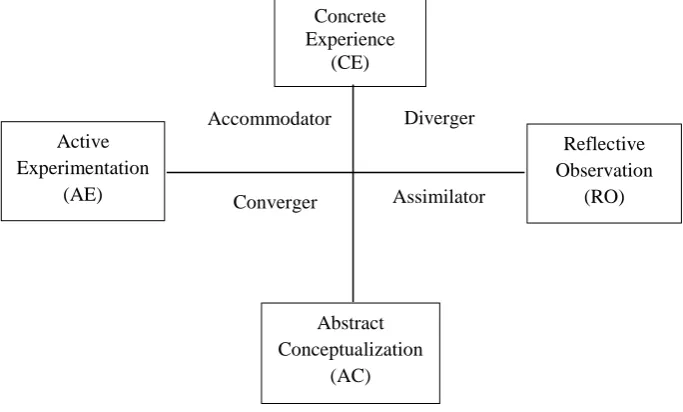
best in authority-directed and impersonal learning situations. Active Experimentation (AE) focuses on learning by doing. AE individuals are good at doing experimentation and learn best when they can actually experience learning process including group discussion and accomplish a work, or project. Reflective Observation (RO) is a learning mode of reflective and tentative learning approach. RO individuals tend to be introverts who rely heavily on thoughtful judgment and observation. They learn best from lecture styles of learning situations.
Figure 1. Kolb’s Learning Styles
Consequently, the following brief description of four basic learning styles is based on four modes (Kolb 1985).
Convergers are characterized by AC and AE. They are
good at problem solving using deductive reasoning. Divergers are characterized by CE and RO which has
the opposite strengths of the convergers. They are good at brainstorming with their imaginative ability.
Assimilators are characterized by AC and RO. They are good at planning theoretical models using inductive reasoning. They are less interested in people as the convergers.
Accommodator Diverger
Converger Assimilator Concrete
Experience (CE)
Active Experimentation
(AE)
Reflective Observation
(RO)
Abstract Conceptualization
Accommodators are characterized by CE and AE which has the opposite strengths of the assimilators. They are good at actively planning things and learn best from trials and errors, relying heavily on other people for information.
Purpose of the Study & Research Questions
This study explores how students’ learning styles influence students’ learning satisfaction with two different e-learning instruction methods. The instruction methods include interactive learning environment adapting Web 3.0 apps which students use in their daily social life and e-campus Web system which the school have been used for years.
(1) Does learning style significantly impact user interface satisfaction?
(2) Does instruction method significantly impact user interface satisfaction?
Method
Participants
This study was implemented at one of the vocational colleges in central Taiwan. The participants (n= 112) first-year full-time undergraduate students enrolled in two Tourism English courses were targeted for the study without any sampling. Among 112 students, 102 students completed the questionnaires, yielding a response rate of 91.07%. Of the 2 classes, 50 out of 59 (49.02%) students participated in class A, whereas 52 out of 53 (50.98%) of the class B student participated. Therefore, there was no significant difference between the groups in terms of the participation rate.
Instrument
The overall instrument consisted of three sections: demographics (gender and age), learning style, and user interface satisfaction.
styles developed by Kolb (1985). Kolb’s LSI has been the most commonly used for assessing students’ learning styles (Gurpinar et al. 2010; Klein et al. 2007). This section consists of 12 items asking about the students’ learning preferences. The Cronbach’s α value of reliability in each learning dimension ranged from .65 to .83. The internal consistency reliability alphas were .65 for diverger, .83 for assimilator, .80 for accommodator, and .74 for the converger category.
User interface satisfaction measure. The author modified the Questionnaire for User Interface Satisfaction that was developed by Lund (2001). This section consists of 14 items with a 5-point Likert-type scale asking about aspects of the learning satisfaction over the human-computer interface, including satisfaction (α= .82), usefulness (α= .75), ease of use (α= .90), and ease of learning (α= .71). The overall internal consistency reliability of this measure was high (α= .81).
Procedures
At the end of the semester, the questionnaires were distributed to the participants. Dependent variable was user satisfaction in both traditional and Web 3.0 instruction groups. Independent variables were 4 types of learning styles.
Results
Participant Characteristics
One hundred and two undergraduate students participated in this study, with the mean age of 17.8 years old, 79% female and 21% male. Table 1 shows a summary of learning styles. The majority of the students were divergers (44%) and assimilators (38%). The results of ANOVA indicate that there is no significant differences (p= .05) between the mean ages of the four learning styles of the groups.
Table 1. Participant characteristics
Learning Style Gender Total
Male Female
Converger 2 6 8%
Diverger 8 37 44%
Assimilator 9 30 38%
Accommodator 2 8 10%
Learning styles with user satisfaction
Research question 1: Does learning style significantly impact user interface satisfaction?
Table 2. Participants’ learning styles versus learning satisfaction in the different instruction groups (n= 102)
Diverger Assimilator Converger Accommodator
Trad. Inst. Mean
SD 3.11 .58 3.13 .60 3.34 .48 3.82 .76 Web 3.0 Inst.
Mean
SD 4.37 .41 4.20 .59 4.24 .50 4.23 .44
Analysis -8.42* 5.89 9.65 -2.01
P-Value .000 .118 .223 .03
* t-value is significant at the .05 level (2-tailed)
User satisfaction with different instructions
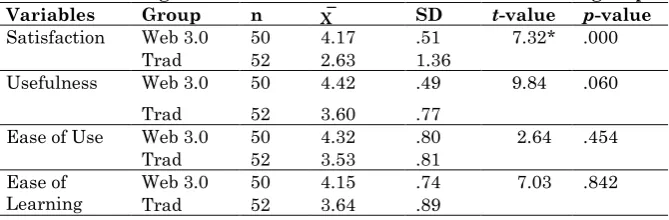
Research question 2: Does instruction method significantly impact user interface satisfaction? One-way repeated measures ANOVA model was conducted for these analyses. The user satisfaction scores in the Web 3.0 instruction group were significantly higher than those in the traditional instruction group (F(3,102)= 99.89, p< .001). In
particularly, subscale of usefulness with Web 3.0 instruction was rated as the highest mean score (Table 3). Sample statements of usefulness included “It makes the things I want to accomplish easier to get done.” (mean= 4.45), “It is useful.” (mean= 4.49). A statistically significant difference (t= 7.32, p= .000) was found for satisfaction between students in the traditional instruction group and students in the Web 3.0 instruction group.
Table 3. Learning satisfaction results between two instruction groups
Variables Group n χ̅ SD t-value p-value
Satisfaction Web 3.0 50 4.17 .51 7.32* .000
Trad 52 2.63 1.36
Usefulness Web 3.0 50 4.42 .49 9.84 .060
Trad 52 3.60 .77
Ease of Use Web 3.0 50 4.32 .80 2.64 .454
Trad 52 3.53 .81
Ease of
Learning Web 3.0 Trad 50 52 4.15 3.64 .74 .89 7.03 .842 * t-value is significant (α= .05)
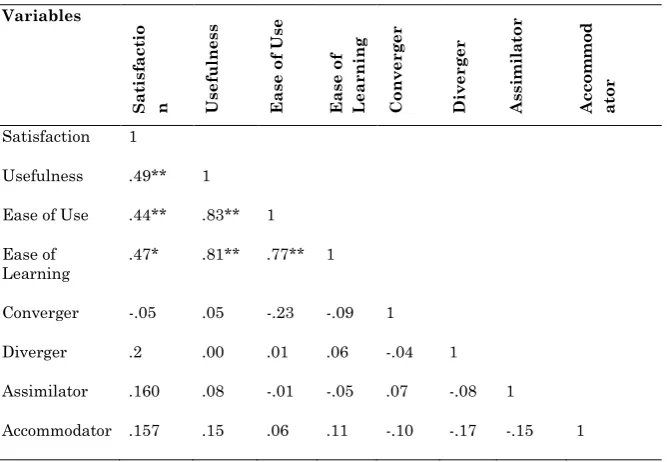
satisfaction sections in the traditional instruction group and the Web 3.0 instruction group, a correlation matrix test was conducted. The results did not find a statistical significant relationship between a student’s learning style and the scores for 4 subscales of user satisfaction, including satisfaction, usefulness, ease of use, and ease of learning, in the traditional instruction group (Table 4). However, There were significant moderate to very strong positive relationships among the subscales of user satisfaction ranged from .44 to .83 in Pearson’s r values at the .01 level.
Table 4. Correlations between learning styles and user satisfaction in the traditional instruction group (n= 52)
Variables S at is fact io n Us efu ln es s Ea se of Us e Ea se of L ear ni n g Conv er g er Di v er g er As si m il a tor Acc om m o d at o r
Satisfaction 1
Usefulness .49** 1
Ease of Use .44** .83** 1
Ease of Learning
.47* .81** .77** 1
Converger -.05 .05 -.23 -.09 1
Diverger .2 .00 .01 .06 -.04 1
Assimilator .160 .08 -.01 -.05 .07 -.08 1
Accommodator .157 .15 .06 .11 -.10 -.17 -.15 1
** correlation is significant at the .01 level (2-tailed)
Table 5. Correlations between learning styles and user satisfaction in the Web 3.0 instruction group (n= 50)
Variables S at is fact ion Us efu ln es s Ea se of Us e Ea se o f L ear ni n g Conv er g er Di v er g er As si m il a tor Acc om m o d a tor
Satisfaction 1
Usefulness .60** 1
Ease of Use .29** .56** 1 Ease of
Learning .41** .64** .56** 1
Converger .00 -.23 .06 -.13 1 Diverger .10 .04 .00 -.04 .20 1 Assimilator .03 .19 .07 .20 .16 -.26 1 Accommodator .18 .28 .32* .25 .00 .24 -.04 1 ** correlation is significant at the .01 level (2-tailed)
* correlation is significant at the .05 level (2-tailed)
Additional Findings
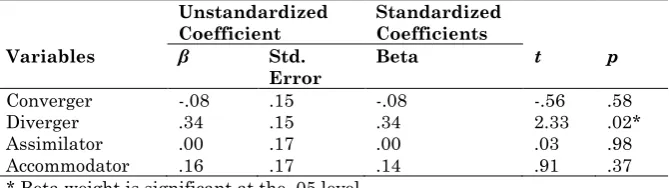
To further investigate the relationships between learning styles and user satisfaction in the Web 3.0 instruction group, a linear logistic regression analysis was conducted. The R2 value for this database was .05. This indicated that only 5%
Table 6. Multiple regression analysis in the Web 3.0 instruction group explaining User satisfaction
Unstandardized
Coefficient Standardized Coefficients
Variables β Std.
Error Beta t p
Converger -.08 .15 -.08 -.56 .58
Diverger .34 .15 .34 2.33 .02*
Assimilator .00 .17 .00 .03 .98
Accommodator .16 .17 .14 .91 .37
* Beta weight is significant at the .05 level
Discussion
The results found that most of the students were groups of diverger and assimilating learning styles which was consistent with previous studies (Gurpinar et al. 2010; Robinson 2002) and that diverger may predict learning satisfaction with mobile apps assisted instruction method. This study used Kolb’s LSI to assess students’ learning styles, the results indicated that most students in general shared very similar learning preferences to this study group. Based on the characteristics of these learning styles, it indicated that the diverger students are those who are interested in people. In the Web 3.0 instruction group, students were given a lot of possibilities to interact with one another to accomplish group projects and share knowledge through a variety of mobile apps. For this study, the reason that diverger was the significant factor predicting learning satisfaction in the Web 3.0 instruction group was a result of previously known definition of diverger. Based on the Kolb’s (2000) learning characteristics, diverger is characteristic of people from liberal arts background that was exactly similar to the sample group. In addition, divergers are characteristized by CE and RO (Kolb 2000). Therefore, part of the reasons that divergers was the significant factor in this current study was that students constantly interacted with one another through mobiles apps and consequently, they benefited from peer discussions (CE) and instructor’s lecture notes (RO).
satisfaction in current study. Students’ perceived user satisfaction with the traditional instruction in this study was not significantly related with any learning styles. In the Web 3.0 instruction group, accommodator learning style was the only factor to have a moderate relationship with ease of use. The reason behind this might be the fact that accommodator prefer to rely on information of others (Kolb 2000). Indeed, with the interaction with peers and instructor through a mobile apps assisted e-learning system, accommodator could gather handful resources from others as needed.
In addition, the results indicated students strongly agreed or agreed they were satisfaction with Web 3.0 instruction when they learned at school. Overall, students with Web 3.0 instruction were found to be more satisfied compared with students with traditional instruction. This finding is consistent with the previous study (Wang, Yu, & Wu 2013) that the students’ perceived learning satisfaction with the mobile apps assisted social e-learning environment was significantly higher than those with traditional instructional learning environment. In addition, the current study found that students’ satisfaction toward the Web 3.0 instruction can predict user satisfaction as the studies (Baroudi, Olson, & Ives 1986; Fisbein & Ajzen 1975; Fredericksen et al. 2000; Marks, Sibley & Arbaugh 2005) suggest that satisfaction leads to usage as the successful instruction (Delone & McLean 1992).
Diverger was the only factor that can predict user satisfaction in the Web 3.0 instruction group. However, only 5% of the user satisfaction was explained by the overall learning styles. In the literature, there is no study conducting the relationship between learning styles and mobile apps assisted instruction method. However, Loo (2004) studied the relationship between learning styles and learning preferences and found that the relationship between these two was weak. It is possible to conclude that learning styles did not greatly influence user satisfaction in an e-learning environment.
satisfaction was weak. However, the suggestions that satisfaction leads to user satisfaction (Baroudi, Olson, Ives 1986; Fisbein & Ajzen 1975; Fredericksen et al. 2000; Marks, Sibley & Arbaugh 2005) and user satisfaction leads to effective instruction (DeLone & McLean 1992) were affirmed. Therefore, educators should focus on how to design an interface that will be used by students, implement teaching and learning tools that most students are actively engaged with in their classrooms. Considering the fact that the students are already in their Web 3.0 era, the current study suggests that as an educator, he/she should plan and implement Education 3.0 in his/her classroom. It is important to consider learning environments merging students’ social and academic lives to maximize their learning.
Limitations
This study has several limitations. The first is the sample which could negatively affect the internal validity. This study was restricted to the liberal art majored students at a vocational college during one semester. As such, the sample was very homogeneous and may not be able to generalize to all the college students. To be able to extrapolate further, similar researches could be conducted in different majors of students, involving different backgrounds. Another limitation was the variables. The results were merely based on the standard quantitative instrument which was self-reports. To be able to more effectively generalize the findings, further research with alternative analysis is needed, such as interview with students and in-class observation. A final limitation is the students’ and instructors’ computer skills. The findings of this study are limited by their abilities to access to the Internet with their prior knowledge of computer skills.
BIBLIOGRAPHY:
DeLone, W.H., and E.R. McLean. 1992. “Information systems success: The quest for the dependent variable.” Information Systems Research 3(1): 60-95.
Facebook (2013, March). Statistics (Online). http://newsroom.fb.com/Key-Facts
Fishbein, M., and I. Ajzen. 1975. Belief, Attitude, Intention, and Behavior: An introduction to theory and research. MA: Reading.
Fredericksen, E., A. Pickett, P. Shea, W. Pelz, and K. Swan. 2000. “Student satisfaction and perceived learning with on-line courses: Principles and examples from the SUNY
Learning Network.” Journal of Asynchronous Learning
Networks 4(2)
http://www.sloanc.org/publications/jaln/v4n2/v4n2_fredericksen. asp
Gerstein, J. 2013. Education 3.0 and the pedagogy (andragogy, heutagogy) of mobile learning. User Generated
Education. Available online:
http://usergeneratededucation.wordpress.com/2013/03/22/school s-are-doing-education-1-0-talking-about-doing-education-2-0-when-they-should-be-planning-education-3-0/
Gurpinar, E., M.K. Alimoglu, S.Mamakli, M.Aktekin. 2010. “Can learning style predict student satisfaction with different instruction methods and academic achievement in medical education?” Advances in Physiology Education 34: 192-196.
Hung, W., J.H. Bailey, and D. H. Jonassen. 2003. “Exploring the tensions of problem-based learning: Insights from research.” New Directions for Teaching and Learning 95: 13-23.
Klein, B., L. McCall, D. Austin, L.Piterman. 2007. “A psychometric evaluation of the learning styles questionnaire: 40-item version.” British Journal of Educational Technology 38: 23-32.
Kolb, D. 1985. Learning Style Inventory. Boston. MA: McBer.
Loo, R. 2004. “Kolb’s learning styles and learning preferences: Is there a linkage?” Educational Psychology 24: 99-108.
Lund, A.M. 2001. “Measuring usability with the USE Questionnaire.” STC Usability SIG Newsletter 8: 2.
Marks, R., S. Sibley, and J. B. Arbaugh. 2005. “A structural equation model on predictors for effective online learning.” Journal of Management Education 29(4): 531-563.
Nay, J. 2013, January 19. “Line games surpasses 150 million downloads, 50 million added in the last 90 days.” Available Online: http://www.trutower.com/2013/06/24/line-app-games-number-of-downloads/
Robinson, G. 2002. “Do general practioners’ risk-taking propensities and learning styles influence their continuing medical education preferences?” Med Tech 24: 71-78.