
TECHNICAL UNIVERSITY OF CLUJ-NAPOCA
ACTA TECHNICA NAPOCENSIS
Series: Applied Mathematics, Mechanics, and Engineering Vol. 61, Issue Special, September, 2018
MANAGING COMPLEXITY IN LARGE-SCALE BUSINESS PROJECTS.
A THEORETICAL MODEL
Frank RENNUNG, Daniel PASCHEK, Corina Monica DUFOUR, Anca DRAGHICI
Abstract: Mastering the complexity is a mission critical action of the future. Due to the actuality of the project Industry 4.0, no concrete methods and tools exist in organizational practice. The model with use cases and the potential applications of the Balanced Scorecard model are the only approaches described (from the theoretical perspective) in the literature. The main objective of the research is to present the design approach of a holistic complexity management model for usage in a large-scale business environment (the case of the information technology services outsourcing projects). The proposed model is highly interdisciplinary and it is based on a knowledge and wisdom base generating by previous researches in different fields and sciences. After the presentation of the research results achieved by the investigation of the further scientific disciplines which are relevant for being considered for complexity management in large-volume business situations there will be described the most important aspects (the criteria and tools developed) of the model definition. Finally, some conclusions and remarks will create the complete view of the research and the possibility of the practical exploitation of it.
Keywords: Complexity, management, outsourcing, big projects, Balanced Scorecard.
1. INTRODUCTION
Outsourcing is a relevant and important sourcing strategy. According to the report “2nd
quarter 2014 EMEA (Europe, Middle East and Africa Area) ISG Outsourcing Index” of the ISG (Information Services Group), outsourcing activities in EMEA have reached a record high in the first half of the year. ISG is a provider of technology information, market research information and consulting services [1]. Such big projects need a common organizational project and program structure [2]. Major causes of increasing complexity are, among some others, strategic alliances, and outsourcing to third parties [3].
Managing complexity is the central challenge of our time [4]. The socio-political and global economic context push companies operating in the service industry in extraordinary challenges: globalization, penetration of new technologies, more dynamic product life cycles. Resource scarcity, demographic change, climate change and energy transition are only some selected
megatrends that affect the company as external factors and the companies need to position their strategies [5]. Due to the existing and further increasing global networking in economic, political and social areas complexity is, more than ever, an essential success factor for organizations [6]. Due to the ongoing globalization, companies need to deal more than ever with new markets, competitors, and individual customer needs to remain on the market in the long term. In addition to the market requirements, the company must manage ever-changing needs of internal and external customers, for example because of new information and telecommunications technologies. Within a short time, the volume of business-related complexity has steadily increased and a large part of the company has evolved from a complicated to a complex system [6].
programmes and portfolios” [7, p. 3]. “Future research should continue to investigate how to mitigate or manage the operational day-to-day uncertainties with the long-term strategy of a company [...]. There is also a need for more research into what alternative strategies are available” [8].
Within the framework of research, it will be examined how complexity can be managed in the service sector (in the case of large-scale projects), if the external factors take over a dominant character. In an outsourcing situation, services (based on the contractual agreement) must be designed at the customer interface and must be integrated and adapted to the internal processes of the service provider. Furthermore, a model for business complexity management that can be used in large-scale environment, e.g. outsourcing project, will be designed and presented systematically. In the final part of this article, will be described the premises of the proposed model practical exploitation and utility.
2. RESEARCH PROBLEM DEFINITION AND CHARACTERIZATION
In the following there will be investigated further scientific disciplines (as knowledge and wisdom resources) which are relevant for being considered for complexity management in large-volume business situations. Partially, only particular aspects will be presented, in terms of research results and findings. Cross-disciplinary research could be of particular relevance for the managing complexity approach [9]. The different disciplines convergent on this topic are structured by considering their relevant issues and aspects and they are not illustrated sorted by time [10].
The most important conclusion of the other scientific disciplines analysis is the finding that other disciplines could support with additional knowledge the research in the field of complexity management in business situations. First reasons for this is that the pure complexity models are often very mechanically oriented and they reflect, only to a limited extent, their use in a business situation. Furthermore, the preparation for their applicability is lacking in
practice (for example, by lack of concrete implementation concepts, as well as the strategic future-oriented character). In addition, it has been observed that the theme (approach and methodologies) of complexity is established more strongly in some disciplines (e.g. in the case of process management and strategic management) and in some other disciplines it is scientifically very little developed (e.g. contract management). Furthermore, it can be pointed out that some criteria for complexity management success across all disciplines are nearly equally assessed, for example, the importance of stakeholders [10].
Service Provisioning Management: The essential feature of the external factor in the service provisioning discipline is essential for this research, due to the nature of the closed relationship between the customer and the provider, and the course of an outsourcing project (first phase transition and second phase transformation, and then to provide the future mode of operation in outsourcing). In high-volume international outsourcing projects, these first two phases generally, last for several years. In designing the proposed complexity model, this aspect will be incorporated decisively. The service evaluation model by [11] significantly considered the external factor, which has a dominant character in outsourcing situations. An evaluation scheme for each dimension and criteria is seen as necessary in the research. Therefore, certain framework conditions must be observed in the evaluation, for example, a clear and understandable definition of the dimensions and criteria.
Furthermore, the adopted assumption model consider that the complexities are all known and can be assessed [10]. A very convenient form for the outsourcing situations is the logic of analyzing the service delivery at different levels and displays.
lines (e.g. line of visibility), which are used by [12] must be supplemented. The use of a Balanced Scorecard for the services evaluation (proposed by [13]) is suitable in outsourcing projects; even here, the dimensions need to be adjusted to the situation.
Customer Integration and Customer
Relationship Management: In particular, the role as substitutes for leadership in outsourcing situations is of great significance within employee’s transition. The background is that key players in the service provider organization are often former executives of the customer organization, who have changed their employment, as part of the new outsourcing contract. These employees are called transferees.
Due to the strong technological, organizational and process integration of the outsourcing relationships, it must be considered in the architectural design of services, that the customer organization will take various roles, such as a services co-producer or co-designer. This is the link of the external factor of the service provisioning discipline [10].
Network Management: An offshoot of service management has existed for years in this field and it is called Service Networks. Network Thinking in combination with a cause and effect analysis are increasingly used as potential methods for the analysis and presentation of complexities [10].
(Strategic) Management has to refer to complexity management [14]. As concrete tools, researchers resort to a parallel research discipline Service Networks. Their proposed procedure allows the derivation and operationalization from the top strategy. In this context, measures can be initiated on the different management levels. In [15], authors understand complexity and management as a justification and a reasoning for the need of management itself and emphasizes that it is not possible to detect the dynamic environment of a company or of a project. This is a fundamentally different approach in comparison to other approaches to complexity management, and it is based on the target to control and manage complexity. Strategic management approaches should be
supplemented by existing complexity management methods [14]. The associated measures are derived from the corporate strategy. In addition, influencing and not influencing the dynamics of the company’s environment must be considered. In this approach, similar as with other approaches of strategic management, it is of great importance, that the stakeholders are taken into consideration. Specific tools, such as the Balanced Scorecard and sensitivity analyses or the X-matrix, support the strategic management in dealing with uncertainties and complexities [10].
Project Management: Agile approach methodology was extended to the holistic view of project management field. An important advantage of this step by step approach is that it can be entered directly to changing environmental conditions and the overall complexity can be partitioned into several individual packages. Furthermore, it should be emphasized that even in this approach, the stakeholder management has a significant role.
Process Management: An essential element of the process management discipline is the analysis of the main processes, as a collection of sub-processes or the synthesis of partial processes in core processes. From this perspective, a branch of the process management is linked to the network (see the Coefficient of Network Complexity). Some research also concentrates on the integration of an external factor in the field of service provision management. In the outsourcing situations this is of great importance because the third party provider must be integrated and often additional parties are involved in this situation. The process model described by [16] is very applicable to be used in outsourcing, from a process management perspective, because it includes the process integration and process consolidation, during a transition and transformation phase of the outsourcing project development. Another reason for considered process management of great importance is the large number of stakeholders that are service provider in an outsourcing project.
proved that there is currently no scientific status on how complexity can be contractually established in a customer-service provider relationship. There are some counsellors in the scientific and practice-oriented literature [17] on how contracts must be designed, but the theme of complexity management is not always included. Due to the highly interdisciplinary nature of complexity management, only the importance is listed or emphasized; concrete implementation concepts are far less pronounced.
3. OTHER PERSPECTIVES OF
BUILDING SUSTAINABILITY
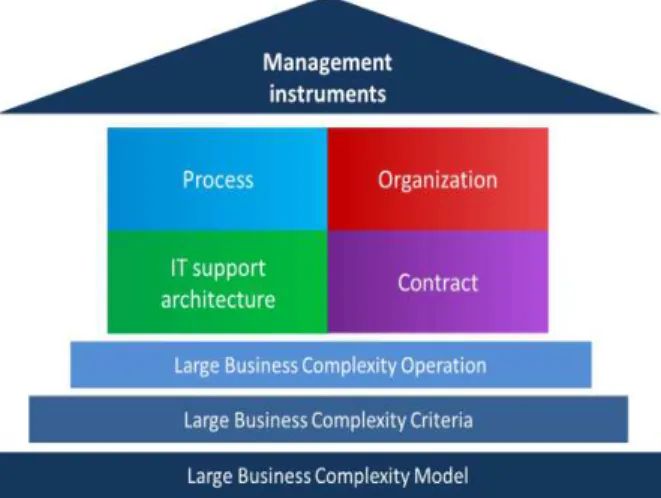
In the following paragraph, the proposed holistic large business complexity management, so called the House of Large Business Complexity Management (Figure 1, [10]). It indicates all relationships that are relevant in a large-scale business project (e.g., outsourcing projects). In this case, the various phases of the project and the on-going operations and the different perspectives of the parties are taken into account. The Large Business Complexity Management Model provides the framework for the other elements of the House of Large Business Complexity. The Complexity Criteria (ComMC) supports the evaluation process in the project phases and for on-going operations. These are based on the current scientific state, adapted to the scope of this research. At this level, an assessment model, defined based on the ComMC, is applied.
Fig. 1. House of Large Business Complexity Management
Table 1. Complexity drivers for large-scale projects (adapted
from [6])
Complexity drivers Result View Cluster Criteria rf
E xt er na l c om pl ex it y dr iv er s Society
complexity environmental factors Economic and 3
Demand complexity
Diversity of customer 5 requirements
Individuality of the
demand 5
Market dynamics 3
Procurement complexity
No. of suppliers 4 Procurement
strategy and concept 5 Fluctuations in
demand 5
Uncertainty of the
delivery or quality 5
In te rn al c om pl ex it y dr iv er s Target complexity
No. of tracked targets
in 4
parallel Dynamics of the target
adjustment 5 Costumer structure complexity Heterogeneity of 3 customers and
customer groups
Level of participation 4 Product and
product program complexity
Structure of products 4 Dynamics of the
product changes 3
Process complexity
No. of interfaces and 5 design
Degree of crosslinking of the processes 5
Standardization
degree 5
Organization complexity
No. of hierarchy levels 5 Centralization degree 5
No. of
organizational units 4
Structure complexity
No. of distribution
levels 4
No. of stock, staff, 5 equipment, ...
Communication
systems 4
Vertical integration 5 Structure of
complexity drivers Result
Planning and
steering complexity Frequency and level of detail of the management and
control area
3
# Evaluation description for the analysis 0 The criteria are not relevant for the application in
large business situations, like IT Outsourcing projects.
1 The criteria have an implication to the scope of this research, but are very weak, indirect and partly relevant.
2 The criteria are relevant for the scope of this research, but are weak, indirect or partly relevant. 3 The criteria could be important for the application
in large business situations, like IT Outsourcing projects; the effects depend on specific environmental aspects, e.g. customer and contract-based aspects.
4 The criteria are important for the application in large business situations, like IT Outsourcing projects and the effects are direct and strong. 5 The criteria are of greatest importance for the
application in large business situations, like IT Outsourcing projects.
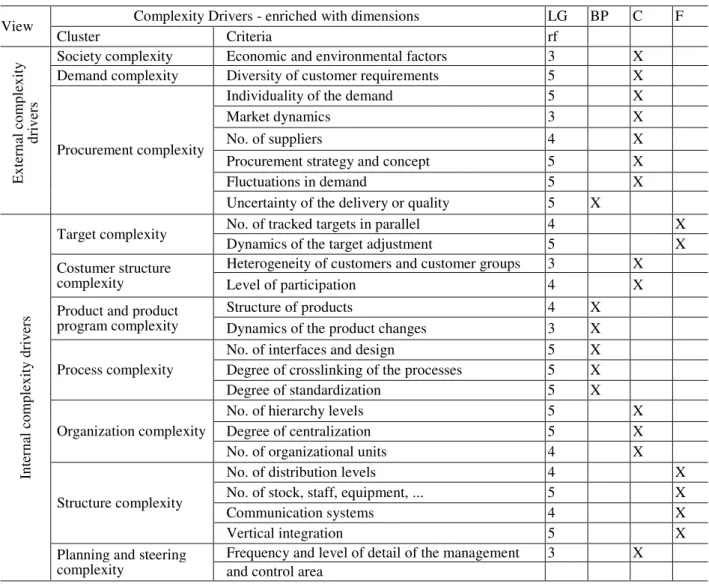
The explanations for the theoretical construct Complexity Criteria are (Table 2) [10] are: (1). The rf = relevance factor is the evaluation, based on the results of the previous research (evaluation of the use case: large business environment as outsourcing projects [10]); (2). The result of the analysis mirrored and continued the research state in this approach; in the following steps, only criteria will be considered with a value from 3 to 5 and they will be specified in the next step. The logic for the criteria hierarchy establishment, which were assessed with a value of 1 and 2, supports the objective to enable a practical application (see also 80/20 rule); (3). The internal and external perspectives, both of the customer’s and the service provider's point of view, are used in the derivation of the complexity and development model. The reason for this is that all potential effects should be considered [10].
In the second design step, first the evaluation dimensions (based on Balanced Scorecard logic) are defined and then they are mapped based on the previously results obtained. The result tool is named: Complexity Management Balance Scorecard (ComMBSC) and the four
dimensions were adapted for the research context (Table 3).
Table 3. Definition of the perspectives for ComMBSC
# Perspectives / dimensions - Short definitions of the perspectives for large-scale projects
1
Learning & Growth (LG) - reflect the maturity of the establishment and on-going development of complexity management (in the organization of the contractor).
2 Business Process (BP) - evaluate the complexity aspects of business processes, for each contractor. 3 Customer (C) – refers to the complexity which is
caused by the customer project itself.
4 Financial (F) - evaluate the maturity level of efficiency of complexity management (for contractor organization) to achieve the targets.
In next step, the dimensions are assigned to the selected complexity criteria. A unique defined table of values for the monthly review supports, operatively and simply the action (Figure 2, as an Excel tool for the operationalization of the proposed model implementation). With the initial joint determination of the values as shown in Table 4, the uniform value patterns between the parties are calculated. The reference point of each criteria factors, which have been considered, is always 1.
The procedure to collect and evaluate the data is described in detail in [10]. The content of the value table for monthly assessment must be defined by negotiation between the participating organizations. By this negotiation, the involved organizations must create a common understanding of each criteria. In the case of the value 1 for a criterion there is considered an insufficient support of this complexity criteria, while reached value 5 represents an over-achievement. The common agreement about each of the target values must be on an optimum cost-benefit level. In calculating this optimum level, two aspects must be taken into consideration: (1) the effects of this measure on the special business situation complexity; (2) the effects of this complexity on the fulfilment of the business needs of the organizations.
Table 4. Complexity drivers for large-scale projects, with dimensions
View Complexity Drivers - enriched with dimensions LG BP C F
Cluster Criteria rf
E
xt
er
na
l c
om
pl
ex
it
y
dr
iv
er
s
Society complexity Economic and environmental factors 3 X Demand complexity Diversity of customer requirements 5 X
Procurement complexity
Individuality of the demand 5 X
Market dynamics 3 X
No. of suppliers 4 X
Procurement strategy and concept 5 X
Fluctuations in demand 5 X
Uncertainty of the delivery or quality 5 X
In
te
rn
al
c
om
pl
ex
it
y
dr
iv
er
s
Target complexity No. of tracked targets in parallel 4 X
Dynamics of the target adjustment 5 X
Costumer structure complexity
Heterogeneity of customers and customer groups 3 X
Level of participation 4 X
Product and product program complexity
Structure of products 4 X
Dynamics of the product changes 3 X Process complexity
No. of interfaces and design 5 X Degree of crosslinking of the processes 5 X
Degree of standardization 5 X
Organization complexity
No. of hierarchy levels 5 X
Degree of centralization 5 X
No. of organizational units 4 X
Structure complexity
No. of distribution levels 4 X
No. of stock, staff, equipment, ... 5 X
Communication systems 4 X
Vertical integration 5 X
Planning and steering complexity
Frequency and level of detail of the management 3 X and control area
The dimension Learning & Growth (L&G) criteria supports the operational phase of the complexity management. This dimension is the basis for the management tool design for control and management by complex criteria [10]. Explanations on the Complexity Management Balanced Scorecard logic (related to Figure 2) are briefly summarized in the following:
• In the column criteria, the agreed criteria for
the respective dimensions are formulated;
• In the column target value, the desired target
values are defined;
• The monthly delivery results are assigned to
the values clusters in the value table (yellow columns);
• The value, which is nearest to the intended
values in the value table, is used;
• The result of this is entered in the column
current assessment and produces value: ca;
• The value of ca is multiplied with the
relevance factor = weighting factor (rf);
• The result is calculated and presented in the
column of criteria current value in results;
• The criteria and the target values are to be
designed so that the target value is 1; this means that at 100% target achievement: rf = criteria current value;
• The reference value corresponds to the
relevance factor = weighting factor (rf);
• All individual results are added;
• The Monthly Complexity Index (mCI) is the
summation of all criteria current values. This value can be compared with the target value (summing all reference values). The mathematical formula of the Monthly Complexity Index (mCI) is:
Fig. 2. Complexity Management Balance Scorecard (ComMBSC) developed with Excel software [10]
Fig. 3. Business Complexity Management approach in IT Outsourcing projects [10]
The designed management tools support the status of complexities transparency. Furthermore, these help to identify appropriate measures to operationalize and to monitor their implementation in the participating organizations. The instruments support the application at the interface between customer
and service provider and are described in detail in [10]. The tools created for the complexity management are:
• Complexity management criteria
success-critical complexity relevant criteria between the involved parties. These criteria are the basis for the further tools development;
• Complexity Management Balance
Scorecard Balance (ComMBSCB) - The target of this too is to create an annual overview evaluation of the complexities for the involved parties top management;
• Complexity Management Balance
Scorecard (ComMBSC) - It is the monthly measure management tool, designed to control the achievement of the defined complexity criteria. This ComMBSC tool is the basis for the Complexity Management Balanced Scorecard Balance (ComMBSCB);
• Complexity Management Measures list
(ComMMeasures list) - The target of the measures list is to manage identified measures, to ensure transparency regarding the progress and the effectiveness and to control and monitor the implementation;
• Complexity Management
Communication (ComMCom) - The scope of this tool is to continue inform the stakeholders from the involved parties about complexity relevant aspects;
• Complexity Management Stakeholder
Analysis (ComMStA) - The objective of the stakeholder analysis is to identify, maintain and integrate their involvement for complexity relevant topics, to ensure that their interests are adequately considered and satisfy;
• Complexity Management Audits and
Review (ComMAR) – The aim of this tool is to ensure an external and independent review process of the complexity management system.
Because of research focus limitation, only the complexity-specific tools have been defined and described in detail [10]. The schema in Figure 3 shows a completed overview of the Business Complexity Management Model (Large Scale Business
Complexity Management Model), with different strategy components.
4. CONCLUSION
The Large Business Complexity Management Model completes previous complexity models described in the literature, which mainly focused on the criteria development. The proposed model’s link with traditional management tools enables active management and control of existing complexities in a business environment. Based on the literature review, complexity criteria were adapted to the focus of the research context (large-scale outsourcing projects in IT sector) and were elaborated specific bundles of weights for the practical exploitation of the model. The developed associated tools for complexity management allow a holistic approach between the organizational units involved in an outsourcing large project and they have been concretely defined and described. From the research conclusions point of view, through an explicit contractual additional regulation of complexity management, there is recommended that the activities related to the out-sourcing processes to be legitimized and thus become an integral part of the contract. The consideration of dimensions’ complexities ensures a holistic, but also differentiated view on complexities issues. In the modelling of the House of Large Business Complexity Management, the previous state of research is considered diverse; this state of research has been enriched with knowledge and wisdom from other disciplines. Thus the interdisciplinary approach and the elaborated model have been proved.
6. REFERENCES
[1] Schuster, H., Schuster, H., IT-Outsourcing erreicht Rekordhoch, (2014). Retrieved from: http://www.it-business.de/marktforschung/studien /articles/455608/ (Access 07 June 2018).
(pp. 163-202). Wiesbaden: Springer Fachmedien, (2014).
[3] Castellano, W., Practices for Engaging the 21st Century Workforce: Challenges
of Talent Management in a Changing Workplace. New Jersey, NJ, Pearson FT Press, (2014). [4] Jischa, M., Management trotz Nichtwissen.
In: Gleich, A., Gössling-Reisemann, S. (Eds.), Industrial Ecology: Erfolgreiche Wege zu nachhaltigen industriellen Systemen (pp. 271-283), Wiesbaden: Vieweg-Teubner Verlag, (2008).
[5] Spath, D. (ed.), Ganschar, O., Gerlach, S., Hämmerle, M., Krause, T., Schlund, S., Produktionsarbeit der Zukunft – Industrie 4.0. Retrieved from Fraunhofer Institut für Arbeitswirtschaft und Organisation, IAO website, (2013).
[6] Schoeneberg, K.-P. Komplexitätsmanagement in Unternehmen: Herausforderungen im Umgang mit Dynamik, Unsicherheit und Komplexität Meistern. Wiesbaden, Springer Gabler Verlag, (2014).
[7] Oehmen, J., Thuesen, C., Ruiz, P.; Geraldi, J., Complexity Management for Projects, Programmes, and Portfolios: An Engineering Systems Perspective (PMI White Paper), (2015). Retrieved from: http://orbit.dtu.dk/ws/files/1085862 58/Complexity_Management.pdf (Access 07 June 2018).
[8] Nordigarden, D., Rehme, J., Chicksand, D.,Sourcing Uncertainties: The Case of Outsourcing and Global Sourcing, Modern Management Science & Engineering, Vol. 3, No. 1, pp. 1-21, (2015).
[9] Veldman, J., Alblas, A., Managing design variety, process variety and engineering change: a case study of two capital good firms. Research in Engineering Design, Vol. 23, No. 4, pp. 269-290, (2012).
[10]Rennung, F.M., Managing Complexity in
Service Processes. The Case of Large Business Organizations, PhD Thesis, Politehnica Unviersty of Timisoara, (2016).
[11]Rieck, A., Qualitätsprüfung komplexer Dienstleistungen - Ein ergebnisorientierter und kennzahlenbasierter Ansatz, Wiesbaden, Gabler Verlag Springer Fachmedien Wiesbaden GmbH, (2011).
[12]Thomas, O., Nüttgens, M., Dienstleistungsmodellierung 2010 -Interdisziplinäre Konzepte und Anwendungsszenarien, Berlin, Heidelberg: Springer Verlag, (2010).
[13]Haller,S.
Dienstleistungsmanagement:Grundl agen - Konzepte – Instrumente (6th
edition). Wiesbaden: Springer Gabler Verlag, (2015).
[14]Probst, G., Wiedemann, C., Strategie-Leitfaden für die Praxis, Wiesbaden: Springer Fachmedien Verlag, (2013).
[15]Niermann, P., Schmutte, A., Exzellente Managemententscheidungen,
Methoden,
Handlungsempfehlungen, Best Practices, Wiesbaden: Springer Fachmedien, (2014).
[16]Fettke, P., Integration von Prozessmodellen im Grossen: Konzept, Implementierung und experimentelle Anwendungen, In: Thomas. O.; Teuteberg, F. (Eds.): Proceedings der 12. Internationalen Tagung Wirtschaftsinformatik (WI 2015), pp. 453-467, (2015).
[17]Sobbing, T., Handbuch IT-Outsourcing: Recht, Strategie, Prozesse, IT, Steuern samt Business Process Outsourcing (4th edition), Heidelberg: C.F. Müller Verlag, (2014).
MANAGEMENTUL COMPLEXITĂŢII ÎN PROIECTE DE AFACERI MARI.
UN MODEL TEORETIC
Abstract: Stăpânirea complexității este o acțiune critică a viitorului. Datorită actualității proiectului Industry 4.0, în
practica organizațională nu există metode și instrumente concrete pentru abordarea complexuității. Modelul pe baza
cazurilor de utilizare și aplicațiile potențiale ale modelului Balanced Scorecard sunt singurele abordări descrise (din
perspectiva teoretică) în literatură. Obiectivul principal al prezentei cercetării este de a prezenta concepția unei abordări
a unui model holistic de management al complexității pentru utilizarea sa într-un mediu de afaceri la scară largă (cazul
proiectelor de outsourcing dedeciate serviciilor IT). Modelul propus este interdisciplinar și se bazează pe o bază de
cunoaștere și înțelepciune generată de cercetări anterioare în diferite domenii și științe. După prezentarea rezultatelor
cercetării realizate asupra disciplinelor științifice care sunt relevante pentru a fi luate în considerare pentru
managementul complexității în situații de afaceri de volum mare vor fi descrise cele mai importante aspecte (criteriile și
mijloacele dezvoltate) de definiție a modelului. În final, concluziile și observațiile elaborate vor crea viziunea completă
a cercetării și posibilitatea exploatării practice a modelului propus.
Frank RENNUNG, T-System Frankfurt, Hahnstraße 43, 60528 Frankfurt am Main, Germania, [email protected]
Daniel PASCHEK, Politehnica University of Timisoara, Faculty of Management in Production and Transportation, 14 Remus str. 3001919 Timisoara, Romania, [email protected]
Corina Monica DUFOUR, Politehnica University of Timisoara, Faculty of Management in Production and Transportation, 14 Remus str. 3001919 Timisoara, Romania, [email protected]
![Fig. 3. Business Complexity Management approach in IT Outsourcing projects [10]](https://thumb-us.123doks.com/thumbv2/123dok_us/7996870.2120464/7.892.124.769.619.987/fig-business-complexity-management-approach-outsourcing-projects.webp)
