© 2015, IJCSMC All Rights Reserved 293 Available Online atwww.ijcsmc.com
International Journal of Computer Science and Mobile Computing
A Monthly Journal of Computer Science and Information Technology
ISSN 2320–088X
IJCSMC, Vol. 4, Issue. 3, March 2015, pg.293 – 300
RESEARCH ARTICLE
COMPUTER CURSOR CONTROL MECHANISM BY
USING HAND GESTURE RECOGNITION
Kalyani Pendke
1, Prasanna Khuje
2, Smita Narnaware
3, Shweta Thool
4, Sachin Nimje
51
Lecturer, Department of CSE, Rajiv Gadhi College Of Engineering, Nagpur, RTM Nagpur University, India
2,3,4,5Department of Computer Science & Engineering RTM Nagpur University, India
3
4
ABSTRACT— Today Human Computer Interaction is an interface with which we can virtually interact with the systems with an ease. Here we are trying to perform the operations of mouse using hand gesture recognition. The project mainly aims at mouse cursor movements and click events based on skin detection technique. It is a cost effective real time working system.
Keywords— Human Computer Interaction (HCI), Hand gestures, Webcam, Graphical User Interface, Application Programming Interface (API)
I. INTRODUCTION
The importance of computers has increased to a great extent these days. Then it can be used for general purpose or at work places. Even there is a demand of more and more application based devices, where the latest example can be of smart phones. Traditionally, we use hardware devices i.e. the mouse and keyboard to interact with the system. But due to the growth of technology and demand of virtualization, this technique has been proposed. An alternative way for touch screen can be creation of a virtual human computer interactive device.
© 2015, IJCSMC All Rights Reserved 294
keyboard, it is not possible to reduce the entire keyboard in a very small size so that it can accommodate the fingers. Thus it becomes somewhat difficulty while working where accuracy is needed [1].
Gestures: Gesture is defined as an expressive, meaningful body motion that expresses an idea, opinion, emotion,
etc. Human interaction with a computer in which human gestures, usually hand motions, are recognized by the computer.
Gesture recognition is used to interact with computers, such as interpreting sign language [2].The hand gesture recognition technique can be classified into two types: 3D-hand model approach and the appearance based approach.
A static gesture is observed at the sudden burst of time whereas a dynamic gesture is intended to change over a period of time. A waving hand means goodbye is an example of dynamic gesture and the stop sign is an example of static gesture. To understand a full message, it is necessary to interpret all the static and dynamic gestures over a period of time. This complex process is called gesture recognition.
II. LITERATURE SURVEY
Literature Review
The main goal of gesture recognition research is creation of a system that can identify specific human hand gestures and use them to convey information or for device control as well as applications control. Hand Gesture Recognition System is a branch of Human Computer Interaction in which Human hand gestures are recognized by the computer system and then perform pre-defined task as per the application for controlling software as well as hardware.
A. Sixth Sense Technology:
‘Sixth Sense' is a wearable gestural interface that augments the physical world around us with digital information and lets us use natural hand gestures to interact with that information. The hardware components are coupled in a pendant like mobile wearable device. Both the projector and the camera are
connected to the mobile computing device in the users pocket. The projector projects visual information enabling surfaces, walls and physical objects around us to be used as interfaces; while the camera recognizes and
tracks user's hand gestures and physical objects using computer-vision based techniques [3].
They required coloured caps on fingers while operating the system. In existing system there is trouble that, while recognizing colours, if in background any object of same colour identified then system do not work properly [3].
B. Mouse free:
© 2015, IJCSMC All Rights Reserved 295
Recognition Vision-Based interaction. The proposed system makes use of the webcam for tracking the user’s hand and to recognize the gestures for the purpose of interaction with the system. The contributions of our work will be to implement a system for hand tracking and simple gesture recognition in real time [4].
Many researchers in the field of robotics and human computer interaction have tried to control mouse movement using video devices. However, different methods were used to make a clicking event. One approach, by Erdem et al, used finger tip tracking to control the motion of the mouse. A click of the mouse button was evolved by defining a screen such that a click occurred when a user passed his hand over the surface [5, 6]. Another approach was developed by Chu-Feng Lien [7]. Only the finger-tips to were used to control the mouse cursor movements. The clicks were based on image density, and the user needed to hold the mouse cursor on the desired spot for a short period of time. Paul et al, used still another mechanism to click. They used the motion of
the thumb from a ‘thumbs-up’ position to a fist to mark a clicking event . Movement of the hand while making a special hand gesture moved the mouse pointer.
C. Vision Based approaches:
In vision based methods no extra devices are required. The system needs only camera to capture the image required for a natural human computer interaction.
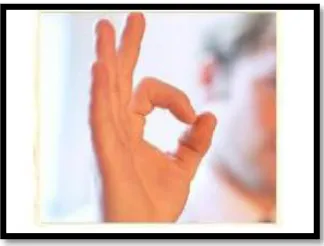
Fig. 1 Vision based approach
D. Instrumented /Data Glove approach:
© 2015, IJCSMC All Rights Reserved 296 Fig.2 Instrumented /Data Glove
E. Colored Markers approaches:
In order to direct the procedure of tracking the hand and locating the palm and fingers colored markers are gloves that are worn by the human hand. It consists of some colors in order to direct, which provide the ability to extract geometric features necessary to form hand shape.
Fig.3 Colored markers gloves [7]
III. PROPOSED WORK
© 2015, IJCSMC All Rights Reserved 297 Fig. 4 Basic block diagram
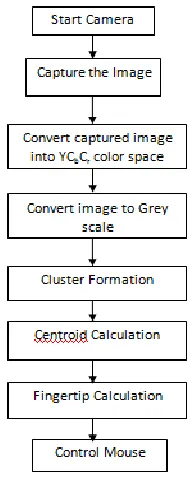
As soon as the palm is detected by the camera, it starts capturing the images and takes out the current images and starts processing. The processed image is given as input to the next phase of processing where it starts detecting the palm following the centers and edges. These all extracted features are used for the further processing such as detecting hand gestures and working according to it. The flowchart of the proposed system above is shown for the single frame which is captured. The system is a real time system so the flowchart is a continuous process for each and every frame that is captured by the web camera.
The detailed working of the proposed system is shown in the following flowchart
© 2015, IJCSMC All Rights Reserved 298
In the proposed architecture, the input is given through the hand gesture to the web camera. The web camera captures the images of the hand gestures. The image processor recognizes the gestures and then deduces the gestures into signals. The API sends the signals to the controller as an input. The signals from the API are thoroughly checked by the controller. Thus the final processed input is given to the hardware to perform the given task, which provides the required output. The actual processing takes place by following main processes such as, Waiting, collecting, manipulating, executing. Where waiting includes waiting of the user to perform a gesture, collecting includes gathering of information by the machine, processing of information is under manipulating and execution involves task performing (software and hardware controlling).
The actual process involves following steps:
Capturing Camera View
Getting current frame out of it
Creating memory image
Finding pixel RGB
Comparing pixel color
Decision making
IV. IMPLEMENTATION
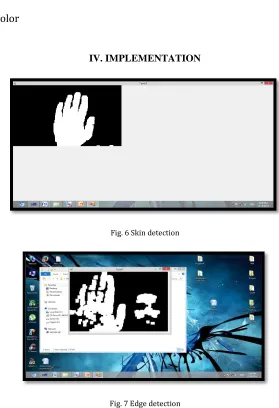
Fig. 6 Skin detection
© 2015, IJCSMC All Rights Reserved 299
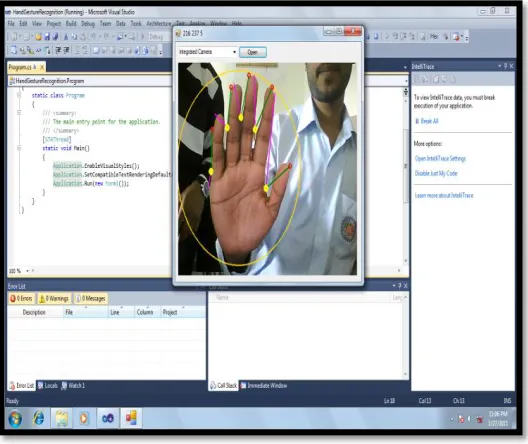
Here we are using EmguCV SDK technology in order to achieve high accuracy with real time processing speed in real environment. Emgu CV is a cross platform .Net wrapper to the OpenCV image processing library.
Advantage using this technology over image processing language like Matlab is that it gives us more control over the source code in order to achieve most realistic output with maximum use of processing speed.
Fig. 8 Edge detection
V. CONCLUSION
The proposed system is used to control the mouse cursor and implement its function using a real-time camera. We implemented mouse movement, selection of the icons and its functions like right, left, double click and scrolling. This system is based on image comparison and motion detection technology to do mouse pointer movements and selection of icon. From the results, we can expect that if the algorithms can work in all environments then our system will work more efficiently. This system could be useful in presentations and to reduce work space. In the future, we plan to add more features such as enlarging and shrinking windows, closing window, etc. by using the palm and multiple fingers.
REFERENCES
[1] Chien-Cheng Lee, Cheng-Yuan Shih, and Bor-ShennJeng,“Fingertip-writing alphanumeric Character Recognition for Vision-based Human Computer Interaction” ,International Conference on Broadband, Wireless Computing, Communication and Applications 978-0-7695-4, 2010. [2] T. Suganya Thevi , C. Chitra, “Cursor Movement in Real Time using Hand Gesture Recognition”, International Journal of Engineering Sciences & Research Technology, ISSN:2277-9655, March 2014.
[3] Shany Jophin, Sheethal M.S, Priya Philip, T M Bhruguram, “Gesture Based Interface Using Motion and Image Comparison”, International Journal of Advanced Information Technology (IJAIT) Vol. 2, No.3, June 2012.
© 2015, IJCSMC All Rights Reserved 300
[5] Rong Chang, Feng Wang and Pengfei You IEEE, “A Survey on the Development of Multi-touch Technology”, 978-0-7695-4003-0/10, DOI 10.1109/APWCS.2010.120, 2010.
[6] Adnan Ibraheem and Rafiqu Izaman Khan, “Survey on Various Gesture Recognition Technologies and Techniques”, International Journal of Computer Applications (0975 –8887) Volume 50 – No.7, July 2012.
[7] Luigi Lamberti & Francesco Camastra, “Real-Time Hand Gesture Recognition Using a Color Glove”, Springer 16th international conference on Image analysis and processing: Part I (ICIAP), pp. 365-373, 2011.