Available online: https://edupediapublications.org/journals/index.php/IJR/ P a g e | 2771
Low Cost Object Sorting Robotic Arm Using Raspberry Pi
B.Santhosh Kumar & Mr. K.Sathish BabuPG Scholar, Dept Of ES, Aurora Technological And Research Institute, Parvathapur(V), Ghatkesar(M), Ranga Reddy, Telangana, India.
Associate Professor, E.C.E Dept Aurora Technological And Research Institute, Parvathapur(V), Ghatkesar(M), Ranga Reddy, Telangana, India.
Abstract:
Gesture recognition is a topic of immense interest in the field of computing and image processing involving numerous factors and constraints nevertheless yielding remarkable simplification of various human affairs. In this work, the problem of gesture recognition is narrowed down to that of hand gesture recognition and specifically deals with finger count extraction to facilitate further processing using the control so effected. A hand gesture recognition system has been developed, wherein the finger count in a certain input hand image is computed in accordance with a simple yet effective procedure. The problem of hand gesture recognition is solved by means of adopting a lucid albeit efficient algorithm which has been implemented using the embedded c System Generator software tool. The algorithm followed I invariant to rotation and scale of the hand. The approach involves segmenting the hand based on skin color statistics and applying certain constraints to classify pixels as skin and non skin regions. Those depending on the robotic arm move the direction and pick the object and drop the object using raspberry pi microcontroller.
The Raspberry Pi is a credit card sized single computer or SoC uses ARM1176JZF-S core. SoC, or System on a Chip, is a method of placing all necessary electronics for running a computer on a single chip. Raspberry Pi needs an Operating system
to start up. In the aim of cost reduction, the Raspberry Pi omits any on-board non-volatile memory used to store the boot loaders, Linux Kernels and file systems as seen in more traditional embedded systems. Rather, a SD/MMC card slot is provided for this purpose. After boot load, as per the application program Raspberry Pi will get execute.
Keywords: Raspberry Pi, Matlab, Python.
I. INTRODUCTION
Available online: https://edupediapublications.org/journals/index.php/IJR/ P a g e | 2772
exceeds that of a microprocessor or DSP processor running at clock rates two to ten times that of the ARM11. Coupled with a capability for implementing highly parallel arithmetic architectures, this makes the ARM11 ideally suited for creating high-performance custom data path processors for tasks such as digital filtering, fast Fourier transforms, and forward error correction. Many ARM11 devices provide dedicated functional blocks such as DSPs. This means that functional blocks of a systemcan be readily moved between software, compiled hardware and DSP inside the ARM11 development. In addition to the different types of implementation, different parameters of each can be tested. An application can be tested on many 8, 16 and 32 bit cores at different clock speeds to see what provides the best power consumption or lower cost.
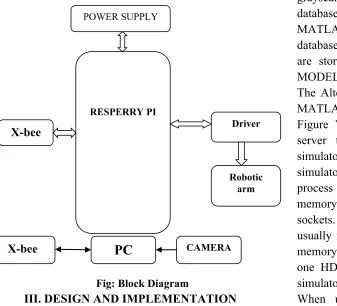
2.1 System Architecture:
Fig: Block Diagram
III. DESIGN AND IMPLEMENTATION
Database Generation
The images for database are captured using a Cannon camera which produces image frames of RGB pixels. The American Sign Language (ASL) alphabet gestures are used to obtain the hand images. The database contains two different subjects with two different backgrounds. Figure VI-2 shows few of the database sets used in this particular application. The Cannon camera is actually not stationary since it is not in a fixed position but the background is maintained as either black or white. The images are stored in .jpg format. The temporal resolution requirements of the application have to be considered. The size of the image frame is 640x480 pixels. To maintain the resolution and decrease redundancy, the frames are resized to 64x64 pixels. Once the input images are obtained they are converted to grayscale values within a range of 0-255. The database obtained is read in the computer using MATLAB. The software converts the entire database image frames into text files. These files are stored in the memory of the ALTERA MODELSIM using command “$readmemh”. The Altera Modelsim is being called from the MATLAB using HDLDAEMON as shown in Figure VI-3 below. HDLDAEMON controls the server that supports interactions with HDL simulators. To communicate with HDL simulators, the server uses one of two inter process communication methods: shared memory (which is the default), or TCP/IP sockets. Communication by shared memory is usually faster than sockets. When using shared memory, the server can communicate with only one HDL simulator at a time, and the HDL simulator must be running on the same host. When using sockets, the server 100 can
RESPERRY PI POWER SUPPLY
X-bee Driver
Robotic arm
Available online: https://edupediapublications.org/journals/index.php/IJR/ P a g e | 2773
communicate with multiple HDL simulators simultaneously, running on the same host or other hosts.
Parallelism between Feature extraction
and CNN tracking
In our developed CNN, all the
feature vectors are not being calculated at
a time. Instead there exists a dual bus for
communication between the feature
extraction layer and the object recognition
layer as shown.
Feature Extraction Logistics
A feature is an attribute of the object that
is considered important in describing and
recognizing the object in relation to other
objects. Generally speaking, the pattern in
the 2D image refers to a real 3D pattern in
real world, which affects the recognition
approach. The commonly used basic
features are size, color, and shape. It is
being chosen from a qualitative or
functional
description
to
precise
geometric surface information.
Available online: https://edupediapublications.org/journals/index.php/IJR/ P a g e | 2774
under strictly defined conditions within
closed systems. The Y component
describes brightness, the other two values
describe a color difference rather than a
color, making the color space unintuitive.
The transformation simplicity and explicit
separation of luminance and chrominance
components makes this color space
attractive for skin color modeling images
and motion images (video) have utilized a
wide variety of color spaces including
RGB, YCrCb, HSI, and other formats to
represent the colors within the image.
Each of these color space representations
has its own set of advantages and
disadvantages. For example, RGB is often
used for the most demanding applications
where ultimate color fidelity must be
maintained. Any given color that the
human eye can see may be represented by
a combination of the primary colors (Red
- R, Blue -B, and Green -G).
IV. SYSTEM HARDWARE
A Raspberry Pi is a thirty five dollar, credit card sized computer board which when plugged into an LCD and attachment of a keyboard and a mouse, it is able to complete the functions of any regular PC can. Like a PC, it has RAM, Hard Drive (SD Card), Audio and Video ports, USB port, HDMI port, and Ethernet port. With the Pi, users can create spread sheets, word-processing, browse the internet, play high definition video and much more. It was designed
to be a cost friendly computer for users who needed one. There are two models, Model A and B. Model B is the faster containing 1GB of RAM as well as the ability to over clock.
Fig: Raspberry Pi Microcontroller
V.SOFTWARE TOOLS
Raspbian Wheezy
Raspbian Wheezy is a free operating system based on Debian distribution. It is created by a small team of developers who are fans of Raspberry Pi. Raspbian is optimized for the Raspberry Pi's hardware and it comes with over 35 000 packag-es and pre-compiled software. Raspbian is still under active development and it aims to improve the stability and performance of the Debian packages. Raspbian is officially recommended for beginners and it includes the graphical desktop environment called LXDE. Raspbian Wheezy is one of the fastest ways to setup and get the RasPi running.
Programming languages
Available online: https://edupediapublications.org/journals/index.php/IJR/ P a g e | 2775
Basically any programming language which can be compiled for ARMv6 can run on the Raspberry Pi. There-fore the users are not restricted to use only the Python. On the Raspberry Pi there are preinstalled several languages for example C, C++, Java, Scratch and Ruby.
Python programming language
Python programming language is developed in the late 1980s at the National Re-search Institute by Guido van Rossum. Python has grown in popularity, and it is widely used commercially.
Python is a flexible and powerful programming language but still it is easy to learn and follow. The clear syntax of Python makes it a valuable tool for users who wants to learn programming. This is one of the reasons why it is recommended by the Raspberry Pi Foundation. Python is published under an open-source license and it is available for different operating systems. Python runs on Linux, OS X and Windows computer systems.
Cross-platform support guarantees that the programs which are written in Python are also compatible in other platforms. There are few exceptions where the pro-grams are not compatible. For instance, when the Python is addressed to use the specific hardware such like Raspberry Pi's GPIO.
CONCLUSION
Present technologies available to recognize hand gestures which use Common methods include cameras. Camera captures the object that depending on robot will move direction. While compared to the other systems this technology can be employed unobtrusively, work through various materials and do not have
a high computational burden also. It allows realization of new user interface applications by detection, tracking and classification of the user’s hand or finger motion in free space.
References
1.Dragusu.M,”Practical applications for robotic arm by using image processing” system theory, control and computing (ICSTCC), 2012 16th international conference.
2. V.Pereira,”Low cost object sorting robotic arm using raspberry pi” Global Humanitarian Technology Conference-South Asia Satellite(GHTC-SAS),2014 IEEE.
3. C.TheisA.Steinhage andI.Iossifidis ,”Image processing methods for interactive robot control”, proceedings 10th IEEE International Workshop on robot and human interactive communication,2001.
4.Vijayalaxmi,K.Anjali,B.Srujana,P.Rohith Kumar “Object Detection and Tracking using Image Processing” Elecronics and Communications Global Journal of Advanced Engineering Technologies, Special Issue (CTCNSF-2014).
5. R.Szabo,”Automated colored object sorting applications for robot arms” Electronics andTelecommunications(ISETC),2012 10th International Symposium.
6.P.Ashish andCharuBhartiya, “Image Processing Based Rose Harvesting System using Raspberry Pi” ElectronicsInternational Journal of Engineering Research & Technology (IJERT)Vol. 4 Issue 04, April-2015.