Effect of Marble and Granite Waste for the
Partial Replacement of Coarse Aggregate in
SCC
Saranya Sasi1, Kavitha P.E2, Minu Anna Johny3
P.G. Student, Department of Civil Engineering, IIET Engineering College, Nellikuzhy, Kerala, India1
Associate Professor, Department of Civil Engineering, SNGCE Engineering College, Kadayiruppu, Kerala, India2
Assistant Professor, Department of Civil Engineering, IIET Engineering College, Nellikuzhy, Kerala, India3
ABSTRACT: Self compacting concrete (SCC) is one of the most important development in construction industry. One of the major property of SCC is its self compacting capability. Due to this property SCC is differ from normal concrete. They does not need any external vibration for placing and compaction. This study is dealing with the effect of marble and granite waste for the partial replacement of coarse aggregate in SCC. Marble and granite are commonly used flooring materials. Disposal of these stone wastes cause environmental problem. So marble and granite is partially replaced with coarse aggregate and produce modified self compacting concrete (MSCC).The test is carried out for M40 gradeconcrete. Fly ash is used as mineral admixture. Super plasticizer is also used to get flowability. Fresh and hardened properties were checked. Based on the test results the fresh properties decreases with increases in marble and granite content. Hardened properties such as compressive strength, split tensile strength, and flexural strength are increases with increase in marble and granite content upto 21%, then decreases. Maximum results obtained at 21% replacement level. But at 40% replacement level the hardened properties are higher than that of control SCC mix. Based on strength point of view and economic point of view the optimum replacement level is 40%.
KEYWORDS: Self Compacting concrete, Modified self compacting concrete, Fresh property, Hardened property
I. INTRODUCTION
Self compacting concrete (SCC) is one of the most important development in construction industry. One of the major property of SCC is its self compacting capability. They does not need any external vibration for placing and compaction.They achieve full compaction underits own weight, even in the presence of congested reinforcement. SCC was conceptualized in 1986 by Prof. Okamura at Ouchi University, Japan. The reduction in skilled workers in Japan’s construction industry has led to a similar reduction in quality of construction work. The solution for the achievement of durable concrete structures independent of the quality of construction work is employment of SCC. SCC has been successfully used in France, Netherland, UK etc.Self compacting concrete also known as self consolidating concrete which is suitable for placing in difficult conditions and in sections with congested reinforcement.EFNARC (2002) has given the specification and guide lines for SCC mix design.
II. LITERATUREREVIEW
RoshanLalet.al (2014) [1] investigate strength characteristics of concrete containing waste marble and granite as coarse aggregate. The coarse aggregate is partially replaced with marble and granite from 0-40% at 10% interval. Physical properties of cement, fine aggregate and coarse aggregate etc. were explained. Based on this study the hardened properties is high at 20 % replacement. The hardened properties decreases due to grading effect.
R.Sivakumaret.al (2016) [2] conduct an experimental study on partial replacement for coarse aggregate by granite waste. In this study the water-cement ratio is fixed as 0.45.The concrete mix design is M30.The granite waste is partially replaced as coarse aggregate from 0-50%.The hardened properties increased upto 40%.
Sudarshan D. Kore et.al(2016) [3] found out the marble waste is fully replaced as coarse aggregate.M10 mix is prepared. The strength is increased with increase in marble content. The results shows that the compressive strength of C4 specimens (80%) is higher than that of control mix.
R.K. Beheraet.al (2016) [4] investigate study on properties of SCC with slag as coarse aggregate. The scope of this project is to determine and compare the SCC by using different % of blast furnace slag as coarse aggregate (0-60%).M30 mix is prepared for this study. The W/C is fixed as 0.43.There is an increase of 13.82% in compressive strength for SCC-60 over SCC-0.The flexural and split tensile strength also increase with increase in slag content.[4]
Karthick M (2016) [5]found out the durability properties of high strength SCC using silica fume and quarry dust. The SCC with 20% replacement of cement by silica fume and 20% replacement of fine aggregate by quarry dust. Master Glenium SKY 8233.Using silica fume and quarry dust 20% by weight of cement and fine aggregate respectively shows good result of fresh and hardened properties attack, water absorption, alkaline attack, acid attack and chloride attack than conventional concrete.
Okonkwo and Arinze EE (2016) [6] investigate properties of concrete in fresh and hardened stage using different aggregates size and mix design was investigated. The sizes of coarse aggregates varies from 25mm,20mm,12mm and 6mm. The mixes prepared for this study was 1:2:4,1:1.5:3,and 1:3:6. The coarse aggregate size of 20mm performed best slump test for 1:2:4 and 12mm coarse aggregate performed best for 1:1.5:3. The coarse aggregate size 20mm shows better hardened properties.
Er.Kuldeep Kumar et.al (2015) [7] conduct an investigation on strength characteristics of concrete containing recycled aggregates of marble waste. Replacement conduct from 0-40%.Sieve analysis of both marble and natural coarse aggregate were done. The hardened properties such as compressive strength and flexural strength is high at 20% replacement level.
N.Anandet.al (2014) [8]A mix design procedure for the design of SCC mixes has been developed by modifying the mix proportions arrived from Indian Standard mix design method for different grades of concrete. Flow and strength properties were determined by experimental investigation. An attempt has been made to study the effect of elevated temperature on SCC specimens heated from 27ºC to 900ºC under hot condition. Compressive strength of SCC was found to decrease by70.60%, 75.31%, 78.57% and 81.76% respectively for M25, M30, M35 and M40 concrete when exposed to a temperature of 900° compared to reference specimen. It is found that as the temperature increases, compressive strength, tensile strength and flexural strength of Self Compacting Concrete was found to decreases.
EFNARC (2002) [9] has given the specification and guide lines for SCC mix design. Each mix design should be tested by more than one test method for different workability parameters. For the initial mix design of SCC all the workability parameters need to ensure that all aspects are fulfilled.
III.MATERIALSANDMETHODS
3.1 Cement
OPC 53 grade cement (Bharathi) is used throughout the work.The physical properties of are shown in table 1. Table 1. Physical properties of cement
Sl No. Property Result
1 Standard consistency 30% 2 Initial setting time 71 minutes 3 Final setting time 310 minutes 4 Specific gravity 3.17 5 Compressive strength at 28 days of curing 56.56 N/mm2
3.2 Fly ash
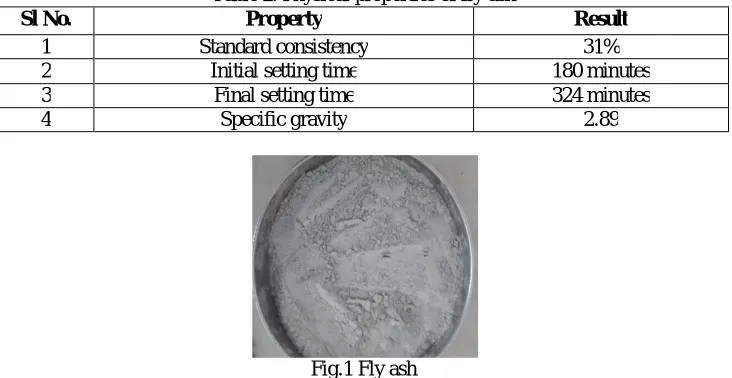
Class F fly ash is used for this study.Older anthracite and bituminous coal typically produces class F fly ash.This fly ash is pozzolanic in nature,and contains less than 10% lime.The glassy silica and alumina of class F fly ash requires a cementing agent,such as Portland cement,quick lime etc. In this study fly ash is replaced 30% by weight of cement.Physical properties of fly ash is shown in table 2.
Table 2. Physical properties of fly ash
Sl No. Property Result
1 Standard consistency 31% 2 Initial setting time 180 minutes 3 Final setting time 324 minutes 4 Specific gravity 2.89
Fig.1 Fly ash Fig.1 shows class Ffly ash.
3.3 Fine Aggregate
M-sand is used as fine aggregate.Properties of M-sand is shown in table 3. Table 3. Properties of fine aggregate
Sl No. Property Result
1 Sieve analysis Zone II
2 Specific gravity 2.79
3 Water absorption 2.8 % 4 Moisture content 3.09 %
3.4 Coarse Aggregate
In this study three types of aggregates are used and they are 12.5mm normal aggregate, marble aggregate and granite aggregate of same size. Marble and granite aggregates are replaced in equal proportions. Properties of these aggregates are shown in table 4.
Table 4. Properties of coarse aggregate
Sl No. Properties 12.5mm normal aggregate
Granite Marble
1 Specific gravity 2.7 2.66 2.66
2 Water absorption 0.4 % 0.2 % 0.2%
3.5 Admixture – Master Glenium ACE 30IT
Glenium ACE 30IT is an admixture with highly early strength gains. It is compatible with all types of cements. Glenium ACE 30IT is the combination of Master matrix 2 capable of self compaction, even in the presence of dense reinforcement without the aid of vibration, for making precast elements.Table 5 shows the properties of admixture.
Table 5. Properties of admixture
Parameter Specification(IS 9103-1999) Results
Physical state Reddish brown liquid Reddish brown liquid Chemical name of active
ingredient
Polycarboxylate Polymers Polycarboxylate Polymers
Relative density at 250 C
1.110 ±0.01 1.108
pH Min.6 7.09
Chloride ion content Max 0.2 0.0081 Dry material content 38 (± 5%) 37.09
3.6 Mix Design
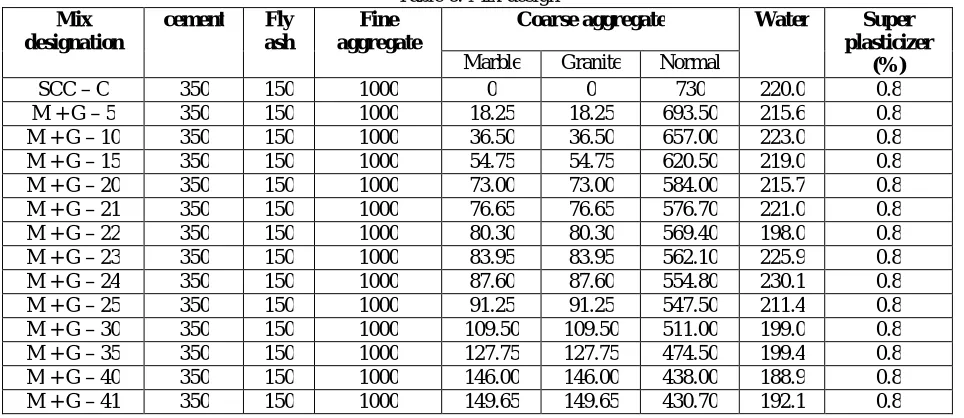
Mix proportion of SCC for this study was based on the EFNARC.Dosage of super plasticizer was fixed as 0.8.Mix design results are shown in table 6.
Table 6. Mix design
Mix designation
cement Fly ash
Fine aggregate
Coarse aggregate Water Super plasticizer
(%)
Marble Granite Normal
M + G – 42 350 150 1000 153.30 153.30 423.40 220.3 0.8 M + G – 43 350 150 1000 156.95 156.95 416.10 199.5 0.8 M + G – 44 350 150 1000 160.60 160.60 408.80 213.0 0.8 M + G – 45 350 150 1000 164.25 164.25 401.50 224.0 0.8 M + G – 50 350 150 1000 182.50 182.50 365.00 221.7 0.8
3.7 Methods
3.7.1 Fresh properties
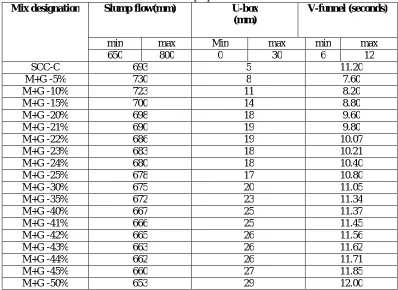
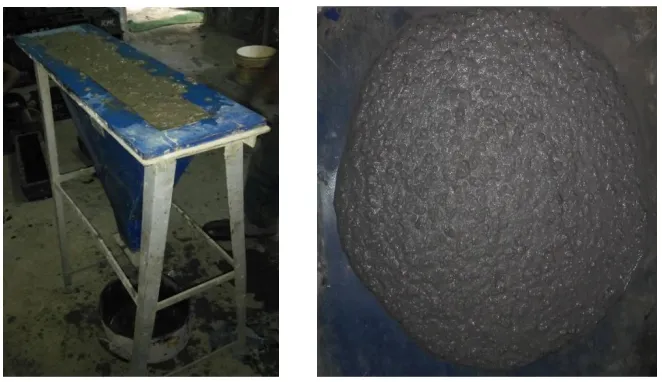
A concrete mixture may be called as SCC only if the mix have shown three properties such as filling ability, passing ability and segregation resistance. To check these requirements slump flow, U-box and V-funnel tests were performed according to EFNARC guidelines. The test results are shown in Table 7.
3.7.2 Mechanical properties
Compressive strength (150 x 150 x 150mm cubes), split tensile strength (cylinder100 x 300mm) and flexural strength (100 x 100 x 400 mm ) was determined at the age of 7 and 28 days.
IV.EXPERIMENTALRESULTS
4.1 Fresh properties
Fresh properties of SCC is shown in table 7. The fresh properties of SCC is decreased with increase in percentage addition of marble and granite. The results of fresh properties is within the allowable limits of EFNARC.
Table 7. Fresh properties of SCC
Mix designation Slump flow(mm) U-box (mm)
V-funnel (seconds)
min max Min max min max
650 800 0 30 6 12
SCC-C 693 5 11.20
M+G -5% 730 8 7.60
M+G -10% 723 11 8.20
M+G -15% 700 14 8.80
M+G -20% 698 18 9.60
M+G -21% 690 19 9.80
M+G -22% 686 19 10.07
M+G -23% 683 18 10.21
M+G -24% 680 18 10.40
M+G -25% 678 17 10.80
M+G -30% 675 20 11.05
M+G -35% 672 23 11.34
M+G -40% 667 25 11.37
M+G -41% 666 25 11.45
M+G -42% 665 26 11.56
M+G -43% 663 26 11.62
M+G -44% 662 26 11.71
M+G -45% 660 27 11.85
M+G -50% 653 29 12.00
Fig.2 V-funnel test Fig.3 Slump flow test
4.2 Hardened properties
The compressive strength of control SCC mix is 42.40N/mm2 and 50.46N/mm2at 7 and 28 day of curing. The compressive strength is increases with increase in marble and granite content upto 40%. Maximum result was obtained at 21 percentage replacement level and the values are 54.60 N/mm2 and 63.34 N/mm2.At 40% replacement level the compressive strength values are 43.30 N/mm2 and 50.55 N/mm2. Compressive strength at 40 replacement level is higher than that of control mix.
The flexural strength of control SCC mix is 3.64 N/mm2 and 4.26 N/mm2at 7 and 28 day of curing. The flexural strength is increases with increase in marble and granite content upto 40%. Maximum result was obtained at 21 percentage replacement level and the values are 7.74 N/mm2 and 8.68 N/mm2.At 40% replacement level the compressive strength values are 3.94 N/mm2 and 4.95 N/mm2.
The split tensile strength of control SCC mix is 3.17 N/mm2 and 4.42 N/mm2at 7 and 28 day of curing. The flexural strength is increases with increase in marble and granite content upto 42%. Maximum result was obtained at 21 percentage replacement level and the values are 7.46 N/mm2 and 8.96 N/mm2.
Table.8 shows the test results of compressive strength, flexural strength and split tensile strength at 7 and 28 days of curing.
Table 8.Hardened properties of control SCC and MSCC
Mix Average compressive strength ( N/mm2 )
Average flexural strength ( N/mm2 )
Average split tensile strength ( N/mm2 )
7th day 28th day 7th day 28th day 7th day 28th day
M+G-30% 47.30 53.40 4.31 5.10 5.93 7.52 M+G-35% 45.70 51.50 4.72 5.83 5.83 7.32 M+G-40% 43.30 50.55 3.94 4.95 5.66 6.95 M+G-41% 40.22 50.41 3.81 4.82 5.34 6.74 M+G-42% 43.42 49.57 3.63 4.53 4.76 5.85 M+G-45% 41.16 47.52 3.14 4.14 2.45 3.53 M+G-50% 37.46 42.53 2.51 3.62 2.12 3.33
Fig.4 shows the variation of compressive strength for different percentage replacement
Fig.4 shows the variation of compressive strength for different percentage replacement of marble and granite content.In this maximum strength is obtained at 21% replacement level.
Fig.5 shows the variation of flexural strength for different percentage replacement of marble and granite content. In this maximum strength is obtained at 21% replacement level.
Fig.6 shows the variation of split tensile strength for different percentage replacement
Fig.6 shows the variation of split tensile strength for different percentage replacement of marble and granite content. In this maximum strength is obtained at 21% replacement level.
V. CONCLUSIONS
Marble and granite waste as coarse aggregate for making MSCC, the physical properties satisfy the IS code specifications. So marble and granite waste can be used as coarse aggregate in MSCC. The fresh properties of control SCC mix conforms with EFNARC code specifications and hardened properties of control SCC mix satisfies Is code specifications. The fresh properties such as flowability and filling ability, that decreases with increases in percentage content of marble and granite waste as coarse aggregate.
Hardened properties such as compressive strength, split tensile strength and flexural strength increases with increase in marble and granite content upto 21%,then decreases. The hardened properties of MSCC is higher than that of control mix upto 40%.Concluding the observations the optimum percentage replacement of marble and granite waste as coarse aggregate in MSCC is 40%.
ACKNOWLEDGEMENT
The authors are thankful to our beloved Principal Dr.N.K.Varghese, Head Of Civil Dept. Ms. Minu Anna Johny, Faculty Members of Civil Engineering Department IIET and staff members of RMC Prism Cement Limited , for their continuous support to carry out this research work.
REFERENCES
[1] RoshanLal, Er.KuldeepKumar, “An investigation on strength characteristics of concrete containing recycled aggregate of marble and granite
waste” , International Journal of Progress In Civil Engineering,Vol.1, ISSN:2394-4676,Issue1,pp-9-16,2014
[2] R.Siva Kumar, H.Mohammedet.al, “An Experimental study on partial replacement for coarse aggregate by granite waste” ,International
Journal of Innovative Science, Engineering & Technology,Vol.3,Issue 8, 2016.
[3] Sudarshan D. Kore,A.K. Vyas, “Impact of marble waste as coarse aggregate on properties of lean cement concrete”, Case studies in
Construction Materials,Vol.4,pp-85-92,2016.
[4] G.C.Behrera,R.K. Behera, “A study on properties of SCC with slag as coarse aggregate”, International Research Journal of Engineering &
[5] Karthick M, Dr. Nirmalkumar K., “Durability properties of high strength SCC using Silica fume and Quarry dust", International Journal of Scientific Engineering&Technology,Vol.3,2016.
[6] OkonkwoV.O,Arinze E.E, “Effects of aggregate gradation on the properties of concrete made from granite chippings”, Journal of steel
structures &Construction.,Issue 1,Vol.2,2016.
[7] KuldeepKumar,Prof.RoshanLal, “An investigation on Strength characteristic of concrete containing recycled aggregates of marble waste”,
International Journal of Engineering, Science & Research Technology,Vol 4(1),ISSN:2277-9655, 2015.
[8] N.Anand,G.PrinceArulraj, “Experimental investigation on mechanical properties of SCC under elevated temperature", International Journal of
Advances in Science Engineering & Technology,Vol.2,Issue 4 ,2014.
[9] EFNAR,Specification and guidelines for Self Compacting Concrete, 2002.