ISSN 2286-4822 www.euacademic.org
Impact Factor: 3.1 (UIF) DRJI Value: 5.9 (B+)
An application of the systemic PEST analysis on the
Internet-based sex trade sector
JOSEPH KIM-KEUNG HO Independent Trainer Hong Kong, China
Abstract:
The notion of the systemic PEST analysis has been proposed by Ho (2014a). In this paper, this notion is further enhanced and applied in an exercise to assess the Internet-based sex trade sector. It has been argued that the systemic PEST analysis can constructively be viewed from two perspectives, i.e. the strategic management perspective and the managerial intellectual learning perspective. To consider both perspectives is to adopt the Multiple Realities inquiry system to study this notion which promotes comprehensive understanding of the concept. A systemic PEST analysis on the Internet-based sex trade sector provides an illustration on its practice, which has pedagogical value.
Key words: The systemic PEST analysis, The Internet-based sex trade sector, Managerial intellectual learning, The Multiple Realities inquiry system, The Five-Force Model
Introduction
perspective and the managerial intellectual learning (MIL) perspective. The aims of the paper are:
Aim 1: to make theoretical development of the notion of systemic PEST analysis by reviewing it via the strategic management lenses and the managerial intellectual learning lenses.
Aim 2: to provide an illustration on how to apply the systemic PEST analysis in a ecommerce study
Aim 3: to further clarify the notion of managerial intellectual learning as a result of using it as a perspective to examine the systemic PEST analysis.
The strategic management view on the systemic PEST analysis
The process of systemic PEST analysis is made up of 2 stages (Ho, 2014a):
Stage 1 involves the study of primary and secondary data on the macro-external environment facing the company, resulting in the construction of a table that identifies and classifies all the significant external environmental factors into the four broad categories of Political (P), Economic (E), Social (S) and Technological (T) factors.
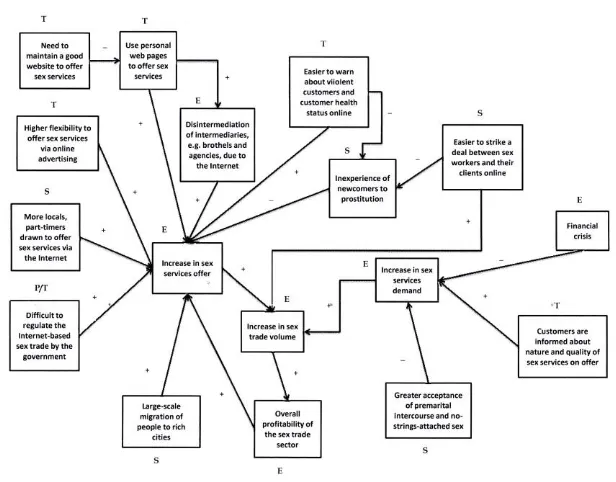
Stage 2 involves relating the various PEST factors to make up a cognitive map of inter-related PEST factors, so as to emphasize the systemic nature of the external environment.
actual practice, the whole process is (i) iterative rather than sequential in nature and (ii) affected by a number of contextual factors which work on the cognitive filters of the PEST analysis participants (Ho, 2014b) and vice versa. From the literature on strategic management, e.g. Ansoff (1984) and Thompson and Martin (2005), the writer identifies the following contextual factors: (i) an organization’s vision-mission-objectives (VMO) (Allbusiness Networks, 2014), (ii) profile of strategy and strategy planning process adopted1, (iii) profile of
organizational capability2, and (iv) level of external
environment turbulence3. For Ansoff (1984), notably on factors
(ii), (iii) and (iv), there should be an alignment between these factors so as to make a company’s strategy effective. These contextual factors and the PEST analysis stages are captured in Figure 1.
1 Profiles of strategy can be in terms of types, e.g., defenders, prospectors,
analyzers and reactors (Thompson and Martin, 2005, p. 345) or aggressiveness, e.g., stable, reactive, anticipatory, exploratory, and creative (Ansoff, 1984).
2 Openness of capability can range from custodial, production, marketing,
strategic to flexible (Ansoff, 1984).
3 Level of environmental turbulence can range from repetitive, expanding,
The managerial intellectual learning view on the systemic PEST analysis
Managerial intellectual learning (MIL) is about learning management theories and concepts by managers so as to strengthen their intellectual competence to appreciate management practices in the real-world (Ho, 2013; 2014c). One way to conduct managerial intellectual learning is to construct a cognitive map to make explicit in a diagrammatic form the management knowledge, viewpoints and concerns on a specific management topic and issue (Ho, 2014b). In this case, the construction of a systemic PEST analysis diagram in the form of a cognitive map is unmistakably a managerial intellectual learning exercise. For this reason, the systemic PEST analysis can be examined from the managerial intellectual learning perspective, other than from the strategic management perspective as discussed in the previous section. Doing so amounts to a perspective switch in the study of systemic PEST analysis from the strategic management perspective to the managerial intellectual learning perspective. Beyond that, to consider more than one perspective to examine the systemic PEST analysis is an application of the Multiple Realities inquiry system4, as espoused by Mitroff and Linstone (1993).
Applying the Multiple Realities inquiry system promotes comprehensive thinking, leading to more understanding of the systemic PEST analysis concept in our case. The MIL perspective also offers to uncover how a particular team of systemic PEST analysis comes up with a specific PEST analysis table and a specific PEST analysis diagram but this theme, being complex, is not pursued here. We now move on to go through the 2-stages systemic PEST analysis process on the Internet-based sex trade sector.
4The Multiple Realities inquiry system examines “a range of different
A systemic PEST analysis on the Internet-based sex trade sector
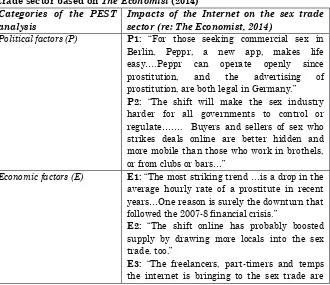
This systemic PEST analysis draws solely on the information provided in The Economist (2014) which reports on the impacts of the Internet on the sex trade sector. This case study is chosen due to the sufficient details reported in this recently published journal article for illustrative purpose. Other recent reports on this sector include Cameron (2014) and Sullivan (2014). They all recognize the substantial impacts of the Internet on this sector. The main points from The Economist (2014) are grouped into the four categories of P, E, S and T and presented in Table 1. The table is the primary output from stage 1 of the systemic PEST analysis process (Ho, 2014a).
Table 1: A PEST analysis table on the Impacts of Internet on the sex trade sector based on The Economist (2014)
Categories of the PEST analysis
Impacts of the Internet on the sex trade sector (re: The Economist, 2014)
Political factors (P) P1: “For those seeking commercial sex in Berlin, Peppr, a new app, makes life easy….Peppr can operate openly since
prostitution, and the advertising of
prostitution, are both legal in Germany.”
P2: “The shift will make the sex industry
harder for all governments to control or regulate……. Buyers and sellers of sex who strikes deals online are better hidden and more mobile than those who work in brothels, or from clubs or bars…”
Economic factors (E) E1: “The most striking trend …is a drop in the average hourly rate of a prostitute in recent years…One reason is surely the downturn that followed the 2007-8 financial crisis.”
E2: “The shift online has probably boosted
supply by drawing more locals into the sex trade, too.”
E3: “The freelancers, part-timers and temps
likely to help absorb demand shocks…”
E4: “Moving online means prostitutes need no
longer rely on the usual intermediaries – brothels and agencies; pimps and madams – to drum up business or provide a venue…”
E5: “… prostitute’s hourly rate varies
according to the nature of the services she
provides and her reported physical
characteristics…”
Social factors (S) S1: “Large-scale migration is another reason prices are falling. Big, rich cities are magnets for immigrants of all professions, including sex workers…”
S2: “Greater acceptance of premarital
intercourse and easier divorce mean fewer frustrated single and married men turning to prostitutes…”
S3: “..broader social change may be reducing
demand, and thus, prices. Free, no-strings-attached sex is far easier to find than in the past. Apps such as Tinder facilitate speedy hookups…”
S4: “As paid-for sex becomes more readily and
discreetly available online, more people will buy it…”
Technological factors (T) T1: “…specialist websites and apps are allowing information to flow between buyer and seller, making it easier to strike mutually satisfactory deals..”
T2: “Even in places….where prostitution and
its facilitation are illegal… the marketing and arrangement of commercial sex is moving online..”
T3: “Advertising and booking clients online
give prostitutes flexibility about where to work..”
T4: “Online forums allow prostitutes to share
tips about how to stay safe and avoid tangling with the law..”
T5: “You need a good website, lots of great
pictures, you need to learn search-engine optimization… it’s exhausting at times….”
workers, apps such as Healthvana make it easy for buyer and seller to share verified results in sexual-health tests…”
This categorization of environmental factors is a rough exercise. Also, while some factors are clearly general/ macro-environmental in nature, others are relatively industry-specific/ micro-environmental. A conventional PEST analysis mainly focuses on the former factors. The next step is to move on to Stage 2 of the systemic PEST analysis by constructing a systemic PEST analysis diagram. This is done and presented in Figure 2.
plus sign in the arrow between A and B (i.e., A—(+)B) means that an increase A leads to an increase in B, while a minus sign (i.e., A—(-)-> B) indicates that an increase in A leads to a reduction in B. Mainly, there are three major clusters of factors in Figure 2. Cluster-1 factors influence the “supply of sex service offer”; cluster-2 factors are those that affect the “demand in sex services”. Finally, there are cluster- 3 factors that influence the “sex trade volume”. The variable of “overall profitability of the sex trade sector” represents an ultimate objective in Figure 2, though it, in turn, can influence “sex service offer”. Figure 2, as a systemic PEST analysis diagram, renders a clearer picture of the external environment facing the sex service providers in the sex trade sector than a PEST analysis table. Note that Figure 2 does not separate factors into general environmental (or macro-environmental) factors and operating environmental (or micro-environmental/ industry-specific) factors as suggested by Ho (2014a) due to space limitation here. It should also be clear that Figure 2 is only one illustrative example. A different group of participants of a PEST analysis exercise, based on different primary and secondary data, with different objectives and capability, will definitely come up with a different PEST analysis table and a dissimilar systemic PEST analysis diagram exhibiting a different extent of system complexity (Ho and Sculli, 1995).
their view of the external environment with management concepts, such as Porter’s Five-Force Model and systems thinking. The exercise of relating management theories and management’s views in the managerial intellectual learning process is reported in the next section.
Enrichment of the systemic PEST analysis exercise via the managerial intellectual learning lenses
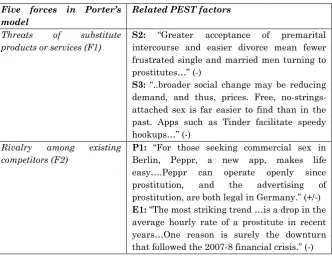
From the managerial intellectual learning perspective, reviewing and refining the systemic PEST diagram with management concepts from the academic sources amounts to an enrichment of managers’ cognitive filter for management (Ho, 2014d). Specifically, it is feasible to further assess the PEST factors in Table 1 using Michael Porter (1980, 2001)’s Five-Force Model. The analysis findings are shown in Table 2.
Table 2: An assessment of the PEST factors in terms of Porter’s Five-Force Model
Five forces in Porter’s model
Related PEST factors
Threats of substitute products or services (F1)
S2: “Greater acceptance of premarital
intercourse and easier divorce mean fewer frustrated single and married men turning to prostitutes…” (-)
S3: “..broader social change may be reducing
demand, and thus, prices. Free, no-strings-attached sex is far easier to find than in the past. Apps such as Tinder facilitate speedy hookups…” (-)
Rivalry among existing competitors (F2)
P1: “For those seeking commercial sex in
Berlin, Peppr, a new app, makes life easy….Peppr can operate openly since
prostitution, and the advertising of
prostitution, are both legal in Germany.” (+/-)
E1: “The most striking trend …is a drop in the
E2: “The shift online has probably boosted supply by drawing more locals into the sex trade, too.” (-)
S3: “..broader social change may be reducing
demand, and thus, prices. Free, no-strings-attached sex is far easier to find than in the past. Apps such as Tinder facilitate speedy hookups…” (-)
Barriers to entry (F3) P2: “The shift will make the sex industry harder for all governments to control or regulate……. Buyers and sellers of sex who strikes deals online are better hidden and more mobile than those who work in brothels, or from clubs or bars…” (-)
E2: “The shift online has probably boosted
supply by drawing more locals into the sex trade, too.” (-)
E3: “The freelancers, part-timers and temps
the internet is bringing to the sex trade are likely to help absorb demand shocks…” (-)
T5: “You need a good website, lots of great
pictures, you need to learn search-engine optimization… it’s exhausting at times….” (+)
Bargaining powers of channels and end users (F4)
P1: “For those seeking commercial sex in
Berlin, Peppr, a new app, makes life easy….Peppr can operate openly since
prostitution, and the advertising of
prostitution, are both legal in Germany.” (-)
E1: “The most striking trend …is a drop in the
average hourly rate of a prostitute in recent years…One reason is surely the downturn that followed the 2007-8 financial crisis.” (-)
E4: “Moving online means prostitutes need no
longer rely on the usual intermediaries – brothels and agencies; pimps and madams – to drum up business or provide a venue…” (+)
S4: “As paid-for sex becomes more readily and
discreetly available online, more people will buy it…” (+)
T1: “…specialist websites and apps are
T3: “Advertising and booking clients online give prostitutes flexibility about where to work..” (+)
T4: “Online forums allow prostitutes to share
tips about how to stay safe and avoid tangling with the law..” (+)
T6: Though not specifically aimed at sex
workers, apps such as Healthvana make it easy for buyer and seller to share verified results in sexual-health tests…” (+/-)
Bargaining power of suppliers (F5)
NIL
secondary data are required than the one illustrated here, which is based on one business journal article.]
analysis with more theory-driven analysis is prompted when the managerial intellectual learning perspective is adopted; this stress on intellectual effort and learning is less explicit from the strategic management perspective.
Concluding remarks
The basic idea underlying the systemic PEST analysis is relatively straightforward, which is to relate all the PEST factors in the form of a cognitive map. By doing so, the systemic nature of the external environment is respected in corporate strategic analysis. The strategic management perspective reminds us that the actual practice of PEST analysis is affected by a number of contextual factors. The managerial intellectual learning perspective, while accepting this strategic management view, also encourages systemic PEST analysis participants to enrich their PEST analysis understanding with management notions from the academic and professional literatures as well as pay more attention to the managerial intellectual learning process itself. The challenge is that such a learning process very often encounters difficulties of various sorts (Ho, 2013; 2014c). Taken as a whole, this paper, with its theoretical discussion as well as an illustrative example on systemic PEST analysis application, sheds lights on both the notions of systemic PEST analysis and managerial intellectual learning. Nonetheless, it has not taken up the task of using a Multi-perspective, Systems-based (MPSB) managerial intellectual learning process (Ho, 2013; 2014c) to examine the systemic PEST analysis concept. Finally, it is hoped that students of ecommerce would also find the analysis on the Internet-based sex trade sector useful to their ecommerce study.
Allbusiness Networks. 2014. “Business Plan Basics: Vision Statements, Mission Statements, and Objectives”
Allbusiness Networks. (url address:
http://www.allbusiness.com/business-planning-structures/business-plans/3514-1.html) [visited at September 4, 201].
Ansoff, H.I. 1984. Implanting Strategic Management. Prentice Hall International, London.
Cameron, D. 2014. “A definitive report on the Internet’s underground sex trade” The Daily Dot March 17. (url address: http://www.dailydot.com/lifestyle/sex-industry-internet-online-report/) [visited at September 9, 2014]. Chaffey, D. 2011. E-Business & e-Commerce Management:
Strategy, Implementation and Practice. Prentice-Hall. Harlow, England.
Dobbs, M.E. 2014. “Guidelines for applying Porter’s five forces framework: a set of industry analysis templates” Competitiveness Review 24(1). Emerald: 32-45.
Eden, C., S. Jones and D. Sims. 1983. Messing About in Problems, Pergamon, Oxford.
Harvard Business Review. 2008. “The Five Competitive Forces that Shape Strategy: an interview with Michael Porter” Harvard Business Review. June 30. (url address: https://www.youtube.com/watch?v=mYF2_FBCvXw) [visited at September 4, 2014].
Ho, J.K.K. 2013. “A Research Note: An exploration on the intellectual learning process of systems thinking by managers in the digital social media ecosystem” European Academic Research Vol. 1(5) August: 636-649. Ho, J.K.K. 2014a. “Formulation of a Systematic PEST Analysis
for Strategic Analysis” European Academic Research 2(5), August: 6478-6492.
Management” European Academic Research 2(1), April: 686-704.
Ho, J.K.K. 2014c. “A Research Note on the Managerial Intellectual Learning Capability-Building Mechanism (MILCBM)” European Academic Research 2(2), May: 2029-2047.
Ho, J.K.K. 2014d “A Research Note on the Concept of the Multi-perspective, Systems-based (MPSB) Cognitive Filter for Management” European Academic Research 2(1), April: 686-704.
Ho, J.K.K. and D. Sculli, 1995. “System Complexity and the Design of Decision Support Systems” Systems Practice 8(5). Plenum: 505-515.
Mahadevan, B. 2000. “Business Models for Internet-based E-Commerce: An Anatomy” California Management Review 42(4), Summer: 55-69.
Mitroff, I.I. and H.A. Linstone. 1993. The Unbounded Mind: Breaking the Chains of Traditional Business Thinking. Oxford University Press. New York.
Porter, M.E. 1980. Competitive Strategy: Techniques for Analyzing Industries and Competitors. The Free Press, London.
Porter, M.E. 2001. “Strategy and the Internet” Harvard Business Review, March: 63-78.
Rayport, J.F. and B.J. Jaworski. 2004. Introduction to e-commerce. McGraw-Hill, Boston.
Sinha, I. 2000. “Cost Transparency: The Net’s Real Threat to Prices and Brands” Harvard Business Review, March-April: 43-50.
Sullivan, G. 2014. “Morning Mix: Study sheds light on dark sex trafficking industry” The Washington Post March 12.
(url address:
The Economist. 2014. “Briefing: Prostitution and the Internet” The Economist,August 9: 15-18.
Thompson, J. and F. Martin. 2005. Strategic Management: Awareness and Change. 5th edition. Thomson. Australia.