© 2014, IJCSMC All Rights Reserved 44 Available Online at www.ijcsmc.com
International Journal of Computer Science and Mobile Computing
A Monthly Journal of Computer Science and Information Technology
ISSN 2320–088X
IJCSMC, Vol. 3, Issue. 12, December 2014, pg.44 – 49
RESEARCH ARTICLE
A Novel Framework for Preventing Inference
Attacks in Collaborative Data Publishing
Prof. L. Ramesh Babu
1,
Mrs. M.Sandhya Rani
2, Shravya Channamadhavuni
3,
Ramana Amrutha. M
4HOD, Department of IT, Bhoj Reddy Engineering College for women, Hyderabad, Andhra Pradesh, India1
Associate Professor, Bhoj Reddy Engineering College for women, Hyderabad, Andhra Pradesh, India2
Student, Department of IT, Bhoj Reddy Engineering College for women, Hyderabad, Andhra Pradesh, India3
Student, Department of IT, Bhoj Reddy Engineering College for women, Hyderabad, Andhra Pradesh, India4
[email protected], [email protected], [email protected], [email protected]
________________________________________________________________________________________________
ABSTRACT: Disclosure of sensitive data is the problem in collaborative data publishing. Collaborative data publishing involves multiple parties where data privacy is very important. There are number of threats to the privacy of data. For instance, there is possibility for insider attacks to obtain identity of real world objects. The data sources provided by multiple parties for collaborative publishing are to be protected from disclosure attacks. Moreover, the sensitive details are to be protected from being disclosed. To overcome this problem, many anonymization techniques came into existence. M-Privacy is one such good algorithm proposed by Goryczka et al. that provides dependable security to collaborative data publishing. In this paper, we propose a framework that that resolves the problem of identity disclosure in the context of collaborative publishing of data. We built a prototype application that demonstrates the proof of concept. Our empirical results are encouraging.
Index Terms – Data mining, privacy preserving data mining, collaborative data publishing
_____________________________________________________________________________________________
I. INTRODUCTION
© 2014, IJCSMC All Rights Reserved 45
Figure 1 – Illustrates a scenario for distributed data publishing [9]
As can be seen in Figure 1, it is evident that (A) represents data publishing individually while (B) represents distributed or collaborative data publishing. With respect to B, there is no loss of integrated data utility. For collaborative data publishing sample data tables are provided in Figure 2.
Figure 2 – Sample input data [9]
© 2014, IJCSMC All Rights Reserved 46
Figure 3 – Provider wise data [9]
Figure 3 shows that insider attack is possible to match the data with external data which is available somewhere else in order to infer the data which is not known. In [5] secure multi-party communications is explored for privacy preserving. In other words it complements the privacy preserving approach. However, the SMC will not be able to detect attacks made by insiders. In order to overcome this problem, m-Privacy [9] was explored. The m-Privacy algorithm is able to preserve data and that is provided as part of multiparty collaborative publishing of data [9]. The algorithm is built in order to apply privacy, otherwise it results in data loss.
In this paper we build a prototype application that uses the concepts of m-Privacy in order to achieve privacy preserving collaborative publishing. Healthcare domain is considered as an example for the application. The remainder of the paper is structured as follows. Section II provides review of literature on anonymization techniques and privacy preserving data publishing and distributed data publishing. Section III provides details about the prototype application. Section IV presents experimental results while section V concludes the paper.
II. RELATED WORK
Data mining is used to mine data from relevant sources. Privacy preserving is an important aspect of data mining. Data when given for third party for mining, its privacy is very important otherwise it is possible to subject to inference attacks. To overcome this problem, many anonymizatoin solutions came into existence. For instance, k-anonymity [11], [10], l-diversity [12] and t-closeness [13]. Many researchers focused on privacy preserving approaches where unconditional pricy is guaranteed [1], [3], [14], [15], [16]. Privacy preserving techniques are common for many datasets. Various datasets can be used for privacy preserving data publishing with anonymization techniques apply. The anonymized data does not disclose sensitive information. There are many techniques that are used to improve anonymizaton in one way or other. With proper anonymization, adversaries will not be able to perform infereene or data disclosure attacks on such data mining operations.
As a matter of fact, recently Goryczka et al. [9] proposed a new privacy preserving algorithm known as m-Privacy which guarantees that information disclose attacks are not possible. The privacy constraint given is satisfied by the proposed model. Many heuristic algorithms are also came into existence. By applying anonymization techniques it is possible to protect data from malicious attacks. Moreover, it is essential in collaborative data publishing environment to be careful about the possible collaborative data publishing. M-Privacy is proved to provide security for data publishing activities. It also ensure that the m-Privacy concept can be achieved between than any other algorithm using m-privacy.
III. PROTOTYPE APPLICATION
© 2014, IJCSMC All Rights Reserved 47
Figure 4 – UI for registration of four data providers
As can be seen in Figure 4, it is evident that there is provision for four data providers for demonstrating privacy preserving collaborative data publishing. The four data providers register themselves and provide various data that is used for publishing after applying mc-privacy.
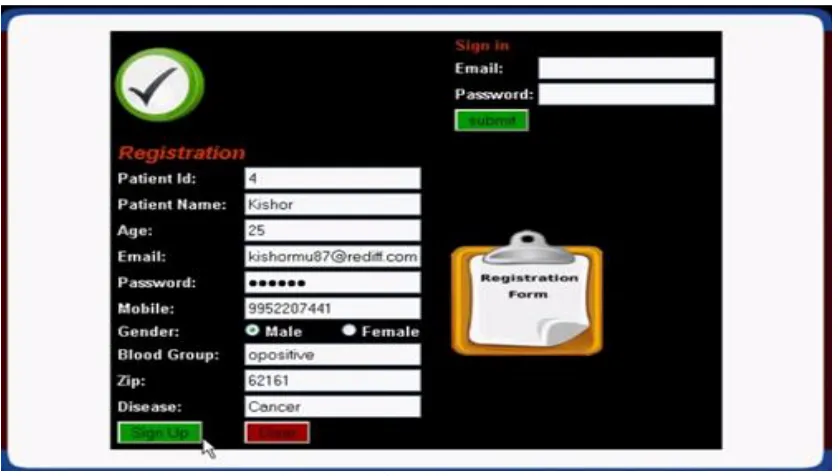
Figure 5 – UI for patient registration
© 2014, IJCSMC All Rights Reserved 48
Figure 6 – Provision for collaborative data publishing
As shown in Figure 6, the prototype application has provision for applying m-privacy for the data provided by four hospitals. The m-privacy concept is applied on the collaborative data and the publishing ensures that the identity of the records is not disclosed. It also ensures that no one can launch collusion attack or identity disclosure attack on the data.
IV. EXPERIMENAL RESULTS
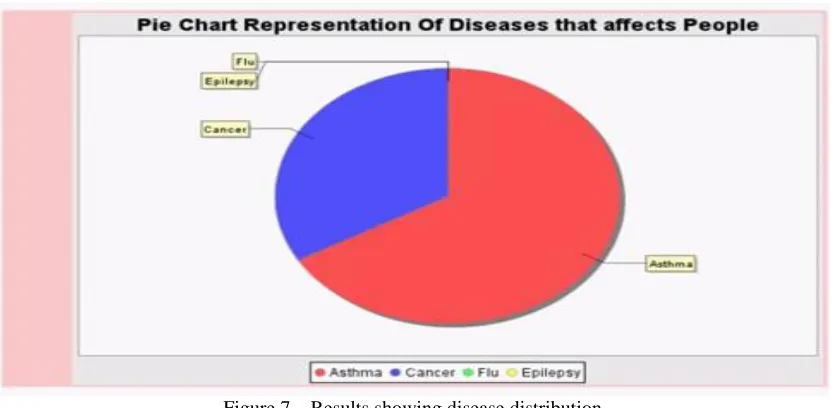
The proposed application demonstrates m-privacy concept with four data providers. The data collected from the data providers is collectively anonymized before using it. The anonymization is done using privacy. The m-privacy guarantees that the identity disclosure attack is prevented. The results of the experiments are presented in Figure 7.
Figure 7 – Results showing disease distribution
© 2014, IJCSMC All Rights Reserved 49
[2] B. C. M. Fung, K. Wang, R. Chen, and P. S. Yu, “Privacy-preserving data publishing: A survey of recent developments,” ACM Comput. Surv., vol. 42, pp. 14:1–14:53, June 2010.
[3] C. Dwork, “A firm foundation for private data analysis,” Commun. ACM, vol. 54, pp. 86–95, January 2011. [4] N. Mohammed, B. C. M. Fung, P. C. K. Hung, and C. Lee, “Centralized and distributed anonymization for high
dimensional healthcare data,” ACM Transactions on Knowledge Discovery from Data (TKDD), vol. 4, no.4, pp. 18:1–18:33, October 2010.
[5] W. Jiang and C. Clifton, “Privacy-preserving distributed k-anonymity,” in Data and Applications Security XIX, ser. Lecture Notes in Computer Science, 2005, vol. 3654, pp. 924–924.
[6] W. Jiang and C. Clifton, “A secure distributed framework for achieving k-anonymity,” VLDB J., vol. 15, no. 4, pp. 316–333, 2006.
[7] O. Goldreich, Foundations of Cryptography: Volume 2, Basic Applications. Cambridge University Press, 2004. [8] Y. Lindell and B. Pinkas, “Secure multiparty computation for privacypreserving data mining,” The Journal of
Privacy and Confidentiality, vol. 1, no. 1, pp. 59–98, 2009.
[9] Slawomir Goryczka, Li Xiong and Benjamin C. M. Fung, “m-Privacy for Collaborative Data Publishing”, IEEE TRANSACTIONS ON KNOWLEDGE AND DATA ENGINEERING VOL:PP NO:99 YEAR 2013, p1-10. [10] L. Sweeney, “k-anonymity: a model for protecting privacy,” Int. J. Uncertain. Fuzz., vol. 10, no. 5, pp. 557–
570, 2002.
[11] P. Samarati, “Protecting respondents’ identities in microdata release,” IEEE T. Knowl. Data En., vol. 13, no. 6, pp. 1010–1027, 2001.
[12] A. Machanavajjhala, J. Gehrke, D. Kifer, and M. Venkitasubramaniam, “l-diversity: Privacy beyond k-anonymity,” in ICDE, 2006, p. 24.
[13] N. Li and T. Li, “t-closeness: Privacy beyond k-anonymity and ldiversity,” in In Proc. of IEEE 23rd Intl. Conf. on Data Engineering (ICDE), 2007.
[14] K. Lefevre, D. J. Dewitt, and R. Ramakrishnan, “Mondrian multidimensional k-anonymity,” in ICDE, 2006.
[15] R. Burke, B. Mobasher, R. Zabicki, and R. Bhaumik, “Identifying attack models for secure recommendation,” in In Beyond Personalization: A Workshop on the Next Generation of Recommender Systems, 2005.
[16] K. LeFevre, D. J. DeWitt, and R. Ramakrishnan, “Incognito: efficient
![Figure 1 – Illustrates a scenario for distributed data publishing [9]](https://thumb-us.123doks.com/thumbv2/123dok_us/1964023.1258982/2.612.124.504.421.562/figure-illustrates-a-scenario-for-distributed-data-publishing.webp)
![Figure 3 – Provider wise data [9]](https://thumb-us.123doks.com/thumbv2/123dok_us/1964023.1258982/3.612.108.521.81.246/figure-provider-wise-data.webp)