ISSN(Online): 2320-9801 ISSN (Print): 2320-9798
International Journal of Innovative Research in Computer
and Communication Engineering
(An ISO 3297: 2007 Certified Organization)
Vol. 3, Issue 4, April 2015
Efficient Segmentation of the Foetal
Ultrasound Image Using Smoothing Algorithm
Shazia Anjum
1, Pavithra G
2., Dr. T.C Manjunath
3M.Tech IV Sem PG Student, CSE Dept., HKBKCE, Bangalore, India1
Asst. Prof., ECE Dept., HKBKCE, Bangalore, Karnataka, India2
Principal, HKBK College of Engg., Bangalore, India3
ABSTRACT: Ultrasound (US) imaging is the modality of choice in many clinical applications compared to other imaging modalities, such as computed tomography (CT). US images are patient-specific, operator-dependent, and machine specific. However these US images are affected by signal dropouts, artefacts, missing boundaries, attenuation, shadows, and speckle, making US one of the most challenging modalities to work with. Earlier work presents qualitative and quantitative segmentation evaluation of the representative selection method submitted to Challenge US: Biometric Measurements from Fetal Ultrasound Images. In this a total of five teams submitted their results to the fetal head sub-challenge and two teams to the fetal femur sub-challenge, including one team who attempted both. The results of the fetal head sub-challenge shows good performance whereas a fetal femur sub-challenge faces the problem in solving a very hard segmentation problem, since the object of interest has strong appearance changes within the object. To deal with this problem the present work proposes smoothing algorithm to smoothen the other elongated objects are present around the femur bone. This algorithm works by computing the optimal fixed range bandwidth in the US image. Finally the proposed work is experimentally evaluated and thus obtains improved result when compare with the existing system.
KEYWORDS: Segmentation, Smoothing algorithm, Optimal fixed range bandwidth, Performance evaluation
I. INTRODUCTION
In imaging science, image processing is any form of signal processing for which the input is an image, such as a photograph or video frame; the output of image processing may be either an image or a set of characteristics or parameters related to the image. Most image-processing techniques involve treating the image as a two-dimensional signal and applying standard signal-processing techniques to it. Image processing usually refers to digital image processing, but optical and analog image processing also are possible. This article is about general techniques that apply to all of them. The acquisition of images (producing the input image in the first place) is referred to as imaging. Closely related to image processing are computer graphics and computer vision. In computer graphics, images are manually made from physical models of objects, environments, and lighting, instead of being acquired (via imaging devices such as cameras) from natural scenes, as in most animated movies. Computer vision, on the other hand, is often considered high-level image processing out of which a machine/computer/software intends to decipher the physical contents of an image or a sequence of images (e.g., videos or 3D full-body magnetic resonance scans).
The paper is organized as follows. A brief introduction about the related work is presented in the next section, followed by the details about the existing systems & the proposed system. System implementation is followed next by the conclusions and the references.
ISSN(Online): 2320-9801 ISSN (Print): 2320-9798
International Journal of Innovative Research in Computer
and Communication Engineering
(An ISO 3297: 2007 Certified Organization)
Vol. 3, Issue 4, April 2015
semi-supervised image segmentation method that relies on a non-local continuous version of the min-cut algorithm and labels or seeds provided by a user. The segmentation process is performed via energy minimization. This method is not applicable in 3D-Medical images. Promising segmentation results is obtained for textures and real-world objects. Ultrasound (US) has been shown to be a safe and effective imaging modality in detecting pregnancy complications such as breech presentation. The non-invasiveness of this technique, alongside its cost efficacy and availability have promoted its uptake in the developed world for routine pregnancy scans and examinations. However the use of US is far less common in low income countries, particularly in rural areas, as there is a lack of training for effective use of this technology and accurate interpretation of the images as well as a relatively high cost associated with the current US devices. Recent technological advancements in the field have led to lower-cost and portable US devices, facilitating its
III.EXISTING SYSTEM
In existing system, automatic segment anatomical structures is presented to measure standard obstetric biometric parameters, from 2D fetal ultrasound images, taken on fetuses at different gestational ages (21 weeks, 28 weeks, and 33 weeks). The segmentation challenge was formed by 4 sub-challenges, named fetal head, fetal abdomen, fetal femur, and whole fetus. Five teams participated in the head sub-challenge and two teams in the femur sub-challenge, including one team who tackled both. Nobody attempted the abdomen and whole fetus challenges. For the head sub-challenge, several groups produced results that could be potentially used in clinical settings. The femur sub-challenge had inferior performance to the head sub-challenge due to the fact that it is a harder segmentation problem and that the techniques presented relied more on the femur’s appearance.
IV. PROPOSED SYSTEM
In proposed the problem in femur sub-challenge is handled by using smoothing algorithm. Two teams participated in this sub-challenge. Both methods relied on appearance and edge information extracted directly from intensity values. The two teams used the following methods. First one is Multilevel Thresholding Combined with Edge Detection and Shape-Based Recognition; second method is Morphology-Based Approach. The result obtains from these two methods results hard segmentation of fetal US image. The result shows that some other elongated objects are present around the femur bone, causing methods to fail in certain situations. These objects are removed by using smoothening algorithm. This algorithm computes optimal fixed range bandwidth. Then for each image, spatial bandwidths using lateral profile of US probe is assigned. Then the pilot density using local spatial scales were computed. Finally adaptive mean shift procedure is defined and executed which efficiently results the smoothened part of region in the image. Experimental result of proposed system provides better result when compare with the existing system.
V. SYSTEM IMPLEMENTATION
In this section, the existing system is implemented in the Matlab software & the simulation results are presented along with brief discussions about the work taken up in the PG project.
ISSN(Online): 2320-9801 ISSN (Print): 2320-9798
International Journal of Innovative Research in Computer
and Communication Engineering
(An ISO 3297: 2007 Certified Organization)
Vol. 3, Issue 4, April 2015
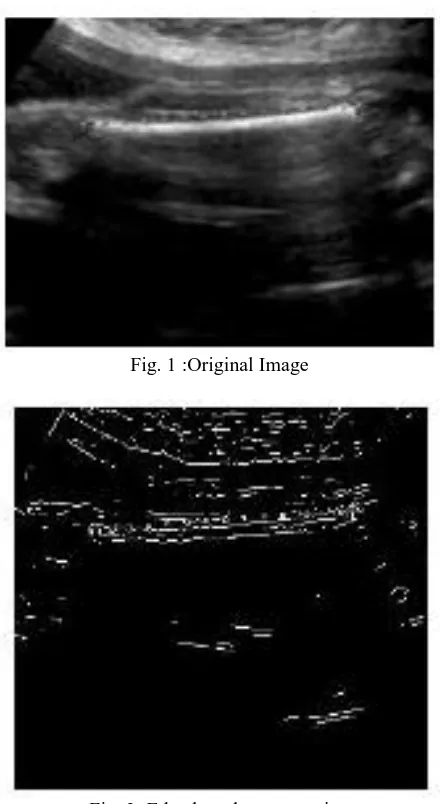
Fig. 1 :Original Image
Fig. 2 :Edge based segmentation
In this module, for smoothening the elongated object of the ultrasound image, variable bandwidth mean algorithm is used which is given by the equation …...
~
(
)
)
(
~
.
2
.
~
)
(
2 0
1
1
f
x
x
f
c
h
x
f
n
x
M
G k n
i i v
ISSN(Online): 2320-9801 ISSN (Print): 2320-9798
International Journal of Innovative Research in Computer
and Communication Engineering
(An ISO 3297: 2007 Certified Organization)
Vol. 3, Issue 4, April 2015
Fig. 4 :Elongated object
ISSN(Online): 2320-9801 ISSN (Print): 2320-9798
International Journal of Innovative Research in Computer
and Communication Engineering
(An ISO 3297: 2007 Certified Organization)
Vol. 3, Issue 4, April 2015
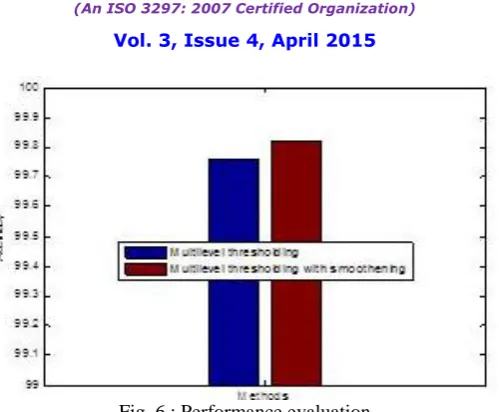
Fig. 6 : Performance evaluation
Performance evaluation
In this module, accuracy of the proposed work is evaluated. Proposed work shows better performance when compared to existing system.
VI. CONCLUSION
In this work a thorough qualitative and quantitative segmentation evaluation of the representative selection of current methods submitted to Challenge US: Biometric Measurements from Fetal Ultrasound Images, held at ISBI 2012. The images were selected to incorporate the different qualities, reflective of a real antenatal clinical environment. Three different gestational ages were assessed to incorporate image variability across gestation. Several experts manually delineated the objects of interest to define the ground truth, which was used within the evaluation framework. For the effective segmentation smoothening algorithm is chosen by using which the accurate and efficient segmentation of ultra sound images are done. The experimental results prove that the proposed work provides better result than the existing work.
REFERENCES
1. Pamela A. Mahon, Cyrus Cooper, Sarah R. Crozier and Keith M. Godfrey, “The use of 3D ultrasound to investigate fetal bone development”, Norweigen journal of epidemiology, Vol 19, No 1, 2009
2. S. C. Perni, F. A. Chervenak, R. B. Kalish, S. Magherini-Rothe, M. Predanic J. Streltzoff And D. W. Skupski, “Intraobserver and interobserver reproducibility of fetal biometry”, Ultrasound ObstetGynecol 2004; 24: 654–658
3. Jamie Shotton, Andrew Blake, Roberto Cipolla, “Multi-Scale Categorical Object Recognition Using Contour Fragments”, IEEE Transactions Of Pattern Analysis And Machine Intelligence, 6 June 2008
4. L. J. Salomon, J. P. Bernard, M. Duyme, B. Doris, N. Mas And Y. Ville, “Feasibility and reproducibility of an image-scoring method for quality control of fetal biometry in the second trimester”, Ultrasound ObstetGynecol 2006; 27: 34–40
5. J. Martin Bland, Douglas G. Altman, “Statistical Methods For Assessing Agreement Between Two Methods Of Clinical Measurement”, Journal of Applied Oral Science, http://dx.doi.org/10.1590/S1678-77572011000500009
6. NawalHouhou, Xavier Bresson, Arthur Szlam, Tony F. Chan2, and Jean-Philippe Thiran, “Semi-Supervised Segmentation based on Non-local Continuous Min-Cut”, Scale Space and Variational Methods in Computer Vision, Volume 5567, 2009, pp 112-123
7. Mohamad Ali Maraci, Raffaele Napolitano, ArisPapageorghiou, J. Alison Noble, “Fetal Head Detection on Images from a Low-Cost Portable USB Ultrasound Device”, Fetal head detection from low cst ultrasound
8. I.Sarris, C.Ioannou, P. Chanmberlain. E.Ohuma, F.Roseman, L.Hoch, D.F. Altman and T.Papageorghiou, “Intra- and inter observer variability in fetal ultrasound measurements”, Ultrasound Obstetgynecol, 2012
9. Anca Ciurte1, Sylvia Rueda2, Xavier Bresson3, Sergiu Nedevschi1, Aris T Papageorghiou4, J. Alison Noble2, and Meritxell Bach Cuadra, “Ultrasound Image Segmentation of the Fetal Abdomen: a Semi-Supervised Patch-Based Appraoch”, Volume 5567, 2009, pp 112-123 10. L.J. Salomon, M. Nassar, J.P. Bernard, Y. Ville, A. Fauconnier, “A score-based method to improve the quality of emergency gynaecological
ISSN(Online): 2320-9801 ISSN (Print): 2320-9798
International Journal of Innovative Research in Computer
and Communication Engineering
(An ISO 3297: 2007 Certified Organization)
Vol. 3, Issue 4, April 2015
BIOGRAPHY
Mrs. Pavithra Chandrasekhar was born in Bangalore, Karnataka, India on September 8, 1984& received the B.E. Degree (Bachelor of Engg.) from Acharya Inst. of Tech..(VTU, Belgaum) in the year 2006 in ECE branch, M.Tech.degree in RF Communications from the prestigious Jain University (Bangalore) in the year 2010 respectively. She has got a teaching (academic), research experience of nearly 8 years in various engineering colleges and is currently working as Assistant Professor in the department of Electronics & Communication Engg.in HKBK College of Engg., Bangalore, Karnataka, India. Her areas of interest are Signals & Systems, Digital Signal Processing, Image Processing, Wireless Communications, Satellite Communications, RF Communications, Basic Electronics, Field Theory, Digital Communications, etc. She has published more than 2 dozen papers in various national & international conferences & journals, also attended more a dozen workshops/FDPs.