ISSN(Online): 2319-8753 ISSN (Print) : 2347-6710
I
nternational
J
ournal of
I
nnovative
R
esearch in
S
cience,
E
ngineering and
T
echnology
(A High Impact Factor, Monthly, Peer Reviewed Journal)
Visit: www.ijirset.com
Vol. 8, Issue 5, May 2019
On Driver’s Drowsiness Detection System
Using an Effective Face Expression
Recognition
Ritendra Ravindra Sawale, Raunak Rajendra Badjate, Krishna Rajendra Chandak, Jagdish Malpani,
Ms. Nital Adikane
B. E Students, Department of Information Technology, MITCOE Pune, India
Professor, Department of Information Technology, MITCOE Pune, India
ABSTRACT: Drowsiness is a process in which one level of consciousness is reduced due to lacking of sleep or exhaustion and it may cause the driver fall into sleep quietly. A Drowsy or sleepy driver is unable to determine when he/she will have an uncontrolled sleep. Fall asleep crashes are very serious in terms of injury. Recent statistics estimate that annually 1,200 deaths and 76,000 injuries can be caused to exhaustion or drowsiness related crashes. More than 25% of highway traffic accidents are caused as result of driver exhaustion. Reduce the risk of an accident by warning the driver of his/her drowsiness. This project is mainly based on four components 1) Face and Eye detection: Performs scale invariant detection using Haar Cascade Classifier perform through a webcam. 2) Eye feature extraction: Eye features are extractedusing Hough Circle and 3) Extract single eye 4) Edge detection and perform drowsiness detection on it. In the proposed method, following the face detection step, the facial components those are more important and considered as the most effective for drowsiness, are extracted and tracked in video sequence frames. The system has been tested and implemented in a real environment. The contribution work is when drowsiness detected, after itwill give alarm warning signal to the driver.
KEYWORDS: Drowsiness, Haar Cascade Classifier, Hough Circle, Image Processing, Real Time Drowsiness Detection, OpenCV
I.INTRODUCTION
ISSN(Online): 2319-8753 ISSN (Print) : 2347-6710
I
nternational
J
ournal of
I
nnovative
R
esearch in
S
cience,
E
ngineering and
T
echnology
(A High Impact Factor, Monthly, Peer Reviewed Journal)
Visit: www.ijirset.com
Vol. 8, Issue 5, May 2019
1.1 MOTIVATION
Vision based real time driver drowsiness systems have been proposed and developed by different institutions; most of the systems are based on eye tracking, head tracking and other facial features that manifest in drowsy drivers. Also gives the alarm signal to the driver for reduce the accidents. This has been highly motivated by the advancement in video image processing algorithms.
II.RELATED WORK
The paper [1] focuses on a driver drowsiness detection system in Intelligent Transportation System, which focuses on abnormal behavior exhibited by the driver using Raspberry pi single board computer. In the proposed system a non-intrusive driver drowsiness monitoring system has been developed using computer vision techniques. Advantages are: This system detects the drowsiness of the driver when the eyes are closed for 4 frames or more (i.e., more than 2 seconds). The system is non- intrusive and can be easily equipped with any vehicle. Disadvantages are: This system is expensive.
The paper [2] represents for enable the vehicle to detect drowsiness or discrepancies in the driver’s behavior and alert the user when it occurs. The main function of drowsiness-/fatigue-detection (DFD) systems is to monitor the driver’s condition and take action accordingly. Advantages are: The vision systems with better time response were the ones that analyzed the driver’s physiological features.
The paper [3] presents visual analysis of eye state and head pose (HP) for continuous monitoring of alertness of a vehicle driver. The proposed scheme uses visual features such as eye index (EI), pupil activity (PA), and HP to extract critical information on non- alertness of a vehicle driver. Advantages are: It gives highest classification accuracy. Minimize the number of errors. Disadvantages are: The SVM classifier shows a low Type-I error, which is morecritical.
The paper [4] presents a nonintrusive drowsiness recognition method using eye- tracking and image processing. A robust eye detection algorithm is introduced to address the problems caused by changes in illumination and driver posture. Six measures are calculated with percentage of eyelid closure, maximum closure duration, blink frequency, average opening level of the eyes, opening velocity of the eyes, and closing velocity of the eyes. Advantages are: The video-based drowsiness recognition method that provided 86% accuracy. Disadvantages are: Need to improve accuracy.
The paper [5] proposed WE in a sliding window (WES), ApEn in a sliding window (ApEnS), and PP-SampEn in a sliding window (PP-PP-SampEnS) for real-time analysis of driver fatigue. The real-time features obtained by WE, PP-ApEn, and PP- SampEn with sliding window were applied to artificial neural network for training and testing the system, which gives four situations for the fatigue level of the subjects, namely, normal state, mild fatigue, mood swing, and excessive fatigue. Advantages are: The driver fatigue can be estimated better by using the method based on EEG, EOG, and EMG signals.
III.OPEN ISSUES
Nowadays more accident occurs in trucks and cars than vehicles due to drowsiness. Nearly 97% of crashes of vehicles happen due to drowsiness of driver. It results into loss for
e.g. human loss, money loss, and medical loss. The accident or crashes not only affect
ISSN(Online): 2319-8753 ISSN (Print) : 2347-6710
I
nternational
J
ournal of
I
nnovative
R
esearch in
S
cience,
E
ngineering and
T
echnology
(A High Impact Factor, Monthly, Peer Reviewed Journal)
Visit: www.ijirset.com
Vol. 8, Issue 5, May 2019
IV.PROPOSED METHODOLOGY
The system starts with continuously capturing the video. The proposed system will generate the frames of driver’s face and eye. Select one frame form the list of frames as known as image. The face and eye detection is based on the PCA algorithm. Detecting the face and eye with such method is proven to be a faster and efficient way of eye detection. This method stays good even under improper/extreme light conditions, as long as the data captured and provided fortraining includes these conditions. The image of drivers face will be processed and the eye images will be derived out of it. Then the eye region along with the boundary of iris will be detected in the frame using Circular Hough Transform. Circular Hough Transform helps in extracting the circles with a center point (xc; yc) and a radius r. The CHT will detect bright spots based on thecircles.
The proposed system consists of three components:
1. Capturing: Camera mounted on the automotive dashboard captures the video of driver’s face includingeyes. 2. Processing: Captured video is converted in frames. Select every frame as facial image is used to determine driver’s eye i.e. open or closed. The driver’s current eye state can be determined using HAAR classifier cascades and Circle Hough Transform inOpenCV.
3. Detecting: When system is to read images and detect drowsy condition when eye is closed.
A. Architecture:
Fig.1 Proposed System Architecture Advantages are:
1. Detects drowsiness.
2. Decreasing roadaccidents.
ISSN(Online): 2319-8753 ISSN (Print) : 2347-6710
I
nternational
J
ournal of
I
nnovative
R
esearch in
S
cience,
E
ngineering and
T
echnology
(A High Impact Factor, Monthly, Peer Reviewed Journal)
Visit: www.ijirset.com
Vol. 8, Issue 5, May 2019
4. No wires, cameras, monitor or other devices are to be attached or aimed at the driver.
5. Due to the non-obtrusive nature of these methods they are more practically applicable.
6. High accuracy in segmentation, low error rate and quick processing of input data distinguishes this system from
similar ones.
B. Algorithms
1. E Algorithm using HAAR Cascaded File
Step1: A Hough Transform function is used to automatically detect circular objects in the image.
Step 2: Horizontal test is applied, since eyes are present along the axis i.e. they lay horizontally. Threshold (distance between two eyes i.e. difference between x axis of centers)
<=10.
Step 3: Apply Upper half test, where the length of the face is divided into two equal halves and upper half is where the eyes are present.
Step 4: Dark pixel test is applied, since iris is dark, this test calculates the average of darkpixels. Radius = constant value
first1 = [x-radius: x+radius, y-radius: y+radius] First = im2bw (first1)
Step 5: Eye Pair Distance Test, distance between the eyes are found manually mu=0.468
cu=15.864 ml=0.418 cl=-7.853 y1= (mu*w) +cu y2= (ml*w) +cl
Where mu, ml are the threshold values of the slope and cu, cl are the threshold values of the intercept. If y1<= distance between 2 eyes <=y2 Then the left out pair of circles are eyes.
2. Face Recognition using Principle Component Analysis
STEP 1: Prepare the Data
The first step is to obtain a set S with M face images. Each image is transformed into a vector of size N and place into the set.
STEP 2: Obtain the Mean
After obtaining the set, the mean image has to be obtained as,
STEP 3:Subtract the Mean from Original Image
ISSN(Online): 2319-8753 ISSN (Print) : 2347-6710
I
nternational
J
ournal of
I
nnovative
R
esearch in
S
cience,
E
ngineering and
T
echnology
(A High Impact Factor, Monthly, Peer Reviewed Journal)
Visit: www.ijirset.com
Vol. 8, Issue 5, May 2019
STEP 4: Calculate the Covariance Matrix
The covariance matrix C is calculated in the following manner
STEP 5: Calculate the Eigenvectors and Eigenvalues of the Covariance Matrix and Select the Principal Components
In this step, the eigenvectors (Eigen faces) and the corresponding eigenvalues ** should be calculated. From M eigenvectors, only M' should be chosen, which have the highest eigenvalues. The higher the eigenvalue, the more characteristic features of a face does the particular eigenvector describe. Eigen faces with low eigenvalues can be omitted, as they explain only a small part of the characteristic features of the faces. After M' Eigen faces are determined, the “training” phase of the
V. RESULTS AND DISCUSSIONS
Experiments are done by a personal computer with a configuration: Intel (R) Core (TM) i3- 2120 CPU @ 3.30GHz, 4GB memory, Windows 7, MySQL 5.1 backend database and jdk 1.8. This application is desktop application used tool for design code in Eclipse and execute. Some functions used in the algorithm are provided by list of libraries like OpenCVjar and JavaCVjar for video capture as well as face and eye detection purpose.The objective here is to capture the video after generate video frames and after read images and drowsiness detect condition when eye is closed. The very first step in this system is to detect the Face, Eye region and the Eye through OpenCV libraries, live video as a input to the system and get output as frame with face and region of interest, simulating the estimated result before actually implementing it to the hardware. The tests were conducted in various conditions including:
1.
Different lightingconditions.2.
Drivers withspectacles.Case 1: driver with normal eye
ISSN(Online): 2319-8753 ISSN (Print) : 2347-6710
I
nternational
J
ournal of
I
nnovative
R
esearch in
S
cience,
E
ngineering and
T
echnology
(A High Impact Factor, Monthly, Peer Reviewed Journal)
Visit: www.ijirset.com
Vol. 8, Issue 5, May 2019
Fig. 3 Open Eye detection result (a) eye detection with circular bounded box and (b) retina detection
Case 2: Driver with sleepy mode
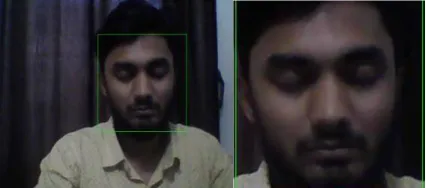
Fig. 4 Face detection result (a) face detection with bounded box and (b) face cropped region
Fig. 5 Closed Eye detection result (a) Closed eye detection with circular bounded box and (b) retinadetection
After finding the consecutive frames if closed eye result displayed, then it will generate the alarm signal to wake up user/driver.
VI.CONCLUSION
ISSN(Online): 2319-8753 ISSN (Print) : 2347-6710
I
nternational
J
ournal of
I
nnovative
R
esearch in
S
cience,
E
ngineering and
T
echnology
(A High Impact Factor, Monthly, Peer Reviewed Journal)
Visit: www.ijirset.com
Vol. 8, Issue 5, May 2019
REFERENCES
[1] SrinivasuBatchu, S. Praveen Kumar,” Driver Drowsiness Detection toReduce the Major Road Accidents in Automotive Vehicles,” International Research Journal of Engineering and Technology (IRJET) e-ISSN: 2395 -0056 Volume: 02 Issue: 01
| April-2015.
[2] Mario I Chacon-MurguiaClaudiaPrieto- Resendiz, ”Detecting Driver Drowsiness- A survey of system designs and technology,” IEEE Consumer Electronics Magazine, pp.107-108, October2015.
[3] Ralph OyiniMbouna, Seong G. Kong, “Visual Analysis of Eye State and Head Pose for Driver Alertness Monitoring” IEEE Transactions onIntelligent Transportation Systems, Vol. 14, No. 3, September 2013.
[4] Wei Zhang, Bo Cheng, Yingzi Lin,” Driver Drowsiness Recognition Based on Computer Vision Technology,” Tsinghua Science and Technology, pp354-362, Volume 17, Number 3, June2012.