CASTLEBERRY, EMILY. Influences of Professional Development on Teachers and Teacher Retention: Perceptions of Teachers and Professional Development Administrators. (Under the direction of Dr. Brad Mehlenbacher.)
The purpose of this case study is to examine the influence of professional development on K-12 teachers to determine how teachers and administrators who are engaged in the professional development process describe their experience with effective professional development in relation to the 12 North Carolina professional development standards, and to ascertain whether the teachers and administrators recognized a relationship between effective professional development and teacher retention. To meet the needs of both the teacher and the administrator, professional development pedagogy must be congruent with the pedagogy desired in the classroom. The study describes both online and face-to-face interviews of teachers who take professional development workshops and administrators who develop them. Teacher Working Conditions (TWC) Survey data from 2002 through 2009 are explored and used as background for the data collected as part of this case study. The TWC data reveal differences in the perceptions of the teachers participating in professional development programs and the administrators who direct those programs (TWC, 2009.)
Influences of Professional Development on Teachers and Teacher Retention: Perceptions of Teachers and Professional Development Administrators
by
Emily Abigail Castleberry
A dissertation submitted to the Graduate Faculty of North Carolina State University
in partial fulfillment of the requirements for the degree of
Doctor of Education
Adult and Community College Education
Raleigh, North Carolina 2010
APPROVED BY:
_______________________________ ______________________________
Dr. Conrad Glass Dr. Karen DeBord
________________________________ ______________________________
Dr. Pooneh Lari Dr. Brad Mehlenbacher
Emily Abigail Mohn Castleberry received her undergraduate Bachelor of Arts degree from the North Carolina Central University in Elementary Education. She received an add-on certificatiadd-on in Specific Learning Disabilities at UNC Chapel Hill. Emily received a Corporation for Public Broadcasting (CPB) scholarship to Ohio University from August 2000 until June 2001. As a CPB Scholar, she received her Masters of Arts degree from Ohio University in Communication within the College of Communications and the School of Telecommunications.
Emily worked as the Literacy Coordinator and Director TeacherLine at UNC Center for Public Television from June 2001 to June 30, 2009. Previously, Emily worked for UNC Center for Public Television as the PreK-12 Manager from March 1, 1996 until February 28, 2000. Prior to this employment she worked for Durham Public Schools at Glen Elementary School as a K-5 teacher from August 1986 until August 1994, and as Sixth Grade Specific Disabilities teacher within the inclusion model at Chewning Middle School from August 1994 until February 1996.
LIST OF TABLES viii
LIST OF FIGURES ix
CHAPTER 1: INTRODUCTION
Introduction 1
Statement of the Problem 1
Purpose of the Study 4
Teachers and Professional Development Administrators 5
Defining Professional Development 6
Exploring Professional Development and Teacher Retention 8
Research Questions 13
Significance of the Study 18
Limitations of this Study 20
CHAPTER 2: LITERATURE REVIEW
Theoretical/Conceptual Framework 22
Professional Development History 24
Quality Professional Development 26
NC 12 Standards of Professional Development 33
State Level Impact on K-12 Teacher Professional Development 35 Putting the NC Professional Development Puzzle Together 36
Summary 39
Major Influencing Factors 40
Theories, Training and Climate 41
CHAPTER 3: METHODOLOG
Introduction to Research Approach 43
Research Design and Rationale 44
Population and Sample 45
Data Management and Procedures
Introduction 46
Sample Selection 47
Online Survey
Introduction 48
Advantages of Web-based Surveys 49
Disadvantages of Web-based Surveys 49
Procedures 50
Pilot Test 50
Sample Selection 51
Open-ended Interviews
Introduction 55
Sample Selection 55
Analysis 56
Other Pertinent Data 64
Data Analysis 65
Verification 65
Role of the Researcher 66
Researcher Background and Bias 67
CHAPTER 4: RESEARCH FINDINGS
Introduction 68
Descriptive Statistics for the Online Survey
Introduction 72
Age
Total Participants 73
Teachers 73
Administrators 74
Years of Service as an Educator
Total Participants 74
Teachers 74
Administrators 74
Number of Job Changes as an Educator
Total Participants 75
Teachers 75
Administrators 75
District/Region
Total Participants 75
Teachers 77
Administrators 77
Race/Ethnicity
Total Participants 77
Teachers 77
Administrators 78
Research Question 1 78
Research Question 2 79
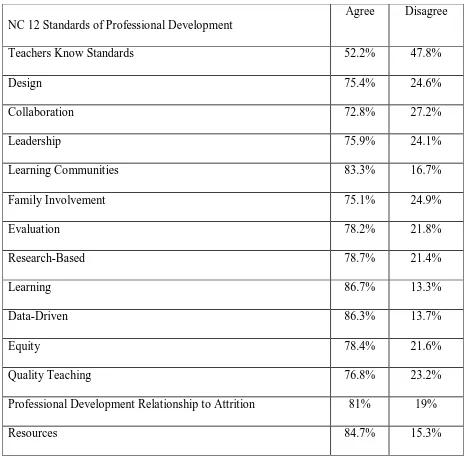
Relationship to NC 12 Standards of Professional Development 79 Results of Online Survey
Introduction 83
Research Question 2 83
Administrators 83
Teachers 83
Total Participants 83
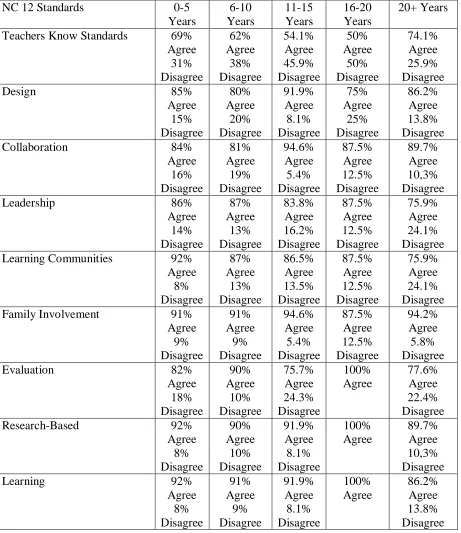
Demographic Factor Age 88
Contextual Factors
Introduction 101
Perceptions of Interviewees 102
Demographics 104
Results of Open-ended Interview 105
Research Question 1 107
Collaboration and Learning Communities 108
Data-driven, Design and Research-Based 110
Equity 113
Evaluation 114
Learning and Quality Teaching 115
Family Involvement 116
Leadership 117
Resources 118
Online Survey and Open-ended Interviews
Introduction 119
Relationship of PD to Teacher Attrition 119
Summary 121
CHAPTER 5: SUMMARY, CONCLUSIONS AND SUGGESTIONS FOR FUTURE RESEARCH
Summary 122
NC 12 Standards of Professional Development 123
Professional Development and Teacher Attrition 124
Conclusions 125
Suggestions for Future Research
Introduction 125
Administrators 127
Teachers and Teacher Leaders 128
Professional Development Specialists 129
K-12 Teacher Assessment Specialists 131
Researchers 132
Closure 132
REFERENCES 134
APPENDICES
Appendices Introduction Page 158
Appendix A: IRB Consent Form 159
METHODOLOGY
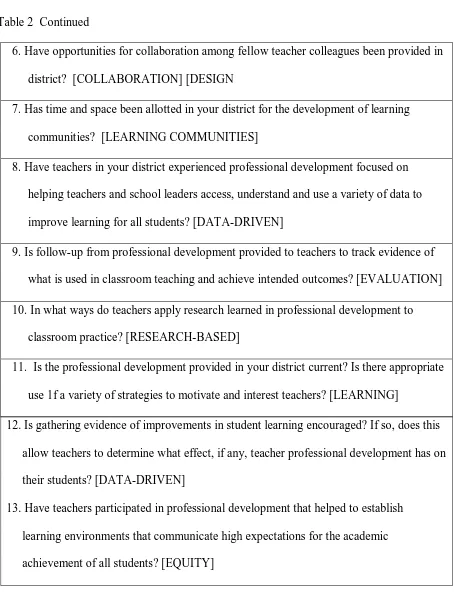
Table 1 Online Survey Questions of NC Teachers and Administrators 52 Table 2 Sample Open-ended Questions of NC Teachers and Administrators 59 RESEARCH FINDINGS
INTRODUCTION
CHAPTER 1: INTRODUCTION Introduction
Teachers are expected to keep abreast of new knowledge, to individualize instruction for a diverse population of students, to help all students achieve high standards, to introduce new technologies into the classroom, to become experts in student growth and development, to help manage the school, and to reach out to parents and the community. K-12 teachers are striving to do all this and more, but they find themselves pressed for time and opportunities to learn. Teachers know that they should work collaboratively yet, daily, they are isolated from other adults (Darling-Hammond, 1998; Guiney, 2001; Loucks-Horsley, Hewson, Love & Stiles, 1998; National Commission on Teaching and America's Future, 1996; National Foundation for the Improvement of Education, 1996; Sokolik, 2005; Wagner, 2001.)
Teachers know that “communities of practice,” which involve working closely with groups of people who share a concern or need can lead to more instances of excellent teaching (Wenger, 1998; Wenger, 2001; Wenger, McDermott & Snyder, 2002; Wenger & Snyder, 2000.) However, neither the time (interviewees’ issue in this study) nor telephones
(interviewees’ feelings of isolation) are available to communicate with other professionals in or outside most K-12 schools (Inman, 2004; Osterholm, Horn & Johnson, 2006.) Ask teachers what they need to do a better job and the first response is always "more time." Statement of the Problem
(Smith, Hofer, Gillespie, Solomon. & Rowe, 2003.) The recruitment and retention of new teachers presents a critical problem within the state of North Carolina as many teachers near retirement age (Gayton, 2008; Hussar, 1999.) The problem is exacerbated by national trends that indicate that one third of new teachers leave during the first year in the classroom and about 50 percent leave after five years (Gayton, 2008; National Commission on Teaching and America's Future, 2003; Yasin, 1999.) According to the Alliance for Excellent Education (2005), teacher attrition costs North Carolina’s schools $188,565,281 each year (not including retirement.) This includes $ 84,497,347 for teachers leaving the profession and $104,067,934 for teachers transferring to other schools (Alliance for Excellent Education, 2005.) The requirement placed on school districts by No Child Left Behind to have teachers meet the “highly qualified” standards complicates the school districts’ constant search for more qualified teachers (Office of the Deputy Secretary, 2004.)
School systems are trying a variety of methods to retain highly qualified teachers. The elements of time, school climate, communication, workload, student discipline and a variety of initiatives are being used to retain teachers (Inman, 2004; Osterholm, Horn & Johnson, 2006.) These factors all fit under the sometimes little understood term of administrator support (Bobek, 2002.) Billingsley (2004) notes the importance of clearly defining expectations. Further, Billingsley indicated when school districts support additional professional development, the faculty members view this as an indication of administration’s belief in their worth and professionalism. This statement appears an obvious conclusion, but according to Billingsley, this is not obvious in all schools and districts across the country. Billingsley concurs that professional development is an important part of teacher retention. She indicates that this especially true for faculty working with special needs children since this is her primary area of research (Billingsley, 2004.) Other school systems try to retain teachers through changes in salary (financial incentives), establishing support groups (learning communities), and through benefits and rewards such as recognition of the teacher’s contributions to the school and community (Davis, 2009.)
Purpose of the Study
The purpose of this case study is to examine the influence of professional development on K-12 teachers to determine how teachers participating in professional development and administrators who are engaged in the professional development process describe their experience with professional development in relation to the 12 North Carolina professional development standards, and to ascertain whether the teachers and administrators recognized a relationship between effective professional development and teacher retention. The learning experiences of the participating teachers and their reflections on how these experiences were connected to their tenure in the classroom are an integral part of this study.
This study focuses on the collection and interpretation of data regarding the
influences of professional development on K-12 teachers in North Carolina along with the perceptions of K-12 teachers and staff development administrators regarding these
influences. Discovering how teachers and administrators viewed professional development required putting all the bits of data together much like completing a puzzle. A cooperative learning environment that provides an open communication between teachers and
administrators through collaboration might be a key to solving the professional development puzzle across North Carolina. Collecting pieces of data required recognizing patterns through discovery and interpretation to provide a clearer picture of how professional development influences teachers through examining teacher and administrator perceptions (Piccoli, Ahmad & Ives, 2001; Smith, 1983.)
(NSDC, 2006.) Opportunities for professional growth and renewal often takes place within the workplace and are integrated into the daily life of practitioners. Opportunities to develop professionally, not only benefited individuals in shaping and performing their craft, but also help ensured that best practice was an everyday procedure and that the most effective
approaches were used (Edwards, 1998; Keller, Ferguson & Wittenborg, 2003; Little, 1993.) Schools struggle to provide adequate professional development for teachers (Schlager & Fusco, 2004.) Problems attracting and maintaining teachers in rural areas were reflected in the growing income differential between rural and urban areas, with poorer counties subject to much higher property tax rates for local school support (Buchanan, 2002; Clewell & Villegas, 2001; Collins, 1999; Gade, Rex, Young & Perry, 2004; Lemke, 1994; Marquardt, 1994;US Department of Agriculture Economic Research Service, 2006.)
Teachers and Professional Development Administrators
backgrounds to leave teaching (Henke, Chen, & Geis, 2000; Murnane, Singer, Willett, Kemple & Olsen, 1991; Odden, Archibald, Fermanich & Gallagher, 2002; Schlechty & Vance, 1983.)
Professional development combined with mentorship may play a role in retaining teachers in the early years. Many first year teachers experience overwhelming isolation as they leave the support of student teaching cohorts, cooperating teachers, and university supervisors to work with children behind the closed door of a classroom. Leaving the support to which they were accustomed in their training may undermine the goals, diminish the spirits, and destroy the self-esteem of first year teachers. New teachers need assistance with both long- and short-range planning, transitioning children from one activity to another, including children with special needs or language differences, and working with parents. This assistance can best be provided by more experienced teachers who are working or have recently worked toward similar goals in similar settings (Certo & Fox, 2002.)
Defining Professional Development
training programs are designed to focus on trainee learning not only at a training site, but also on-the-job (North Carolina Professional Development Committee, 2003.)
Professional development is also the term that educators use to describe the
continuing education of teachers, administrators, and other school employees. The National Staff Development Council (NSDC) provides standards for professional development for all those who work with students and clearly articulates the intended outcome of all professional development should be to improve student achievement. The 12 standards are research-based and organized around three broad areas to support the research: context standards, process standards and content standards (North Carolina Professional Development Committee, 2003.)
High-quality professional learning produces positive results that manifest in teachers’ classroom practice and the performance of their students. Although staff development may have increased teachers’ knowledge of their subject content, unless staff development was high-quality professional learning, teachers would not use that knowledge to improve classroom curricula and help students perform at standard. Staff development may increase teachers’ knowledge of effective pedagogy, but it is high-quality professional learning that causes them to translate that knowledge into more focused and engaging classroom
Context standards address the organization, system, and culture in which the new learning becomes instruction that is implemented and described through structures that must be in place for successful learning to occur. Process standards describe the learning
processes used in the acquisition of new knowledge and skills and address the use of data, evaluation and research. Content examines what students must know and be able to do. Professional development content addresses the knowledge and skills that ensure all students are successful. The NSDC standards serve as the basis for the North Carolina 12 standards of professional development for teachers (North Carolina Professional Development Committee, 2003; North Carolina Public Schools, 2007.) These 12 standards include dimensions related to learning communities, leadership, resources, data driven, research based, design, learning, collaboration, equity, quality teaching, and family involvement. Exploring Professional Development and Teacher Retention
“Fundamental…is the idea that adults are learners just as are children, and learn best when there are ongoing opportunities to develop questions, investigate, reflect, apply and share knowledge in real-life contexts" (p. 4.) Independent or self-directed learning can be defined as "a process in which individuals take the initiative, with or without the help of others” (Knowles, 1975, p. 11), to diagnose their learning needs, formulate learning goals, identify resources for learning, select and implement learning strategies, and evaluate learning outcomes (Knowles, 1975.) Herber and Nelson-Herber (1987) noted the challenge for teachers to become lifelong learners. For example, adult learners who have not been given the responsibility and the expectations for their own transformation and professional development may need modeled independent learning skills in order to incorporate such practice into their own learning as well as their teaching methods (Herber & Nelson-Herber, 1987; Lowry, 1989; Marsick and Watkins, 1989.)
turnover leads to less stable and less effective learning environments for students, places greater demands on other teachers and other school staff members, and increases the amount of money and time that must be spent recruiting, hiring, and training replacements (DePaul, 2000.) High turnover also limits the ability of schools to carry out long-term planning, curriculum revision, and reform, which may in turn have a significant impact on school funding (Halford, 1999.)
To understand the relationship between professional development and teacher retention, it was important to understand how professional development fits into the schema of the standards-based reform and/or accountability movement. Standards-based reform was more than just external standards and assessments, in that teachers were increasingly
expected to emphasize higher order content and more demanding thinking skills (e.g., conjecture versus memorization) than they have in the past (Clotfelter, Ladd, Vigdor & Aliaga, 2004.)
This could be seen as either a challenge to teachers’ professional autonomy, requiring teachers to obtain more content knowledge than the profession has typically required, or the chance to enhance their professionalization (the process whereby an occupation becomes a profession) by facilitating the development of subject-specific content and pedagogical skills (Cohen, 1990; Elmore, Peterson, & McCarthey, 1996; Grant, Peterson, &
learn much at all. Although NCLB (2001, sect. 9191) requires new teachers to have in-depth content knowledge in the fields that they will teach before they enter teaching, professional development was the primary means for deepening content knowledge among current teachers.
To improve classroom teaching in a steady, lasting way, the teaching profession needs a knowledge base that grows and improves (Hiebert, Gallimore & Stigler, 2002.) Furthermore, participation in professional development activities is one way in which states can ensure that teachers were highly qualified according to NCLB (Public Education
Network & National Coalition for Parent Involvement In Education, 2004a, 2004b & 2004c.) Although increased student achievement is the ultimate goal of most current professional development activities, systemic reform initiatives were more likely to have a lasting impact if professional development offerings served to enhance teachers’ commitment to the
profession as well as their knowledge and skills to teach to higher standards (Wenglinsky, 2000 & 2002.)
While few studies have examined the relationship between teacher commitment and professional development activities, Rosenholtz (1989) and Louis (1998) found teachers’ learning opportunities have a direct relationship with teacher self-reports of their
commitment to the profession. Furthermore, Rutter and Jacobson (1986) found the
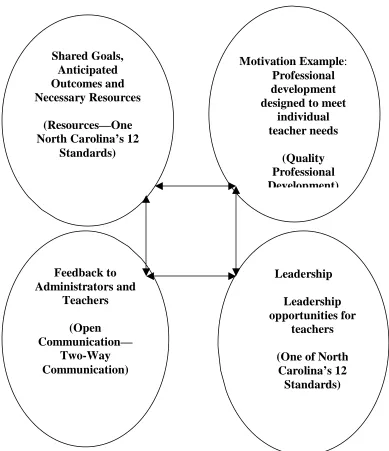
professional development can provide a complete picture of how North Carolina professional development can help K-12 teachers apply or adapt learning (see Figure 1 in Chapter 2.)
Developing an effective means of supporting and retaining teachers was also crucial to creating a quality-learning environment for students and a supportive work environment for teachers. Added to the already difficult task of retaining teachers in North Carolina and other parts of the nation were in continual preparation of those teachers in order to meet the ongoing needs of an increasingly culturally diverse and bilingual population (Bernal, 2002; Branch, 2001; DePaul, 2000; Kestner, 1994; Shure, 2001; Torres-Guzman, 1996; U. S. Department of Education, 2007.) To be successful, teacher professional development needs to be a sustained, intensive effort to improve teaching and learning. This involved both teachers and the professional development administrators across the state. However only 27 percent of teachers nationally who received professional development in 2000 reported that it improved their teaching (NCES, 2001.) The TWC study began in 2002 in response to the state’s need to retain teachers in North Carolina classrooms. The North Carolina 2006 Teachers Working Conditions (TWC) annual survey of North Carolina teachers with 75,000 (66% of North Carolina public school educators) responses from 90% of North Carolina schools looked at time, empowerment, facilities and resources, and professional
involved. The 2008 TWC notes, “School leaders that can empower teachers, create safe school environments and develop supportive, trusting climates will be successful in
promoting student learning.” The TWC also notes that a key issue in retaining teachers is the provision of a supportive learning environment (TWC, 2008.) The 2006 and 2008 TWC studies’ results lead to the belief that a possibility exists that there may have been a difference between the way administrators and teachers describe effective professional development and how they understand the relationship between professional development and retention. The idea of a difference in perceptions by teachers and administrators is identified in the 2008 TWC. The 2008 TWC stresses the different perceptions held by teachers and administrators. Gaps between “the perceptions of teachers and administrators regarding how school leadership addresses teacher concerns” and the degree of the
discrepancies “is startling and must be taken into consideration for any working conditions reforms to be successful” (TWC, 2008.)
Research Questions
Question 1: How do teachers and administrators who engaged in the professional
development process describe their experience with effective professional development in relationship to the 12 North Carolina Professional Development Standards?
standards developed by the National Staff Development Council (NSDC.) These NSCD standards emphasize the importance of not only the content of professional development, but also the process in which it is communicated and the context in which it should occur. Professional development can be either good—adherent to a given set of principles and standards set forth — or bad—by not adhering to a given set of standards. This strong dichotomy serves as the standard and basis for the standards set forth by the state of North Carolina. Although in practice most professional development is a combination of these elements, it is not the role of this researcher to determine what is good or bad professional development, but to note whether a particular form of professional development adheres to standards set forth.
North Carolina became the first state to study teacher working conditions by
surveying teachers and administrators and providing customized reports to individual schools about how their teachers feel about their school and what matters to them in making
decisions about whether to continue teaching. From the first study in 2002 to the fourth study in 2008, the Teacher Working Conditions Survey (TWC), the number of participants continues to grow in the number. The 2002 and 2004 TWC studies found five conditions that concerned teachers—time, professional development, empowerment, and facilities and resources—needed to improve learning conditions of students and to assist in teacher retention. As a result, professional development requirements became a major focus of the North Carolina Department of Public Instruction to meet this need. The number of
percent of the state’s schools (1,985) that reached the minimum response rate (40 percent) necessary to have valid data.
The data received were essential to help policymakers design flexible and effective policies that could be adapted to unique needs of individual school communities (U. S. Secretary of Education, 2003.) In chapters four and five of this research, teachers in North Carolina note lack of input into their professional development. The lack of communication between teachers and administrators was noted in this research (Dufour, 2001.) This lack of communication leads to the question as to whether districts were using the results of the annual survey.
In 2003, North Carolina adopted 12 research-based professional development standards for teachers organized around three broad areas. These standards serve to support teacher reflection research. They include content, context, and process (National Staff Development Council.) Five standards addressed within the professional development division context include learning communities, leadership, resources, data-driven systems and evaluation (DuFour & Eaker, 1998; Dufour & Eaker, 1999; Stein, 1998.) Within the division of process, professional development strands addressed include design, learning, collaboration, and equity and research driven. Within the division of content, two
Question 2: Do teachers and administrators believe there is relationship between effective professional development and attrition?
Teachers and administrators are vital to the success of any school and must work in partnership with schools and school districts in the training, retention, and development of teachers. The educational community is facing a tremendous shortage of trained
professionals, teachers, principals, and other administrators, to serve in leadership roles in our nation's schools. It is crucial that we nurture and support the pool of candidates that now exists as we look for ways to recruit additional candidates for the future (Bolman & Deal, 2002; McCreight, 2000; Roberts & Pruitt, 2009.) There are four essential elements of organizational culture that foster high levels of employee retention. The culture must
maintain choice, balance, development, and care (Bolman & Deal, 1997.) The greatest agent for organizational change is socialization within a culture. If an organization takes on the identity of a growing, adapting, and learning organization, it becomes part of the fabric of how they operate.
It is important for both teachers and administrators to understand how they can work together to meet the professional development needs of North Carolina teachers. The 2004 Teacher Working Conditions survey and the Southeast Center for Teaching Quality
(SECTQ) report notes that teachers and local school administrators had different perceptions of teacher working conditions. How this factor will impact the current study was important to note in the findings.
communication and understanding between administration and teachers might have been expected given the focus of the day-to-day work of administrators and teachers. The overall goal of positively impacting students was the same, but an understanding of how this was accomplished varied. The study data collected complimented existing research on the relationship of professional development to teacher working conditions and any relationship to teacher attrition. Based upon the literature, teachers and administrators in North Carolina recognize the need to restructure current professional development opportunities for all teachers in order to retain teachers and decrease attrition (Teacher Working Conditions, 2004, 2005, 2006, 2007, 2008.)
The variables of age, years of service and number of job changes impacted the responses and perceptions of teachers and administrators to questions during semi-structure open-ended interviews and questions in an online survey. The variables within this research included the personal characteristics or individual factors and the contextual factors
regarding the self-selected teachers and administrators, and their influence on professional development outcomes for teacher. Personal characteristics include age, race, number of years teaching, number of career or job changes. Contextual factors were characteristics of the environment that were related to the effectiveness of collaboration. Contextual
characteristics center on the 12 professional development standards that include learning communities, resources, learning communities, leadership, design, equity, data-driven,
This case study examined the individual and contextual influence of these characteristics impact upon K-12 professional development perceptions of teachers and administrators.
Significance of the Study
Research suggests that professional development activities could influence teacher satisfaction and subsequent plans to remain in teaching (Parkes & Stevens, 2000.)
Professional development is essential to maintaining the requisite knowledge, skills, and attitudes to success on the job (Bempah, Kaylen, Osburn & Birkenholz, 1994; Darling-Hammond, 1997; Ginsberg & Berry, 1996; Murnane & Levy 1996; Rice, Gentile & McFarlin, 1991.) This development was defined as opportunities offered to educators to develop knowledge, skills, approaches, and dispositions to improve job effectiveness. Professional development supports growth through individual and group activity that includes independent study, action research, study groups, peer coaching, journaling,
computer applications, and training. (Arnstine, 1975; Kohl, 1976; Lampert, 1985; McDonald, 1986; Schon, 1983; National Staff Development Council, 2001; Wilson, 1975.)
The 2004 North Carolina Teacher Working Conditions Survey (TWC) showed that North Carolina’s 11,399 teachers or 12.37% of the 92,166 teachers employed in North Carolina’s 117 school systems during the 2003-2004 school year left their systems (Office of the Governor in conjunction with the North Carolina Professional Teaching Standards Commission and the North Carolina Association of Educators, 2004.) The Center for
measures of student achievement, such as Adequate Yearly Progress status under the federal No Child Left Behind Act, student achievement growth and ABC school designation status.
The TWC Survey results indicate a high level of teacher satisfaction with the effectiveness, supportiveness, and professionalism of their school leaders, and with the opportunities they had to design and engage in professional development and school leadership activities (Birman, Desimone, Porter & Garet, 2000; Roberts & Pruitt, 2009.) However, the teachers’ greatest concern in the 2004 survey regards the time available to engage in planning, teaching and professional development critical to reaching all students. This was shown clearly in the closeness of the average rating for professional development (3.77) to the highest rated working conditions domain of leadership (3.78) (NCDPI, 2004.) The summary of the 2004 TWC suggests a correlation between professional development and retention for elementary teachers within the conclusions (NCDPI, 2004.)
The findings for the 2004, 2005 and 2006 TWC surveys suggest a correlation
Smylie & Fuller, 2008.) Grissom analyzed Schools and Staffing Surveys (SASS) and related Teacher Follow-Up Surveys (TFS) from the National Center for Education Statistics and found evidence that principal leadership, an orderly schooling environment, greater
classroom autonomy, and increased professional development predict lower teacher turnover after controlling for student and teacher demographics (Grissom, 2008.) Harris and Spillane looked at distributed leadership and how there were multiple leaders in a school system (Harris & Spillane, 2008.) Woods and Gronn reviewed the comparative merits of distributed leadershipand democratic leadership as understandings of leadership in organizations
(Woods & Gronn, 2009.) Limitations of this Study
As with any study, there were some limitations that must be recognized. Simply collecting data about teacher professional development in North Carolina was not sufficient. Data must be valid, reliable, and clearly defined to meet the criteria regarding teacher and administrator views on professional development and teacher retention. However, collection of too much data can make the process unwieldy and cumbersome. The relationship between increased teacher development and increased time on-the-job is a complex one and
relationships between variables may be accidental rather than causal. Using the qualitative method of interviewing greatly limits the sample size. Time and related costs were limiting factors due to the size and geography of the teacher-administrator population in North
administrators to provide a snapshot of the views of teachers and administrators in North Carolina. This is accomplished by the use of both an online survey made available to teachers and administrators across North Carolina that uses the same questions and information as the interview questionnaire. In a descriptive qualitative case study such as this, verification determines the trustworthiness or how well the results transfer or what were the generalizability of the findings. The elements come together as pieces of a puzzle to provide a clearer picture of the influences of professional development on North Carolina K-12 teachers. By using the case study model that includes open-ended interviews and an online survey, a clearer understanding of the issues becomes possible. Current research relating to the 12 North Carolina standards of professional development adds background to the puzzle of professional development. One limitation that must was considered was that the results of the study may not fully reflect the beliefs of all North Carolina teachers and administrators concerning professional development’s role in teacher recruitment and retention and might not be completely transferable to other states.
Using a descriptive case study brings with it the limitations inherent in a case study. First and foremost this was a descriptive method, not an explanatory one. That is, without the controlled conditions of a laboratory, conclusions about cause-and-effect relationships that could be drawn. Behavior could only be described, not explained. Case studies involve only a single individual or just a few and, therefore, may not be representative of the general group or population. Case studies often rely on descriptive information provided by different people. This is retrospective data, and is therefore subject to the problems inherent to
CHAPTER 2: LITERATURE REVIEW Theoretical/Conceptual Framework
The theoretical or conceptual framework for this study was based upon professional development theory. There has been a growing consensus in the literature regarding the elements of effective professional development for teachers. It incorporated principles of adult learning: Adult learners need to be self-directed; displayed readiness to learn when they have a perceived need, and they desired immediate application of new skills and knowledge (Knowles, 1980.) Effective professional development was embedded in the reality of schools and teachers' work (Darling-Hammond & McLaughlin, 1995; Darling-Hammond, 1996, Darling-Hammond, 1997; Elmore, Peterson, & McCarthey, 1996; Garet, Porter, Desimone, Birman, & Yoon, 2001.) Professional development was designed with teacher input and fosters critical reflection and meaningful collaboration. It is internally coherent and rigorous, and it was sustained over the long term (Little, 1993; Renyi, 1996; Sparks & Hirsch, 1997.) Promising professional development was aligned with effective teaching and learning: "Principles that describe effective teaching for students in classrooms should not differ for adults in general and teachers in particular" (Rueda, 1998.) Professional development
activities that have significant, positive effects on teachers’ knowledge, skills and changes in classroom practice have three components. Quality professional development focuses on content knowledge; provide opportunities for active learning, and coherence with other learning activities (Garet el al, 2001; Hirsch, 2001.)
& Pogson, 1995.) Involving learners in planning and implementing learning activities were seen as the foundation for successful learning. Current research on teacher preparation, licensure, and recruitment begs the question — how effective was today's teacher education and professional development (Sullivan, 2002)? Current teacher professional development often provided mandatory and uniform opportunities for teachers that were ancillary to teacher practice, and that were periodic in nature (Sandholtz, 2002.) Ironically much of accepted pedagogy regarding the factors and conditions that promoted effective student learning was often ignored when it comes to the adults who teach and work in K-12 schools (Bredeson, 2003; Van Driel, Beijaard & Verloop, 2000.) Instead of teachers engaging in personally matched learning, and collaborating with peer learners on relevant tasks,
predetermined programmed professional development was all too often the norm (Cameron, 1996; Cochran-Smith & Lytle, 1990; Elmore, 1995.) Breaking teachers into groups simply renaming those groups learning communities does not create “learning communities.” The theoretical framework of adult learning theory shares the many aspects of the teaching career and need for ongoing quality professional development that requires teachers to become lifelong adult learners (Dufour, 2004; Eleonora, 2003; Hiebert; Gallimore, & Stigler, 2002; Hord, 1998; Roberts & Pruitt, 2009.)
classroom tales. By starting out planning together and sharing ideas on a regular basis, the learning community developed as teachers bonded. As a result, there was a boost in teacher morale and student achievement (Rigsbee, 2008.)
Professional Development History
The professional development literature points to the inefficiencies of large group, one-time professional development sessions led by experts with little or no follow-up (Darling-Hammond, 1997; Loucks-Horsley et al, 1987.) In large group sessions teachers often received credit for occupying a seat during a professional development session, but neither had ongoing support nor were held accountable for perceived professional
development learning (Shibley, 2001.) Female adult learners constitute a large portion of the K-12 teacher population. This portion of the adult learner population may have gender specific learner needs such as learning style and the type of learning support he or she may require (Hayes & Flannery, 2000.) As noted previously, much of what andragogy teaches about how adults learn is greatly ignored when professional development is offered to the adults who work within K-12 schools (Bredeson, 2003; Merriam, 2001; Sandholtz, 2002.) For example, an adult teacher with more than 20 years of experience teaching one way in a given area requires more than a one-shot afternoon workshop to shift thinking into a
lead teachers to see themselves as acted upon by change as opposed to being agents of change (Lieberman, 1995, 1996.)
The professional development literature points to the inefficiencies of large group, one-time professional development sessions led by experts with little or no follow-up (Darling-Hammond, 1997; Loucks-Horsley et al, 1987.) In large group sessions teachers often received credit for occupying a seat during a professional development session, but neither had ongoing support nor were held accountable for perceived professional
Quality Professional Development
Quality professional development can lead to important qualitative outcomes such as the creation of a positive school culture, improvement in individual teacher skills, and development of opportunities for peer learning (Cohen, 2009; Haslam & Seremet, 2001.) School climate is based on these patterns and reflects norms, goals, values, interpersonal relationships, teaching, learning, leadership practices, and organizational structures. Quality professional development gives teachers at all experience levels the tools they need to approach classroom challenges with agreement, and access to a professional community that can support their endeavors provided resources, time, standards support and equity were in place (Cohen, 2009; Grossman, Wineburg & Woolworth, 2001; Haslam & Seremet, 2001.)
Numerous studies on effective professional development cite that ongoing
development activities (Buldu & Yilmaz, 2002; Caldwell, 1989; Ganser, 2000; McCarthy and Riley, 2000; National Staff Development Council, 2001, 2006.)
A quality teacher professional development program should include several essential elements. There needs to be a focus on the teacher as central to student learning. The teacher is also a part of the larger school community, and the relationships within that community must be respected. This leads to a focus that spirals outward from individual to collegial to organizational involvement. The context of professional development often extends beyond the school or districts. At each level, the recognition and respect for the leadership abilities of teachers and all members of the school community is essential (McConney, Ayres, Hansen, Cuthbertson, 2003.) Teaching practice and leadership skills advocated by quality
professional development ought to reflect the best available research. Teachers need to be empowered to further develop expertise in subject matter content, technologies and other essential elements that lead to high standards or quality teaching. Quality professional development should be embedded in the day-to-day life of the school (Armour & Fernandez-Balboa, 2001.) Collaboration, time, and resources must be made available for professional development to be successful. Both those who facilitate the professional development and those who participate in that professional development must incorporate a long-term professional development plan (Gabriel Diaz-Maggioli, 2004; Office of Educational Research and Improvement [OERI], 1997; NSDC, 2006.)
an open communication standard between teachers and administrators. First, teachers need a “collaborative environment” in which teachers feel safe and supported (Chubbuck, Clift, Allard & Quinlan, 2001; Darling-Hammond & McLaughlin, 1995; Tinzmann, Jones,
Fennimore, Bakker, Fine, & Pierce, 1990.) Second, leadership opportunities for all teachers regardless of years of service were needed (Barone, 2003; Riordan, 2003.) Third, choice in professional development opportunities provided motivation for learning (Dewey, 1933; Hoban & Erickson, 2004; Loughran, 1996; Torres, Pionte & Preskill, 2005.) Fourth, feedback to teachers and administrators must be an integral part of school cultures
(Bransford, Brown & Cocking, 1999.) Fifth, a set of shared goals, anticipated outcomes, and other teacher specified resources are essential for successful professional development (Bransford, Brown & Cooking, et al., 1999; McCombs, 1996; Pintrich and Schunk, 1996; National Staff Development Council, 2006.) Open communication provides the perimeter of the puzzle and allows teachers and administrators the opportunity to collaborate (Fox, 2008.)
The 2009 National Comprehensive Center for Teacher Quality included aspects of the five puzzle components listed above and fitted well within the parameters of North
induction and mentoring of teachers and included in this strategy an endorsement of a comprehensive system of mentoring and formative assessment. The second strategy addressed the improvement of working conditions. This included addressing working conditions and the measurement of school climate, the involvement of families within the community, and creating a school culture that encouraged collaboration. The third strategy involved differentiation of pay structures and sought to address the need for motivation. The fourth strategy was to provide for teacher advancement and leadership opportunities. This included not only the opportunity, but also the instruction in how to meet this strategy (Lasagna, 2009.)
Effective professional development is thus cyclical, ongoing, and includes the three phases: vision building, implementation, and sustainability (Steinkuehler, Derry, Woods and Hmelo-Silver, 2001.) Teachers learn their craft and improve their practice to meet the diverse needs of a changing K-12 school population (Hindley, 1996.) Professional identity is the teacher’s representation of the self within the context of professional practice. It emerges from an iterative process of reflection on practice through continual evaluation of
performance (Wheeler, Kelly & Gale, 2004.)
Professional development research stresses that professional development is most effective when integrated into a teacher’s daily classroom practice, and incorporates
thoughts and behaviors through strategic processing, (3) remain sensitive to teacher motivation and issues of affect, (4) realize and provide for the fact that teacher learning is developmental, and (5) be contextually grounded. From this foundation, Hawley and Valli (1999) connect each of their eight principles to one or more of these five dimensions of learner centeredness discussed by Alexander and Murphey (1998.) Whether professional development activities are positive or negative on the professional development of the teachers involved depends greatly on the culture of the school setting (Peterson, 2002.)
A recent survey question addressed the use of data to drive educational decisions. Respondents indicated that this was happening in a variety of ways—and nearly two-thirds said they now offer professional development to ensure that data were interpreted accurately. Respondents indicated that 65% of respondents use data to help allocate district resources; 49% use data to aid in staffing decisions; and 45% said their teachers use data to customize lessons based on students' abilities. Finally, the survey noted that 56% said they have student information systems that provide for easy analysis of data (Teaching and Learning, 2008.)
A recent paper from the Center for American Progress focused on six state strategies for attracting and retaining effective teachers in high poverty and high-minority schools. Chait (2009) elaborated on six strategies that include:
Analyze teacher and student distribution
Design an evaluation system to measure teacher effectiveness and improvement of teacher performance
Provide funding for teacher preparations programs that target high need schools
Provide an induction program for new teachers in high need areas and require schools to report their budgets by actual expenditures
Professional development takes place in the real world with many factors impacting its outcomes. Sandra Kerka (2003) divided these factors into four basic categories. The first category is practitioner characteristics such as motivation, experience or whether the teacher is full-time or part-time in status. The second addressed learner characteristics such as stability or transience, educational attainment of the adult learner, how the learner defines “outcomes” and “achievement” along with other individual characteristics. The third category refers to program factors. These factors can include teacher working conditions such as those studied in the North Carolina Teacher Working Conditions Survey (TWC)— autonomy, access to resources and colleagues, standardized curriculum and administrative support. The fourth factor approached by Belzer (2001) was the professional development system characteristics. The characteristics may include a lack of alignment between standards for learners and for practitioners; to what degree state authorities agree;
A particular school’s culture enhances or hinders professional learning. Culture enhances professional learning when teachers believe professional development is important, of value, and "the way we do things around here." Professional development is nurtured when the school's history and stories include examples of meaningful professional learning and a group commitment to improvement. Professional learning is reinforced when sharing ideas, working collaboratively to learn (Marx, Blumenfeld, Krajcik, & Soloway, 1997), and using newly learned skills are recognized symbolically and orally in faculty meetings and other school ceremonies. The most positive cultures value staff members who help lead their own development, create well-defined improvement plans, organize study groups, and learn in a variety of ways. Cultures that celebrate, recognize, and support professional learning bolster professional community (Knapp, Copland, Talbert, 2003; Inverso, 2003; Lasagna, 2009; Peterson, 2002.) There is a growing body of empirical research that indicates, “positive school climate is associated with and predictive of academic achievement, school success, effective violence prevention, students’ healthy development, and teacher retention” (Cohen, McCabe, Michelli & Pickeral, 2009.)
NC 12 Standards of Professional Development
North Carolina’s Twelve Professional Development Standards are divided with three strands of standards: context, process and content. Each of these major components forms s section of what constitutes quality professional development. The standards found within each strand further illuminate a visual picture of what constitutes quality professional development for teachers. Context standards include learning communities, leadership and resources. Process standards include the strands data-driven, evaluation, research-based, design, learning and collaboration. Content standards refer to equity, quality teaching and family involvement (North Carolina Public Schools, 2007.)
In order that North Carolina teachers and all those involved in professional
development have a common understanding of this terminology, the North Carolina Public Schools system has defined the terms as follows:
1. Learning Communities — Professional development that improves the learning of all students and organizes adults into learning communities whose goals are aligned with those of the school and district.
2. Leadership — Professional development that improves the learning of all students and requires skillful school and district leaders who guide continuous instructional
improvement.
4. Data-Driven — Professional development that improves the learning of all students and uses disaggregated student data to determine adult learning priorities, monitors progress and help sustain continuous improvement.
5. Evaluation — Professional development that improves the learning of all students and uses multiple sources of information to guide improvement and demonstrate its impact.
6. Research-Based — Professional development that improves the learning of all students and prepares educators to apply research to decision making.
7. Design — Professional development that improves the learning of all students and uses learning strategies appropriate to the intended goal.
8. Learning — Professional development that improves the learning of all students and applies knowledge about human learning and change.
9. Collaboration — Professional development that improves the learning of all students and provides educators with the knowledge and skills to collaborate.
10. Equity — Professional development that improves the learning of all students, prepares educators to understand and appreciate all students; creates safe, orderly, caring and supportive learning environments and hold high expectations for their academic achievement.
11. Quality Teaching — Professional development that improves the learning of all students, deepens educators’ knowledge, provides them with research-based
12. Family Involvement — Professional development that improves the learning of all students and provides teachers and school leaders with knowledge and skills to involve families and other stakeholders appropriately (NCDPI, 2008.)
State Level Impact on K-12 Teacher Professional Development
Professional development for North Carolina’s K-12 teachers is influenced by a variety of state level entities. The North Carolina Professional Teaching Standards Commission (NCPTSC) establishes standards for North Carolina teachers and teaching profession. The Commission’s standards are aligned with state, regional and national
“ideals” for teaching (NCPTSC, 2004.) The School Improvement Division of North Carolina Public Schools provides statewide leadership for school improvement and recruits, trains, and supervises state assistance teams. Three of the duties assigned to this division impact professional development—staff development coordination, school technical coordination and closing the achievement gap (Harkreader & Weathersby, 1998; North Carolina Public Schools, 2004.) The state level governing programs were just part of the picture.
The Blue Ribbon Commission (2008) reinforces the need for quality professional development of teachers to meet the needs of 21st Century learners. North Carolina was the first to administer a teacher working conditions survey to every K-12 educator and the first to partner with the Federal Twenty-first Century skills focusing on revising standards,
assessment and professional development (May 2008 State Board of Education Meeting.) Currently, a coalition of educators at various levels of academia in North Carolina, professional development producers and providers, professional organizations and
Carolina public instruction. The Race to the Top group efforts are focused on securing funding and creating strategies to positively impact administrators, schools, teachers, and students success across North Carolina. Highly qualified teachers and administrators are essential to the plans of this collaboration. Professional development, adequate resources, a strong infrastructure, coaching and teacher leadership development are areas of concern. Ways to meet the needs of rural school districts in North Carolina include recruitment and training of administrators and teachers, providing a statewide system of evaluation, involving the community, and creating a dynamic, cost-effective technological infrastructure for all North Carolina schools are included in this effort (Race to the Top, 2009.)
Putting the NC Professional Development Puzzle Together
Drawing from the essential elements discussed previously, professional development programs should possess particular characteristics and give importance to certain strategies in order to be successful. This case study explores those characteristics in North Carolina K-12 teacher professional development as a puzzle that addresses how teacher professional
development is viewed by teachers and professional development administrators and possible implications of these perceptions.
As mentioned previously, five major puzzle pieces impact both teachers and professional development administrators in the need to create a cooperative learning
Darling-Hammond & McLaughlin, 1995; Tinzmann, Jones, Fennimore, Bakker, Fine, & Pierce, 1990.) Collaboration is also one of North Carolina’s 12 professional development standards. Another puzzle piece stresses the importance of leadership opportunities for all teachers regardless of years of service (Barone, 2003; Riordan, 2003.) Teacher leadership opportunities fall under North Carolina’s leadership standard. A third major piece of the puzzle notes that choice in professional development opportunities provides motivation for learning (Dewey, 1933; Hoban & Erickson, 2004; Loughran, 1996; Torres, Pionte & Preskill, 2005.) Meeting individual teacher needs in professional development provides motivation for teachers and is part of the aforementioned job embedded professional development. A fourth puzzle piece requires that feedback to teachers must be an integral part of school cultures (Bransford, Brown & Cocking, 1999.) Feedback to teachers and administrators creates open communication. The fifth major puzzle piece is the need for a set of shared goals, anticipated outcomes, and other teacher specified resources essential for successful professional development (Bransford, Brown & Cooking, et al., 1999; McCombs, 1996; Pintrich and Schunk, 1996; National Staff Development Council, 2006.) This fifth piece of shared goals, anticipated outcomes and essential resources provides teachers and
administrators with a common culture and understanding of professional development that benefits both teachers and students. Resources are one of North Carolina’s 12 standards of professional development.
Motivation Example: Professional development designed to meet
individual teacher needs
(Quality Professional Development)
Note: The elements of the diagram are part of a cycle that creates open communication between North Carolina teachers and administrators that can impact teacher professional development.
Figure 1. Professional Development Cooperative Learning Environment Leadership
Leadership opportunities for
teachers (One of North
Carolina’s 12 Standards) Shared Goals,
Anticipated Outcomes and Necessary Resources
(Resources—One North Carolina’s 12
Standards)
Feedback to Administrators and
Teachers (Open Communication—
Summary
Introduction
This study explores how professional development is an essential piece of the
education conundrum in North Carolina for both teachers and the students they impact. The current pertinent research is included as part of this case study.
Professional development research reiterates that professional development is most effective when integrated into a teacher’s daily classroom practice, and incorporates
immediate and ongoing follow-up designed to close identified gaps in a teacher’s capabilities (Johnson, Potter, Pughsley, Wallace, Kellor & Odden, 1999; Fishman, Best, Marx & Tal, 2001.) As addressed previously under the section addressing quality professional
development, the principles noted by Alexander and Murphey (1998) and Hawley and Valli (1999), give clear indicators or what quality professional development should include. Both sets of quality professional development indicators stress the importance of teacher input in the professional development process and both fit well within North Carolina’s 12 standards of professional development.
Principals and other school leaders shape school culture, impact the quality of professional development teachers receive. They do this through three key processes. First, they read the culture, understanding the culture's historical source as well as analyzing
culture is negative or positive depends greatly on principals and other school leaders as they read, interpret and shape the school’s “persona” (Fullan, 1999, 2001, 2002; Peterson, 2002; Peterson & Brietzke, 1994; Peterson & Deal, 2002)
Online surveys for teachers and administrators developed through the use of North Carolina’s 12 standards of professional development aids in the understanding of the
influences of professional development on K-12 teachers. Scaled and open-ended questions are included and responses are analyzed in conjunction with retention data made available through the North Carolina Department of Public Instruction in Chapter 5. Comparisons of perceptions of teachers and administrators are made on common survey or interview items.
Major Influencing Factors
The traditional form of teacher professional development may lead teachers to see themselves as being acted upon by change as opposed to being agents of change (Lieberman, 1995, 1996.) This challenge of professional development is to inspire and prepare classroom teachers to launch curriculum rich activities with the tools that make sense regardless of the delivery format. The definitive goal of technology use in any teaching and learning situation must be the advancement of student learning (Cooper & Bull, 1997; Gibbons & Young, 1997, Roach, Snyder & Seamon, 1996; Rossiter & Bagdon, 1999) in order to meet the Twenty-first Century learning goals.
agreement, and access to a professional community that can support their endeavors. One major component of professional development for teachers and other adult learners is the involvement of the adult learner in the learning process. Involving learners in planning and implementing learning activities is seen as the foundation for successful learning (Guarino, Sandtibanez, Daley, & Brewer, 2004.)
Theories, Training and Climate
Professional development can start a personal journey of growth and discovery that allows the learner to connect with the learning process on a daily and hourly basis. Effective professional development allows the adult learner to bond concept with context and
encourage change in teaching practices to achieve desired academic results for students. Effective professional development strategies may require a change in the ways teachers spend their time, the ways they work together and may develop as teachers involved in professional development build informal support systems, partnerships, teams and
collaborative structures (Astuto, Clark, Read & McGee, 1993; Borthwick, Pierson, Anderson, Morris, Lathem, & Parker, 2004; Roberts & Pruitt, 2009.)
collaboration among adult learners, small group usage appears embedded in adult education (Bruner, 1986, 1990 & 1996; Draper, 1992; Murphy & Lick, 1998.)
CHAPTER 3: METHODOLOGY Introduction to Research Approach
In order to place the puzzle pieces of collaboration, leadership, feedback to teachers and administrators, shared goals and objectives with anticipated outcomes and motivation in their correct locations, this study included the explorations of self-selected teacher and administrator personal characteristics (age, race, number of years teaching, number of career or job changes) and contextual characteristics (12 professional development standards, administrative support, teacher attrition.) This research examined the individual and contextual characteristics influence on professional development.
Research Design and Rationale
Case study research can include quantitative evidence and qualitative data, rely on multiple sources of evidence, and benefits from the prior development of theoretical propositions. Merriam Webster’s Online Dictionary (2008) defines “case study” as “an intensive analysis of an individual unit (as a person or community) stressing developmental factors in relation to environment.” The ideographic case study is descriptive, explanatory, or interpretive (Levy, 2008.) This model fits the research study of determining the influences of professional development on North Carolina teachers.
This research includes surveys and open-ended interviews, with the retrospective interviews following the online surveys. Data from these interviews was meant to augment the survey data and to allow respondents to elaborate more reflectively perhaps on
there is aresearch consensus to support the use of a set of core featuresand a common conceptual framework in professional developmentimpact studies, and urged researchers to move away from automatic biaseseither for or against observation, interviews, or surveys in such studies. Desimone argues that the use of a common conceptualframework would elevate the quality of professional developmentstudies and subsequently the general understanding of how bestto shape and implement teacher learning opportunities for the maximum benefit of both teachers and students (Desimone, 2009.)
Population and Sample
The population for this study includes North Carolina K-12 teachers who have participated in professional development within the past 12-month period and district level K-12 professional development administrators employed in their positions within the last 12-month period. The teacher and administrative samples were self-selected. The online survey of 399 teachers and professional development administrator and open-ended interviews of four currently employed teachers, one retired teacher, two who self-identified as
teacher/administrators and three district level staff development administrators help answer the research questions of how teachers and administrators who are engaged in the
professional development process describe their experience with effective professional development in relation to the 12 North Carolina professional development standards and whether the teachers and administrators recognize a relationship between effective professional development and attrition.
North Carolina school districts. A total of 33 self-identified staff development administrators completed the online survey and four completed open-ended interviews. The K-12 teachers sample was solicited through both the North Carolina Department of Public Instruction Section Chief’s lists and professional teachers’ organizations that the researcher retains including the North Carolina Reading Association, the North Carolina Science Teachers Association, the North Carolina Middle School Association, and the North Carolina Teachers of Mathematics Association to solicit teachers who may have retired or left the teaching profession and the subject division chiefs at the North Carolina Department of Public Instruction to reach teachers currently practicing in North Carolina schools. A total of 367 self-identified teachers completed the online survey and five completed open-ended interviews. A total of 33 self-identified staff development administrators completed the online survey and five completed the open-ended interviews (three district level professional development administrators plus two professional development teacher administrators.) Data Management and Procedures
Introduction
Various data sources added to the richness and depth of this study. The data sources aided in understanding how, why, and under what circumstances conventional and
of triangulation. The final result constituted a case study. The participants in this study are a self-selected sample of North Carolina teachers or administrators out of the possible
population who either completed open-ended interviews or an online survey questionnaire. The data received are subjective. The subjective measurement technique provides the only direct means for the assessment of user opinion and preferences (Cushman & Rosenberg 1991.)
Sample Selection
The open-ended interviews consist of five teachers (n = 5) at various stages of years of employment and five professional development administrators (n = 5) also in various stages of years of employment in their positions that are located in different districts across North Carolina. An online survey of teachers (n=366) and professional development
administrators (n=33} garners data about current attitudes and opinions of a diverse group of present and past North Carolina teachers. The researcher made the online survey available to rural and urban areas as well as the three regional areas of North Carolina: mountains, piedmont, and coastal plain as noted in chapter one through existing databases of teachers and administrators. Respondents include all three geographic regions with an n=399 for the online survey. Although an online survey generally garners a lower percentage of the total population, using an online survey allows for comparison and contrast with the open-ended interviews throughout the 115 school districts within North Carolina.