ISSN(Online): 2319-8753 ISSN (Print): 2347-6710
I
nternational
J
ournal of
I
nnovative
R
esearch in
S
cience,
E
ngineering and
T
echnology
(A High Impact Factor, Monthly, Peer Reviewed Journal)
Visit: www.ijirset.com
Vol. 7, Issue 5, May 2018
Analysis of Load Frequency Control in Two
Area Thermal-Hydro using Fuzzy and
Conventional Controller
Deepti Prakash Bodra1, Pradeep Kumar Shill 2, Dr. Prasanta Kumar Satapathy3
P.G. Student, Department of Electrical Engineering, C.E.T, Bhubaneswar, Odisha, India1 P.G. Student, Department of Electrical Engineering, C.E.T, Bhubaneswar, Odisha, India2 Professor, Department of Electrical Engineering, C.E.T, Bhubaneswar, Odisha, India3
ABSTRACT: This work involves the analysis of Load Frequency Control (LFC) of 2 different area and analysis of its
system parameters. Though LFC helps in maintaining uniform frequency, to divide the load between the generators and to control the tie-line interchange schedule, we compare the values of undershoot, overshoot and settling time in fuzzy and some conventional controller (i.e. PI and PID). Considering area-1 as thermal and area-2 as hydro, a step load perturbation of 1% is applied in area-1. We develop the model of the system in MATLAB Simulink environment, and we compare for each case using the proposed controller. The output response of proposed fuzzy logic controller exhibit better performance than both PI and PID controller.
KEYWORDS: Load Frequency Control, Fuzzy Logic Controller, Conventional Controller, Tie-line, Two Area.
I. INTRODUCTION
The General Role of Power System is to transmit generated electric power to consumer end, consumer can be small or big depending on it, and it comes in different size from those with single small generator to multiple generators that loads to the gigantic resulting the cost is also affected so to minimise the loss from every aspect in terms of money, time and power, the supply of load demand should match with generation [1]. So the important function is to make both the active and reactive power steady. In terms of LFC active power is considered because for frequency active power demand is controlled failing to which the machine speed will vary with consequent change in frequency (maximum permissible change in frequency is ±0.5 . Similarly for reactive power the voltage is controlled within its prescribed limits (± 2.5 v). With the time passing load demand vary for peak period and low period. Here in LFC frequency regulation is seen. The objectives of LFC are to provide zero steady-state error of frequency and tie-line exchange variations, high damping of frequency oscillations and decreasing overshoot of the disturbance so that the system is not too far from the stability. In this work Fuzzy Logic Controller (FLC) is used. This type of controller adds a pole at origin resulting in system type so reducing the steady state error. System load is never steady using controller these can be controlled. When there is a uncontrolled case more oscillation, negative overshoot be observed but while comparing to conventional controller and propose work result is shown to see better performances of dynamic responses.
II. TWOAREATHERMAL-HYDROPOWERSYSTEM
ISSN(Online): 2319-8753 ISSN (Print): 2347-6710
I
nternational
J
ournal of
I
nnovative
R
esearch in
S
cience,
E
ngineering and
T
echnology
(A High Impact Factor, Monthly, Peer Reviewed Journal)
Visit: www.ijirset.com
Vol. 7, Issue 5, May 2018
the primary loop typically responds within 2-20 sec. The secondary speed control takes over the fine adjustment of the frequency by resetting the frequency error to zero through an integral action. The relation between the speed and load can be adjusted by changing load reference set point. The adjustment of the load reference set point is accomplished by operating the speed changer motor. The output of each unit at a given system frequency can be varied only by changing its load reference, which in effect moves the speed-droop characteristics up and down. The speed governing system is used to adjust the frequency. A governor adjusts the turbine valve/gate to bring the frequency back to the nominal or scheduled value. For power and load sharing among the generator connected to the system, speed regulation or droop characteristics must be provided. The speed-droop or regulation characteristics is obtained by adding a steady state feedback loop around the integrator. Fig 1 shows ‘Two Interconnected System’.
III.MATHEMATICALMODELLINGOFTWOAREATHERMAL-HYDROPOWERPLANTS
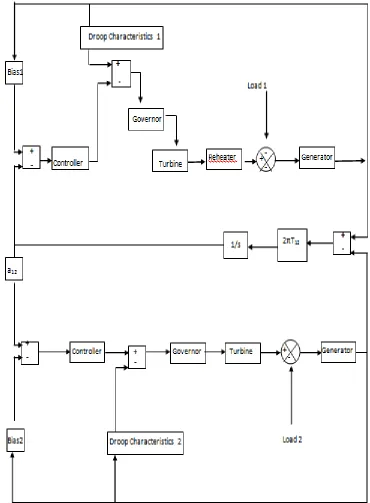
There are two types approach one is i) Transfer function approach and another is ii) State variable approach. Easiest way is to approach on Transfer function approach because it can be easily designed due to numerator and denominator for which determining pole and zero and other is stability is easily noticed on s-plane, as it says for stability it should stay on left half of s-plane [10]. For analysing the system performance, the mathematical model is required, then only control system is designed for which the modelling should exists before. The mathematical modelling of Thermal and Hydro is considered in this work. The tie-line modelling is developed to make the power out and in so it is necessary to work for its transfer function Fig 3 shows ‘Block Diagram of two area LFC’.
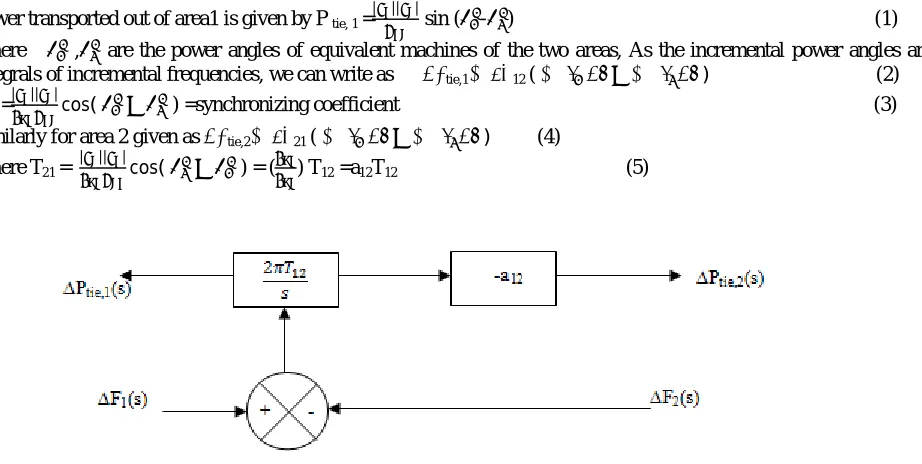
Power transported out of area1 is given by P tie, 1 =
| || |
sin ( - ) (1) Where , are the power angles of equivalent machines of the two areas, As the incremental power angles are integrals of incremental frequencies, we can write as ∆Ptie,1=2πT12 ( ∫ ∆ − ∫ ∆ ) (2)
T21 =
| || |
cos( − ) =synchronizing coefficient (3) Similarly for area 2 given as ∆Ptie,2=2πT21 ( ∫ ∆ − ∫ ∆ ) (4)
Where T21 =
| || |
cos( − ) = ( ) T12 =a12T12 (5)
Fig 2: Transfer function of Tie-line
Control Area 1
Control Area 2
ISSN(Online): 2319-8753 ISSN (Print): 2347-6710
I
nternational
J
ournal of
I
nnovative
R
esearch in
S
cience,
E
ngineering and
T
echnology
(A High Impact Factor, Monthly, Peer Reviewed Journal)
Visit: www.ijirset.com
Vol. 7, Issue 5, May 2018
The Tie-line is used in two area to interconnect between the two control areas.
Using the Tie-line two area Thermal-Hydro systems are constructed which is shown in fig 3.
ISSN(Online): 2319-8753 ISSN (Print): 2347-6710
I
nternational
J
ournal of
I
nnovative
R
esearch in
S
cience,
E
ngineering and
T
echnology
(A High Impact Factor, Monthly, Peer Reviewed Journal)
Visit: www.ijirset.com
Vol. 7, Issue 5, May 2018
IV.CONTROLLERSUSED
a. Conventional PI Controller
b. Conventional PID Controller
c. Fuzzy Logic Controller(FLC)
These Controllers used for comparison to see whose system parameters are evaluating best result in terms of its overshoot, undershoot and settling time.
For PIthe proportional gain provides stability and high frequency response. The integral term insures that the average error is driven to zero. Advantages of PI include that only two gains must be tuned, that there is no long-term error, and that the method normally provides highly responsive systems. The predominant weakness is that PI controllers often produce excessive overshoot to a step command.
For PID the equation The mathematical equation for the PID controller is given as y(t) = Kpe(t)+
Ki∫ ( ) +Kd e(t)
Where y (t) is the controller output and r(t) is the input.A proportional controller ( )will have the effect of reducing the rise time and will reduce but never eliminate the steady-state error. An integral control ( ) will have the effect of eliminating the steady-state error, but it may make the transient response worse. A derivative control ( ) will have the effect of increasing the stability of the system, reducing the overshoot, and improving the transient response. The limitation conventional PI and PID controllers are slow and lack of efficiency in handling system non-linearity. Generally these gains are tuned with help of different optimizing methods such as Ziegler Nicholas method, Hit and trial Method (manual Control) and optimal control solution. The values obtained in this work is through optimal control solution and the values obtained in optimal control solution method for PI Controller.
Kp= -0.8147 and Kd = -0.1270
For PID controller Kp = -0.0005 , Ki= -0.6126 and Kd= -0.8790
There are some uncertainties in load and change in system parameter is seen. So to avoid such situation soft computing method is used as Fuzzy Logic Controller to tuned continuously.
C. Fuzzy Logic Controller: The development of power system characteristics is complex and variable in conventional controller in short difficult in hard computing methods where we use mathematical functions, values to describe the function, but in FLC soft computing is used. For it there are some rules to define which is easy in implementation because it can be replaced easily with conventional controllers to get fast and good response in Load frequency problems. Fuzzy logic controller can be more powerful in solving large scale with respect to conventional controller, which proved to be slower. FLC is designed to minimize fluctuation on system outputs. It mainly consists of 3 stages namely Fuzzification, Inference rule engine and Defuzzification. For LFC the operator assumed as error and change in error. The Fuzzy Controller takes the input as ACE1 and ACE2 which is ACE i = Fi Bi +P tie (6)
Where Bi is the frequency bias, FLC has used in both thermal-hydro using Triangular Membership function to provide
better dynamic response in error and change in error with range -0.1 to 0.1 in thermal and -0.8 to 0.6 in hydro with the rules of 25.The dynamic response is then compared with conventional controllers.
ISSN(Online): 2319-8753 ISSN (Print): 2347-6710
I
nternational
J
ournal of
I
nnovative
R
esearch in
S
cience,
E
ngineering and
T
echnology
(A High Impact Factor, Monthly, Peer Reviewed Journal)
Visit: www.ijirset.com
Vol. 7, Issue 5, May 2018
Ce
E
NL NS Z PS PL
NL
PL PL PL PS Z NS
PL PS PS Z Z Z
PL PS Z NS NL PS
Z Z NS NS NL PL Z NS NL NL NL
Fig 5:
V. SIMULATIONRESULTS
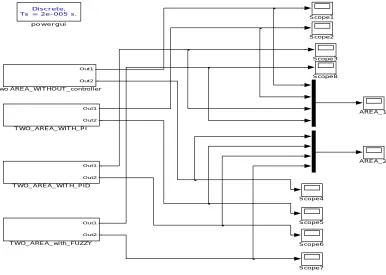
Simulink model of interconnected Thermal-Hydro using Fuzzy and its conventional PI and PID controllers are shown and its result is also shown.
Fig 6 Matlab Design of Area1 and 2
Out 1
Out 2
two AREA_WIT HOUT _control l er D iscrete,
Ts = 2e-005 s.
powergui
Out1
Out2
T WO_AREA_wi th_FUZZY Out1
Out2
T WO_ AREA_WIT H_PID Out1
Out2
T WO_AREA_WIT H_PI
Scope 8
Scope7 Scope6 Scope5 Scope4
Scope 3 Scope2 Scope1
ISSN(Online): 2319-8753 ISSN (Print): 2347-6710
I
nternational
J
ournal of
I
nnovative
R
esearch in
S
cience,
E
ngineering and
T
echnology
(A High Impact Factor, Monthly, Peer Reviewed Journal)
Visit: www.ijirset.com
Vol. 7, Issue 5, May 2018
SUBSYSTEM OF FUZZY
Fig 7: A Subsystem of Fuzzy Matlab Model
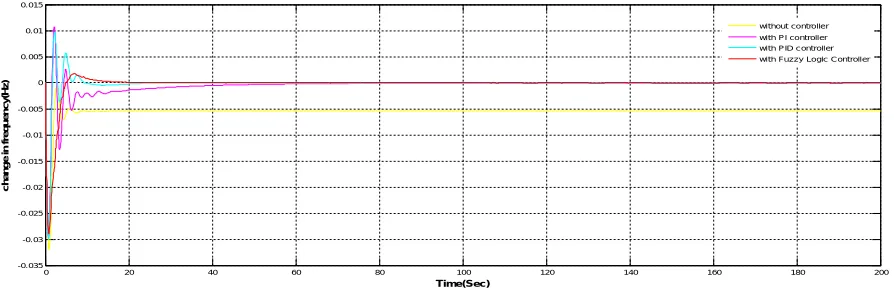
Similarly, different subsystems are designed without controller, with PI and PID controller and Fuzzy Logic Controller for the comparative study. The results are as follows:
Fig 8: For Area1
2 Ou t2 1 Out1 1 0.3s+1 turbi ne2 -s+1 0.5s+1 turbin e1 1 2.4
reul ati on1 5s+1
10s+1
rehe ate r1
1
2 .4
re gul ation 1
0.08s+1
hyd rau li c am pl ifie r1
1
0.2s+1
gove rn or
12 0
20 s+1
gen era to r1
1
0 .6s+1
gen era to r
I n1 Out1
Su bsystem 1
I n1 Out 1
Sub system Scop e .0 1 Constant1 .0 1 Constant
0 20 40 60 80 100 120 140 160 180 200
-0.035 -0.03 -0.025 -0.02 -0.015 -0.01 -0.005 0 0.005 0.01 0.015 Time(Sec) c h a n g e i n f re q u e n c y (H z ) without controller with PI controller with PID c ontroller
ISSN(Online): 2319-8753 ISSN (Print): 2347-6710
I
nternational
J
ournal of
I
nnovative
R
esearch in
S
cience,
E
ngineering and
T
echnology
(A High Impact Factor, Monthly, Peer Reviewed Journal)
Visit: www.ijirset.com
Vol. 7, Issue 5, May 2018
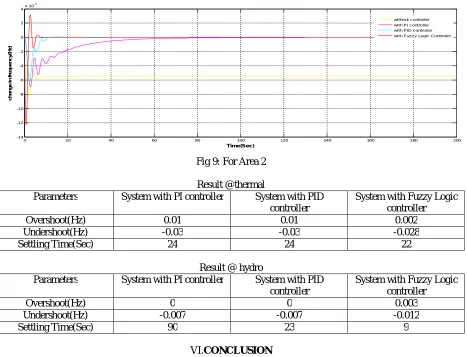
Fig 9: For Area 2 Result @thermal
Parameters System with PI controller System with PID controller
System with Fuzzy Logic controller Overshoot(Hz) 0.01 0.01 0.002 Undershoot(Hz) -0.03 -0.03 -0.028 Settling Time(Sec) 24 24 22
Result @ hydro
Parameters System with PI controller System with PID controller
System with Fuzzy Logic controller Overshoot(Hz) 0 0 0.003 Undershoot(Hz) -0.007 -0.007 -0.012 Settling Time(Sec) 90 23 9
VI.CONCLUSION
From the above work it can be conclude that fuzzy exhibit better performance than its conventional controller We have implemented the Simulink modelling as per foresaid requirement to check the settling time of its system parameters. The FLC have better control performance according to its data obtained on 1% load Perturbation. In short we can say that FLC is adequate for better quality and reliable electric power supply due to less settling time, less peak overshoot and quick rise time.
REFERENCES
[1] C. Concordia, L. K. Kirchmayer, "Tie-Line Power & Frequency Control of Electric Power Systems- Part II", AIEE Trans., vol. 73, part III-A, 1954, pp. 133-141 (1954).
[2] Elgerd.O.I Energy system Theory: an introduction”, New York: McGraw-Hill,. Electric (1982).
[3] Chang CS, Fu W. Area load-frequency control using fuzzy gain scheduling of PI controllers. Electrical Power Syst Res;42:145-52 (1997). [4] B.Anand ,A Ebenezer jayakumar”fuzzy logic based load frequency control of thermal hydro power system with non-linarites(2009)
[5] Kashyap Ramnand,S.s Sankeshwari and B.A.Patil,2013. Load frequency control using fuzzy Pi controller generation of Interconnected Hydro power system, International journal of emerging technologyand advanced engineering (2013).
[6] Prajod, V.S. and M. Carolin Mabel, 2013. Design of PI controller using MPRS method for Automatic Generation Control of hydro power system, International Journal of Theoretical and Applied Research in Mechanical Engineering, 2(1): 1-7.(2013)
[7] Rajaguru, V., R. Sathya and V. Shanmugam, 2015. Load Frequency Control in an Interconnected Hydro-Hydro Power System with Superconducting Magnetic Energy Storage Units, International Journal of Current Engineering and Technology 5(2): 1243-1248(2015). [8] Prabha Kundur,Power system stability and control,Newyork:McGraw-Hill,(1994).
0 20 40 60 80 100 120 140 160 180 200
-14 -12 -10 -8 -6 -4 -2 0 2 4x 10
-3 Time(Sec) c h a n g e i n f re q u e n c y (H z ) without controller
with PI controller with PID controller
ISSN(Online): 2319-8753 ISSN (Print): 2347-6710
I
nternational
J
ournal of
I
nnovative
R
esearch in
S
cience,
E
ngineering and
T
echnology
(A High Impact Factor, Monthly, Peer Reviewed Journal)
Visit: www.ijirset.com
Vol. 7, Issue 5, May 2018
[9] Shabani Hamed, Behrooz Vahidi and Majid Ebrahimpour, 2013. A robust PID controller based on Imperialist competitive algorithm for load frequency control of power systems, ISA Transactions, 52: 88-95.(2013).
[10] Kashyap Ramanand and S.S. Sankeswari, 2014 A simulation model for LFC using fuzzy PID with interconnected hydro power systems, International Journal of Current Engineering and Technology, 3: 183-86(2014).
[11] Ala Eldin Awouda & Rosbi Bin Mamat, “New PID Tuning Rule Using ITAE Criteria”, International Journal of Engineering (IJE), Volume (3), Issue (6).
[12] Mohan BM, Sinha A. Analytical structure and stability analysis of a fuzzy PID controller. Applied Soft Computing;8:749-58(2008).
[13] Muthana T. Alrifai and Mohamed Zribi “Decentralized Controllers for Power System Load Frequency Control” ASCE Journal, Volume 5, IssueII, June, (2005).