ISSN(Online): 2320-9801
ISSN (Print): 2320-9798
I
nternational
J
ournal of
I
nnovative
R
esearch in
C
omputer
and
C
ommunication
E
ngineering
(An ISO 3297: 2007 Certified Organization)
Vol. 3, Issue 7, July 2015
Set-Theoretic Characterization for Blur Face
Recognition
Apurva D. Kandelkar1, Prof.P.A.Tijare2, Prof. S.N.Sawalkar3
Student, M.E. (C.E.), Dept. of C.S.E., SIPNA C.O.E.T, Amravati, Maharashtra, India1
Associate Professor, Dept. of I. T., SIPNA C.O.E.T, Amravati, Maharashtra, India2
Assistant Professor, Dept. of I. T., SIPNA C.O.E.T, Amravati, Maharashtra, India3
ABSTRACT: This paper proposes a novel method for recognizing faces degraded by blur and illumination variation using set-theoretic characterization method. In the unconstrained environment, face recognition becomes difficult because of Blur, noise and illumination. In this paper, we address problem of face recognition in unconstrained domain. The convex set is set of all images which are obtained by blurring a given image. In this algorithm, various blur characteristics are taken under consideration. By blurring image by various blur function convex set is formed and that corresponding convex set is associated with each gallery image. Face recognition algorithm is implemented based on this set-theoretic characterization.
The (LBP) Local Binary Pattern feature of Blurred probe image (which we need to recognize) is extracted. Each convex set is associated with every gallery image in the database. The Local Binary Pattern (LBP) features of all gallery images are extracted. These Local Binary Pattern (LBP) features of probe input image is compared with the LBP features of every image in convex set from the gallery and closest match is identity of probe image. The face recognition is depends on the factor called Similarity between probe image and gallery image. The robust version of this algorithm the input image is divided into different regions and we divide each input image into blocks. These images weight differently when computing the distance of probe image (Ib) and gallery sets (Bj). As a result of this algorithm is able to recognize human faces with good accuracy and for different blur types.
KEYWORDS: unconstrained, Blur, Local Binary Pattern (LBP), convex set.
I. INTRODUCTION
ISSN(Online): 2320-9801
ISSN (Print): 2320-9798
I
nternational
J
ournal of
I
nnovative
R
esearch in
C
omputer
and
C
ommunication
E
ngineering
(An ISO 3297: 2007 Certified Organization)
Vol. 3, Issue 7, July 2015
photograph) but still challenges remain for recognition of faces in uncontrolled domain. Because of variations in appearance due to illumination, pose, noise and degradations of image due to different types of blur the face recognition is becoming challenging problem.
A few existing methods are attempts to handle this problem of blur. An obvious way is to recognizing blurred faces are to deblur the image first and then recognize it by using traditional face recognition techniques. But, it is necessary to solve the blind image deconvolution problem [3] in this approach. The Blind deconvolution is the processes of recovery of a sharp version of a blurred image when the blur kernel is unknown [2] or blind deconvolution is to restore image without prior knowledge about function that blurred the image.
H.Hu and G. D. Haan [4] proposes facial deblur estimation, to obtain blur map of image a robust local blur estimation is applied and deblurred the image which is blurred and then used for recognition. In multi-focusing technique, the blur in image is estimated first and all-in-focus images are restored, but the drawback of this is during restoration process sensor noise may get amplified.
M. Nishiyama, A. Hadid, and O. Yamaguchi, [5] uses Facial deblur inference (FADEIN) approach which first deblur face image but drawback of the approach is to solve Blind image deconvolution.
II. LOCAL BINARY PATTERN
III.
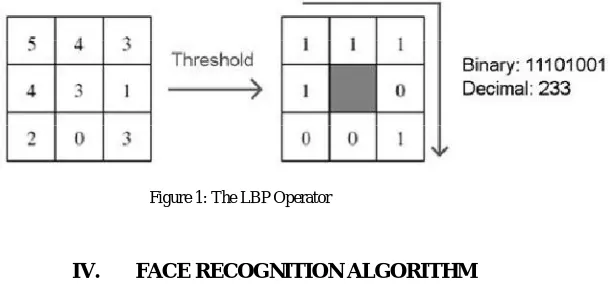
To perform face recognition feature extraction is important process where useful features are extracted from the face image. For the extraction of features the Local Binary Pattern is used. The Local Binary Pattern is used to describe shape of digital image and image texture. The face image is divided into small regions and then every pixel of an image is assigned with the label by the operator and by thresholding the 3x3-neighborhood of each pixel with the center pixel value and considering that result as a binary number [7]. For texture description 256–bin histogram of the labels can be used.
The center pixel as threshold is considered by LBP operator and then works with eight neighbours of a pixel using center value. To each neighbour pixel value ‘1’ is assigned if that neighbour pixel is having higher gray value than the central pixel (or the same gray value) and value ‘0’ is assigned to that pixel if neighbour is having lower gray value than central pixel
Figure 1: The LBP Operator
IV. FACE RECOGNITION ALGORITHM
A. DIRECT RECOGNITION OF BLURRED FACES (DRBF)
ISSN(Online): 2320-9801
ISSN (Print): 2320-9798
I
nternational
J
ournal of
I
nnovative
R
esearch in
C
omputer
and
C
ommunication
E
ngineering
(An ISO 3297: 2007 Certified Organization)
Vol. 3, Issue 7, July 2015
a. Convolution Model for Blur
In any blurred image, blurring is form of bandwidth reduction of the ideal image which results to imperfect reduction of ideal image. In any blurred image, a pixel is weighted average of pixels neighbourhood in original sharp image. To model blur, convolution operation is performed between original images and blur kernel. The blur image (Ib) is given by
Ib=I*H(r,c)
Where r is row and c is column indices of image and convolution operator is represented by * operator. This convolution model is expressed by function kblur= fspecial (‘motion’, 25, 90) in this algorithm. The blur kernel may possess additional structure depending on the type of blur. The types of blur which are implemented in the algorithm are Motion blur, Gaussian blur and General blur.
b. Set of Blurred images
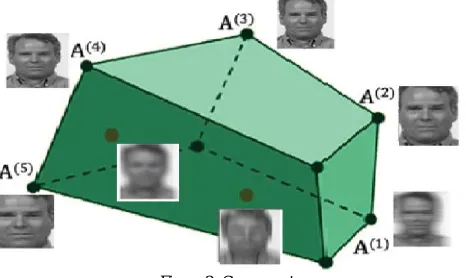
We are going to characterize the set of all images obtained by blurring image I. Two types of Gaussian blur three types of motion blur, one disc blur and a general blur are total seven types of blur implementation in our algorithm. is convex set which is obtained by blurring an image.
≜{ | ≥0, ||h||1=1}
c. Geometric Face Recognition algorithm
Let I j , j = 1, 2, . . . , M be the set of M sharp gallery images. To the every image in gallery (Ij) associated convex set of blurred images (represented by Bj) is formed. For every gallery image LBP features are extracted. The extracted LBP feature of probe image is compared with every LBP feature of gallery image. The gallery image with similarity and that image having closest match is the identity of blurred image.
Algorithm 1 DRBF/rDRBF Algorithm: Algorithm for Recognizing Blurred Faces
Input: (Blurred) probe image Ib and Ij is set of gallery images.
Output: Identity of probe image
1. For each gallery image Ij, the convex set associated with each gallery image is formed. 2. Blur each gallery image Ij with every blur type and extract LBP features.
3. Compare the probe image LBP features with gallery images LBP features and find the closest match.
V. IMPLEMENTATION
In this paper, by using set-theoretic characterization methods, an algorithm performs face recognition across varying blur condition. In this, convex set is formed which is set of all images is obtained by blurring a given image so corresponding convex set is associated with each gallery image.
ISSN(Online): 2320-9801
ISSN (Print): 2320-9798
I
nternational
J
ournal of
I
nnovative
R
esearch in
C
omputer
and
C
ommunication
E
ngineering
(An ISO 3297: 2007 Certified Organization)
Vol. 3, Issue 7, July 2015
The distance of probe image (which is to be recognize) from each convex set is to be computed and assign it to closest gallery image. The algorithm computed with closest image by LBP (Local Binary Pattern) space. Figure shows the implementation block diagram of DRBF algorithm. This set-theoretic characterization method is used for implementing a blur-robust face recognition algorithm.
Figure 3: Implementation Block Diagram of DRBF algorithm
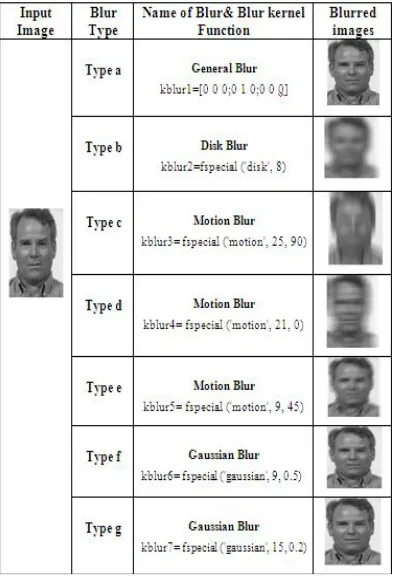
To evaluate the proposed algorithm DRBF on different types and amount of blur, we synthetically blur face image from FERET dataset with seven different types of blur: General blur, Disk blur, Motion blur and Gaussian blur. The following table shows various types of blur and blurs functions implemented in our algorithm.
ISSN(Online): 2320-9801
ISSN (Print): 2320-9798
I
nternational
J
ournal of
I
nnovative
R
esearch in
C
omputer
and
C
ommunication
E
ngineering
(An ISO 3297: 2007 Certified Organization)
Vol. 3, Issue 7, July 2015
In Robust version of algorithm rDRBF, the input image is divided into different regions and weight them differently when computing the distance of probe image (Ib) and gallery sets (Bj). The different face regions have different amount of information. Here input image is divided into blocks 30×30 pixels. LBP features of divided regions are extracted and that are matched with LBP features of gallery images to find the closest matched.
VI. EXPERIMENT AND DISCUSSION
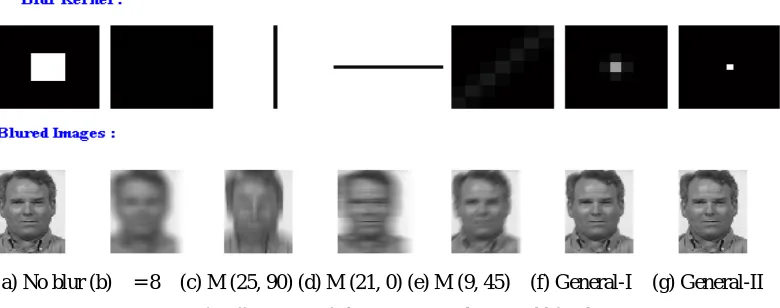
In this section, the algorithm is applied and is used to test performance of set-theoretic characterization method on different kind of blur input faces. An experimental result is performed on some publically available dataset for face recognition such as FERET dataset. We consider only 102 gray scale gallery images from FERET dataset for our experiment. The set-theoretic characterization method is used. The frontal images are selected and images are blurred by various type of blur. We investigate motion blur which is caused due to relative motion between camera and the scene, Gaussian blur which is caused by long-time atmospheric exposure. In this, we have set of 102 gallery images and for every gallery image its associative convex set is formed. The input to our algorithm is blurred image. Every gallery image is blurred by different type of blur like General blur, disk blur, three types Motion blur and two types of blur. Following figure shows Convolution Model for blur. The convolution operation of blur is applied for every gallery image.
a) No blur (b) σ = 8 (c) M (25, 90) (d) M (21, 0) (e) M (9, 45) (f) General-I (g) General-II
Figure 4: Different types of Blur images (Convolution Model for Blur).
Based on algorithm, the input blur face image of an unknown is compared with face images of known individuals from a large database. By set theoretic characterization method, every gallery image is blurred by various blur function and convex set is formed for each image, then LBP features are extracted from every gallery images.
ISSN(Online): 2320-9801
ISSN (Print): 2320-9798
I
nternational
J
ournal of
I
nnovative
R
esearch in
C
omputer
and
C
ommunication
E
ngineering
(An ISO 3297: 2007 Certified Organization)
Vol. 3, Issue 7, July 2015
For the every image in gallery, convex set is formed that is set of all images which are obtained by blurring the image. The convolution model for blur as shown below
Then Local Binary Pattern (LBP) of Probe input image are extracted and in the gallery for every image convex set is formed and their LBP features are extracted for comparison with probe image. The LBP feature of probe image is compared with LBP features of all the gallery images. If LBP features of input image are found with similarity of LBP features of face images from the database then we said that face image is successfully recognized. Two images are completely similar, that is identical, objects give the maximum similarity (usually 1 but0 in our experiment since we consider zero as maximum similarity of images), whereas the least similar pairs reach the minimum value 1.
ISSN(Online): 2320-9801
ISSN (Print): 2320-9798
I
nternational
J
ournal of
I
nnovative
R
esearch in
C
omputer
and
C
ommunication
E
ngineering
(An ISO 3297: 2007 Certified Organization)
Vol. 3, Issue 7, July 2015
In the next step, the LBP features of input image are calculated and that are matched with the LBP features of all gallery images and the closest match is the identity of probe image. In robust version of DRBF (rDRBF), the similarity factor is more accurate as compared with the DRBF algorithm.
Table 2: DRBF and rDRBF face recognition with similarity values
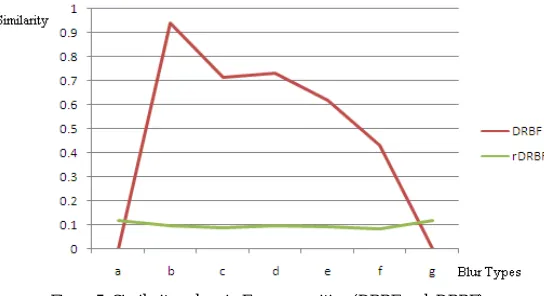
The Table 2 shows the similarity values of recognized face for various blur type in DRBF and Robust DRBF (rDRBF) algorithm. We use FERET dataset as a gallery input set and we create probe image by synthetically blurring the image from FERET dataset using various blur types or blur kernel functions as shown in Table 1.
Figure 5: Similarity values in Face recognition (DRBF and rDRBF)
In gallery, the FERET dataset is used as database and convex set of all gallery images are formed in the database. Table 2 shows input images, that are tested for different blur types and recognized successfully for both DRBF and rDRBF algorithm. The similarity values of DRBF are much better than the rDRBF for various blur like motion blurs (type c, d, e) and Gaussian blur (type f and g). Figure 5 shows, the similarity values are close to zero value (Maximum similarity) that is, rDRBF values are better than DRBF.
VII. CONCLUSION
ISSN(Online): 2320-9801
ISSN (Print): 2320-9798
I
nternational
J
ournal of
I
nnovative
R
esearch in
C
omputer
and
C
ommunication
E
ngineering
(An ISO 3297: 2007 Certified Organization)
Vol. 3, Issue 7, July 2015
Features are based on this set-theoretic characterization. We propose DRBF for blurred face and rDRBF for the robust version of DRBF algorithm. The proposed algorithm tackles the challenging problem of face recognition under uncontrolled condition.
REFERENCES
[1] S.L.Li and A.K.Jain Handbook of face recognition Springer,2005.
[2] R. L. Lagendijk and J. Biemond, “Basic methods for image restoration and identification, ”In Essential Guide to Image Processing. Ed. A. C.Bovic, Boston: Academic Press, 2009, pp. 323–348.
[3] M. Nishiyama, A. Hadid, H. Takeshima, J. Shotton, T. Kozakaya, and O. Yamaguchi, “Facial deblur inference using subspace analysis for recognition of blurred faces,” IEEE Trans. Pattern Anal. Mach. Intell.,vol. 33, no. 4, pp. 838–845, Apr. 2011.
[4] H. Hu and G. De Haan, “Adaptive image restoration based on local robust blur estimation,” In Proc. Int. Conf. Adv. Concep. Intell. Vis.
Syst., 2007.
[5] M. Nishiyama, A. Hadid, H. Takeshima, J. Shotton, T. Kozakaya, and O. Yamaguchi, “Facial deblur inference using subspace analysis for recognition of blurred faces,” IEEE Trans. Pattern Anal .Mach.Intell., Apr. 2011.
[6] R. Basri and D. W. Jacobs, “Lambertian reflectance and linear subspaces, ”IEEE Trans . Pattern Anal.
Mach. Intell., vol. 25, no. 2, pp.218–233, Feb. 2003.