Which way to turn? Guide orientation in virtual way finding
Mark Evers Technical & Professional
Communication University of Twente
The Netherlands [email protected]
Mari¨et Theune Human Media Interaction
University of Twente The Netherlands [email protected]
Joyce Karreman Technical & Professional
Communication University of Twente
The Netherlands [email protected]
Abstract
In this paper we describe an experiment aimed at determining the most effective and natural orientation of a virtual guide that gives route directions in a 3D virtual envi-ronment. We hypothesized that, due to the presence of mirrored gestures, having the route provider directly face the route seeker would result in a less effective and less nat-ural route description than having the route provider adapt his orientation to that of the route seeker. To compare the effectiveness of the different orientations, after having re-ceived a route description the participants in our experiment had to ‘virtually’ traverse the route using prerecorded route segments. The results showed no difference in effectiveness between the two orientations, but suggested that the orientation where the speaker di-rectly faces the route seeker is more natural.
1 Introduction
When someone approaches us and asks which way to go, we naturally turn – if necessary – so we face the direction to take (which makes it also easier for ourselves to imagine traversing the route). Gener-ally, the route seeker then also turns to adapt his or her orientation to match ours, and we end up sharing the same perspective on the route to take.1 Presumably, this matching of physical orientation is
1
This observation is based on personal experience. We also observed this behaviour in a small corpus of route description video’s.
meant to reduce the mental effort that is involved in matching another person’s perspective on a spa-tial scene for both speaker and hearer (Shelton and McNamara, 2004). However, someone who faces an embodied virtual agent presenting a route de-scription in a virtual environment (projected on a computer screen) cannot turn to match his or her perspective with that of the agent, as turning away from the screen would result in losing sight of both the agent and the virtual environment. In this sit-uation, the only way to bring the perspectives of route provider (agent) and route seeker (user) closer together is for the agent to adapt its orientation to match that of the user. In this paper, we describe an experiment carried out to determine if such a change in orientation by the route provider helps the route seeker with virtual way finding. Although the ex-periment was aimed at determining the most effec-tive and natural orientation of a Virtual Guide, we used prerecorded route descriptions presented by a human route provider. The Virtual Guide that we have developed (see next section) was still being im-plemented at the time.
2 The Virtual Guide
We have developed an embodied Virtual Guide2that can give route directions in a 3D environment, which is a virtual reality replica of a public building in our home town. When navigating through this virtual environment, shown on the computer screen from a first person perspective, the user can approach the Virtual Guide to ask for directions. Currently the
2
See http://wwwhome.cs.utwente.nl/˜hofs/dialogue for an online demo.
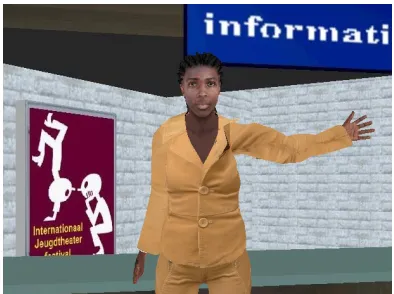
Guide is behind the reception desk (see Figure 1), but she can be situated anywhere in the building.
The first part of the interaction between the Vir-tual Guide and the user consists of a natural lan-guage dialogue in which the Guide tries to find out the user’s intended destination. This may involve subdialogues, in which either the Guide or the user asks the other for clarification, and the resolution of anaphoric expressions (e.g., How do I get there?). Input and output modalities include text, speech and pointing. For an in-depth description of the dialogue module of the Virtual Guide, see Hofs et al. (2003).
When the user’s destination has been established, the Virtual Guide gives a natural language route de-scription, in the form of a monologue that cannot be interrupted. This is somewhat unnatural since in real direction giving, the route seeker tends to give feedback and, if necessary, ask for clarification while the route is being described. However, since in our system dialogue management and the gener-ation of route descriptions are handled by separate, specialised modules this is currently not possible.
The route is presented as a sequence of segments, which are mostly expressed as “point+direction” combinations (Dale et al., 2005). That is, they con-sist of a turn direction combined with the location where this turn is to be made, specified in terms of a landmark. For example, You go left at the
in-formation sign. The route description is generated
as follows. First, the shortest path between starting point and destination is computed based on prede-fined paths in the virtual environment. Turn direc-tions are derived from the relative angles of sub-sequent path segments, and landmarks are selected based on their relative salience (e.g., in terms of size or colour) and proximity to a turning point. The se-quence of turn directions and associated landmarks is then given as input to the natural language gen-eration component, which is based on Exemplars (White and Caldwell, 1998). After a first version of the route description has been generated using a collection of standard sentence structures, this ini-tial description is revised by randomly aggregating some sentences and adding cue phrases such as and
then, after that etc. to achieve some variation in the
generated text.
To generate appropriate gestures to accompany the verbal route description, the generated text is
Figure 1: The Virtual Guide.
extended with tags associating the words in the route description with different types of gestures. Currently this is done using a simple keyword ap-proach. Direction words (left, right) are associated with pointing gestures in the corresponding direc-tions, and references to landmarks are associated with deictic gestures pointing to either the absolute or the relative location of these objects (see Sec-tion 3). Some iconic gestures (i.e., gestures that have a resemblance in shape to what they depict) are also available, for example a horizontal tube-like gesture that can be used in references to corridors and tun-nels. Unlike the pointing gestures, which are gener-ated “on the fly”, the iconic gestures of the Virtual Guide are generated by using canned animations. For a more sophisticated approach to the generation of iconic gestures, see the work by Kopp et al. (in press) who describe the dynamic planning of novel iconic gestures by NUMACK, an embodied conver-sational agent that functions as a virtual guide for the Northwestern University campus.
The last stage of the route description process in our Virtual Guide is to send the marked-up text to the animation planner, which actually generates the required animations in synchronization with text-to-speech output. The animation planner is based on the work by Welbergen et al. (2006).
3 The Guide’s gestures and orientation
point-ing at locations relative to the position of a person who is walking the route. An objective viewpoint makes most sense when pointing at objects that are (in principle) visible to both the agent and the user, which is only the case for objects that are located at the start of the route. So, most of the time the Guide will be using the character viewpoint, pointing left and right relative to its own body to indicate land-marks and directions from the perspective of some-one who is walking along the route being described. The typical orientation of information presenting agents is facing the user. However, it is not a priori clear that this would be the best option for the Vir-tual Guide. When facing the user, all pointing ges-tures made by the guide from a character viewpoint would mirrored in the eyes of the user, so the latter would have to perform a mental 180◦re-orientation of the gestures. This would demand extra cognitive effort on top of processing and storing the verbally presented route information, and might negatively influence the user’s ability to reproduce the route di-rections during actual traversal of the route.
In actual direction giving situations, people of-ten of-tend to minimize the difference in orientation between them. Therefore we wondered if reducing the difference in orientation between the agent and the user would help the user to find his way dur-ing traversal. If the agent would turn to face almost the same direction as the user, its gestures could be expressed as close to the route seeker’s perspective as possible, thus reducing the cognitive load for the user in processing them. Also, we wondered if this configuration would yield a more natural effect than having the agent directly face the user during the route description. We investigated these questions in an experiment where participants had to virtu-ally follow a route, presented to them in one of two versions that differed in the orientation of the route provider. Because the Virtual Guide was still be-ing implemented at the time, we used route descrip-tions by a human route provider. The experimental setup and its results are presented below, followed by some conclusions and future research directions.
4 The orientation experiment
The goal of the experiment was to investigate the ef-fect of speaker orientation on the efef-fectiveness and
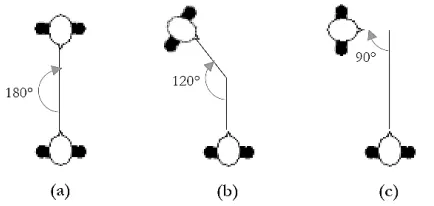
Figure 2: Angle between route provider and route seeker (camera)
naturalness of a route description. For our exper-iment, we opted to use prerecorded route descrip-tions, as this matched the capabilities of our Vir-tual Guide (which can only present the route as a monologue with no interaction) and also ensured an unlimited number of reproductions of constant quality and content. We recorded two separate route descriptions that differed in speaker orienta-tion with respect to the route seeker, but were other-wise (largely) the same:
180◦ version The route provider is oriented at a
180◦angle with respect to the route seeker, i.e., he directly faces the camera lens, creating mir-rored gestures (his left is seen as right by the viewer and vice versa). See Figures 2(a) and 3(a).
120◦ version The route provider is oriented at a
120◦ angle toward the route seeker, as if to adapt his orientation to that of the route seeker. See Figures 2(b) and 3(b).
We chose an orientation of 120◦ for the route seeker-oriented version, so as to maintain visibility of non-verbal signals. If the route provider were to assume an orientation of 90◦ or less, as illustrated in Figure 2(c), not all gestures would be visible and maintaining eye contact could make his posture un-natural.
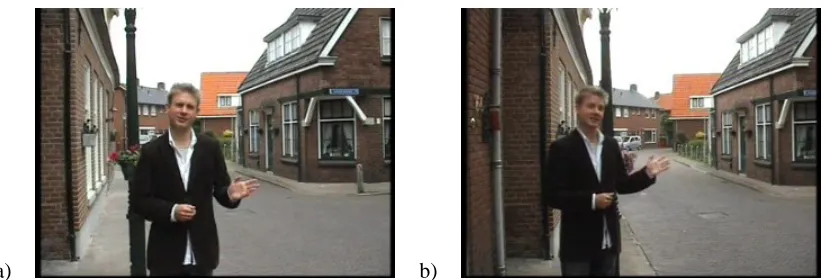
a) b)
Figure 3: “Turn left at the white building” (a: 180◦, b: 120◦)
of landmarks. The route being described led from the recording location to the town hotel. The verbal description was similar in structure to those gener-ated by the Virtual Guide. It mentioned five decision points, each connected with one or two characteris-tic landmarks. For example, At the men’s fashion
shop, you turn right. During the route description,
the route provider made beat gestures and pointing gestures from a character viewpoint, taking his own body orientation as a reference for left and right. Apart from a few slight variations, the gestures used in both versions of the route description were the same; see Figure 3. At the start of the route de-scription, both route provider and route seeker were exactly (180◦version) or almost (120◦ version) per-pendicular to the starting direction of the route.
After viewing one of the two versions of the route description, the participants in the experiment had to ‘virtually traverse’ the route (to measure effec-tiveness of the route description) and were asked how natural they found the route description. The most realistic way to measure effectiveness of the route description would have been to have the partic-ipants walk the route in reality after having received the description, as was done by Fujii et al. (2000) and Michon and Denis (2001). However, conduct-ing such an experiment is a very time consumconduct-ing activity. As a more practical alternative we devel-oped a reconstructive method allowing participants to traverse the route on the computer, instead of in a real (live) environment. In this set-up, participants ‘traversed’ the route by viewing prerecorded route segments, showing a moving scene from a first per-son perspective as if they walked through the streets
themselves, accompanied by street sounds. Apart from practical considerations, an additional advan-tage of this set-up is that it yields full control with respect to repeatability and the participation setting because of its playback nature.
Our hypotheses were as follows:
1. The 120◦ version is more effective, i.e., yields a more successful traversal than its 180◦ coun-terpart.
2. The 120◦ version yields a more natural route description than its 180◦counterpart.
4.1 Participants
A total of 49 participants were involved in the ex-periment, aged 20 to 64 years (with an average of 33 years). Since no participants were younger than 12 or post 70, no specific effect of age on their spatial skills was expected (Hunt and Waller, 1999). Since gender is an influential factor in orientation and way finding (Hunt and Waller, 1999; Lawton, 1994), we used a 50% male - 50% female test population. The 120◦ version of the route description was shown to 13 male and 12 female participants; the 180◦version to 11 male and 13 female participants.
4.2 Procedure
The experiment consisted of the following steps.
Introduction - After reading an introductory text
5-point scale ranging from not at all familiar (1) to very familiar (5). If the participant indicated being moderately or more familiar with the location, his or her results were discarded. The questionnaire was followed by an example question to familiarize the participant with the controls and with the set-up of the traversal part of the experiment.
Route description - First, the participant was
shown a video impression of the location where he or she, being lost in an unfamiliar town, supposedly approached someone to ask the way to the hotel. Then the participant watched one of the two pre-recorded route descriptions. To compensate for the fact that, unlike a real-life situation, there was no opportunity to verify understanding or ask for clar-ifications, the participants were allowed to play the route description video twice.
Traversal - After having received the route
de-scription, the participant had to virtually traverse the route by watching six prerecorded traversal seg-ments in succession, appearing in a pop-up window. The first segment began at the starting point of the route and ended at the first decision point (intersec-tion). Each following segment started where the pre-vious one ended, with the final segment ending at the destination of the route. At the end of each route segment, an overview of the next intersection was provided by moving the camera viewpoint gradu-ally so the entire intersection was shown. The av-erage length of each traversal segment was around 1.5 minutes.
After watching each segment, the participant had to select which direction to take next from a lim-ited set of options: left, straight ahead or right (if applicable). Each option was accompanied with a photo of the corresponding view from the crossing. After answering the question, the participant was in-formed which direction was correct. Then the par-ticipant proceeded with the route traversal from the correct turn, regardless whether the correct direction had been chosen or not.3
3
This differs from the effectiveness measure of Fujii et al. (2000), who used a movement failure rate defined as Out/N, with Out being the number of times a participant lost the way and was unable to return to the route, and N being the number of trials. We found this method too complicated in design and too confusing for the participants to be used in this experiment. In our set-up, the participant was only allowed one trial per de-cision point and always traveled along the correct route.
120◦ 180◦ Total
Male 3.46 (0.88) 3.27 (1.19) 3.38 (1.01) Female 4.00 (1.04) 3.62 (0.77) 3.80 (0.91) Total 3.72 (0.98) 3.46 (0.98) 3.59 (0.98)
Table 1: Number of correct decisions as a func-tion of gender and version (results are presented as Means with Std. Deviations in brackets).
Post-questionnaire - After route traversal, the
participants answered several questions about the route description. Here we only focus on one of the questions, i.e., “Do you think the route provider de-scribed the route in a natural way?”, to be answered on a 5-point scale ranging from very natural (1) to very artificial (5). The participants were also offered the opportunity to comment on their answer.
5 Results and discussion
Here we present and discuss the main findings from our experiment.
5.1 Effectiveness of the route description
Hypothesis 1 concerned the influence of speaker ori-entation on the effectiveness of the route description. We measured this by counting the number of correct turns taken by the participants during route traver-sal. The route contained five decision points (inter-sections), so participants’ scores ranged from 0 to 5 correct turns. Gender has been proved to strongly in-fluence way finding ability (Hunt and Waller, 1999; Lawton, 1994), so gender was accounted for as a fixed factor in our analysis.
The results are summarized in Table 1, which shows that participants performed slightly better in the 120◦ version than in the 180◦ version, and that women performed slightly better than men. How-ever, these differences were not significant; neither for version nor gender. Thus, our first hypothesis is not supported.
(Rim´e and Schiaratura, 1991; Morsella and Krauss, 2004). Still, though most spontaneous gestures may not be produced for the interlocutor’s benefit, it has been shown experimentally that people do make use of the information conveyed by gestures (Kendon, 1994; Cassell et al., 1999; Kelly et al., 1999). The communicative power of gestures does seem to de-pend on the task and the type of gesture, however (Bangerter and Chevalley, 2007). In fact, in our ex-periment the gestures were not essential for under-standing the route description. All pointing gestures were accompanied by explicit verbal descriptions of the corresponding landmarks and/or directions; in other words, the gestures were redundant with re-spect to speech. So, regarded from a purely informa-tional point of view, these gestures were superfluous and the participants may have paid only limited at-tention to them or even consciously ignored them. This explanation is supported by the comments of various participants who said they tried to focus on the verbal instructions because the description was extensive and they found the gestures distracting.
We consciously limited the number of decision points in the experiment to five, well within the 7±2 range of short term memory, but for each decision point the route provider not only mentioned the di-rection to take, but also one or two landmarks. Fur-thermore, he gave some auxiliary hints of what to do in-between turns (Walk straight ahead until you see
a traffic sign; there you keep walking straight ahead)
and some more details. In their comments, several participants mentioned being distracted by too much detail in the description, and said they found the di-rections hard to remember. As a consequence, some participants tended to ignore the gestures or look away from the computer screen altogether. Obvi-ously, doing so would clearly impair the effect of speaker orientation to be demonstrated by the exper-iment. On the other hand, not all participants ig-nored the gestures (at least not initially) as in the 180◦ version, some participants declared that they found the mirrored gestures annoying.
5.2 Naturalness of the route description
In Table 2, test results on the naturalness of the route description are shown for speaker orientation and gender. Orientation had an almost-significant effect on participants’ judgement of naturalness (two-way
ANOVA; F(1,45)=3.35, p=0.07 two-tailed).4 The effect would have been significant if it had been the other way around. The effect of gender was not sig-nificant, and neither was the interaction of version and gender.
Contrary to our hypothesis, the participants judged the 180◦ version as being more natural than the 120◦version. This was contrary to what was ex-pected, because ‘in the real world’ route providers and seekers tend to minimize the difference in their orientation. In fact, as mentioned above, several participants reported being annoyed by the mirrored gestures in the 180◦ version. These contradictory findings suggest that it was not the route provider’s gestures or their orientation that were crucial for the judgement on naturalness, but only whether the route provider’s body was fully turned toward his au-dience – directly addressing them – or not. This may be the result of many previous confrontations with presenters (human or other) displayed on television or computer screens, explaining things to an audi-ence. Perhaps the natural tendency to make orienta-tions as similar as possible when explaining a route to someone does not transfer to a situation where the route is presented by somebody on a screen: a form of presentation in which we expect someone to be facing us.
Furthermore, the fixed position of the camera dur-ing the route description may also have interfered with its naturalness. If the route provider points into some direction, we tend to turn our heads to that di-rection, maybe in the assumption he will point at some landmark that can help us orientate or navi-gate. The fixed position of the camera, in contrast with the adaptive orientation of the route provider, may have yielded an unnatural combination in the case of the 120◦ version of the route description.
5.3 Gender effects
For both versions of the route description, women performed better than men. Although not signifi-cant, the difference in performance is sufficiently re-markable to merit some discussion. We believe the difference may be explained by the fact that women and men employ different strategies for way
find-4
120◦ 180◦ Total Male 2.62 (1.26) 1.73 (0.91) 2.21 (1.18) Female 2.75 (1.14) 2.46 (1.13) 2.60 (1.12) Total 2.68 (1.18) 2.13 (1.08) 2.41 (1.15)
Table 2: Naturalness as a function of gender and ver-sion (results are presented as Means with Std. Devi-ations in brackets).
ing (Hunt and Waller, 1999): women’s strategies are most suited for tracking and piloting, whereas men use strategies appropriate for navigation. Tracking is a point-to-point way finding strategy that relies on information limited to environmental characteristics along the route. Piloting combines these environ-mental characteristics with self-centered orientation and direction (e.g., “When you’re facing the main entrance, turn to the right”). Navigation, on the other hand, uses configurational information: routes are derived from knowledge of the surroundings of the destination or its global position. Thus, men tend to pay attention to bearings while women often rely on descriptions of control points and cues to the route such as landmarks (Lawton, 1994).
Looking at the set-up of our experiment, we see that it seems to favour a strategy of point-to-point decision making instead of relying on a more gen-eral and global sense of direction, as in naviga-tion. First, the route description consisted entirely of landmarks to identify decision points and turns to be made when encountering them, fitting a track-ing and pilottrack-ing approach to way findtrack-ing. Second, both the route description and the traversal segments were shown on a screen, with a restricted and forced field of vision. This may have impeded the estima-tion of global posiestima-tion, direcestima-tion and distance, i.e., the kind of spatial knowledge men rely on for orien-tation and way finding. So, the way finding strategy that women already tend to employ in everyday life may have been most suited to this experiment and hence their higher score.
6 Conclusions and future work
The goal of this study was to find out which ori-entation of the Virtual Guide would be most ef-fective and natural for providing route descriptions in a virtual environment. To test effectiveness, we devised a method that allowed participants to
‘vir-tually’ traverse a route by watching pre-recorded route segments and making turn decisions at inter-sections. We hypothesized that a speaker orientation of 120◦ with respect to the route seeker would re-sult in a more effective and natural route description than a 180◦ orientation, because it would take the route seeker less effort to match the speaker’s ges-tures with his or her own perspective. However, we found no effect of speaker orientation on task per-formance. A possible explanation lies in the com-plexity of our route description, which caused some participants to focus only on the verbal part of the description. Contrary to our expectation, the 180◦ orientation was judged to be more natural, in spite of the fact that some participants found the mirrored gestures annoying. The reason for this may be that people expect a speaker to be directly facing them when presenting information on a screen.
Based on these results, we decided to stick to the standard 180◦ orientation for our Virtual Guide. However, some reservations are in order when ap-plying the results of our study to the Virtual Guide. For one thing, the route descriptions used in the ex-periment were not given by an agent but by a real human, albeit pre-recorded. This is still far from the situation in which an embodied agent is com-municating with a user by means of an interface. A second difference with the Virtual Guide lies in the participant’s navigational control. In the con-text of the Virtual Guide, the user can actively nav-igate through, and look around in, the environment to be traversed. In our experiment, the participants’ view was restricted and forced by that of the camera which severely restricted their possibilities for ori-entation and navigation.
be less biased toward a 180◦orientation of the route provider. Finally, all information not strictly nec-essary for way finding will be left out of the route description. This includes landmarks located along traversal segments rather than at intersections, and instructions to go ‘straight ahead’ (which several participants found confusing in the current experi-ment). With a less complex description, participants may refrain from ignoring the gestures made by the route provider and thereby be more susceptible to manipulation of speaker orientation.
Acknowledgements
The authors would like to thank Mark Tempelman and Job van den Wildenberg for their help with the experiment. The Virtual Guide was imple-mented by Dennis Hofs, Rieks op den Akker, Marco van Kessel, Richard Korthuis and Martin Bouman. The research reported here was carried out within the context of the project ANGELICA (A Natural-language Generator for Embodied, Lifelike Con-versational Agents) sponsored by the Netherlands Organisation for Scientific Research, NWO (grant number 532.001.301).
References
A. Bangerter and E. Chevalley. 2007. Pointing and describing in referential communication: When are pointing gestures used to communicate? In
Proceed-ings of the Workshop on Multimodal Output Genera-tion (MOG 2007), pages 17–28.
J. Cassell, D. McNeill, and K.E. McCullough. 1999. Speech-gesture mismatches: Evidence for one under-lying representation of linguistic and non-linguistic in-formation. Pragmatics and Cognition, 7(1):1–33.
R. Dale, S. Geldof, and J. Prost. 2005. Using natural lan-guage generation in automatic route description.
Jour-nal of Research and Practice in Information Technol-ogy, 37(1):89–105.
K. Fujii, S. Nagai, Y. Miyazaki, and K. Sugiyama. 2000. Navigation support in a real city using city metaphors. In T. Ishida and K. Isbister, editors, Digital Cities, Lec-ture Notes in Computer Science 1765, pages 338–349. Springer-Verlag, Berlin Heidelberg.
D. Hofs, R. op den Akker, and A. Nijholt. 2003. A generic architecture and dialogue model for multi-modal interaction. In P. Paggio, K. Jokinen, and
A. Jnsson, editors, Proceedings of the 1st Nordic
Sym-posium on Multimodal Communication, volume 1,
pages 79–91, Copenhagen. CST Publication, Center for Sprogteknologi.
E. Hunt and D. Waller. 1999. Orientation and wayfind-ing: A review. ONR technical report N00014-96-0380, Office of Naval Research, Arlington, VA.
S. D. Kelly, D. Barr, R.B. Church, and K. Lynch. 1999. Offering a hand to pragmatic understanding: The role of speech and gesture in comprehension and memory.
Journal of Memory and Language, 40:577–592.
A. Kendon. 1994. Do gestures communicate? a re-view. Research on Language and Social Interaction, 27(3):175–200.
S. Kopp, P. Tepper, K. Striegnitz, and J. Cassell. in press. Trading spaces: How humans and humanoids use speech and gesture to give directions. In T. Nishida, editor, Engineering Approaches to Conversational
In-formatics. John Wiley and Sons.
C.A. Lawton. 1994. Gender differences in wayfinding strategies: Relationship to spatial ability and spatial anxiety. Sex Roles, 30(11-12):765–779.
P. Michon and M. Denis. 2001. When and why are vi-sual landmarks used in giving directions? In D.R. Montello, editor, Spatial Information Theory.
Foun-dations of Geographic Information Science: Inter-national Conference, COSIT 2001, Lecture Notes in
Computer Science 2205, pages 292–305. Springer-Verlag, Berlin Heidelberg.
E. Morsella and R. Krauss. 2004. The role of gestures in spatial working memory and speech. American
Jour-nal of Psychology, 117(3):251–270.
B. Rim´e and L. Schiaratura. 1991. Gesture and speech. In R. Feldman and B. Rim´e, editors, Fundamentals of
Nonverbal Behavior, pages 239–281. Cambridge
Uni-versity Press, Cambridge.
A.L. Shelton and T.P. McNamara. 2004. Spatial mem-ory and perspective taking. Memmem-ory and Cognition, 32(3):416–426.
H. van Welbergen, A. Nijholt, D. Reidsma, and J. Zwiers. 2006. Presenting in virtual worlds: Towards an archi-tecture for a 3d presenter explaining 2d-presented in-formation. IEEE Intelligent Systems, 21(5):47–53.
M. White and T. Caldwell. 1998. EXEMPLARS: A practical, extensible framework for dynamic text gen-eration. In Proceedings of the Ninth International
Workshop on Natural Language Generation, pages