International Research Journal of Management and Commerce Vol. 3, Issue 6, June 2016 IF- 3.861 ISSN: (2348-9766)
© Associated Asia Research Foundation (AARF)
Website: www.aarf.asia Email : [email protected] , [email protected]
A Comparative Study of Customer Satisfaction towards E-Banking: With
reference to Selected Public and Private Sector Bank, Mysuru City
*
Dr. Veena K.P.
Associate Professor, Dept. of Master of Business Administration (MBA), Visvesvaraya Technological University, Post Graduation Studies, Mysore Regional Centre,
Mysore – 570029, Karnataka.
**
Ms. Shilpa D. **
Research Scholar, Dept. of Master of Business Administration (MBA), Visvesvaraya Technological University, Post Graduation Studies, Mysore Regional Centre,
Mysore – 570029, Karnataka.
ABSTRACT
E-Banking is an innovative era in globalized stage and provides various electronic
services such as Mobile Banking, Internet Banking, ATM services, Electronic Fund Transfer
(EFT), Credit Cards and Electronic Clearing Services etc. Among all of these, ATM is the widely
used and popular E-Banking services. This study aims at analyzing the satisfaction level of
customers of Canara Bank and Axis Bank. The main objectives of the study is to highlight the
theoretical background of E-banking services of public and private sector banks and examine the
demographic profile of the respondents in public and private sector bank in Mysuru City and
also to analyse the factors influencing and satisfaction level among the customer for adoption of
E-banking Services in public and private sector bank in Mysuru City. The present study has been
collected from primary data on the basis of issue of questionnaire, the sample size for study was
only 75 respondents. For the purpose of analysis of data Chi- square tests and descriptive
statistics is applied. The major findings of the study is there is no relationship between
demographic variables of customer and E- banking services relates to public and private sector
banks (Canara Bank and Axis Bank). Finally this study concludes that private banks are more
sectors bank in particular improve their performance in order to provide better modernized E-
banking services to the customers.
Key Words: E-Banking, Customer Satisfaction, Globalisation, Public and Private Sector Bank.
INTRODUCTION
In banking industry, E-services are at revolutionary stage. Electronic based banking is
replacing conventional banking system. Now, trend in banking has evolved from cash economy
to plastic card economy. Fierce competition among banks along with the global forces has
compelled the banks to adopt the technological changes to face the electronic age. It is also
known as E-banking or internet banking or online banking which provides various alternative
electronic channels to using banking services i.e. internet banking, mobile banking, ATM
services, electronic fund transfer, credit card, debit card, and electronic clearing services etc.
Among these services, ATM is the main channel of distribution to be explored due to the
increases in its popularity.
As per an Internet survey conducted by NASSCOM the Indian Internet market grew
steadily in terms of subscribers. There is a growth of 78.50 per cent in March 2015 compared to
the 1.1 million active subscriber bases in March 2001. The survey also forecasts that the number
of Internet subscribers in the year 2015-16 is likely to reach 18.7 million, with the user base to
grow over 50 million. India's Internet user base is growing at a rapid pace. India's Internet
population grows to 10.7 million in March 2010 to 18.6 million in 2015. Banking and finance
market has got the largest share i.e. 83.00 per cent among the other sectors of economy in using
information technology. Thus there is a lot of scope for banking institutions to expand their
Internet banking services to have a more sophisticated customer based banking Industry. The
present study focused on comparative study on Canara Bank (public sector) and Axis Bank
(Private sector) situated in Jayalakshmi Puram Branch, Mysuru City. Karnataka State.
An Overview of Canara Bank (Public Sector Bank):
The public sector banks means where majority stake is held by the Government of India
or Reserve Bank of India. Canara Bank was founded by a great visionary and philanthropist, in
July 1906, at Mangalore, then a small port town in Karnataka. The Bank has gone through the
Bank was phenomenal, especially after nationalization in the year 1969, attaining the status of a
national level player in terms of geographical reach and clientele segments. Eighties was
characterized by business diversification for the Bank. In June 2006, the Bank completed a
century of operation in the Indian banking industry. The eventful journey of the Bank has been
characterized by several memorable milestones. Today, Canara Bank occupies a premier position
in the comity of Indian banks with an unbroken record of profits since its inception; Canara Bank
has several firsts to its credit.
An Overview of Axis Bank (Private Sector Bank):
In case of private sector banks majority of share capital of the bank is held by private
individuals. These banks are registered as companies with limited liability. Axis Bank Limited is
the third largest private sector bank in India. Axis Bank's stake holders include prominent
national and international entities. This bank is establish on 1976. As of 31 Dec. 2015,
approximately 46.80 per cent growth of the shares are owned by Foreign Institutional Investors.
Promoters (UTI, LIC and GIC), who collectively held approx. 34.00 of the shares, are all entities
owned and controlled by the Government of India. The remaining 23.00 shares are owned by
corporate bodies, financial institutions and individual investors among others. The bank offers
financial services to customer segments covering Large and Mid-Sized Corporate, MSME,
Agriculture and Retail Businesses. Axis Bank has its registered office at Ahmedabad.
Finally the current study deals with the various aspects of banking sector and a
comparison between various kinds of banks with regard to services, strategies and customer
satisfaction level etc. E- Banking Technological innovations have been identified to contribute to
the distribution channels of banks. The electronic delivery channels are collectively referred to as
Electronic Banking. Electronic Banking is really not a technology, but an attempt to merge
several different technologies. Bankers now see a kind of evolution in their business, partly,
because the world has taken a quantum leap in the use of technologies in the last decadal years.
REVIEW OF LITERATURE:
Tater (2012), this study conducted on “Customer Adoption of Banking technology in
Private Banks of India”. The study emphasizes the perception of Indian customers on the usage
of technologies that enables them to adopt banking technology. The study indicates that there is a
relation between benefits of banking services and increasing banking technology adoption.
technology adoption. in order to facilitate the promotion of e-banking services, bank managers
should make systematic efforts in exploiting internet banking.
Doddaraju (2013), this study emphasized on “A Study on Customer Satisfaction towards
Public and Private Sector Banking Services: with Special Reference to Anantapur District of
Andra Pradesh” This paper makes an attempt to study customer service is an integral part of any
organization it is necessary to identify the key success factors in terms of customer satisfaction.
These paper mainly focus is done on whether private banks bring more satisfaction then public
sector banks to the people residing in Anantapur District .
Verma(2014), this study conducted on “Measuring customer satisfaction towards ATM
services-A Comparative study of union bank of India and Yes Bank” This study aims at
analyzing the satisfaction level of customers of Union Bank of India and Yes Bank based on
various aspects related to ATMs. In this study, data will be collect from the way of survey from
bank customers and later on will be analyze by statistical technique and tools like Descriptive
Statistics, Percentage Method, and Ranking Method. The conclusion would be interpreted
accordingly to the respondents opinion relates to E- banking services.
Chandra(2015),this study was undertaken on” A Comparative Study of E-Banking in
Public and Private Sector Banks with Special Reference to (SBI and HDFC)” The paper present
the comparative study between the private sector banks and public sector banks in electronic
banking in different cities. E –banking is the provision of banking service through electronic
channels and the customer can access the data without any time and geographical limitation..This
paper identified the how much electronic banking adoption in different Banks in Korba City.
Nandhini (2016), this study focused on Customer satisfaction towards online banking in
Coimbatore district”. This paper examines the customer’s banking in Coimbatore district. From the analysis, it is ascertained that customer’s usage of online banking can be known through
friends, relatives or through bank employees. This current study helps us to know about the
online banking and the uses as it minimize the work of customers compared to the traditional
banking systems.
OBJECTIVES OF THE STUDY:
The major objectives of the study are as follows:
1. To highlight the theoretical background of E-banking services of public and private
2. To examine the demographic profile of the respondents in public and private sector bank
in Mysuru City.
3. To analyse the factors influencing for adoption of E-banking Services among the
customer in public and private sector bank in Mysuru City.
4. To assess the customer satisfaction level regarding E-banking Services in public and
private sector bank in Mysuru City.
5. To offer findings and suggestions in the light of the study.
HYPOTHESES FOR THE STUDY:
The study is based on the following hypotheses.
(i) There is no significant difference between customers satisfaction toward E-banking
Services and demographical factors such as(age, gender, qualification, income level,
occupation)
RESEARCH METHODOLOGY:
The present study has been collected from both primary and secondary sources. The
primary data was collected by on the basis of issue of questionnaire, The study area has been
identified one public sector and one private sector bank namely, Canara Bank and Axis Bank
both banks situated in Jayalakshmi puram branch in Mysuru city. The questionnaire was designed
and contained several questions for collection of data from the customers. The overall sample
size for study was only 75 respondents, out of those 35 respondents were selected from Canara
Bank and 40 respondents from Axis Bank. The method of sampling used is Random sampling.
The secondary data was collected from related research publications in books, journals,
periodicals, dailies and reports available on the chosen topic. And also internet was used to
collect information on the theoretical background of customer satisfaction towards E- banking
services. The data drawn from various sources are analyzed with the help of statistical tools
and techniques such as Chi- square tests, descriptive statistics such as mean, standard deviation
and co-efficient of variation.
ANALYSIS AND INTERPRETATION:
Demographic Profile of the Respondents:
Table No.1 represents the demographic profile of respondents of the respondents in
that 35 respondents are from Canara Bank and 40 respondents from Axis Bank. Majority of
the respondents numbering, 12 and 15 customers belongs to age group of less than 30 years
in both public and private sector respectively. In the context of gender profile majority
numbering, 20 and 23 customers are male in public and private sector bank respectively this
shows male customers used more E- banking services compared to the female respondents.
Further the educational background of the respondents majority numbering, 18 and 16
respondents were post graduates using more E- banking services in public and private sector
bank. Around 11 and 13 respondents were working in private employees they used more E-
banking services in public and private bank sector. In the context of income level of the
customers, Majority numbering, 14 and 19 respondents were belongs to income level of above
30000 rupees it shows more income level of the respondents they used more E- banking
services in both public and private bank sector. Further the awareness about the E- banking
services, majority 28 and 31 respondents were fully aware of E- banking services in both public
and private sector bank.
To calculate, chi –square test for data of age pattern of the table value of χ2 for 5 degrees of
freedom at 5% level of significance is 5.991 comparing calculated χ2 value is 3.36 in public
sector and 0.7491 in private sector bank. Therefore the χ2 value is less than p value hence H0 is
accepted, the result is not significant at P >0.05. In the context of gender profile of the
respondents, the table value of χ2 for 5 degrees of freedom at 5% level of significance is 3.841
comparing calculated χ2 value is 0.714 in public sector and 0.90 in private sector bank.
Therefore the χ2 value is less than p value hence H0 is accepted, the result is not significant at P
Table No.1
Demographic Profile of the Respondents
SI. No.
Particulars Frequency Chi-Square P-Value Hypothesis(H0)
1. Age Pattern:
a) Less than 30 years b) Between 30-40 years c) Above 40 years
Public Private Public Private Public Private Public Private
12 09 06 15 14 11
3.36 0.7491 5.991 5.991 H0
Accepted
H0 Accepted
Total 35 40
2. Gender:
a) Male b) Female 20 15 23 17
0.714 0.90 3.841 3.841 H0
Accepted
H0 Accepted
Total 35 40
3. Educational Background:
a)Under graduation b) Graduation c) Post Graduation
07 10 18 10 14 16
5.545 1.697 5.991 5.991
H0 Accepted
H0 Accepted
Total 35 40
4. Occupation:
a) Private employee
b) Government employee
c) Self – Employed
d) Professional 11 07 08 10 13 09 06 12
1.171 1.56 7.815 7.815 H0
Accepted
H0 Accepted
Total 35 40
5. Income Level:
a) Less than 15000.
b) Between15000 to 25000.
c) Above 35000
09 12 14 06 15 19
1.0863 7.244 5.991 5.991
H0 Accepted
H0 Rejected
Total 35 40
6. Awareness about E-Banking:
a) Fully aware
b) Somewhere aware 28
07
31 09
12.6 12.10 3.841 3.841
H0 Rejected
H0 Rejected
Total 35 40 - - - - - -
Further the data of educational profile of the respondents, the table value of χ2 for 5 degrees of
freedom at 5% level of significance is 5.991 comparing calculated χ2 value is 5.545 in public
sector and 1.697 in private sector bank. Therefore the χ2 value is less than p value hence H0 is
accepted, the result is not significant at P >0.05.In the context of occupation profile of the
respondents, the table value of χ2 for 5 degrees of freedom at 5% level of significance is 7.815
comparing calculated χ2 value is 1.171 in public sector and 1.56 in private sector bank.
Therefore the χ2 value is less than p value hence H0 is accepted, the result is not significant at P
>0.05.Further the data of Income level of the respondents, the table value of χ2 for 5 degrees of
freedom at 5% level of significance is 5.991 comparing calculated χ2 value is 1.0863 in public
sector. Therefore the χ2 value is less than p value hence H0 is accepted, the result is not
significant at P >0.05.In the context of private sector bank calculated χ2 value is
7.244.therefore the χ2 value is more than p value hence H0 is rejected, the result is significant at
P <0.05. In the context of awareness about E- banking services of the respondents, the table
value of χ2 for 5 degrees of freedom at 5% level of significance is 3.841 comparing calculated
χ2 value is 12.6 in public sector and 12.10 in private sector bank. Therefore the χ2 value is more
than p value hence H0 is rejected, the result it is significant at P <0.05.
Factors Influencing for adoption of E-banking Services:
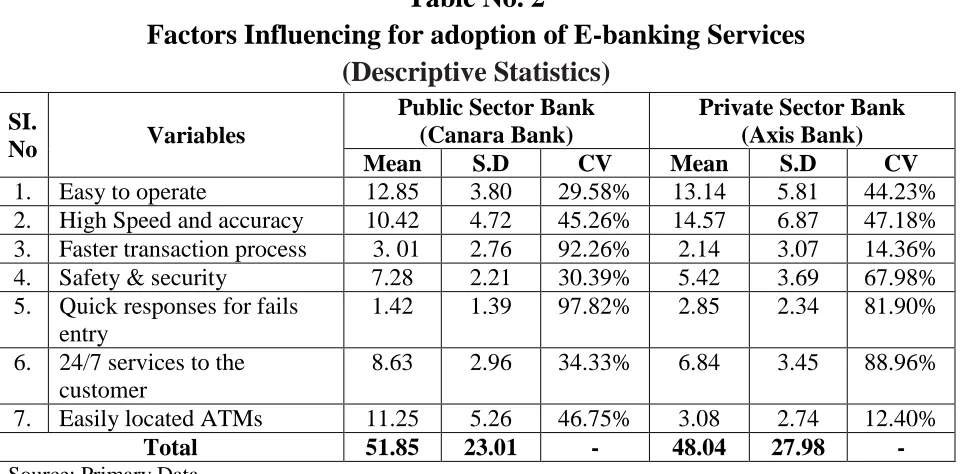
Table No.2 depicts the factors influencing for adoption of E- banking services. According to
descriptive statistics, the highest mean of 12.85 in public sector bank and 14.57 in private sector
bank its indicates compared to public sector banks, private sector bank it’s very easy to operate
E- banking services. As against the lowest mean are 1.42 and 2.85 in public and private sector
banks respectively. it denotes that quick responses for fails entry e- banking factor is more
accuracy in private sector banks compared public sector banks. The standard deviation recorded
around 3.80 to 5.26 in public sector banks and in the case of private sector banks recorded 5.81
to 2.74 considered all the factors shows public sector bank is less efficiency provides E- banking
services compared to the private sector banks. The co-efficient of variance of factors influencing
towards e- banking service, among easy to operate having category was lowest 29.58% in public
sector bank and the factor of easily located ATMs having category was lowest 14.36% in private
sector bank indicating the lower co-efficient of variation is better. From the below analysis
banking services in Private Sector Bank(Axis Bank) compared to the Public Sector Bank (Canara
[image:9.612.68.548.87.324.2]Bank) in Mysuru city.
Table No. 2
Factors Influencing for adoption of E-banking Services
(Descriptive Statistics)
SI.
No Variables
Public Sector Bank (Canara Bank)
Private Sector Bank (Axis Bank) Mean S.D CV Mean S.D CV
1. Easy to operate 12.85 3.80 29.58% 13.14 5.81 44.23%
2. High Speed and accuracy 10.42 4.72 45.26% 14.57 6.87 47.18%
3. Faster transaction process 3. 01 2.76 92.26% 2.14 3.07 14.36%
4. Safety & security 7.28 2.21 30.39% 5.42 3.69 67.98%
5. Quick responses for fails
entry
1.42 1.39 97.82% 2.85 2.34 81.90%
6. 24/7 services to the
customer
8.63 2.96 34.33% 6.84 3.45 88.96%
7. Easily located ATMs 11.25 5.26 46.75% 3.08 2.74 12.40%
Total 51.85 23.01 - 48.04 27.98 -
Source: Primary Data.
Customer satisfaction level regarding E-banking Services:
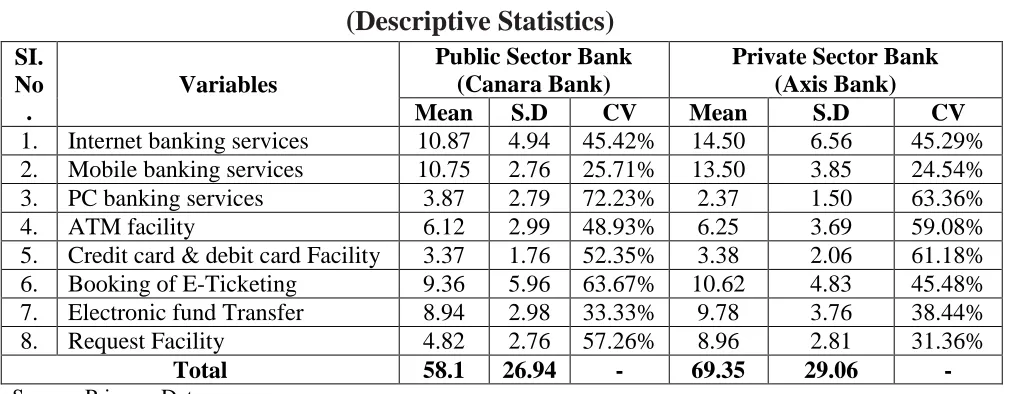
Table No.2 indicates the customer satisfaction level regarding E- banking services a
comparison of public and private sector bank. Majority of the respondents has agreed with all
statements pertaining to customer satisfaction level regarding E- banking services. According to
descriptive statistics, the highest mean of 10.87 in public sector bank and 14.50 in private sector
bank indicated compared to public sector banks, private sector bank customer are more satisfied
of internet banking services. As against the lowest mean is 3.37 in public sector bank customers
are not satisfied with credit card and debit card facilities. In the context of private sector bank
have the lowest mean is 2.37 this results shows that customers are not satisfies with PC banking
facilities. The standard deviation recorded around 4.94 to 2.76 in public sector banks and in the
case of private sector banks recorded 6.56 to 2.81. It is considered all the mentioned variables
related to E- banking services private sector banks customers are more satisfied compared with
customers of public sector bank. The co-efficient of variance of customer satisfaction level
regarding e- banking service, among mobile banking service category was lowest 25.71% and
the 24.54% in public and private sector bank respectively. These indicating the lower co-efficient
of variation is better. Therefore private sector bank provide better E- banking customer services
Table No.3
Customer satisfaction level regarding E-banking Services
(Descriptive Statistics)
SI.No .
Variables
Public Sector Bank (Canara Bank)
Private Sector Bank (Axis Bank)
Mean S.D CV Mean S.D CV
1. Internet banking services 10.87 4.94 45.42% 14.50 6.56 45.29%
2. Mobile banking services 10.75 2.76 25.71% 13.50 3.85 24.54%
3. PC banking services 3.87 2.79 72.23% 2.37 1.50 63.36%
4. ATM facility 6.12 2.99 48.93% 6.25 3.69 59.08%
5. Credit card & debit card Facility 3.37 1.76 52.35% 3.38 2.06 61.18%
6. Booking of E-Ticketing 9.36 5.96 63.67% 10.62 4.83 45.48%
7. Electronic fund Transfer 8.94 2.98 33.33% 9.78 3.76 38.44%
8. Request Facility 4.82 2.76 57.26% 8.96 2.81 31.36%
Total 58.1 26.94 - 69.35 29.06 -
Source: Primary Data.
FINDINGS OF THE STUDY:
The following are the major findings of the study:
The overall respondents were numbering 75 customers out of that 35 respondents were from
canara bank and 40 respondents from axis bank. Majority of the respondents numbering, 12
and 15 customers belongs to age group of less than 30 years both public and private sector
respectively.
In the context of gender profile majority numbering, 20 and 23 customers are male in public
and private sector bank respectively this shows male customers used more E- banking services
compared to the female respondents.
Further the awareness about the E- banking services, majority 28 and 31 respondents were fully
aware of E- banking services in both public and private sector bank.
The highest mean of 12.85 in public sector bank and 14.57 in private sector bank indicates
compared to public sector banks, private sector bank it’s very easy to operate E- banking
services.
The standard deviation recorded around 3.80 to 5.26 in public sector banks and in the case of
private sector banks recorded 5.81 to 2.74 considered all the factors shows public sector bank
is less efficiency provides E- banking services compared to the private sector banks.
The co-efficient of variance of factors influencing towards e- banking service, among easy to
In the context of customer level of satisfaction ,the highest mean of 10.87 in public sector
bank and 14.50 in private sector bank its indicates compared to public sector banks, private
sector bank customer are more satisfied internet banking services.
.The standard deviation recorded around 4.94 to 2.76 in public sector banks and in the case of
private sector banks recorded 6.56 to 2.81.
The co-efficient of variance of customer satisfaction level regarding e- banking service,
among mobile banking service category was lowest 25.71% and the 24.54% in public and
private sector bank respectively.
SUGGESTIONS FOR THE STUDY:
The following are the suggestion for the study:
Public sector banks need to do hard efforts to retain their customers according to the findings.
These banks can cut some service charges & be more responsible & responsive for their
services.
Addressing to the individual customer needs is one crucial aspect to be considered, as the
customer would find himself as a part of the organization. This would build a good
relationship between the bank and the customer.
Both private and public sector bank customers prefer electronic banking, mobile banking and
internet banking. So, the bank will apply facilities for all people as soon as possible.
Customer queries should be opened in order to avoid mistake and also the separate counters
should be allotted for providing passbook and collection of cheque to render faster services to
the customers.
Online banking is a technological advancement, which no one can wish away. But there
needs to be sufficient safeguards to protect the interest of the customers.
The private sector banks need to improve the level of transparency and also the level of
safety and security of online transactions, since some of the customers are skeptical about the
level of confidentiality of their transactions.
The banks need to provide more information pertaining to the use and utility of online
banking among the customers, since it will help them in cutting down their
The public sector banks can improve their quantity of quality of services, as far as online
banking activities are concerned, since they lack behind the private sector banks in this
CONCLUSION:
In the competitive era customer satisfaction is considered to be the most important thing
in banking industry. So the bankers are in the position to adapt to the information technology to
change the way of service to attract customers and increase their satisfaction level. This study
provides information about online banking and their services methodology, design and validation
of questionnaire and factor analysis were used to enhance the reliability and accuracy of the
research findings. Finally this study concludes customers are more satisfied with private sector
banks are more accuracy and speed towards E-banking services compared to the public sector
bank. but in the ATMs services public sector banks easy available to the customer every 3 km
canara bank will be situated provide better services, but Axis bank ATMs situated every 8 Km.
its hurdle thing customers to get axis bank ATMs. Therefore public sectors and private sector
bank are both improve their performance in order to provide better modernized E- banking
services to the customers in Mysuru District.
References:
Bindiya Tater (2012). “Customer Adoption of Banking technology in Private Banks of
India”. . Associate Professor, DAV Institute of Management. p-ISSN : 0974-8032, e- ISSN : 2278-6120, Vol. 6 No. 1, June 2012, pp 47 – 60.
M.E. Dodda raju (2013). “A Study on Customer Satisfaction towards Public and Private
Sector Banking Services: with Special Reference to Anantapur District of Andra Pradesh” ISSN 2248-9878 Volume 3, Number 3 (2013), pp. 287-294.
Kanika Verma(2014). “Measuring customer satisfaction towards ATM services-A
Comparative study of union bank of India and Yes Bank”
Dr. Ashok Kumar Chandra(2015). “A Comparative Study of E-Banking in Public and Private
Sector Banks with Special Reference to (SBI and HDFC)” International Journal of Management and Commerce Innovations ISSN 2348-7585 (Online) Vol. 3, Issue 1, pp: (388-389).
P.V. Nandhini (2016). ”Customer satisfaction towards online banking in Coimbatore
district”. International Journal of Multidisciplinary Research and Modern Education (IJMRME) , ISSN (Online): 2454, Volume II, Issue I, 2016.
Uppal R.K. (2008). “Customer Perception of E- Banking Services of Indian Banks: Some
Survey Evidence” The ICFAI Journal of Bank Management, Vol. VII, No. 1 pp. 63-78.
Kumbhar M. Vijay (2011-12). “Determinants of Customer's Satisfaction in ATM Services