ElixirFM — Implementation of Functional Arabic Morphology
Otakar Smrˇz
Institute of Formal and Applied Linguistics Faculty of Mathematics and Physics
Charles University in Prague [email protected]
Abstract
Functional Arabic Morphology is a formula-tion of the Arabic inflecformula-tional system seek-ing the workseek-ing interface between morphol-ogy and syntax. ElixirFM is its high-level implementation that reuses and extends the Functional Morphology library for Haskell. Inflection and derivation are modeled in terms of paradigms, grammatical categories, lexemes and word classes. The computation of analysis or generation is conceptually dis-tinguished from the general-purpose linguis-tic model. The lexicon of ElixirFM is de-signed with respect to abstraction, yet is no more complicated than printed dictionaries. It is derived from the open-source Buckwal-ter lexicon and is enhanced with information sourcing from the syntactic annotations of the Prague Arabic Dependency Treebank.
1 Overview
One can observe several different streams both in the computational and the purely linguistic modeling of morphology. Some are motivated by the need to ana-lyze word forms as to their compositional structure, others consider word inflection as being driven by the underlying system of the language and the for-mal requirements of its grammar.
In Section 2, before we focus on the principles of ElixirFM, we briefly follow the characterization of morphological theories presented by Stump (2001) and extend the classification to the most promi-nent computational models of Arabic morphology (Beesley, 2001; Buckwalter, 2002; Habash et al., 2005; El Dada and Ranta, 2006).
In Section 3, we survey some of the categories of the syntax–morphology interface in Modern Written Arabic, as described by the Functional Arabic Mor-phology. In passing, we will introduce the basic con-cepts of programming in Haskell, a modern purely functional language that is an excellent choice for declarative generative modeling of morphologies, as Forsberg and Ranta (2004) have shown.
Section 4 will be devoted to describing the lexicon of ElixirFM. We will develop a so-called domain-specific language embedded in Haskell with which we will achieve lexical definitions that are simulta-neously a source code that can be checked for con-sistency, a data structure ready for rather indepen-dent processing, and still an easy-to-read-and-edit document resembling the printed dictionaries.
In Section 5, we will illustrate how rules of in-flection and derivation interact with the parameters of the grammar and the lexical information. We will demonstrate, also with reference to the Functional Morphology library (Forsberg and Ranta, 2004), the reusability of the system in many applications, in-cluding computational analysis and generation in various modes, exploring and exporting of the lex-icon, printing of the inflectional paradigms, etc.
2 Morphological Models
According to Stump (2001), morphological theories can be classified along two scales. The first one deals with the core or the process of inflection:
lexical theories associate word’s morphosyntactic properties withaffixes
prop-erties are expressed by therulesthat relate the form in a given paradigm to the lexeme
The second opposition concerns the question of inferability of meaning, and theories divide into:
incremental wordsacquiremorphosyntactic prop-erties only in connection with acquiring the in-flectional exponents of those properties
realizational association of a set of properties with a word licenses the introduction of the expo-nents into the word’s morphology
Evidence favoring inferential–realizational theo-ries over the other three approaches is presented by Stump (2001) as well as Baerman et al. (2006) or Spencer (2004). In trying to classify the implemen-tations of Arabic morphological models, let us re-consider this cross-linguistic observation:
The morphosyntactic properties associ-ated with an inflected word’s individ-ual inflectional markings may underdeter-mine the properties associated with the word as a whole. (Stump, 2001, p. 7)
How do the current morphological analyzers in-terpret, for instance, the number and gender of the Arabic broken masculine plurals ˇgudud
X
Y
g.
new onesorqud. ¯ahèA
¯
judges, or the case ofmustawanø ñ
J
Ó
a level? Do they identify the values of these features that the syntax actually operates with, or is the resolution hindered by some too generic assump-tions about the relation between meaning and form? Many of the computational models of Arabic morphology, including in particular (Beesley, 2001), (Ramsay and Mansur, 2001) or (Buckwalter, 2002), are lexical in nature. As they are not designed in connection with any syntax–morphology interface, their interpretations are destined to beincremental.Some signs of alexical–realizationalsystem can be found in (Habash, 2004). The author mentions and fixes the problem of underdetermination of in-herent number with broken plurals, when develop-ing a generative counterpart to (Buckwalter, 2002).
The computational models in (Soudi et al., 2001) and (Habash et al., 2005) attempt the inferential– realizational direction. Unfortunately, they imple-ment only sections of the Arabic morphological
sys-tem. The Arabic resource grammar in the Grammat-ical Framework (El Dada and Ranta, 2006) is per-haps the most complete inferential–realizational im-plementation to date. Its style is compatible with the linguistic description in e.g. (Fischer, 2001) or (Badawi et al., 2004), but the lexicon is now very limited and some other extensions for data-oriented computational applications are still needed.
ElixirFM is inspired by the methodology in (Fors-berg and Ranta, 2004) and by functional program-ming, just like the Arabic GF is (El Dada and Ranta, 2006). Nonetheless, ElixirFM reuses the Buckwal-ter lexicon (2002) and the annotations in the Prague Arabic Dependency Treebank (Hajiˇc et al., 2004), and implements yet more refined linguistic model.
3 Morphosyntactic Categories
Functional Arabic Morphology and ElixirFM re-establish the system of inflectional and inher-entmorphosyntactic properties (alternatively named grammatical categories or features) and distinguish precisely the senses of their use in the grammar.
In Haskell, all these categories can be represented as distinct data types that consist of uniquely identi-fied values. We can for instance declare that the cate-gory of case in Arabic discerns three values, that we also distinguish three values for number or person, or two values of the given names for verbal voice:
data Case = Nominative | Genitive | Accusative
data Number = Singular | Dual | Plural
data Person = First | Second | Third
data Voice = Active | Passive
All these declarations introduce new enumerated types, and we can use some easily-defined meth-ods of Haskell to work with them. If we load this (slightly extended) program into the interpreter,1we can e.g. ask what category the valueGenitive be-longs to (seen as the:: type signature), or have it evaluate the list of the values thatPersonallows:
? :type Genitive → Genitive :: Case
? enum :: [Person] → [First,Second,Third]
Lists in Haskell are data types that can be parametrized by the type that they contain. So, the value[Active, Active, Passive]is a list of three elements of typeVoice, and we can write this if nec-essary as the signature:: [Voice]. Lists can also
1
be empty or have just one single element. We denote lists containing some typeaas being of type[a].
Haskell provides a number of useful types al-ready, such as the enumerated boolean type or the parametric type for working with optional values:
data Bool = True | False
data Maybe a = Just a | Nothing
Similarly, we can define a type that couples other values together. In the general form, we can write
data Couple a b = a :-: b
which introduces the value :-: as a container for some value of typeaand another of typeb.2
Let us return to the grammatical categories. In-flection of nominals is subject to several formal re-quirements, which different morphological models decompose differently into features and values that are not always complete with respect to the inflec-tional system, nor mutually orthogonal. We will ex-plain what we mean by revisiting the notions of state and definiteness in contemporary written Arabic.
To minimize the confusion of terms, we will de-part from the formulation presented in (El Dada and Ranta, 2006). In there, there is only one relevant category, which we can reimplement asState’:
data State’ = Def | Indef | Const
Variation of the values ofState’would enable gen-erating the formsal-kit¯abu
H.A
Jº
Ë@
def.,kit¯abunH.A
J»
indef., and kit¯abu
H.A
J»
const. for the nominative singular ofbook. This seems fine until we explore more inflectional classes. The very variation for the nominative plural masculine of the adjective highgets ar-raf¯ı,¯una
àñ ªJ
¯
QË@
def., raf¯ı,¯unaàñ ªJ
¯ P
in-def., and raf¯ı,¯uñ ªJ
¯ P
const. But what value does the formar-raf¯ı,¯uñ ªJ
¯
QË@
, found in improper annex-ations such as inal-mas-¯ul¯una ’r-raf¯ı,¯u ’l-mustaw¯aø ñ
JÜÏ@ ñ ªJ
¯
QË@ àñ
Ëð
ñÜÏ@
the-officials the-highs-of the-level, receive?It is interesting to consult for instance (Fischer, 2001), where state has exactly the values ofState’, but where the definite stateDef covers even forms without the prefixed al-
Ë@
article, since also some separate words likel¯aB
noory¯aAK
ohcan have the effects on inflection that the definite article has. To distinguish all the forms, we might think of keeping2
Infix operators can also be written as prefix functions if en-closed in(). Functions can be written as operators if enclosed in‘‘. We will exploit this when defining the lexicon’s notation.
state in the sense of Fischer, and adding a boolean feature for the presence of the definite article . . . However, we would get one unacceptable combina-tion of the values claiming the presence of the def-inite article and yet the indefdef-inite state, i.e. possibly the indefinite article or the diptotic declension.
Functional Arabic Morphology refactors the six different kinds of forms (if we consider all inflec-tional situations) depending on two parameters. The first controls prefixation of the (virtual) definite arti-cle, the other reduces some suffixes if the word is a head of an annexation. In ElixirFM, we define these parameters as type synonyms to what we recall:
type Definite = Maybe Bool type Annexing = Bool
The Definite values include Just True for
forms with the definite article, Just False for
forms in some compounds or after l¯a
B
or y¯aAK
(absolute negatives or vocatives), andNothing for
forms that reject the definite article for other reasons. Functional Arabic Morphology considers state as a result of coupling the two independent parameters:
type State = Couple Definite Annexing
Thus, the indefinite stateIndefdescribes a word void of the definite article(s) and not heading an an-nexation, i.e.Nothing :-: False. Conversely,
ar-raf¯ı,¯u
ñ ªJ
¯
QË@
is in the state Just True :-: True.The classical construct state isNothing :-: True.
The definite state isJust _ :-: False, where_is
Truefor El Dada and Ranta andFalsefor Fischer.
We may discover that now all the values of State are meaningful.3
Type declarations are also useful for defining in what categories a given part of speech inflects. For verbs, this is a bit more involved, and we leave it for Figure 2. For nouns, we set this algebraic data type:
data ParaNoun = NounS Number Case State
In the interpreter, we can now generate all 54 combinations of inflectional parameters for nouns:
? [ NounS n c s | n <- enum, c <- enum, s <- values ]
The functionvaluesis analogous toenum, and both need to know their type before they can evaluate.
3
The ‘magic’ is that the bound variablesn, c, ands have their type determined by theNounSconstructor, so we need not type anything explicitly. We used the list comprehension syntax to cycle over the lists that enumandvaluesproduce, cf. (Hudak, 2000).
4 ElixirFM Lexicon
Unstructured text is just a list of characters, or string:
type String = [Char]
Yet words do have structure, particularly in Arabic. We will work with strings as the superficial word forms, but the internal representations will be more abstract (and computationally more efficient, too).
The definition oflexemescan include the deriva-tional root and pattern information if appropriate, cf. (Habash et al., 2005), and our model will encour-age this. The surface wordkit¯ab
H.A
J»
bookcan de-compose to the triconsonantal rootk t bI
.
J»
and themorphophonemic patternFiCALof typePatternT:
data PatternT = FaCaL | FAL | FaCY | FiCAL | FuCCAL | {- ... -}
MustaFCaL | MustaFaCL
deriving (Eq, Enum, Show)
The deriving clause associates PatternT with methods for testing equality, enumerating all the val-ues, and turning the names of the values into strings: ? show FiCAL → "FiCAL"
We choose to build on morphophonemic patterns rather than CV patterns and vocalisms. Words like
istaˇg¯ab
H.A
j.
J@
to respond andistaˇgwabH.
ñj.
J@
to interrogatehave the same underlying VstVCCVC pattern, so information on CV patterns alone would not be enough to reconstruct the surface forms. Mor-phophonemic patterns, in this case IstaFAL and IstaFCaL, can easily be mapped to the hypothetical CV patterns and vocalisms, or linked with each other according to their relationship. Morphophonemic patterns deliver more information in a more com-pact way. Of course, ElixirFM provides functions for properly interlocking the patterns with the roots: ? merge "k t b" FiCAL → "kitAb" ? merge "ˆg w b" IstaFAL → "istaˆgAb" ? merge "ˆg w b" IstaFCaL → "istaˆgwab" ? merge "s ’ l" MaFCUL → "mas’Ul" ? merge "z h r" IFtaCaL → "izdahar"The izdahar
Q
ë
X P@
to flourish case exemplifies that exceptionless assimilations need not be encoded in the patterns, but can instead be hidden in rules.The whole generative model adopts the multi-purpose notation of ArabTEX (Lagally, 2004) as a meta-encoding of both the orthography and phonol-ogy. Therefore, instantiation of the"’"hamza car-riers or other merely orthographic conventions do not obscure the morphological model. With Encode Arabic4 interpreting the notation, ElixirFM can at the surface level process the original Arabic script (non-)vocalized to any degree or work with some kind of transliteration or even transcription thereof.
Morphophonemic patterns represent the stems of words. The various kinds of abstract prefixes and suffixes can be expressed either as atomic values, or as literal strings wrapped into extra constructors:
data Prefix = Al | LA | Prefix String
data Suffix = Iy | AT | At | An | Ayn | Un | In | Suffix String
al = Al; lA = LA -- function synonyms
aT = AT; ayn = Ayn; aN = Suffix "aN"
Affixes and patterns are arranged together via theMorphs a data type, where a is a triliteral pat-ternPatternTor a quadriliteralPatternQor a non-templatic word stemIdentityof typePatternL:
data PatternL = Identity
data PatternQ = KaRDaS | KaRADiS {- ... -}
data Morphs a = Morphs a [Prefix] [Suffix]
The word l¯a-silk¯ıy
ú
¾
ÊB
wireless can thus be decomposed as the root s l k
½Ê
and the value Morphs FiCL [LA] [Iy]. Shunning such concrete representations, we define new operators>|and|< that denote prefixes, resp. suffixes, insideMorphs a:? lA >| FiCL |< Iy → Morphs FiCL [LA][Iy]
Implementing>|and|<to be applicable in the in-tuitive way required Haskell’s multi-parameter type classes with functional dependencies (Jones, 2000):
class Morphing a b | a -> b where
morph :: a -> Morphs b
instance Morphing (Morphs a) a where
morph = id
instance Morphing PatternT PatternT where
morph x = Morphs x [] []
The instance declarations ensure how the morph method would turn values of typeaintoMorphs b.
4
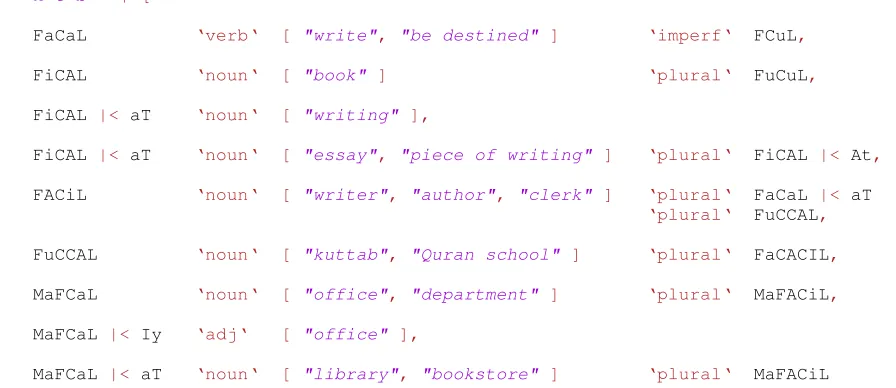
|> "k t b" <| [
FaCaL ‘verb‘ [ "write", "be destined" ] ‘imperf‘ FCuL,
FiCAL ‘noun‘ [ "book" ] ‘plural‘ FuCuL,
FiCAL |< aT ‘noun‘ [ "writing" ],
FiCAL |< aT ‘noun‘ [ "essay", "piece of writing" ] ‘plural‘ FiCAL |< At,
FACiL ‘noun‘ [ "writer", "author", "clerk" ] ‘plural‘ FaCaL |< aT ‘plural‘ FuCCAL,
FuCCAL ‘noun‘ [ "kuttab", "Quran school" ] ‘plural‘ FaCACIL,
MaFCaL ‘noun‘ [ "office", "department" ] ‘plural‘ MaFACiL,
MaFCaL |< Iy ‘adj‘ [ "office" ],
[image:5.612.77.525.62.256.2]MaFCaL |< aT ‘noun‘ [ "library", "bookstore" ] ‘plural‘ MaFACiL ]
Figure 1: Entries of the ElixirFM lexicon nested under the rootk t b
I
.
J»
using morphophonemic templates.Supposing thatmorphis available for the two types, (|<)is a function ony :: aandx :: Suffix giv-ing a value of typeMorphs b. The intermediate re-sult ofmorph yis decomposed, andxis prepended to the stacksof the already present suffixes.
(|<) :: Morphing a b =>
a -> Suffix -> Morphs b
y |< x = Morphs t p (x : s)
where Morphs t p s = morph y
With the introduction of patterns, their synony-mous functions and the>|and|<operators, we have started the development of what can be viewed as a domain-specific language embedded in the general-purpose programming language. Encouraged by the flexibility of many other domain-specific languages in Haskell, esp. those used in functional parsing (Ljungl¨of, 2002) or pretty-printing (Wadler, 2003), we may design the lexicon to look like e.g.
module Elixir.Data.Lexicon
import Elixir.Lexicon
lexicon = listing {- lexicon’s header -}
|> {- root one -} <| [ {- Entry a -} ]
|> {- root two -} <| [ {- Entry b -} ]
-- other roots or word stems and entries
and yet be a verifiable source code defining a data structure that is directly interpretable. The meaning
of the combinators|>and<|could be supplied via an external moduleElixir.Lexicon, so is very easy to customize. The effect of these combinators might be similar to the:and:-:constructors that we met previously, but perhaps other data structures might be built from the code instead of lists and pairs.
Individual entries can be defined with functions in a convenient notational form using‘‘. Infix opera-tors can have different precedence and associativity, which further increases the options for designing a lightweight, yet expressive, embedded language.
In Figure 1, each entry reduces to a record of type Entry PatternT reflecting internally the lexeme’s inherent properties. Consider one such reduction be-low. Functions likepluralorgenderorhumanness could further modify theNoun’s default information:
? FiCAL |< aT ‘noun‘ [ "writing" ] →
noun (FiCAL |< aT) [ "writing" ] →
Entry (Noun [] Nothing Nothing) (morph (FiCAL |< aT))
[ "writing" ] →
Entry (Noun [] Nothing Nothing) (Morphs FiCAL [] [AT]) [ "writing" ]
The lexicon of ElixirFM is derived from the open-source Buckwalter lexicon (Buckwalter, 2002).5 We devised an algorithm in Perl using the
morpho-5
data Mood = Indicative | Subjunctive | Jussive | Energetic deriving (Eq, Enum)
data Gender = Masculine | Feminine deriving (Eq, Enum)
data ParaVerb = VerbP Voice Person Gender Number | VerbI Mood Voice Person Gender Number
| VerbC Gender Number deriving Eq
paraVerbC :: Morphing a b => Gender -> Number -> [Char] -> a -> Morphs b paraVerbC g n i = case n of
Singular -> case g of Masculine -> prefix i . suffix "" Feminine -> prefix i . suffix "I"
Plural -> case g of Masculine -> prefix i . suffix "UW" Feminine -> prefix i . suffix "na"
_ -> prefix i . suffix "A"
Figure 2: Excerpt from the implementation of verbal inflectional features and paradigms in ElixirFM.
phonemic patterns of ElixirFM that finds the roots and templates of the lexical items, as they are avail-able only partially in the original, and produces the lexicon in formats for Perl and for Haskell.
Information in the ElixirFM lexicon can get even more refined, by lexicographers or by programmers. Verbs could be declared via indicating their deriva-tional verbal form (that would, still, reduce to some Morphs avalue), and deverbal nouns and participles could be defined generically for the extended forms. The identification of patterns as to their derivational form is implemented easily with theisFormmethod:
data Form = I | II | III | IV {- .. -} XV
? isForm VIII IFtaCaL → True ? isForm II TaKaRDuS → True ? filter (‘isForm‘ MuFCI) [I ..] → [IV]
Nominal parts of speech need to be enhanced with information on the inherent number, gender and hu-manness, if proper modeling of linguistic agreement in Arabic is desired.6 Experiments with the Prague Arabic Dependency Treebank (Hajiˇc et al., 2004) show that this information can be learned from an-notations of syntactic relations (Smrˇz, 2007).
5 Morphological Rules
Inferential–realizational morphology is modeled in terms of paradigms, grammatical categories, lex-emes and word classes. ElixirFM implements the comprehensive rules that draw the information from
6
Cf. e.g. (El Dada and Ranta, 2006; Kremers, 2003).
the lexicon and generate the word forms given the appropriate morphosyntactic parameters. The whole is invoked through a convenientinflectmethod.
The lexicon and the parameters determine the choice of paradigms. The template selection mecha-nism differs for nominals (providing plurals) and for verbs (providing all needed stem alternations in the extent of the entry specifications of e.g. Hans Wehr’s dictionary), yet it is quite clear-cut (Smrˇz, 2007).
In Figure 2, the algebraic data type ParaVerb restricts the space in which verbs are inflected by defining three Cartesian products of the elementary categories: a verb can haveVerbPperfect forms in-flected in voice, person, gender, number,VerbI im-perfect forms inflected also in mood, andVerbC im-peratives inflected in gender and number only.7
The paradigm for inflecting imperatives, the one and only such paradigm in ElixirFM, is imple-mented asparaVerbC. It is a function parametrized by some particular value of gendergand numbern. It further takes the initial imperative prefixiand the verbal stem (both inferred from the morphophone-mic patterns in the lexical entry) to yield the in-flected imperative form. Note the polymorphic type of the function, which depends on the following:
prefix, suffix :: Morphing a b =>
[Char] -> a -> Morphs b
prefix x y = Prefix x >| y suffix x y = y |< Suffix x
7
If one wished to reuse the paradigm and apply it on strings only, it would be sufficient to equate these functions with standard list operations, without any need to reimplement the paradigm itself.
The definition ofparaVerbCis simple and concise due to the chance to compose with . the partially applied prefixandsuffix functions and to virtu-ally omit the next argument. This advanced formu-lation may seem not as minimal as when specifying the literal endings or prefixes, but we present it here to illustrate the options that there are. An abstract paradigm can be used on more abstract types than just strings.8 Inflected forms need not be merged with roots yet, and can retain the internal structure:
? paraVerbC Feminine Plural "u" FCuL → Prefix "u" >| FCuL |< Suffix "na"
? merge "k t b" ({- previous value -}) →
"uktubna"uktubna
á
.
J
»
@
fem. pl.write! ? [ merge "q r ’" (paraVerbC g n "i"FCaL) | g <- values, n <- values ] →
masc.:"iqra’"iqra-
@Q
¯@
sg."iqra’A"iqra-¯a@Q
¯@
du."iqra’UA"iqra-¯u@ð
ð Q
¯@
pl. fem.:"iqra’I"iqra-¯ıú
G
Q
¯@
sg."iqra’A"iqra-¯a@Q
¯@
du."iqra’na"iqra-naà
@Q
¯@
pl.read!The highlight of the Arabic morphology is that the ‘irregular’ inflection actually rests in strictly ob-serving some additional rules, the nature of which is phonological. Therefore, surprisingly, ElixirFM does not even distinguish between verbal and nomi-nal word formation when enforcing these rules. This reduces the number of paradigms to the prototypical 3 verbal and 5 nominal! Yet, the model is efficient.
Given that the morphophonemic patterns already do reflect the phonological restrictions, the only places of further phonological interaction are the prefix boundaries and the junction of the last letter of the pattern with the very adjoining suffix. The rules are implemented with->-and-<-, respectively, and are invoked from within themergefunction:
merge :: (Morphing a b, Template b) =>
[Char] -> a -> [Char]
(->-) :: Prefix -> [Char] -> [Char] (-<-) :: Char -> Suffix -> [Char]
8
Cf. some morphology-theoretic views in Spencer (2004).
’I’ -<- x = case x of
AT -> "iyaT" ; Un -> "Una" Iy -> "Iy" ; In -> "Ina"
Suffix "" -> "i"
Suffix "Una" -> "Una" Suffix "U" -> "U" Suffix "UW" -> "UW"
Suffix "Ina" -> "Ina" Suffix "I" -> "I"
Suffix x | x ‘elem‘ ["i", "u"] -> "I" | x ‘elem‘ ["iN", "uN"] -> "iN"
| "n" ‘isPrefixOf‘ x ||
"t" ‘isPrefixOf‘ x -> "I" ++ x
_ -> "iy" ++ show x
(-<-) is likewise defined when matching on ’Y’, ’A’, ’U’, and when not matching. (->-) imple-ments definite article assimilation and occasional prefix interaction with weak verbs.
Nominal inflection is also driven by the informa-tion from the lexicon and by phonology. The reader might be noticing that the morphophonemic patterns and theMorphs atemplates are actually extremely informative. We can use them as determining the in-flectional class and the paradigm function, and thus we can almost avoid other unintuitive or excessive indicators of the kind of weak morphology, diptotic inflection, and the like.
6 Applications and Conclusion
The ElixirFM linguistic model and the data of the lexicon can be integrated into larger applications or used as standalone libraries and resources.
There is another, language-independent part of the system that implements the compilation of the inflected word forms and their associated mor-phosyntactic categories into morphological analyz-ers and generators. This part is adapted from (Fors-berg and Ranta, 2004). The method used for analysis is deterministic parsing with tries (Ljungl¨of, 2002).
ElixirFM also provides functions for exporting and pretty-printing the linguistic model into XML, LATEX, Perl, SQL, and other custom formats.
pro-posed a model that represents the linguistic data in an abstract and extensible notation that encodes bothorthography andphonology, and whose inter-pretation is customizable. We developed a domain-specific language in which the lexicon is stored and which allows easy manual editing as well as auto-matic verification of consistency. We believe that the modeling of both thewrittenlanguage and the spo-kendialects can share the presented methodology.
ElixirFM and its lexicons are open-source soft-ware licensed under GNU GPL and available on
http://sf.net/projects/elixir-fm/. This work has been supported by the Ministry of Education of the Czech Republic (MSM00216208-38), by the Grant Agency of Charles University in Prague (UK 373/2005), and by the Grant Agency of the Czech Academy of Sciences (1ET101120413).
References
Elsaid Badawi, Mike G. Carter, and Adrian Gully. 2004.
Modern Written Arabic: A Comprehensive Grammar.
Routledge.
Matthew Baerman, Dunstan Brown, and Greville G.
Cor-bett. 2006. The Syntax-Morphology Interface. A
Study of Syncretism. Cambridge Studies in
Linguis-tics. Cambridge University Press.
Kenneth R. Beesley. 2001. Finite-State Morphological Analysis and Generation of Arabic at Xerox Research:
Status and Plans in 2001. InEACL 2001 Workshop
Proceedings on Arabic Language Processing: Status and Prospects, pages 1–8, Toulouse, France.
Tim Buckwalter. 2002. Buckwalter Arabic
Morpho-logical Analyzer Version 1.0. LDC catalog number LDC2002L49, ISBN 1-58563-257-0.
Ali El Dada and Aarne Ranta. 2006. Open Source Arabic
Grammars in Grammatical Framework. In
Proceed-ings of the Arabic Language Processing Conference
(JETALA), Rabat, Morocco, June 2006. IERA.
Wolfdietrich Fischer. 2001. A Grammar of Classical
Arabic. Yale Language Series. Yale University Press, third revised edition. Translated by Jonathan Rodgers.
Markus Forsberg and Aarne Ranta. 2004. Functional
Morphology. InProceedings of the Ninth ACM
SIG-PLAN International Conference on Functional
Pro-gramming, ICFP 2004, pages 213–223. ACM Press.
Nizar Habash, Owen Rambow, and George Kiraz. 2005. Morphological Analysis and Generation for Arabic
Dialects. In Proceedings of the ACL Workshop
on Computational Approaches to Semitic Languages,
pages 17–24, Ann Arbor, Michigan. Association for Computational Linguistics.
Nizar Habash. 2004. Large Scale Lexeme Based
Ara-bic Morphological Generation. In JEP-TALN 2004,
Session Traitement Automatique de l’Arabe, Fes, Mo-rocco, April 2004.
Jan Hajiˇc, Otakar Smrˇz, Petr Zem´anek, Jan ˇSnaidauf, and Emanuel Beˇska. 2004. Prague Arabic Dependency
Treebank: Development in Data and Tools. In
NEM-LAR International Conference on Arabic Language
Resources and Tools, pages 110–117. ELDA.
Paul Hudak. 2000. The Haskell School of Expression:
Learning Functional Programming through Multime-dia. Cambridge University Press.
Mark P. Jones. 2000. Type Classes with Functional
De-pendencies. InESOP ’00: Proceedings of the 9th
Eu-ropean Symposium on Programming Languages and
Systems, pages 230–244, London, UK. Springer.
Joost Kremers. 2003. The Arabic Noun Phrase. A
Minimalist Approach. Ph.D. thesis, University of Ni-jmegen. LOT Dissertation Series 79.
Klaus Lagally. 2004. ArabTEX: Typesetting Arabic and Hebrew, User Manual Version 4.00. Technical Report 2004/03, Fakult¨at Informatik, Universit¨at Stuttgart.
Peter Ljungl¨of. 2002. Pure Functional Parsing. An
Ad-vanced Tutorial. Licenciate thesis, G¨oteborg Univer-sity & Chalmers UniverUniver-sity of Technology.
Allan Ramsay and Hanady Mansur. 2001. Arabic
mor-phology: a categorial approach. InEACL 2001
Work-shop Proceedings on Arabic Language Processing: Status and Prospects, pages 17–22, Toulouse, France.
Otakar Smrˇz. 2007.Functional Arabic Morphology.
For-mal System and Implementation. Ph.D. thesis, Charles University in Prague.
Abdelhadi Soudi, Violetta Cavalli-Sforza, and Abder-rahim Jamari. 2001. A Computational Lexeme-Based
Treatment of Arabic Morphology. In EACL 2001
Workshop Proceedings on Arabic Language Process-ing: Status and Prospects, pages 155–162, Toulouse.
Andrew Spencer. 2004. Generalized Paradigm Function
Morphology. http://privatewww.essex.
ac.uk/˜spena/papers/GPFM.pdf, October 6.
Gregory T. Stump. 2001. Inflectional Morphology. A
Theory of Paradigm Structure. Cambridge Studies in
Linguistics. Cambridge University Press.
Philip Wadler. 2003. A Prettier Printer. In Jeremy
Gibbons and Oege de Moor, editors,The Fun of
Pro-gramming, Cornerstones of Computing, pages 223–