Dependency treebanks: methods, annotation schemes and
tools
Tuomo Kakkonen
Department of Computer Science
University of Joensuu
P.O. Box 111
FI-80101 Joensuu
[email protected]
Abstract
In this paper, current dependency-based treebanks are introduced and analyzed. The methods used for building the resources, the annotation schemes applied, and the tools used (such as POS taggers, parsers and an-notation software) are discussed.
1 Introduction
Annotated data is a crucial resource for devel-opments in computational linguistics and nat-ural language processing. Syntactically anno-tated corpora, treebanks, are needed for de-veloping and evaluating natural language pro-cessing applications, as well as for research in empirical linguistics. The choice of annota-tion type in a treebank usually boils down to two options: the linguistic resource is anno-tated either according to some constituent or functional structure scheme. As the name tree-bank suggests, these linguistic resources were first developed in the phrase-structure frame-work, usually represented as tree-shaped con-structions. The first efforts to create such re-sources started around 30 years ago. The most well-known of such a treebank is thePenn Tree-bank for English (Marcus et al., 1993).
In recent years, there has been a wide in-terest towards functional annotation of tree-banks. In particular, many dependency-based treebanks have been constructed. In addi-tion, grammatical function annotation has been added to some constituent-type treebanks. De-pendency Grammar formalisms stem from the work of Tesnieére (1959). In dependency gram-mars, only the lexical nodes are recognized, and the phrasal ones are omitted. The lexi-cal nodes are linked with directed binary re-lations. The most commonly used argument
for selecting the dependency format for build-ing a treebank is that the treebank is bebuild-ing created for a language with a relatively free word order. Such treebanks exist e.g. for Basque, Czech, German and Turkish. On the other hand, dependency treebanks have been developed for languages such as English, which have been usually seen as languages that can be better represented with constituent formal-ism. The motivations for using dependency an-notation vary from the fact that the type of structure is the one needed by many, if not most, applications to the fact that it offers a proper interface between syntactic and seman-tic representation. Furthermore, dependency structures can be automatically converted into phrase structures if needed (Lin, 1995; Xia and Palmer, 2000), although not always with 100% accuracy. The TIGER Treebank of Ger-man, a free word order language, with 50,000 sentences is an example of a treebank with both phrase structure and dependency annota-tions (Brants et al., 2002).
The aim of this paper is to answer the follow-ing questions about the current state-of-art in dependency treebanking:
• What kinds of texts do the treebanks con-sist of?
• What types of annotation schemes and for-mats are applied?
• What kinds of annotation methods and tools are used for creating the treebanks?
• What kinds of functions do the annotation tools for creating the treebanks have?
analyzed. Finally in Section 4, we conclude the findings.
2 Existing dependency treebanks
2.1 Introduction
Several kinds of resources and tools are needed for constructing a treebank: annotation guide-lines state the conventions that guide the an-notators throughout their work, a software tool is needed to aid the annotation work, and in the case of semi-automated treebank construc-tion, apart-of-speech (POS) tagger, morpholog-ical analyzer and/or a syntactic parser are also needed. Building trees manually is a very slow and error-prone process. The most commonly used method for developing a treebank is a combination of automatic and manual process-ing, but the practical method of implementation varies considerably. There are some treebanks that have been annotated completely manually, but with taggers and parsers available to auto-mate some of the work such a method is rarely employed in state-of-the-art treebanking.
2.2 The treebanks
2.2.1 Prague Dependency Treebank
The largest of the existing dependency tree-banks (around 90,000 sentences), the Prague Dependency Treebank for Czech, is annotated in layered structure annotation, consisting of three levels: morphological, analytical (syntax), and tectogrammatical (semantics) (Böhmová et al., 2003). The data consist of newspaper ar-ticles on diverse topics (e.g. politics, sports, culture) and texts from popular science mag-azines, selected from the Czech National Cor-pus. There are 3,030 morphological tags in the morphological tagset (Hajiˇc, 1998). The syn-tactic annotation comprises of 23 dependency types.
The annotation for the levels was done sep-arately, by different groups of annotators. The morphological tagging was performed by two human annotators selecting the appropriate tag from a list proposed by a tagging sys-tem. Third annotator then resolved any differ-ences between the two annotations. The syn-tactic annotation was at first done completely manually, only by the aid of ambiguous mor-phological tags and a graphical user interface. Later, some functions for automatically assign-ing part of the tags were implemented. After
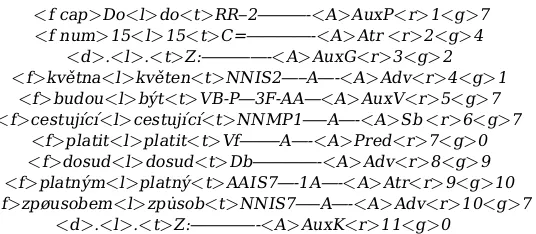
some 19,000 sentences were annotated,Collins lexicalized stochastic parser (Nelleke et al., 1999) was trained with the data, and was capa-ble of assigning 80% of the dependencies cor-rect. At that stage, the work of the annotator changed from building the trees from scratch to checking and correcting the parses assigned by the parser, except for the analytical functions, which still had to be assigned manually. The de-tails related to the tectogrammatical level are omitted here. Figure 1 illustrates an example of morphological and analytical levels of anno-tation.
There are other treebank projects using the framework developed for the Prague Depen-dency Treebank. Prague Arabic Dependency Treebank (Hajiˇc et al., 2004), consisting of around 49,000 tokens of newswire texts from Arabic Gigaword and Penn Arabic Treebank, is a treebank of Modern Standard Arabic. TheSlovene Dependency Treebank consists of around 500 annotated sentences obtained from theMULTEXT-East Corpus (Erjavec, 2005b; Er-javec, 2005a).
2.2.2 TIGER Treebank
The TIGER Treebank of German (Brants et al., 2002) was developed based on theNEGRA Corpus (Skut et al., 1998) and consists of com-plete articles covering diverse topics collected from a German newspaper. The treebank has around 50,000 sentences. The syntactic anno-tation combining both phrase-structure and de-pendency representations is organized as fol-lows: phrase categories are marked in non-terminals, POS information in terminals and syntactic functions in the edges. The syntactic annotation is rather simple and flat in order to reduce the amount of attachment ambiguities. An interesting feature in the treebank is that a MySQL database is used for storing the anno-tations, from where they can be exported into NEGRA Export and TIGER-XML file formats, which makes it usable and exchangeable with a range of tools.
<f cap>Do<l>do<t>RR–2———-<A>AuxP<r>1<g>7 <f num>15<l>15<t>C=————-<A>Atr<r>2<g>4
<d>.<l>.<t>Z:————-<A>AuxG<r>3<g>2 <f>kvˇetna<l>kvˇeten<t>NNIS2—–A—-<A>Adv<r>4<g>1
<f>budou<l>být<t>VB-P—3F-AA—<A>AuxV<r>5<g>7 <f>cestující<l>cestující<t>NNMP1—–A—-<A>Sb<r>6<g>7
<f>platit<l>platit<t>Vf——–A—-<A>Pred<r>7<g>0 <f>dosud<l>dosud<t>Db————-<A>Adv<r>8<g>9 <f>platným<l>platný<t>AAIS7—-1A—-<A>Atr<r>9<g>10 <f>zpøusobem<l>zp˙usob<t>NNIS7—–A—-<A>Adv<r>10<g>7
[image:3.595.169.437.75.192.2]<d>.<l>.<t>Z:————-<A>AuxK<r>11<g>0
Figure 1: A morphologically and analytically annotated sentence from the Prague Dependency Treebank (Böhmová et al., 2003).
broad coverage LFG parser is used, producing the constituent and functional structures for the sentences. As almost every sentence is left with unresolved ambiguities, a human annota-tor is needed to select the correct ones from the set of possible parses. As each sentence of the corpus has several thousands of possible LFG representations, a mechanism for automatically reducing the number of parses is applied, drop-ping the number of parses represented to the human annotator to 17 on average. Interactive annotation is also a type of semi-automated an-notation, but in contrast to human post-editing, the method makes the parser and the annotator to interact. First, the parser annotates a small part of the sentence and the annotator either accepts or rejects it based on visual inspection. The process is repeated until the sentence is annotated completely.
2.2.3 Arboretum, L’Arboratoire, Arborest and Floresta Sintá(c)tica
Arboretum of Danish (Bick, 2003), L’Arboratoire of French and Floresta Sintá(c)tica of Portuguese (Afonso et al., 2002), and Arborest of Estonian (Bick et al., 2005) are "sibling" treebanks, Arboretum being the "oldest sister". The treebanks are hybrids with both constituent and dependency annotation organized into two separate levels. The levels share the same morphological tagset. The dependency annotation is based on the Constraint Grammar (CG) (Karlsson, 1990) and consists of 28 dependency types. For creating each of the four treebanks, a CG-based morphological analyzer and parser was applied. The annotation process consisted of CG parsing of the texts followed by conversion
to constituent format, and manual checking of the structures.
Arboretum has around 21,600 sentences an-notated with dependency tags, and of those, 12,000 sentences have also been marked with constituent structures (Bick, 2003; Bick, 2005). The annotation is in both TIGER-XML and PENN export formats. Floresta Sintá(c)tica consists of around 9,500 manually checked (version 6.8, October 15th, 2005) and around 41,000 fully automatically annotated sentences obtained from a corpus of newspaper Por-tuguese (Afonso et al., 2002).Arborest of Esto-nian consists of 149 sentences from newspaper articles (Bick et al., 2005). The morphosyntac-tic and CG-based surface syntacmorphosyntac-tic annotation are obtained from an existing corpus, which is converted semi-automatically to Arboretum-style format.
2.2.4 The Dependency Treebank for Russian
The Dependency Treebank for Russian is based on theUppsala University Corpus (Lön-ngren, 1993). The texts are collected from contemporary Russian prose, newspapers, and magazines (Boguslavsky et al., 2000; Bo-guslavsky et al., 2002). The treebank has about 12,000 annotated sentences. The annota-tion scheme is XML-based and compatible with Text Encoding for Interchange (TEI), except for some added elements. It consists of 78 syntac-tic relations, divided into six subgroups, such as attributive, quantitative, and coordinative. The annotation is layered, in the sense that the lev-els of annotation are independent and can be extracted or processed independently.
and a syntactic parser, ETAP (Apresjan et al., 1992), and was followed by post-editing by hu-man annotators. Two tools are available for the annotator: a sentence boundary markup tool and post-editor. The post-editor offers the annotator functions for building, editing, and managing the annotations. The editor has a special split-and-run mode, used when the parsers fails to produce a parse or creates a parse with a high number of errors. In the mode the user can pre-chunk the sentence into smaller pieces to be input to the parser. The parsed chucks can be linked by the annotator, thus producing a full parse for the sentence. The tool also provides the annotator with the possibility to mark the annotation of any word or sentence as doubtful, in order to remind at the need for a later revision.
2.2.5 Alpino
TheAlpino Treebank of Dutch, consisting of 6,000 sentences, is targeted mainly at parser evaluation and comprises of newspaper arti-cles (van der Beek et al., 2002). The annotation scheme is taken from the CGN Corpus of spo-ken Dutch (Oostdijk, 2000) and the annotation guidelines are based on the TIGER Treebank’s guidelines.
The annotation process in the Alpino Tree-bank starts with applying a parser based on Head-Driven Phrase Structure Grammar (HPSG) (Pollard and Sag, 1994) and is followed by a manual selection of the correct parse trees. An interactive lexical analyzer and a con-stituent marker tools are employed to restrict the number of possible parses. The interac-tive lexical analyzer tool lets the user to mark each word in a sentence belonging to correct, good, or bad categories. ’Correct’ denotes that the parse includes the lexical entry in ques-tion, ’good’ that the parse may include the en-try, and ’bad’ that the entry is incorrect. The parser uses this manually reduced set of en-tries, thus generating a smaller set of possi-ble parses. With the constituent marker tool, the annotator can mark constituents and their types to sentences, thus aiding the parser.
The selection of the correct parse is done by the help of a parse selection tool, which calculates maximal discriminants to help the annotator. There are three types of discrimi-nants. Maximal discriminants are sets of short-est dependency paths encoding differences
be-tween parses, lexical discriminants represent ambiguities resulting from lexical analysis, and constituent discriminants group words to stituents without specifying the type of the con-stituent. The annotator marks each of the max-imal discriminants as good or bad, and the tool narrows down the number of possible parses based on the information. If the parse result-ing from the selection is not correct, it can be edited by a parse editor tool.
2.2.6 The Danish Dependency Treebank
The annotation of the Danish Dependency Treebank is based on Discountinuous Gram-mar, which is a formalism closely related to Word Grammar (Kromann, 2003). The tree-bank consists of 5,540 sentences covering a wide range of topics. The morphosyntactic annotation is obtained from the PAROLE Cor-pus (Keson and Norling-Christensen, 2005), thus no morphological analyzer or POS tagger is applied. The dependency links are marked manually by using a command-line interface with a graphical parse view. A parser for au-tomatically assigning the dependency links is under development.
2.2.7 METU-Sabanci Turkish Treebank
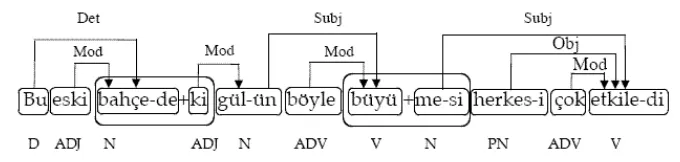
Morphologically and syntactically annotated Turkish Treebank consists of 5,000 sentences obtained from theMETU Turkish Corpus (Ata-lay et al., 2003) covering 16 main genres of present-day written Turkish (Oflazer et al., 2003). The annotation is presented in a format that is in conformance with theXML-based Cor-pus Encoding Standard (XCES) format (Anne and Romary, 2003). Due to morphological com-plexity of Turkish, morphological information is not encoded with a fixed set of tags, but as se-quences ofinflectional groups (IGs). An IG is a sequence of inflectional morphemes, divided by derivation boundaries. The dependencies be-tween IGs are annotated with the following 10 link types: subject, object, modifier, possessor, classifier, determiner, dative adjunct, locative adjunct, ablative adjunct, and instrumental ad-junct. Figure 2 illustrates a sample annotated sentence from the treebank.
ap-Figure 2: A sample sentence from the METU-Sabanci Treebank (Oflazer et al., 2003).
plied to the texts. The morphologically ana-lyzed and preprocessed text is input to an an-notation tool. The tagging process requires two steps: morphological disambiguation and de-pendency tagging. The annotator selects the correct tag from the list of tags proposed by the morphological analyzer. After the whole sentence has been disambiguated, dependency links are specified manually. The annotators can also add notes and modify the list of de-pendency link types.
2.2.8 The Basque Dependency Treebank
The Basque Dependency Treebank (Aduriz and al., 2003) consists of 3,000 manually anno-tated sentences from newspaper articles. The syntactic tags are organized as a hierarchy. The annotation is done by aid of an annotation tool, with tree visualization and automatic tag syntax checking capabilities.
2.2.9 The Turin University Treebank
The Turin University Treebank for Italian consisting of 1,500 sentences is divided into four sub-corpora (Lesmo et al., 2002; Bosco, 2000; Bosco and Lombardo, 2003). The ma-jority of texts is from civil law code and news-paper articles. The annotation format is based on the Augmented Relational Structure (ARS). The POS tagset consists of 16 categories and 51 subcategories. There are around 200 depen-dency types, organized as a taxonomy of five levels. The scheme provides the annotator with the possibility of marking a relation as under-specified if a correct relation type cannot be determined.
The annotation process consists of automatic tokenization, morphological analysis and POS disambiguation, followed by syntactic pars-ing (Lesmo et al., 2002). The annotator can interact with the parser through a graphical interface, in a similar way to the interactive method in the TIGER Treebank. The annota-tor can either accept or reject the suggested
tags for each word in the sentence after which the parser proceeds to the next word (Bosco, 2000).
2.2.10 The Dependency Treebank of English
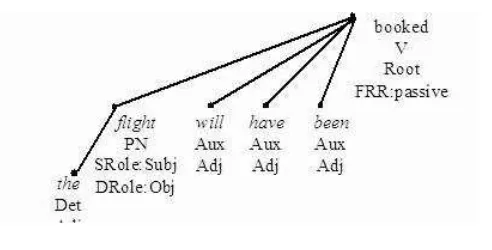
The Dependency Treebank of English con-sists of dialogues between a travel agent and customers (Rambow et al., 2002), and is the only dependency treebank with spoken lan-guage annotation. The treebank has about 13,000 words. The annotation is a direct repre-sentation of lexical predicate-argument struc-ture, thus arguments and adjuncts are depen-dents of their predicates and all function words are attached to their lexical heads. The anno-tation is done at a single, syntactic level, with-out surface representation for surface syntax, the aim being to keep the annotation process as simple as possible. Figure 3 shows an exam-ple of an annotated sentence.
The trained annotators have access to an on-line manual and work off the transcribed speech without access to the speech files. The dialogs are parsed with a dependency parser, the Supertagger and Lightweight Dependency Analyzer (Bangalore and Joshi, 1999). The an-notators correct the output of the parser using a graphical tool, the one developed by Prague Dependency Treebank project. In addition to the standard tag editing options, annotators can add comments. After the editing is done, the sentence is automatically checked for in-consistencies, such as the difference in surface and deep roles or prepositions missing objects etc.
2.2.11 DEPBANK
[image:5.595.128.468.74.155.2]Figure 3: The sentence "The flight will have been booked" from the English treebank (Rambow et al., 2002). The words are marked with the word form (first line), the POS (second line), and the surface role (third line). In addition, node ’flight’ is marked with a deep role (DRole) and the root node as passive in the FRR feature, not set in any other nodes.
feature types (e.g. number (pl/sg), passive (+/-), tense (future/past/present)) in the annotation scheme.
The annotation process is semi-automatic, consisting of parsing by broad-coverage LFG, converting the parses to the DEPBANK for-mat and manually checking and correcting the resulting structures. The annotations are checked by a tool that lookse.g. for the correct-ness of header information and the syntax of the annotation, and inconsistencies in feature names. The checking tool helps in two different ways: first, when the annotator makes correc-tions to the parsed structure, it makes sure that no errors were added, and second, the tool can detect erroneous parses and note that to the annotator.
3 Analysis
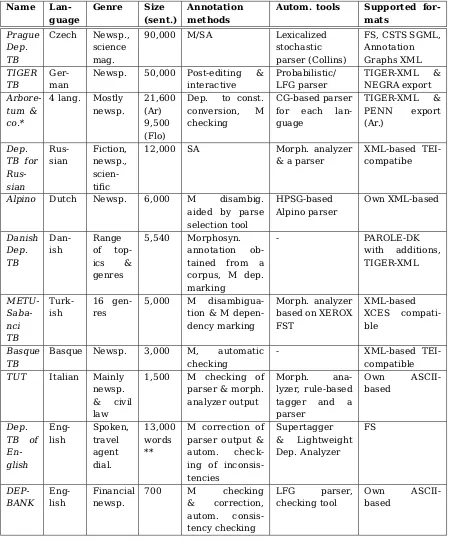
Table 1 summarizes some key properties of the existing dependency treebanks. The size of the treebanks is usually quite limited, ranging from few hundreds to 90,000 sentences. This is partly due to the fact that even the most long-lived of the dependency treebank projects, the Prague Dependency Treebank, was started less than 10 years ago. The treebank producers have in most cases aimed at creating a multi-purpose resource for evaluating and develop-ing NLP systems and for studies in theoreti-cal linguistics. Some are built for specific pur-poses, e.g. the Alpino Treebank of Dutch is mainly for parser evaluation. Most of the de-pendency treebanks consist of written text; to our knowledge there is only one that is based on a collection of spoken utterances. The written texts are most commonly obtained from
news-paper articles, and in the cases ofe.g. Czech, German, Russian, Turkish, Danish, and Dutch treebanks from an existing corpus. Annotation usually consists of POS and morphological lev-els accompanied by dependency-based syntac-tic annotation. In the case of the Prague De-pendency Treebank a higher, semantic layer of annotation is also included.
Table 1: Comparison of dependency treebanks. (*Due to limited number of pages not all the treebanks in the Arboretum "family" are included in the table. **Information of number of utterances was not available. M=manual, SA=semi-automatic, TB=treebank)
Name Lan-guage Genre Size (sent.) Annotation methods
Autom. tools Supported for-mats Prague Dep. TB Czech Newsp., science mag.
90,000 M/SA Lexicalized stochastic parser (Collins)
FS, CSTS SGML, Annotation Graphs XML TIGER TB Ger-man
Newsp. 50,000 Post-editing & interactive Probabilistic/ LFG parser TIGER-XML & NEGRA export Arbore-tum & co.*
4 lang. Mostly newsp.
21,600 (Ar) 9,500 (Flo)
Dep. to const. conversion, M checking
CG-based parser for each lan-guage TIGER-XML & PENN export (Ar.) Dep. TB for Rus-sian Rus-sian Fiction, newsp., scien-tific
12,000 SA Morph. analyzer & a parser
XML-based TEI-compatibe
Alpino Dutch Newsp. 6,000 M disambig. aided by parse selection tool HPSG-based Alpino parser Own XML-based Danish Dep. TB Dan-ish Range of top-ics & genres 5,540 Morphosyn. annotation ob-tained from a corpus, M dep. marking - PAROLE-DK with additions, TIGER-XML METU- Saba-nci TB Turk-ish 16 gen-res
5,000 M disambigua-tion & M depen-dency marking
Morph. analyzer based on XEROX FST XML-based XCES compati-ble Basque TB
Basque Newsp. 3,000 M, automatic checking
- XML-based TEI-compatible TUT Italian Mainly
newsp. & civil law
1,500 M checking of parser & morph. analyzer output
Morph. ana-lyzer, rule-based tagger and a parser Own ASCII-based Dep. TB of En-glish Eng-lish Spoken, travel agent dial. 13,000 words **
M correction of parser output & autom. check-ing of inconsis-tencies Supertagger & Lightweight Dep. Analyzer FS DEP-BANK Eng-lish Financial newsp.
example, in the METU-Sabanci Treebank a spe-cial type of morphological annotation scheme was introduced due to the complexity of Turk-ish morphology.
Semi-automated creation combining parsing and human checker is the state-of-art annota-tion method. None of the dependency tree-banks are created completely manually; at least an annotation tool capable of visualizing the structures is used by each of the projects. Ob-viously, the reason that there aren’t any fully automatically created dependency treebanks is the fact there are no parsers of free text capa-ble of producing error-free parses.
The most common way of combining the hu-man and machine labor is to let the huhu-man work as a post-checker of the parser’s output. Al-beit most straight-forward to implement, the method has some pitfalls. First, starting an-notation with parsing can lead to high number of unresolved ambiguities, making the selec-tion of the correct parse a time-consuming task. Thus, a parser applied for treebank building should perform at least some disambiguation to ease the burden of annotators. Second, the work of post-checker is mechanic and there is a risk that the checker just accept the parser’s suggestions, without a rigorous inspection. A solution followed e.g. by the both treebanks for English and the Basque treebank is to ap-ply a post-checking tool to the created struc-tures before accepting them. Some variants of semi-automated annotation exist: the TIGER, TUT, Alpino, and the Russian Treebanks apply a method where the parser and the annotator can interact. The advantage of the method is that when the errors by the parser are corrected by the human at the lower levels, they do not mul-tiply into the higher levels, thus making it more probable that the parser produces a correct parse. In some annotation tools, such as the tools of the Russian, the English Dependency treebanks, the annotator is provided with the possibility of adding comments to annotation, easing the further inspection of doubtful struc-tures. In the annotation tool of the TUT Tree-bank, a special type relation can be assigned to mark doubtful annotations.
Although more collaboration has emerged between treebank projects in recent years, the main problem with current treebanks in re-gards to their use and distribution is the fact that instead of reusing existing formats, new
ones have been developed. Furthermore, the schemes have often been designed from the-ory and even application-specific viewpoints, and consequently, undermine the possibility for reuse. Considering the high costs of tree-bank development (for example in the case of the Prague Dependency Treebank estimated USD600,000 (Böhmová et al., 2003)), reusabil-ity of tools and formats should have a high pri-ority. In addition to the difficulties for reuse, creating a treebank-specific representation for-mat requires developing a new set of tools for creating, maintaining and searching the tree-bank. Yet, the existence of exchange formats such as XCES (Anne and Romary, 2003) and TIGER-XML (Mengel and Lezius, 2000) would allow multipurpose tools to be created and used.
4 Conclusion
We have introduced the state-of-art in depen-dency treebanking and discussed the main characteristics of current treebanks. The find-ings reported in the paper will be used in de-signing and constructing an annotation tool for dependency treebanks and constructing a treebank for Finnish for syntactic parser eval-uation purposes. The choice of dependency format for a treebank for evaluating syntactic parser of Finnish is self-evident, Finnish be-ing a language with relatively free word order and all parsers for the language working in the dependency-framework. The annotation format will be some of the existing XML-based formats, allowing existing tools to be applied for search-ing and editsearch-ing the treebank.
The findings reported in this paper indicate that the following key properties must be im-plemented into the annotation tool for creating the treebank for Finnish:
• An interface to a morphological analyzer and parser for constructing the initial trees. Several parsers can be applied in parallel to offer the annotator a possibility to compare the outputs.
• Support for an existing XML annotation format. Using an existing format will make the system more reusable. XML-based for-mats offer good syntax-checking capabili-ties.
sentences to be saved will be checked against errors in tags and annotation for-mat. In addition to XML-based validation of the syntax of the annotation, the incon-sistency checker will inform the annota-tor about several other types of mistakes. The POS and morphological tags will be checked to find any mismatching combina-tions. A missing main verb, a fragmented, incomplete parse etc. will be indicated to the user.
• A comment tool. The annotator will be able to add comments to the annotations to aid later revision.
• Menu-based tagging. In order to minimize errors, instead of typing the tags, the an-notator will only be able to set tags by se-lecting them from predefined lists.
5 Acknowledgments
The research reported in this work has been supported by the European Union un-der a Marie Curie Host Fellowship for Early Stage Researchers Training at MULTILINGUA, Bergen, Norway and MirrorWolf project funded by the National Technology Agency of Finland (TEKES).
References
Anne Abeillé. 2003. Introduction. In Anne Abeillé, editor, Treebanks: Building and Using Syntactically Annotated Corpora. Kluwer Academic Publishers, Dordrecht, The Netherlands.
Itziar Aduriz and al. 2003. Construction of a Basque dependency treebank. In Proceed-ings of the 2nd Workshop on Treebanks and Linguistic Theories, Växjö, Sweden.
Susana Afonso, Eckhard Bick, Renato Haber, and Diana Santos. 2002. "Floresta Sintá(c)tica": a treebank for Portuguese. In Proceedings of the 3rd International Confer-ence on Language Resources and Evaluation, Las Palmas, Gran Canaria, Spain.
Nancy Anne and Laurent Romary. 2003. En-coding syntactic annotation. In Anne Abeillé, editor, Treebanks: Building and Using Syn-tactically Annotated Corpora. Kluwer Aca-demic Publishers, Dordrecht, The Nether-lands.
Jurij Apresjan, Igor Boguslavsky, Leonid Iomdin, Alexandre Lazursku, Vladimir San-nikov, and Leonid Tsinman. 1992. ETAP-2: the linguistics of a machine translation sys-tem. META, 37(1):97–112.
Nart B. Atalay, Kermal Oflazer, and Bilge Say. 2003. The annotation process in the Turkish treebank. InProceedings of the EACL Work-shop on Linguistically Interpreted Corpora, Budapest, Hungary.
Srinivas Bangalore and Aravind K. Joshi. 1999. Supertagging: An approach to almost pars-ing. Computational Linguistics, 25(2):237– 265.
Eckhard Bick, Heli Uibo, and Kaili Müürisep. 2005. Arborest - a growing treebank of Es-tonian. In Henrik Holmboe, editor, Nordisk Sprogteknologi 2005. Nordic Language Tech-nology 2005. Museum Tusculanums Forlag, Copenhagen, Denmark.
Eckhard Bick. 2003. Arboretum, a hybrid tree-bank for Danish. In Proceedings of the 2nd Workshop on Treebanks and Linguistic Theo-ries, Växjö, Sweden.
Eckhard Bick. 2005. Current status of Arbore-tum treebank. Electronic mail communica-tion, October 12th, 2005.
Igor Boguslavsky, Svetlana Grigorieva, Niko-lai Grigoriev, Leonid Kreidlin, and Nadezhda Frid. 2000. Dependency treebank for Rus-sian: Concept, tools, types of information. In Proceedings of the 18th International Con-ference on Computational Linguistics, Saar-brücken, Germany.
Igor Boguslavsky, Ivan Chardin, Svetlana Grig-orieva, Nikolai Grigoriev, Leonid Iomdin, Leonid Kreidlin, and Nadezhda Frid. 2002. Development of a dependency treebank for Russian and its possible applications in NLP. InProceedings of the 3rd International Con-ference on Language Resources and Evalua-tion, Las Palmas, Gran Canaria, Spain.
Alena Böhmová, Jan Hajiˇc, Eva Hajiˇcová, and Barbora Hladká. 2003. The Prague depen-dency treebank: Three-level annotation sce-nario. In Anne Abeillé, editor, Treebanks: Building and Using Syntactically Annotated Corpora. Kluwer Academic Publishers, Dor-drecht, The Netherlands.
Cristina Bosco. 2000. An annotation schema for an Italian treebank. In Proceedings of the Student Session, 12th European Summer School in Logic, Language and Information, Birmingham, UK.
Sabine Brants, Stefanie Dipper, Silvia Hansen, Wolfgang Lezius, and George Smith. 2002. The Tiger Treebank. In Proceedings of the Workshop on Treebanks and Linguistic Theo-ries, Sozopol, Bulgaria.
Tomaž Erjavec. 2005a. Current status of the Slovene dependency treebank. Electronic mail communication, September 29th, 2005.
Tomaž Erjavec. 2005b. Slovene depen-dency treebank. http://nl.ijs.si/sdt/. (Ac-cessed November 9th, 2005).
Jan Hajiˇc, Otakar Smrž, Petr Zemáánek, Jan Šnaidauf, and Emanuel Beška. 2004. Prague Arabic dependency treebank: Development in data and tools. InProceedings of the NEM-LAR International Conference on Arabic Lan-guage Resources and Tools, Cairo, Egypt. Jan Hajiˇc. 1998. Building a syntactically
anno-tated corpus: The Prague dependency tree-bank. In Eva Hajiˇcová, editor, Issues of Valency and Meaning. Studies in Honor of Jarmila Panevová, pages 12–19. Charles Uni-versity Press, Prague, Czech Republic.
Fred Karlsson. 1990. Constraint grammar as a framework for parsing running text. In Pro-ceedings of the 13th Conference on Compu-tational Linguistics - Volume 3, Helsinki, Fin-land.
Britt-Katrin Keson and Ole Norling-Christensen. 2005. PAROLE-DK. Det Danske Sprog- litteraturselskab. http://korpus.dsl.dk/e-resurser/parole-korpus.php. (Accessed October 7th, 2005).
Tracy H. King, Richard Crouch, Stefan Rie-zler, Mary Dalrymple, and Ronald M. Kaplan. 2003. The PARC 700 dependency bank. In Proceedings of the 4th International Work-shop on Linguistically Interpreted Corpora, the 10th Conference of the EACL, Budapest, Hungary.
Matthias T. Kromann. 2003. The Danish depen-dency treebank and the DTAG treebank tool. InProceedings of the 2nd Workshop on Tree-banks and Linguistic Theories, Växjö, Swe-den.
Leonardo Lesmo, Vincenzo Lombardo, and Cristina Bosco. 2002. Treebank develop-ment: the TUT approach. In Proceedings of the International Conference on Natural Lan-guage Processing, Mumbai, India.
Dekang Lin. 1995. A dependency-based method for evaluating broad-coverage parsers. In The 1995 International Joint Conference on AI, Montreal, Canada.
Lennart Lönngren. 1993. Chastotnyj slo-var’ sovremennogo russkogo jazyka. (A fre-quency dictionary of modern Russian). In Acta Universitatis Upsaliensis, Studia Slavica Upsaliensia 32, Uppsala, Sweden.
Mitchell Marcus, Beatrice Santorini, and Mary Ann Marcinkiewicz. 1993. Building a large annotated corpus of English: The Penn Treebank. Computational Linguistics, 19(2):313–330.
Mitchell Marcus, Grace Kim, Mary Ann Marcinkiewicz, Robert MacIntyre, Ann Bies, Mark Ferguson, Karen Katz, and Britta Schasberger. 1994. The Penn treebank: An-notating predicate argument structure. In Proceedings of the ARPA Human Language Technology Workshop, Princeton, New Jer-sey, USA.
Andreas Mengel and Wolfgang Lezius. 2000. An XML-based representation format for syn-tactically annotated corpora. InProceedings of the International Conference on Language Resources and Evaluation, Athens, Greece.
Michael Nelleke, Jan Hajiˇc, Eric Brill, Lance Ramshaw, and Christoph Tillmann. 1999. A statistical parser of Czech. In Proceedings of 37th Annual Meeting of the Association for Computational Linguistics, College Park, Maryland, USA.
Kermal Oflazer, Bilge Say, Dilek Zeynep Hakkani-Tür, and Gökhan Tür. 2003. Build-ing a Turkish treebank. In Anne Abeillé, ed-itor, Treebanks: Building and Using Syntac-tically Annotated Corpora. Kluwer Academic Publishers.
Kemal Oflazer. 1994. Two-level description of Turkish morphology. Literary and Linguistic Computing, 9(2):472–472.
Nelleke Oostdijk. 2000. The Spoken Dutch Corpus: Overview and first evaluation. In Proceedings of the 2nd International Confer-ence on Language Resources and Evaluation, Athens, Greece.
Carl Pollard and Ivan A. Sag. 1994. Head-Driven Phrase Structure Grammar. Univer-sity of Chicago Press and CSLI Publications, Chicago, Illinois, USA.
2002. A dependency treebank for English. In Proceedings of the 3rd International Confer-ence on Language Resources and Evaluation, Las Palmas, Gran Canaria, Spain.
Wojciech Skut, Thorsten Brants, Birgitte Krenn, and Hans Uszkoreit. 1998. A linguistically in-terpreted corpus of German newspaper text. InProceedings of the 10th European Summer School in Logic, Language and Information, Saarbrücken, Germany.
Lucien Tesnieére. 1959. Éléments de syntaxe structurale. Klincksiek, Paris, France.
Leonoor van der Beek, Gosse Bouma, Robert Malouf, and Gertjan van Noord. 2002. The Alpino dependency treebank. In Ma-riet Theune, Anton Nijholt, and Hendri Hon-dorp, editors, Computational Linguistics in the Netherlands 2001. Selected Papers from the Twelfth CLIN Meeting. Rodopi, Amster-dam, The Netherlands.