
Volume 8, No. 5, May – June 2017
International Journal of Advanced Research in Computer Science SURVEY REPORT
Available Online at www.ijarcs.info
ISSN No. 0976-5697
Comparative Analysis of Few Cloud Service Providers Considering Their Distinctive
Properties
Dr. Richa Purohit
Assistant Professor, MIT ACSC Pune, India
Abstract: Cloud services are now a days very popular among small or big organizations, who want to emphasis on their product
rather than concentrating on internet services and infrastructure for managing their huge data over the net. There are number of cloud service providers such as Amazon, IBM, Oracle, Red Hat etc. who give platform, infrastructure or software as service. This paper discusses few distinctive features of various cloud service providers. These features are the main criterion for selecting a particular service provider by any organization. Further paper provides comparison between these service providers on many parameters in tabular manner.
Keywords: Cloud Service Provider, Computing Mechanism, Storage Mechanism, Network Mechanism, Encryption.
I. INTRODUCTION
With growing business and their ever escalating data, the organizations are swiftly moving towards clouds. Not even organizations, each individual, any professional, student, business of any size … anyone may use cloud services for placing huge amount of data, that can be movies, songs, images, books, personal data, organizational data, professional data, anything, so that this data can be accessed from anywhere, without using our own secondary storage, such as hard disks or pen-drives. These cloud computing solutions provide an easy, efficient and yet cost effective way of managing information systems. These cloud services are provided and supported by as number of cloud service providers. The main benefit of using CSPs is basically the cost effectiveness and efficiency to scale the business along with their data as per the demand. Now individuals or organizations need not possess or build their own infrastructure to work upon all internal applications or services, rather they can buy them from CSPs as IaaS, SaaS or PaaS.
II. DISTINCT FEATURES OG CLOUD SERVICE PROVIDERS
Cloud Service Providers (CSP) or simply the Cloud Providers are companies that present various components of cloud computing such as Infrastructure as a Service (IaaS), Software as a Service (SaaS) and Platform as a Service (PaaS) to business organizations or individuals [1]. There are a huge number of cloud service providers available for the interested ones, and, there can be various criterions for selecting a particular CSP. These criterions depend upon diverse reasons based on utility, size of organization, budget, security required, storage required, etc. Following are possible decisive factors, before selecting a particular CSP:
a) Technical Expertise of CSP:- Technical capabilities of CSP play an important role for its selection by anyone. Implementation and further
management of new technologies, as per business requirement and market demand, can be effectively carried out, if the cloud provider is well efficient and expert in the domain.
b) Security: Various security aspects like success control, malware and threat protection, encryption techniques, government rules and regulations etc. are considered important factors for selecting a CSP. CSA (Cloud Security Organization) is a not-for-profit organization whose mission is to “promote the use of best practices for providing security assurance within Cloud Computing, and to provide education on the uses of Cloud Computing to help secure all other forms of computing”[2]. Almost all major cloud providers follow guidelines of CSA.
c) Cost: - Though cost is a major criterion for selection of any service, yet it cannot be the sole one for the same. There are few CSPs that provide cheap services, but they are not able to serve for a longer time with reliability as expected by organization. On the other hand, there are few CSPs that are very expensive, but they are quite reliable, available and secure enough to trust all the time. Few CSPs may charge as per the organization scales its requirement of cloud services over time. Thus any organization or even individual may select a CSP as per its current budget plus future extension requirements from cloud and its relevant charges.
e) Reliability: - A reliable server and hosting services can handle increased demand of bandwidth and more and more data storage requirements with elapsed time. Thus reliability also plays an important role in this regard. Usually cloud storage service level agreement specifies the level of reliability like, 99.99999% availability. While considering reliability, one should also consider the time to recovery and various data protection schemes promised and applied by cloud provider.
f) Customer Support Services: - After deploying cloud services, client may need support services from the cloud service provider at any time. In such situation, it is always required that cloud vender is ready to provide 24 × 7 support and may solve the problem at the earliest.
g) Possession of Network: - The vendor must take the ownership of the network and whole cloud infrastructure. He must provide a reliable and secure service to all its clients while providing efficient connectivity through cloud services throughout.
h) Supple with solutions: - There could be a scenario where customer is not willing to move its complete infrastructure on cloud at one go, in such a case, the service providers should be ready with their flexible and open solutions. The movement over virtual machines or increased/decreased workload should not affect the data and working at client side.
i) Reputation and feedback: - Client should select service providers as per their unique demands due to their specific business requirements. Certain memory space, speed, reliability, after sales support, etc. always vary business to business and with CSP to CSP too. Before finalizing, client can go through previous record of cloud provider by close examining the feedbacks and track records of it.
After considering various aspects of selection of Cloud Service Providers, the following section discusses about few popular cloud service providers worldwide.
III. FEW POPULAR CLOUD SERVICE PROVIDERS
There are many cloud service providers available in the market space to select from, such as: Amazon, Microsoft, Google, IBM, Oracle, Red Hat, CloudWare, ZippyCloud, exosclae, e24Cloud etc. Many of them are giant names in IT. They provide different services at different cost. In this section, we will discuss only eight popular Cloud Service Providers, namely- (i) Amazon Web Services (ii) Microsoft Azure (iii) Google Cloud Platform (iv) IBM Clouds (v) Rackspace (vi) VMWare (vii) Red Hat and (viii) Oracle Cloud.
(i) Amazon Web Services: - Amazon Web Services (AWS) are currently supporting in 190 countries to more than a million customers including businesses, non-profit organizations, and governmental organizations [3]. It is known for providing a flexible, highly scalable, and least expensive method to deliver their websites and web applications.AWS offers the most seamless migration path to organization to move virtual machines from the organization’s on-premise hypervisor to public cloud and vice-versa, when required. It provides AWS Management Portal, which is a graphical interface to administer, manage and migrate VMware Virtual Machines to public cloud. It also supports a number of OS including Windows and many varieties of Linux images like SUSE Linux, CentOS, Oracle Linux, Fedora etc [4]. It has auto scale ability for increased and decreased demands of workload with time. It supports enhanced networking to provide low latency, low jitter and high performance. Storage support is through Amazon EC2 which can connect connect to Amazon’s Elastic Block Storage Service (EBS) that is fault tolerant, scalable and flexible. AWS also provides regional support and has a number of Availability Zones within region to cope up with any disaster [3].
(ii) Microsoft Azure: - As Microsoft Azure is built upon Windows server, it is easy to migrate virtual machines on public cloud because of many similar software and applications between local data centers and Microsoft Azure. Custom image creation is also an easy task using Virtual Hard Disks. It supports a huge number of OS including Ubuntu, Windows server, CentOS, CoreOS and many more. For scaling purpose, Microsoft has a Scale page in Azure interface that be handled manually or automatically. Azure can have virtual networks in it and it can also be connected to corporate network using VPN. Storage requirements can be handled category wise- standard (makes use of rotational HDD) and premium (makes use of Secondary Storage Disk). Multiple disks per virtual machine (up to 32 TB per virtual machine) can be used. Microsoft also provides regional support and has 17 different regions for Azure at various locations like Australia, Asia, Europe and US [5].
(iv) IBM Clouds:- IBM provides IBM Cloud Migration services to migrate workload from virtually any source to be benefitted from hybrid clouds. It uses highly efficient automated tools to streamline migration process [7]. A vast number of OS are supported by IBM cloud, including Red Hat Enterprise Linux 6.4 and 6.5 mainly. IBM Cloud- Bluemix automatically adds or removes resources to match the current workload. IBM cloud supports local, global or high availability options suited to individual’s specific workload. It gives three options for storage- (a) Object storage- provides flexible storage for exponential growth (b) block storage- for providing a complete control over continual storage and (c) File storage- virtually like a cloud file cabinet [8].
(v) Rackspace: - Migration of virtual machines to and from cloud is not supported by Rackspace, but it provides RackConnect, a service that helps for hybrid clouds. Custom images can easily be transferred between Rackspace cloud environments. Numerous server operating systems are offered by including various versions of servers of Linux and Windows. It also supports autoscale feature as per increased or decreased demand of workload. Various networking options are also given by Rackspace for high bandwidth, fast and generic networking. Two main storage options are supported by it, namely- No Spinning Disk, which is available for virtual machines and bare metal cloud servers, and Cloud Block Storage, only for virtual servers. It has its data centers at a number of places including US, London, Hong Kong, Australia and Sydney [9].
(vi) VMware: - VMware supports vCloud Air which ensures smooth migration to and from cloud by its networking services and capabilities. A long list of operating systems, comprising of various versions of Microsoft Windows servers, Red Hat Enterprise Linux, SUSE Linux, CentOS, Ubuntu etc. Its vCloud Air Object storage helps bridging gap between flat budget and growing storage demand. VMware vSphere with DRS nad distributed power management, hosts are evacuated and put on standby, ready for their need in case of power up and down. Autoscaling feature is not supported by VMware itself. Other tools like Morpheus can be added to have autoscaling feature with it. VMware system supports various options for storage like local disk option, VSAN or Quantastor for private storage, or Endurance or performance for shared storage. Several private storage options like NetApp OnTap Edge, IBM Spectrum Accelerate, Virtual SAN are also available [10].
(vii) Red Hat: - Red Hat’s cloud allows for both rapid migration and comprehensive orchestration across environments. The collective potency of Red Hat Enterprise Virtualization and Red Hat CloudForms provides a highly secure, full-featured virtualization solution with a management tool that covers not only Red Hat Enterprise Virtualization, but also VMware vSphere and Microsoft Hyper-V as well [11]. It support at various regions of North and Latin America, Europe, Middle East, Africa and Asia Pacific. Red Hat provides Gluster Storage for a scalable, reliable and cost-effective data management platform which also enables streamlining file and object access across physical, virtual and loud environments. Red Hat also supports Ceph Storage to provide robust, highly scalable block and object storage platform for the enterprises that deploy public or private clouds [11].
(viii) Oracle Cloud: - Oracle supports a number of options to migrate on-premise oracle data bases to oracle cloud database using several different automated tools. Oracle Database Cloud services use the same skills, products and standards that customers uses on-premise so that moving database workload to public cloud becomes more easy [12]. It can be done by Unplug/Plug method, Remote Cloning or by using Datapump, RMAN and SQL developer methods. Oracle’s shared infrastructure allows for infinite scalability of storage and eliminates forecasting and long procurement cycles. Oracle Network Cloud Service offers FastConnect for all Oracle Cloud customers [13]. FastConnect provides a high bandwidth connection between data center and Oracle Cloud Services. Its storage service- Archive Storage provides storage for applications and workloads that require long term retention. It also supports File Storage and its extensibility allows ease of integration with other Oracle and third party storage appliances.
IV. COMPARISON BETWEEN SOME
FEATURES OF FEW POPULAR CLOUD SERVICE PROVIDERS
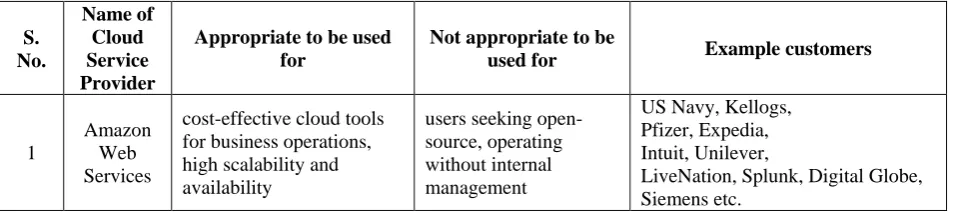
[image:3.595.61.538.641.747.2]After a brief discussion of few CSPs in previous section, this section emphasizes comparison among few distinctive features and services provided by them in tabular fashion.
Table 1 simply highlights the areas where these clouds are most suitable and their major users:
S. No.
Name of Cloud Service Provider
Appropriate to be used for
Not appropriate to be
used for Example customers
1
Amazon Web Services
cost-effective cloud tools for business operations, high scalability and availability
users seeking open-source, operating without internal management
US Navy, Kellogs, Pfizer, Expedia, Intuit, Unilever,
2 Microsoft Azure
Enterprise clients familiar with Microsoft products, robust development and deployment.
Managed cloud, or those unfamiliar with Microsoft products.
Microsoft, Candando, Mazda, Xerox, FreshDirect
NBC Sports, 3M
3
Google Cloud Platform
Developers seeking a streamlined cloud
ecosystem for development and deployment.
user seeking a managed cloud platform, simple cloud-based tasks.
Snapchat, Workiva,
Rovio, CocaCola, Motorola, Philips, HTC, AirBus
4 IBM Cloud
Business users seeking, bare metal servers, infrastructure, and analytics tools.
Minimal cloud functions, simple storage and computing needs.
SilverHook, Ahrefs, Jelastic, Gamifo, ChannelPace
5 Rackspace
Powerful managed hosting with various managed services.
Complete cloud ecosystems, interconnected PaaS and IaaS.
Simon Property Group, Transsmart, Cinepolis, AeroMaxico
6 VMware
Ongoing testing and deployment of
applications, users familiar with vSphere.
Simple, private computing platform, or those without a need for virtualization.
SAIC, Wachter Inc.
The Hut Group, SugarCreek, Seventy Seven Energy
7 Red Hat
Users preferring open-source networks and Linux systems.
Turnkey service with a complete set of cloud services and tools.
Amadeus, Penn State University, Acuity Systems, Genfare, European Space Agency
8 Oracle Cloud
Enterprise-grade cloud computing capabilities, including SaaS, IaaS, and PaaS.
Single-user or small business user client, simple turnkey cloud solution.
Skanska,
[image:4.595.62.539.54.414.2]Valdosta State, Duko Sign, GE, IBM, orange
Table 1: Various Cloud Service Providers with their appropriate uses [1-13]
Following Table 2 discusses the computing and encryption method used by these clouds and data retention time:
S. No. Name of Cloud Service Provider
Computing Mechanism Encryption Retention Time
1
Amazon Web Services
1.Elastic Cloud Computing (EC2) 2.Elastic Beanstalk
3.Additional Computing Services: a. AWS Lambda
b. Auto Scaling
c. Elastic Load Balancing d. Amazon WorkSpaces
1. In-Transit: SSL or Client-Side
2. At Rest: SSE (256 bit
AES algorithm in
GCM) or Client-Side
User-defined
2 Microsoft Azure
1.Linux and Windows Virtual Machines 2.Azure Container Registry
3.Additional Computing Services: a. Batch
b. RemoteApp
c. Azure Service Fabric d. Web Apps
1. In-Transit: SSL/TLS and IPSec 2. At Rest: Client-side with .NET and 256 bit AES 90 days 3 Google Cloud Platform
1. Google Container Engine 2. Google App Engine 3. Google Compute Engine
1. In-Transit: HTTPS/TLS 2. At Rest: DES or SSE AES-256
6 weeks
5 Rackspace
1. Rackspace Cloud Servers
2. Rackspace OnMetal Cloud Servers 3. Dedicated Servers
4. Microsoft Hyper-V
1. In-Transit: SSL 2. At Rest: AES-256
User-defined
6 VMware
1. Virtual Private Cloud 2. Dedicated Cloud 3. VMWare vCloud Air
1. In-Transit: Client-managed SSL VPN 2. At Rest: Third-party options
30 days
7 Red Hat
1. Red Hat Cloud Infrastructure
2. Red Hat Enterprise Linux OpenStack Platform
3. Red Hat Virtualization 4. Red Hat Openshift
1. In-Transit: SSL/TLS
2. At Rest: AES-256 180 days
8 Oracle Cloud
1. Dedicated Compute 2. Compute
1. In-Transit: Network Security by SSL 2. At Rest: Transparent Data Encryption(TDE)
[image:5.595.76.522.52.293.2]User-defined
Table 2: Various Cloud Service Providers with their computing mechanisms, encryption and retention time [1-13]
Next, Table 3 discusses Storage Mechanism and its properties used by these CSPs:
S. No.
Name of Cloud Service
Provider
Storage Mechanism Properties
1 Amazon Web Services
1. Amazon Simple Storage Service (Amazon S3)
i) Storage Classes for different use cases ii) Object Durability up to 99.999999999% iii) Spontaneous scaling
2.
i) highly optimized connectivity to AWS Cloud storage ii) helps with backup, cloud bursting and storage tiring use cases
iii) Replace tape automation without disrupting existing processes
3. Amazon Glacier
i) Integrated with Amazon S3
ii) Unlimited and largely Scalable Platform iii) Storage Redundancy
2 Microsoft Azure
1. Azure Storage
i) Geo-redundant Storage ii) Available in Petabytes
iii) Supports .NET, Android, Java, C++, Python, Ruby, PHP and Node.js
iv) massively scalable
2. Azure Backup
i) Availability is guaranteed up to 99.9% time ii) Data is encrypted in transit and at rest iii) Geo-redundant Storage
3 Google Cloud Platform
1. Google Cloud Storage
i) Designed for 99.999999999% durability with multiple copies and locations
ii) Nearly infinitely scalable, fully managed, highly reliable iii) No minimum fee and a pay-by-usage model
2. Google Cloud Datastore
i) Powerful query engine that allows users to search for data across multiple properties in NoSQL Database
3. Google Cloud Spanner
i) Used for Mission-critical applications
ii) Provides relational database service with transactional consistency
iii) Very high availability.
4 IBM Cloud
1. SoftLayer object storage
i) Scaling to practically infinite capacity
ii) Objects written multiple times per cluster, with auto-healing capabilities in case of drive failure
iii) Data organization with tagging, search, and indexing capabilities
2. Softlayer Backup
i) Custom schedules while targeting full systems, specific directories, or individual files
ii) Supports for bare metal as well as virtual server restore and recovery
iii) Monitoring, reporting, and alerting tools
3. Block Storage
i) Provides complete control over persistent storage using iSCSI-based block storage.
ii) up to 12 TB in capacity. iii) Customizable to suit workloads
5 Rackspace
1. Cloud Files
i) Files are replicated three times to three storage nodes with dual power supplies
ii) Open-source and supported developer tools for Java, Python, Node.js, Ruby, PHP, and .NET
iii) Access Rackspace Cloud Mobile on Windows 8
2. RackSpace CDN
i) A global Content Delivery Network (CDN), for video, images and websites
ii) Provides a cost effective way to improve speed and eliminate need for multiple data centers.
3. Cloud Backup
i) Block-level compression and deduplication reduce storage costs by up to 20 times
ii) Control Panel to create, schedule, and manage file-level backups
iii) No long-term commitment
iv) Enterprise-grade encryption (AES 256-bit key)
6 VMware
1. vCloud Air Object Storage
i) Distributed cloud-based disk storage for business continuity
ii) Petabyte scale static data with custom metadata iii) Data repository for file and application data across multiple virtual machines and users
2. Cloud Computing Block Storage
i) SSD-Accelerated Storage ii) Persistent block storage iii) Select storage tiers as needed
7 Red Hat
1. Red Hat Gluster Storage
i) Bit-rot detection to preserve the integrity of your data assets
ii) Storage deployment is available in seconds
iii) A single management point across multiple data storage locations
2. Red Hat Ceph Storage
i) Easily integrated with existing storage infrastructure ii) Advanced block storage capabilities working like a traditional block storage device
iii) A self-healing, self-managing platform
8 Oracle Cloud
1. Oracle Storage i) Capacity On-demand ii) Built-in Redundancy iii) Granular Access Control
2. Archive Storage i) for large scale data-sets ii) provides long term retention
3. Back up Storage
i) for Oracle database backup needs
ii) backups stored in encrypted form and transferred securely.
[image:7.595.68.533.173.775.2]iii) more capacity can be added when needed.
Table 3: Various Cloud Service Providers with their storage mechanism and their properties [1-13]
Next, Table 4 displays Networking Mechanism and its properties used by these CSPs:
S. No.
Name of Cloud Service Provider
Networking
Mechanism Properties
1 Amazon Web Services
1. Amazon Virtual Private Cloud (VPC)
i) A variety of connectivity options (i.e. public/private subnets)
ii) Supports Instantaneous Scaling iii) Amazon S3 Integration
2. Amazon EC2
i) Provides Virtual Server
ii) Provides resizable computing capacity
iii) Provides preconfigured templates, known as AMI (Amazon Machine Images) for instances
3. AWS Direct Connect i) Flexible Connection Scaling ii) Consistent Network Performance iii) Compatible with all AWS Services
4. Elastic Load Balancing
i) Automatically distributes incoming application traffic across multiple Amazon EC2 instances ii) Supports very high level of fault tolerance
2 Microsoft Azure
1. Azure Virtual Network
i) Micro level control over traffic between subnets ii) User-controlled hybrid infrastructure
iii) IP addresses and DNS servers are defined by user
2. Load Balancer i) for high availability and Network performance ii) robust performance and highly reliable
3. Azure ExpressRoute i) Dedicated Private connections to Azure data centers ii) Cost benefits and lower latency
3 Google Cloud Platform
1. HTTP/HTTPS Google Cloud load balancing
i) Fault Tolerant
ii) Scalable and requires no pre-warming iii) Simplified DNS setup
2. Google Cloud DNS
i)scalable, reliable and managed authoritative DNS ii) High performance, reliable
ii) cost effective while customizing as per customer needs
iii) Connect DNS records for other Google Cloud Platform services
4 IBM Cloud
1. SoftLayer load balancing
i) Management with SoftLayer API and Web portal ii) Hardware firewall options
iii) Responsive balance during peak traffic times
2. Network Appliances
i) Advanced load balancing functionality and application-aware health monitoring
ii) Application compression, caching, and optimization iii) Security add-ons for appliances
5 Rackspace
1. RackConnect Global
i) High-performance, low-latency connection speeds ii) Private circuit bypassing the internet for secure connectivity to other centers and environments iii) Connects to other cloud services, such as Azure
2. RackConnect Hybrid
i) Mix and match public cloud, private cloud, and dedicated servers
3. Custom Networking i) provides customizable, high speed network ii) immediate DDoS mitigation
6 VMware
1. vCloud Air Direct Connect
i) High throughput up to 1 or 10 Gbps ii) Dedicated path with low latency
iii) Support for secure multi-point connections
2. Hybrid Cloud Networking
i) Avoid the need to reconfigure applications by mirroring on-premises policies
ii) Edge Gateway for high availability
iii) vCloud Connector for hybrid cloud migration
3. VMware vCloud Connector
i) Helps in migration of existing applications, workloads and templates to vCloud Air ii) Hassle free easy migration
7 Red Hat
1. Red Hat Enterprise Virtualization
i) No vendor dependency with a fully open source solution
ii) Performance for both Windows and Linux guests iii) Top virtualization benchmarks for performance and scalability
2. Red Hat CloudForms
i) Self-service portal and catalog with automatic provisioning
ii) Discovery, monitoring, and tracking
iii) Automated policy enforcement and remediation
8 Oracle Cloud
1. VPN for Dedicated Compute
i) Multiple Tunnels ii) 128 bit AES encryption
iii) Simple UI and API to create a VPN gateway and VPN connection
2. FastConnect
i) Standard Layer3 Routing ii) Non-Metered Usage
iii) A predetermined path for data transfer
Table 4: Various Cloud Service Providers with their Network mechanism and their properties [1-13]
Following Table 5 shows the basic mechanism used by cloud service providers to provide after sales customer support:
S. No. Name of Cloud Service Provider Mechanism to Provide Basic Customer Support
1 Amazon Web Services Tutorials and Premium Support
2 Microsoft Azure
Tutorials and Premium Support 3 Google Cloud Platform Tutorials and Premium Support
4 IBM Cloud
Tutorials and Support on Phone calls and chats 5 Rackspace Tutorials and Support on Phone calls
6 VMware Tutorials and Premium Support
7 Red Hat
[image:8.595.68.530.53.422.2]Only Premium Support 8 Oracle Cloud Tutorials and Premium Support
Table 5: Various Cloud Service Providers with their basic mechanism to provide support services [1-13]
V. CONCLUSION
In today’s era where organizations are rapidly generating
client to compare these services and get benefit out of them. This paper provides a short list of parameters that need to be considered before selecting a CSP and various factors on which client can compare various CSPs.
REFERENCES
[1] Y. wei,
Cloud Computing: Challenges and Opportunities”. IEEE Internet Computing, Vol. 14(6), 2010, pp- 72-75. DOI:
[2] Messmer, Ellen. "Cloud Security Alliance formed to promote best practices". Computerworld. 2009.
[3] URL: https://aws.amazon.com/ Last retrieved on: 14 April 2017.
[4]
[5]
AWS Storage Services Overview: A Look at Storage Services Offered by AWS (White Paper), Amazon Web Services, Inc. or its affiliates. December 2016. Last viewed on: 15 April 2017.
URL: https://azure.microsoft.com. Last retrieved on: 11 April 2017.
[6] URL: https://cloud.google.com/. Last retrieved on: 14 April 2017.
[7] URL:https://www.ibm.com/cloud-omputing/services/cloud-migration-services/. Last retrieved on: 16 March 2017.
[8] URL: https://www.ibm.com/cloud-computing/ Last retrieved on: 4 May 2017.
[9] URL: https://www.rackspace.com/en-in/cloud. Last retrieved on: 3 Feb 2017.
[10] URL: http://www.vmware.com/in/solutions/cloud-computing.html. Last retrieved on: 30 April 2017.
[11]
[12]
URL: https://www.redhat.com/cms/managed-files/rhci-cloud-infrastructure-inc0370810mm-201603-en_0.pdf Last retrieved on: 14 April 2017.
[13]
URL: https://www.oracle.com/database/solutions/migration-to-cloud.html. Last retrieved on: 7 March 2017.
![Table 1: Various Cloud Service Providers with their appropriate uses [1-13]](https://thumb-us.123doks.com/thumbv2/123dok_us/687865.1076191/4.595.62.539.54.414/table-various-cloud-service-providers-appropriate-uses.webp)
![Table 2: Various Cloud Service Providers with their computing mechanisms, encryption and retention time [1-13]](https://thumb-us.123doks.com/thumbv2/123dok_us/687865.1076191/5.595.76.522.52.293/table-various-service-providers-computing-mechanisms-encryption-retention.webp)
![Table 3: Various Cloud Service Providers with their storage mechanism and their properties [1-13]](https://thumb-us.123doks.com/thumbv2/123dok_us/687865.1076191/7.595.68.533.173.775/table-various-cloud-service-providers-storage-mechanism-properties.webp)
![Table 5: Various Cloud Service Providers with their basic mechanism to provide support services [1-13]](https://thumb-us.123doks.com/thumbv2/123dok_us/687865.1076191/8.595.68.530.53.422/table-various-service-providers-mechanism-provide-support-services.webp)
