Simple is Best: Experiments with Different Document Segmentation
Strategies for Passage Retrieval
J¨org Tiedemann Information Science University of Groningen
Jori Mur Information Science University of Groningen
Abstract
Passage retrieval is used in QA to fil-ter large document collections in order to find text units relevant for answering given questions. In our QA system we ap-ply standard IR techniques and index-time passaging in the retrieval component. In this paper we investigate several ways of dividing documents into passages. In par-ticular we look at semantically motivated approaches (using coreference chains and discourse clues) compared with simple
window-based techniques. We evaluate
retrieval performance and the overall QA performance in order to study the impact of the different segmentation approaches. From our experiments we can conclude that the simple techniques using fixed-sized windows clearly outperform the se-mantically motivated approaches, which indicates that uniformity in size seems to be more important than semantic coher-ence in our setup.
1 Introduction
Passage retrieval in question answering is differ-ent from information retrieval in general. Extract-ing relevant passages from large document col-lections is only one step in answering a natural
language question. There are two main
differ-ences: i) Passage retrieval queries are generated from complete sentences (questions) compared to bag-of-keyword queries usually used in IR. ii) Re-trieved passages have to be processed further in
or-c
2008. Licensed under the Creative Commons Attribution-Noncommercial-Share Alike 3.0 Unported li-cense (http://creativecommons.org/licenses/by-nc-sa/3.0/). Some rights reserved.
der to extract concrete answers to the given ques-tion. Hence, the size of the passages retrieved is important and smaller units are preferred. Here, the division of documents into passages is crucial. The textual units have to be big enough to en-sure IR works properly and they have to be small enough to enable efficient and accurate QA. In this study we investigate whether semantically moti-vated passages in the retrieval component lead to better QA performance compared to the use of document retrieval and window-based segmenta-tion approaches.
1.1 Index-time versus Search-time Passaging
In this paper, we experiment with various possi-bilities of dividing documents into passages before indexing them. This is also called index-time pas-saging and refers to a one-step process of retriev-ing appropriate textual units for subsequent an-swer extraction modules (Roberts and Gaizauskas, 2004; Greenwood, 2004). This is in contrast to other strategies using a two-step procedure consist-ing of document retrieval and search-time passag-ing thereafter. Here, we can distpassag-inguish between approaches that only return one passage per rel-evant document (see, for example, (Robertson et al., 1992)) and the ones that allow multiple pas-sages per document (see, for example (Moldovan et al., 2000)). In general, allowing multiple pas-sages per document is preferable for QA as possi-ble answers can be contained at various positions in a document (Roberts and Gaizauskas, 2004). For this, an index-time approach has the advan-tage that the retrieval of multiple passages per doc-uments is straightforward because all of them com-pete which each other in the same index using the same metric for ranking.
A comparison between index-time and
time passaging has been carried out in (Roberts
and Gaizauskas, 2004). In their experiments,
index-time passaging performs similarly to search-time passaging in terms of coverage and redun-dancy (measures which have been introduced in the same paper; see section 4.2 for more informa-tion). Significant differences between the various approaches can only be observed in redundancy on higher ranks (above 50). However, as we will see later in our experiments (section 4.2), redundancy is not as important as coverage for our QA system . Furthermore, retrieving more than about 40 pas-sages does not produce significant improvements of the QA system anymore but slows down the pro-cessing time substantially.
Another argument for our focus on a one-step retrieval procedure can be taken from (Tellex et al., 2003). In this paper, the authors do not actually use any index-time passaging approach but compare various search-time passage retrieval algorithms. However, they obtain a huge performance differ-ence when applying an oracle document retriever (only returning relevant documents in the first re-trieval step) instead of a standard IR engine. Com-pared to this, the differences between the various passage retrieval approaches tested is very small. From this we can conclude that much improve-ment can be gained by improving the initial re-trieval step, which seems to be the bottleneck in the entire process. Unfortunately, the authors do not compare their results with index-time approaches. However, looking at the potential gain in document retrieval and keeping in mind that the performance of index-time and search-time approaches is rather similar (as we have discussed earlier) we believe that the index-time approach is preferable.
1.2 Passages in IR
Certainly, IR performance is effected by chang-ing the size of the units to be indexed. The task in document segmentation for our index-time pas-saging approach is to find the proper division of documents into text passages which optimize the retrieval in terms of overall QA performance.
The general advantages of passage retrieval over full-text document retrieval has been investigated in various studies, e.g., (Kaszkiel and Zobel, 2001; Callan, 1994; Hearst and Plaunt, 1993; Kaszkiel and Zobel, 1997). Besides the argument of de-creasing the search space for subsequent answer extraction modules in QA, passage retrieval also
improves standard IR techniques by “normaliz-ing” textual units in terms of size which is espe-cially important in cases where documents come from very diverse sources. IR is based on similar-ity measures between documents and queries and standard approaches have shortcomings when ap-plying them to documents of various sizes and text types. Often there is a bias for certain types raising problems of discrimination between documents of different lengths and content densities. Passages on the other hand provide convenient units to be returned to the user avoiding such ranking difficul-ties (Kaszkiel and Zobel, 2001). For IR, passage-level evidence may be incorporated into document retrieval (Callan, 1994; Hearst and Plaunt, 1993) or passages may be used directly as retrieval unit (Kaszkiel and Zobel, 2001; Kaszkiel and Zobel, 1997). For QA only the latter is interesting and will be applied in our experiments.
Passages can be defined in various ways. The most obvious way is to use existing markup (ex-plicit discourse information) to divide documents into smaller units. Unfortunately, such markup is not always available or ambiguous with other types of separators. For example, headers, list elements or table cells might be separated in the same way (for example using an empty line) as discourse related paragraphs. Also, the division into para-graphs may differ a lot depending on the source of the document. For example, Wikipedia entries are divided on various levels into rather small units whereas newspaper articles often include very long paragraphs.
to decide which of the competing window types is preferred and it may even return overlapping sec-tions multiple times.
In the following sections we will discuss two techniques of semantically motivated docu-ment segdocu-mentation and compare them to simple window-based techniques in terms of passage re-trieval and QA performance.
2 Passage Retrieval in our QA system
Our QA system is an open-domain question
an-swering system for Dutch. It includes two
strategies: (1) A table-lookup strategy using fact databases that have been created off-line, and, (2) an “on-line” answer extraction strategy with pas-sage retrieval and subsequent answer identification and ranking modules. We will only look at the second strategy as we are interested in the passage retrieval component and its impact on QA perfor-mance.
The passage retrieval component is imple-mented as an interface to several open-source IR engines. The query is generated from the given natural language question after question analysis. Keywords are sent to the IR engine(s) and results (in form of sentence IDs) are returned to the QA system.
In the experiments described here, we apply Zettair (Lester et al., 2006), an opsource IR en-gine developed by the search enen-gine group at the RMIT University in Melbourne, Australia. It im-plements a very efficient standard IR engine with high retrieval performance according to our exper-iments with various alternative systems. Zettair is optimized for speed and is very efficient in both indexing and retrieval. The outstanding speed in indexing is very fortunate for our experiments in which we had to create various indexes with dif-ferent document segmentation strategies.
3 Document Segmentation
We now discuss the different methods for docu-ment segdocu-mentation, starting with the semantically motivated ones and then looking at the window-based techniques.
3.1 Using Coreference Chains
Coreference is the relation which holds between two NPs both of which are interpreted as refer-ring to the same unique referent in the context in which they occur ((Van Deemter and Kibble,
2000)). Since the coreference relation is an equiv-alence relation and consequently a transitive rela-tion chains of coreferring entities can be detected in arbitrary documents. We can use these coref-erence chains to demarcate passages in the text. The assumption in this approach is that corefer-ence chains mark semantically coherent passages, which are good candidates for splitting up docu-ments.
Figure 1 illustrates chains detected by a resolu-tion system in five successive sentences.
1. [Jim McClements en Susan Sandvig-Shobe]i hebben een onrechtmatig argument gebruikt.
2. [De Nederlandse scheidsrechter]j[Jacques de Koning]j
bevestigt dit.
3. [Kuipers]k versloeg zondag in een rechtstreeks duel [Shani Davis]m.
4. Toch werd [hij]k in de rangschikking achter [de Amerikaan]mgeklasseerd.
5. [De twee hoofdarbiters]i verklaarden dat [Kuipers’]k voorste schaats niet op de grond stond.
Cluster i (1,5): [Jim McClements en Susan Sandvig-Shobe]
[De twee hoofdarbiters]
Cluster j (2): [De Nederlandse scheidsrechter]
[Jacques de Koning]
Cluster k (3-5): [Kuipers] [hij] [Kuipers’]
Cluster m (3,4): [Shani Davis] [de Amerikaan]
Figure 1: Example of coreference chains used for document segmentation
The coreferential units can then be used to form passages consisting of all sentences the corefer-ence chain spans over, i.e. the boundaries of pas-sages are sentences containing the first occurrence of the referent and the last occurrence of a refer-ent. Thus, in the example in figure 1 we obtain four passages: 1) sentence one to sentence five, 2) sentence two, 3) sentence three to five, and, 4) sen-tence three and four. Note that such passages can be included in others and may overlap with yet oth-ers. Furthermore, there might be sentences which are not included in any chain which have to be han-dled by some other techniques.
For our purposes we used our own coreference resolution system which is based on information derived from Alpino, a wide-coverage dependency
parser for Dutch (van Noord, 2006). We
clustering-based ranking task. Some NP pairs are more likely to be coreferent than others. The sys-tem ranks possible antecedents for each anaphor considering syntactic features, semantic features and surface structure features from the anaphor and the candidate itself, as well as features from the cluster to which the candidate belongs. It picks the most likely candidate as the coreferring an-tecedent.
References relations are detected between pro-nouns, common nouns and named entities. The resolution system yields a precision of 67.9% and a recall of 45.6% (F-score = 54.5%) using MUC scores (Vilain et al., 1993) on the annotated test corpus developed by (Hoste, 2005) which consist of articles taken from KNACK, a Flemish weekly news magazine.
3.2 TextTiling
TextTiling is a well-known algorithm for segment-ing texts into subtopic passages (Hearst, 1997). It is based on the assumption that a significant portion of a set of lexical items in use during the course of a given subtopic discussion changes when that subtopic in the text changes.
Topic shifts are found by searching for lexi-cal co-occurrence patterns and comparing
adja-cent blocks. First the text is subdivided into
pseudo-sentences of a predefined size rather than using syntactically-determined sentences. These pseudo-sentences are called token-sequences by Hearst.
The algorithm identifies discourse boundaries by calculating a score for each token-sequence
gap. This score is based on two methods,
block comparison and vocabulary introduction. The block comparison method compares adjacent blocks of text to see how similar they are accord-ing to how many words the adjacent blocks have in common. The vocabulary introduction method is based on how many new words were seen in the interval in which the token-sequence gap is the midpoint.
The boundaries are assumed to occur at the largest valleys in the graph that results from plot-ting the token-sequences against their scores. In this way the algorithm produces a flat subtopic structure from a given document.
3.3 Window-based
The simplest way of dividing documents into pas-sages is to use a fixed-sized window. Here we
do not take any discourse information nor seman-tic clue into account but split documents at arbi-trary positions. Windows can be defined in various ways, in terms of characters, words or sentences. In our case it is important to keep sentences to-gether because of the answer extraction compo-nent in our QA system that works on that level and expects complete sentences. Window-based segmentation techniques may be applied with var-ious amounts of overlaps. The simplest method is to split documents into passages in a greedy way, starting a new passage immediately after the pre-vious one (and starting the entire process at the be-ginning of each document)1. Another method is to allow some overlap between consecutive passages, i.e. starting a new passage at some position within the previous one. If we use the maximum possible overlap such an approach is usually called a “slid-ing window” in which the difference between two consecutive passages is only two basic units (sen-tences) - the first and the last one.
4 Experiments
4.1 Setup
For our experiments we applied the Dutch news-paper corpus used at the QA track at CLEF, the cross-language evaluation forum. It contains about 190,000 documents consisting of about 4,000,000 sentences (roughly 80 million words). As mtioned earlier, we applied the opsource IR en-gine, Zettair, in our experiments and used a lan-guage modeling metric with Dirichlet smoothing, which is implemented in the system.
The evaluation is based on 778 Dutch CLEF questions from the QA tracks in the years 2003 – 2005 which are annotated with their answers. We use simple matching of possible answer strings to determine if a passage is relevant for finding an accepted answer or not. Similarly, answer string matching is applied to evaluate the output of the entire QA system; i.e. an answer by the system is counted as correct if it is identical to one of the accepted answer strings without looking at the sup-porting sentence/passage. For evaluation we used the standard measure ofMRRwhich is defined as follows:
1Note that in our approach we still keep the document
MRRQA= N1 N
X
1
1
rank(first correct answer)
Using the string matching strategy for evalu-ation this corresponds to the lenient MRR mea-sures frequently used in the literature. Strict MRR scores (requiring a match with supporting docu-ments) is less appropriate for our data coming from the CLEF QA tracks. In CLEF there are usually only a few participants and, therefore, only a small fraction of relevant documents are known for the given questions.
4.2 Evaluation of Passage Retrieval
There are various metrics that can be employed for evaluating passage retrieval. Commonly it is ar-gued that passage retrieval for QA is merely a fil-tering task and ranking (precision) is less impor-tant than recall. Therefore, the measure of
redun-dancy has been introduced which is defined as the
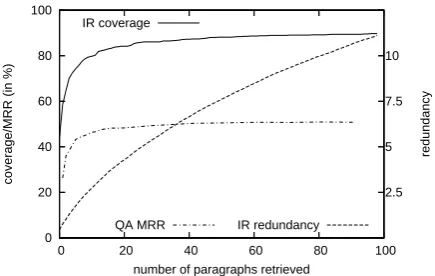
average number of relevant passages retrieved per question (independent of any ranking). Passage re-trieval is, of course, a bottleneck in QA systems that make use of such a component. The system has no chance to find an answer if the retrieval en-gine fails to return relevant passages. Therefore, another measure, coverage is often used in combi-nation with redundancy. It is defined as the pro-portion of questions for which at least one relevant passage is found. In order to validate the use of these measures in our setup we experimented with retrieving various amounts of paragraphs. Figure 2 illustrates the relation of coverage and redundancy scores compared to the overall QA performance
measured in terms ofMRRscores.
From the figure we can conclude that cover-age is more important than redundancy in our sys-tem. In other words, our QA system is quite good in finding appropriate answers if there is at least one relevant passage in the set of retrieved ones. Redundancy on the other hand does not seem to provide valuable insides for the end-to-end perfor-mance of our QA system.
However, our system also uses the passage re-trieval score (and, hence, the ranking) as a clue for answer extraction. Therefore, other standard IR measures might be interesting for our investi-gations as well. The following three metrics are common in the IR literature.
0 20 40 60 80 100
0 20 40 60 80 100
coverage/MRR (in %)
number of paragraphs retrieved IR coverage
redundancy
2.5 5 7.5 10
[image:5.595.312.530.87.225.2]IR redundancy QA MRR
Figure 2: The correlation between coverage and
redundancy and MRRQA with varying numbers
of paragraphs retrieved. Note that redundancy and coverage use different scales on the y-axis which makes them not directly comparable. The inten-tion of this plot is to illustrate the tendency of both measures in comparison with QA performance.
Mean average precision (MAP): Average of
precision scores for top k documents; MAP
is the mean of these averages over all theN queries.
MAP = N1 XN
n=1
1
K
K
X
k=1
Pn(1..k)
(Pn(1..k) is the precision of the top k docu-ments retrieved for queryqn)
Uninterpolated average precision (UAP):
Average of precision scores at each relevant document retrieved; UAP is the mean of these averages over theN queries.
UAP = N1 XN
n=1
1
|Dn r|
X
k:dk∈Dnr
Pn(1..k)
(Dnr is the set of relevant documents among the ones retrieved for questionn)
Mean reciprocal ranks: The mean of the
recip-rocal rank of the first relevant passage re-trieved.
MRRIR = N1
N
X
1
1
rank(first relevant passage)
15 20 25 30 35 40 45 50 55 60
0 20 40 60 80 100
MRR/UAP/MAP (in %)
number of paragraphs retrieved IR MRR
IR UAP
[image:6.595.304.533.70.124.2]IR MAP QA MRR
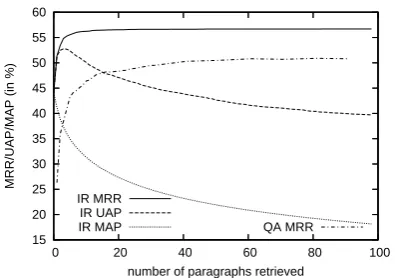
Figure 3: The correlation between IR evaluation
measures (MAP, UAP and MRRIR) and QA
evaluation scores (MRRQA) with varying
num-bers of paragraphs retrieved.
From the picture we can clearly see that the
MRRIR scores correlate the most with the QA
evaluation scores when retrieving different num-bers of paragraphs. This, again, confirms the
im-portance of coverage as the MRRIR score only
takes the first relevant passage into account and ig-nores the fact that there might be more answers
to be found in lower ranked passages. Hence,
MRRIR seems to be a good measure that
com-bines coverage with an evaluation of the rank-ing and, therefore, we will use it as our main IR evaluation metric instead of coverage, redundancy, MAP & UAP.
4.3 Baselines
The CLEF newspaper corpus comes with para-graph markup which can easily be used as the seg-mentation granularity for passage retrieval. Table 1 shows the scores obtained by different baseline retrieval approaches using either sentences, para-graphs or documents as base units.
We can see from the results that document re-trieval (used for QA) is clearly outperformed by both sentence and paragraph retrieval. Surpris-ingly, sentence retrieval works even better than paragraph retrieval when looking at the QA per-formance even though all IR evaluation measures
(cov, red, MRRIR) suggest a lower score. Note
that MRRIR is almost as good as MRRQA for
sentence retrieval whereas the difference between them is quite large for the other settings. This indi-cates the importance of narrowing down the search
space for the answer extraction modules. The
MRR
#sent cov red IR QA CLEF
sent 16,737 0.784 2.95 0.490 0.487 0.430
[image:6.595.81.279.86.225.2]par 80,046 0.842 4.17 0.565 0.483 0.416 doc 618,865 0.877 6.13 0.666 0.457 0.387
Table 1: Baselines with sentence (sent), paragraph (par) and document (doc) retrieval (20 units).
MRRQA is measured on the top 5 answers
re-trieved. CLEF is the accuracy of the QA system measured on the top answer provided by the sys-tem. cov refers to coverage and red refers to redun-dancy. #sent gives the total number of sentences included in the retrieved text units to give an im-pression about the amount of text to be processed by subsequent answer extraction modules.
amount of data to be processed is much smaller for sentence retrieval than for the other two while coverage is still reasonably high. The CLEF scores (accuracy measured on the top answer provided by the system) follow the same pattern. Here, the dif-ference between sentence retrieval and document retrieval is even more apparent.
Certainly, the success of the retrieval compo-nent depends on the metric used for ranking doc-uments as implemented in the IR engine. In or-der to verify the importance of document seg-mentation in a QA setting we also ran experi-ments with another standard metric implemented in Zettair, the Okapi BM-25 metric (Robertson et al., 1992). Similar to the previous setting using the LM metric, QA with paragraph retrieval (now yieldingMRRQA= 0.460) outperforms QA with
document retrieval (MRRQA = 0.449).
How-ever, sentence retrieval does not perform as well (MRRQA= 0.420) which suggests that the Okapi metric is not suited for very small retrieval units. Still, the success of paragraph retrieval supports the advantage of passage retrieval compared to document retrieval and suggests potential QA per-formance gains with improved document segmen-tation strategies. In the remaining we only report results using the LM metric for retrieval due to its superior performance.
4.4 Semantically Motivated Passages
coref-erence chains have been used as the only way
of forming passages. Sentences which are not
included in any passage are included as single-sentence passages. This settings is referred to as
sent/coref.
In the second setting we restrict the passages in length. Coreference chains can be arbitrary long and, as we can see in the results in table 2, the IR engine tends to prefer long passages which is not desirable in the QA setting. Hence, we define the constraint that passages have to be longer than 200 characters and shorter than 1000. This setup is referred to as sent/coref(200-1000).
In the third setting we combine paragraphs (us-ing exist(us-ing markup) and coreference chain pas-sages including the length restriction. This is mainly to get rid of the single-sentence passages included in the previous settings. Note that all paragraphs are used even if all sentences within them are included in coreferential passages. Note also that in all settings passages may refer to overlapping text units as coreference chains may stretch over various overlapping passages of a doc-ument.
We did not perform an exhaustive optimization
of the length restriction. However, we
experi-mented with various settings and 200-1000 was the best performing one in our experiments. For illus-tration we include one additional experiment using a slightly different length constraint (200-400) in table 2.
For the document segmentation strategy us-ing TextTilus-ing we used a freely available im-plementation of that algorithm (the Perl Module
Lingua::EN::Segmenter::TextTilingavailable
[image:7.595.307.532.71.144.2]at CPAN). Note that we do not include other pas-sages in this approach (paragraphs using existing markup nor single-sentence passages).
Table 2 summarizes the scores obtained by the various settings when applied for passage retrieval and when embedded into the QA system.
It is worth noting that including coreferential chains without length restriction forced the re-trieval engine to return a lot of very long passages which resulted in a degraded QA performance (also in terms of processing time which is not shown here). The combination of paragraphs and coreferential passages with length restrictions
pro-ducedMRRQAscores above the baseline.
How-ever, these improvements are not statistically sig-nificant according to the Wilcoxon matched-pair
MRR
#sent IR QA CLEF sent/coref 490,968 0.604 0.469 0.405 sent/coref(200-1000) 76,865 0.535 0.462 0.395
par+coref(200-1000) 82,378 0.560 0.493 0.426
par+coref(200-400) 67,580 0.555 0.489 0.422
TextTiling 107,879 0.586 △0.503 0.434
Table 2: Passage retrieval with document segmen-tation using coreference chains and TextTiling (re-trieving a maximum of 20 passages;△means sig-nificant withp <0.05and Wilcoxon Matched-pair Signed-Ranks Test compared to paragraph base-line – only tested forMRRQA)
signed-ranks test and looking at the corresponding CLEF scores we can even see a slight drop in per-formance. Applying TextTiling yielded improved scores in both passage retrieval and QA
perfor-mance (MRRQAand CLEF). The MRRQA
im-provement is statistically significant according to the same test.
4.5 Window-based Passages
In comparison to the semantically motivated pas-sages discussed above we also looked at simple window-based passages as described earlier. Here we do not consider any linguistic clues for divid-ing the documents besides the sentence and docu-ment boundaries. Table 3 summarizes the results obtained for various fixed-sized windows used for document segmentation.
MRR
#sent IR QA CLEF 2 sentences 33468 0.545 △0.506 0.443
3 sentences 50190 0.554 0.504 0.436
4 sentences 66800 0.581 △0.512 0.447
5 sentences 83575 0.588 0.493 0.422 6 sentences 100110 0.583 0.489 0.423 7 sentences 116872 0.572 0.491 0.422 8 sentences 133504 0.577 0.481 0.409 9 sentences 150156 0.578 0.475 0.405 10 sentences 166810 0.596 0.470 0.396
Table 3: Passage retrieval with window-based
doc-ument segmentation (△ means significant with
p < 0.05 and Wilcoxon Matched-pair
Signed-Ranks Test)
[image:7.595.311.521.502.614.2]out-perform the best semantically motivated segmen-tation approach. This result was unexpected espe-cially considering the naive way of splitting docu-ments into parts disregarding any discourse struc-ture (besides document boundaries) and other se-mantic clues.
We did another experiment using window-based segmentation and a sliding window approach. Here, fixed-sized passages are included starting at every point in the document and, hence, various overlapping passages are included in the index. In this way we split documents at various points and leave it to the IR engine to select the most ap-propriate ones for a given query. The results are shown in table 4.
MRR
#sent IR QA CLEF 2 sent (sliding) 29095 0.548 △0.516 0.456
3 sent (sliding) 36415 0.549 0.484 0.411 4 sent (sliding) 41565 0.546 0.476 0.409 5 sent (sliding) 45737 0.534 0.465 0.403 6 sent (sliding) 49091 0.528 0.454 0.390 7 sent (sliding) 51823 0.529 0.439 0.372 8 sent (sliding) 54600 0.535 0.428 0.360 9 sent (sliding) 57071 0.531 0.420 0.351 10 sent (sliding) 59352 0.542 0.420 0.354
Table 4: Passage retrieval with window-based doc-ument segmentation and a sliding window
Again, we see a significant improvement with 2-sentence passages (the overall best score so far) but the performance degrades when increasing the window size. Note that the number of sentences re-trieved is growing very slowly for larger windows. This is because more and more of the overlapping regions are retrieved and, hence, the total number of unique sentences does not grow with the size of the window as we have seen in the non-sliding approach.
5 Discussion & Conclusions
Our experiments show that passage retrieval is in-deed different to general document retrieval. Im-proved retrieval scores do not necessarily lead to better QA performance. Important for QA is to reduce the search space for subsequent answer ex-traction modules and, hence, passage retrieval has to balance retrieval accuracy and retrieval size. In our setup it seems to be preferable to return very small units with a reasonable coverage. For this, index-time passaging is very effective.
In this study we were especially interested in se-mantically motivated approaches to document
seg-mentation. In particular, two techniques have been investigated, one using the well-known TextTil-ing algorithm and one usTextTil-ing coreference chains for passage boundary detection. We compared them to simple window-based techniques using various sizes. From our experiments we can conclude that simple document segmentation techniques using small fixed-sized windows work best among the ones tested here. Semantically motivated passages in the retrieval component helped to slightly im-prove QA performance but do not justify the effort spent in producing them. One of the main reasons for the failure of using coreference chains for seg-mentation might be the fact that this approach pro-duces many overlapping passages which does not seem to be favorable for passage retrieval. This can also be seen in the sliding window approach which did not perform as well as the one without over-lapping units (except for two-sentence passages). In conclusion, uniformity in terms of length and
uniqueness (in terms of non-overlapping contents)
seem to be more important than semantic coher-ence for one-step passage retrieval in QA. A fu-ture direction could be to test an approach that bal-ances both a uniform document segmentation and semantic coherence.
References
Callan, James P. 1994. Passage-level evidence in doc-ument retrieval. In SIGIR ’94: Proceedings of the 17th annual international ACM SIGIR conference on Research and development in information retrieval, pages 302–310, New York, NY, USA. Springer-Verlag New York, Inc.
Greenwood, Mark A. 2004. Using pertainyms to im-prove passage retrieval for questions requesting in-formation about a location. In Proceedings of the Workshop on Information Retrieval for Question An-swering (SIGIR 2004), Sheffield, UK.
Hearst, Marti A. and Christian Plaunt. 1993. Subtopic structuring for full-length document access. In Re-search and Development in Information Retrieval, pages 59–68.
Hearst, Marti A. 1997. Texttiling: Segmenting text into multi-paragraph subtopic passages. Computational Linguistics, 23(1):33–64.
Hoste, V. 2005. Optimization Issues in Machine Learn-ing of Coreference Resolution. Ph.D. thesis, Univer-sity of Antwerp.
Research and development in information retrieval, pages 178–185, New York, NY, USA. ACM Press.
Kaszkiel, Marcin and Justin Zobel. 2001. Ef-fective ranking with arbitrary passages. Journal of the American Society of Information Science, 52(4):344–364.
Lester, Nicholas, Hugh Williams, Justin Zobel, Falk Scholer, Dirk Bahle, John Yiannis, Bodo von Billerbeck, Steven Garcia, and William Web-ber. 2006. The Zettair search engine. http://www.seg.rmit.edu.au/zettair/.
Llopis, F., J. Vicedo, and A. Ferr´andez. 2002. Pas-sage selection to improve question answering. In Proceedings of the COLING 2002 Workshop on Mul-tilingual Summarization and Question Answering.
Moldovan, D., S. Harabagiu, M. Pasca, R. Mihalcea, R. Girju, R. Goodrum, and V. Rus. 2000. The struc-ture and performance of an open-domain question answering system.
Monz, Christof. 2003. From Document Retrieval to Question Answering. Ph.D. thesis, University of Amsterdam.
Roberts, Ian and Robert Gaizauskas. 2004. Evaluating passage retrieval approaches for question answering. In Proceedings of 26th European Conference on In-formation Retrieval.
Robertson, Stephen E., Steve Walker, Micheline Hancock-Beaulieu, Aarron Gull, and Marianna Lau. 1992. Okapi at TREC-3. In Text REtrieval Confer-ence, pages 21–30.
Tellex, S., B. Katz, J. Lin, A. Fernandes, and G. Marton. 2003. Quantitative evaluation of passage retrieval al-gorithms for question answering. In Proceedings of the SIGIR conference on Research and development in informaion retrieval, pages 41–47. ACM Press.
Van Deemter, K. and R. Kibble. 2000. On coreferring: Coreference in muc and related annotation schemes. Computational Linguistics, 26(4):629–637.
van Noord, Gertjan. 2006. At Last Parsing Is Now Operational. In TALN 2006 Verbum Ex Machina, Actes De La 13e Conference sur Le Traitement Automatique des Langues naturelles, pages 20–42, Leuven.
Vilain, M., J. Burger, J. Aberdeen, D. Connolly, and L. Hirschman. 1993. A model-theoretic coreference scoring scheme. In Proceedings of the 6th confer-ence on Message understanding (MUC 6), pages 45– 52.