Named Entity Extraction Using Information Distance
∗Sangameshwar Patil†, Sachin Pawar‡, Girish K. Palshikar Tata Research Development and Design Centre, TCS
54B, Hadapsar Industrial Estate, Pune 411013, India
{sangameshwar.patil,sachin7.p,gk.palshikar}@tcs.com
Abstract
Named entities (NE) are important infor-mation carrying units within documents. Named Entity extraction (NEX)task con-sists of automatic construction of a list of phrases belonging to each NE of in-terest. NEX is important for domains which lack a corpus with tagged NEs. We present an enhanced version and im-proved results of our unsupervised (boot-strapping) NEX technique (Patil et al., 2013) and establish its domain indepen-dence using experimental results on cor-pora from two different domains: agricul-ture and mechanical engineering (IC en-gine1parts). We use a new variant of Mul-tiword Expression Distance (MED) (Bu et al., 2010) to quantify proximity of a can-didate phrase with a given NE type. MED itself is an approximation of the informa-tion distance (Bennett et al., 1998). Effi-cacy of our method is shown using exper-imental comparison with pointwise mu-tual information (PMI), BASILISK and KNOWITALL. Our method discovered 8 new plant diseases which are not found in Wikipedia. To the best of our knowl-edge, this is the first use of NEX tech-niques for agriculture and mechanical en-gineering (engine parts) domains.
1 Introduction
Agriculture is an activity of fundamental impor-tance in all societies. For example, agriculture plays a vital role in the economy of India: gen-erating second largest farm output in the world,
∗
Preliminary version of this paper was presented as a poster at NLDB 2013.
†
Doctoral research scholar at Dept. of CSE, IIT Madras ‡
Doctoral research scholar at Dept. of CSE, IIT Bombay
1Internal Combustion engine
providing 52% of rural employment (≈ 250 mil-lion people) and contributing≈15% to the GDP2. Hence timely and widespread dissemination of agriculture-related information is important. Such information - extracted, collated and summarized from a variety of document sources such as news, reports, web-sites and scientific literature - can be used to improve various aspects of services pro-vided to large population dependent on agricul-ture. Problem of information extraction for do-mains such as agriculture is particularly challeng-ing due to non-availability of any tagged corpus.
Several domain-specific named entities (NE) occur in the documents (such as news) related to the agriculture domain- CROP: names of the crops including varieties; DISEASE: names of the crop diseases and disease causing agents such as pathogen (bacteria, viruses, fungi), insects etc.; CHEMICAL TREATMENT: names of pesticides, insecticides, fungicides etc. used in the treatment of a crop disease. Consider an example of NEs tagged for agricultural information extraction: We usually spray [soybeans]CROP with a
[strobilurin fungicide]CHEM T REAT M EN T
because of the potential for [soybean
rust]DISEASE and other diseases.
As there are few, if any, tagged corpora of agriculture-related documents, we consider an un-supervised approach for extracting these NEs.NE extraction (NEX) problem consists of automati-cally constructing a gazette containing example in-stances for each NE of interest. A NE recogni-tion (NER)algorithm basically matches the given gazette G (for a particular NE, say DISEASE) with the given documentDto identify occurrences of the instances fromGinD. While gazette-based NER is fast, the accuracy depends on the quality and completeness of the gazette.
In this paper, we present an enhanced version
2http://en.wikipedia.org/wiki/Economy of India
(access date 31-Jan-2013)
and improved results of our bootstrapping ap-proach to NEX (Patil et al., 2013) and establish its domain independence. We demonstrate the use of this NEX technique for creating gazettes of NE in the agriculture and mechanical engineering do-mains. Apart from the new application domains for NE extraction, other specific contributions of this paper are as follows: We propose a new vari-ant of the well-known information distance (Ben-nett et al., 1998; Li et al., 2004; Bu et al., 2010) measure, to decide whether a candidate phrase is a valid instance of the NE or not. We use additional tools and show their effectiveness on improving the gazette quality: (i) a candidate generation al-gorithm based on maximum entropy classifier; and (ii) a post processing algorithm in the spirit of the assessor module in (Etzioni et al., 2005), but we use statistical hypothesis-testing. Utility and effectiveness of our method is evident from its ability to discover new named entities. For in-stance, using a limited news corpus, we discov-ered 8 new crop diseases which are not mentioned in Wikipedia.
The rest of the paper is organized as follows. Section 2 contains a brief overview of related work. In Section 3, we summarize information distance and multiword expression distance, along with new extensions. In Section 4, we discuss our unsupervised algorithm for gazette creation. In Section 5, we present experimental results. Finally we conclude with an outline of future work.
2 Related Work
Thelen and Riloff (2002) propose a bootstrapping algorithm called BASILISK for NEX. Etzioni et al. (2005) present a system called KNOWITALL, which implements an unsupervised domain-independent, bootstrapping approach to generate large facts of a specified NE (such as CITY or FILM) from the Web. Many other unsupervised approaches have been proposed for both NEX and NER: (Collins and Singer, 1999; Kim et al., 2002; Meulder and Daelemans, 2003; Talukdar et al., 2006; Jimeno et al., 2008; Liao and Veera-machaneni, 2009; Palshikar, 2012). The basic structure of the bootstrapping approach to NEX is well-known: starting with a seed list of examples of a particular NE type, iteratively identify other phrases which are “similar” to them and add them to the seed list. The algorithm terminates either af-ter a specified number of iaf-terations, or on reaching
a specified gazette size, or when no new entries get added or when the new entities show a “drift”.
3 Information Distance for NE
Information distance (Bennett et al., 1998) is an abstract and universal domain-independent, statis-tically motivated distance measure based on the concept ofKolmogorov complexity. Given a Uni-versal Turing Machine (UTM) U, Kolmogorov complexity KU(x|y) of a binary string x, given
another binary stringy, is the length of the short-est program for U that computes x when given y as input. Bennett et al. (1998) showed that the quantity (which they called the information distance) Dmax(x, y) = max{K(x|y), K(y|x)}
measures the distance between objects (such as bi-nary strings)xandy.
Bu et al. (2010) presented a variant of the in-formation distance, which measures the distance between an n-gram and its semantics. They de-fine the context φ(g) of an n-gram g as the set of all web-pages containinggwhile thesemantics µ(g)ofg is the set of all web-pages that contain all words ingbut not necessarily as a contiguous n-gram. For example, forg =Bill Gates,φ(g) consist of all pages containingBill Gatesas the bigram whileµ(g) consists of all web-pages that contain both Billand Gates but not necessarily as a bigram. Clearly, φ(g) ⊆ µ(g). The Multi-word Expression Distance (MED)M ED(g) mea-sures the distance ofg from an “intended” (non-compositional) semantics:
M ED(g) =Dmax(φ(g), µ(g))
M ED(g)≈log|µ(g)| −log|φ(g)|
Bu et al. (2010) demonstrated the use of MED to perform NER. In this paper, we use a variant of MED to perform NEX. Unlike (Bu et al., 2010), we are constrained to use a corpus rather than the entire Web. LetDbe a given untagged corpus of sentences. Let K be a given constant indicating the window size (e.g., K = 3). Letg be a given candidate phrase. The context of g and a given word w, denoted φK(g, w), is the set of all
not be within a window of sizeK in the sentence. Clearly,φK(g, w)⊆µ(g, w). Then we define the distancebetweeng(a given candidate phrase) and a given wordwas follows:
M ED0D,K(g, w) =log|µ(g, w)|−log|φK(g, w)|
Let W = {w1, w2, . . . , wm} be a given finite,
non-empty set of m words. The definition of M ED0is extended to use a given set W (rather than a single wordw) by taking the average of the M ED0distance betweengand each word inW:
M EDD,K(g, W) =
M ED0D,K(g, w1) +. . .+M ED0D,K(g, wm)
m
We assume that a subroutineM ED(D, K, W, g) returns the MED distance M EDD,K(g, W), as
defined above.
4 NEX Using MED
In NEX task, we are given (i) an untagged corpus
D of documents; and (ii) a seed list L contain-ing known examples of a particular NE type T. The goal is to create a gazette containing other in-stances of the NE typeT that occur inD. We first look at some sub-problems and then give the com-plete algorithm for NEX in Section 4.4.
4.1 Pre-processing step
The first task is to identify all phrases in D that are likely to be instances of the NE typeT. In the simplest case, all phrases inDthat have the same syntactic structure as the instances in Lcould be considered as candidates. For example, for DIS-EASE, one could look for all NPs that may begin with at most one adjective (e.g.,gray mold), fol-lowed by one or more nouns and whose head word is a singular common noun (as in crown rot or tissue blight). We assume such simple logic is implemented in a subroutineGenCandidates (not shown in this paper). However, even with such syntactic restrictions, the number of candi-date instances is usually very large. For instance, for agricultural domain corpus described in Sec-tion 5, around 350,000 candidates were output by GenCandidates. It also contains many phrases which are obviously not the instances ofT (e.g., moderate field tolerance).
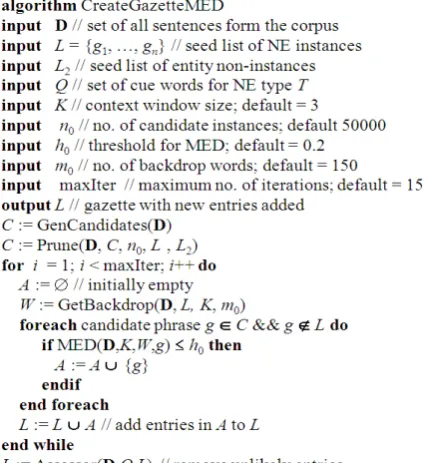
AlgorithmP rune(Fig. 1)pre-processesthe list C of candidates from GenCandidates using a
Figure 1: AlgorithmPrune
self-trained, iterative maximum entropy (MaxEnt) classifier. Some of the major features used by MaxEnt classifier are: words in the phrase, words in context and their POS tags, next and previous verbs, binary features to capture presence of ad-jective, capitalization, proper nouns within phrase.
4.2 Backdrop of a Gazette
The key problem in unsupervised NEX is to de-cide, using D, whether a candidate phraseg has the same NE type T as the examples in L. For example, given L = {gray mold, crown rot, tissue blight}as a seed list forT = DISEASE andg=corn rustas a candidate phrase, we need to decide whether g is a DISEASE or not. The idea is to use the M EDD,K as defined above to
accept only those g which have “low” distance (“high” similarity) betweengand the backdrop of the gazetteL, which is defined as a setW of words “characteristic” (or strongly indicative) ofT.
Function GetBackdrop(D, L, K, m0)(Fig. 2)
computes, usingD, the setW for a given gazette L. Essentially, it computes how many times each word w occurs in the context window of given size K around every entry in L. Then it com-putes a relevance scorefor each word. The rel-evance scoreis computed as a product of follow-ing factors: the entropyH of the word; the num-ber b of entries in L for which it is a context word; and ratio of the total number fL of times
the word occurs in the context of all entries in L to its frequencyf in the entire corpus D. Fi-nally, it returns the topm0 words in terms of the
Figure 2: AlgorithmGetBackDrop
L. For example, suppose L consists of 6 DIS-EASE instances. For the wordcauses,b(causes) = 6,H(causes) = 1.51 andf(causes) = 75, lead-ing to score(causes) = 16.9895. For the word technology,b(technology) = 2,H(technology) = 0.0646 and f(technology) = 84, leading to score(technology) = 0.2485. Clearly, causes is much more relevant as a cue word for DIS-EASE than technology. The score gives more importance to words that appear more frequently as well as in the context of more entries in the given gazette. Higher entropy value indicates that the word is used more uniformly in the context of many entries inL. Words with a more skewed us-age (lower entropy) may be good indicator words for specific entries rather than for all entries inL. Such words are not preferred.
4.3 Assessing the Gazette
We propose a post-processing step to assess and improve the quality of the candidate gazette cre-ated, by identifying (and removing) those entries in the candidate gazette which are very unlikely to be true instances of NE typeT.
Suppose the candidate gazette includes the two phrasesg1=late blightandg2=wet weather.
Suppose we had also been given a small setQof cue wordsfor the NE typeT; e.g., for DISEASE, Q could be {disease, cause, symptom}. For a given phrase g, we compute two counts: c(g) = count of sentences in D which contain the
n-gramgandcq(g)= count of sentences inDwhich contain (in any order) both the n-gram g and at least one word in Q. Clearly,cq(g) ≤ c(g). Let
ˆ
f(g) = cq(g)c(g). Clearly, 0 ≤ fˆ(g) ≤ 1. For
ex-ample, fˆ(g1) = 38/90 = 0.422 and fˆ(g2) =
104/642 = 0.162.
Let0 < f0 <1be a fixed value; e.g.,f0 = 0.2
(we shall shortly discuss how to obtainf0).
Essen-tially, fˆ(g) indicates how well the phrase g “co-occurs” with words in Q. “Low” values offˆ(g) (e.g., those belowf0) indicate that the number of
occurrences of g drops drastically when you re-strict to only those sentences that contain at least one word inQ. Such phrases are unlikely to be true instances ofT. We perform a statistical hy-pothesis test (calledproportion test) that the frac-tionfˆ(g)is greater than the given constantf0. The
null hypothesis isH0 :f(g) ≥f0, wheref(g)is
the “true” proportion forg, since the observed pro-portion varies depending onD. The test statistic is
ˆ
f(g)−f0 r
f0(1−f0)
c(g)
which follows the Standard Normal distribution. Hence the probability (p-value) of observing a par-ticular value of the test statistic can be computed using standard tables. The null hypothesis is re-jected ifpis less than the given significance level α(we useα= 0.05).
Forg1,g2, the test statistic values are 5.270 and
−2.407; and the p-values are 0.999 and 0.008. Thus g2 is correctly rejected as an unlikely
in-stance for the NE type DISEASE. Note that this step requires the user to provide the setQof cue words for NE typeT; we found that generally only a few words (≤10) are enough. We setf0to just
below the minimum among the values for the cur-rent gazetteL. We assume that this logic is imple-mented as a functionAssessor(D, Q, L), where Lis the gazette containing phrases to be assessed.
4.4 Unsupervised Gazette Creation
cre-Figure 3: AlgorithmCreateGazetteM ED
ate the setW of backdrop words for T using L. Then it uses the modified MED to measure the similarity of each candidate phrase g ∈ C with W and addsg to a temporary setAonly if it has a “high” similarity with W (above a threshold). A configurable number (default 10) of top can-didates from set A are added to L in each iter-ation. At the end of maxIter, final set of can-didates in L is then pruned using the Assessor algorithm. We have enhanced the earlier ver-sion (Patil et al., 2013) by using weighted back-drop to computeM EDD,K(g, W). Note that the
algorithm contains four independent ways of as-sessing whether a sequence of words is an instance ofT or not, as implemented inGenCandidates, P rune,M EDD,K andAssessor.
5 Experimental Evaluation
Experimental Setup: In addition to the
agri-cultural news corpus described in (Patil et al., 2013), we also evaluated the proposed technique on a corpus of 7500 engine repair records from mechanical engineering domain. Goal is to create a gazette of engine part names from the engine repair records. The agriculture corpus consists of 30533 documents in English containing 999168 sentences and approximately 19 million words. It was collected using crawler4j (Ganjisaffar, 2013) by crawling the agriculture news
web-Figure 4: Number of entries (& precision) in the final gazette for each NE type. (To use the same base-line for comparing precision of the proposed algorithm and BASILISK, we use the gazette size of BASILISK compara-ble to that ofM EDD,Kwith Assessor.)
sites (websites, 2012)3. A sample of seeds used to bootstrap the NEX for each category are as following - CROP: {wheat, cotton, corn, soybean, banana} ; DISEASE: {wilt, leaf spot, rust, weevil} ; CHEM TREATMENT:
{di-syston, evito, tilt, headline} ; EN-GINE PARTS:{piston, gaskets, bearings, crankshaft, cylinder}.
Results: Fig. 4 summarizes the gazette sizes
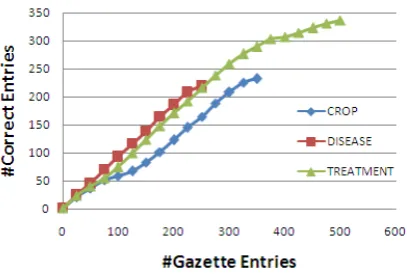
along with precision for NE types from both agri-culture and mechanical engineering (IC engine parts) corpora. Detection rate for agriculture NE type are shown in Fig. 5. To calculate the pre-cision, all the gazettes created by all the algo-rithms were manually and independently verified by at least three different human annotators. From these results, we conclude that the proposed tech-nique performs well indomain independent man-ner. Assessor module improves precision for all NE types for both measuresM EDD,K and PMI.
Post-processing using assessor has positive im-pact on gazette quality. In this experiment, we used top 1000 candidates produced by algorithm P rune, instead of top 5000 used in the earlier ver-sion (Patil et al., 2013). We observe significant im-provement in precision for all NE types. It is clear that the gazette quality is dependent on the output of algorithm P rune. We are investigating their inter-relationship as part of this on-going work.
A sample entries from gazette created for each NE type T are as follows: CROP: {rr alfalfa, sugarcane, biofuel crops, winter canola};
3Permission awaited from the content-owners for public
Figure 5: Detection rate ofCreateGazetteM ED with Assessor
DISEASE: {asian soybean rust, alternaria, downy mildew, citrus greening, fusarium wilt}; CHEM TREATMENT: { ultra blazer, strobilurin, telone II, gaucho grande,
spartan}; ENGINE PARTS:{ piston pin, conn rod, cam gear, cyl head, piston skirt}.
To highlight effectiveness of the gazettes created, we compared our DISEASE gazette with wikipedia. We listed all the page titles on wikipedia falling under categories Plant pathogens and diseases (1935) and Agricultural pest insects (203). It was quite encouraging to find that, our gazette, though created on a limited size corpus, contained diseases/pathogens not present in wikipedia.4 Some of these are -limb rot, grape colaspis, black shank, glume
blotch, seed corn maggot, mexican rice borer, green bean syndrome, hard lock.
Comparison with BASILISK: Our
imple-mentation of BASILISK (Pawar et al., 2012) has comparable precision with the proposed CreateGazetteM ED algorithm for DISEASE category. However, CreateGazetteM ED clearly outperforms BASILISK for all other cat-egories. Major reason behind worse performance of BASILISK is that it scores each occurence of the phrase in the corpus independently and the decision to add that phrase to the gazette de-pends on the highest among all of these scores. CreateGazetteM ED computes a single score for each phrase by combining evidences from all of its occurrences in the corpus.
Comparison with KNOWITALL:
KNOW-ITALL (Etzioni et al., 2005) is a leading, web-scale unsupervised information extraction engine. We implemented basic version of KNOWITALL
4Verified on30thJanuary,2013
algorithm and executed it on above mentioned cor-pus of agricultural news items. For agriculture do-main, KNOWITALL extracted gazettes of follow-ing sizes for the three NE types - CROP : 36 entries (20 correct); DISEASE : 55 entries (49 correct); CHEM TREATMENT : 13 entries (12 correct).
We believe that reason for KNOWITALL’s lim-ited gazette size lies in inherent difference be-tween a web-scale search vis-a-vis searching a given corpus. This results in skewed search query statistics and affects the size of gazettes created.
Comparison with PMI: To gauge the
ef-fictiveness of M EDD,K as a proximity
mea-sure, we compare it with PMI (Bouma, 2009). We follow exactly the same steps as described in our CreateGazetteM EDalgorithm with the only difference being use of PMI, instead of M EDD,K. For the results with top 1000
candi-dates from Prune (Fig. 4), M EDD,K compares
favorably with PMI as a proximity measure for all the NE types. Comparing with results with top 5000 candidates from Prune (in (Patil et al., 2013)), we observe thatM EDD,K is a more
ro-bust proximity measure than PMI. Sensitivity of these measures to output of pre-processing step is part of future work.
6 Conclusions and Further Work
References
C.H. Bennett, P. Gacs, M. Li, P.M.B. Vitanyi, and W.H. Zurek. 1998. Information distance. IEEE Transac-tions on Information Theory, 44(4):1407–1423.
G. Bouma. 2009. Normalized (pointwise) mutual in-formation in collocation extraction. InProceedings of the Biennial GSCL Conference.
F. Bu, X. Zhu, and M. Li. 2010. Measuring the non-compositionality of multiword expressions. In Pro-ceedings Of the 23rd Conf. on Computational Lin-guistics (COLING).
M. Collins and Y. Singer. 1999. Unsupervised models for named entity classification. In Proceedings of Joint SIGDAT Conference on Empirical Methods in Natural Language Processing and Very Large Cor-pora (EMNLP).
O. Etzioni, M. Cafarella, D. Downey, A.-M. Popescu, T. Shaked, S. Soderland, and D.S. Weld. 2005. Un-supervised named-entity extraction from the web: an experimental study. Artificial Intelligence, 165:91–134.
Yasser Ganjisaffar. 2013.http://code.google. com/p/crawler4j/. [Online; accessed 16 Aug. 2013].
A. Jimeno, E. Jimenez-Ruiz, V. Lee, S. Gaudan, R. Berlanga, and D. Rebholz-Schuhmann. 2008. Assessment of disease named entity recognition on a corpus of annotated sentences. BMC Bioinformat-ics, 9(Suppl 3)(S3):1–10.
J.-H. Kim, I.-H. Kang, and K.-S. Choi. 2002. Unsuper-vised named entity classification models and their ensembles. InProceedings of COLING.
M. Li, X. Chen, X. Li, B. Ma, and P.M.B. Vitanyi. 2004. The similarity metric. IEEE Transactions on Information Theory, 50(12):3250–3264.
W. Liao and S. Veeramachaneni. 2009. A simple semi-supervised algorithm for named entity recog-nition. InProceedings of the NAACL HLT Workshop on Semi-Supervised Learning for Natural Language Processing, pages 58–65.
F.D. Meulder and W. Daelemans. 2003. Memory-based named entity recognition using unannotated data. In Proceedings of the seventh conference on Natural language learning at HLT-NAACL - Volume 4, pages 208–211.
G. K. Palshikar. 2012. Techniques for named entity recognition: A survey. In Collaboration and the Semantic Web: Social Networks, Knowledge Net-works and Knowledge Resources, pages 191–217. IGI Global.
S. Patil, S. Pawar, G. K. Palshikar, S. Bhat, and R. Sri-vastava. 2013. Unsupervised gazette creation us-ing information distance. InProceedings of the 18th
International Conference on Application of Natural Language to Information Systems (NLDB), LNCS 7934. Springer-Verlag.
S. Pawar, R. Srivastava, and G. K. Palshikar. 2012. Automatic gazette creation for named entity recog-nition and application to resume processing. In Pro-ceedings of ACM COMPUTE.
P.P. Talukdar, T. Brants, M. Liberman, and F. Pereira. 2006. A context pattern induction method for named entity extraction. InProceedings of the 10th Confer-ence on Computational Natural Language Learning (CoNLL), pages 141–148.
M. Thelen and E. Riloff. 2002. A bootstrapping method for learning seman-tic lexicons using extrac-tion pattern contexts. In Proceedings of the Con-ference on Empirical Methods in Natural Language Processing (EMNLP).
Agriculture News Source websites.
2012. cornandsoybeandigest.
com,deltafarmpress.
com,southwestfarmpress.com, southeastfarmpress.com,