Keyphrase Extraction from Online News Using Binary Integer
Programming
Zhuoye Ding, Qi Zhang, Xuanjing Huang Fudan University
School of Computer Science
{09110240024,qz,xjhuang}@fudan.edu.cn
Abstract
In recent years, keyphrase extraction has received great attention, and been success-fully employed by various applications. Keyphrases extracted from news articles can be used to concisely represent main contents of news events. Keyphrases can help users to speed up browsing and find the desired contents more quickly. In this paper, we first present several crite-ria of high-quality news keyphrases. Af-ter that, in order to integrate those crite-ria into the keyphrase extraction task, we propose a novel formulation which con-verts the task to a binary integer program-ming problem. The formulation cannot only encode the prior knowledge as con-straints, but also learn constraints from data. We evaluate the proposed approach on a manually labeled corpus. Experi-mental results demonstrate that our ap-proach achieves better performances com-pared with the state-of-the-art methods.
1 Introduction
Keyphrase extraction is a long studied topic in natural language processing. A keyphrase, which consists a word or a group of words, is defined as a precise and concise expression of one or more documents. It has been widely used in var-ious applications such as summarization, cluster-ing, categorizcluster-ing, browscluster-ing, and so on. In recent years, keyphrase extraction has received much at-tention (Witten et al., 1999; Zha, 2002; Hulth, 2003; Tomokiyo and Hurst, 2003; Chen et al., 2005; Medelyan et al., 2009; Liu et al., 2009).
Keyphrases are usually manually chosen by
authors, for scientific publications, magazine ar-ticles, books, et al. Due to the expensive and time consuming effort of manually assign-ing keyphrase, web pages and online news rarely contain keyphrases. It should be useful to au-tomatically extract keyphrases from online news to represent their main contents. There are al-ready a number of studies which focus on extract-ing keyphrases from scientific publications or sin-gle news article (Frank et al., 1999; Turney, 2000; Wan and Xiao, 2008; Jiang et al., 2009). We also notice that, currently, many websites provide the service which group related news together to fa-cilitate users’ browsing. In this paper, we focus on extracting keyphrases from a group of news arti-cles which describe the same news event by dif-ferent publishers.
Previous studies on keyphrase extraction can be roughly categorized into two groups: super-vised and unsupersuper-vised. Unsupersuper-vised approaches usually select a set of candidates and use dif-ferent ranking methods to select the candidates with the highest scores as keyphrases. Most of ranking methods are based on the information ex-tracted from the document, such as TF·IDF,
po-sition, syntactic relation with other words, and so on. Supervised methods convert the task into a binary classification problem, which categorizes phrases as keyphrases or non-keyphrases. Simi-lar as other tasks applied by supervised methods, a large amount of domain dependent training data is required. When the domain is changed, the la-beled corpus should also be changed. And corpus labeling is a time-consuming and tedious task.
Most of the current methods focus on judging the importance of each phrase, and individually extract phrases with the highest scores. After ana-lyzing the human assigned keyphrases, we observe
that the keyphrases of news should satisfy the fol-lowing properties:
1. Relevance. The keyphrases should be se-mantically relevant to the news theme. The most important ones should be selected as keyphrases.
2. Coverage. The keyphrases should be indica-tive of the whole news event. The extracted keyphrases should cover most of the aspects of the news event.
3. Coherence. The keyphrases should be se-mantically related to each other, and logically consistent and holding together as a harmo-nious whole.
4. Conciseness. The keyphrases should not contain keyphrases with redundant informa-tion.
In order to automatically select keyphrases which can satisfy the above properties, in this pa-per, we propose a novel formulation which con-verts keyphrase extraction to a binary integer pro-gramming problem (BIP) (Alevras and Padberg, 2001). An objective function and a number of con-straints which high-quality keyphrases should sat-isfy are specified. BIP, which is the special case of integer programming and a well-studied opti-mization framework, is used to efficiently search the entire space to extract keyphrases. The for-mulation provides a flexible framework for inte-grating different criteria as objective functions or constraints.
The major contributions of this work can be summarized as follows: 1) We propose a novel formulation of keyphrase extraction as a binary integer programming problem; 2) Several crite-ria which high-quality keyphrases should satisfy are converted to the objective function and a set of constraints in order to fit the formulation; 3) Keyphrases are extracted as a set with considera-tion of their relaconsidera-tionships; 4) Experimental results on the dataset consisting of 150 groups of news articles with human annotated keyphrases demon-strate that the proposed method performs better than the state-of-the-art algorithms.
The rest of this paper is organized as follows: Section 2 reviews some related studies. We pro-pose our approach in Section 3. In Section 4, the experimental results are shown and discussed. Fi-nally, we conclude this paper in Section 5.
2 Related Work
As mentioned in the previous section, most of current studies on keyphrase extraction can be roughly divided into two categories: supervised and unsupervised approaches.
Unsupervised approaches usually select gen-eral sets of candidates and use a ranking step to select the most important candidates. For ex-ample, Mihalcea and Tarau proposed a graph-based approach called TextRank, where the graph nodes are tokens and the edges reflect cooccur-rence relations between tokens in the document (Mihalcea and Tarau, 2004). Wan and Xiao ex-panded TextRank by using a small number of topic-related documents to provide more knowl-edge, which improved results compared with stan-dard TextRank and a tf.idf baseline (Wan and Xiao, 2008). Tomokiyo and Hurst used point-wise KL-divergence between language models de-rived from the documents and a reference corpus (Tomokiyo and Hurst, 2003). Matsuo and Ishizuka presented a statistical keyphrases extraction ap-proach that did not make use of a reference corpus, but was based on cooccurrences of terms in a sin-gle document (Y.Matsuo and M.Ishizuka, 2004). In this paper the proposed BIP based method can combine those unsupervised methods as assign-ment value in the objective function. TF·IDF and
extrac-tion algorithm for scientific publicaextrac-tions and in-troduced novel features towards scientific publi-cations such as section information and certain morphological phenomena often found in scien-tific papers (T.D.Nguyen and Kan., 2007).
Since integer linear programming (Alevras and Padberg, 2001) can be used to incorporate both local features and non-local features, which are difficult to handle with traditional algorithms, it has received much attention in various NLP prob-lems in recent years. Roth and Yih (2005) ex-tended CRF models by applying inference pro-cedure based on ILP to naturally and efficiently support general constraint structures. They ap-plied their model on semantic role labeling (SRL) task. Martin et al. (2009) formulated the prob-lem of nonprojective dependency parsing as a polynomial-sized integer linear program. Wood-send and Lapata (2010) presented a joint con-tent selection and compression model for single-document summarization using an integer linear programming formulation.
3 Keyphrase Extraction Using BIP The objective of keyphrase extraction is to se-lect the most informative group of phrases, which are relevant to the news event and subject to constraints including the number of phrases, topic/aspect coverage, and coherence. Since these constraints are global, and cannot be adequately satisfied by optimizing each of them individually, our approach uses the BIP formulation, a well-studied optimization framework, which can be ef-ficiently solved using standard optimization tools, to extract keyphrases.
Integer Linear Programming (ILP) denotes a set of constraint optimization problems which have a linear objective function, subject to linear equality and linear inequality constraints, and require the objective variables to be integers. ILP can be ex-pressed in canonical form:
maximize cTx
subject to Ax≤b (1) Gx=d
x∈Zn
Binary Integer Programming (BIP) is the special case of ILP where variables are either 0 or 1.
In this paper, we treat the keyphrase extraction task as a two class labeling problem. Given a
group of documentsD, for each wordw∈D, we decide to select this word as a keyphrase (assign label “1” to the word), or non-keyphrase (assign label “0”). We use a vector of binary variables
x = (x1, x2, ..., xn) over word wi ∈ D, to in-dicate whether the corresponding word should be selected or not. With the objective variablesxand word wi ∈ D, c = (c1, c2, ..., cn) is defined as the assignment value. The variablecigives the ex-pected value of labeling wi as a keyphrase. The basic extraction model is shown in Eq.(2). Our goal is to find the optimal point of weightsx∗
sat-isfying the constraints.
maximize cTx
subject to 0≤xi ≤1 (2)
x∈Zn
3.1 Objective Function
With the BIP formulation, objective function
cTx = Pkckxk denotes the expected informa-tive scores over all the words of a solution x. Maximizing the expected scores biases the words with highestci values as keyphrases. Various fea-tures can be considered as the values c. In this work, we use two basic features TF·IDF and lo-cality. They have also been widely used in exist-ing keyphrase extraction methods. The objective function is given in the Eq.(3).
cTx, ci = α·
P
d∈DT F·IDF(wi,d) |D|
+β·µi+γ·νi (3)
Three parametersα,β, andγ are used to tradeoff among the different parts, |D| is the number of documents in this news group. The latter section provides detailed description of this equation.
3.1.1 TF·IDF
TF·IDF compares the frequency of a phrase in a particular document with that in general corpus. The TF·IDF for wordwiis computed as:
T F·IDF(wi, d) = freq
(wi, d)
|d| ·log2 N
df(wi), where freq(wi, d)is the number of timeswi occurs ind;
df(wi)is the number of documents containingwi in the global corpus; N is the size of the global corpus;|d|is the length of the document of d..
In this paper, we use the average TF·IDF over
3.1.2 Locality
The first occurrence position of the candidate phrase is an important feature for keyphrase ex-traction. It has also been used by many existing methods (Witten et al., 1999; Zha, 2002; Liu et al., 2009). In this paper, we also incorporate the information as parts of objective function.
For the words in the title of news articles, we define a bonus µ for their informative scores. It
is the second component in the Eq.(3). Theµi is defined as follows:
µi =
½
µ, wi ∈T
0, otherwise
, whereT represents the set of all the title words.
Similarly, we define ν for those words which
occur in the first sentences. It is the third compo-nent of the objective function. Theνiis defined as follows:
νi =
½
ν, wi∈F S
0, otherwise
,whereF Srepresents the set of words which occur
in the first sentences.
3.2 Constraints
One limitation of existing keyphrase extraction methods is that they usually separately make judg-ment of individual phrase instead of considering the qualities of the set of phrases as a whole. In this section, we define several constraints con-verted from the coverage and coherence criteria, and the number of extracted phrases.
3.2.1 Coverage
From both observations we make, and the proper-ties proposed by Liu et al.(2009), we believe that high-quality keyphrases should cover the whole document or group of documents well. For ex-ample, if we have a document describing “Toy-ota recalls Prius” from various aspects of “rea-son”, “scope”, “influence” and so on., the ex-tracted keyphrases should cover as many aspects as possible.
In order to satisfy this criterion, topic model is used to estimate words distribution over top-ics. In this paper, we use latent Dirichlet alloca-tion (LDA) (Blei et al., 2003) to do it1. LDA is a
three-level hierarchical Bayesian model, in which each word is modeled as a finite mixture over an underlying set of topics. Each topic is, in turn,
1We use MALLET 2.0.6 in the experiments
modeled as an infinite mixture over an underlying set of topic probabilities.
From LDA model, we can get p(w|z), which
represents aspect distributions over words. It in-dicates which words are important to an aspect. We use matrix G to representp(w|z). The
vec-torgi denote the distribution over words of aspect
i. The projectiongT
i x gives us the aspect cover-age of topic iunder current solutionx. We want
the coverage of every aspect to exceed the same threshold ζ. The constraint can be expressed as
follows:
GTxºζ
3.2.2 Coherence
According to the properties which high-quality keyphrases should satisfy, the keyphrases should be semantically related and coherent. Tur-ney (2003) also mentioned this issue and pointed out that incoherent keyphrases might highly im-pact the quality and user experience.
An intuitive method for measuring word re-lations is based on word cooccurrence rere-lations within the document. It indicates that word pairs with high cooccurrence frequency should be se-lected together. For instance, the words “econ-omy”, “unemployment”, and “loan” are likely to cooccur in documents about “financial crisis”. And we are aiming to extract them together to en-sure coherence property. In this paper, we use mu-tual information (MI) to measure the word’s co-herence. MI is a measure of association which quantifies the discrepancy between the dependent joint distribution and the independent individual distributions.
For each word pair< wi, wj >, whose mutual informationI(wi, wj)is bigger than a pre-defined thresholdξ, we add the following constraint:
xi−xj = 0
It encodes the fact that keyphrases pairs with high cooccurrence frequency should be selected together.
3.2.3 Number of Extracted Phrases
can be represented as follows: n
X
i=1
xi≤K
,whereKis the pre-defined threshold.
3.3 BIP Problem
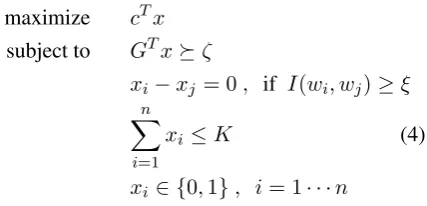
Putting the objective function and all the con-straints together, we obtain the BIP program to ex-tract keyphrases as follows:
maximize cTx
subject to GTxºζ
xi−xj = 0, if I(wi, wj)≥ξ n
X
i=1
xi ≤K (4)
xi∈ {0,1}, i= 1· · ·n
Binary integer programming is a popular op-timization technique and many effective solvers have been developed. In this paper we use CPLEX solver, which is part of AIMMS2system, to
esti-mate the optimal solution from the Eq.(4).
4 Experiments
In this section, we perform evaluations of the pro-posed method. The data sets we used in the exper-iments are described in the first part. After that, experimental results are given and detailedly de-scribed in the following sections.
4.1 Dataset and Evaluation Metric
There are almost no publicly available datasets with manually annotated gold standard keyphrases for news, due to the high expense of labor and time for manual annotation. In this experiment, we randomly selected 150 groups of online news articles from Goolge News. Three annotators par-ticipated in the annotation task. They were asked to manually assign keyphrases for each group of news. The keyphrases which at least two annota-tors have agreed on are selected as the “Golden” ones. Statistics on the dataset are shown in Table 1. The corpus data is divided into development set and test set. The development set, which contains 50 groups of news, is used to tune the parameters. The other 100 groups of news are used as test set. We regard an extracted keyphrase as “correct” if it matches one of the ground truth. We measure the
2http://www.aimms.com/
Description value
# News articles 1103
# Words 345K
# News articles per group 7.35 # Labeled keyphrases per group 5.83
Table 1: Statistics on the dataset
performance by Precision (the percentage of cor-rect extracted keyphrases out of all the extracted ones), Recall (the percentage of correct extracted keyphrases out of the ground truth) and F-Measure (the harmonic mean of the precision and recall).
4.2 Comparisons with Other Methods
Since the dataset used in this paper is manually labeled by ourselves, we implement three baseline methods on the same dataset for comparison.
BL-1: The titles of news articles provide a rea-sonable summary or keyphrase sequence. So base-line 1 is performed based on the titles of news ar-ticles. We sort the phrases in multi-news titles ac-cording to the TF·IDF scores and select top-k as keyphrases. We assign K to 6 after tuning the pa-rameter.
BL-2: Many existing methods converted the keyphrase extraction as a classification problem. In this paper, we used SVM3 as baseline 2. The
features include TF·IDF, “First occurrence”, and “Is in title or not”. Those feature sets are similar to our objective function. We divided the dataset into five subsets and conducted a 5-fold cross-validation.
BL-3: We re-implemented the ranking ap-proach proposed by Jiang et al. (2009) as baseline 3. This method employed Ranking SVM (Joachims, 2006), the learning to rank method, to perform keyphrase extraction. Feature sets are the same as the feature sets used in the BL-2. We also conducted a 5-fold cross-validation.
We used the following default values for the parameters of our method: α = 0.4, β = 0.3,
γ = 0.3,µ= 0.1,ν= 0.05,ζ = 0.005,ξ = 16.5,
and K = 6. The meaning of these parameters
are described in the previous section. And how to learning the optimal values will be discussed in section 4.4. The test set is used in this ex-periment. Since the average number of
60% 65% 70% 75%
Precision Recall F1-Score Title
SVM Ranking SVM BIP
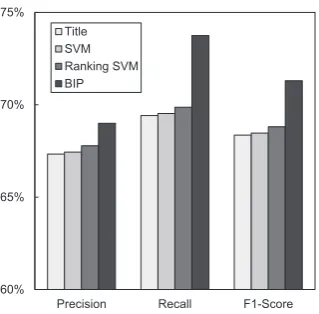
Figure 1: Comparison results of Title, SVM, Ranking SVM and our BIP-based methods .
labeled keyphrases is six, we selected the top 6 ones as keyphrases in all three baseline methods.
Figure 1 shows the performance comparison of BIP-based method with baselines. From the fig-ure, we have the following observations. Firstly, BIP-based method consistantly outperforms all baselines under all evaluation metrics – Preci-sion, Recall, and F1-Score. This indicates the ro-bustness and effectiveness of our method. Fur-thermore, compared with the supervised methods, BIP-based method does not need any labeled cor-pus. Secondly, Ranking SVM performs slightly better than SVM. This is congruence with the previous conclusion given by Jiang et al. (2009). However, the improvement of BL-3 over BL-2 is not significant. We also observe that the perfor-mances of BL-1 are quite good. The precision, recall, and F1-score achieved by it are comparable with results of SVM and Ranking SVM.
4.3 Contribution of Constraints and Objective Function
To determine the contribution of different com-ponents of objective function and individual con-straints, we omit components and constraints one by one to identify its contribution to the perfor-mance. Table 2 shows the results on development set. The first row represents the performance of the BIP-based method with all constraints and ob-jective function with all three components. The parameters are default ones listed in the previous section.
The contribution of different components in the objective function is shown from the second row to fourth row. From the results we can observe that, TF·IDF is the most important feature in the
Table 2: Contribution of different components of objective function (TFIDF, InTitle, InFirstSene-tence) and two constraints (Coverage and Coher-ence) under Precision, Recall, and F1-Score.
Pre. Rec. F.
All 71.45% 73.96% 72.68%
All - TF·IDF 58.86% 60.82% 59.82% All - InTitle 60.96% 62.77% 61.85% All - InFirstSentence 71.00% 73.20% 72.08% All - Coverage 68.56% 70.68% 69.60% All - Coherence 70.67% 72.85% 71.74%
objective function. Without the feature of TF·IDF, the evaluation metrics drop sharply from 72.68% to 59.82%. The candidate occurs in the title is also an important feature. It is consistent with the ob-servations given by the results of BL-1. It gives about 17.27% relative improvement over the per-formance without it. Compared with the two fea-tures, the occurrence in the first sentence gives less contribution. The improvement given by it is not significant.
The fifth row shows the results without the cov-erage constraint. From the result, we observe that the coverage constraint is effective, which can give more than 4.2% relative improvement. The contri-bution of coherence constraint is shown in the end of the table. Althoug its contribution is less than that of coverage constraint, an outlier keyphrase may highly impact the user experience. Coherence constraint is important to improve user experience.
4.4 Varying Parameters
As we mentioned in the previous section, there are eight parameters which should be adjusted in our method. One may concern the problem of param-eters tuning. In order to answer this question, in this section, we explore the impact of different pa-rameters on our approach’s performance in the de-velopment set. Except the parameter under inves-tigation, the other parameters are set to the default values which are listed in the Section 4.2.
4.4.1 Number of KeyphrasesK
Figure 2 presents the performance varying the number of keyphrases, which ranges from 1 to 10. K is one of the most important arguments
leading to the trade-off between precision and re-call. LargerKincreases recall but decreases
0 0.1 0.2 0.3 0.4 0.5 0.6 0.7 0.8 0.9 1
1 2 3 4 5 6 7 8 9 10
# Keyphrases
F1-Score Precision Recall
Figure 2: Results of varying the number of ex-tracted keyphrases using the proposed BIP-based extraction method.
result is achieved at the point K = 6, which is similar to the average number of manually se-lected keyphrases. We also observe that the F1-Score drops quickly whenKis bigger than 7. The main reason is that only a small number of phrases which should be selected are ranked after the top 10.
0.1 0.3
0.5 0.7
60% 65% 70% 75%
0.1 0.2
0.3 0.4
0.5 0.6
0.7 0.8
F1-Score
70%-75%
65%-70%
60%-65%
Figure 3: Results of varying the parametersα, β, γ
in the objective function.
4.4.2 α, β, γin the Objective Function
In the objective function, there are three param-eters α,β, and γ , which are used to trade off
among TF·IDF and two locality features. Figure 3 gives the F1-Score surface varyingαandβ. Since α +β +γ equals to 1, α and β are used as
x-axis and y-x-axis in the figure. We have found that the surfaces are almost concave around a number of areas. Therefore, a simple hill-climbing search can be used to optimize F1-Score. Since the sur-face is almost concave, the global maximum can be easily achieved though a few initial seeds. For
Table 3: Influence of the Coverage thresholdζ
ζ Pre. Rec. F.
0.001 69.44% 71.59% 70.50% 0.002 70.33% 72.50% 71.40% 0.003 71.22% 73.43% 72.31% 0.004 71.00% 73.20% 72.08% 0.005 71.45% 73.65% 72.53% 0.006 71.33% 73.54% 72.42% 0.007 71.22% 73.43% 72.31% 0.008 71.11% 73.31% 72.19% 0.009 70.67% 72.85% 71.74%
example, the optimal parameters for this experi-ment areα = 0.4,β = 0.3. Theγ can be
calcu-lated through function1−α−β.
4.4.3 Coverage thresholdζ
Coverage thresholdζ represents the property that
the extracted keyphrases should cover most of the important aspects of a news event. We want the aspect coverage for all topics to exceed the thresh-old. Table 3 shows the results whenζranges from
0.001 to 0.009. All of them perform better than the result without coverage constraint, and the best re-sult is achieved atζ = 0.005. From the results, we
observe that the coverage thresholdζ can also be
easily selected. From 0.005 to 0.008, the changes of F1-score are not significant. When the coverage threshold is above 0.02, in order to get the solution of the ILP program, the impact of objective func-tion would be limited. We think that it is the main reason of why best result is achieved at a small value threshold.
4.4.4 Coherence thresholdξ
Finally, we explore the inference of ξ, which is
used to represent the word coherence. When the threshold is below 12, there would be too many co-herence constraints. More than 30.05% word pairs can satisfy the threshold. Under this condition, no solution can be estimated in some cases. When the threshold is above 32, there are rarely word pairs satisfying the threshold. In other words, there would be no coherence constraints. In table 4 we show the influence ofξ, which ranges from 15 to
18. Similar to the results of coverage threshold, a large range ofξ’s value can achieve satisfactory
Table 4: Influence of the Coherence thresholdξ
ξ Pre. Rec. F.
15.0 68.00% 70.10% 69.04% 15.5 69.89% 72.05% 70.95% 16.0 70.78% 72.97% 71.85% 16.5 71.45% 73.65% 72.53% 17.0 71.22% 73.43% 72.30% 17.5 71.00% 73.20% 72.08% 18.0 71.00% 73.20% 72.08%
4.5 Extracting Example
Table 5 shows examples of extracted keyphrases by different methods from a group of news arti-cles about “Master Kong applies for TDR listing in Taiwan”. Top 6 extracted keyphrases for each method are shown in the table, and the correct ones are marked with “(+)”. From table 5, we ob-serve that keyphrases extracted through BIP-based method are relevant, coherent, with good cover-age. Without the coverage constraint, “Taiwan Depositary Receipt” and it’s abbreviation “TDR” are both selected. And, the topic coverage cannot be well satisfied through the top keyphrases. For SVM and Ranking SVM, they separately consider each word, some of the high frequency words are selected as keyphrases, such as “billion”, and “is-sue”. However, those words are not meaningful.
5 Conclusions
In this paper, we have presented a novel keyphrase extraction approach. It adapts the integer linear programming methods to the keyphrase extraction problem by casting features and criteria as objec-tive function and constraints.
By integrating TF·IDF and two locality features as objective function, and the coverage and coher-ence properties as constraints, the proposed ILP-based unsupervised approach achieves better per-formance than the state-of-the-art supervised ap-proaches, SVM and Ranking SVM. Contributions of constraints and different components of the ob-ject function are experimental evaluated. In the objective function, the TF·IDF is the most
portant feature. Locality features can further im-prove the performance. Results also demonstrate that both the coverage and coherence constraints are useful to keyphrase extraction task. We also detail the impact of parameters used in our ap-proach. Through experimental results, we
demon-Table 5: Example of extracted keyphrases by SVM, Ranking SVM and BIP-based method∗.
BIP
Masker Kong(+), Ting Hsin International Group(+), Taiwan Depositary Receipt(+), instant noodle, Taiwan Stock Exchange(+), NT$30 billion
BIP without Coverage constraint Masker Kong(+), Taiwan Depositary Receipt(+), TDR, lunch, Taiwan Stock Exchange(+), Taiwan
BIP without Coherence constraint Masker Kong(+), Taiwan Depositary Receipt(+), Taiwanese-invested food producer(+), IPO, issue, Taiwan Stock Exchange(+)
SVM
Taiwan Depositary Receipt(+), Masker Kong(+), China market, TDR, Hong Kong Exchanges, billion
Ranking SVM
Masker Kong(+), China market, TDR,
Taiwan Depositary Receipt(+), issue, Taiwan
∗The keyphrases are translated from Chinese.
strate that the parameters are not sensitive. The value of them can be easily estimated using sim-ple hill-climbing search methods.
Acknowledgments
The author wishes to thank the anonymous review-ers for their helpful comments. This work was par-tially funded by 973 Program (2010CB327906), National Natural Science Foundation of China (61003092, 61073069), Shanghai Science and Technology Development Funds(10dz1500104), Doctoral Fund of Ministry of Education of China (200802460066), Shanghai Leading Academic Discipline Project (B114), and Key Projects in the National Science & Technology Pillar Pro-gram(2009BAH40B04).
References
Dimitris Alevras and Manfred W. Padberg. 2001. Lin-ear Optimization and Extensions: Problems and So-lutions. Springer.
David M. Blei, Andrew Y. Ng, and Michael I. Jordan. 2003. Latent dirichlet allocation. J. Mach. Learn. Res., 3:993–1022, March.
extrac-tion for web pages. InProceedings of the 14th ACM international conference on Information and knowl-edge management, CIKM ’05, pages 277–278, New York, NY, USA. ACM.
Eibe Frank, Gordon W. Paynter, Ian H. Witten, Carl Gutwin, and Craig G. Nevill-Manning. 1999. Domain-specific keyphrase extraction. In Proceed-ings of the 16th international joint conference on Ar-tificial intelligence - Volume 2, pages 668–673, San Francisco, CA, USA. Morgan Kaufmann Publishers Inc.
Anette Hulth. 2003. Improved automatic keyword ex-traction given more linguistic knowledge. In Pro-ceedings of the 2003 conference on Empirical meth-ods in natural language processing - Volume 10, pages 216–223, Morristown, NJ, USA. Association for Computational Linguistics.
Xin Jiang, Yunhua Hu, and Hang Li. 2009. A ranking approach to keyphrase extraction. In Proceedings of the 32nd international ACM SIGIR conference on Research and development in information retrieval, SIGIR ’09, pages 756–757, New York, NY, USA. ACM.
Thorsten Joachims. 2006. Training linear svms in lin-ear time. InProceedings of the 12th ACM SIGKDD international conference on Knowledge discovery and data mining, KDD ’06, pages 217–226, New York, NY, USA. ACM.
Zhiyuan Liu, Peng Li, Yabin Zheng, and Maosong Sun. 2009. Clustering to find exemplar terms for keyphrase extraction. In Proceedings of the 2009 Conference on Empirical Methods in Natural Lan-guage Processing: Volume 1 - Volume 1, EMNLP ’09, pages 257–266, Morristown, NJ, USA. Associ-ation for ComputAssoci-ational Linguistics.
Andr´e F. T. Martins, Noah A. Smith, and Eric P. Xing. 2009. Concise integer linear programming formula-tions for dependency parsing. InProceedings of the Joint Conference of the 47th Annual Meeting of the ACL and the 4th International Joint Conference on Natural Language Processing of the AFNLP: Vol-ume 1 - VolVol-ume 1, ACL-IJCNLP ’09, pages 342– 350, Morristown, NJ, USA. Association for Compu-tational Linguistics.
Olena Medelyan and Ian H. Witten. 2006. Thesaurus based automatic keyphrase indexing. In Proceed-ings of the 6th ACM/IEEE-CS joint conference on Digital libraries, JCDL ’06, pages 296–297, New York, NY, USA. ACM.
Olena Medelyan, Eibe Frank, and Ian H. Witten. 2009. Human-competitive tagging using automatic keyphrase extraction. In Proceedings of the 2009 Conference on Empirical Methods in Natural Lan-guage Processing: Volume 3 - Volume 3, EMNLP ’09, pages 1318–1327, Morristown, NJ, USA. As-sociation for Computational Linguistics.
Rada Mihalcea and Paul Tarau. 2004. Textrank: Bringing order into texts. In Dekang Lin and Dekai Wu, editors, Proceedings of EMNLP 2004, pages 404–411, Barcelona, Spain, July. Association for Computational Linguistics.
Dan Roth and Wen-tau Yih. 2005. Integer linear pro-gramming inference for conditional random fields. InProceedings of the 22nd international conference on Machine learning, ICML ’05, pages 736–743, New York, NY, USA. ACM.
T.D.Nguyen and M.-Y. Kan. 2007. Keyphrase extrac-tion in scientific publicaextrac-tions. InProceedings of In-ternational Conference on Asian Digital Libraries. Takashi Tomokiyo and Matthew Hurst. 2003. A
lan-guage model approach to keyphrase extraction. In Proceedings of the ACL 2003 workshop on Multi-word expressions: analysis, acquisition and treat-ment - Volume 18, pages 33–40, Morristown, NJ, USA. Association for Computational Linguistics. Peter D. Turney. 2000. Learning algorithms for
keyphrase extraction. volume 2, pages 303–336, Hingham, MA, USA, May. Kluwer Academic Pub-lishers.
Peter D. Turney. 2003. Coherent keyphrase extraction via web mining. InProceedings of the 18th inter-national joint conference on Artificial intelligence, pages 434–439, San Francisco, CA, USA. Morgan Kaufmann Publishers Inc.
Xiaojun Wan and Jianguo Xiao. 2008. Single document keyphrase extraction using neighborhood knowledge. In Proceedings of the 23rd national conference on Artificial intelligence - Volume 2, pages 855–860. AAAI Press.
Ian H. Witten, Gordon W. Paynter, Eibe Frank, Carl Gutwin, and Craig G. Nevill-Manning. 1999. Kea: practical automatic keyphrase extraction. In Pro-ceedings of the fourth ACM conference on Digital libraries, DL ’99, pages 254–255, New York, NY, USA. ACM.
Kristian Woodsend and Mirella Lapata. 2010. Auto-matic generation of story highlights. In Proceed-ings of the 48th Annual Meeting of the Association for Computational Linguistics, ACL ’10, pages 565– 574, Morristown, NJ, USA. Association for Compu-tational Linguistics.
Y.Matsuo and M.Ishizuka. 2004. Keyword extraction from a single document using word co-occurrence statistical information. InInternational Journal on Artificial Intelligence Tools.