Improving Dependency Parsing with
Interlinear Glossed Text and Syntactic Projection
Ryan Georgi
1Fei Xia
1William D Lewis
2(1) University of Washington, Seattle, WA 98195, USA (2) Microsoft Research, Redmond, WA 98052, USA
{rgeorgi, fxia}@uw.edu, [email protected]
A
BSTRACTProducing annotated corpora for resource-poor languages can be prohibitively expensive, while obtaining parallel, unannotated corpora may be more easily achieved. We propose a method of augmenting a discriminative dependency parser using syntactic projection information. This modification will allow the parser to take advantage of unannotated parallel corpora where high-quality automatic annotation tools exist for one of the languages. We use corpora of interlinear glossed text—short bitexts commonly found in linguistic papers on resource-poor languages with an additional gloss line that supports word alignment—and demonstrate this technique on eight different languages, including resource-poor languages such as Welsh, Yaqui, and Hausa. We find that incorporating syntactic projection information in a discriminative parser generally outperforms deterministic syntactic projection. While this paper uses small IGT corpora for word alignment, our method can be adapted to larger parallel corpora by using statistical word alignment instead.
1 Introduction
The development of large-scale treebanks has significantly improved the performance of statisti-cal parsers (e.g. Klein and Manning, 2001; Collins and Koo, 2005; de Marneffe et al., 2006) Unfortunately, resources such as these typically only exist for a handful of languages, because building large treebanks is very labor-intensive and often cost-prohibitive. As thousands of other languages have no such resources, other techniques are required to attain similar performance.
One way in which natural language tools might be created for resource-poor languages is by using resources containing translations between resource-rich and resource-poor languages and use the alignment information to transfer information to the resource-poor ones. Syntactic projection takes advantage of existing tools used to annotate a resource-rich language in a corpus, and transfers the analysis to the resource-poor language by means of syntactic projection using word-to-word alignment (Yarowsky and Ngai, 2001; Hwa et al., 2002).
While little annotated data typically exists for resource-poor languages, some work has been done examining the utility of interlinear glossed text (IGT) (Xia and Lewis, 2007; Lewis and Xia, 2008), a format used for illustrative examples in linguistic papers. An IGT instance includes a language line which is a phrase or sentence in a foreign language, a gloss line that shows word-to-word translation, and a translation line which is normally in English. We chose IGT for this study because the gloss line can serve as a bridge for aligning the words in the language line and the translation line. The method proposed in this paper can be easily extended when IGT is replaced by bitexts of sufficient size to train a high-quality word aligner.
In this paper, we investigate the possibility of using small corpora of interlinear text and syntactic projection to bootstrap a dependency parser and improve the resulting parses over projection alone.
2 Background
Before presenting our system, we will first describe previous studies on syntactic projection. Next, we will describe the phenomenon of linguistic divergence, and explain why this can affect projection performance. Finally, we will describe interlinear glossed text (IGT) in more detail and highlight the ways in which it is well-suited to this task.
2.1 Syntactic Projection
Syntactic projection via word alignment has shown promise in adapting resources between languages. Merlo et al. (2002) demonstrated a technique of classifying verb types via projection, while Yarowsky and Ngai (2001) worked on projecting POS taggers and NP bracketers. Hwa et al. (2004) bootstrapped both phrase and dependency parsers. While these systems did not match the performance of supervised systems, they do succeed in demonstrating that even a small amount of information can significantly boost the performance of a baseline system.
minister [erg]
ne kiyA manxira uxGAtana
manwrIjI kA
did temple of inauguration
“the minister inaugurated the temple”
(a) Original IGT representation and word alignment between the three lines.
temple inaugurated
minister
kiyA did
manwrIjI minister
uxGAtana ingauguration
the manxira
temple the
kA of ne [erg]
[image:3.420.239.369.83.160.2](b) The dependency trees for Hindi and English
Figure 1: An example of the light verb construction in Hindi.
2.2 Linguistic Divergence
Dorr (1994) defined several types of translation divergence. These variations, or linguistic divergence, can be problematic for projection algorithms, as the assumptions that projection relies on may not hold. One example which may affect projections is the light-verb construction. Take as an example the Hindi sentence in Figure 1, where an English verb (“inaugurated”) is represented in Hindi as a light verb (“did”) plus a noun (“inaugurate”). As a result, the dependency structures in English and Hindi are not identical, as illustrated in Figure 1(b). In order to address some of the noise inherent in projection results, Ganchev et al. (2009) took an approach of using “soft” constraints to improve projection results. Rather than commit to a single parse, Ganchev et al. used statistical methods to disambiguate between multiple parse options, and showed significant improvements over a purely deterministic approach. In our previous study, (Georgi et al., 2012), we looked at measuring forms of alignment between dependency structures to quantify the amount of divergence between languages. In this paper we will look at how performance varies among a set of typologically different languages. We hope to investigate the correlation between performance in these languages and these quantitative measures in future work.
2.3 Interlinear Glossed Text (IGT)
IGT is a resource well-suited to the task of adapting dependency parsing to new languages. As seen in Figure 1a, an IGT instance contains a foreign-language line, an English translation, and a gloss line, which provides additional annotation about the foreign language line. Xia and Lewis (2007) demonstrated that interlinear glossed text can be used to obtain high quality word-to-word alignments with a relatively small amount of data. Xia and Lewis further show
Hindi German Irish Hausa Korean Malagasy Welsh Yaqui # IGT Instances 147 105 46 77 103 87 53 68
# of Words (F) 963 747 252 424 518 489 312 350 # of Words (E) 945 774 278 520 731 646 329 544
[image:3.420.70.365.466.507.2]that these heuristics can be used to augment statistical methods to produce higher-quality alignments over statistical methods alone, suggesting that a small corpus of IGT may be able to provide a bootstrap for alignment on much larger parallel corpora.
Where does one find IGT corpora? The Online Database of INterlinear text (ODIN) (Lewis and Xia, 2010) is an online resource of IGT instances for that contains approximately two hundred thousand instances for 1274 languages. Lewis and Xia (2008) use ODIN data for 97 languages to perform syntactic projection and determine basic word order. They found that the languages in this sample with 40 or more instances could be used to predict basic word order with 99% accuracy. With such broad language coverage, ODIN is an ideal resource for providing information for resource-poor languages for which little other data exists.
3 Methodology
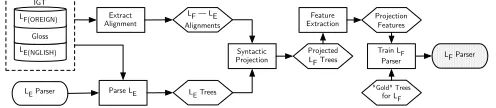
Given a set of IGT instances, our system works as follows (see Figure 2):
1. Align words in the language line and translation line (the translation lines are all English in our experiments)
2. Parse the translation lines using an English parser
3. Project the dependency structure of the translation line to the language line 4. Extract features from the projected structure and use them to train a parser.
If the input is a set of parallel sentences instead of IGT, the process will be exactly the same except that word alignment in step (1) will be done by training a statistical word aligner, instead of using the gloss line in IGTs as a bridge between the language lines and the translation lines.
IGT
Extract Alignment LE(NGLISH)
Gloss
LE Parser Parse LE LE Trees LF — LE Alignments
Syntactic Projection
Projected
LF Trees Train LF Parser LF Parser LF(OREIGN)
"Gold" Trees for LF Feature
Extraction ProjectionFeatures
(a) Flowchart illustrating the training procedure for a givenLF–LElanguage pair, whereLFis the foreign (non-English) language, andLEis English.
IGT
Extract Alignment
LE(NGLISH) Gloss
LE Parser Parse LE LE Trees LF — LE Alignments Syntactic Projection Projected LF Trees LF Parser LF(OREIGN) Feature
Extraction ProjectionFeatures
Parse LF Output LF Trees
[image:4.420.80.328.332.386.2](b) A flowchart showing an overview of the testing procedure for theLF–LElanguage pair using theLFparser produced in the training phase, and augmented by the information projected from the parsedLEportion of the bitext. A Future system will include an augmented statistical aligner to produce theLF–LEalignments.
satan-i cenpang-ulo itongha-n-ta
unit-Nom frontline-to move-Pres-Decl
unit the frontline
The is moving to
(a) An IGT example in Korean.
unit
the frontline The
is moving
to
(b) The parse of the English translation from (a). The words in solid boxes do not align to any word in Korean, while the words in dotted boxes align to the same word in Korean.
satan-i itongha-n-ta
cenpang-ulo
(c) The projected tree for the Korean sentence, after the English words are replaced by Korean counterparts, words in the solid boxes are re-moved and words in the dotted boxes are col-lapsed into a single node.
Figure 3: The steps of the projection process, as illustrated using an IGT instance from Korean.
In this study, we will focus the last two steps. Therefore, for the first two steps, we use word alignment and English parse trees from the gold standard. The last two steps and the evaluation corpora are explained below.
3.1 Corpora
We used two different sources of language data for our experiment. The first was a set of guideline sentences for the Hindi treebank (Bhatt et al., 2009). These sentences were provided both in the IGT format, as well as with gold-standard dependency trees in both English and Hindi. The second set was the IGT data used in Xia and Lewis (2007), which includes IGTs for seven languages, plus manually annotated word alignment and dependency trees for both English and the foreign language. In all, eight languages were used for our experiments: Hindi, German, Irish, Hausa, Korean, Malagasy, Welsh, and Yaqui. The size of each data set is given in Table 1. We use the pre-existing, manually annotated parse trees in these two data sets as our gold standard for evaluation.
For the Hindi data, which did not include word alignment, we first automatically aligned the Hindi sentences and the English translation via the gloss line as in Xia and Lewis (2007), then manually corrected the alignment errors. While this manual correction step creates alignments that are not fully automated, the amount of effort required to make these modifications are minimal, and still greatly reduces the costs involved in creating parallel annotated corpora.
3.2 The Projection Algorithm
For the projection algorithm, we follow the dependency projection algorithm described in Xia and Lewis (2007), an example of which can be seen in Figure 3. Given the word alignment
LEandLFand the parse treeTEforLE, the projection algorithm works as follows. For each
English nodeeithat aligns with foreign wordfi, we replace the node foreiwith the foreign
copies ofeias siblings in the tree for each source word, then replace the English words with
those from the source. If multiple English nodes align to a single foreign word, the node highest
up in the tree is kept, and all others removed. Finally, remaining unaligned words inLFare
attached heuristically, following (Quirk et al., 2005).
3.3 The Parser
Due to linguistic divergence, projected trees are error-prone. Instead of making hard decisions based on projection, we use information from projected trees as a feature in a discriminative parser. This feature will be highly predictive, but not result in a strictly deterministic method like projection alone. We modified the MST Parser (McDonald et al., 2006) by adding features that check whether certain edges considered by the parser appear in the projected tree. We
define two types of features:BOOL, andTAG.
The first feature type,BOOL, looks at the current parent→child edge being considered by the
parser and returnstrueif the edge matches one in the projected tree. While this feature was a
logical starting point, we also wondered if certain word classes of English projected better than
others, and so the second feature type,TAG, creates a feature for eachPOSparent,POSchild
pair such that the feature is true if the current parent→child edge being considered matches
the one in the projected tree, and the POS tags of the parent and child arePOS_parentand
POSchild, respectively.
4 Experiments
As shown in Figure 2a, theLFparser is trained with two kinds of input: (1) projectedLFtrees
from whichBOOLandTAGfeatures are extracted, and (2) “Gold” trees forLFfrom which the
standard features used by the MST parser are extracted.
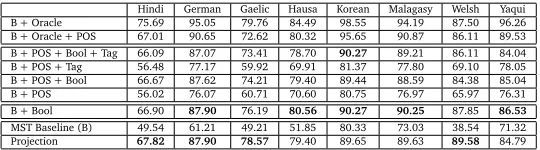
We ran two sets of experiments. In the first, the “Gold” trees are the same as the projectedLF
trees. This is to replicate the case when no gold standard is available forLF. In the second set
of experiments, the “Gold” trees are indeed the manually-corrected trees for theLFsentences.
The results are shown in Tables 2a and 2b, respectively.
In each set, there are several individual experiments. The “projection” row shows the results
of evaluating the projectedLFtrees directly without training a parser. The “MST baseline (B)”
row shows the results when we train the MST parser without part-of-speech (POS) tag features
and features from projectedLFtrees. The third to seventh rows show the results when features
from the projectedLFtrees are added when training the MST parser. Finally, we want to see
how well the system works if the projectedLFtrees are perfect, so in the first two rows, we
replace the projectedLFtrees with theLFtrees from the gold standard. Because our data sets
are small, we ran ten-fold cross validation. The highest results in each column for rows 3–9 are shown in bold.
5 Discussion
There are several observations to make from Table 2. First, comparing Tables 2a and 2b, it is
clear that using the gold standard trees forLFimproves performance. Second, the projected
Hindi German Gaelic Hausa Korean Malagasy Welsh Yaqui
B+Oracle 75.69 95.05 79.76 84.49 98.55 94.19 87.50 96.26
B+Oracle+POS 67.01 90.65 72.62 80.32 95.65 90.87 86.11 89.53 B+POS+Bool+Tag 66.09 87.07 73.41 78.70 90.27 89.21 86.11 84.04
B+POS+Tag 56.48 77.17 59.92 69.91 81.37 77.80 69.10 78.05
B+POS+Bool 66.67 87.62 74.21 79.40 89.44 88.59 84.38 85.04
B+POS 56.02 76.07 60.71 70.60 80.75 76.97 65.97 76.31
B+Bool 66.90 87.90 76.19 80.56 90.27 90.25 87.85 86.53
MST Baseline (B) 49.54 61.21 49.21 51.85 80.33 73.03 38.54 71.32
Projection 67.82 87.90 78.57 79.40 89.65 89.63 89.58 84.79
(a) Parse accuracy results for experiments where the parser was trained on automatically-produced projected trees for each language.
Hindi German Gaelic Hausa Korean Malagasy Welsh Yaqui
B+Oracle 98.03 98.07 95.63 99.31 99.17 97.93 98.26 96.51
B+Oracle+POS 97.34 97.94 89.29 94.44 98.34 97.72 94.44 97.26 B+POS+Bool+Tag 79.05 90.23 70.24 88.66 87.78 89.63 88.89 86.53
B+POS+Tag 76.74 83.49 65.87 82.64 82.40 79.46 72.92 83.79
B+POS+Bool 79.51 91.47 69.84 88.43 87.37 90.25 89.24 86.28
B+POS 77.20 82.12 63.10 83.80 80.75 81.54 75.00 81.80
B+Bool 77.31 87.76 70.24 87.73 92.34 89.42 91.32 85.54
MST Baseline (B) 65.16 62.72 55.16 72.22 80.75 73.03 51.39 66.08
Projection 67.82 87.90 78.57 79.40 89.65 89.63 89.58 84.79
[image:7.420.83.353.70.145.2](b) Parse accuracy results for experiments where the parser was trained on manually-corrected trees for each language.
Table 2: Parse accuracy results for all experiments. In each table, projection and baseline parser (“B”) results are shown at the bottom. Oracle results, where the gold-standard trees (rather
than projected trees) were used for theBOOL/TAGfeatures, rather than projection are at top.
“POS” represents the experiments where part-of-speech tags were projected from the English side, and “Bool” and “Tag” are features as explained in §3.3. The best result for the non-oracle runs is shown in bold.
additional features derived from projection (see Table 2b), the results are much better than both the MST baseline and projection, and often outperforms the heuristics-based projection algorithm as well. This indicates that, although projected trees are error-prone, using features from them indeed improves parsing performance.
6 Conclusion and Future Work
Building large-scale treebanks is very labor-intensive and often cost-prohibitive. As thousands of languages do not have such resources, syntactic projection has been proposed to transfer syntactic structure from resource-rich languages to resource-poor languages and the projected structure is used to bootstrap NLP tools. However, the projected structure is error-prone due to linguistic divergence.
web, it is conceivable that our method can be applied to bootstrap dependency parsers for hundreds of languages at a very low cost.
For future work, there are several avenues we would like to investigate further. First, the results in this study have all been obtained from very small sets of data. Extending one or more of these languages out to a larger data set may give us a better understanding of the effects of incorporating IGT information. Second, we plan to extend our system to take advantage of a large amount of bitext if it is available. For that, we will train statistical word aligners and test how word alignment errors affect system performance. Finally, while the features used in this study look solely at the result of the projected trees, we would like to add features that look at different divergence types as discussed in Georgi et al. (2012).
Acknowledgments
This work is supported by the National Science Foundation Grant BCS-0748919.
References
Bhatt, R., Narasimhan, B., Palmer, M., Rambow, O., Sharma, D. M., and Xia, F. (2009). A
multi-representational and multi-layered treebank for Hindi/Urdu. InThe Third Linguistic
Annotation Workshop (The LAW III) in conjunction with ACL/IJCNLP 2009. Association for Computational Linguistics.
Collins, M. and Koo, T. (2005). Discriminative reranking for natural language parsing.
Compu-tational Linguistics, 31(1):25–70.
de Marneffe, M.-C., MacCartney, B., and Manning, C. D. (2006). Generating typed dependency
parses from phrase structure parses. InFifth International Conference on Language Resources
and Evaluation.
Dorr, B. J. (1994). Machine translation divergences: a formal description and proposed
solution.Computational Linguistics, 20:597–633.
Ganchev, K., Gillenwater, J., and Taskar, B. (2009). Dependency grammar induction via bitext
projection constraints. InProceedings of the Joint Conference of the 47th Annual Meeting of the
ACL and the 4th International Joint Conference on Natural Language Processing of the AFNLP, pages 369–377.
Georgi, R., Xia, F., and Lewis, W. (2012). Measuring the divergence of dependency structures cross-linguistically to improve syntactic projection algorithms. In Chair), N. C. C., Choukri, K.,
Declerck, T., Do˘gan, M. U., Maegaard, B., Mariani, J., Odijk, J., and Piperidis, S., editors,
Pro-ceedings of the Eight International Conference on Language Resources and Evaluation (LREC’12), Istanbul, Turkey. European Language Resources Association (ELRA).
Hwa, R., Resnik, P., Weinberg, A., Cabezas, C., and Kolak, O. (2004). Bootstrapping parsers via
syntactic projection across parallel texts.Natural Language Engineering, 1(1):1–15.
Hwa, R., Resnik, P., Weinberg, A., and Kolak, O. (2002). Evaluating translational
correspon-dence using annotation projection. InProceedings of the Annual Meeting of the Association for
Computational Linguistics.
Klein, D. and Manning, C. (2001). An O(n3) agenda-based chart parser for arbitrary
Lewis, W. and Xia, F. (2008). Automatically identifying computationally relevant typological
features. InProceedings of the Third International Joint Conference on Natural Language
Processing.
Lewis, W. D. and Xia, F. (2010). Developing ODIN: A multilingual repository of annotated
language data for hundreds of the world’s languages. Journal of Literary and Linguistic
Computing (LLC), 25(3):303–319.
McDonald, R., Lerman, K., and Pereira, F. (2006). Multilingual dependency analysis with
a two-stage discriminative parser. InProceedings of the Tenth Conference on Computational
Natural Language Learning, pages 216–220. Association for Computational Linguistics. Merlo, P., Stevenson, S., Tsang, V., and Allaria, G. (2002). A multilingual paradigm for
automatic verb classification. Proceedings of the 40th Annual Meeting on Association for
Computational Linguistics, pages 207–214.
Quirk, C., Menezes, A., and Cherry, C. (2005). Dependency treelet translation: Syntactically
informed phrasal SMT. InProceedings of the ACL 2005. Microsoft Research.
Xia, F. and Lewis, W. D. (2007). Multilingual Structural Projection across Interlinear Text. In
Human Language Technologies: The Annual Conference of the North American Chapter of the Association for Computational Linguistics.
Yarowsky, D. and Ngai, G. (2001). Inducing multilingual POS taggers and NP bracketers via
robust projection across aligned corpora. InProceedings of NAACL, Stroudsburg, PA. Johns