ES-LDA: Entity Summarization using
Knowledge-based Topic Modeling
Seyedamin Pouriyeh1, Mehdi Allahyari∗2, Krys Kochut1, Gong Cheng3, and Hamid Reza Arabnia1
1Computer Science Department, University of Georgia, Athens, GA, USA
{pouriyeh,kkochut,[email protected]}
2Department of Computer Science, Georgia Sothern University, Statesboro, USA
3National Key Laboratory for Novel Software Technology, Nanjing University, Nanjing, China
Abstract
With the advent of the Internet, the amount of Semantic Web documents that describe real-world entities and their inter-links as a set of statements have grown consid-erably. These descriptions are usually lengthy, which makes the utilization of the underlying entities a difficult task. En-tity summarization, which aims to cre-ate summaries for real world entities, has gained increasing attention in recent years. In this paper, we propose a probabilistic topic model, ES-LDA, that combines prior knowledge with statistical learning tech-niques within a single framework to cre-ate more reliable and representative sum-maries for entities. We demonstrate the effectiveness of our approach by conduct-ing extensive experiments and show that our model outperforms the state-of-the-art techniques and enhances the quality of the entity summaries.
1 Introduction
With the emergence of Linked Open Data (LOD)1 as a way of publishing and interacting with the in-formation, many datasets such as DBpedia (Bizer et al., 2009) and YAGO (Hoffart et al.,2013) have been created and are publicly available on the Web. For example, DBpedia as part of LOD is a knowledge base extracted from Wikipedia that consists of Wikipedia resources (entities) described as RDF statements (i.e., RDF triples). The Resource Description Framework (RDF) is the Semantic Web standard data model used for representing information on the Web. An RDF triple is represented in the form of
∗Equal contribution
1http://linkeddata.org
< subject, predicate, object >. The latest En-glish version of DBpedia contains over 4.5 million entities collectively described by over 1.6 billion triples. This means that each entity description has an average of 355 RDF triples. Human users and computer applications need to consider these lengthy descriptions while performing various se-mantic tasks. Thus, entity summarization, a task of producing more concise, but still sufficient en-tity description, has garnered a significant amount of attention.
Recently, with the huge growth of information, summarization techniques are becoming some of the main approaches to making the information more readily available. In fact, summarization techniques aim to facilitate the identification of structure and meaning in data. Researchers in different communities have taken a strong inter-est in this task and, accordingly, have proposed various methods for a wide variety of summa-rization techniques in multiple areas. Document summarization (Nenkova and McKeown, 2012), database summarization (Bu et al., 2005), and graph summarization (Navlakha et al., 2008) are just a few examples that have been studied by different communities. RDF data summarization and in particular entity summarization, has at-tracted considerable attentions in recent years as it can benefit many other tasks in the natural lan-guage processing area, including entity recogni-tion (Zhao and Kit,2008), entity disambiguation (Dai et al., 2011), and many others. Several ap-proaches have been developed to summarize RDF data with respect to entities, including RELIN (Cheng et al., 2011), FACES (Gunaratna et al.,
2015), and LinkSUM (Thalhammer et al.,2016). RDF summarization differs from document sum-marization in the sense that RDF triples are struc-tured and do not have many frequently used words to help the summarization task, which makes RDF
summarization more challenging.
Topic modeling has become a popular method for uncovering the hidden themes from text cor-pora. Topic models usually consider each doc-ument as a mixture of topics, where a topic is a probability distribution over words. When the topic proportions of documents are estimated, they can be used as the themes (high-level seman-tics) of the documents. Topic models have been widely used for various text mining tasks, such as machine translation (Su et al., 2015), word em-bedding (Batmanghelich et al., 2016; Das et al.,
2015), automatic topic labeling (Wan and Wang,
2016;Allahyari and Kochut,2015;Allahyari et al.,
2017b), and others(Allahyari et al.,2017a). In this paper, we propose a novel topic model, called ES-LDA, that integrates prior knowledge with the topic modeling within a single framework for RDF entity summarization. In our approach, each entity, which is considered as a document, is a multinomial distribution over the predicates (properties), where each predicate is a probabil-ity distribution over the subjects and objects of the triples in the RDF data. We rank the triples based on their probability distributions and choose the top-k triples that best describe the underly-ing entity as its summary. We evaluated our ap-proach against state-of-the-art techniques and our experiments indicate that our approach outper-forms other methods in terms of the quality of summarization.
The rest of the paper is organized as follows: Section 2 presents an overview of related work. Section3introduces the baseline for this paper. In Section 4, we define the main problem and pro-pose our model in detail and afterwards, in Section
5, we explain the configurations of our model and describe the experiments. Finally, in Sections 6
and Section7, we discuss the results and conclude the paper, respectively.
2 Related Work
Summarization methods can be divided into two main categories, which are called extractive and none-extractive (abstractive) summarization. In extractive approaches, which are usually applica-ble in text and ontology summarization (Jones,
2007) (Zhang et al.,2007), a set of features is ex-tracted directly from the input data. On the other hand, in non-extractive methods, which generally are employed in graph (Navlakha et al., 2008)
and database (Bu et al.,2005) summarization, new sentences from the input data are generated (Hahn and Mani, 2000) to form a summary. In this research, we focus on extractive summarization. The concept of entity summarization in the form of RDF graph data has attracted more attention in recent years. Cheng et al. (Cheng et al.,2011) pro-posed entity summarization method, called RE-LIN, based on the PageRank algorithm to extract representative triples, called representative fea-tures for RDF graph entities. Because of the cen-trality based ranking issue, RELIN highlights the most similar and central triples, while in summa-rization, the diversity of summarized triples is the key point.
SUMMARUM (Thalhammer and Rettinger,2014) is a system for a better navigation within Linked Data through the ranking of triples. This system also uses the PageRank algorithm to rank triples according to the popularity of resources with the help of Wikipedia pages. Two aforementioned approaches could not meet the diversity require-ment in the summarization process. FACES ( Gu-naratna et al., 2015), on the other hand, tries to keep a balance between the centrality and diversity of the selected triples for each entity. It utilizes a clustering algorithm, called Cobweb (Fisher,
1987), to cluster related triples before ranking them to keep the diversity in the summarization. The recent version of SUMMARUM, which is called LinkSUM (Thalhammer et al., 2016), fo-cused more on the objects instead of the diversity of properties for entities and showed a better result on the same dataset, in comparison with FACES. Beside the aforementioned techniques dedicated to entity summarization, there are various rank-ing models and tools, includrank-ing TripleRank (Franz et al.,2009) and TRank (Tonon et al.,2013) that rank triples and concepts, respectively, incorporat-ing rankincorporat-ing algorithms. However, Cheng et al. (2011) indicated that these methods are not ap-propriate for the entity summarization problem, which needs ranking of feature sets based on their importance to identify the underlying entity.
3 Preliminaries
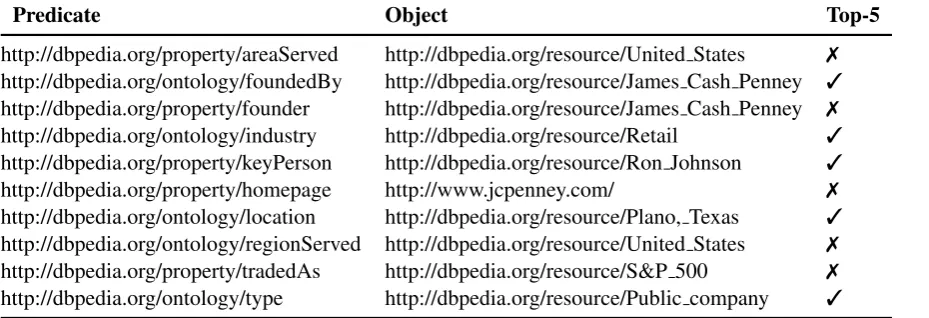
Lit-Table 1: J.C.Penny entity predicates and corresponding objects with the top-5 ES-LDA summary.
Predicate Object Top-5
http://dbpedia.org/property/areaServed http://dbpedia.org/resource/United States 7 http://dbpedia.org/ontology/foundedBy http://dbpedia.org/resource/James Cash Penney 3 http://dbpedia.org/property/founder http://dbpedia.org/resource/James Cash Penney 7 http://dbpedia.org/ontology/industry http://dbpedia.org/resource/Retail 3 http://dbpedia.org/property/keyPerson http://dbpedia.org/resource/Ron Johnson 3
http://dbpedia.org/property/homepage http://www.jcpenney.com/ 7
http://dbpedia.org/ontology/location http://dbpedia.org/resource/Plano, Texas 3 http://dbpedia.org/ontology/regionServed http://dbpedia.org/resource/United States 7 http://dbpedia.org/property/tradedAs http://dbpedia.org/resource/S&P 500 7 http://dbpedia.org/ontology/type http://dbpedia.org/resource/Public company 3
erals. An RDF graph is represented in a form of a collection of triples, each including a Sub-ject, Predicate, and Object. In an RDF graph, an entity is defined as a subject with all pred-icates and corresponding objects to those predi-cates, collectively forming the entity’s description. As Table 1 shows, the J.C.Pennyentity is repre-sented by its predicates (properties) and the corre-sponding objects in the triple format. For exam-ple, the triple< J.C.P enny, industry, Retail >
introduces J.C.Penny’s industry as Retail (due to space limitations we have dropped the first part of theURIs).
Definition 1 (Entity summary): Given an en-tity e and a positive integerk, a summary of the entitye, denotedSum(e, k), is the top-ksubset of all predicates and corresponding objects that are most relevant to that entity. As Table1shows the top-5 summary forJ.C.Pennyentity, which is rep-resented throughfoundedBy, industry, keyPerson, location, and type.
3.1 Latent Dirichlet Allocation (LDA)
The Latent Dirichlet Allocation (LDA) is a genera-tive probabilistic model for extracting thematic in-formation (topics) from a collection of documents. LDA assumes that each document is made up of various topics, where each topic is a probability distribution over words.
Let D = {d1, d2, . . . , d|D|} be a corpus of documents and V = {w1, w2, . . . , w|V|} a vocabulary (words) of the corpus. A topic
zj,1 ≤ j ≤ K is represented as a
multino-mial probability distribution over the |V| words,
p(wi|zj),P|V|i p(wi|zj) = 1. LDA generates the
words in a two-stage process: words are
gener-↵ ✓ z w
N
D K
1
Figure 1: LDA Graphical Representation
ated from topics and topics are generated by doc-uments. More formally, the distribution of words, given the document, is calculated as follows:
p(wi|d) =
K X
j=1
p(wi|zj)p(zj|d) (1)
The graphical model of LDA is shown in Figure
1and the generative process for the corpusDis:
1. For each topick ∈ {1,2, . . . , K}, sample a word distributionφk∼Dir(β)
2. For each documentd∈ {1,2, . . . ,D}, (a) Sample a topic distributionθd∼Dir(α)
(b) For each word wn, where n ∈
{1,2, . . . , N}, in documentd, i. Sample a topiczi∼Mult(θd)
ii. Sample a wordwn∼Mult(φzi)
In the LDA model, the word-topic distribution
re-lated to the topics and what topics are rere-lated to individual documents.
4 Problem Statement
In this section, we first describe the problem and then define how to utilize topic models for RDF graphs. Then, we formally introduce our ES-LDA model and explain how to integrate prior knowl-edge from RDF data graph within a topic model for entity summarization.
4.1 Problem Definition
Generating summaries for voluminous Semantic Web data, and in particular RDF data, for quick identification of entities has gained considerable attention as a challenging problem in the Seman-tic Web community. In the literature,Entity Sum-marizationis defined as selecting a small but rep-resentative subset of the original triples associated with an entity. In this context, given an RDF data set comprising a collection of entities, where each entity is described by a set of its properties (i.e., all triples with the entity as the subject), our goal is to choose top-k representative triples for each entity. In other words, since all triples associ-ated with an entity (as its description) share the same subject, our objective is to selecttop-k predi-cates and their corresponding objects among these triples that best summarize the entity’s description.
4.2 Topic Models for RDF Graphs
Topic models were originally introduced for text documents, however, they have been applied to other types of data, such as images (Blei and Jor-dan, 2003), and recently (Sleeman et al., 2015) used topic modeling for RDF graphs. The first step in applying topic models is to define docu-ments and word-like eledocu-ments as the basic build-ing blocks of documents. Since an RDF graph is usually represented as a set of triples, where each tripletconsists of a subjects, predicatep, and an objecto, in the form of<s,p,o>, we can consider a collection of such triples as a “document”.
Definition 2 (document): A documentdis de-fined as a set of triples, d = {t1, t2,· · ·, tn},
that describe a single entitye. In other words, all triples of a documentdhave the same subject.
“Words” of a document can be extracted from different parts of its triples. We define a “word”w
as the subject or object of a tripletin documentd. Therefore, each document is represented by a “bag
of words” including all the subjects and objects of its triples. In this paper, all subjects in the triples of a document are the same, because each document corresponds to a single entity, hence, in practice each document is a “bag of objects”2
Topic models usually utilize some data pre-processing, such as punctuation removal, down-casting, and abbreviation expansion, etc., to en-hance the final performance. We also performed preprocessing on the RDF data and filtered out the schema and dataset dependent predicates, such as sameAs, wikiPageExternalLink, subject, wikiPageWikiLink, in addition toliterals. Since we work with RDF graphs that differ from typical text documents in the sense that RDF data are repre-sented as triples, we need to address several chal-lenges mentioned in (Sleeman et al., 2015) to be able to run topic models on RDF data. These chal-lenges include sparseness, use of unnatural lan-guage, and the lack of context. RDF data can be affected by Sparseness. We consider docu-ments as sets of triples associated with a single entity. Such a set can be very large, leading to a large bag of words with a semantic theme, or small (sparse), resulting in a poor bag of words with less contextual information. It is also possible that a document with a high number of triples ends up having a small bag of words after pre-processing; for example based on Table 1, J.C.Penny entity comes with United States, James Cash Penney, Retail, Ron Johnson, Plano, Texas, United States, S&P 500 and Public companyas a bag of words for J.C.Penny entity, which shows sparseness in this document. Unnatural Language can be problematic for RDF data. A typical text docu-ment contains sentences where each sentence has a natural structure. These extra components of a sentence usually provide a further “context” for understanding words that are ambiguous or have multiple meanings, such as polysemous or homonymous ones. The aforementioned exam-ple for theJ.C.Pennyentity also confirms the un-natural language problem. The ”lack of context” can further impact RDF data because they are po-tentially sparse, described by unnatural language, and often using words that have multiple mean-ings, difficult to differentiate (J.C.Penny bag of words example). Additionally, triples are more prone to pre-processing, because it is not
uncom-2“bag of words” and “bag of objects” are interchangeably
↵
✓
r
s o
⇤
N
D
R
1
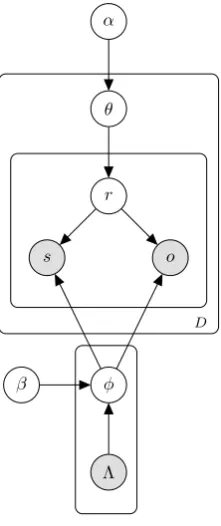
Figure 2: Entity Summarization Model
mon for triples to contain unexpected characters. RDF data resemble short texts in terms of the aforementioned challenges. Sparseness in a short text causes the model to be less discriminative to recognize how words are related and the limited context makes it hard for the model to identify the meanings of the words in such short text docu-ments (Yan et al.,2013). In order to alleviate these issues, researchers usually take two approaches. They either augment the short text or design cus-tom versions of the LDA model that address their specific problems. In this paper, we have used both approaches. We describe how to supplement the RDF data in the following section and describe the details of our model in section4.4.
4.3 Supplementing RDF Data
As topic modeling is based on statistics of the co-occurrence of terms (Sleeman et al.,2015), when we are dealing with short texts with a very lim-ited number of repetitions, which is the case with RDF data, we need to find a way to supplement the data to elevate the performance of the topic modeling approach. We augment the documents using two different methods. In the first method, we increase the frequency of the words in each document. But the question is “How many times each word of a document should be repeated?”.
Algorithm 1:ES-LDA Model
1 foreachpredicater ∈ {1,2, . . . , R}do 2 Draw an object distributionφr ∼
Dir(βr×Λr) 3 end
4 foreachdocumentd∈ {1,2, . . . , D}do 5 Draw a predicate distributionθd∼
Dir(αd)
6 foreachsubjectsand objectoof
documentddo
7 Draw a predicater ∼Mult(θd) 8 Draw a subjectsfrom predicate
r, s∼Mult(φr)
9 Draw an objectofrom predicate r, o∼Mult(φr)
10 end 11 end
4.4 Proposed Model
ES-LDA is a probabilistic generative model for modeling entities in RDF graphs. The key idea behind our model is twofold: (1) we exploit sta-tistical topic models as the underlying quantitative framework for entity summarization; and (2) ES-LDA incorporates the prior knowledge from the RDF knowledge base directly into the topic model. The plate notation is shown in Figure2.
In our model, each document is a multinomial distribution over the predicates. If we consider predicates as topics, at the document level, our model is the same as standard LDA. However, we set the number of topics in ES-LDA to be the num-ber of unique predicates in the corpus. Unlike the standard LDA, where each topic is a multinomial distribution over the vocabulary from the Dirichlet priorβ, in our model each predicate is a multino-mial distribution over all the subjects and objects of the RDF graph. In our approach, a document consists of a set of triples describing a single en-tity, i.e. all these triples share the same subject. Thus, we constrain the documents to only have the objects of related triples and also restrict the pred-icates to be defined only over the objects. In ad-dition, for each predicater, we further smooth its distribution byΛr. Λis a matrix that has encoded
the background knowledge about predicate-object values from DBpedia. Section4.5explains howΛ is constructed. The generative process of ES-LDA is shown in Algorithm1.
Following this process, the joint probability of generating a corpus D = {d1, d2, . . . , d|D|}, the predicate assignments r given the hyperparame-tersα, βand the prior matrixΛis:
P(o,s,r|α, β,Λ) =
Z
φP(φ|β; Λ)
Y
d
X
rd
P(od|rd, φ)P(sd|rd, φ)
× Z
θP(θ|α)P(rd|θ, φ)dθdφ (2)
4.5 Constructing Predicate-Object Prior MatrixΛ
In the ES-LDA model, each predicate has a prob-ability distribution over the objects of the RDF graph. Entity summarization is the task of choos-ing the top-k predicate-object pairs that best de-scribe an entity. Presumably, if an object is associ-ated with more categories in DBpedia, it is likely more important. We create the theΛmatrix to en-code the prior weight of the predicate-object pairs
and utilize it to smooth the predicate-object distri-butionsφby incorporating this domain knowledge into the topic model. We build theΛmatrix of size
R×O, whereRis the number of predicates andO
is the number of objects in the RDF graph. Letf
be an indicator function wheref(i, j) = 1if there is a triple in RDF graph with predicateiand object
j, and1otherwise, for1≤i≤Rand1≤j≤O. Additionally, letcbe the number of categories as-signed to objectj. Then, we defineΛij as follows:
Λij =
c iff(i, j) = 1
1 otherwise. (3)
For example, the “Barack Obama” entity has multiple predicate-object pairs in DBpedia, in-cluding “profession-author”, “profession-lawyer” and “profession-professor” pairs. According to DBpedia, cauthor = 2, clawyer = 4 and cprofessor = 2. It is reasonable to expect a
higher probability for the “profession-lawyer” pair as it seems to be slightly more important than the other two pairs for “Barack Obama”. As a result, Λprofession−lawyer = 4, which promotes
“profession-lawyer” in Eq. 5.
4.6 Inference using Gibbs Sampling
Since the posterior inference of the LDA is in-tractable, we need to find an algorithm for esti-mating the posterior inference. A variety of al-gorithms have been used to estimate the parame-ters of topic models, such as variational EM (Blei et al., 2003) and Gibbs sampling (Griffiths and Steyvers,2004). In this paper we use the collapsed Gibbs sampling procedure for our ES-LDA topic model. Collapsed Gibbs sampling (Griffiths and Steyvers, 2004) is a Markov Chain Monte Carlo (MCMC) (Robert and Casella, 2004) algorithm, which constructs a Markov chain over the latent variables in the model and converges to the pos-terior distribution, after a number of iterations. In our case, we aim to construct a Markov chain that converges to the posterior distribution overr con-ditioned on observed subjectss, objectso, hyper-parametersα, β, and the prior matrixΛ.
In our modified version of the learning algo-rithm to infer p(oi|rj) and p(rj|d), we (1)
con-strain the objects that are not paired with a pred-icate to have 0 probability, i.e. p(oi|rj) = 0, if
(ri, oj)∈/ RDF graph, and (2)P(s|rj) = 1, since
all the triples of a document have the same subject
follows:
P(r|o,s, α, β,Λ) = P(Pr,(oo,|α, β,s|α, β,Λ)Λ)
∝P(r,o|α, β,Λ)∝P(r)P(o|r)P(s|r) (4)
P(ri=r|oi =o,r−i,o−i, α, β,Λ)∝ n(r,d−)i+αr
P
r0(nr(d0,)−i+αr0)
× n
(r)
o,−i+ Λroβo
P
o0(no(r0,)−i+ Λroβo) (5)
wheren(or) is the number of times object ois
as-signed to predicate r. n(rd) denotes the number
of times predicate r is associated with document
d. The subscript−iindicates that the contribution of the current objectoibeing sampled is removed
from the counts. After Gibbs sampling, we can use the sampled predicate to estimate the proba-bility of a predicate, given a document,θdrand the
probability of an object, given a predicate,φro:
θdr = n
(d)
r +αr
P
r0(n(rd0)+αr0)
(6)
φro = n
(r)
o + Λroβo
P
o0(n(or0)+ Λroβo)
(7)
5 Experiments
We evaluated our ES-LDA model against the state-of-the-art LinkSUM (Thalhammer et al., 2016) and FACES (Gunaratna et al., 2015) systems. Our goal was to show that the ES-LDA model produces results that are closer to human judg-ment, in comparison with the other approaches. We used the same dataset3 that was used in the experiments conducted with FACES, as well as LinkSUM models. The dataset contained 50 en-tities randomly selected from DBpedia (English version 3.9) in domains including politician, ac-tors, scientist, song, film, country, city, river, com-pany, game, etc.. 15 people in the field of Se-mantic Web were selected as reviewers and each entity was evaluated by at least 7 reviewers to pro-duce the top-5 and top-10 summaries. The average number of properties for each entity was 44.
Based on the two types of RDF supplement methods we discussed in4.3, we applied two dif-ferent configurations for the proposed model. In
3http://wiki.knoesis.org/index.php/FACES
the first experiment, ES-LDA @config-1, we con-figured the system to supplement each entity (doc-ument) by repeating each object based on the num-ber of categoriesthat the object has in the DBpe-dia knowledge base. For example, for the triple
< J.C.P enney, industry, Retail >we repeated
Retailobject, 5 times in that document, asRetail
has five different categories in DBpedia (i.e. ”Re-tailers, Retailing, French words and phrases, Mer-chandising, Marketing”)
In the second experiment, ES-LDA @config-2, we configured the system to supplement each en-tity (document) by adding the corresponding cate-gory(ies) of each object into the document. In this case, each entity is defined as a bag of words in-cluding objects and categories of each object. For example, for the aforementioned triple, in addition to the Retail we included ”Retailers, Retailing, French words and phrases, Merchandising, Mar-keting”as the corresponding categories to the Re-tailobject.
For the other parameters, we assumed a sym-metric Dirichlet prior and setβ = 0.01 andα = 50/R, whereRis the total number of unique pred-icates. We ran the Gibbs sampling algorithm for 1000iterations and computed the posterior infer-ence after the last sampling iteration. We selected the top-5 and top-10 most probable properties for each entity and calculate the quality of the sum-mary for each entity through equation8.
Quality(Sum(e)) = 1nXn
i=1
|Sum(e)∩SumI
i(e)| (8)
In our experiments, we used the quality of the summary proposed in (Cheng et al., 2011), in which n ideal summaries SumI
i(e) generated by
expert users for i = 1, ..., n and the summaries generated by the systemSum(e)were compared. The average of the overlap between an ideal sum-mary and a sumsum-mary generated by the system is denoted as the quality of the summary, which is 0≤Quality(Sum(e))≤kin the top-ksettings.
5.1 Experiment Results
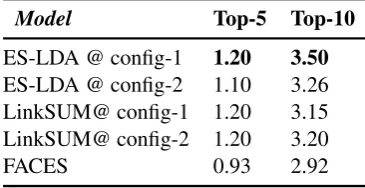
Table 2: Overall quality results of different models. Best result are bold.
Model Top-5 Top-10
ES-LDA @ config-1 1.20 3.50
ES-LDA @ config-2 1.10 3.26 LinkSUM@ config-1 1.20 3.15 LinkSUM@ config-2 1.20 3.20
FACES 0.93 2.92
the Summary Quality for each entity and aver-age them. As (Thalhammer et al., 2016) repro-duced the FACES overall Summary Quality based on this criteria and also applied it to their model, we decided to use their result as it was completely aligned with our summary definition.
In Table 2, we compare the quality of the results from LinkSUM, FACES, and ES-LDA with two distinct configurations (supplementing by object reputation and object categories). As Table 2 shows, the quality of our model out-performs the FACES approach, in both cases. The ES-LDA @ config-2 demonstrates a com-parable result with the two configurations of LinkSUM, while ES-LDA @ config-1 outper-forms LinkSUM. For some of the entities, the predicates that ES-LDA selected as top-5 most probable did not exist in the FACES dataset. It forced us to calculate the quality of summary for some of the entities with just 4 predicates instead of 5. We believe to be the only reason why top-5 Quality of Summary was lower than or equal to LinkSUM. Although, we had the same issue for the top-10 results, overall, ES-LDA shows a better performance in two configurations.
6 Discussion
We evaluated our approach against the state-of-the-art summarization techniques, including LinkSUM and FACES. LinkSUM primarily focuses on the most relevant facts for each entity, while FACES tries to keep a balance between diversity and relevancy in entity summarization. There is usually a trade-off between diversity and relevancy of the selected predicates. Our ES-LDA model maintains both diversity and relevancy, while representing each entity through
top-kpredicates. As shown in Table2, our model outperforms the state-of-the-art approaches.
Table 3 illustrates a sample of entities from the dataset along with their top-10 predicates, for all approaches. As Table 3 shows, the LinkSUM model is focusing more on the objects, while predicate repetition is permitted. For example,
<Marie Curie, birthPlace, Warsaw>, <Marie Curie, birthPlace, Russian Empire>, and <Marie Curie, birthPlace, Congress Polandare> are representing Marie Curie’s birth place. Although, they differ in terms of objects, it is arguable that referring to the same predicate with multiple objects that are more likely relevant reduces the chance of other important triples that could potentially appear in the summary. It should be noted that in the current ES-LDA configuration, we have not considered predicate repetition, thus, all the predicates of the triples appearing in the resultant summary are unique. FACES on the other hand, considers predicate diversity and tries to keep a balance between the diversity and relevancy but the overall quality of the FACES model is lower than LinkSUM and ES-LDA. In the FACES model, there are selected predicates which seems to be less informative in the sense to be top-10 representative for a particular entity. For example,
<Marie Curie, thumbnail, 200px-Marie Curie c1920.png>,
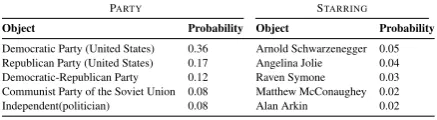
which is referring to apngfile, could be replaced with more descriptive one. Additionally, our proposed technique features several unique characteristics: (1) the ES-LDA is a knowledge-based probabilistic model that combines prior knowledge with statistical learning technique into a unified framework for entity summarization; (2) for each entity, it ranks all predicates based on their importance by computing marginal probabilities for the predicates. Table4illustrates the top-5 predicates for a sample of two entities; and finally (3), each predicate can be represented as a probability distribution over objects in the ES-LDA model, which allows us to describe the relations (predicates) of the RDF graph based on its nodes as shown in Table5.
7 Conclusions
Table 3: Top-10 predicates for three randomly selected entities after applying three different models. MARIECURIE REIGN OFFIRE SEYCHELLES
ES-LDA LinkSUM FACES ES-LDA LinkSUM FACES ES-LDA LinkSUM FACES
doctoralStudents birthPlace spouse starring country starring leaderName largestCity leaderName doctoralAdvisor birthPlace field producer starring country governmentType governmentType governmentType deathPlace field workInstitutions music starring distributor leaderTitle governmentType largestCity children field birthPlace director starring musicComposer officialLanguage governmentType sovereigntyType knownFor knownFor deathPlace cinematography studio director capital governmentType source spouse almaMater doctoralAdvisor country producer editing currency sovereigntyType capital almaMater birthPlace knownFor distributor producer studio timeZone source leaderTitle birthPlace knownFor almaMater studio director music legislature capital language field doctoralAdvisor doctoralStudents editing artist producer anthem language languages establishedEvent knownFor thumbnail screenplay producer thumbnail callingCode timeZone legislature
Table 4: Probabilities of top-5 predicates for two randomly selected entities.
LEXUS MORTALKOMBATTRILOGY Predicate Probability Predicate Probability
foundedBy 0.21 platforms 0.30
owner 0.17 publisher 0.18
location 0.15 developer 0.17 keyPerson 0.06 computingMedia 0.07
service 0.04 designer 0.05
Table 5: Distributions of two randomly selected predicates over top-5 objects.
PARTY STARRING
Object Probability Object Probability
Democratic Party (United States) 0.36 Arnold Schwarzenegger 0.05 Republican Party (United States) 0.17 Angelina Jolie 0.04 Democratic-Republican Party 0.12 Raven Symone 0.03 Communist Party of the Soviet Union 0.08 Matthew McConaughey 0.02 Independent(politician) 0.08 Alan Arkin 0.02
sparseness, unnatural language, and lack of con-text. We conducted extensive experiments, which show the quality of the top-10 triples in both con-figurations outperforms the state-of-the-art tech-niques, LinkSUM and FACES, while for the top-5 quality we surpassed FACES and equaled the LinkSUM results.
There are many interesting future research di-rections of this work. It would be interesting to in-vestigate how this model and a much richer set of topic models that combine prior knowledge with statistical learning techniques could be used for various tasks in the Semantic Web domain, such as ontology summarization, ontology tagging, and finding similar ontologies.
Acknowledgments
Gong Cheng was partially funded by the NSFC under Grant 61572247.
References
Mehdi Allahyari and Krys Kochut. 2015. Automatic topic labeling using ontology-based topic models. In14th International Conference on Machine Learn-ing and Applications (ICMLA), 2015. IEEE. Mehdi Allahyari, Seyedamin Pouriyeh, Mehdi Assefi,
Saied Safaei, Elizabeth D Trippe, Juan B Gutierrez, and Krys Kochut. 2017a. A brief survey of text min-ing: Classification, clustering and extraction tech-niques.arXiv preprint arXiv:1707.02919.
Mehdi Allahyari, Seyedamin Pouriyeh, Krys Kochut, and Hamid R Arabnia. 2017b. A knowledge-based topic modeling approach for automatic topic labeling. INTERNATIONAL JOURNAL OF AD-VANCED COMPUTER SCIENCE AND APPLICA-TIONS8(9):335–349.
Kayhan Batmanghelich, Ardavan Saeedi, Karthik Narasimhan, and Sam Gershman. 2016. Nonpara-metric spherical topic modeling with word embed-dings. arXiv preprint arXiv:1604.00126.
Christian Bizer, Jens Lehmann, Georgi Kobilarov, S¨oren Auer, Christian Becker, Richard Cyganiak, and Sebastian Hellmann. 2009. Dbpedia-a crystal-lization point for the web of data. Web Semantics: science, services and agents on the world wide web
7(3):154–165.
David M Blei and Michael I Jordan. 2003. Model-ing annotated data. InProceedings of the 26th an-nual international ACM SIGIR conference on Re-search and development in informaion retrieval. ACM, pages 127–134.
David M Blei, Andrew Y Ng, and Michael I Jordan. 2003. Latent dirichlet allocation. the Journal of ma-chine Learning research3:993–1022.
Shaofeng Bu, Laks VS Lakshmanan, and Raymond T Ng. 2005. Mdl summarization with holes. In Pro-ceedings of the 31st international conference on Very large data bases. VLDB Endowment, pages 433–444.
Hong-Jie Dai, Richard Tzong-Han Tsai, Wen-Lian Hsu, et al. 2011. Entity disambiguation using a markov-logic network. InIJCNLP. pages 846–855.
Rajarshi Das, Manzil Zaheer, and Chris Dyer. 2015. Gaussian lda for topic models with word embed-dings. InACL (1). pages 795–804.
Douglas H Fisher. 1987. Knowledge acquisition via in-cremental conceptual clustering. Machine learning
2(2):139–172.
Thomas Franz, Antje Schultz, Sergej Sizov, and Stef-fen Staab. 2009. Triplerank: Ranking semantic web data by tensor decomposition. The Semantic Web-ISWC 2009pages 213–228.
Thomas L Griffiths and Mark Steyvers. 2004. Find-ing scientific topics. Proceedings of the National academy of Sciences of the United States of America
101(Suppl 1):5228–5235.
Kalpa Gunaratna, Krishnaprasad Thirunarayan, and Amit P Sheth. 2015. Faces: diversity-aware entity summarization using incremental hierarchical con-ceptual clustering .
Udo Hahn and Inderjeet Mani. 2000. The challenges of automatic summarization. Computer33(11):29–36. Johannes Hoffart, Fabian M Suchanek, Klaus Berberich, and Gerhard Weikum. 2013. Yago2: A spatially and temporally enhanced knowledge base from wikipedia. Artificial Intelligence194:28–61. Karen Sp¨arck Jones. 2007. Automatic summarising:
The state of the art. Information Processing & Man-agement43(6):1449–1481.
Saket Navlakha, Rajeev Rastogi, and Nisheeth Shri-vastava. 2008. Graph summarization with bounded error. InProceedings of the 2008 ACM SIGMOD international conference on Management of data. ACM, pages 419–432.
Ani Nenkova and Kathleen McKeown. 2012. A sur-vey of text summarization techniques. In Mining text data, Springer, pages 43–76.
Christian P Robert and George Casella. 2004. Monte Carlo statistical methods, volume 319. Citeseer.
Jennifer Sleeman, Tim Finin, and Anupam Joshi. 2015. Topic modeling for rdf graphs. InLD4IE@ ISWC. pages 48–62.
Jinsong Su, Deyi Xiong, Yang Liu, Xianpei Han, Hongyu Lin, Junfeng Yao, and Min Zhang. 2015. A context-aware topic model for statistical machine translation. InACL (1). pages 229–238.
Andreas Thalhammer, Nelia Lasierra, and Achim Ret-tinger. 2016. Linksum: using link analysis to sum-marize entity data. In International Conference on Web Engineering. Springer, pages 244–261.
Andreas Thalhammer and Achim Rettinger. 2014. Browsing dbpedia entities with summaries. In Eu-ropean Semantic Web Conference. Springer, pages 511–515.
Alberto Tonon, Michele Catasta, Gianluca Demartini, Philippe Cudr´e-Mauroux, and Karl Aberer. 2013. Trank: Ranking entity types using the web of data. In International Semantic Web Conference. Springer, pages 640–656.
Xiaojun Wan and Tianming Wang. 2016. Automatic labeling of topic models using text summaries. In
ACL (1).
Xiaohui Yan, Jiafeng Guo, Yanyan Lan, and Xueqi Cheng. 2013. A biterm topic model for short texts. InProceedings of the 22nd international conference on World Wide Web. ACM, pages 1445–1456. Xiang Zhang, Gong Cheng, and Yuzhong Qu. 2007.
Ontology summarization based on rdf sentence graph. InProceedings of the 16th international con-ference on World Wide Web. ACM, pages 707–716. Hai Zhao and Chunyu Kit. 2008. Unsupervised