Partial Descriptions and Systemic Grammar
C h r i s B r e w
C e n t r e f o r C o g n i t i v e S c i e n c e U n i v e r s i t y o f E d i n b u r g h
2 B u c c l e u c h P l a c e E d i n b u r g h
U.K.
c h r i s b r ~ u k . a c . e d . c o g s c i
A b s t r a c t
This paper exarnines the properties of feature- ba~sed partial descriptions built on top of tlalli- day's systemic networks. We show that the cru- cial operation of consistency checking for such descriptions is NP-complete, and therefore prob- ably intractable, but proceed to develop algo- rithms which can sometimes alleviate the un- pleasant consequence s of this intractability.
1
I n t r o d u c t i o n
tIalliday's system networks [3] lay out in dia- grammatic form the interlinked sets of linguistic choices which a speaker nmst make in order to generate an utterance. As such they have formed the basis of several computer models of natu- ral language generation [4,11].ttowever, as Mel- lish [12] has pointed out, a network can also be read as encoding a set of background constraints which restrict the co- occurrence of descriptive features, and hence as a specification of the way in which partial descriptions of linguistic objects can be combined. Although it is easy to com- bine feature sets, it is not a.lways clear whether the resulting combined description can actually describe any well-formed linguistic object. Thus the main task we face is that of checking feature sets for consistency.
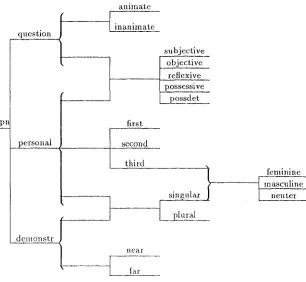
Consider for example the framework given by Winograd for the description of English pro- nouns, which is reproduced in figure 1. Sup- pose thai; a natural language system has some- how recovered the information that a pronoun in a particular position can be treated as both third (person) and subjective. At this stage
we could be dealing with either "they", "he", "she" or "it". Were we to combine this under- specified pronoun with the further description feminine we should know for sure that the pro- noun described is "she" and the number has to be singular, since the network dictates, in a way which will be explained in detail below, that the choice between feminine, masculine, and neuter is only applicable to third person singular pronouns. The network thus provides the raw material for particular sorts of limited inference about the behaviour of pronouns. We wanted to investigate the mathematical proper- ties of systemic networks in order to better un- derstand the nature of the constraints on feature structure which they are capaMe of expressing.
Both Mellish and Kasper [7] provide trans- lations of systemic networks into non-graphical formMisms: Mellish expresses constraints as ax- ioms within a simple subset of predicate logic, while Kasper uses an extended version'of Func- tional Unification G r a m m a r [10]. Unfortunately the methods which they then use to check for consistency are powerful general methods which may incur considerable computational cost.
We initially hoped to show that systemic net- works constitute a low-power constraint lan- guage which combines the twin goals of linguis- tic credibility and computationM tractability. While the main result we present in this paper is a negative one indicating the unexpected power of systemic networks, we do go on to present sug- gestions about how networks can be exploited in natural language applications.
p I
question
animate
[inanimate
personM
demonstr
first
second
third
i l e a l '
{
~_~ fat'
su bjective objective
rettexive possessive
possdet
feminine { m~tsculine
sing}}la r ] neuter
phtr a,1
Figure 1: A pronoun network for English
2
W h a t ' s in a n e t ?
Our first task is to provide a precise charact.erisa-- tion of the information expressed by ~ systemic network. We begin by defining a way of labelling systemic networks, then provide a translation which m a p s labelled networks into collections of axioms expressed in the tbrm of' propositional logic. This work is a slight retinement of a very similar approach used by Mellish.
Figure 1 contains examples of each of the tbur types of syste.m which we need to consider, linked together in such a way as to produce a descrip- tion of the possible ['(3rills of English pronouns.
T h e leftmost system is a choice system ex- pressing the opposition between qucslion~ per- soual and dcmonslral, ive pronotlns. Within these broad classification further distinctions op- erate. For example queslion pronouns iila~y be
a'lt{71?ralC or inani'maiG and m,lst also make a choice between various case'-;. T h e system which expresses t~he necessity of making i;wo sinmltane-- otis choices is indicated wit.h a left. curly bracket, and is i,l,e and system. Note t h a t ~here are two routes ~,o tile choice of case, one t?om q'ucslion and the other f r o , , personal. T h e system which
ties these two routes together is called the dis- junctive system. Finally, the rightmost system is a choice between various g r a m m a t i c a ! genders. This system can only be reached it' a pronoun is both third and singular. The system involv- ing the right-hand curly bracket which expresses this is called the conjunctive system.
3
L a b e l l l n g s for n e t w o r k s
We now establish technical definitions of two types of labelling for systemic networks.
3 . 1 B a s i c L a b e l t i n g s
A basic labelling is defined to be a partial func- tion from lines to names such that
¢~ A line receives a name if and only if there is a c h o i c e system to whose right hand side i~ is directly attached.
No two lines carry the same name.
[image:2.596.67.373.101.383.2]plq
question
personal
demonstr
animate question
] ~nanimate
question personal
V
question
personal
first
personal
personal
demonstr
demonstr
second
subjective objective reflexive possessive
possdet
third , third
personal ~ - - ~
V singular
rtemcm~tr [
[ plur______~L__
near
f
[ far
feminine masculine
neuter
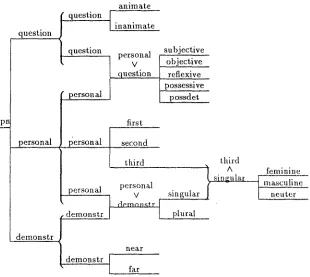
Figure 2: An exhaustively labelled version of Winograd's network
3 . 2 E x h a u s t i v e l a b e l l i n g s
Let ~" be a 1-1 function from lines to names for these lines. 5 c is an e x h a u s t i v e l a b e l l i n g of a network if and only if the following conditions hold :-
1. T h a t p a r t of ~" which provides names for lines attached directly to the right of c h o i c e systems must be a basic labelling.
. If 5 c assigns a line name
lzh~
to the line which is directly attached to the left hand side of an a n d system, then it must also assign t h a t name to the lines which are di- rectly attached to the right hand side of t h a t system.. If )c assigns line names
11,12,... lm
to the lines entering a c o n j u n c t i v e s y s t e m (where ll is the label for the line appearing at the top of the s y s t e m and lm t h a t at the b o f tom), then it must assign the label ll A 12 A• .. lm to the line which leaves t h a t system
4. If ~" assigns line narnes ll, 12,... l,~ to the lines entering a d i s j u n c t i v e system (adopt- ing the same ordering convention as above),
then it must assign the label 11 V l~ V ...Ira to the line which leaves t h a t system.
Figure 2 is an exhaustively labelled version of figure 1.
4
T r a n s l a t i n g l a b e l l e d n e t -
w o r k s
We use a translation scheme given by Mellish [12] to produce a set of logical axioms equiva- lent in meaning to the original network. Mel- lish's scheme can be applied to all four types of system and the correct results will be produced, but with our labelling scheme only
choice
sys- tems contribute to the meaning of the network. Eachchoice
s y s t e m translates into two axioms: anaccessibility
axiom, expressing tile constraint t h a t none of the labels to the right of the system can be selected unless the entry point of the sys- t e m has been reached; and anexclusivity
axiom expressing the fact t h a t these labels are mutually exclusive. [image:3.596.93.403.100.377.2]v
a2
Figure 3: A network for 3SAT
5
S y s t e m i c classification is
N P - h a r d
In this section we show that the problem of sys- temic cl~sification is at least as hard as prob- lerns known to be NP-hard. This is done by constructing a polynomial time m a p p i n g 1~ from instances of the N P - h a r d problem called 3SAT to networks which can be tricked into solving this p r o b l e m for us. For an introduction to similar linguistic applications of complexity theory see Barton et al [1].
If there were a polynomial time algorithm tbr checking a r b i t r a r y systemic networks, it would follow t h a t 3SAT could be solved by the compo- sition of the m a p p i n g t h a t constructs the net- work with the algorithm t h a t cheeks the net- work. Since this composition is itself a polyno-. mial time algorithm we would then have a poly- nomial time solution fc)r 3SAT, and hence for all other problems of the complexity class AfT ) . T h u s the successflfl construction of 1I implies
that systemic classification is itself NP-hard.
5.1. ~_[~he 3 S A T p r o b l e m
3SAT is the p r o b l e m of determining the satisfia- bility of a boolean forrnnla, stated ill con imictive normal form, in which exactly three va~:iables oc- cur in each clause, of the conj unctioa. These vari- ables may either be positive or negated, and may be repeated fl:om clause to clause. It, is known t h a t 3SAT is just as hard as the proble~rl of sat-- isfiability for general boolean formulae (Barl, on at al provide a demonst, ration of this fact on pp 52-~35 of [(I).
5 . 2 T h e m a p p i n g f r o m 3 S A T i n -
s t a n c e s t o n e t w o r k s
The m a p p i n g II takes a 3SAT instance and pro- duces a network. Let tile n a m e of the 3SAT in- stance be E and its length
NI,;.
• Make a list of the variable names used in E, counting positive and negative occurrences of a wtriable as tile same. This can certainly he done in time polynomial in Nt~ using a
standard sorting algorithm such as merge sort. Let the name of tile list of variable names be V and its length N v . We use the example of the very simple expression
(x VffVz) A(zV~V~7)
(1)
• Construct
a
network consisting of a large a n d s y s t e m feeding N v parallel binary c h o i c e systems. Each c h o i c e system car- ries two labels, one corresponding to a vari- ahle name in V and the other formed by negating the label on the other branch of the system. The choice of prefix should be such that all labels on tile resulting network are unique. ']'his p a r t of the process is poly- nomial in the length of V.e For every clause in E, add a t e r a a r y dis° j u n c t i v e system linking the lines of the net- work having the label,; corresponding to the three symbols of the clause. This part of the process involves scanning down the N v sys- tems of the network once for each clause of E, and is thereR)re also polynomial in NE.
Finally, binary e h o l e e systems are attached to the o u t p u t s of all the d i s j u n c t i v e sys- tems introduced in tile last stage. These systems are labelled with generated labels distinct from those already used in the net- work. 'l'his step is clearly also polynomia, l in Nt~', requiring the crealion of a nmnber of c h o i c e systems equal t,o the number of' clauses in P;.
The network giveu i~ figure 3 is the Oile which would be produced l¥om t5'. In order to use the construcLed network to solve the satisfiabil- ity problem for /';, we check an expression cor- respouding t/) I;he conjnnction of all the three member (-lause,~; in t~:. This is lmili by choosing ~:,l arbitrary label from each of tim rightmost c h o i c e systems. ' f h e coa itmct, io~ of the:;e la-
clauses of E can be satisfied by the same value assignment. T h e c h o i c e systems to the left of the disjunction express the facts that no vari- able can be simultaneously true and false. A correct checking algorithm will succeed in just those circumstances where there is at least one value assignment for the variables of E which makes E come out true. Systemic classification is therefore at least as hard as the other problems in A l p , a n d we should be very surprised to find that it can in general be solved in polynomial time.
6
Checking
systemic
de-
scriptions
Although accurate checking of systemic descrip- tions is an NP-hard problem, it is still possible to devise algorithms which carry out part of the process of checking without incurring the cost of complete correctness. Our algorithm depends on a pre-processing step in which the original net- work is split into two components, each of which embodies some but not all of the information that was present at the outset.
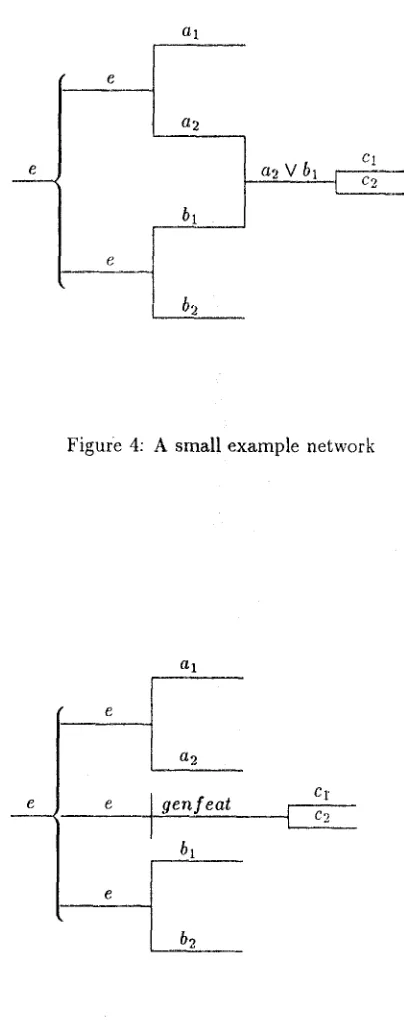
T h e first component is a simplified version of the original network, in which no disjunctive sys- tems are present. This is achieved by remov- ing all disjunctive systems, then re-attaching any dangling systems to a suitable point to the left of the position of the disjunction. For convenience in book-keeping we introduce special generated features which take the place of the disjunctive expressions that appear in the labelling of the original network. Figure 5 shows the result of peeling awaythe disjunction in figure 4.
T h e second component of the network consists of a collection of statements indicating ways in which the generated features may be discharged. For the example network we would have had to note that
gen f eat ~_ cl V c2
Taken together the simplified version of the net- work and the statements about generated fen- tures contain all the information needed. The simplified network is now amenable to deterrnin- istic and efficient checking procedures, includ- ing reductions to term unification as proposed by Mellish. T h e efficiency of these techniques hinges on the removal of disjunctive systems.
The second stage of checking involves the search for a consistent way of discharging all the
a l
a2
a2 Vbl
bl
b~
CI [ C2
Figure 4: A small example network
a l
a2
C~ genfeat { c2
bl
b2
Figure 5: The transformed version of the exam- ple
[image:5.596.308.510.150.661.2]generated features introduced by the first stage. This is the potentially costly part of the checking process, since separate disjunctions may conspire to produce exponentially many different alter- natives which have to be checl(ed. It was to be expected that the process of systemic checking would involve an exponential cost somewhere, so this is no surprise.
Even the second stage of checking is cheap un- less two separate conditions hoh:t
1.. The description produced by the first stage of checking must involve many generated features.
2. The generated features must be interdepen- dent, in that the way in which one feature is discharged colmtrains the way in which olher fiea.tures can be discharged.
We can't be sure whether the first condition is going to hold until we see the OUtl)ut of the first stage, but we ca.n estimate the extent to which features interact, by inspect, lag the check- ing rules which arise when (he net, work is pard- t.ioned. Thus, while we can't promise that the use of systemic networks will ensure tractability !'or arbitrary grammars, v,'e can help linguists to catch potential t)roblerns in the formulation of their feature system,,~ during grammar develop- ment, and avoid the risk of unexpected combi- natorial explosions during the exploitation of the grammars in question.
R e f e : r e a c e s
[1] G.Edward Barton, Robert C.13erwick, and Eric Sven I{,istad. Computational Complex- ily a'ad Nalu~al La'/zguage. MIT Press, 1988. [2] Andreas Eisele and aochen l)6rre. Unifi- cation of Disjunctiw.' Feature I)escriptions in Proceedings of the 25t, h Annual Meeting of the Association for Computational l,ino guisi;ics, Stanford University, Stanford, ()A. July G-9, t987.
[3] M.A.K Halliday. q'he /brm of! a func- tional grammar, h: G.R.Krcss, edit.or, llatlidayl:Sysle'm and t"~clioTt i7~ Larzc/~za:]e, chapter '.2, pages 7-25. ()×ford University Press, t976.
[4] (:~eo;ge t[oughton. 73c pvocl'~clio~' of ga~;'- 9uoye i~ Dialo9~¢c: A co'mp~daZio-nal model Ph D thesi,;, Universit.y of Sussex, 1986.
[5] Lauri Karttunen. Features and Values Pro-- ceedings of the 25th Annual Meeting of the Association for Computational Linguistics, Stantbrd University, StaMbrd, CA, July 2- (5, 1984.
[6] Robert T. Kasper. Fea(,ure Structures: A Logical Theory with Application to l,an- guage Analysis PhD thesis, University of Michigan, 1987.
[7] l/,obert T. Kasper. An Experimental Parser for Systemic Grammars Ill Proceedings of the i2th International Conference on Con> putational l,inguistics: COLIN(] 88, Bu- dapest: August 1988.
[8] tlobert T.Kaspcr. A Unification Method for 1)isjunctive Feature Descriptions In Pro- ceedings of the 25th Annual Meeting of the As,;ociation for Computational l,inguistics, Stanford University, Stanford, CA, July 6- 9, 1987.
[9] Robert T.Ka.~per, and William Rounds. A Logical Semantics For Feature Structur(~s In Proceedings of the 24th Annual Meeting of the Association t'or Computatiorm.1 Lin-- guistics, Columbia University, New York, NY, June 10-13, 1986.
[10] Martin Kay. Parsing in flmctional tmiti- cation grammar. In D.R. Dowry, L. Kar- tunnen, and A.Zwicky, editors, Nalural Langua,qe Pa','sin9, pages 251 278. Can> bridge University Press, Cambridge, Eng- land, 1982.
[11] W.C.Mann and C.Mathiessen. Nigel : A systemic
grammar for text generation l/_Benson and a.Greaves Sy.siemic Perspectives on Dis-
course, A blex,London,England,1985. [12] C.S. Mellish. hnplementing sysl,cmic dassi-.
fication by unilication. Comlnda*io~zal law. guistics, 14(11):40 5l, 1988. Wil~ter. 1[3] Terry Winograd. U~,dc~:sla~dz/~ 9 Nol~tra[