Reusing an ontology to generate numeral classifiers
Francis Bond3NTT Communication Science Laboratories 2-4 Hikari-dai, Kyoto 619-0237, JAPAN
Kyonghee Paik
Center for the Study of Language and Information Stanford University, CA 94305-2150, USA
Abstract
In this paper, we present a solution to the prob-lem of generating Japanese numeral classifiers us-ing semantic classes from an ontology. Most nouns must take a numeral classifier when they are quan-tified in languages such as Chinese, Japanese, Ko-rean, Malay and Thai. In order to select an appro-priate classifier, we propose an algorithm which as-sociates classifiers with semantic classes and uses inheritance to list only those classifiers which have to be listed. It generates sortal classifiers with an ac-curacy of 81%. We reuse the ontology provided by Goi-Taikei — a Japanese lexicon, and show that it is a reasonable choice for this task, requiring infor-mation to be entered for less than 6% of individual nouns.
1 Introduction
In this paper we consider two questions. The first is: how to generate numeral classifiers such as piece in
2 pieces of paper? To do this we use a semantic
hier-archy originally developed for a different task. The second is: how far can such a hierarchy be reused?
In English, uncountable nouns cannot be directly modified by numerals, instead the noun must be embedded in a noun phrase headed by a classi-fier. Knowing when to do this is a language spe-cific property. For example, French deux
renseigne-ment must be translated as two pieces of information
in English.1 In many languages, including most South-East Asian languages, Chinese, Japanese and Korean, the majority of nouns are uncountable and must be quantified by numeral classifier combina-tions. These languages typically have many differ-ent classifiers. There has been some work on the analysis of numeral classifiers in natural language processing, particularly for Japanese (Asahioka et al., 1990; Kamei and Muraki, 1995; Bond et al.,
3
Visiting CSLI, Stanford University (1999-2000).
1
Numeral-classifier combinations are shown in bold, the noun phrases they quantify are underlined.
1996; Bond et al., 1998; Yokoyama and Ochiai, 1999), but very little on their generation. We could only find one paper on generating classifiers in Thai (Sornlertlamvanich et al., 1994). One immediate application for the generation of classifiers is ma-chine translation, and we shall take examples from there, but it is in fact needed for the generation of any quantified noun phrase with an uncountable head noun.
The second question we address is: how far can an ontology be reused for a different task to the one it was originally designed for. There are several large ontologies now in use (WordNet (Fellbaum, 1998); Goi-Taikei (Ikehara et al., 1997); Mikrokos-mos (Nirenburg, 1989)) and it is impractical to re-build one for every application. However, there is no guarantee that an ontology built for one task will be useful for another.
The paper is structured as follows. In Section 2, we discuss the properties of numeral classifiers in more detail and suggest an improved algorithm for generating them. Section 3 introduces the ontology we have chosen, the Goi-Taikei ontology (Ikehara et al., 1997). Then we show how to use the ontology to generate classifiers in Section 4. Finally, we discuss how well it performs in Section 5.
2 Generating Numeral Classifiers
In this section we introduce the properties of nu-meral classifiers, focusing on Japanese, then give an algorithm to generate classifiers. Japanese was chosen because of the wealth of published data on Japanese classifiers and the availability of a large lexicon with semantic classes marked.
2.1 What are Numeral Classifiers
Japanese is a language where most nouns can not be directly modified by numerals. Instead, nouns are modified by a numeral-classifier combination as shown in (1).2
2
We use the following abbreviations: NOM= nominative;
(1) 2-ts ¯u-no
2-CL-ADN
denshim¯eru email
2 pieces of email
2 emails
In Japanese, numeral classifiers are a subclass of nouns. The main property distinguishing them from prototypical nouns is that they cannot stand alone. Typically they postfix to numerals, forming a quan-tifier phrase. Japanese also allows them to combine with the quantifier s¯u “some” or the interrogative
nani “what” (2). We will call all such combinations
of a numeral/quantifier/interrogative with a numeral classifier a numeral-classifier combination.
(2) a. 2-hiki “2 animals” (Numeral)
b. s¯u-hiki “some animals” (Quantifier)
c. nan-biki “how many animals” (Inter-rogative)
Classifiers have different properties depending on their use. There are five major types: sortal which classify the kind of the noun phrase they quan-tify (such as -tsu “piece”); event which are used to quantify events (such as -kai “time”);
mensu-ral which are used to measure the amount of some
property (such as senchi “-cm”), group which refer to a collection of members (such as -mure “group”); and taxonomic which force the noun phrase to be interpreted as a generic kind (such as -shu “kind”).
We propose the following basic structure for sor-tal classifiers (3). The lexical structure we adopt is an extension of Pustejovsky’s (1995) generative lex-icon, with the addition of an explicit quantification relationship (Bond and Paik, 1997).
(3)
classifier
2
6 6 4
ARGSTR
"
ARG1 x:numeral+
D-ARG1 y: ?
#
QUANT quantifies(x,y)
3
7 7 5
There are two variables in the argument struc-ture: the numeral, quantifier or interrogative (repre-sented bynumeral+), and the noun phrase being classified. Because the noun phrase being classified can be omitted in context, it is a default argument, one which participates in the logical expressions in the qualia, but is not necessarily expressed syntacti-cally.
= argument structure;ARG= argument; D-ARG= default argu-ment,QUANT= quantification.
Sortal classifiers differ from each other in the re-strictions they place on the quantified variable y. For example the classifier -nin adds the restriction y:human. That is, it can only be used to classify human referents.
Japanese has two number systems: a Sino-Japanese one based on Chinese for example, ichi “one”,ni “two”,san “three”, etc., and an alternative native-Japanese system, for example, hitotsu “one”
futatsu “two”,mitsu “three”, etc. In Japanese the
na-tive system only exists for the numbers from one to ten. Most classifiers combine with the Chinese forms, however, different classifiers select Sino-Japanese for some numerals, for example, ni-hiki “two-cl”, and most classifiers undergo some form of sound change (such as -hiki to -biki in (2)). We will not be concerned with these morphological changes, we refer interested readers to Backhouse (1993, 118–122) for more discussion.
Numeral classifiers characteristically premodify the noun phrases they quantify, linked by an adnom-inal case marker, as in (4); or appear ‘floating’ as adverbial phrases, typically to before the verb: (5). The choice between pre-nominal and floating quan-tifiers is largely driven by discourse related consid-erations (Downing, 1996). In this paper we concen-trate on the semantic contribution of the quantifiers, and ignore the discourse effects.
(4) 2-ts ¯u-no
2-CL-ADN
tegami-o letter-ACC
yonda read
I read two letters
(5) tegami-o letter-ACC
2-ts ¯u
2-CL yonda read
I read two letters
Quantifier phrases can also function as noun phrases on their own, with anaphoric or deictic ref-erence, when what is being quantified is recover-able from the context. For example (7) is accept-able if the letters have already been referred to, or are clearly visible.
(6) [some background with letters salient]
(7) 2-ts ¯u-o
2-CL-ACC yonda read
(Japanese)
I read two letters
quantification can be of the object denoted by the noun phrase itself as in (8); or of a sub-part of it as in (9) (see Bond and Paik (1997) for a fuller discus-sion).
(8) 3-ts ¯u-no
3-CL-ADN tegami letter 3 letters
(9) 3-mai-no
3-CL-ADN tegami letter
a 3 page letter
2.2 An Algorithm to Generate Numeral
Classifiers
The only published algorithm to generate classifiers is that of Sornlertlamvanich et al. (1994). They propose to generate classifiers in Thai as follows: First create a lexicon with default classifiers listed for as many nouns as possible. This was done by automatically extracting noun classifier pairs from a sense-tagged corpus, and taking the classifier that appeared most often with each sense of a noun.3 Then, the most frequent classifier is listed for each semantic class. Generation is then simple: if a noun has a default classifier in the lexicon, then use it, otherwise use the default classifier associated with its semantic class.
Unfortunately, no detailed results were given as to the size of the concept hierarchy, the number of nodes in it or the number of nouns for which clas-sifiers were found. As the generation procedure was not implemented, there was no overall accuracy given for the system.
As a default, Sornlertlamvanich et al.’s algorithm is useful. However, it does not cover several ex-ceptional cases, so we have refined it further. The extended algorithm is shown in Figure 1.
Firstly, we have made explicit what to do when a noun is a member of more than one semantic class or of no semantic class. In the lexicon we used, nouns are, on average, members of 2 seman-tic classes. However, the semanseman-tic classes are or-dered so that the most typical use comes first. For example, usagi “rabbit” is marked as bothanimal and meat, withanimal coming first (Figure 3). In this case, we would take the classifier associated
3
In fact, Thai also has a great many group classifiers, much like herd, flock and pack in English. Therefore each noun has two classifiers, a sortal classifier and a group classifier listed. Japanese does not, so we will not discuss the generation of group classifiers here.
with the first semantic class. However, in the case of
usagi it is not counted with the default classifier for
animals -hiki, but with that for birds -wa, this must be listed as an exception.
Secondly, we have added a method for generating classifiers that quantify coordinate noun phrases. These commonly appear in appositive noun phrases such as ABC-to XYC-no 2-sha “the two companies, ABC and XYZ”.
1. For a simple noun phrase
(a) If the head noun has a default classifier in the lexicon:
use the noun’s default classifier
(b) Else if it exists, use the default classifier of the head noun’s first listed semantic class (the class’s default classifier)
(c) Else use the residual classifier -tsu
2. For a coordinate noun phrase
generate the classifier for each noun phrase use the most frequent classifier
Figure 1: Algorithm to generate numeral classifiers
In addition, we investigate to what degree we could use inheritance to remove redundancy from the lexicon. If a noun’s default classifier is the same as the default classifier for its semantic class, then there is no need to list it in the lexicon. This makes the lexicon smaller and it is easier to add new en-tries. Any display of the lexical item (such as for maintenance or if the lexicon is used as a human aid), should automatically generate the classifier from the semantic class. Alternatively (and equiv-alently), in a lexicon with multiple inheritance and defaults, the class’s default classifier can be added as a defeasible constraint on all members of the se-mantic class.
3 The Goi-Taikei Ontology
We used the ontology provided by Goi-Taikei — A Japanese Lexicon (Ikehara et al., 1997). We choose it because of its rich ontology, its extensive use in many other NLP applications, its wide coverage of Japanese, and the fact that it is being extended to other numeral classifier languages, such as Malay.
with bothis-aandhas-arelationships. 2,710 se-mantic classes (12-level tree structure) for common nouns, 200 classes (9-level tree structure) for proper nouns and 108 classes for predicates. We show the top three levels of the common noun ontology in Figure 2. Words can be assigned to semantic classes anywhere in the hierarchy. Not all semantic classes have words assigned to them.
The semantic classes are used in the Japanese word semantic dictionary to classify nouns, verbs and adjectives. The dictionary includes 100,000 common nouns, 70,000 technical terms, 200,000 proper nouns and 30,000 other words: 400,000 words in all. The semantic classes are also used as selectional restrictions on the arguments of predi-cates in a separate predicate dictionary, with around 17,000 entries.
Figure 3 shows an example of one record of the Japanese semantic word dictionary, with the addi-tion of the new DEFAULTCLASSIFIERfield (under-lined for emphasis).
Each record has an index form, pronunciation, a canonical form, part-of-speech and semantic classes. Each word can have up to five common noun classes and ten proper noun classes. In the case of usagi “rabbit”, there are two common noun classes and no proper noun classes.
4 Mapping Classifiers to the Ontology
In this section we investigate how far the seman-tic classes can be used to predict default classifiers for nouns. Because most sortal classifiers select for some kind of semantic class, we thought that nouns grouped together under the same semantic class should share the same classifier.
We associated classifiers with semantic classes by hand. This took around two weeks. We found that, while some classes were covered by a single classifier, around 20% required more than one. For example, 1056:song is counted only by -kyoku “tune”, and 989:water vehicleby only by
-seki “ship”, but the class[961:weapon] had mem-bers counted by -hon “long thin”, -ch¯o “knife”, -furi “swords”, -ki “machines” and more.
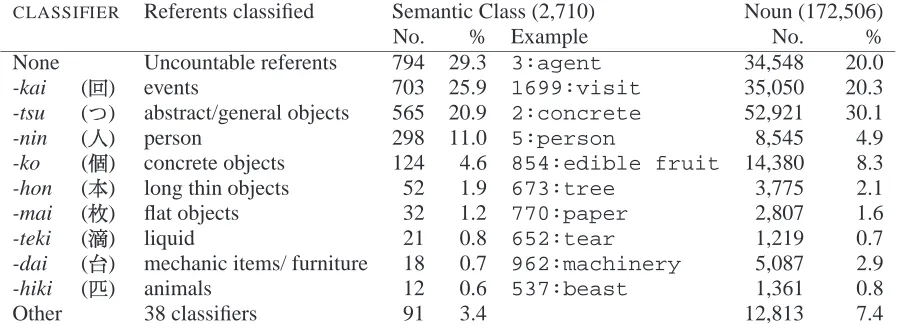
We show the most frequent numeral classifiers in Table 1. We ended up with 47 classifiers used as semantic classes’ default classifiers. This is in line with the fact that most speakers of Japanese know and use between 30 and 80 sortal classifiers (Down-ing, 1996). Of course, we expect to add more clas-sifiers at the noun level.
801 semantic classes turned out not to have clas-sifiers. This included classes with no words associ-ated with them, and those that only contained nouns with referents so abstract we considered them to be uncountable, such as greed, lethargy, etc.
We used the default classifiers assigned to the se-mantic classes to generate defeasible defaults for the noun entries in the common and technical term dic-tionaries (172,506 words in all). We did this in order to look at the distribution of classifiers over words in the lexicon. In the actual generation this would be done dynamically, after the semantic classes have been disambiguated. The distributions of classifiers were similar to those of the semantic classes, al-though there was a higher proportion counted with the residual classifier -tsu, and the classifier for ma-chines -dai. This may be an artifact of the 70,000 word technical term dictionary. As further research, we would like to calculate the distribution of classi-fiers in some text, although we expect it to depend greatly on the genre.
The mapping we created is not complete because some of the semantic classes have nouns which do not share the same classifiers. We have to add more specific defaults at the noun level. As well as more specific sortal classifiers, there are cases where a group classifier may be more appropriate. For ex-ample, among the nouns counted with -nin there are entries such as couple, twins and so on which are often counted with -kumi “pair”.
In addition, the choice of classifier can depend on factors other than just semantic class, for example,
hito “people” can be counted by either -nin or -mei,
the only difference being that -mei is more polite. It was difficult to assign default classifiers to the semantic classes that referred to events. These classes mainly include deverbal nouns (e.g. konomi “liking”) and nominal verbs (e.g., benky¯o “study”). These can stand for both the action or the result of the action: e.g. kenky¯u “a study/research”. In these cases, every application we considered would dis-tinguish between event and sortal classification in the input, so it was only necessary to choose a clas-sifier for the result of the action.
5 Evaluation and Discussion
The algorithm was tested on a 3700 sentence ma-chine translation test set of Japanese with English translations, although we only used the Japanese.4
4
1:noun
Figure 2: Top three levels of the Goi-Taikei Common Noun Ontology
record
INDEXFORM DGE(usagi)
PRONUNCIATION (0,/usagi/
CANONICALFORM x(usagi)
PART OFSPEECH noun DEFAULTCLASSIFIER Q(-wa)
SEMANTICCLASSES
"
COMMON NOUN 537:beast 843:meat/egg
Figure 3: Japanese Lexical Entry for rabbit “usagi”
We only considered sentences with a noun phrase modified by a sortal classifier. Noun phrases modi-fied by group classifiers, such as -soku “pair” were not evaluated, as we reasoned that the presence of such a classifier would be marked in the input to the generator. We also did not consider the anaphoric use of numeral classifiers. Although there were many anaphoric examples, resolving them requires robust anaphor resolution, which is a separate prob-lem. We estimate that we would achieve the same accuracy with the anaphoric examples if their ref-erents were known, unfortunately the test set did not always include the full context, so we could not identify the referents and test this. A typical exam-ple of anaphoric use is (10).
(10) shukka-ga
Cumulative shipments reached 500 ?bar-rels/rolls/logs/. . .
In total, there were 90 noun phrases modified by a sortal classifier. Our test of the algorithm was done by hand, as we have no Japanese generator. We as-sumed as input only the fact that a classifier was required, and the semantic classes of the head noun given in the lexicon. Using only the default classi-fiers predicted by the semantic class, we were able to generate 73 (81%) correctly. A classifier was only judged to be correct if it was exactly the same as that in the original test set. This was almost double the base line of generating the most common clas-sifier (-nin) for all noun phrases, which would have achieved 41%. The results, with a breakdown of the errors, are summarized in Table 2.
CLASSIFIER Referents classified Semantic Class (2,710) Noun (172,506)
No. % Example No. %
None Uncountable referents 794 29.3 3:agent 34,548 20.0
-kai (T) events 703 25.9 1699:visit 35,050 20.3
-tsu (6) abstract/general objects 565 20.9 2:concrete 52,921 30.1
-nin (h) person 298 11.0 5:person 8,545 4.9
-ko (]) concrete objects 124 4.6 854:edible fruit 14,380 8.3 -hon () long thin objects 52 1.9 673:tree 3,775 2.1
-mai () flat objects 32 1.2 770:paper 2,807 1.6
-teki (v) liquid 21 0.8 652:tear 1,219 0.7
-dai (q) mechanic items/ furniture 18 0.7 962:machinery 5,087 2.9
-hiki (~) animals 12 0.6 537:beast 1,361 0.8
Other 38 classifiers 91 3.4 12,813 7.4
Table 1: Japanese Numeral Classifiers and associated Semantic Classes
Result % No.
Correctly generated 81% 73 Incorrectly generated 19% 17
Total 100% 90
Breakdown of Errors
Noun needs default classifier — 6 Target not in lexicon, bad entry — 4
Other errors — 7
Table 2: Results of applying the algorithm
Looking at it from another point of view, the Goi-Taikei ontology, although initially designed for Japanese analysis, was also useful for generating Japanese numeral classifiers. We consider that it would be equally useful for the same task with Ko-rean, or even the unrelated language Malay.
We generated the residual classifier -tsu for nouns not in the lexicon, this proved to be a bad choice for three unknown words. If we had a method of deducing semantic classes for unknown words we could have used it to predict the classifier more successfully. For example, kikan-t¯oshika “insti-tutional investor”5 was not in the dictionary, and so we used the semantic class for t ¯oshika “in-vestor”, which was 175:investor, a sub-type of 5:person. Had kikan-t¯oshika “institutional investor” been marked as a subtype of company, or if we had deduced the semantic class from the modifier, then we would have been able to
gener-5
Institutional investors are financial institutions that invest savings of individuals and non-financial companies in the fi-nancial markets.
ate the correct classifier -sha. In one case, we felt the default ordering of the semantic classes should have been reversed: 673:treewas listed before
854:edible fruitfor ringo “apple”.
The remaining errors were more problematic. There was one example, 80,000-nin-amari-no sh¯omei “about 80,000 signatures”, which could be
treated as referent transfer: shomei “signature”
was being counted with the classifier for people. Another possible analysis is that the classifier is the head of a referential noun phrase with deic-tic/anaphoric reference, equivalent to the signatures
of about 80,000 people. A couple were quite literary
in style: for example 10nen-no toshi “10 years (Lit: 10 years of years)”, where the toshi “year” part is redundant, and would not normally be used. In two of the errors the residual classifier was used instead of the more specific default. Shimojo (1997) pre-dicts that this will happen in expressions where the amount is being emphasized more than what is be-ing counted. Intuitively, this applied in both cases, but we were unable to identify any features we could exploit to make this judgment automatically.
A more advanced semantic analysis may be able to dynamically determine the appropriate semantic class for cases of referent transfer, unknown words, or words whose semantic class can be restricted by context. Our algorithm, which ideally generates the classifier from this dynamically determined seman-tic class allows us to generate the correct classifier
in context, whereas using a default listed for a noun
Sornlert-lamvanich et al. (1994) do.
In this paper we have concentrated on solving the problem of generating appropriate Japanese nu-meral classifiers using an ontology. In future work, we would like to investigate in more detail the con-ditions under which a classifier needs to be gener-ated.
6 Conclusion
In this paper, we presented an algorithm to generate Japanese numeral classifiers. It was shown to select the correct sortal classifier 81% of the time. The al-gorithm uses the ontology provided by Goi-Taikei, a Japanese lexicon, and shows how accurately se-mantic classes can predict numeral classifiers for the nouns they subsume. We also show how we can improve the accuracy and efficiency further through solving other natural language processing problems, in particular, referent transfer, anaphor resolution and word sense disambiguation.
Acknowledgments
The authors thank Kentaro Ogura, Timothy Bald-win, Virach Sornlertlamvanich and the anonymous reviewers for their helpful comments.
References
Yoshimi Asahioka, Hideki Hirakawa, and Shin-ya Amano. 1990. Semantic classification and an analyzing system of Japanese numerical expres-sions. IPSJ SIG Notes 90-NL-78, 90(64):129– 136, July. (in Japanese).
A. E. Backhouse. 1993. The Japanese Language:
An Introduction. Oxford University Press.
Francis Bond and Kyonghee Paik. 1997. Classify-ing correspondence in Japanese and Korean. In
3rd Pacific Association for Computational Lin-guistics Conference: PACLING-97, pages 58–67.
Meisei University, Tokyo, Japan.
Francis Bond, Kentaro Ogura, and Satoru Ikehara. 1996. Classifiers in Japanese-to-English machine translation. In 16th International Conference on
Computational Linguistics: COLING-96, pages
125–130, Copenhagen, August. (http://
xxx.lanl.gov/abs/cmp-lg/9608014).
Francis Bond, Daniela Kurz, and Satoshi Shirai. 1998. Anchoring floating quantifiers in Japanese-to-English machine translation. In 36th Annual
Meeting of the Association for Computational Linguistics and 17th International Conference on Computational Linguistics: COLING/ACL-98, pages 152–159, Montreal, Canada.
Pamela Downing. 1996. Numeral Classifier
Sys-tems, the case of Japanese. John Benjamins,
Am-sterdam.
Christine Fellbaum, editor. 1998. WordNet: An
Electronic Lexical Database. MIT Press.
Satoru Ikehara, Masahiro Miyazaki, Satoshi Shirai, Akio Yokoo, Hiromi Nakaiwa, Kentaro Ogura, Yoshifumi Ooyama, and Yoshihiko Hayashi. 1997. Goi-Taikei — A Japanese Lexicon.
Iwanami Shoten, Tokyo. 5 volumes/CDROM. Shin-ichiro Kamei and Kazunori Muraki. 1995. An
analysis of NP-like quantifiers in Japanese. In
First Natural Language Processing Pacific Rim Symposium: NLPRS-95, volume 1, pages 163–
167.
Sergei Nirenburg. 1989. KBMT-89 — a knowledge-based MT project at Carnegie Mellon University. pages 141–147, Aug. 16–18. James Pustejovsky. 1995. The Generative Lexicon.
MIT Press.
Mitsuaki Shimojo. 1997. The role of the general category in the maintenance of numeral classi-fier systems: The case of tsu and ko in Japanese.
Linguistics, 35(4). (http://ifrm.glocom.
ac.jp/doc/s01.001.html).
Virach Sornlertlamvanich, Wantanee Pantachat, and Surapant Meknavin. 1994. Classifier assignment by corpus-based approach. In
15th International Conference on Computa-tional Linguistics: COLING-94, pages 556–
561, August. (http://xxx.lanl.gov/
abs/cmp-lg/9411027).
Shoichi Yokoyama and Takeru Ochiai. 1999. Aimai-na s ¯ury¯oshi-o fukumu meishiku-no kaisekih¯o [a method for analysing noun phrases with ambiguous quantifiers.]. In 5th Annual
Meeting of the Association for Natural Language Processing, pages 550–553. The Association for
Natural Language Processing. (in Japanese).
[X=OpjB17eid<mk
BtN2@!z|CHC\^Bc? s`^ }
^ W`^{=r<d*Rb8 i
B2P;eidB92@!aT=}^<
eid<l1'mk<P }^^rY<V"
<Opj;wn:eidBJMF035!4<
ZS &$#>8l1-mk2@/9*8+5!
>5 %#uy<d=] <LIK8gB
)@9Uo8+@<8 4AB_3@9&&#>