Using SMT for OCR Error Correction of Historical Texts
Haithem Afli, Zhengwei Qiu, Andy Way and Páraic Sheridan
ADAPT CentreSchool of Computing Dublin City University
Dublin, Ireland
{hafli, zqui, away, psheridan}@computing.dcu.ie
Abstract
A trend to digitize historical paper-based archives has emerged in recent years, with the advent of digital optical scanners. A lot of paper-based books, textbooks, magazines, articles, and documents are being transformed into electronic versions that can be manipulated by a computer. For this purpose, Optical Character Recognition (OCR) systems have been developed to transform scanned digital text into editable computer text. However, different kinds of errors in the OCR system output text can be found, but Automatic Error Correction tools can help in performing the quality of electronic texts by cleaning and removing noises. In this paper, we perform a qualitative and quantitative comparison of several error-correction techniques for historical French documents. Experimentation shows that our Machine Translation for Error Correction method is superior to other Language Modelling correction techniques, with nearly 13% relative improvement compared to the initial baseline.
Keywords:OCR error correction, statistical machine translation, historical documents.
1.
Introduction
Optical Character Recognition (OCR) systems transform a document image into character-code text. In this process, a document image is segmented into character images in the linear reading order using image-analysis heuristics. An au-tomatic classifier is then applied to determine the character code that most likely corresponds to each character image. However, such systems are still imperfect. There are of-ten mistakes in the scanned texts as the OCR system occa-sionally misrecognizes letters and falsely identifies scanned text, leading to misspellings and linguistic errors in the out-put text (Niklas, 2010). In this context, it is appropriate to investigate how we can automatically correct such OCR outputs. This paper explores the effectiveness of OCR out-put error correction. The correction uses an improved noisy channel model, language modelling and statistical machine translation (SMT) to correct OCR errors. The remainder of the paper is organized as follows: Section 2 provides back-ground information on OCR errors; Section 3 presents re-lated work and our error-correction methodology; Section 4 discusses the results; Section 5 concludes and provides directions for further investigation.
2.
OCR errors
Optical Character Recognition of historical French docu-ments presents several challenges, including:
• Old-style language: some old letters can be used in these kinds of texts such as the"long s"in old French writing which is often confused with the lower-cased
" f "in various Roman typefaces and inblackletter. In the example of Figure 1,"belle femme surpasse"can be recognised by automatic systems as"belle femme furpaffe".
• Punctuation errors: especially when we have a poor scanning quality (like in Figure 2), punctuation char-acter misrecognition can cause commas or full stops to often occur in the wrong positions.
Figure 1: Example of a French sentence in old-style lan-guage using a"long s"character.
• Character format: variations in font can also prevent accurate character recognition which leads to wrong word recognition (e.g."èn" instead of "en" ). It can also cause the case-sensitivity errors when lower and upper case characters can be mixed up.
• Character Insertion, Deletion and Substitution (IDS): it is often the case that one or more characters are sub-stituted or deleted, or that a character is wrongly in-serted in the middle of a word.
• Segmentation errors: different spacings in lines, words or characters lead to misrecognitions of white-spaces in some cases which can cause segmentation errors (e.g."bellefemme" instead of "belle femme").
• Word meaning: some misrecognized characters can generate new words which are often wrong in context but correctly spelled (e.g."red dear" instead of "red deer").
3.
OCR error correction
3.1.
Related work
Figure 2: Example of French historical document from Na-tional Library of France.
2012).
Post-OCR correction, which represents the basis of correc-tion in this paper, is one of the main direccorrec-tions in this field. In this way, we can consider the OCR system as a black-box, since this technique does not rely on any parameters specific to the OCR system.
The goal of post-processing is to detect and correct errors in the OCR output after the input image has been scanned and completely processed. The obvious way to correct OCR misspellings is to edit the output text manually us-ing translators or lus-inguists. This method requires a con-tinuous manual human intervention which is to a costly and time-consuming practice. There are two main exist-ing approaches to automatically correct OCR outputs. The first approach is based on lexical error correction (Niwa et al., 1992; Hong, 1995; Bassil and Alwani, 2012). In this method, a lexicon is used to spell-check OCR-recognized words and correct them if they are not present in the dictio-nary. Although this technique is easy to implement and use, it still has various limitations that prevent it from being the perfect solution for OCR error correction (Hong, 1995). It requires a wide-ranging dictionary that covers every word in the language. Existing linguistic resources can usually target a single specific language in a given period, but can-not, therefore, support historical documents.
The second type of approach in OCR post-processing is context-based error correction. Those techniques are founded on statistical language modelling and word n -grams. It aims at calculating the likelihood that a word sequence appears Tillenius (1996); Magdy and Darwish (2006). Applying this technique on historical documents might be challenging because work on building corpora for this kind of task (on old-style languages) has been very limited. Furthermore, when many consecutive cor-rupted words are encountered in a sentence, it is difficult to choose good candidate words. This is illustrated in
Fig-ure 2 where OCR recognised"„Ea ffSYftÿânt,.l’éprçuvè .ce matih, j’app.rends jos dé§Qt;d4es.qui.se Sontpasses dan-sja, rne du F.auô.uçg- "instead of"En revoyant l’épreuve ce matin, j’apprends les désordres qui se sont passés dans la rue du Faubourg"because of the very poor quality of the document.
In this paper we are using a corpus on old-style French OCR-ed data from the17th,18thand19thcenturies in or-der to test this kind of approach with new OCR error cor-rection techniques.
3.2.
Statistical Machine Translation method
The idea centres on using an SMT system trained on OCR output texts which have been post-edited and manually cor-rected. SMT systems handle the translation process as the transformation of a sequence of symbols in a source guage into another sequence of symbols in a target lan-guage. Generally the symbols dealt with are the words in two languages. We consider that our SMT system will translate OCR output to corrected text in the same lan-guage following the work of Fancellu et al. (2014); Afli et al. (2015). In fact, using the standard approach of SMT we are given a sentence (sequence of OCR output words)sM = s
1...sM of sizeM which is to be translated into a corrected sentencetN =t
1...tN of sizeNin the same lan-guage (French in our case). The statistical approach aims at determining the translationt∗ which maximize the pos-terior probability given the source sentence. Formally, by using the Bayes’rule, the fundamental equation is (1):
t∗= arg max
t P r(t|s) = arg maxt P r(s|t)P r(t) (1)
It can be decomposed, as in the original work of (Brown et al., 1993), into a language model probabilityP r(t), and a translation model probabilityP r(s|t). The language model is trained on a large quantity of correct French data, and the translation model is trained using a bilingual text aligned at sentence (segment) level,i.e.an OCR output for a segment and its ground-truth obtained manually, so-called bitexts. As in most current state-of-the-art systems, the translation probability is modelled using the log-linear model (Och and Ney, 2002) in (2): (determined by an optimization process). We call this method"SMT_cor "in the rest of this paper. We used only Word-based model for this task because Afli et al. (2015) demonstrated in a similar work that it improves the results better than the character-based model. In the special case of OCR correction, the source and target languages are the same (French in this case) which should not require the use of a reordering model.
3.3.
Language Modelling
error might be successfully found using the "Noisy Chan-nel Model" Mays et al. (1991). Considering the sentence"I saw a red daer", the error-correction system would replace the word"daer"by"dear"or"deer", and then a language model will likely indicate that the word bigram"red deer"
is much more likely the the bigram "red dear". For each OCR-ed wordwwe are looking for the wordc that is the most likely spelling correction for that word (this "correc-tion" may be the original word itself). Following the stan-dard methodology we are trying to find the correctioncthat maximizesP(c|w), as in (3):
arg max
c P r(w|c)P r(c) (3)
Here P(c)is the probability that c is the intended word. This is called thelanguage model.P(w|c)is the probabil-ity that the OCR system recogniseswwhencis intended. This is called theerror modelor thenoisy channel model. We call this method"LM_cor"in the rest of this paper.
Some OCR systems like ABBYY1 have an internal evalu-ation that can detect a suspicious character in the wordw
and provide some possible candidates as in Figure 3.
Figure 3: Example of a suspicious character and its pro-posed candidates. The OCR system proposes 4 candidates ("á","â","à" and "d") and after the calculation of an internal character confidence the second candidate "â" is chosen.
This internal evaluation can reduce the problem of estimat-ing the error modelin the previous method by using the language model only on suspicious words (that contain sus-picious characters). In what follows, we call this method
"Sus_cor".
4.
Experimental Results
4.1.
Data description
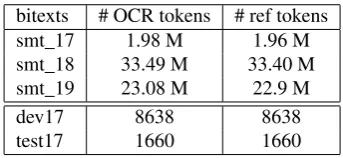
For the training of our models, we used a corpus of nearly 60 million OCR output words obtained from scanned doc-uments, developed by Afli et al. (2015). The original data composes about 90 million words, but we only used texts from19th,18thand17thcenturies. We used the corrected part of this corpus to develop language model. Next, the OCR output sentences and the manually corrected version were aligned at word level and this bitext was used for our SMT error correction method. For testing, we processed 10 documents in old-style French from the17thcentury using theABBYYOCR tool and manually corrected the text out-put in order to provide a correction reference for the evalu-ation. The statistics of all corpora used in our experiments can be seen in Table 1.
1
http://www.abbyy.com/
bitexts # OCR tokens # ref tokens
smt_17 1.98 M 1.96 M
smt_18 33.49 M 33.40 M
smt_19 23.08 M 22.9 M
dev17 8638 8638
test17 1660 1660
Table 1: Statistics of MT training, development and test data available to build our systems.
4.2.
Testing the Models
For all of the different techniques used in this paper, the lan-guage model was built using the KenLM2toolkit (Heafield, 2011) with Kneser-Ney smoothing (Kneser and Ney, 1995) and default backoff. For theSM T_cor method, an SMT system is trained on all available parallel data. Our SMT system is a phrase-based system (Koehn et al., 2003) based on the Moses SMT toolkit (Koehn et al., 2007). It is con-structed as follows. First, word alignments in both direc-tions are calculated, using GIZA++ (Gao and Vogel, 2008). Phrases are extracted using the default settings in the Moses toolkit. The parameters of our system were tuned on a development corpus, using Minimum Error Rate Training (Och, 2003).
We combined our different systems in order to test the im-pact of successive corrections using different models. Our different techniques do not always correct the same er-rors, so a combination can be beneficial. Two paths were pursued to explore the effect of the combination of the
SM T_cor and LM_cor methods. In the first one, we begin by generating the corrected output of the LM_cor
which is then processed by theSM T_corsystem. We call this combinationLM_cor+SM T_cor. In the second one, we reverse the use of the two systems and we call this com-binationSM T_cor+LM_cor.
4.3.
Results
For the evaluation, we used Word Error Rate (WER) which is derived from Levenshtein distance Levenshtein (1966). We compare results on test data of all different methods used in our experiments to the baseline results which repre-sent scores between the OCR output and the corrected ref-erence (which we callOCR-Baseline). Table 2 reports on the percentage of Correctness, Accuracy and WER of dif-ferent system outputs. The best model, using theSMT_cor
system, was able to decrease nearly 3% of the OCR word errors with 12.99% relative improvement.
It can also be observed that the LM_cor and the Sus_cor systems did not improve the results in this task of cor-recting errors in OCR-ed historical documents. The fail-ure to find a proper correction using these two systems was generally due to words from the 17th century that were changed in the18thor19thcenturies. As our train-ing data are almost are from 18th and 19th centuries, the language modelling methodology can even introduce more errors when correcting test data from 17th century. This observation is confirmed by the combination of the
2
% Relative Errors
Systems Correctness Accuracy WER improvement % Insertion % Deletion % Substitution
OCR-Baseline 81.14 77.59 22.41 - - 15.86 12.90 71.23
LM_cor 79.22 75.66 24.34 - 8.61 14.60 11.88 73.51
Sus_cor 79.76 77.05 22.95 - 2.41 11.81 12.33 75.85
SMT_cor 83.92 80.48 19.52 + 12.99 17.59 15.43 66.97
Systems Combination
LM_cor + SMT_cor 81.45 78.01 21.99 + 1.87 15.61 13.69 70.68
SMT_cor + LM_cor 81.87 78.43 21.57 + 3.74 15.92 13.96 78.43
Sus_cor+ SMT_cor 82.65 79.94 20.06 + 10.48 13.51 12.91 73.57
Table 2: Percentage of Relative improvement, WER, Accuracy and Correctness results of our System Correction on test17.
best model (SMT_cor) with theLM_cor and theSus_cor
systems, where we can see that errors introduced by the language-modelling method decreases the overall result of theSMT_corcorrection. We anticipate that more training data in the same style of the test data would improve the correction of all proposed methods in this paper and espe-cially the language modelling methodology.
5.
Conclusion
In this paper, we have investigated the use of different post-OCR correction methods to correct errors in post-OCR-ed his-torical documents. The results show the superiority of the SMT method in the case where training data in the same style of the test data is lacking, compared to the different language modelling methods used. Our best model outper-forms the OCR-Baseline by nearly 13% relative improve-ment. Accordingly we believe that our methods can be a good way to resolve the problem of correcting OCR errors for historical texts. We plan to test these methods on other different languages and types of data.
-6.
Acknowledgments
This research is supported by Science Foundation Ireland through the TIDA Programme (Grant 14/TIDA/2384) in the ADAPT Centre (Grant 13/RC/2106) (www.adaptcentre.ie) at Dublin City University.
References
Haithem Afli, Loïc Barrault, and Holger Schwenk. OCR Error Correction Using Statistical Machine Translation.
16th International Conference on Intelligent Text Pro-cessing and Computational Linguistics, Cairo, Egypt 2015.
Youssef Bassil and Mohammad Alwani. OCR Post-Processing Error Correction Algorithm Using Google’s Online Spelling Suggestion.Journal of Emerging Trends in Computing and Information Sciences, 3:90–99, 2012.
Peter F. Brown, Vincent J. Della Pietra, Stephen A. Della Pietra, and Robert L. Mercer. The mathematics of statis-tical machine translation: parameter estimation.Comput. Linguist., 19:263–311, 1993.
Federico Fancellu, Andy Way, and Morgan O’Brien. Stan-dard language variety conversion for content localisa-tion via SMT. 17th Annual Conference of the Euro-pean Association for Machine Translation, pages 143– 149, Dubrovnik, Croatia 2014.
Q. Gao and S. Vogel. Parallel implementations of word alignment tool. InSoftware Engineering, Testing, and Quality Assurance for Natural Language Processing, SETQA-NLP ’08, pages 49–57, in Columbus, Ohio, USA 2008.
Kenneth Heafield. Kenlm: Faster and smaller language model queries. InProceedings of the 6th Workshop on Statistical Machine Translation, pages 187–197, Edin-burgh, Scotland, UK, 2011.
Tao Hong. Degraded Text Recognition Using Visual and Linguistic Context. PhD thesis, University of New York, NY, USA 1995.
Reinhard Kneser and Hermann Ney. Improved backing-off for m-gram language modeling. InProceedings of the IEEE International Conference on Acoustics, Speech and Signal Processing, pages 181–184, Detroit, Michi-gan, USA, 1995.
P. Koehn, Franz J. Och, and D. Marcu. Statistical phrase-based translation. In Proceedings of the 2003 Confer-ence of the North American Chapter of the Associa-tion for ComputaAssocia-tional Linguistics on Human Language Technology, volume 1, pages 48–54, Edmonton, Canada 2003.
P. Koehn, H. Hoang, A. Birch, C. Callison-Burch, M. Fed-erico, N. Bertoldi, B. Cowan, W. Shen, C. Moran, R. Zens, C. Dyer, O. Bojar, A. Constantin, and E. Herbst. Moses: open source toolkit for statistical machine trans-lation. InProceedings of the 45th Annual Meeting of the ACL on Interactive Poster and Demonstration Sessions, pages 177–180, Prague, Czech Republic 2007.
V. I. Levenshtein. Binary codes capable of correcting dele-tions, inserdele-tions, and reversals. Soviet Physics Doklady, 10:707–710, 1966.
Lan-guage Modeling, and Shallow Morphology. In Proceed-ings of the 2006 Conference on Empirical Methods in Natural Language Processing, pages 408–414, Sydney, Australia 2006.
Eric Mays, Fred J. Damerau, and Robert L. Mercer. Context based spelling correction. Information Processing and Management, 27(5):517–522, 1991.
Kai Niklas. Unsupervised Post-Correction of OCR Errors. PhD thesis, Leibniz University Hannover, in Germany 2010.
Hisao Niwa, Kazuhiro Kayashima, and Yasuham Shimeki. Postprocessing for character recognition using keyword information. In IAPR Workshop on Machine Vision Applications, volume MVA’92, pages 519–522, Tokyo, Japan 1992.
Franz J. Och. Minimum error rate training in statistical machine translation. InProceedings of the 41st Annual Meeting on Association for Computational Linguistics, volume 1, pages 160–167, Sapporo, Japan 2003.
Franz Josef Och and Hermann Ney. Discriminative train-ing and maximum entropy models for statistical machine translation. InProceedings of the 40th Annual Meeting of the Association for Computational Linguistics (ACL), pages 295–302, Philadelphia, USA, 2002.
Ulrich Schäfer and Benjamin Weitz. Combining OCR out-puts for logical document structure markup: Technical background to the ACL 2012 contributed task. In Pro-ceedings of the ACL-2012 Special Workshop on Redis-covering 50 Years of Discoveries, pages 104–109, Jeju Island, Korea 2012.