Volume 2010, Article ID 943565,9pages doi:10.1155/2010/943565
Research Article
N
-Structures Applied to Closed Ideals in
BCH-Algebras
Young Bae Jun,
1Mehmet Ali ¨
Ozt ¨urk,
2and Eun Hwan Roh
31Department of Mathematics Education (and RINS), Gyeongsang National University,
Chinju 660-701, South Korea
2Department of Mathematics, Faculty of Arts and Sciences, Adiyaman University,
02040 Adiyaman, Turkey
3Department of Mathematics Education (and IME), Chinju National University of Education,
Chinju 660-756, South Korea
Correspondence should be addressed to Eun Hwan Roh,[email protected]
Received 28 December 2009; Revised 2 February 2010; Accepted 9 February 2010
Academic Editor: Ilya M. Spitkovsky
Copyrightq2010 Young Bae Jun et al. This is an open access article distributed under the Creative Commons Attribution License, which permits unrestricted use, distribution, and reproduction in any medium, provided the original work is properly cited.
The notions of N-subalgebras andN-closed ideals in BCH-algebras are introduced, and the relation between N-subalgebras and N-closed ideals is considered. Characterizations of N-subalgebras andN-closed ideals are provided. Using special subsets,N-subalgebras andN-closed ideals are constructed. A condition for anN-subalgebra to be anN-closed ideal is discussed. Given anN-structure, the greatestN-closed ideal which is contained in theN-structure is established.
1. Introduction
In 1, 2, Hu and Li introduced the notion of BCH-algebras which are a generalization of BCK/BCI-algebras. Ahmad 3 classified algebras, and decompositions of BCH-algebras are considered by Dudek and Thomys4. Jun et al. 5 discussed the notion of
2. Preliminaries
By a BCH-algebra we mean an algebraX,∗,0of type2,0satisfying the following axioms:
H1x∗x0,
H2x∗y0 andy∗x0 implyxy,
H3 x∗y∗z x∗z∗y
for allx, y, z∈X.
In a BCH-algebraX,the following conditions are validsee1,4.
a1x∗0x,
a2x∗00 impliesx0,
a30∗x∗y 0∗x∗0∗y,
a40∗0∗0∗x 0∗x.
A nonempty subsetSof a BCH-algebraXis called a subalgerba ofXifx∗y∈Sfor all
x, y ∈S.A nonempty subsetAof a BCH-algebraXis called a closed ideal ofX see7if it satisfies:
1 for allx∈Xx∈A⇒0∗x∈A,
2 for ally∈Xfor allx∈Ay∗x∈A⇒y∈A.
Note that every closed ideal is a subalgebra, but the converse is not truesee7. Since every closed ideal is a subalgebra, we know that any closed ideal contains the element 0.Denote by
SXandIXthe set of all subalgebras and closed ideals ofX,respectively. For any family{ai|i∈Λ}of real numbers, we define
∨{ai|i∈Λ} :
⎧ ⎨ ⎩
max{ai |i∈Λ} if Λis finite,
sup{ai|i∈Λ} otherwise,
2.1
∧{ai|i∈Λ}:
⎧ ⎨ ⎩
min{ai|i∈Λ} ifΛ is finite,
inf{ai|i∈Λ} otherwise.
2.2
3.
N
-Closed Ideals of BCH-Algebras
Denote byFX,−1,0 the collection of functions from a set X to−1,0.We say that an element ofFX,−1,0is a negative-valued function fromX to−1,0 briefly,N-function on X. By anN-structure we mean an ordered pairX, μofXand anN-functionμonX.In what follows, letXdenote a BCH-algebra andμanN-function onXunless otherwise specified.
For anyN-structureX, μandt∈−1,0,the set
Cμ;t:x∈X|μx≤t 3.1
Using the similar method to the transfer principle in fuzzy theorysee8,9, we can consider transfer principle inN-structures. LetAbe a subset ofXand satisfy the following propertyPexpressed by a first-order formula:
P: t1
x, . . . , y∈A, . . . , tnx, . . . , y∈A
tx, . . . , y∈A , 3.2
where t1x, . . . , y, . . . , tnx, . . . , y and tx, . . . , y are terms of X constructed by variables
x, . . . , y. We note that the subset A satisfies the property P if, for all elements a, . . . , b ∈
X, ta, . . . , b ∈ Awhenevert1a, . . . , b, . . . , cna, . . . , b ∈ A.For the subsetAwe define an
N-structureX, μAwhich satisfies the following property
P:μAtx, . . . , y≤ ∨μAt1
x, . . . , y, . . . μAtnx, . . . , y. 3.3
We establish a statement without proof, and we call itN-transfer principle inN-structures.
Theorem 3.1. (N-transfer principle) AnN-structureX, μsatisfies the propertyPif and only if for allα∈−1,0,
Cμ;α/∅⇒Cμ;α satisfies the propertyP. 3.4
Definition 3.2. By anN-subalgebra ofXwe mean anN-structureX, μin whichμsatisfies:
∀x, y∈X μx∗y≤ ∨μx, μy. 3.5
Theorem 3.3. For anN-structureX, μ,the following are equivalent:
1 X, μis anN-subalgerba ofX;
2 for allt∈−1,0Cμ;t∈ SX∪ {∅}.
Proof. It follows from theN-transfer principle.
Definition 3.4. By anN-closed ideal ofXwe mean anN-structureX, μin whichμsatisfies:
∀x, y∈X μ0∗x≤μx≤ ∨μx∗y, μy. 3.6
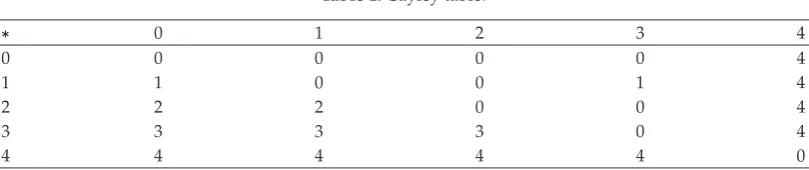
Table 1: Cayley table.
∗ 0 1 2 3 4
0 0 0 0 0 4
1 1 0 0 1 4
2 2 2 0 0 4
3 3 3 3 0 4
4 4 4 4 4 0
Theorem 3.5. EveryN-closed ideal is anN-subalgebra.
Proof. LetX, μbe anN-closed ideal ofX.For anyx, y∈X,we have
μx∗y≤ ∨μx∗y∗x, μx ∨μx∗x∗y, μx ∨μ0∗y, μx
≤ ∨μx, μy.
3.7
HenceX, μis anN-subalgebra ofX.
The converse ofTheorem 3.5may not be true as seen in the following example.
Example 3.6. Consider a BCH-algebraX {0,1,2,3,4}with the Cayley table which is given inTable 1see7. LetX, μbe anN-structure in whichμis given by
μ 0 1 2 3 4
−0.8 −0.3 −0.3 −0.3 −0.8
. 3.8
It is easy to check thatX, μis anN-subalgebra ofXbut it is not anN-closed ideal ofXsince
μ3 −0.3>−0.8∨{μ3∗4, μ4}.
In order to discuss the converse of Theorem 3.5 we need to strengthen some conditions. We first consider the following lemma.
Lemma 3.7. EveryN-subalgebraX, μofXsatisfies the following inequality:
∀x∈X μx≥μ0∗x. 3.9
Proof. For anyx∈X,we get
μ0∗x≤ ∨μ0, μx∨μx∗x, μx
∨∨μx, μx, μxμx, 3.10
Theorem 3.8. If anN-subalgerbaX, μsatisfies
∀x, y∈X μy≤ ∨μy∗x, μx, 3.11
thenX, μis anN-closed ideal ofX.
Proof. It is straightforward byLemma 3.7.
Proposition 3.9. LetX, μbe anN-closed ideal ofXthat satisfies the following inequality
∀x∈X μx≤μ0∗x. 3.12
ThenX, μsatisfies the inequality
∀x, y∈X μy∗x≤μx∗y. 3.13
Proof. Using3.12,3.6,a3,H1, andH3, we have
μy∗x≤μ0∗y∗x
≤ ∨μ0∗y∗x∗x∗y, μx∗y
∨μ0∗y∗0∗x∗x∗y, μx∗y
∨μ0∗y∗x∗y∗0∗x, μx∗y
∨μ0∗x∗y∗y∗0∗x, μx∗y
∨μ0∗x∗0∗y∗0∗x∗y, μx∗y
∨μ0∗0∗y∗y, μx∗y
∨μ0, μx∗yμx∗y
3.14
for allx, y∈X.
Using theN-transfer principle, we have a characterization of anN-closed ideal.
Theorem 3.10. For anN-structureX, μ,the following are equivalent: 1 X, μis anN-closed ideal ofX.
2 for allt∈−1,0Cμ;t∈ IX∪ {∅}.
Consider two subsets ofXas follows:
D1:{x∈X|0∗x0}, D2:{x∈X|0∗0∗x x}. 3.15
Theorem 3.11. LetX, μbe anN-structure in whichμis given by
μx ⎧ ⎨ ⎩
α ifx∈D1,
β otherwise
3.16
for allx∈Xwhereα < β.ThenX, μis anN-closed ideal ofX.
Theorem 3.12. LetX, μbe anN-structure in whichμis given by
μx ⎧ ⎨ ⎩
α ifx∈D2,
β otherwise
3.17
for allx∈Xwhereα < β.ThenX, μis anN-subalgebra ofX.
We provide a condition for anN-subalgebra to be anN-closed ideal.
Theorem 3.13. LetX, μbe anN-subalgebra ofXin whichμsatisfies
∀x, y∈X μy∗x≥μx∗y. 3.18
ThenX, μis anN-closed ideal ofX.
Proof. Takingx0 in3.18inducesμ0∗y≤μy∗0 μyfor ally∈X.Usinga1,3.18,
H1,H3, and3.5, we have
μyμy∗0≤μ0∗y
μx∗x∗yμx∗y∗x
≤ ∨μx∗y, μx≤ ∨μy∗x, μx
3.19
for allx, y∈X.ThereforeX, μis anN-closed ideal ofX.
For anyN-structureX, μand any elementw∈X,we consider the set
Xw:x∈X|μx≤μw. 3.20
Theorem 3.14. If anN-structureX, μis anN-closed ideal ofX,thenXwis a closed ideal ofXfor
allw∈X.
Proof. Ifx ∈ Xw,then μx ≤ μwwhich implies from3.6thatμ0∗x ≤ μx ≤ μw. Thus 0∗x ∈Xw.Letx, y ∈X be such thaty∈ Xwandx∗y ∈Xw.Thenμy ≤μwand
μx∗y≤μw.Using3.6, we have
μx≤ ∨μx∗y, μy≤μw, i.e., x∈Xw. 3.21
ThereforeXwis a closed ideal ofX.
Proposition 3.15. LetX, μbe anN-structure such thatXw is a closed ideal ofXfor allw ∈ X. ThenX, μsatisfies the following assertion:
μx≥ ∨μy∗z, μz⇒μx≥μy 3.22
for allx, y, z∈X.
Proof. Letx, y, z ∈ X be such thatμx ≥ ∨{μy∗z, μz}.Theny∗z ∈ Xx andz ∈ Xx. SinceXxis a closed ideal ofX,it follows thaty∈Xxso thatμy≤μx.This completes the proof.
Theorem 3.16. If anN-structureX, μsatisfies3.22andμ0∗x≤μxfor allx∈X,thenXw
is a closed ideal ofXfor allw∈X.
Proof. For eachw∈X,letx, y∈Xbe such thatx∗y∈Xwandy∈Xw.Thenμx∗y≤μw and μy ≤ μw,which imply that ∨{μx∗y, μy} ≤ μw.It follows from3.22 that
μx≤ μwso thatx∈ Xw.Ifx ∈Xw,thenμ0∗x ≤μx≤ μwby assumption. Hence 0∗x∈Xw.ThereforeXwis a closed ideal ofX.
Theorem 3.17. Given anN-structureX, μ,letX, μ∗be anN-structure in whichμ∗is defined by
μ∗x ∧t∈−1,0|x∈Cμ;t 3.23
for allx ∈ X. ThenX, μ∗is the greatestN-closed ideal ofX such thatX, μ∗ ⊆ X, μ,where
Cμ;tis a closed ideal ofXgenerated byCμ;t.
Proof. For anys∈Imμ∗,letsn s 1/nfor anyn∈N.Letx∈Cμ∗;s.Thenμ∗x≤s, and so
∧t∈−1,0|x∈Cμ;t≤s < s 1
n sn 3.24
x∈ n∈NCμ;sn, .On the other hand, ifx∈n∈NCμ;sn, ,thensn ∈ {t∈ −1,0|x ∈
Cμ;t}for anyn∈N.Therefore
μ∗x ∧t∈−1,0|x∈Cμ;t≤s
ns1n 3.25
for alln∈N.Sincenis arbitrary, it follows thatμ∗x≤sso thatx∈Cμ∗;s.ThusCμ∗;s
n∈NCμ;sn,which is a closed ideal ofX.UsingTheorem 3.10, we conclude thatX, μ∗is anN-closed ideal ofX.For anyx∈X,let
s∈t∈−1,0|x∈Cμ;t. 3.26
Thenx∈Cμ;sand thusx∈ Cμ;s.It follows that
s∈t∈−1,0|x∈Cμ;t 3.27
so that{t∈−1,0|x∈Cμ;t} ⊆ {t∈−1,0|x∈ Cμ;t}.Hence
μx ∧t∈−1,0|x∈Cμ;t
≥ ∧t∈−1,0|x∈Cμ;t
μ∗x,
3.28
and soX, μ∗⊆X, μ.Finally, letX, νbe anN-closed ideal ofXsuch thatX, ν⊆X, μ. Let x ∈ X.If μ∗x 0, then clearly νx ≤ μ∗x.Assume that μ∗x s /0.Thenx ∈
Cμ∗;s
n∈NCμ;sn,and sox∈ Cμ;snfor alln∈N.It follows thatνx ≤μx ≤
sn s 1/nfor alln ∈ Nso thatνx ≤ s μ∗xsince nis arbitrary. This shows that
X, ν⊆X, μ∗.This completes the proof.
Acknowledgments
The authors wish to thank the anonymous reviewers for their valuable suggestions. The first author was supported by the fund of sabbatical year program2009, Gyeongsang National University.
References
1 Q. P. Hu and X. Li, “On BCH-algebras,” Mathematics Seminar Notes. Kobe University, vol. 11, no. 2, part 2, pp. 313–320, 1983.
2 Q. P. Hu and X. Li, “On proper BCH-algebras,” Mathematica Japonica, vol. 30, no. 4, pp. 659–661, 1985. 3 B. Ahmad, “On classification of BCH-algebras,” Mathematica Japonica, vol. 35, no. 5, pp. 801–804, 1990. 4 W. A. Dudek and J. Thomys, “On decompositions of BCH-algebras,” Mathematica Japonica, vol. 35, no.
6, pp. 1131–1138, 1990.
5 Y. B. Jun, K. J. Lee, and S. Z. Song, “N-ideals of BCK/BCI-algebras,” The Journal of Chungcheong
Mathematical Society, vol. 22, pp. 417–437, 2009.
7 M. A. Chaudhry, “On BCH-algebras,” Mathematica Japonica, vol. 36, no. 4, pp. 665–676, 1991.
8 Y. B. Jun and M. Kondo, “On transfer principle of fuzzy BCK/BCI-algebras,” Scientiae Mathematicae
Japonicae, vol. 59, no. 1, pp. 35–40, 2004.