Annotating Discourse Connectives And Their Arguments
Eleni Miltsakaki
University of Pennsylvania
Philadelphia, PA 19104 USA
[email protected]
Rashmi Prasad
University of Pennsylvania
Philadelphia, PA 19104 USA
[email protected]
Aravind Joshi
University of Pennsylvania
Philadelphia, PA 19104 USA
[email protected]
Bonnie Webber
University of Edinburgh
Edinburgh, EH8 9LW Scotland
[email protected]
Abstract
This paper describes a new, large scale discourse-level annotation project – the Penn Discourse TreeBank (PDTB). We present an approach to annotating a level of discourse structure that is based on identifying discourse connectives and their arguments. The PDTB is being built directly on top of the Penn Tree-Bank and Propbank, thus supporting the extrac-tion of useful syntactic and semantic features and providing a richer substrate for the devel-opment and evaluation of practical algorithms. We provide a detailed preliminary analysis of inter-annotator agreement – both the level of agreement and the types of inter-annotator vari-ation.
1
Introduction
Large scale annotated corpora have played a critical role in speech and natural language research. The Penn Tree-Bank (PTB) is an example of such a resource with world-wide impact on natural language processing (Marcus et al., 1993). However, the PTB deals with text only at the sentence level: with the demand for more power-ful NLP applications comes a need for greater richness in annotation. At the sentence level, Penn Propbank is adding predicate-argument annotation to sentences in PTB (Kingsbury and Palmer, 2002). At the discourse-level are efforts to produce corpora annotated with rhetor-ical relations (Carlson et al., 2003). This paper describes a more basic discourse-level annotation project – the Penn Discourse TreeBank (PDTB) – that aims to produce a large-scale corpus in which discourse connectives are annotated, along with their arguments.
There have been several approaches to describing dis-course in terms of disdis-course relations (Mann and Thomp-son, 1988; Asher and Lascarides, 1998; Polanyi and
van den Berg, 1996). In these approaches, the additional meaning the discourse contributes beyond the sentence derives from discourse relations. Specification of the dis-course relations for a disdis-course thus constitutes a descrip-tion of a certain level of discourse structure.
Rather than starting from (abstract) discourse rela-tions, we describe an approach to annotating a large-scale corpus in terms of a more basic characterisation of discourse structure in terms of discourse connectives and their arguments. The motivation for such an ap-proach stems from work by Webber and Joshi (1998), Webber et al. (1999a), Webber et al. (2000) which inte-grates sentence level structures with discourse level struc-ture (using tree-adjoining grammars for both cases, LTAG and DLTAG, respectively).1 This allows structural com-position and its associated semantic comcom-position at the sentence level to be smoothly carried over to the dis-course level, a goal also shared by Gardent (1997), Schilder (1997) and Polanyi and van den Berg (1996), among others.2
Discourse connectives and their arguments can be suc-cessfully annotated with high reliability (cf. Section 4). This is not surprising, given that the task resem-bles that of annotating verbs and their arguments at the sentence level (Kingsbury and Palmer, 2002). In fact, we use a fine-grained, lexically grounded annota-tion in which argument labels are specific to the
dis-1
In the PDTB annotations, we have deliberately adopted a policy to make the annotations independent of the DLTAG framework for two reasons: (1) to make the annotated corpus widely useful to researchers working in different frameworks and (2) to make the annotators’ task easier, thereby increasing interannotator reliability.
2
course connectives involved, in much the same way as in Kingsbury and Palmer (2002). In contrast, a recent attempt (Carlson et al., 2003) at using RST-type rela-tions for annotating a much smaller corpus has already revealed difficulties involved in reliably annotating more abstract discourse relations. Moreover, this type of anno-tation does not contain any record of the basis on which a relation was assigned.
The paper is organized as follows. Section 2 provides a brief overview of the fundamental ideas that provide the basis for the design of the PDTB annotation. Section 3 gives a detailed description of the annotation project, including information about the size of the corpus, com-pleted annotations as well as annotation instructions as formulated in the guidelines. Section 4 presents data analysis based on current annotations as well as results from inter-annotator agreement. Section 5 wraps up with a summary of the work.
2
Theoretical background
The annotation project presented in this paper builds on basic ideas presented in Webber and Joshi (1998), Webber et al. (1999b) and Webber et al. (2003) – that connectives are discourse-level predicates which project predicate-argument structure on a par with verbs at the sentence level. Webber and Joshi (1998) propose a tree-adjoining grammar for discourse (DLTAG) in which compositional aspects of discourse meaning are for-mally defined, thus teasing apart compositional from non-compositional layers of meaning. In this framework, con-nectives are grouped into natural classes depending on the structure that they project at the discourse level. Subordi-nate and coordinating conjunctions, for example, require two arguments that can be identified structurally from ad-jacent units of discourse. What Webber et al. (2003) call
anaphoric discourse connectives (some, but not all,
dis-course adverbials, such as “otherwise”, “instead”, “fur-thermore”, etc.) also require two arguments, but only one of them derives structurally. For the complete interpreta-tion of these connectives, their other argument needs to be recovered. The crucial contribution of this framework to the design of the current project is what can be seen as a bottom-up approach to discourse structure. Specifi-cally, instead of appealing to an abstract (and arbitrary) set of discourse relations whose identification involves confounding multiple sources of discourse meaning, we start with the annotation of discourse connectives and their arguments, thus exposing a clearly defined level of discourse representation.
3
Project description
The PTDB project began in November 2002. The first phase, including pilot annotations and preliminary
devel-opment of guidelines, was completed in May 2003. The PDTB is expected to be released by November 2005. In-termediate versions of the annotated corpus will be made available for receiving feedback.
The PDTB corpus will include annotations of four types of connectives: subordinating conjunctions, coor-dinating conjunctions, adverbial connectives and implicit connectives. We specify each of these types in more de-tail in Section 3.1. The final number of annotations in the corpus will amount to approximately 30,000; 10,000 implicit connectives and 20,000 annotations of the 250 explicit connectives identified in the corpus. The final version of the corpus will also contain characterizations of the semantic roles associated with the arguments of each type of connective.
In this paper we present the results of annotating 10 explicit connectives, amounting to a total of 2717 anno-tations, as well as 386 tokens of implicit connectives. The set of 10 connectives comprises the adverbial connectives ‘therefore’, ‘as a result’, ‘instead’, ‘otherwise’, ‘never-theless’, and the subordinate conjunctions ‘because’, ‘al-though’, ‘even ‘al-though’, ‘when’, and ‘so that’. In all cases, annotations have been performed by four annota-tors. While this slows down the annotation process con-siderably, the nature, significance and magnitude of the project as well as the well-known complexity of discourse annotation tasks impels us to strive for maximum relia-bility, achieved by having the task performed by multiple annotators.3
Individual annotation proceeds one connective at a time. The annotation tool WordFreak4 is used to iden-tify all instances of the given connective in the corpus, and these are then annotated independently and manu-ally by four annotators. This way, the annotators quickly gain experience with that connective and develop a better understanding of its predicate-argument characteristics. Similarly, for the annotation of implicit connectives, all instances (as specified in the guidelines, see Section 3.2) are identified one file at a time. For this task, the anno-tators are required to read the entire file so that they can make well-informed and reliable decisions about the im-plicit connectives and their arguments. In addition, after the arguments of each implicit connective have been iden-tified, the annotators provide, if possible, an explicit con-nective (or other suitable expression) that best expresses the inferred relation. As with explicit connectives, anno-tations of implicit connectives are done by four
annota-3When inter-annotator consistency has stabilized, we intend
to reduce the number of annotators to three, or maybe two at the minimum.
4
WordFreak was developed by Tom Morton at the University
tors.
Compared with Propbank’s annotation of verb predicate-argument structures, annotation of arguments of discourse predicates is different in interesting ways. Propbank annotators have to determine the number of ar-guments required by each verb. In contrast, discourse connectives exhibit a clear predicate-argument structure requiring only two arguments. The main challenge we have discovered for annotating discourse connectives is determining the extent of their arguments. Even subor-dinate conjunctions whose arguments never cross a sen-tence boundary may sometimes be the source of disagree-ment between annotators.
In what follows, we present a brief overview of the classes of connectives that we annotate, followed by highlights of the annotation manual and relevant corpus examples.
3.1 Discourse connectives
We classify discourse connectives into four classes: sub-ordinate and coordinating conjunctions, adverbials and implicit connectives. Examples of each type are given be-low, with their arguments shown in square brackets and the connectives, in italics.
3.1.1 Subordinate conjunctions
Subordinate conjunctions introduce clauses that are syntactically dependent on a main clause. The most com-mon types of relations that they express are temporal (e.g., ‘when’, ‘as soon as’), causal e.g., ‘because’), con-cessive (e.g., ‘although’, ‘even though’), purpose (e.g., ‘so that’, ‘in order that’) and conditional (e.g., ‘if’, ‘un-less). Clauses introduced with a subordinate conjunction may be preposed (or, more rarely, interposed) with re-spect to the main clause, as shown in (1).
(1) Because [the drought reduced U.S. stockpiles], [they
have more than enough storage space for their new crop], and that permits them to wait for prices to rise.
3.1.2 Coordinating conjunctions
Coordinating conjunctions are ones such as ‘and’, ‘but’, and ‘or’. Example (2) shows the annotation of an instance of the conjunction ‘and’.
(2) [William Gates and Paul Allen in 1975 developed an early language-housekeeper system for PCs], and [Gates became an industry billionaire six years after IBM adapted one of these versions in 1981].
Instances of coordinating conjunctions which coordi-nate nominal or other non-clausal constituents are ex-cluded from annotation. We also exclude cases of VP-coordination because in such cases the arguments of the connective can be retrieved automatically from the syn-tactic layer.
3.1.3 Adverbial connectives
Adverbial connectives are sentence-modifying adverbs which express a discourse relation (Forbes, 2003). The class of adverbial connectives includes ‘however’, ‘there-fore’, ‘then’, ‘otherwise’, etc. In this class, we have also included prepositional phrases with a similar sentence modifying function such as ‘as a result’, ‘in addition’, ‘in fact’, etc. Example (3) shows the annotation of an instance of the adverbial connective ‘as a result’.
(3) ...[many analysts expected energy prices to rise at the consumer level too]. As a result, [many economists were expecting the consumer price index to increase significantly more than it did].
The arguments of adverbial connectives may or may not be adjacent to the sentence containing the connective. In a few cases, an argument may be found one or two paragraphs away from the connective.
3.1.4 Implicit connectives
Implicit connectives are identified between adjacent sentences with no explicit connectives.5 The annotation
of implicit connectives is intended to capture the connec-tion between two sentences appearing in adjacent posi-tions. For example, in (4), the two adjacent sentences are connected in a way similar to having the explicit nective “but” contrasting them. Indeed, for implicit con-nectives, annotators are asked to provide, when possible, an explicit connective that best describes the inferred re-lation. The explicit connective provided in (4) was ‘in contrast’.
(4) ...[The $6 billion that some 40 companies are looking to raise in the year ending March 31 compares with only $2.7 billion raised on the capital market in the previous fiscal year]. IMPLICIT-(In contrast) [In fiscal 1984 be-fore Mr. Gandhi came to power, only $810 million was raised].
3.2 Annotation guidelines
The annotation guidelines for PDTB have been revised considerably since the pilot phase of the project in May 2003. The current version of the guidelines is available at
http://www.cis.upenn.edu/∼pdtb. Below we
out-line the basic points.
3.2.1 What counts as a discourse connective?
We count as discourse connectives (1) all subordinat-ing and coordinatsubordinat-ing conjunctions, (2) certain adverbials, and (3) implicit connectives. The adverbials include only those which convey a relation between events or states. For example, in (5) ‘as a result’ conveys a cause-effect re-lation between the event of limiting the size of new steel
5There are, of course, other implicit connectives that we are
mills and that of the industry operating out of small, ex-pensive and highly inefficient units. In contrast, the se-mantic interpretation of ‘strangely’ in (6) only requires a single event/state which it classifies in the set of strange events/states.6
(5) [In the past, the socialist policies of the government strictly limited the size of new steel mills, petrochem-ical plants, car factories and other industrial concerns to conserve resources and restrict the profits businessmen could make]. As a result, industry operated out of small, expensive, highly inefficient industrial units.
(6) Strangely, conventional wisdom inside the Beltway re-gards these transfer payments as “uncontrollable” or “nondiscretionary.”
The guidelines also highlight instances of lexical items with multiple functions, only one of which is as a dis-course connective. For example, ‘when’ can either serve as a subordinate conjunction or introduce a relative clause modifying a nominal phrase, as in (7), where the when-clause modifies the nominal ‘1985’.7Here we again
ben-efit from building discourse annotation on top of Penn TreeBank because the syntactic annotation of when-clauses distinguishes the two functions: When-relatives are marked as NP-modifiers adjoining to an NP, whereas adverbial when-clauses adjoin to a sentential node.
(7) Attorneys have argued since 1985, when the law took effect.
Similarly, some since-clauses function as NP modifiers as shown in (8). In such cases, ‘since’ is not annotated as a connective. As in the case of when-clauses, instances of NP modifying since-clauses can be identified in the Penn TreeBank by virtue of their syntactic annotation.
(8) In the decade since the communist nation emerged from isolation, its burgeoning trade with the West has lifted Hong Kong’s status as a regional business partner.
Finally, implicit connectives count as connectives. They are identified between adjacent sentences which do not contain any other explicit connectives. Currently, we are not annotating implicit connectives intra-sententially, such as between the matrix clause and free adjunct in Ex-ample (9). We plan to incorporate annotations of implicit intra-sentential connectives at a later stage of the project.
(9) Second, they channel monthly mortgage payments into semiannual payments, reducing the administrative bur-den on investors.
6For a more detailed discussion of the basis for
distin-guishing discourse adverbials from clausal adverbials, see Forbes (2003).
7In cases of when-relatives, a when-clause can be annotated
as SUP (see Section 3.2.3).
3.2.2 What counts as a legal argument?
Because we take discourse relations to hold between abstract objects, we require that an argument contains at least one predicate along with its arguments. Of course, a sequence of clauses or sentences may also form a legal argument, containing multiple predicates.
Because our annotations are done directly on top of the Penn TreeBank, annotators may select as an argument certain textual spans that appear to exclude one or more arguments of the predicate. These are cases in which these arguments are directly retrievable from the syntac-tic annotation. Thus, we are able to select only the pred-icates that are required for the interpretation of the dis-course connective and simultaneously access their argu-ments for the complete interpretation of the clause while keeping the annotations of single arguments simple and maximally contiguous. In (10), for example, the relative clause is marked as one of the two arguments of the con-nective ‘even though’. The subject of the verb in the rela-tive clause is directly retrievable from the Penn TreeBank annotation. Similarly, in (11) the subject of the infinitival clause is also available from the syntactic representation.
(10) Workers described “clouds of dust” [that hung over parts of the factory] even though [exhaust fans venti-lated the air].
(11) The average maturity for funds open only to institutions, considered by some [to be a stronger indicator] because [those managers watch the market closely], reached a high point for the year – 33 days.
There are two exceptions to the requirement that an argument include a verb – these are nominal phrases that express an event or a state, and discourse deictics that denote an event or state. In (12), for example, the nominal phrase ‘fainting spells’ can be marked as a legal argument of the connective ‘when’ because the phrase expresses an event of fainting.
(12) Its symptoms include a cold sweat at the sound of de-bate, clammy hands in the face of congressional crit-icism, and [fainting spells] when [someone writes the word ”controversy.”]
Discourse deictic expressions are forms such as ‘this’ and ‘that’ that can be used to denote the interpretation of clausal textual spans from the preceding discourse. In (13), for example, ‘that’ denotes the interpretation of the sentence immediately preceding it. Our annotators are guided to make argument selections that assume that anaphoric and deictic expressions have been resolved. Thus, in (13), they are able to select ‘That’s’ as one ar-gument of the connective ‘because’.
The annotators are also informed that in some cases, an argument of a connective must be derived from the selected textual span (Webber et al., 1999a; Webber et al., 2003). This is the case for the first argument of ‘instead’ in (14), which does not include the negation, although it is contained in the selected text.8
(14) [No price for the new shares has been set]. Instead, [the companies will leave it up to the marketplace to decide].
In sum, legal arguments can be groups of sentences, single sentences (a main clause and its subordinate clauses), single clauses (tensed or non-tensed), NPs that specify events or situations, and discourse deictic expres-sions.
3.2.3 How far does an argument extend?
One particularly significant addition to the guidelines came as a result of differences among annotators as to how large a span constituted the argument of a connec-tive. During pilot annotations, annotators used three an-notation tags: CONN for the connective and ARG1 and ARG2 for the two arguments. To this set, we have added the optional tags SUP1, SUP2 (supplementary) for cases when the annotator wants to mark textual spans s/he con-siders to be useful, supplementary information for the interpretation an argument. Example (15) demonstrates the use of SUP1. Arguments are shown in square brack-ets, while spans providing supplementary information are shown in parentheses.
(15) Although [started in 1965], [Wedtech didn’t really get
rolling until 1975] (when Mr. Neuberger discovered the Federal Government’s Section 8 minority business pro-gram).
4
Data analysis
To test the reliability of the annotation, we first con-sidered the kappa statistic (Siegel and Castellan, 1988) which is used extensively in empirical studies of dis-course (Carletta, 1996). The kappa coefficient provides an inter-annotator agreement figure for any number of an-notators by measuring pairwise agreement between them and by correcting for chance expected agreement. How-ever, the statistic requires the data tokens to be classified into discrete categories, and as a result, we could not ap-ply it to our data since the PDTB annotation tokens can-not be classified as such. Rather, ancan-notation in the PDTB constitutes either selection of a span of text for the ar-guments of connectives which can be of indeterminate length or providing explicit expressions for implicit con-nectives from an open-ended class of expressions.
8For a preliminary corpus-based analysis of the arguments
of ‘instead’, see Miltsakaki et al. (2003).
Instead, we have assessed inter-annotator agreement in terms of agreement/disagreement on span or named ex-pression identity for each token as a percentage of the pairs of spans or expressions that actually matched ver-sus those that should have. For the argument annotations, we use a most conservative measure - the exact match criterion. In addition, we also used different diagnostics for the argument annotations for the explicit connectives, reporting percentage agreement on different classes of to-kens, such as those in which the first argument (ARG1) annotations and second argument (ARG2) annotations were counted independently, as well as those in which the ARG1 and ARG2 annotations (for each connective) were counted together as a single token. For all the argument annotations, the computation of agreement excluded the
supplementary annotations (cf. Section 3.2.3).
We present here agreement results on ARG1 and ARG2 annotations by two annotators for the annotation of ten explicit connectives, amounting to a total of 2717 annotations, and 368 annotations of implicit connectives, including agreement results on the explicit expression the annotators used in in place of the implicit connectives as well as the ARG1 and ARG2 annotations of the implicit connectives.9The ten explicit connectives include 5
sub-ordinating conjunctions (when, because, even though,
al-though, and so that) and 5 adverbials (nevertheless, oth-erwise, instead, therefore, and as a result).
4.1 Inter-annotator Agreement
4.1.1 Explicit connectives
For the explicit connective annotations, we used two diagnostics for measuring inter-annotator agreement. In the first diagnostic , we took the class of tokens as the to-tal number of argument annotations, treating ARG1 and ARG2 annotations as independent tokens. The total num-ber of tokens in this class is therefore twice the numnum-ber of connective tokens, i.e, 5434. We recorded agreement using the exact match criterion. That is, for any ARG1 or ARG2 token, agreement was recorded as 1 when both annotators made identical textual selections for the an-notation and 0 when the annotators made non-identical selections.
We achieved 90.2% agreement (4900/5434 tokens) on the annotations for this class. Agreement on only ARG1 tokens was 86.3%, and agreement on only ARG2 tokens was 94.1%. Further distribution of the agree-ments by connective is given in Table 1. Connectives are grouped in the table by type (subordinating conjunc-tion (SUBCONJ) and adverbial (ADV)). The second
col-9
umn gives the number of agreeing tokens for each con-nective and the third column gives the total number of (ARG1+ARG2) tokens available for that connective. The last column gives the percent agreement for the connec-tive in that row, i.e., as a percentage of tokens for which agreement was 1 (column 2) versus the total number of tokens for that connective (column 3).
CONNECTIVES AGR No. Conn. Total %AGR when 1877 2032 92.4% because 1703 1824 93.4% even though 194 206 94.1% although 635 704 90.1% so that 66 74 89.2% TOTAL SUBCONJ 4469 4834 92.4%
nevertheless 56 94 59.6% otherwise 44 46 95.7% instead 172 236 72.9% as a result 110 168 65.5% therefore 49 56 87.5% TOTAL ADV. 431 600 71.8%
[image:6.612.86.301.142.289.2]OVERALL TOTAL 4900 5434 90.2% Table 1: Distribution of Agreement by Connective, with ARG1 and ARG2 Annotations Counted Independently
The table shows that we achieved high agreement on argument annotations of subordinating conjunctions (92.4%). Average agreement on the adverbials was lower (71.8%). This difference between the two types is not sur-prising, since locating the anaphoric (ARG1) argument of adverbial connectives is believed to be a harder task than that of locating the arguments of subordinating conjunc-tions. For example, the anaphoric argument of the ad-verbial connectives may be located in some non-adjacent span of text, even several paragraphs away. Arguments of subordinating conjunctions, on the other hand, can most often be found in spans of text adjacent to the connective. The table also shows that there was uniform agreement across the different subordinating conjunctions (roughly 90%), whereas the adverbials showed more variation. In particular, agreement on otherwise and therefore was high (95.7% and 87.5% respectively), while lower for the other three adverbials, instead (72.9%), as a result (65.5%), and nevertheless (59.6%). This suggests either
greater variability in how these adverbials are interpreted
or greater complexity in their interpretation, which results in more variability when people are forced to associate an interpretation with a particular text span.
We also computed agreement using a second more conservative diagnostic in which we took the class of to-kens as the total number of connective toto-kens (2717) so that the ARG1 and ARG2 annotations for each connec-tive were treated together as part of the same token. Here again, we recorded agreement using the exact match mea-sure. That is, for any connective token, agreement was recorded as 1 when both annotators made identical
tex-tual selections for the annotation of both arguments and 0 when the annotators made non-identical selections for any one or both arguments.
We achieved 82.8% agreement (2249/2717 tokens) on the annotations for this class. Table 2 gives the distribu-tion of the agreements by connective. The table shows relatively lower agreements when compared with the first diagnostic, for both subordinating conjunctions (86%) as well as adverbials (57%). However, this difference is un-derstandable since the token class as defined for this di-agnostic yields a stricter measure of agreement.
CONNECTIVES AGR No. Conn. Total %AGR when 868 1016 86.4% because 804 912 88.2% even though 91 103 88.3% although 288 352 81.8% so that 27 34 79.4% TOTAL SUBCONJ 2078 2417 86.0%
nevertheless 18 47 38.3% otherwise 21 23 91.3% instead 72 118 61.0% as a result 38 84 45.2% therefore 22 28 78.6% TOTAL ADV. 171 300 57.0%
OVERALL TOTAL 2249 2717 82.8% Table 2: Distribution of Agreement by Connective, with ARG1 and ARG2 Annotations Counted Together
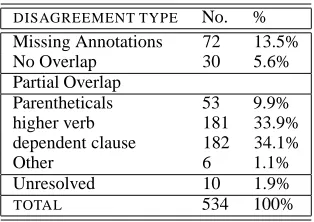
We classified disagreements into 4 major types. The result of classifying the 534 disagreements from Diag-nostic 1 (Table 1) is given in Table 3. The third column gives the percent of the total disagreements for each type.
DISAGREEMENT TYPE No. % Missing Annotations 72 13.5% No Overlap 30 5.6% Partial Overlap
Parentheticals 53 9.9% higher verb 181 33.9% dependent clause 182 34.1%
Other 6 1.1%
Unresolved 10 1.9%
[image:6.612.326.542.190.336.2]TOTAL 534 100%
Table 3: Disagreement Classification
The majority of disagreements (79%) were due to
Partial Overlap, which subsumes the categories Higher Verb, Dependent Clause, Parenthetical and Other. Par-tial Overlap means that there was parPar-tial overlap in the
[image:6.612.356.513.431.542.2]was selected by both, and that occurs on the left or right periphery of the common text. Parenthetical means
that one of the annotators included a medial parentheti-cal, while the other did not. The intervening text could be the main as well as the dependent clause. An example is provided below:
(16) Bankers said [warrants for Hong Kong stocks are at-tractive] because [they give foreign investors], wary of volatility in the colony’s stock market, [an opportunity to buy shares without taking too great a risk].
(17) Bankers said [warrants for Hong Kong stocks are at-tractive] because [they give foreign investors, wary of volatility in the colony’s stock market, an opportunity to buy shares without taking too great a risk].
Other included tokens with partial overlap between
an-notations, but in addition included a combination of more than type, such as higher verb+dependent clause.
Note that disagreements that contain a partial over-lap could be counted as agreeing tokens if we relaxed the more conservative exact match measure to a partial
match measure. Our subjective view was that in several
cases, the “extra” textual material, especially those fit-ting the dependent clause and parenthetical category did not make any significant semantic contribution in terms of their inclusion or exclusion in the argument. With the
partial match measure, excluding these cases reduces the
disagreements to half the given number, giving us 94.5% agreement overall.
The No Overlap tokens were cases of true disagree-ment in that there was no overlap in the annotations se-lected by the annotators. These tokens constituted 5.6% of the disagreements. Examples (18) and (19) shows the two annotations for a token in which there was no over-lap in the ARG1 annotation. Missing Annotations also constituted a substantial proportion of the disagreements (13.5%) and was used for tokens where the annotation was missing for one annotator. Note that these don’t re-ally count as disagreement, since all connectives are pre-theoretically assumed to require two arguments.
Unre-solved includes tokens which have introduced new issues
for the annotation guidelines and cannot be resolved at this time. These include issues such as how to treat com-paratives, certain types of adjunct clauses, certain types of nominalizations etc.
(18) [The word ”death” cannot be escaped entirely by the industry], but salesmen dodge it wherever possible or cloak it in euphemisms, [preferring to talk about ”sav-ings” and ”investment”] instead.
(19) The word ”death” cannot be escaped entirely by the industry, but salesmen dodge it wherever possible or [cloak it in euphemisms], preferring [to talk about ”sav-ings” and ”investment”] instead.
4.1.2 Implicit connectives
For the 386 tokens of implicit connectives, we ana-lyzed inter-annotator agreement between two annotators for (a) the explicit connectives they provided in place of an implicit connective, and (b) the argument annotations of the implicit connectives.
As a preliminary step in analyzing agreement on the type of explicit connective provided by the annotators in place of an implicit connective, we considered 5 groups of connectives conveying : a) additional information (e.g., ‘furthermore’, ‘in addition’) b) cause-effect rela-tions (e.g., ‘because’, ‘as a result’), c) temporal relarela-tions (e.g., ‘then’, ‘simultaneously’), d) contrastive relations (e.g., ‘however’, ‘although’), and e) restatement or sum-marization (e.g., ‘in other words’, ‘in sum’).10 Agree-ment was then computed on these basic groups of con-nectives.11 From the total of 386 tokens of implicit
con-nectives, 9 were excluded from the analysis due to tech-nical error (missing annotation). For the remaining 307 tokens, we achieved 72% agreement on the type of ex-plicit connective that best conveyed the interpretation of the implicit connective.
For the argument annotations of the implicit connec-tives, we present agreement results from using the first diagnostic used for the explicit connectives. That is, we counted ARG1 and ARG2 annotations as independent to-kens and computed percent agreement using the exact
match criterion. On the 772 ARG1 and ARG2 tokens,
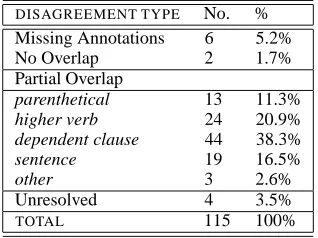
we achieved 85.1% (657/772) agreement between 2 an-notators. The analysis of the 115 disagreements is given in Table 4. Note that here again, the number of disagree-ments reduces to half using the partial match measure for the parenthetical and dependent clause classes, giving us 92.6% agreement overall.
DISAGREEMENT TYPE No. % Missing Annotations 6 5.2% No Overlap 2 1.7% Partial Overlap
parenthetical 13 11.3%
higher verb 24 20.9%
dependent clause 44 38.3%
sentence 19 16.5%
other 3 2.6%
Unresolved 4 3.5%
[image:7.612.355.514.473.592.2]TOTAL 115 100%
Table 4: Disagreement Classification for Implicit Con-nective ARG Annotations
10These groups are based on types of coherence relations
de-rived from corpus-based distributions of connectives presented in (Knott, 1996). Initially, we also considered a group of con-nectives expressing hypothetical relations but no such connec-tives were identified in the annotations.
11Some polysemous connectives such as ‘while’ and ‘in fact’
5
Summary
In this paper we presented a new and innovative discourse-level annotation project, the Penn Discourse TreeBank (PDTB), in which discourse connectives and their arguments are annotated, thereby defining a clear level of discourse structure that can be reliably annotated for a large corpus. Our inter-annotator results confirm our expectations of high agreement and annotation reliability. At a later stage of the project, we plan to provide seman-tic characterizations of the arguments of connectives and resolve any cases of polysemy that might arise.
Acknowledgments
We are very grateful to Tom Morton and Jeremy Lacivita for the development and special modification of the
WordFreak annotation tool. Special thanks to Jeremy for
providing continuous technical support. Thanks are also due to our annotators, Cassie Creswell, Driya Amandita, John Laury, Emily Pawley, Alan Lee, Alex Derenzy and Steve Pettington. Also, many thanks to Katherine Forbes Riley and Jean Carletta for their comments and sugges-tions. Finally, we would like to thank the reviewers for their very useful comments. This work was partially sup-ported by NSF Grant EIA 02-24417.
References
Nicholas Asher and Alex Lascarides. 1998. The seman-tics and pragmaseman-tics of presupposition. Journal of
Se-mantics, 15(3):239–300.
Jean Carletta. 1996. Assessing agreement on classifica-tion tasks. Computaclassifica-tional Linguistics, 22:249–254.
Lynn Carlson, Daniel Marcu, and Mary Ellen Okurowski, 2003. Current Directions in Discourse and Dialogue, chapter Building a Discourse-Tagged Corpus in the Framework of Rhetorical Structure Theory. Kluwer Academic Publishers.
Kate Forbes. 2003. Discourse Semantics of S-Modifying
Adverbials. Ph.D. thesis, Department of Linguistics,
University of Pennsylvania.
Claire Gardent. 1997. Discourse tree adjoining gram-mars. Claus 89, University of the Saarlandes, Saar-brucken.
Paul Kingsbury and Martha Palmer. 2002. From Tree-bank to PropTree-bank. In Third International
Confer-ence on Language Resources and Evaluation, LREC-02, Las Palmas, Canary Islands, Spain.
Alistair Knott. 1996. A Data-Driven Methodology for
Motivating a Set of Coherence Relations. Ph.D. thesis,
University of Edinburgh.
William Mann and Sandra Thompson. 1988. Rhetori-cal structure theory. toward a functional theory of text organization. Text, 8(3):243–281.
Mitch Marcus, Beatrice Santorini, and Mary Ann Marcinkiewicz. 1993. Building a large annotated cor-pus of english: the Penn Treebank. Computational
Linguistics, 19:313–330.
Eleni Miltsakaki, Cassandre Creswell, Kate Forbes, Ar-avind Joshi, and Bonnie Webber. 2003. Anaphoric arguments of discourse connectives: Semantic prop-erties of antecedents versus non-antecedents. In
Pro-ceedings of the Computational Treatment of Anaphora Workshop, EACL 2003, Budapest.
Livia Polanyi and Martin van den Berg. 1996. Discourse structure and discourse interpretation. In Proceedings
of the Tenth Amsterdam Colloquium, University of Am-sterdam, pages 113–131.
Frank Schilder. 1997. Discourse tree grammar or how to get attached to a discourse? In Proceedings of the
the second International Workshop on Computational Semantics (IWCS-II), Tilburg, The Netherlands, pages
261–273.
Sidney Siegel and N. J. Castellan. 1988.
Nonparama-teric Statistics for the Behavioral Sciences.
McGraw-Hill, 2nd edition.
Bonnie Webber and Aravind Joshi. 1998. Anchoring a lexicalized tree adjoining grammar for discourse. In
ACL/COLING Workshop on Discourse Relations and Discourse Markers, Montreal, pages 8–92. Montreal,
Canada.
Bonnie Webber, Alistair Knott, Matthew Stone, and Ar-avind Joshi. 1999a. Discourse relations: A struc-tural and presuppositional account using lexicalized TAG. In Proceedings of the 37th Annual Meeting of
the Association for Computational Linguistics, Mary-land, pages 41–48. College Park MD.
Bonnie Webber, Alistair Knott, Matthew Stone, and Ar-avind Joshi. 1999b. What are little texts made of? A structural and presuppositional account using lexical-ized TAG. In Proceedings of the International
Work-shop on Levels of Representation in Discourse (LORID ’99), Edinburgh, pages 145–149.
Bonnie Webber, Alistair Knott, and Aravind Joshi. 2000. Multiple discourse connectives in a lexicalized gram-mar for discourse. In Proceedings of the Third
Interna-tional Workshop on ComputaInterna-tional Semantics, Tilburg,
The Netherlands.
Bonnie Webber, Matthew Stone, Aravind Joshi, and Al-istair Knott. 2003. Anaphora and discourse structure.