Syntactic Scope Resolution in Uncertainty Analysis
Lilja Øvrelid♠♣ and Erik Velldal♣ and Stephan Oepen♣ ♣University of Oslo, Department of Informatics
♠Universität Potsdam, Institut für Linguistik
[email protected] and [email protected] and [email protected]
Abstract
We show how the use of syntactic struc-ture enables the resolution of hedge scope in a hybrid, two-stage approach to un-certainty analysis. In the first stage, a Maximum Entropy classifier, combining surface-oriented and syntactic features, identifies cue words. With a small set of hand-crafted rules operating over depen-dency representations in stage two, we at-tain the best overall result (in terms of both combined ranks and average F1) in
the 2010CoNLLShared Task.
1 Background—Motivation
Recent years have witnessed an increased interest in the analysis of various aspects of sentiment in natural language (Pang & Lee, 2008). The sub-task of hedge resolution deals with the analysis of uncertainty as expressed in natural language, and the linguistic means (so-called hedges) by which speculation or uncertainty are expressed. Infor-mation of this kind is of importance for various mining tasks which aim at extracting factual data. Example (1), taken from the BioScope corpus (Vincze, Szarvas, Farkas, Móra, & Csirik, 2008), shows a sentence where uncertainty is signaled by the modal verb may.1
(1) {The unknown amino acidhmayibe used by these species}.
The topic of the Shared Task at the 2010 Con-ference for Natural Language Learning (CoNLL) is hedge detection in biomedical literature—in a sense ‘zooming in’ on one particular aspect of the broader BioNLP Shared Task in 2009 (Kim, Ohta, Pyysalo, Kano, & Tsujii, 2009). It involves two subtasks: Task 1 is described as learning to detect
1
In examples throughout this paper, angle brackets high-light hedge cues, and curly braces indicate the scope of a given cue, as annotated in BioScope.
sentences containing uncertainty; the objective of Task 2 is learning to resolve the in-sentence scope of hedge cues (Farkas, Vincze, Mora, Csirik, & Szarvas, 2010). The organizers further suggest: This task falls within the scope of semantic analy-sis of sentences exploiting syntactic patterns [...]. The utility of syntactic information within var-ious approaches to sentiment analysis in natu-ral language has been an issue of some debate (Wilson, Wiebe, & Hwa, 2006; Ng, Dasgupta, & Arifin, 2006), and the potential contribution of syntax clearly varies with the specifics of the task. Previous work in the hedging realm has largely been concerned with cue detection, i.e. identify-ing uncertainty cues such as may in (1), which are predominantly individual tokens (Medlock & Briscoe, 2007; Kilicoglu & Bergler, 2008). There has been little previous work aimed at actually resolving the scope of such hedge cues, which presumably constitutes a somewhat different and likely more difficult problem. Morante and Daele-mans (2009) present a machine-learning approach to this task, using token-level, lexical informa-tion only. To this end,CoNLL2010 enters largely uncharted territory, and it remains to be seen (a) whether syntactic analysis indeed is a necessary component in approaching this task and, more generally, (b) to what degree the specific task setup can inform us about the strong and weak points in current approaches and technology.
In this article, we investigate the contribution of syntax to hedge resolution, by reflecting on our experience in theCoNLL2010 task.2 Our CoNLL
system submission ranked fourth (of 24) on Task 1 and third (of 15) on Task 2, for an overall best av-erage result (there appears to be very limited over-lap among top performers for the two subtasks).
2It turns out, in fact, that all the top-performing systems
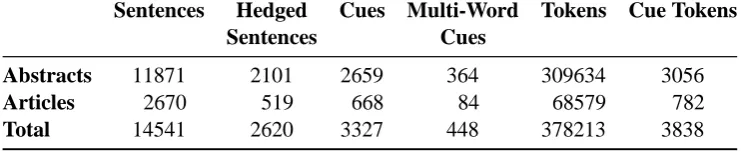
Sentences Hedged Cues Multi-Word Tokens Cue Tokens
Sentences Cues
Abstracts 11871 2101 2659 364 309634 3056
Articles 2670 519 668 84 68579 782
Total 14541 2620 3327 448 378213 3838
Table 1: Summary statistics for the Shared Task training data.
This article transcends ourCoNLLsystem descrip-tion (Velldal, Øvrelid, & Oepen, 2010) in several respects, presenting updated and improved cue de-tection results (§ 3 and § 4), focusing on the role of syntactic information rather than on machine learning specifics (§ 5 and § 6), providing an anal-ysis and discussion of Task 2 errors (§ 7), and gen-erally aiming to gauge the value of available anno-tated data and processing tools (§ 8). We present a hybrid, two-level approach for hedge resolution, where a statistical classifier detects cue words, and a small set of manually crafted rules operating over syntactic structures resolve scope. We show how syntactic information—produced by a data-driven dependency parser complemented with in-formation from a ‘deep’, hand-crafted grammar— contributes to the resolution of in-sentence scope of hedge cues, discussing various types of syn-tactic constructions and associated scope detec-tion rules in considerable detail. We furthermore present a manual error analysis, which reveals re-maining challenges in our scope resolution rules as well as several relevant idiosyncrasies of the preexisting BioScope annotation.
2 Task, Data, and System Basics
Task Definition and Evaluation Metrics
Task 1 is a binary sentence classification task: identifying utterances as being certain or uncer-tain. Following common practice, this subtask is evaluated in terms of precision, recall, and F1 for the ‘positive’ class, i.e. uncertain. In
our work, we approach Task 1 as a byproduct of the full hedge resolution problem, labeling a sentence as uncertain if it contains at least one token classified as a hedge cue. In addition to the sentence-level evaluation for Task 1, we also present precision, recall, and F1for the cue-level.
Task 2 comprises two subtasks: cue detection and scope resolution. The official CoNLL
eval-uation does not tease apart these two aspects of the problem, however: Only an exact match of both the cue and scope bracketing (in terms of substring positions) will be counted as a success, again quantified in terms of precision, recall, and F1. Discussing our results below, we report cue
detection and scope resolution performance sepa-rately, and further put scope results into perspec-tive against an upper bound based on the gold-standard cue annotation.
Besides the primary biomedical domain data, some annotated Wikipedia data was provided for Task 1, and participating systems are classi-fied as in-domain (using exclusively the domain-specific data), cross-domain (combining both types of training data), or open (utilizing addi-tional uncertainty-related resources). In our work, we focus on the interplay of syntax and the more challenging Task 2; we ignored the Wikipedia track in Task 1. Despite our using general NLP
tools (see below), our system falls into the most restrictive, in-domain category.
Training and Evaluation Data The training data for theCoNLL2010 Shared Task is taken from the BioScope corpus (Vincze et al., 2008) and consists of 14,541 ‘sentences’ (or other root-level utterances) from biomedical abstracts and articles (see Table 1).3 The BioScope corpus provides annotation for hedge cues as well as their scope. According to the annotation guidelines (Vincze et al., 2008), the annotation adheres to a principle of minimalism when it comes to hedge cues, i.e. the minimal unit expressing hedging is annotated. The inverse is true of scope annotations, which ad-here to a principle of maximal scope—meaning that scope should be set to the largest syntactic
3As it was known beforehand that evaluation would draw
ID FORM LEMMA POS FEATS HEAD DEPREL XHEAD XDEP
1 The the DT _ 4 NMOD 4 SPECDET
2 unknown unknown JJ degree:attributive 4 NMOD 4 ADJUNCT
3 amino amino JJ degree:attributive 4 NMOD 4 ADJUNCT
4 acid acid NN pers:3|case:nom|num:sg|ntype:common 5 SBJ 3 SUBJ
5 may may MD mood:ind|subcat:MODAL|tense:pres|clauseType:decl 0 ROOT 0 ROOT
6 be be VB _ 5 VC 7 PHI
7 used use VBN subcat:V-SUBJ-OBJ|vtype:main|passive:+ 6 VC 5 XCOMP
8 by by IN _ 7 LGS 9 PHI
9 these these DT deixis:proximal 10 NMOD 10 SPECDET
10 species specie NNS num:pl|pers:3|case:obl|common:count|ntype:common 8 PMOD 7 OBL-AG
11 . . . _ 5 P 0 PUNC
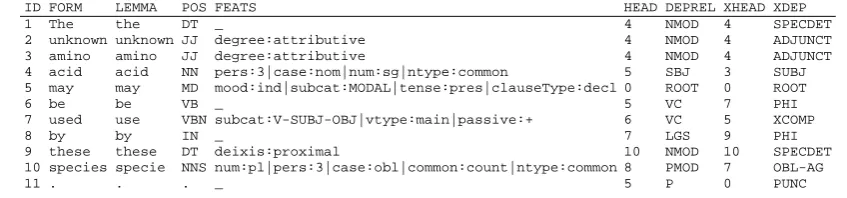
Table 2: Stacked dependency representation of example (1), with MaltParser andXLEannotations.
unit possible.
For evaluation purposes, the task organizers provided newly annotated biomedical articles, fol-lowing the same general BioScope principles. The
CoNLL 2010 evaluation data comprises 5,003 ad-ditional utterances (138,276 tokens), of which 790 are annotated as hedged. The data contains a to-tal of 1033 cues, of which 87 are so-called multi-word cues (i.e. cues spanning multiple tokens), comprising 1148 cue tokens altogether.
Stacked Dependency Parsing For syntactic analysis we employ the open-source MaltParser (Nivre, Hall, & Nilsson, 2006), a platform for data-driven dependency parsing. For improved accuracy and portability across domains and gen-res, we make our parser incorporate the pre-dictions of a large-scale, general-purpose LFG
parser—following the work of Øvrelid, Kuhn, and Spreyer (2009). A technique dubbed parser stack-ing enables the data-driven parser to learn, not only from gold standard treebank annotations, but from the output of another parser (Nivre & Mc-Donald, 2008). This technique has been shown to provide significant improvements in accuracy for both English and German (Øvrelid et al., 2009), and a similar setup employing an HPSG gram-mar has been shown to increase domain indepen-dence in data-driven dependency parsing (Zhang & Wang, 2009). The stacked parser combines two quite different approaches—data-driven de-pendency parsing and ‘deep’ parsing with a hand-crafted grammar—and thus provides us with a broad range of different types of linguistic infor-mation for the hedge resolution task.
MaltParser is based on a deterministic pars-ing strategy in combination with treebank-induced classifiers for predicting parse transitions. It sup-ports a rich feature representation of the parse
his-tory in order to guide parsing and may easily be extended to take additional features into account. The procedure to enable the data-driven parser to learn from the grammar-driven parser is quite simple. We parse a treebank with the XLE plat-form (Crouch et al., 2008) and the English gram-mar developed within the ParGram project (Butt, Dyvik, King, Masuichi, & Rohrer, 2002). We then convert theLFGoutput to dependency struc-tures, so that we have two parallel versions of the treebank—one gold standard and one with LFG
annotation. We extend the gold standard treebank with additional information from the correspond-ingLFGanalysis and train MaltParser on the en-hanced data set.
Table 2 shows the enhanced dependency rep-resentation of example (1) above, taken from the training data. For each token, the parsed data con-tains information on the word form, lemma, and part of speech (PoS), as well as on the head and dependency relation in columns 6 and 7. The addedXLEinformation resides in theF E A T S col-umn, and in the XLE-specific head and depen-dency columns 8 and 9. Parser outputs, which in turn form the basis for our scope resolution rules discussed in Section 5, also take this same form. The parser employed in this work is trained on the Wall Street Journal sections 2 – 24 of the Penn Treebank (PTB), converted to dependency format (Johansson & Nugues, 2007) and extended with
XLEfeatures, as described above. Parsing uses the arc-eager mode of MaltParser and an SVM with a polynomial kernel. When tested using 10-fold cross validation on the enhanced PTB, the parser achieves a labeled accuracy score of 89.8.
ex-pected to aid domain portability, substantial dif-ferences in domain and genre are bound to neg-atively affect syntactic analysis (Gildea, 2001). MaltParser presupposes that inputs have beenPoS
tagged, leaving room for variation in preprocess-ing. On the one hand, we aim to make parser inputs maximally similar to its training data (i.e. the conventions established in the PTB); on the other hand we wish to benefit from specialized re-sources for the biomedical domain.
The GENIA tagger (Tsuruoka et al., 2005) is particularly relevant in this respect (as could be the GENIA Treebank proper4). However, we found thatGENIAtokenization does not match the
PTB conventions in about one out of five sen-tences (for example wrongly splitting tokens like ‘390,926’ or ‘Ca(2+)’); also in tagging proper nouns, GENIA systematically deviates from the
PTB. Hence, we adapted an in-house tokenizer (using cascaded finite-state rules) to the CoNLL
task, run two PoS taggers in parallel, and eclec-tically combine annotations across the various preprocessing components—predominantly giv-ing precedence to GENIA lemmatization and PoS
hypotheses.
To assess the impact of improved, domain-adapted inputs on our hedge resolution system, we contrast two configurations: first, running the parser in the exact same manner as Øvrelid, Kuhn, and Spreyer (2010), we use TreeTagger (Schmid, 1994) and its standard model for English (trained on thePTB) for preprocessing; second, we give as inputs to the parser our refined tokenization and mergedPoStags, as described above. When eval-uating the two modes of preprocessing on the ar-ticles subset of the training data, and using gold-standard cues, our system for resolving cue scopes (presented in § 5) achieves an F1 of 66.31 with
TreeTagger inputs, and 72.30 using our refined to-kenization and tagger combination. These results underline the importance of domain adaptation for accurate syntactic analysis, and in the following we assume our hybrid in-house setup.
4Although theGENIATreebank provides syntactic
anno-tation in a form inspired by thePTB, it does not provide func-tion labels. Therefore, our procedure for converting from constituency to dependency requires non-trivial adaptation before we can investigate the effects of retraining the parser againstGENIA.
3 Stage 1: Identifying Hedge Cues
For the task of identifying hedge cues, we devel-oped a binary maximum entropy (MaxEnt) clas-sifier. The identification of cue words is used for (a) classifying sentences as certain/uncertain (Task 1), and (b) providing input to the syntac-tic rules that we later apply for resolving the in-sentence scope of the cues (Task 2). We also re-port evaluation scores for the sub-task of cue de-tection in isolation.
As annotated in the training data, it is possible for a hedge cue to span multiple tokens, e.g. as in whether or not. The majority of the multi-word cues in the training data are very infrequent, how-ever, most occurring only once, and the classifier itself is not sensitive to the notion of multi-word cues. Instead, the task of determining whether a cue word forms part of a larger multi-word cue, is performed in a separate post-processing step (ap-plying a heuristic rule targeted at only the most frequently occurring patterns of multi-word cues in the training data).
During development, we trained cue classifiers using a wide variety of feature types, both syn-tactic and surface-oriented. In the end, however, we found n-gram-based lexical features to have the greatest contribution to classifier performance. Our best-performing classifier so far (see ‘Final’ in Table 3) includes the following feature types:
n-grams over forms (up to 2 tokens to the right),
n-grams over base forms (up to 3 tokens left and right), PoS (from GENIA), subcategorization frames (fromXLE), and phrase-structural coordi-nation level (from XLE). Our CoNLL system de-scription includes more details of the various other feature types that we experimented with (Velldal et al., 2010).
4 Cue Detection Evaluation
Table 3 summarizes the performance of our Max-Ent hedge cue classifier in terms of precision, re-call and F1, computed using the official Shared
Sentence Level Cue Level
Configuration Prec Rec F1 Prec Rec F1
Baseline, Development 79.25 79.45 79.20 77.37 71.70 74.43 Final, Development 91.39 86.78 89.00 90.18 79.47 84.49 Final, Held-Out 85.61 85.06 85.33 81.97 76.41 79.10
Table 3: Isolated evaluation of the hedge cue classifier.
As theCoNLLtest data was known beforehand to consist of articles only, in 10-fold cross vali-dation for classifier development we tested exclu-sively against the articles segment, while always including all sentences from the abstracts in the training set. This corresponds to the development results in Table 3, while the held-out results are for the official Shared Task evaluation data (train-ing on all the available train(train-ing data). A model using only unigram features serves as a baseline.
5 Stage 2: Resolving Scope
Hedge scope may vary quite a lot depending on linguistic properties of the cue in question. In our approach to scope resolution we rely heavily on syntactic information, taken from the dependency structures proposed by both MaltParser andXLE, as well as on various additional features relating to specific syntactic constructions.
We constructed a small set of heuristic rules which define the scope for each cue detected in Stage 1. In developing these rules, we made use of the information provided by the guidelines for scope annotation in the BioScope corpus (Vincze et al., 2008), combined with manual inspection of the training data in order to further generalize over the phenomena discussed by Vincze et al. (2008) and work out interactions of constructions for var-ious types of cues.
The rules take as input a parsed sentence which has been further tagged with hedge cues. They operate over the dependency structures and ad-ditional features provided by the parser. Default scope is set to start at the cue word and span to the end of the sentence (modulo punctuation), and this scope also provides the baseline for the eval-uation of our rules. In the following, we discuss broad classes of rules, organized by categories of hedge cues. As there is no explicit representa-tion of phrase or clause boundaries in our
depen-dency universe, we assume a set of functions over dependency graphs, for example finding the left-or rightmost (direct) dependent of a given node, or transitively selecting left- or rightmost descen-dants.
Coordination The dependency analysis of co-ordination provided by our parser makes the first conjunct the head of the coordination. For cues that are coordinating conjunctions (PoS tag CC), such as or, we define the scope as spanning the whole coordinate structure, i.e. start scope is set to the leftmost dependent of the head of the coor-dination, e.g., roX in (2), and end scope is set to its rightmost dependent (conjunct), e.g., RNAs in (2). This analysis provides us with coordinations at various syntactic levels, such asNP and N(2),
APandAdvP, orVP(3):
(2) [...] the{roX geneshoriRNAs}recruit the entire set of MSL proteins [...]
(3) [...] the binding interfaces are more often{kepthori even reused}rather than lost in the course of evolution.
Adjectives We distinguish between adjectives (JJ) in attributive (N M O D) function and adjectives in predicative (P R D) function. Attributive adjec-tives take scope over their (nominal) head, with all its dependents, as in (4) and (5):
(4) The{hpossibleiselenocysteine residues}are shown in red, [...]
(5) Extensive analysis of the flanks failed to show any hallmarks of{hputativeitransposons that might be associated with this RAG1-like protein}, [...]
(6) Therefore,{the unknown amino acid, if it is encoded by a stop codon, ishunlikelyito exist in the current databases of microbial genomes}.
(7) For example, it is quite{hlikelyithat there exists an extremely long sequence that is entirely unique to U}.
Verbs The scope of verbal cues is a bit more complex and depends on several factors. In our rules, we distinguish passive usages from active usages, raising verbs from non-raising verbs, and the presence or absence of a subject-control em-bedding context. The scopes of both passive and raising verbs include the subject argument of their head verb, as in (8) and (9), unless it is an exple-tive pronoun, as in (10).
(8) {Interactions determined by high-throughput methods are generallyhconsideredito be less reliable than those obtained by low-throughput studies}1314 and as a consequence [...]
(9) {Genomes of plants and vertebrateshseemito be free of any recognizable Transib transposons}(Figure 1).
(10) It has been{hsuggestedithat unstructured regions of proteins are often involved in binding interactions, particularly in the case of transient interactions}77.
In the case of subject control involving a hedge cue, specifically modals, subject arguments are in-cluded in scopes where the controller heads a pas-sive construction or a raising verb, as in exam-ple (1) above, repeated here for convenience:
(11) {The unknown amino acidhmayibe used by these species}.
In general, the end scope of verbs should ex-tend over the minimal clause that contains the verb in question. In terms of dependency structures, we define the clause boundary as comprising the chain of descendants of a verb which is not inter-vened by a token with a higher attachment in the graph than the verb in question. In example (8) for instance, the sentence-level conjunction and marks the end of the clause following the cue con-sidered.
Prepositions and Adverbs Cues that are tagged as prepositions (including some complementizers) take scope over their argument, with all its de-scendants, (12). Adverbs take scope over their head with all its (non-subject) syntactic descen-dants (13).
Configuration F1
B
S
P Default, Gold Cues 45.21
Rules, Gold Cues 72.31 Rules, System Cues 64.77
B
S
E Rules, Gold Cues 66.73
Rules, System Cues 55.75
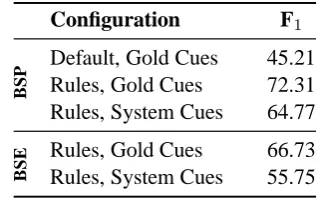
Table 4: Evaluation of scope resolution rules.
(12) {hWhetherithe codon aligned to the inframe stop codon is a nonsense codon or not}was neglected at this stage.
(13) These effects are{hprobablyimediated through the 1,25(OH)2D3 receptor}.
Multi-Word Cues In the case of multi-word cues, such as indicate that or either ... or, we need to determine the head of the multi-word unit. We then set the scope of the whole unit to the scope of the head token.
As an illustration of rule processing, consider our running example (11), with its syntactic anal-ysis as shown in Table 2 above. This example invokes a variety of syntactic properties, includ-ing parts of speech, argumenthood, voice etc. Ini-tially, the scope of the hedge cue is set to default scope. Then the subject control rule is applied, which checks the properties of the verbal argu-ment used, going through a chain of verbal depen-dents from the modal verb. Since it is marked as passive in theLFGanalysis, the start scope is set to include the subject of the cue word (the leftmost descendant in itsS B J dependent).
6 Rule Evaluation
Table 4 summarizes scope resolution performance (viewed as a an isolated subtask) for various con-figurations, both against the articles section of the
CoNLLtraining data (dubbedBSP) and against the held-out evaluation data (BSE). First of all, we note that the ‘default scope’ baseline is quite strong: unconditionally extending the scope of a cue to the end of the sentence yields an F1 of 45.21.
Given gold standard cue information, our scope rules improve on the baseline by 27 points on the articles section of the data set, for an F1of 72.31;
achieve an F1 of 64.77. Note that scope
resolu-tion scores based on classified cues also yield the end-to-end system evaluation for Task 2.
The bottom rows of Table 4 show the evaluation of scope rules on theCoNLLheld-out test data. Us-ing system cues, scope resolution on the held-out data scores at 55.75 F1. Comparing to the result
on the (articles portion of the) training data, we observe a substantial drop in performance (of six points with gold-standard cues, nine points with system cues). There are several possible explana-tions for this effect. First of all, there may well be a certain degree of overfitting of our rules to the training data. The held-out data may contain hedging constructions that are not covered by our current set of scope rules, or annotation of parallel constructions may in some cases differ in subtle ways (see § 7 below). Moreover, scope resolution performance is of course influenced by cue detec-tion (see Table 3). The cue-level F1 of our
sys-tem on the held-out data set is 79.10, compared to 84.49 (using cross validation) on the training data. This drop in cue-level performance appears to af-fect classification precision far more than recall. Of course, given that our heuristics for identifying multi-word cues were based on patterns extracted from the training data, some loss in the cue-level score was expected.
7 Error Analysis
To start shedding some light on the significance of our results, we performed a manual error anal-ysis on the article portion of the training material (BSP), with two of the authors (trained linguists) working in tandem. Using gold-standard cues, our scope resolution rules fail to exactly replicate the target annotation in 185 (of 668) cases, corre-sponding to 72.31 F1in Table 4 above. Our
eval-uators reviewed and discussed these 185 cases, classifying 156 (84 %) as genuine system errors, 22 (12 %) as likely5 annotation errors, and a
re-5
In some cases, there is no doubt that annotation is er-roneous, i.e. in violation of the available annotation guide-lines (Vincze et al., 2008) or in conflict with otherwise un-ambiguous patterns. In other cases, however, judgments are necessarily based on generalizations made by the evaluators, i.e. assumptions about the underlying system and syntactic analyses implicit in the BioScope annotations. Furthermore, selecting items for manual analysis that do not align with the
maining seven cases as involving controversial or seemingly arbitrary decisions.
The two most frequent classes of system er-rors pertain (a) to the recognition of phrase and clause boundaries and (b) to not dealing success-fully with relatively superficial properties of the text. Examples (14) and (15) illustrate the first class of errors, where in addition to the gold-standard annotation we use vertical bars (‘|’) to indicate scope predictions of our system.
(14) [...]{the reverse complement|mR of m will be hconsideredito be [...]|}
(15) This|{hmightiaffect the results}if there is a systematic bias on the composition of a protein interaction set|.
In our syntax-driven approach to scope resolution, system errors will almost always correspond to a failure in determining constituent boundaries, in a very general sense. However, specifically exam-ple (15) is indicative of a key challenge in this task, where adverbials of condition, reason, or contrast frequently attach within the dependency domain of a hedge cue, yet are rarely included in the scope annotation.
Example (16) demonstrates our second fre-quent class of system errors. One in six items in theBSP training data contains a sentence-final parenthesized element or trailing number, as for example (2), (9), or (10) above; most of these are bibliographic or other in-text references, which are never included in scope annotation. Hence, our system includes a rule to ‘back out’ from trail-ing parentheticals; in examples like (16), how-ever, syntax does not make explicit the contrast between an in-text reference vs. another type of parenthetical.
(16) More specifically,{|the bristle and leg phenotypes are hlikelyito result from reduced signaling by Dl|(and not by Ser)}.
Moving on to apparent annotation errors, the rules for inclusion (or not) of the subject in the scope of verbal hedge cues and decisions on boundaries (or internal structure) of nominals
predictions made by our scope resolution rules is likely to bias our sample, such that our estimated proportion of12 %
seem problematic—as illustrated in examples (17) to (22).6
(17) [...] and|this is also{hthoughtito be true for the full protein interaction networks we are modeling}|.
(18) [...]{Neur|hcanipromote Ser signaling|}.
(19) |Some of the domain pairs{hseemito mediate a large number of protein interactions, thus acting as reusable connectors}|.
(20) One{|hpossibleiexplanation|is functional redundancy with the mouse Neur2 gene}.
(21) [...]|redefinition of{one of them ishfeasiblei}|.
(22) |The{Bcl-2 familyhappearsito function [...]}|.
Finally, the difficult corner cases invoke non-constituent coordination, ellipsis, or NP-initial fo-cus adverbs—and of course interactions of the phenomena discussed above. Without making the syntactic structures assumed explicit, it is often very difficult to judge such items.
8 Reflections — Outlook
Our combination of stacked dependency parsing and hand-crafted scope resolution rules proved adequate for the CoNLL 2010 competition, con-firming the central role of syntax in this task. With a comparatively small set of rules (imple-mented in a few hundred lines of code), con-structed through roughly two full weeks of ef-fort (studying BioScope annotations and develop-ing rules), ourCoNLLsystem achieved an end-to-end F1 of 55.33 on Task 2.7 The two
submis-sions with better results (at 57.32 and 55.65 F1)
represent groups who have pioneered the hedge analysis task in previous years (Morante et al., 2010; Rei & Briscoe, 2010). Scores for other ‘in-domain’ participants range from 52.24 to 2.15 F1.
6
Like in the presentation of system errors, we include scope predictions of our own rules here too, which we be-lieve to be correct in these cases. Also in this class of errors, we find the occasional ‘uninteresting’ mismatch, for exam-ple related to punctuation marks and inconsistencies around parentheses.
7
In § 4 and § 6 above, we report scores for a slightly im-proved version of our system, where (after the officialCoNLL submission date) we eliminated a bug related to the treatment of sentence-initial whitespace in theXMLannotations. At an end-to-end F1of 55.75, this system would outrank the
sec-ond best performer in Task 2.
Doubtless there is room for straightforward exten-sion: for example retraining our parser on the GE-NIATreebank, further improving the cue classifier, and refining scope resolution rules in the light of the error analysis above.
At the same time, we remain mildly am-bivalent about the long-term impact of some of the specifics of the 2010 CoNLL task. Shared tasks (i.e. system bake-offs) have become increas-ingly popular in past years, and in some sub-fields (e.g.IE,SMT, or dependency parsing) high-visibility competitions can shape community re-search agendas. Hence, even at this early stage, it seems appropriate to reflect on the possible con-clusions to be drawn from the 2010 hedge res-olution task. First, we believe the harsh ‘exact substring match’ evaluation metric underestimates the degree to which current technology can solve this problem; furthermore, idiosyncratic, string-level properties (e.g. the exact treatment of punc-tuation or parentheticals) may partly obscure the interpretation of methods used and corresponding system performance.
These effects are compounded by some con-cerns about the quality of available annotation. Even though we tried fine-tuning our cross vali-dation testing to the nature of the evaluation data (comprising only articles), our system performs substantially worse on the newly annotatedCoNLL
test data, in both stages.8 In our view, the anno-tation of hedge cues and scopes ideally would be overtly related to at least some level of syntactic annotation—as would in principle be possible for the segment of BioScope drawing on the abstracts of theGENIATreebank.
Acknowledgements
We are grateful to the organizers of the 2010
CoNLLShared Task and creators of the BioScope resource; first, for engaging in these kinds of com-munity service, and second for many in-depth dis-cussions of annotation and task details. We thank our colleagues at the Universities of Oslo and Potsdam for their comments and support.
8
References
Butt, M., Dyvik, H., King, T. H., Masuichi, H., & Rohrer, C. (2002). The Parallel Grammar Project. In
Proceed-ings of COLING workshop on grammar engineering and evaluation (pp. 1 – 7). Taipei, Taiwan.
Crouch, D., Dalrymple, M., Kaplan, R., King, T., Maxwell, J., & Newman, P. (2008). XLE documentation. Palo Alto, CA. (Palo Alto Research Center)
Farkas, R., Vincze, V., Mora, G., Csirik, J., & Szarvas, G. (2010). The CoNLL 2010 Shared Task: Learning to de-tect hedges and their scope in natural language text. In
Proceedings of the 14th Conference on Natural Language Learning. Uppsala, Sweden.
Gildea, D. (2001). Corpus variation and parser perfor-mance. In Proceedings of the 2001 conference on
Empir-ical Methods in Natural Language Processing (pp. 167 –
202). Pittsburgh, PA.
Johansson, R., & Nugues, P. (2007). Extended constituent-to-dependency conversion for English. In J. Nivre, H.-J. Kaalep, & M. Koit (Eds.), Proceedings of NODALIDA
2007 (p. 105-112). Tartu, Estonia.
Kilicoglu, H., & Bergler, S. (2008). Recognizing speculative language in biomedical research articles: A linguistically motivated perspective. In Proceedings of the BioNLP
2008 Workshop. Columbus, OH, USA.
Kim, J.-D., Ohta, T., Pyysalo, S., Kano, Y., & Tsujii, J. (2009). Overview of BioNLP 2009 Shared Task on event extraction. In Proceedings of the BioNLP 2009 workshop
companion volume for shared task (pp. 1 – 9). Boulder,
CO: Association for Computational Linguistics. Medlock, B., & Briscoe, T. (2007). Weakly supervised
learn-ing for hedge classification in scientific literature. In
Pro-ceedings of the 45th Meeting of the Association for Com-putational Linguistics (pp. 992 – 999). Prague, Czech
Re-public: Association for Computational Linguistics. Morante, R., Asch, V. V., & Daelemans, W. (2010).
Memory-based resolution of in-sentence scope of hedge cues. In Proceedings of the 14th Conference on Natural
Language Learning (pp. 40 – 47). Uppsala, Sweden.
Morante, R., & Daelemans, W. (2009). Learning the scope of hedge cues in biomedical texts. In Proceedings of
the BioNLP 2009 Workshop (pp. 28 – 36). Boulder,
Col-orado.
Ng, V., Dasgupta, S., & Arifin, S. M. N. (2006). Examin-ing the role of lExamin-inguistic knowledge sources in the auto-matic identification and classification of reviews. In
Pro-ceedings of the 21st International Conference on Compu-tational Linguistics and the 44th Annual Meeting of the Association for Computational Linguistics. Sydney,
Aus-tralia.
Nivre, J., Hall, J., & Nilsson, J. (2006). MaltParser: A data-driven parser-generator for dependency parsing. In
Pro-ceedings of the Fifth International Conference on Lan-guage Resources and Evaluation (p. 2216-2219). Genoa,
Italy.
Nivre, J., & McDonald, R. (2008, June). Integrating graph-based and transition-graph-based dependency parsers. In
Pro-ceedings of the 46th Meeting of the Association for Com-putational Linguistics (pp. 950 – 958). Columbus, Ohio.
Øvrelid, L., Kuhn, J., & Spreyer, K. (2009). Improving data-driven dependency parsing using large-scale LFG
gram-mars. In Proceedings of the 47th Meeting of the
Associ-ation for ComputAssoci-ational Linguistics (pp. 37 – 40).
Singa-pore.
Øvrelid, L., Kuhn, J., & Spreyer, K. (2010). Cross-framework parser stacking for data-driven dependency parsing. TAL 2010 special issue on Machine Learning
for NLP, 50(3).
Pang, B., & Lee, L. (2008). Opinion mining and senti-ment analysis. Foundations and Trends in Information
Retrieval, 2(1-2).
Rei, M., & Briscoe, T. (2010). Combining manual rules and supervised learning for hedge cue and scope detection. In
Proceedings of the 14th Conference on Natural Language Learning (pp. 56 – 63). Uppsala, Sweden.
Schmid, H. (1994). Probabilistic part-of-speech tagging us-ing decision trees. In International conference on new
methods in language processing (p. 44-49). Manchester,
England.
Tsuruoka, Y., Tateishi, Y., Kim, J.-D., Ohta, T., McNaught, J., Ananiadou, S., et al. (2005). Developing a robust Part-of-Speech tagger for biomedical text. In Advances in
informatics (pp. 382 – 392). Berlin, Germany: Springer.
Velldal, E., Øvrelid, L., & Oepen, S. (2010). Resolving speculation: MaxEnt cue classification and dependency-based scope rules. In Proceedings of the 14th Conference
on Natural Language Learning. Uppsala, Sweden.
Vincze, V., Szarvas, G., Farkas, R., Móra, G., & Csirik, J. (2008). The BioScope corpus: Annotation for negation, uncertainty and their scope in biomedical texts. In
Pro-ceedings of the BioNLP 2008 Workshop. Columbus, OH,
USA.
Wilson, T., Wiebe, J., & Hwa, R. (2006). Recognizing strong and weak opinion clauses. Computational Intelligence,
22(2), 73 – 99.
Zhang, Y., & Wang, R. (2009). Cross-domain dependency parsing using a deep linguistic grammar. In Proceedings