Exploiting Paraphrases and Deferred Sense Commitment
to Interpret Questions more Reliably
Peter Clark and Phil Harrison
Boeing Research & Technology
{peter.e.clark,philip.harrison}@boeing.com
Abstract
Creating correct, semantic representa-tions of quesrepresenta-tions is essential for appli-cations that can use formal reasoning to answer them. However, even within a restricted domain, it is hard to anticipate all the possible ways that a question might be phrased, and engineer reliable processing modules to produce a correct semantic interpretation for the reasoner. In our work on posing questions to a bi-ology knowledge base, we address this brittleness in two ways: First, we exploit the DIRT paraphrase database to intro-duce alternative phrasings of a question; Second, we defer word sense and se-mantic role commitment until question answering. Resulting ambiguities are then resolved by interleaving additional interpretation with question-answering, allowing the combinatorics of alterna-tives to be controlled and domain knowledge to guide paraphrase and sense selection. Our evaluation suggests that the resulting system is able to un-derstand exam-style questions more re-liably.
1
Introduction
Our goal is to allow users to pose exam-style questions to a biology knowledge base (KB), containing formal representations of biological structures and processes expressed in first-order logic. As the questions typically require auto-mated reasoning to answer them, a semantic interpretation of each question is needed. In our earlier work (Clark et al, 2007), questions were interpreted using a conventional pipeline (parse,
coreference, sense and role disambiguation). However, despite moderate performance, the original ("base") system suffered from well-known problems of brittleness, arising from both premature commitments in the pipeline and the system's limited knowledge of the multiple ways that questions can be expressed. In this paper, we describe how deferred commitment and a large paraphrase database can be used to reduce these problems, drawing on prior work and applying it in the context of a large KB be-ing available. In particular, by interleavbe-ing in-terpretation and answering, we are able to con-trol the combinatorics of alternatives that would otherwise arise. An evaluation suggests that this improves the ability of the system to correctly interpret, and hence answer, questions.
2
Context and Related Work
Our system aims to interpret and answer high-school level, exam-style biology questions, ex-pressed in sentence form. Our source of answers is a formal knowledge-base and reasoning en-gine (rather than a text corpus), placing specific requirements on the interpretation process - in particular, a full semantic interpretation of the question is required. Questions are typically one or two sentences long, for example:
(1) Does a prokaryotic cell contain ribosomes? (2) A eukaryotic cell has a nucleus. Does that
nucleus contain RRNA?
(3) Is adenine found in RNA molecules? (4) Does a prokaryotic cell have a region
con-sisting of cytosol?
(5) Do ribosomes synthesize proteins in the cy-toplasm?
Interpreting and answering this style of question has a long history in NLP, both for answers found via database retrieval and formal reason-ing, and for answers extracted from a large text corpus.
For answers found using reasoning, the focus of this paper, early NL systems typically used a pipelined architecture for question interpretation (e.g., Bobrow, 1964; Woods 1977), with later systems also using semantic constraints to guide disambiguation decisions (e.g., Novak, 1977). More recently, as well as there being significant improvements in the performance of typical pipeline modules, e.g., word sense disambigua-tion (Navigli, 2009), there has been substantial work on various forms of deferred commitment, underspecification, and paraphrasing to expand the space of interpretations considered, and thus improve interpretation. Underspecified repre-sentations (e.g., van Deemter and Peters, 1996; Pinkal, 1999) allow ambiguity (in particular scope ambiguity) to be preserved in a single structure and commitments deferred until later, allowing multiple interpretations to be carried through the system. Similarly, a system can de-fer commitment by simply carrying multiple, alternative interpretations forward as individual structures, or packed together into a single structure (e.g., Alshawi and van Eijck, 1989, Bobrow et al., 2005; Kim et al., 2010a,b). Fi-nally, canonicalized representations are often used to represent (and hence carry through the system) multiple, equivalent surface forms as a single structure, e.g., normalizing active and passive forms, or alternative forms of noun modification (Rinaldi et al., 2003). All these techniques help avoid premature commitment in interpretation.
As well as avoiding early rejection of interpreta-tions in these ways, there has been substantial, recent work on expanding the space of possible interpretations considered through the use of paraphases (e.g., Sekine and Inui, 2007). Para-phrasing is based on the observation that there are many ways of saying (roughly) the same thing, and that syntatic manipulation alone is not sufficient to enumerate them all. Para-phrases aim to enumerate these additional alter-natives, and may be generated synthetically (e.g., Rinaldi et al., 2003), drawn from similar texts (e.g., from similar questions for QA,
Harabagiu et al., 2000), or mined from a corpus using machine learning techniques (e.g., Lin and Pantel, 2001). They have proved to be par-ticularly useful in the context of textual entail-ment (e.g., Bentivogli et al., 2009), and in cor-pus-based question answering (e.g., Harabagiu et al., 2003).
Our work builds on this prior work, applying and extending these ideas to the context where a formal knowledge base and reasoning engine is available. In particular, we interleave the proc-ess of expanding the space of interpretations considered (using paraphrases and deferred commitment) with the process of question an-swering (which narrows down that space by selecting interpretations supported by the KB), thus controlling the otherwise combinatorial explosion of alternatives. This makes it feasible to use the DIRT paraphrase database (12 million paraphrases) for generating a full semantic in-terpretation of the original question, extending its previous use in the semi-formal context of textual entailment (Bentivogli et al., 2009). Our use of reasoning to guide disambiguation fol-lows Hobbs et als (1993) method of "interpreta-tion as abduc"interpreta-tion", where the system searches a space of possible interpretations for one(s) that are provable from the KB, preferring those in-terpretations.
3
The Problem
Although the biology KB we are using con-tains the knowledge to answer the six earlier questions (1)-(6), only the first two are correctly answered with the original pipelined (“base”) system. For question (3):
(3) Is adenine found in RNA molecules? the system (mis-)interprets this as referring to some actual “finding” event, not recognizing that this is an alternative way of phrasing a question about physical structure. Similarly, the notion of "consisting of" in question (4) is an unexpected phrasing that the system does not understand. Questions (5) and (6) are also an-swered incorrectly by the base system due to errors in semantic role labeling during interpre-tation. In (5):
"in" is (mis-)interpreted by the language inter-preter as an is-inside(x,y) relation, while the KB itself represents this relationship as site(x,y), hence the system fails to produce the correct answer (yes). Similarly, for (6) "into" is (mis)interpreted as destination(x,y) but repre-sented in the KB as result(x,y).
Clearly, one can tweak the original interpreter to overcome these particular problems. How-ever, it is a slow, expensive process, and in gen-eral it is impossible to anticipate all such prob-lems up front. Statistical methods (e.g., Man-ning and Schutze, 1999) offer an alternative approach but one that is similarly noisy, prob-lematic for question-answering applications.
4
Solution Approach
The brittleness of the base system can be par-tially attributed to its eager commitments, ahead of specifics that might be discovered dur-ing question-answerdur-ing itself. To address this, we have modified the system in two ways. First, we have added use of paraphrases to explore additional interpretations of the question during question-answering. Second, we defer sense and semantic role disambiguation until question an-swering. As a result, part of interpretation oc-curs during answering itself: multiple interpreta-tions are tried and a commitment is made to the one(s) that produce a non-null answer. The jus-tification for this commitment is a benevolent user assumption, namely that the interpretation that “makes sense” with respect to the KB (i.e., produces a non-null answer) is the one that the user intended.
This use of question-answering to drive dis-ambiguation follows Hobbs et als. (1993) work on Interpretation as Abduction. In that frame-work, a system searches for an interpretation that is provable from the KB plus a minimal cost set of assumptions, the interpretation corre-sponding to a particular way to disambiguate the text. In our work we do a similar thing, al-though restrict the assumptions to disambigua-tion decisions and exclude assuming new knowledge, as we are dealing with questions rather than assertions (if no interpretations are provable, then we treat the answer as "no" rather than treating the unproven query as some-thing that should be asserted as true).
4.1 Paraphrases
Several paraphrase databases are now available to the NLP community1, typically built by auto-matically finding phrases that occur in distribu-tionally similar contexts (e.g., Dras et al, 2005). To date, paraphrase databases have primarily been exploited for recognizing textual entail-ment (e.g., Bentivogli et al., 2009, Clark et al, 2009), and for corpus-based question answering (e.g., Harabagiu et al., 2003). Here we use them for generating a full semantic interpretation in the context of querying a formal knowledge re-source.
We use the DIRT paraphrase database (Lin and Pantel, 2001), containing approximately 12 million automatically learned rules of the form:
IF X relation Y THEN X relation' Y
where relation is a path in the dependency tree
between constitutents X and Y, or equivalently (as we use later) a chain of literals:
{p0(x0,x1), w1(x1), …pn-1(x n-1,xn)}
where pi is the syntactic relation between
(non-prepositional) constituents xi and xi+1, and wi is
the word used for xi. An example from DIRT is:
IF X is found in Y THEN X is inside Y The condition “X is found in Y” can be ex-pressed as the chain of literals:
{ object-of(x,f), "find"(f), "in"(f,y) } The database itself is noisy, containing both good and nonsensical paraphrases. Interestingly, their use in question-answering tends to filter out most bad paraphrases, as it is rare that a nonsensical paraphrases will by chance produce an answer (i.e., the question + KB together help "triangulate" on good paraphrases). Neverthe-less, bad paraphrases can sometimes produce incorrect answers. To handle this in a practical setting, we are adding an interactive interface (outside the scope of this paper) that shows the user any paraphrases used, and allows him/her to verify/block them as desired.
4.2 Deferred Sense Commitment
A second, common cause of failure of the base system was incorrect assignment of senses and
1e.g., http://www.aclweb.org/aclwiki/index.php?
semantic relations during word sense disam-biguation (WSD) and semantic role labeling (SRL). While domain-specific terms are gener-ally reliably disambiguated, disambiguation of general terms (e.g., whether "split" denotes the concept of Separate or Divide) and semantic roles (e.g., whether "into" denotes destina-tion(x,y) or result(x,y)) is less reliable, with only limited improvement attainable through manual engineering or machine learning. The problem is compounded by a degree of subjec-tivity in the way knowledge is encoded in the KB, for example whether the KB engineer chose to conceptualize a biological object as the "agent" or "instrument" or "site" of an activ-ity is to a degree a matter of viewpoint.
To overcome this, we defer WSD and SRL commitments until question-answering itself. One can view this as a trivial form of preserving underspecification (eg. Pinkal, 1999) in the ini-tial language processing, where the words them-selves denote their possible meanings.
4.3 Algorithm and Implementation
Questions are first parsed using a broad cov-erage, phrase structure parser, followed by coreference resolution, producing an initial "syntactic" logical form, for example:
Question: Do mitotic spindles consist of hollow
microtubules?
Logical Form (LF): "mitotic-spindle"(s), "con-sist"(c), "hollow"(h), "microtubule"(m), sub-ject(c,s), "of"(c,m), modifier(m,h).
Next, rather than attempting word sense dis-ambiguation (WSD) and semantic role labeling (SRL) as would be done in the base system, the system immediately starts work on answering the question, even though a complete semantic interpretation has not yet been produced. In the process of answering, the system explores alter-native word senses, semantic roles, and para-phrases for the particular literals it is working on (described shortly), and if any are provable from the knowledge in the knowledge base then those branch(es) of the search are explored fur-ther. There are two basic steps in this process:
(a) setup: create an instance X0 of the object being universally quantified over2 (identi-fied during initial language interpretation) (b) query: for each literal in the LF with at
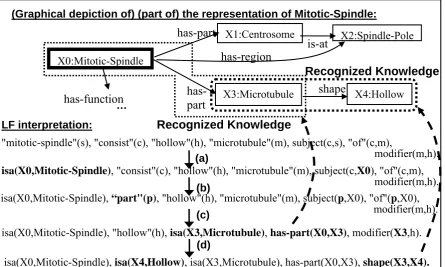
least one bound variable, iteratively query the KB to see if some interpretation of those literals are provable i.e., already known. In this example, illustrated in Figure 1, for step (a) the system first creates an instance X0 of a mitotic spindle, i.e., asserts the instantiated first literal isa(X0,Mitotic-Spindle), and then queries the inference engine with the remaining LF lit-erals. (If there are multiple senses for “mitotic spindle”, then an instance for each sense is cre-ated, to be explored in parallel). For step (b), the system uses the algorithm as follows:
repeat
select a chain Cu of “syntactic” literals in
the LF with at least 1 bound variable Cu = {p(x,y)} or {w(x)} or
{p1(x,z), w(z), p2(z,y)}
select some interpretation C of Cu where:
C is a possible interpretation of Cu
or C'u is a possible paraphrase for Cu and
C is a possible interpretation of C'u
try prove C[bindings] → new-bindings If success:
replace Cu with C
add new-bindings to bindings until
all clauses are proved where:
• A syntactic literal is a literal whose
predi-cate is a word or syntactic role (subject, ob-ject, modifier, etc.) All literals in the initial LF are syntactic literals.
• A chain of literals is a set of syntactic
liter-als in the LF of the form {p(x,y)} or {w(x)} or {p1(x,z), w(z), p2(z,y)}, where pi, w are
words or syntactic roles (subject, mod, etc).
• A possible paraphrase is a possible
substi-tution of one chain of literals with another, listed in the DIRT paraphrase database.
2If the system can prove the answer for a (new)
X0:Mitotic-Spindle
X1:Centrosome
X3:Microtubule
has-function
has-part
has-region
is-at
has-
part
X4:Hollowshape
isa(X0,Mitotic-Spindle), isa(X4,Hollow), isa(X3,Microtubule), has-part(X0,X3), shape(X3,X4). "mitotic-spindle"(s), "consist"(c), "hollow"(h), "microtubule"(m), subject(c,s), "of"(c,m),
modifier(m,h). isa(X0,Mitotic-Spindle), "consist"(c), "hollow"(h), "microtubule"(m), subject(c,X0), "of"(c,m),
modifier(m,h).
isa(X0,Mitotic-Spindle), "hollow"(h), isa(X3,Microtubule), has-part(X0,X3), modifier(X3,h). isa(X0,Mitotic-Spindle), “part"(p), "hollow"(h), "microtubule"(m), subject(p,X0), "of"(p,X0),
modifier(m,h). (a)
(b)
(c)
(d)
(Graphical depiction of) (part of) the representation of Mitotic-Spindle:
LF interpretation:
…
Figure 1: The path found through the search space for an interpretation of the example question. (a) setup (b) paraphrase substitution (IF X consists of Y THEN Y is part of X) (c) interpretation of {subject-of(X0,p),“part”(p), “of”(p,X0)} as has-part(X0,m), preferred as it is provable from the KB, resulting in m=X3 (d) interpretation of the syntactic modifier(X3,h) relation (from “hollow micro-tubule”) as shape(X3,h) as it is provable from the KB.
X2:Spindle-Pole
Recognized Knowledge
Recognized Knowledge
• A possible interpretation of the singleton
chain of literals {w(x)} is isa(x,class),
where class is a possible sense of word w.
As there are several points of non-determinism in the algorithm, e.g., which literals to select, which interpretation to explore, it is a search process. Our current implementation uses most-instantiated-first query ordering plus breadth-first search, although other implementations could traverse the space in other ways.
• A possible interpretation of a chain of
liter-als {p(x,y)} or {p1(x,z),w(z),p2(z,y)} is r(x,y), where r is a semantic relation corre-sponding to syntactic relation p (e.g., "in"(x,y) → is-inside(x,y)) or word w (e.g., {subject-of(e,h), "have"(h), "of"(h,n)} →
has-part(e,n)).
5
Evaluation
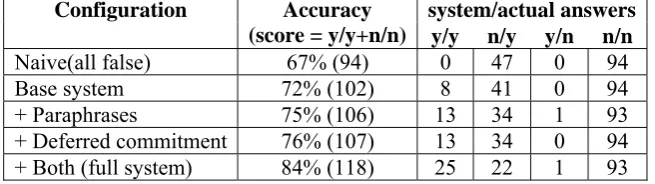
To evaluate the system, we measured its question-answering performance on a set of 141 true/false biology questions, ablating para-phrases and deferred commitment to measure their impact. The 141 questions were senten-cized versions of the multiple choice options in 22 original AP-level exam questions that, in an earlier evaluation (Clark, 2009), users had diffi-culty rephrasing into a form that the system un-derstood. Each original multiple choice option was minimally rewritten as a complete sentence (most multiple choice questions were partial se- Possible word-to-class and word-to-predicate
mappings are specified in the KB.
system/actual answers Configuration Accuracy
(score = y/y+n/n) y/y n/y y/n n/n Naive(all false) 67% (94) 0 47 0 94
Base system 72% (102) 8 41 0 94
+ Paraphrases 75% (106) 13 34 1 93
+ Deferred commitment 76% (107) 13 34 0 94 + Both (full system) 84% (118) 25 22 1 93
Table 1: Performance of different configurations of the system. The y/y column shows the number of questions for which the system answered “yes” and the correct answer is “yes”, etc.
ntences), while preserving the original Eng-lish phrasing. For example the original ques-tion:
73. Which of the following best describes the DNA molecule?
a. Two parallel strands of nitrogen bases held together by hydrogen bonding b. Two complementary strands of
deoxyri-bose and phosphates held together by hydrogen bonding
c. Two antiparallel strands of nucleotides held together by hydrogen bonding d. A single strand of nitrogen bases coiled
upon itself by hydrogen bonding
e. A single strand of nucleotides coiled into a helix.
was rewritten as five questions:
• Does a DNA molecule have two parallel strands of nitrogen bases held together by hydrogen bonding?
• Does a DNA molecule have two com-plementary strands of deoxyribose and phosphates held together by hydrogen bonding?
• Does a DNA molecule have two antipar-allel strands of nucleotides held together by hydrogen bonding?
• Does a DNA molecule have a single strand of nitrogen bases coiled upon itself by hydrogen bonding?
• Does a DNA molecule have a single strand of nucleotides coiled into a helix? Similarly:
79. All of the following organelles are associ-ated with protein synthesis EXCEPT:
a. ribosomes; b. Golgi bodies;...; e... was rewritten as five questions:
• Are ribosomes associated with protein syn-thesis?
• Are Golgi bodies associated with...etc.
For 18 of the original questions, each of the 5 options expanded to 1 true/false question. For 3 comparison questions (“Which X is in Y but not Z?”), each option expanded into 2 questions (“Is X in Y?” “Is X in Z?”). Finally 1 question involved parallelism (“Which of the following A,B,C do X,Y,Z respec-tively?”) which expanded into 21 questions (“Does A do X?” “Does A do Y?” etc.) after removing duplicates. Of the resulting 141 questions, 47 had the "gold" answer of true, 94 false. Of the 47 positives, 4 were out of scope of the reasoning engine, involving questions about possibility rather than truth, for example:
• Can a DNA adenine bond to an RNA
uracil?
Another 3 were out of scope of the knowl-edge in the KB (2 requiring unrepresented temporal knowledge and 1 requiring com-monsense knowledge). Thus the upper bound on performance, given the particular KB and reasoning engine that we are using, is 134/141 (95%).
by the only small (8) increase in number cor-rectly answered.
Paraphrases allow the system to search for alternative interpretations, adding five more questions to be answered correctly but also introducing one false positive (y/n). The false positive was for the question:
Do peroxisomes make proteins?
This was (incorrectly) answered "yes" by the system as it used a bad DIRT paraphrase (IF X makes Y THEN X is made from Y), se-lected because it led to a provable interpreta-tion (peroxisomes are made (synthesized) from proteins), but not the one the author in-tended. It is an interesting and perhaps somewhat surprising result that this was the only false positive, given that the DIRT data-base is noisy (approximately half its para-phrases are questionable or invalid). The low number of false positives appears to be due to the fact that the vast number of invalid para-phrases produce nonsensical, hence unprov-able and rejected, interpretations.
Similarly, deferred commitment (alone) al-lowed five additional questions (different to those for paraphrasing) to be answered, again as premature word sense and semantic role labeling was avoided. For example, for "...the polymerase builds a strand...", the pipeline prematurely commits to the strand being the object of the build, while in the KB it is rep-resented as the result of the build. Deferred commitment allows the system to search and find such alternatives.
Finally there were several (7) questions re-quiring both paraphrases and deferred com-mitment to answer. For example, "Do mito-chondria provide cellular energy?" was an-swered using both a paraphrase (IF X pro-vides Y THEN X creates Y) and deferred commitment (mitochondria was correctly in-terpreted as the site of the creation, as repre-sented in the KB, while the pipeline prema-turely committed to agent).
Although deferring SRL and WSD mitment, the final system still eagerly com-mits to a single syntactic analysis, and in some cases that analysis was wrong (e.g., wrong PP attachment), causing failure for some of the 16 in-scope, positive examples
that the final system failed to answer. Clearly deferred commitment can be further extended to explore alternative syntactic analyses. The remaining failures were due to incorrect se-mantic interpretation of the syntactic analysis, primarily due to poor handling of coordina-tion.
The median, average, and maximum cpu times per question were 0.7, 4.9, and 20.3 seconds respectively.
6
Discussion and Conclusion
Although question interpretation is challeng-ing, we are in the unusual position of having substantial, formal domain (biology) knowl-edge available. We have illustrated how this knowledge can be exploited to improve ques-tion understanding by interleaving interpreta-tion and answering together, allowing the DIRT paraphrase database to be feasibly used and avoiding premature sense commitment. The result is an improved understanding of the original biology questions.
Our work extends previous work (Section 2) on exploring multiple interpretations and ex-ploiting paraphrases, doing so in the context of a task involving formal reasoning. In par-ticular, by interleaving the expansion of pos-sible interpretations with reasoning (that con-tracts those alternatives), a viable system can be constructed in which the combinatorics are controlled. However, although the system defers WSD and SRL commitment, there are other sources of brittleness – in particular its commitment to a single semantic analysis – that could also benefit from exploration of alternatives, e.g., by using packed representa-tions (Bobrow et al., 2005).
in biology, they are common in other sciences (e.g., physics). Handling such questions would require extension of this approach, eg by matching a generalized form of the asser-tion X against the KB to identify how to dis-ambiguate it. Similarly, if we wished to use the system to read new knowledge, as op-posed to identify old knowledge, further ex-tensions would be needed, as new knowledge by definition cannot be proved from the KB.
Finally, this work suggests that paraphrase databases such as DIRT offer potential for language understanding in the context of pos-ing formal questions to a reasonpos-ing system or database, by bridging gaps that would other-wise have to be hand-engineered, extending their previous use in semi-formal settings such as textual entailment (Bentivogli et al., 2009). Despite noise, the question plus KB help "triangulate" on good paraphrases, and with a suitable user interface to expose their use, this work suggests that there is substan-tial potensubstan-tial for deploying them in a practi-cal, end-user environment.
Acknowledgements
We are grateful to Vulcan Inc., who funded this work as part of Project Halo.
References
Alshawi H., van Eijck, J. 1989. Logical Forms in the Core Language Engine. Proc ACL, pp25-32.
Bentivogli, L., Dagan, I., Dang, Hoa, Giampic-colo, D., Magnini, B. 2009. The Fifth PASCAL Recognizing Textual Entailment Challenge. In Proc Text Analysis Conference (TAC’09). Bobrow, D. 1964. A Question-Answering System
for High School Algebra Word Problems. AFIPS conference proceedings, 16: 591-614. Bobrow, D. G., Condoravdi, Crouch, R. Kaplan,
R. Karttunen, L., King, L.T.H., de Paiva, V., Zaenen, A. 2005. A Basic Logic for Textual In-ference. In Proceedings of the AAAI Workshop on Inference for Textual Question Answering, Pittsburgh, PA.
Chierchia, G. 1993. Questions with Quantifiers. In Natural Language Semantics 1, 181-234.
Clark, P. 2009. A Study of Some “Hard to Formu-late” Biology Questions. Working Note 33, Boeing Technical Report.
Clark, P., Chaw, J., Chaudhri, V., Harrison, P. 2007. Capturing and Answering Questions Posed to a Knowledge-Based System. In Proc. KCap 2007.
Clark, P. Harrison, P. 2009. An inference-based approach to textual entailment. In Proc TAC 2009 (Text Analysis conference).
Curtis, J., Matthews, G., Baxter, D. 2005. On the Effective Use of Cyc in a Question-Answering System. Proc Workshop on Knowledge and Reasoning for Answering Questions, IJCAI’05, pp 61-70.
Dras, M., Yamamoto, K. (Eds). 2005. Proc 3rd Internationl Workshop of Paraphrasing. South Korea.
Harabagiu, S., Moldovan, D., Pasca, M., Mihal-cea, R.,et al., 2000. FALCON: Boosting Knowledge for Answer Engines. Proc TREC'2000 (9th Text Retrieval Conf), pp 479-488.
Hobbs, J. Stickel, M., Appelt, D., Martin, P. 1993. Interpretation as Abduction. Artificial Intelli-gence 63 (1-2), pp 69-142.
Kim, D., Barker, K., Porter, B. 2010a. Building an End-to-End Text Reading System based on a Packed Representation. Proc NAACL-HLT Workshop on Machine Reading.
Kim, D., Barker, K., Porter, B. 2010b. Improving the Quality of Text Understanding by Delaying Ambiguity Resolution. Proc COLING 2010. Lin, D. and Pantel, P. 2001. Discovery of
Infer-ence Rules for Question Answering. Natural Language Engineering 7 (4) pp 343-360. Manning, C., Schutze, H. 1999. Foundations of
Statistical Natural Language Processing. MA: MIT Press.
Navigli. R. 2009. Word Sense Disambiguation: a Survey. ACM Computing Surveys, 41(2), ACM Press, pp. 1-69
Novak, G. 1977. Representations of Knowledge in a Program for Solving Physics Problems, IJCAI’77, pp. 286-291
Rinaldi, F., Dowall, J. et al., 2003. Exploiting Paraphrases in a Question Answering System. In Proc 2003 ACL Workshop on Paraphrasing (IWP 2003).
Sekine, S., Inui, K. 2007. Proc ACL-PASCAL Workshop on Textual Entailment and Para-phrasing.
van Deemter, K., Peters, S. 1996. Semantic Ambi-guity and Underspecification. CA: CSLI. Woods, W. 1977. Lunar rocks in natural English: