Synchronous Constituent Context Model for Inducing Bilingual
Synchronous Structures
Xiangyu Duan Min Zhang∗ Qiaoming Zhu
School of Computer Science & Technology, Soochow University
{xiangyuduan;minzhang;qmzhu}@suda.edu.cn
Abstract
Traditional Statistical Machine Translation (SMT) systems heuristically extract synchronous structures from word alignments, while synchronous grammar induction provides better so-lutions that can discard heuristic method and directly obtain statistically sound bilingual syn-chronous structures. This paper proposes Synsyn-chronous Constituent Context Model (SCCM) for synchronous grammar induction. The SCCM is different to all previous synchronous grammar induction systems in that the SCCM does not use the Context Free Grammars to model the bilin-gual parallel corpus, but models bilinbilin-gual constituents and contexts directly. The experiments show that valuable synchronous structures can be found by the SCCM, and the end-to-end ma-chine translation experiment shows that the SCCM improves the quality of SMT results.
1 Introduction
Traditional Statistical Machine Translation (SMT) learns translation model from bilingual corpus that is sentence aligned. No large-scale hand aligned structures inside the parallel sentences are usually available to the SMT community, while the aligned structures are essential for training the translation model. Thus, various unsupervised methods had been explored to automatically obtain aligned structures inside the parallel sentences. Currently, the dominant method is a two step pipeline that obtains word alignments by unsupervised learning (Brown et al., 1993) at the first step, then obtains aligned structures at the second step by heuristically extracting all bilingual structures that are consistent with the word alignments.
The second step in this two step pipeline is problematic due to its obtained aligned structures, whose counts are heuristically collected and violate valid translation derivations, while most SMT decoders perform translation via valid translation derivations. This problem leads to researches on synchronous grammar induction that discards the heuristic method and the two separate steps pipeline.
Synchronous grammar induction aims to directly obtain aligned structures by using one statistically sound model. The aligned structures in synchronous grammar induction are hierarchical/syntax level (Cohn and Blunsom, 2009) synchronous structures, which can be modeled by Synchronous Context Free Grammars (SCFGs) (Cohn and Blunsom, 2009; Levenberg et al., 2012; Xiao et al., 2012; Xiao and Xiong, 2013) or a kind of SCFGs variant - Inversion Transduction Grammars (ITGs) (Neubig et al., 2011; Cohn and Haffari, 2013). Both SCFGs and ITGs are studied in recent years by using generative or discriminative modeling.
This paper departs from using the above two traditional CFGs-based grammars, and proposes Syn-chronous Constituent Context Model (SCCM) which models synSyn-chronous constituents and contexts directly so that bilingual translational equivalences can be directly modeled. The proposed SCCM is inspired by researches on monolingual grammar induction, whose experience is valuable to the syn-chronous grammar induction community due to its standard evaluation on released monolingual tree-banks, while no hand annotated bilingual synchronous treebank is available for evaluating synchronous
∗
Corresponding Author
This work is licenced under a Creative Commons Attribution 4.0 International License. Page numbers and proceedings footer are added by the organizers. License details:http://creativecommons.org/licenses/by/4.0/
grammar induction. According to the evaluation results, the state-of-the-art monolingual grammar induc-tion was achieved by Bayesian modeling of the Constituent Context Model (CCM) (Duan et al., 2013; Klein and Manning, 2002), while traditional CFGs based monolingual grammar induction methods per-form well below the CCM.
In view of the significant achievements of the CCM in monolingual grammar induction, we propose the SCCM to apply the CCM to the bilingual case. The tremendous possible constituents and contexts incurred in this bilingual case put a challenge for the SCCM to model such kind of sparse variables. We further propose a non-parametric Bayesian Modeling of the SCCM to cope with the sparse variables. Experiments on Chinese-English machine translation show that meaningful synchronous phrases can be detected by our SCCM, and the performance of the end-to-end SMT is significantly improved.
The rest of the paper is structured as follows: we propose the SCCM in Section 2. The non-parametric Bayesian modeling of the SCCM is presented in Section 3, followed by the presentation of posterior inference for the Bayesian SCCM. Then experiments and results are presented. Conclusion are presented in the final section.
2 Synchronous Constituent Context Model (SCCM)
We propose the SCCM to model synchronous structures explicitly. Unlike Synchronous Context Free Grammars (SCFGs) which are defined on latent production rules of parallel corpus, the SCCM deals with both synchronous tree spans (syn spans) and non-synchronous spans (non-syn spans). All spans are represented by two kinds of strings: bilingual constituents and bilingual contexts. The SCCM is a generative model defined over such representations.
2.1 Bilingual Constituents and Contexts
By extending the concept of constituents and contexts introduced in (Klein and Manning, 2002), we define bilingual constituents and contexts as follows. Bilingual constituents are pairs of contiguous surface strings of sentence spans (bilingual subsequences), bilingual contexts are tokens preceding and following the bilingual constituents. In the SCCM, each bi-span in a sentence pair, either asyn spanor anon-syn span, is represented by a bilingual constituent and a bilingual context.
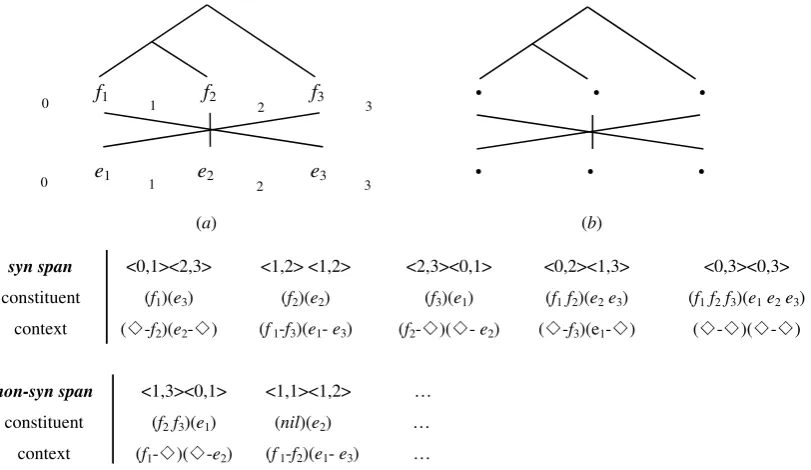
Fig. 1 gives an illustration of the bilingual constituents and contexts. In Fig. 1-(a), a latent syn-chronous tree over the example sentence pair is illustrated. With the word alignments shown in the sentence pair, the latent tree over the target sentence “e1 e2e3” can be inferred. For the ease of presen-tation, the latent target side tree is neglected in Fig. 1-(a).
Given the synchronous tree, two sets of bilingual constituents and contexts can be extracted as shown in the two tables of Fig. 1. One is aboutsyn spans, the other is aboutnon-syn spans. 3appearing in the contexts denotes a sentence boundary. nilappearing in the constituents of the non-tree spans denotes an empty span, which is actually a space between two terminals (or between a terminal and3).
2.2 Generative Model
The SCCM computes the joint probability of a sentence pairSand its synchronous treeT as below:
P(S, T) =P(S|T)P(T) =P(S|T)P(B)P(T|B) (1) =P(S|T)P(B) ∏
0≤i≤j≤m
0≤p≤q≤n
P(αij,pq|Bij,pq)P(βij,pq|Bij,pq)
whereBdenotes a synchronous bracketing skeleton, in which no words are populated. Fig. 1-(b) shows the skeleton of Fig. 1-(a). The skeletonB is considered being filled by the synchronous tree T, and P(T|B)is decomposed into conditional probabilities of bilingual constituentsαand contextsβ condi-tioning onBij,pq, a Boolean variable indicating whether the under-consideration bi-span<i, j><p, q>
is asyn spanor not. In particular,αij,pqdenotes the bilingual constituent spanning fromitojon source
f1 f2 f3
0 1 2 3
e1 e2 e3
0 1 2 3
syn span <0,1><2,3> <1,2> <1,2> <2,3><0,1> <0,2><1,3> <0,3><0,3>
constituent (f1)(e3) (f2)(e2) (f3)(e1) (f1f2)(e2e3) (f1f2f3)(e1e2e3) context (-f2)(e2-) (f 1-f3)(e1- e3) (f2-)(- e2) (-f3)(e1-) (-)(-)
non-syn span <1,3><0,1> <1,1><1,2> …
constituent (f2f3)(e1) (nil)(e2) … context (f1-)(-e
2) (f 1-f2)(e1- e3) …
[image:3.595.99.505.62.297.2](a) (b)
Figure 1: Illustration of bilingual constituents and contexts over a sentence pair which consists of a source side sentence “f1f2f3” and a target side sentence “e1e2e3”. In (a), the bottom numbers around each word are indexes for denoting spans. A synchronous tree is illustrated in (a), based on which two sets of bilingual constituents and contexts are extracted as shown in the two tables below the tree. Take a syn span <1,2><1,2>for example, the source side span<1,2>is ”f2” and the target side span<1,2> is ”e2”. They constitutes a bilingual constituent ”(f2)(e2)”, whose context is ”(f1-f3)(e1-e3)” that is preceding and following the bilingual constituent. Figure (b) shows the skeleton of figure (a).
Bij,pq is defined as below:
Bij,pq= {
1 if bispan < i, j >< p, q > is a syn span 0 otherwise
In the SCCM, skeletons Bs are restricted to be binary branching and are distributed uniformly. Fur-thermore, sinceT andSare consistent,P(S|T)is always equal to 1 in Eq. (1). Therefore, we can infer (with the expansion of the continued multiplication operator of Eq. (1) ):
P(S, T)∝ ∏ <i,j><p,q>∈T
(P(αij,pq|Bij,pq= 1)P(βij,pq|Bij,pq= 1)) (2) ∏
<i,j><p,q≯∈T
(P(αij,pq|Bij,pq= 0)P(βij,pq|Bij,pq= 0))
where <i, j><p, q> ∈ T indicates that bi-span <i, j><p, q> is a syn span contained in T, <i, j><p, q> ̸∈ T indicates otherwise case. Formula (2) is the basis for Bayesian modeling of the SCCM and the posterior inference that are proposed in the following sections.
3 Bayesian Modeling for the SCCM
For the SCCM, the posterior of a synchronous tree T given the observation of a sentence pair S is: P(T|S)∝P(S, T). As shown in formula (2), it turns out that the posteriorP(T|S)depends on the four kinds of distributions:
P(αij,pq|Bij,pq= 1) P(βij,pq|Bij,pq = 1)
We propose to define two kinds of Bayesian priors over the constituents related variablesαij,pq|Bij,pq
and the contexts related variablesβij,pq|Bij,pq respectively. Since constituents exhibits richer
appear-ances than contexts, the proposed Bayesian prior over αij,pq|Bij,pq is more complicate than that over
βij,pq|Bij,pq.
Specifically, one of the non-parametric Bayesian priors, the Pitman-Yor-Process (PYP) prior, is defined onαij,pq|Bij,pq. The PYP prior can produce the power-law distribution (Goldwater et al., 2009) that is
commonly observed in natural languages, and can flexibly model distributions on layer structures due to its defined distribution on distribution hierarchy. The PYP prior had been successfully applied on many NLP tasks such as language modeling (YeeWhye, 2006), word segmentation (Johnson et al., 2007b; Goldwater et al., 2011), dependency grammar induction (Cohen et al., 2008; Cohn et al., 2010), grammar refinement (Liang et al., 2007; Finkel et al., 2007) and Tree-Substitution Grammar induction (Cohn et al., 2010). We use the PYP to model the constituents’ layered structure by using the PYP’s distribution hierarchy. Onβij,pq|Bij,pq, we use the Dirichlet distribution for its simplicity because contexts appear in
much fewer kinds of surface strings than those of constituents.
3.1 The PYP Prior over Bilingual Constituents
Constituents consist of both words and POS tags. Though in much monolingual grammar induction works, only POS tag sequences were used as the observed constituents for their significant hints of phrases (Klein and Manning, 2002; Cohn et al., 2010), our work needs considering raw words as obser-vation data too because word alignments encode the important translation correspondence and contribute to synchronous bi-spans. But it causes severe data sparse problem due to the quite large number of unique constituents consisting of both words and POS tags. Besides, constituents can be extremely long which intensify the data sparse problem. So, solely using the surface strings of constituents is impractical.
In this section, we propose a hierarchical representation of constituents to overcome the data sparse problem and use the PYP prior on this kind of representation. From top to bottom, the hierarchical rep-resentation encodes the information of a bilingual constituent from fine-grained level to coarse-grained levels. The probability of a fine-grained level can be backed-off to the probabilities of coarse-grained levels.
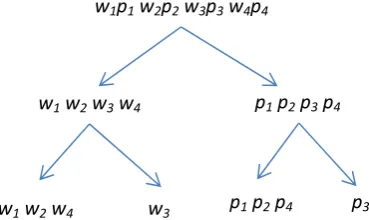
The first (top) level of the hierarchical representation is the bilingual constituent itself. The second level is composed of two sequences: one is word sequence, the other is POS tags sequence. The third level mainly decomposes the second level into boundaries and middle words/POSs. Since the target of inducing synchronous structures in this paper is to induce the latent phrasal equivalences of a parallel sentence, boundaries of bilingual constituents play the key role of identifying phrasal equivalences. The third level is the function to make use of boundaries. Fig. 2 gives an illustration of the hierarchical representation.
w1p1w2p2w3p3w4p4
w1w2w3w4 p1p2p3p4
[image:4.595.206.391.560.670.2]w1w2w4 w3 p1p2p4 p3
The PYP prior encodes distribution on distribution. Recursively using the PYP prior can create a distribution hierarchy, which is appropriate for modeling the distribution over the hierarchical repre-sentations of constituents. Smoothing is fulfilled through backing-off fine-grained level distributions to coarse-grained level distributions.
3.1.1 The PYP Hierarchy
We define the PYP hierarchy over the hierarchical representation of bilingual constituents in a top-down manner. For the topmost (first) level:
αij,pq|Bij,pq =b ∼ Gfirstb
Gfirstb ∼ P Y P(dfirstb , θfirstb , Pword−pos(.|Bij,pq =b))
The PYP has three parameters: (dfirstb , θfirstb , Pword−pos). Pword−pos(.|Bij,pq = b) is a base
distributionover infinite space of bilingual constituents conditioned on span type b, which provides the back-off probability ofP(αij,pq|Bij,pq =b). The remaining parametersdfirstb andθfirstb control the
strength of the base distribution.
The back-off probabilityPword−pos(αij,pq =x|Bij,pq =b)is defined as below:
Pword−pos(αij,pq =x|Bij,pq =b)) =Pword(Rw(x)|b)×Ppos(Rp(x)|b)
whereRw(x)is the function returning a word sequence of a bilingual constituent x, Rp(x)returning the correspondent POS sequence. This is the second level of the hierarchical representation of bilingual constituents as illustrated in Fig. 2. Further,Rw(x)andRp(x)are decomposed into the third level of the hierarchy. TakingRw(x)for example:
Pword(Rw(x)|Bij,pq =b)) =Pword−bound(Rwb(x)|b)×|W||Rw(x1)|−|Rwb(x)|
whereRwbis a function returning a word sequence’s boundary representation, |W|is the vocabulary size,|Rw(x)| − |Rwb(x)|is the number of the words inRw(x)excluding those in the boundary rep-resentation. The above equation models the generation of a word sequence with surface stringRw(x) (givenb) by first generating its boundary representationRwb(x), then generating its middle words from a uniform distribution over the vocabulary.Ppos(Rp(x)|Bij,pq =b))is defined similarly.
We put the Dirichlet prior overPword−bound(Rwb(x)|b):
Rwb(x)|b ∼ Discrete(GRwbb ) GRwbb ∼ Dirichlet(τb)
ForPpos−bound(Rpb(x)|b), similar definition toPword−bound(Rwb(x)|b)is applied.
3.2 The Dirichlet Prior over Bilingual Contexts
The Dirichlet prior is defined as below:
βij,pq|Bij,pq =b ∼ Discrete(GDirb )
GDirb ∼ Dirichlet(τb)
A contextβij,pq (given the specific span typeb) is drawni.i.daccording to a multinomial parameter
GDir
4 MCMC Sampling for Inferring the Latent Synchronous Trees
We approximate the distribution over latent synchronous trees by sampling them from the posterior P(T|S), whereT is a latent synchronous tree of a sentence pairS. As presented in the beginning of section 3, the posterior depends on P(αij,pq|Bij,pq = b) andP(βij,pq|Bij,pq = b), on which we put
the PYP prior and the Dirichlet prior respectively. Because of integrating out allGs in all of the priors, interdependency between samples of αij,pq|Bij,pq = b orβij,pq|Bij,pq = bis introduced, resulting in
simultaneously obtaining multiple samples impractical. On the other hand, blocked sampling, which ob-tains sentence-level samples simultaneously (Blunsom and Cohn, 2010; Cohn et al., 2010; Johnson et al., 2007a) is attractive for the fast mixing speed and the easy application of standard dynamic programming algorithms.
4.1 Metropolis-Hastings (MH) Sampler
We apply a MH sampler similar to (Johnson et al., 2007a) to overcome the difficulty of obtaining multi-ple sammulti-ples simultaneously from posterior. The MH sammulti-pler is a MCMC technique that draws sammulti-ples from a true distribution by first drawing samples simultaneously from a proposal distribution, and then correcting the samples to the true distribution by using an accept/reject test. In practical, the proposal distribution is designed to facilitate the use of blocked sampling that applies standard dynamic program-ming, and the resulting samples are corrected by the accept/reject test to the true distribution.
In our case, the proposal distribution is the Maximum-a-Posteriori (MAP) estimate ofP(αi,j|Bi,j =b)
andP(βi,j|Bi,j =b), and the blocked sampling ofT applies a dynamic programming algorithm that is
based on the inside chart derived from a transformation of Eq. (1):
P(S, T) =K(S) ∏
<i,j><p,q>∈T
ϕ(ij, pq)
where ϕ(ij, pq) = PP((ααij,pq|Bij,pq= 1)P(βij,pq|Bij,pq = 1)
ij,pq|Bij,pq= 0)P(βij,pq|Bij,pq = 0)
K(S)is a constant givenS. The inside chartIcan be constructed recursively as below:
Iij,pq=
ϕ(ij, pq) if j−i≤1and q−p≤1
ϕ(ij, pq) ∑
i≤u≤j p≤v≤q
(Iiu,pvIuj,vq +Iiu,vqIuj,pv) otherwise
Based on this inside chart, a synchronous tree can be top-down sampled (Johnson et al., 2007a), then is accepted or rejected by the MH-test to correct to the true distribution.
5 Experiments
5.1 Sampler Configuration
Our sampler was initialised with trees through a random split process. Firstly, we used GIZA++ mod-el 4 to get source-to-target and target-to-source word alignments, and used grow-diag-final-and (gdfa) heuristic to extract reliable word alignments for each sentence pair. Secondly, we randomly split each sentence pair in a top-down manner, and make sure that each split is consistent with the GIZA++ gdfa word alignments. For example, given a sentence pair ofmsource words andntarget words, we random-ly choose a split point at each side and the alignment type (straight alignment or inverted alignment), then recursively build bi-spans further on each new split. Finally, a synchronous binary tree is built at the end of this process1. Note that all splits must be consistent with the GIZA++ gdfa word alignments. When a piece of word alignments (such as non-ITG alignment structure) do not permit binary split, we keep this structure unsplitted and continue split only on its sub-structures that are ITG derivable.
Our sampler ran 200 iterations for all data. After each sampling iteration, we resample all the hyper-parameters using slice-sampling, with the following priors:d∼Beta(1,1),θ∼Gamma(10,0.1).
The time complexity of our inference algorithm isO(n6), which is not practical in applications. We reduce the time complexity by only considering bi-spans that do not violate GIZA++ intersection word alignments (intersection of source-to-target and target-to-source word alignments) (Cohn and Haffari, 2013).
5.2 Word Alignment Task 5.2.1 Experimental Setting
Since there are no annotated synchronous treebanks, we evaluate the SCCM indirectly by evaluating its output word alignments on a gold standard English Chinese parallel tree bank with hand aligned word alignments referred as HIT corpus2. The HIT corpus, which was collected from English learning text books in China as well as example sentences in dictionaries, was originally designed for annotating bilingual tree node alignments. The annotation strictly reserves the semantic equivalence of the aligned sub-tree pair. The byproduct of this corpus is the hand aligned word alignments, which was utilized to evaluate word alignment performance3. The word segmentation, tokenization and parse-tree in the corpus were manually constructed or checked. The statistics of the HIT corpus are shown in table 1.
Table 1: Corpus statistics of the HIT corpus.
ch en
sent 16131 word 210k 209k avg. len. 13.06 13.0
5.2.2 Results
We adopt the commonly used metric: the alignment error rate (AER) to evaluate our proposed ments (a) against hand-annotated alignments, which are marked with sure (s) and possible (p) align-ments. TheAERis given by (the lower the better):
AER(a, s, p) = 1−|a∩|sa||++||as|∩p|
In the HIT corpus, only sure alignments were annotated, possible alignments were bypassed because of the strict annotation standard of semantic equivalence.
The word alignments evaluation results are reported in Table 2. The baseline was GIZA++ model 4 in both directions with symmetrization by the grow-diag-final-and heuristic (Koehn et al., 2003). A
1The initialization with different random split bi-trees results in marginal variance of performances. 2HIT corpus is designed and constructed by HIT-MITLAB. http://mitlab.hit.edu.cn/index.php/resources.html
released induction system - PIALIGN (Neubig et al., 2011)4was also experimented to compare with our proposed induction system - SCCM.
PIALIGN is a model that generalizes adaptor grammars for machine translation (MT), while our mod-el is to generalize CCM for MT. Adaptor grammars has been successfully applied on shallow unsuper-vised tasks such as morphlogical/word analysis, while CCM has obtained state-of-the-art performance on the more complex unsupervised task - inducing syntactic trees. In view of CCM’s successful mono-lingual application, we generalize it to bimono-lingual case. In depth comparison: our SCCM deals with both consituents and distituents, and contexts of them, while PIALIGN only deals with constituents. Fur-thermore, SCCM does not model non-terminal rewriting rules, while PIALIGN model those rules which can rewrite a non-terminal into a complete subtree as adaptor grammars does. In addition, PIALIGN adopts a beam search algorithm of (Saers et al., 2009). Through setting small beam size, PIALIGN’s time complexity is almostO(n3). But as critisized by (Cohn and Haffari, 2013), their heuristic beam search algorithm does not meet either of the Markov Chain Monte Carlo (MCMC) criteria of ergodic-ity or detailed balance. Our method adopts MCMC sampling (Johnson et al., 2007a) which meets the MCMC criteria.
We can see that the two induction systems perform significantly better than GIZA++, and our proposed SCCM performs better than PIALIGN. Manual evaluation for the quality of the phrase pairs generated from word alignments is also reported in Table 2. We considered the top-100 high frequency phrase pairs that are beyond word level and less than six words on both sides, and report the proportion of reasonably well phrase pairs through manual check. We found that more good phrase pairs can be derived from the SCCM’s word alignments than from others.
Table 2: Quality of word alignments and their generated phrase pairs.
AER good phrase pairs proportion
GIZA++ 0.322 0.493
PIALIGN 0.263 0.531
SCCM 0.255 0.534
5.3 Machine Translation Task 5.3.1 Experimental Setting
A released tourism-related domain machine translation data was used in our experiment. It consists of a parallel corpus extracted from theBasic T ravel Expression Corpus(BTEC), which had been used in evaluation campaigns of the yearly International Workshop on Spoken Language Translation (IWSLT). Table 3 lists statistics of the corpus used in the experiment.
Table 3: Statistics of the corpus used by IWSLT
ch en
sent 23k word 190k 213k avg. len. 8.3 9.2
We used CSTAR03 as development set, used IWSLT04 and IWSLT05 official test set for test. A 4-gram language model with modified Kneser-Ney smoothing was trained on English side of parallel corpus. We use minimum error rate training (Och, 2003) with nbest list size 100 to optimize the fea-ture weights for maximum development BLEU. Experimental results were evaluated by case-insensitive BLEU-4 (Papineni et al., 2001). Closest reference sentence length was used for brevity penalty.
5.3.2 Results
Following (Levenberg et al., 2012; Neubig et al., 2011; Cohn and Haffari, 2013), we evaluate our model by using the SCCM’s output word alignments to construct a phrase table. As a baseline, we train a phrase-based model using the moses toolkit 5 based on the word alignments obtained using GIZA++
model 4 in both directions and symmetrized using the grow-diag-final-and heuristic (Koehn et al., 2003). For comparison with CFG-based induction systems, word alignments generated by the PIALIGN were also used to train a phrase-based model.
In the end-to-end MT evaluation, we used the standard set of features: relative-frequency and lexical translation model probabilities in both directions; distance-based distortion model; language model and word count. The evaluation results are reported in table 4. Word alignments derived by the two induction systems can be more helpful to obtain better translations than GIZA++ derived word alignments. The SCCM, while departing from traditional CFG-based methods, achieves comparable translation perfor-mance to the PIALIGN.
Table 4: BLEU on both the development set: CSTAR03, and the two test sets: IWSLT04 and IWSLT05. CSTAR03 IWSLT04 IWSLT05
GIZA++ 0.4304 0.4190 0.4866 PIALIGN 0.4661 0.4556 0.5248
SCCM 0.4560 0.4469 0.5193
6 Conclusion
A new model for synchronous structure induction is proposed in this paper. Different to all the previous works that are based on Context Free Grammars, our proposed SCCM deals with bilingual constituents and contexts explicitely so that bilingual translational equivalences can be directly modeled. A non-parametric Bayesian modeling of the SCCM is applied to cope with the sparse representations of bilin-gual constituents and contexts. Both intrinsic evaluation on word alignments and extrinsic evaluation on end-to-end machine translation were conducted. The intrinsic evaluation show that the highest quality word alignments were obtained by our proposed SCCM. Such statistically sound word alignments of the SCCM were used in the extrinsic evaluation on machine translation, showing that significantly better translations were achieved than those obtained by using the word alignments of GIZA++, the widely used word aligner in the two-step pipeline.
Acknowledgments
This work was supported by the National Natural Science Foundation of China under grant No. 61273319, and grant No. 61373095. Thanks for the helpful advices of anonymous reviewers.
References
Phil Blunsom and Trevor Cohn. 2010. Unsupervised induction of tree substitution grammars for dependency
parsing. InProceedings of the 2010 Conference on Empirical Methods in Natural Language Processing, pages
1204–1213. Association for Computational Linguistics.
Peter F Brown, Vincent J Della Pietra, Stephen A Della Pietra, and Robert L Mercer. 1993. The mathematics of
statistical machine translation: Parameter estimation.Computational linguistics, 19(2):263–311.
Shay B Cohen, Kevin Gimpel, and Noah A Smith. 2008. Logistic normal priors for unsupervised probabilistic
grammar induction. InProceedings of the Advances in Neural Information Processing Systems.
Trevor Cohn and Phil Blunsom. 2009. A bayesian model of syntax-directed tree to string grammar induction. In
Proceedings of the 2009 Conference on Empirical Methods in Natural Language Processing: Volume 1-Volume
1, pages 352–361. Association for Computational Linguistics.
Trevor Cohn and Gholamreza Haffari. 2013. An infinite hierarchical bayesian model of phrasal translation. In
Proceedings of the 51th Annual Meeting of the Association for Computational Linguistics.
Trevor Cohn, Phil Blunsom, and Sharon Goldwater. 2010. Inducing tree-substitution grammars. Journal of
Machine Learning Research, 11:3053–3096.
Xiangyu Duan, Zhang Min, and Chen Wenliang. 2013. Smoothing for bracketing induction. InProceedings of
Jenny Rose Finkel, Trond Grenager, and Christopher D Manning. 2007. The infinite tree. InANNUAL MEETING-ASSOCIATION FOR COMPUTATIONAL LINGUISTICS, volume 45, page 272.
Sharon Goldwater, Thomas L Griffiths, and Mark Johnson. 2011. Producing power-law distributions and damping
word frequencies with two-stage language models. Journal of Machine Learning Research, 12:2335–2382.
Mark Johnson, Thomas Griffiths, and Sharon Goldwater. 2007a. Bayesian inference for pcfgs via markov chain
monte carlo. InProceedings of Human Language Technologies 2007: The Conference of the North American
Chapter of the Association for Computational Linguistics; Proceedings of the Main Conference, pages 139–146. Mark Johnson, Thomas L Griffiths, and Sharon Goldwater. 2007b. Adaptor grammars: A framework for
specify-ing compositional nonparametric bayesian models. Proceedings of Advances in neural information processing
systems, 19:641.
Dan Klein and Christopher Manning. 2002. A generative constituent-context model for improved grammar
induc-tion. InProceedings of the 40th Annual Meeting on Association for Computational Linguistics, pages 128–135.
Association for Computational Linguistics.
Philipp Koehn, Franz Josef Och, and Daniel Marcu. 2003. Statistical phrase-based translation. InProceedings
of the 2003 Conference of the North American Chapter of the Association for Computational Linguistics on Human Language Technology-Volume 1, pages 48–54. Association for Computational Linguistics.
Abby Levenberg, Chris Dyer, and Phil Blunsom. 2012. A bayesian model for learning scfgs with discontiguous
rules. InProceedings of the 2012 joint conference on empirical methods in natural language processing and
computational natural language learning, pages 223–232. Association for Computational Linguistics.
P. Liang, S. Petrov, M. I. Jordan, and D. Klein. 2007. The infinite PCFG using hierarchical Dirichlet
process-es. In Empirical Methods in Natural Language Processing and Computational Natural Language Learning
(EMNLP/CoNLL).
Graham Neubig, Taro Watanabe, Eiichiro Sumita, Shinsuke Mori, and Tatsuya Kawahara. 2011. An unsupervised
model for joint phrase alignment and extraction. In Proceedings of the 49th Annual Meeting of the
Associa-tion for ComputaAssocia-tional Linguistics: Human Language Technologies-Volume 1, pages 632–641. Association for Computational Linguistics.
Franz Josef Och. 2003. Minimum error rate training in statistical machine translation. InProceedings of the
41st Annual Meeting on Association for Computational Linguistics-Volume 1, pages 160–167. Association for Computational Linguistics.
Markus Saers, Joakim Nivre, and Dekai Wu. 2009. Learning stochastic bracketing inversion transduction
gram-mars with a cubic time biparsing algorithm. InProceedings of the 11th International Conference on Parsing
Technologies, pages 29–32. Association for Computational Linguistics.
Xinyan Xiao and Deyi Xiong. 2013. Max-margin synchronous grammar induction for machine translation. In
EMNLP.
Xinyan Xiao, Deyi Xiong, Yang Liu, Qun Liu, and Shouxun Lin. 2012. Unsupervised discriminative induction of
synchronous grammar for machine translation. InCOLING, pages 2883–2898.
Teh YeeWhye. 2006. A bayesian interpretation of interpolated kneser-ney. InTechnical Report TRA2/06. School