Towards an Annotated Corpus of Discourse Relations in Hindi
Rashmi Prasad
*, Samar Husain
†, Dipti Mishra Sharma
†and Aravind Joshi
*Abstract
We describe our initial efforts towards developing a large-scale corpus of Hindi texts annotated with discourse relations. Adopting the lexically grounded approach of the Penn Discourse Treebank (PDTB), we present a preliminary analysis of discourse connectives in a small corpus. We describe how discourse connectives are
represented in the sentence-level
dependency annotation in Hindi, and discuss how the discourse annotation can enrich this level for research and applications. The ultimate goal of our work is to build a Hindi Discourse Relation Bank along the lines of the PDTB. Our work will also contribute to the cross-linguistic understanding of discourse connectives.
1
Introduction
An increasing interest in human language technologies such as textual summarization, question answering, natural language generation has recently led to the development of several discourse annotation projects aimed at creating large scale resources for natural language processing. One of these projects is the Penn
Discourse Treebank (PDTB Group, 2006),1whose
goal is to annotate the discourse relations holding between eventualities described in a text, for example causal and contrastive relations. The PDTB is unique in using a lexically grounded approach for annotation: discourse relations are anchored in lexical items (called “explicit discourse connectives”) whenever they are
* University of Pennsylvania, Philadelphia, PA, USA, {rjprasad,joshi}@seas.upenn.edu
† Language Technologies Research Centre, IIIT, Hyderabad,
India, [email protected], [email protected] 1
http://www.seas.upenn.edu/˜pdtb
explicitly realized in the text. For example, in (1),
the causal relation between ‘the federal
government suspending US savings bonds sales’ and ‘Congress not lifting the ceiling on government debt’ is expressed with the explicit
connective ‘because’.2 The two arguments of each
connective are also annotated, and the annotations of both connectives and their arguments are recorded in terms of their text span offsets.3
(1) The federal government suspended sales of U.S. savings bonds because Congress hasn’t lifted the ceiling on government debt.
One of the questions that arises is how the PDTB style annotation can be carried over to languages other than English. It may prove to be a challenge cross-linguistically, as the guidelines and methodology appropriate for English may not apply as well or directly to other languages, especially when they differ greatly in syntax and
morphology. To date, cross-linguistic
investigations of connectives in this direction have been carried out for Chinese (Xue, 2005) and Turkish (Deniz and Webber, 2008). This paper explores discourse relation annotation in Hindi, a language with rich morphology and free word order. We describe our study of “explicit connectives” in a small corpus of Hindi texts, discussing them from two perspectives. First, we consider the type and distribution of Hindi connectives, proposing to annotate a wider range
2 The PDTB also annotates implicit discourse relations, but
only locally, between adjacent sentences. Annotation here consists of providing connectives (called “implicit discourse connectives”) to express the inferred relation. Implicit connectives are beyond the scope of this paper, but will be taken up in future work.
3
of connectives than the PDTB. Second, we consider how the connectives are represented in the Hindi sentence-level dependency annotation, in particular discussing how the discourse annotation can enrich the sentence-level structures. We also briefly discuss issues involved in aligning the discourse and sentence-level annotations.
Section 2 provides a brief description of Hindi word order and morphology. In Section 3, we present our study of the explicit connectives identified in our texts, discussing them in light of the PDTB. Section 4 describes how connectives are represented in the sentence-level dependency annotation in Hindi. Finally, Section 5 concludes with a summary and future work.
2
Brief Overview of Hindi Syntax and
Morphology
Hindi is a free word order language with SOV as the default order. This can be seen in (2), where (2a) shows the constituents in the default order, and the remaining examples show some of the word order variants of (2a).
(2) a. malaya nao samaIr kao iktaba dI .
malay ERG sameer DAT book gave
“Malay gave the book to Sameer” (S-IO-DO-V)4
b. malaya naoiktabasamaIr kaodI. (S-DO-IO-V)
c. samaIr kaomalaya naoiktabadI. (IO-S-DO-V)
d. samaIr kaoiktabamalaya naodI. (IO-DO-S-V)
e. iktabamalaya naosamaIr kaodI. (DO-S-IO-V)
f. iktabasamaIr kaomalaya naodI. (DO-IO-S-V)
Hindi also has a rich case marking system, although case marking is not obligatory. For example, in (2), while the subject and indirect object are explicitly for the ergative (ERG) and dative (DAT) cases, the direct object is unmarked for the accusative.
3
Discourse Connectives in Hindi
Given the lexically grounded approach adopted for discourse annotation, the first question that arises is how to identify discourse connectives in Hindi. Unlike the case of the English connectives in the PDTB, there are no resources that alone or together provide an exhaustive list of connectives in the
4
S=Subject; IO=Indirect Object; DO=Direct Object; V=Verb; ERG=Ergative; DAT=Dative
language. We did try to create a list from our own knowledge of the language and grammar, and also by translating the list of English connectives in the PDTB. However, when we started looking at real data, this list proved to be incomplete. For example, we discovered that the form of the complementizer ‘ik’ also functions as a temporal subordinator, as in (3).
(3) [ vah baalaTI ko gaMdo panaI sao ApnaI caaOklaoT [he bucket of dirty water from his chocolates inakalanao hI vaalaa qaa] ik {]sakI mammaI nao
taking-out just doing was] that {his mother ERG
]sao raok idyaa }
him stop did}
“He was just going to take out the chocolates from the dirty water in the bucket when his mother stopped him.”
The method of collecting connectives will therefore necessarily involve “discovery during annotation”. However, we wanted to get some initial ideas about what kinds of connectives were likely to occur in real text, and to this end, we looked at 9 short stories with approximately 8000 words. Our goal here is to develop an initial set of guidelines for annotation, which will be done on the same corpus on which the sentence-level dependency annotation is being carried out (see Section 4). Table 1 provides the full set of connectives we found in our texts, grouped by syntactic type. The first four columns give the
syntactic grouping, the Hindi connective
Connective Type Hindi Gloss English Num
when till..then till (of for) as just..(then)
Table 1: A Partial List of Discourse Connectives in Hindi. Parentheses are used for optional
elements; “|” is used for alternating elements; TOP = topic marker.
3.1 Types of Discourse Connectives
3.1.1 Subordinating Conjunctions
Finite adverbial subordinate clauses are
introduced by independent lexical items called
“subordinating conjunctions”, such as @yaaoMik
(‘because’), as in (4), and they typically occur as right or left attached to the main clause.
(4) [maOM [sa saBaI Qana kao rajya ko baadSaah
“I would give all this wealth to the king, because he alone is the lord of this whole world’s wealth.”
and in our texts, this was most often the subordinate clause element.
(5) @yaaoMik {yah tumharI ja,maIna pr imalaa hO}, [sailae
because {this your land on found has}, this-for
[[sa Qana pr tumhara AiQakar hO] [this treasure on your right is]
“Because this was found on your land, you have the right to this treasure.”
(6) []saka vaSa calata] tao {vah ]sao Gar sao
[her power walk] then {she it home from
baahr inakala dotI}
out take would}
“Had it been in her power, she would have banished it from the house.”
When both elements of the paired connective are explicit, their text spans must be selected discontinuously. The main clause argument is called Arg1 and the subordinate clause argument, Arg2.
Subordinating conjunctions, whether single or paired, can occur in non-initial positions in their clause. However, this word order variability is not completely unconstrained. First, not all conjunctions display this freedom. For example, while ‘jaba’ (‘when’) can be clause-medial (Ex. 7), ‘@yaaoMik’ (‘because’) cannot. Second, when the main clause precedes the subordinate clause, the main clause element, if explicit, cannot appear clause-initially at all. Consider the causal ‘@yaaoMik.. [salaIe’ (Ex.5), which represents the subordinate-main clause order. In the reverse order, the explicit main clause ‘[salaIe’ (Ex.8) appears clause medially. Placing this element in clause-initial position is not possible.
(7) {lakD,haro kI p%naI kao} jaba {yah
{woodcutter of wife DAT} when {this maalaUma pD,a ik [sa icaiDyaa ko karNa, knowledge put that this bird of reason kama CaoD,kr Gar Aa gayaa hO} tao [vah
work leaving home come went is} then [she
]sa pr barsa pD,I]. him on anger-rain put]
“When the woodcutter’s wife found out that he had left his work and come home to care for the bird, she raged at him.”
(8) [. . .pr icaraga kI ba%tI ]sakanaa yaa daohrI
[. . .but lamp of light light or another
ba%tI lagaanaa] Saayad [sailae []icat nahIM
light putting] perhaps this-for [appropriate not samaJato qao] ik {tola ka Apvyaya haogaa}.
Consider did] that {oil of waste be-FUT}.
“. . . but he did not consider it appropriate to light the lamp repeatedly or light another lamp, perhaps because it would be a waste of oil.”
3.1.2 Sentential Relative Pronouns
Since discourse relations are defined as holding between eventualities, we have also identified relations that are expressed syntactically as relative pronouns in sentential relative clauses, which modify the main clause verb denoting an eventuality, rather than some entity denoting
noun phrase. For example, in (9), a
result/purpose relation is conveyed between ‘the man’s rushing home’ and ‘the bird being taken care of’, and we believe that this relation between the eventualities should be captured despite it’s syntactic realization as the relative pronoun ‘ijasasao’ (‘because of which/so that’). (10) gives an example of a modified relative pronoun.
(9) [saara kama caaoD,kr vah ]sa baImaar icaiD,yaa
[all work leaving he that sick bird kao ]zakr dbaa Gar kI Aaor Baagaa], ACC picking-up fast home of direction ran], ijasasao {]saka sahI [laaja ikyaa jaa sako}
from-which {her proper care do go able}
“Leaving all his work, he picked up the bird and ran home very fast, so that the bird could be given proper care.”
(10) [}^MTaoM ko hr baar kdma rKnao pr
[camels of every time step keeping upon icaiD,yaao M ko isar Aapsa maoM tqaa }^MT kI
birds of head each-other in and camels of gardna sao Tkra rho qao] ijasako karNa
neck with hit-against be had] of-which reason {]na pixayaaoM kI drdBarI caIKoM inakla
{those birds of painful screams come-out rhI qaIM}.
be had}
“With each step of the camels, the birds heads were hitting against each other as well as with the camels’ necks because of which the birds were screaming painfully.”
3.1.3 Subordinators
English, where certain non-finite subordinate clauses, called “free adjuncts”, appear without any overt marking so that their relationship with the main clause is unspecified, Hindi non-finite subordinate clauses almost always appear with overt marking. However, also unlike English, where the same elements may introduce both finite and non-finite clauses (cf. After leaving, she caught the bus vs. After she left, she caught the bus), different sets of elements are used in Hindi. In fact, as can be seen in the subordinator group in Table 1, the non-finite clause markers are either postpositions (Ex.11), particles following verbal participles (Ex.12), or suffixes marking serial verbs (Ex.13).
(11) {mammaI ko manaa krnao} ko karNa [ramaU
{mummy of warning doing} of reason [Ramu qaaoD,I qaaoD,I caaOklaoT baD,o AnaMd ko saaqa
little little chocolate big pleasure of with Ka rha qaa].
eat being be]
“Because of his mother’s warning, Ramu was eating bits of chocolate with a lot of pleasure.”
(12). . .AaOr {Kolato} hue [yah BaUla jaata hO
. . . and {playing} happening [this forget go is ik yaid ]saka ima~ BaI Apnao iKlaaOnao kao
that if his friends also their toys to ]sao haqa nahIM lagaanao dota, tao ]sao
him hand not touching did, then he iktnaa baura lagata]
how-much bad feel]
“. . . and while playing, he forgets that if his friends too didn’t let him touch their toys, then how bad he would feel.”
(13){ApnaI p%naI sao yah sauna}kr [lakD,hara
{self wife from this listen}-do [woodcutter bahut duKI huAa]
much sad became]
“Upon hearing this from his wife, the woodcutter became very sad.”
While subordinators constitute a frequently-used way to mark discourse relations, their annotation raises at least two difficult problems, both of which have implications for the reliability of annotation. The first is that these markers are used for marking both argument clauses and adjunct clauses, so that annotators would be required to make difficult decisions for distinguishing them: in the former case, the
marker would not be regarded as a connective, while in the latter case, it would. Second, the clauses marked by these connectives often seem to be semantically weak. This is especially true of verbal participles, which are nonfinite verb appearing in a modifying relation with another finite verb. Whereas in some cases (Ex.12-13) the two verbs are perceived as each projecting “two distinct events” between which some discourse relation can be said to exist, in other cases (Ex.14), the two verbs seem to project two distinct actions but as part of a “single complex event” (Verma, 1993). These judgments can be very subtle, however, and our final decision on whether to annotate such constructions will be made after some initial annotation and evaluation.
(14) {doKto hI doKto saba baOla Baagato } {looking EMPH looking all buffalos running} hue [gaaoSaalaa phu^Mca gae]
happening [shed reach did]
“Within seconds all the buffalos came running to the shed.”
The naming convention for the arguments of
subordinators is the same as for the
subordinating conjunctions: the clause
associated with the subordinator is called Arg2 while its matrix clause is called Arg1.
Unlike subordinating conjunctions,
subordinators do not come paired and they can only appear clause-finally. Clause order, while not fixed, is restricted in that the nonfinite subordinate clause can appear either before the main clause or embedded in it, but never after the main clause.
3.1.4 Coordinating Conjunctions
Coordinating conjunctions in Hindi are found in both inter-sentential (Ex.15) and intra-sentential (Ex.16) contexts, they always appear as independent elements, and they almost always
appear clause-initially.5 For these connectives,
5
the first clause is called Arg1 and the second, Arg2.
(15) [jaba vah laaOTta tao gaa-gaakr ]saka mana
[when he return then sing-singing his mind KuSa kr dotI]. laoikna {]sakI p%naI kao vah
happy do gave]. But {his wife DAT the icaiD,yaa fUTI Aa^MK nahIM sauhatI qaI}.
bird torn eye not bear did}
“Upon his return, she would make him happy by singing. But his wife could not tolerate the bird even a little bit.”
(16) [ tBaI drvaaja,a Kulaa] AaOr {maalaikna Aa
[then-only door opened] and {wife come ga[- }.
went}
“Just then the door opened and the wife came in.”
We also recognize paired coordinating conjunctions, such as ‘naa kovala..balaik’ (See Table 1). The argument naming convention for these is the same as for the single conjunctions.
3.1.5 Discourse Adverbials
Discourse adverbials in Hindi modify their clau- ses as independent elements, and some of these are free to appear in non-initial positions in the clause. Example (17) gives an example of the consequence adverb, ‘saao’. The Arg2 of discourse adverbials is the clause they modify, whereas Arg1 is the other argument.
(17) [icaiD,yaa jabaana kT jaanao AaOr maalaikna ko eosao
[bird tongue cut going and wife of this vyavahar sao Dr ga[- qaI]. saao {vah iksaI
behavior with fear go had]. So {she some trh ]D,kr calaI ga[-}.
manner flying walk went}.
“The bird was scared due to her tongue being cut and because of the wife’s behavior. So she somehow flew away.”
As with the PDTB, one of our goals with the Hindi discourse annotation is to explore the structural distance of Arg1 from the discourse adverbial. If the Arg1 clause is found to be snon-adjacent to the connective and the Arg2 clause, it may suggest that adverbials in Hindi behave anaphorically. In the texts we looked at, we did not find any instances of non-adjacent Arg1s.
Addtional annotation will provide further evidence in this regard.
4
Hindi
Sentence-level
Annotation
andDiscourse Connectives
The sentence-level annotation task in Hindi is an ongoing effort which aims to come up with a dependency annotated treebank for the NLP/CL community working on Indian languages. Presently a million word Hindi corpus is being manually annotated (Begum et al., 2008). The dependency annotation is being done on top of the corpus which has already been marked for POS tag and chunk information. The scheme has 28 tags which capture various dependency relations. These relations are largely inspired by the Paninian grammatical framework. Given below are some relations, reflecting the argument structure of the verb.
a) kta- (agent) (k1) b) kma- (theme) (k2) c) krNa (instrument) (k3)
d) samp`dana sampradaan (recipient) (k4) e) Apadana (source) (k5)
f) AiQakrNa (location) (k7)
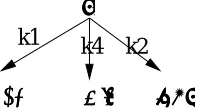
Figure 1 shows how Examples (2a-f) are represented in the framework. Note that agent and theme are rough translations for ’kta-’ and ’kma-’ respectively. Unlike thematic roles, these relations are not purely semantic, and are motivated not only through verbal semantics but also through vibhaktis (postpositions) and TAM (Tense, aspect and modality) markers (Bharati et al., 1995). The relations are therefore syntactico-semantic, and unlike thematic roles there is a greater binding between these relations and the syntactic cues.
k1 k4 k2
Figure 1: Dependency Diagram for Example (2) Some discourse relations that we have identified are already clearly represented in the sentence-level annotation. But for those that aren’t, the
dIdIdIdI
discourse level annotations will enrich the sentence-level. In the rest of this section, we discuss the representation of the different types of connectives at the sentence level, and discuss how the discourse annotation will add to the
information present in the dependency
structures.
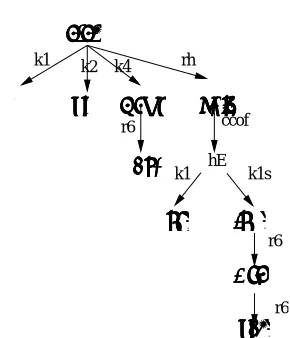
Subordinating Conjunctions Subordinating conjunctions are lexically represented in the dependency tree, taking the subordinating clause as their dependents while themselves attaching to the main verb (the root of the tree). Figure 2 shows the dependency tree for Example (4) containing the subordinating conjunction ’@yaaoMik’. Note that the edge between the connective and the main verb gives us the causal relation between the two clauses, the relation label being ’rh’ (relation hetu ’cause’). Thus, the discourse level can be taken to be completely represented at the sentence-level.
hE
k1 k2 k4 rh
ccof r6
k1s k1
r6
r6
Figure 2: Dependency Tree for Subordinating Conjunction in Example (4)
Paired Subordinating Conjunctions Unlike Example (4), however, the analysis for the paired connective in Example (5), given in Figure 3, is insufficient. Despite the lexical representation of the connective in the tree, the correct interpretation of the paired conjunction and the clauses which it relates is only possible at the discourse level. In particular, the dependencies don’t show that ’@yaaoMik’ and ’[salaIe’ are two parts of the same connective, expressing a single relation and taking the same two arguments. Thus, the discourse annotation will
be able to provide the appropriate argument structure and semantics for these paired connectives.
ccof
k2 k1 rh
ccof
k7p
r6 k1
Figure 3: Dependency Tree for Paired Subordinating Conjunction in Example (5)
Subordinators As mentioned earlier, Hindi nonfinite subordinate clauses almost always appear with overt marking. But unlike the subordinating conjunctions, subordinators are not lexically represented in the dependency
trees. Figure 4 gives the dependency
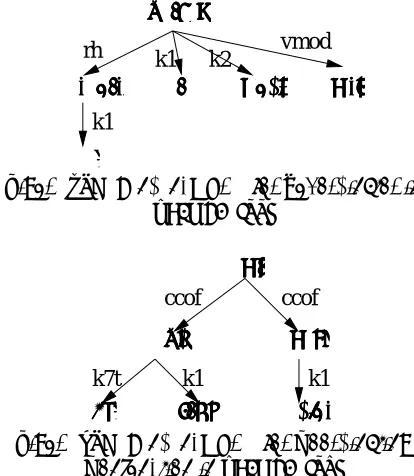
representation for Example (11) containing a postposition subordinator ’ko karNa’, which relates the main and subordinate clauses causally. As the figure shows, while the causal relation label (‘rh’) appears on the edge between the main and subordinate verbs, the subordinator itself is not lexically represented as the mediator of this relation. The lexically grounded annotation at the discourse level will thus provide the textual anchors of such relations, enriching the dependency representation. Furthermore, while many of the subordinators in Table 1 are fully specified in the dependency trees for the semantic relation they denote (e.g., ‘pr’ and ‘maoM’ marked as the ‘k7t’ (location in time) relation, and ‘ko karNa’ and ‘sao’ marked as the ‘rh’ (cause/reason) relation), others, like the particle ‘hue’ are underspecified for their semantics, being marked only as ‘vmod’ (verbal modifier). The discourse-level annotation will thus be the source for the semantics of these subordinators.
Coordinating Conjunctions Coordinating conjunctions at the sentence level anchor the root of the dependency tree. Figure 5 shows the
do dotado dotado dotado dota
maOMmaOMmaOMmaOM QanaQanaQanaQana baaddddSaahbaabaabaa SaahSaahSaah @yaaoMik @yaaoMik @yaaoMik @yaaoMik
rajya rajya rajya rajya
vahIvahIvahIvahI svaamaIsvaamaIsvaamaIsvaamaI
sampdasampdasampdasampda
QartIQartIQartIQartI
[sailae[sailae[sailae[sailae
AiQakar hO AiQakar hO AiQakar hO AiQakar hO
QanaQanaQanaQana tutututumharamharamharamhara @yaaoMik @yaaoMik @yaaoMik @yaaoMik
imalaa hOimalaa hOimalaa hOimalaa hO
yahyahyahyah ja,maInaja,maInaja,maInaja,maIna
dependency representation of Example (16) containing a coordinating conjunction.
rh k1 k2 vmod
k1
Figure 4: Dependency Tree for Subordinator in Example (11)
ccof ccof
k7t k1 k1
Figure 5: Dependency Tree for Coordinating Conjunction in Example (16)
While the sentence-level dependency analysis here is similar to the one we get at the discourse level, the semantics of these conjunctions are again underspecified, being all marked as ‘ccof’, and can be obtained from the discourse level.
Discourse Adverbials Like subordinating
conjunctions, discourse adverbials are
represented lexically in the dependency tree. They are attached to the verb of their clause as its child node and their denoted semantic relation is specified clearly. This can be seen with the temporal adverb ‘tBaI’ (‘then-only’) and its semantic label ‘k7t’ in Figure 5. At the same time, since the Arg1 discourse argument of adverbials is most often in the prior context, the discourse annotation will enrich the semantics of these connectives by providing the Arg1 argument.
5
Summary and Future Work
In this paper, we have described our study of discourse connectives in a small corpus of Hindi texts in an effort towards developing an annotated corpus of discourse relations in Hindi. Adopting the lexically grounded approach of the Penn Discourse Treebank, we have identified a
wide range of connectives, analyzing their types and distributions, and discussing some of the issues involved in the annotation. We also described the representation of the connectives in the sentence-level dependency annotation being carried out independently for Hindi, and discussed how the discourse annotations can enrich the information provided at the sentence level. While we focused on explicit connectives in this paper, future work will investigate the annotation of implicit connectives, the semantic classification of connectives, and the attribution of connectives and their arguments.
References
Rafiya Begum, Samar Husain, Arun Dhwaj, Dipti Misra Sharma, Lakshmi Bai, and Rajeev Sangal. 2008. Dependency annotation scheme for Indian
languages. In Proceedings of IJCNLP-2008.
Hyderabad, India.
Akshar Bharati, Vineet Chaitanya, and Rajeev
Sangal. 1995. Natural Language Processing: A
Paninian Perspective. Prentice Hall of India. http://ltrc.iiit.ac.in/downloads/nlpbook/nlppanini.p df.
Manindra K. Verma (ed.). 1993. Complex Predicates in South Asian Languages. New Delhi: Manohar.
The PDTB-Group. 2006. The Penn Discourse TreeBank 1.0 Annotation Manual. Technical
Report IRCS-06-01, IRCS, University of
Pennsylvania.
Bonnie Webber, Aravind Joshi, Matthew Stone, and Alistair Knott. 2003. Anaphora and discourse
structure. Computational Linguistics, 29(4):545–
587.
Nianwen Xue. 2005. Annotating Discourse
Connectives in the Chinese Treebank. In Proceedings of the ACL Workshop on Frontiers in Corpus Annotation II: Pie in the Sky. Ann Arbor, Michigan.
Deniz Zeyrek and Bonnie Webber. 2008. A Discourse Resource for Turkish: Annotating Discourse Connectives in the METU Corpus. In Proceedings of IJCNLP-2008. Hyderabad, India.
Ka Ka Ka Ka rha qaarha qaarha qaarha qaa
manaa manaa manaa
manaa krnaokrnaokrnaokrnao ramaramaramarama caaOkcaaOcaaOcaaOkkklaoTlaoTlaoTlaoT AanaMdAanaMdAanaMdAanaMd
mammaImammaImammaImammaI
AaOrAaOrAaOrAaOr
Kulaa KulaaKulaa
Kulaa AaAaAaAaga[ga[ga[
ga[----maalaikna maalaikna maalaikna maalaikna
drvaaja,adrvaaja,adrvaaja,adrvaaja,a