Development of Roller Ends Forced-Contact Model and
Cambering Technology for UCM Temper Mill (I)
*
——Development of Roller Ends Forced-Contact Model and the Computational Model of Flatness for UCM Temper Mill
Zhenhua Bai1, Hongxin Si1, Xiaodong Shi1, Linfang Han1, Ruibing Long1, Shoumin Wu2, Xiujun Li2, Dongdong Zhang1
1School of Mechanical Engineering, State Key Laboratory of Metastable Materials Science and
Technology, Yanshan University, Qinhuang Island, China
2Thin Strip Co., Ltd., Baoshan Iron & Steel Co., Ltd., Shanghai, China
E-mail: [email protected], sihongxin@126.com, xiaodong_shi@126.com Received April 18, 2011; revised May 18, 2011; accepted May 25, 2011
Abstract
Roller ends forced-contact and overmuch roll consumption are the widespread problems in temper rolling process of thin strip for two-stand UCM temper mill. Fully thinking the equipment and technology charac-teristics of UCM temper mill, we took the newly-built 1220 UCM temper mill of Baosteel as the research object in this paper. A model of roller ends forced-contact and a calculation model of flatness for UCM tem-per mill are established after a great deal of site tracing and theoretical researches. On this basis, an optimal mathematical model of roll shape which is suited for UCM temper mill is developed. Working roll curve is the combination of cosine curve and high order curve. The cosine subentry is used to control edge wave, the high order curve subentry is used to control roller ends forced-contact. Furthermore, the chamfering curve of middle roller end is optimized. Those are the innovations. Through the above-mentioned technology, pres-sure distribution between rollers caused by the shift of middle roll becomes more homogeneous, prespres-sure peak disappeared, working life of roll is improved effectively as well. Relevant technologies have been used to the practice of 1220 UCM temper mill of Baosteel and have achieved good use effects, which is of further extending application value [1].
Keywords: UCM, Temper Mill, Forced-Contact, Roll Shape, Roll Consumption
1. Introduction
Cold rolled thin strip production developed rapidly with the huge demand in household appliances, automobile, electronic, can-manufacturing in recent years. Temper rolling is the process nearest to finished product, it plays a vital role to the shape and mechanical property of rolled strip. In addition, it is found in practice that the contact of working rolls outside the plate width will ap-pear when thin and narrow strip are temper rolled. The forced-contact of working roller ends will lead to that only partial presetting rolling force are used to make the
metal deformed and the rest cause the roller ends squashed which will lead to the actual elongation is smaller than design value. And the product performance will not meet the users’ demand. Moreover, after the forced-contact of working roller ends happened, the roll-ing force consumed in the flattenroll-ing of roller ends also increased with the increase of presetting rolling force. The increased rolling force will waste in the forced- contact of working roller ends mostly when the rolling force increases to the certain extent. So that the increase of rolling force not only failed to increase elongation, but will shorten the rollers’ lifespan. Particularly, if the original shape model is still used, strip shape will not reach the target and even bring new shape defects.
Formerly, the cambering of four high cold mill in pro-duction site only aimed to a single wave, for example,
*Contract/grant sponsor and Grant Number: 1) Hundred Excellent
737
when there are many edge waves, the convex roll-shape of working roll and backup roll is often adopted; when there are many center waves, the disposition form of roll configuration curves is the concave roll-shape of work-ing roll and plain roll-shape of backup roll. These above disposition forms of roll configuration curves often can’t do anything about complex waves, even will lead to new wave defects. So, how to calculate the forced-contact value and relevant shape value accurately in the process of temper rolling and provide a relevant compensation technique is the emphasis of field tackling key problems. Therefore, a model of roller ends forced-contact and a computational model of flatness which is suited for UCM temper mill is established after lots of field tracing and theoretical research. Moreover, on the basis of this, starting with the roll crown optimization of working rolls and intermediate rolls, strip shape, roll consumption and the management of roll forced-contact are considered as well. A mathematical model of roll crown optimization which is suited for the working rolls and intermediate rolls of UCM temper mill is developed. Relevant tech-nologies have been used to the practice of 1220 UCM temper mill of Baosteel and have achieved good use ef-fects, which is of further extending application value.
2. The Model of Roller Ends Forced-Contact
and Shape Calculation for the Process of
UCM Temper Rolling
2.1. Introduction of Roller Ends Forced-Contact What is called the forced-contact of roller ends is refer to the phenomenon that the contact of working rolls outside the plate width when paper-thin strip is temper rolled. As shown in Figure 1.
2.2. Establishment of the Model of
Forced-Contact Value, Contact Width, Rolling Force and Shape of UCM Temper Mill
What can know after analysis is the model of mental deformation within the plate width still holds true even though the forced-contact of roller ends exists. Based on relevant model, the function of forward and backward tension (1i and 0i) can be shown as follows:
1i f1 1i, 0i, , , ,L B T Ti 0 1
(1)
0i f0 1i, 0i, , , ,L B T Ti 0 1
[image:2.595.311.538.75.215.2] (2) where 1i is the transverse distribution value of strip thickness in exit, 0i is the transverse distribution value of strip thickness in entry, Li is the transverse distribu-tion value of length and used to express the incoming
Figure 1. The Schematic diagram of the forced-contact of roller ends.
profile, B is the width of strip, T0 is the average
back-ward tension, T1 is the average forward tension.
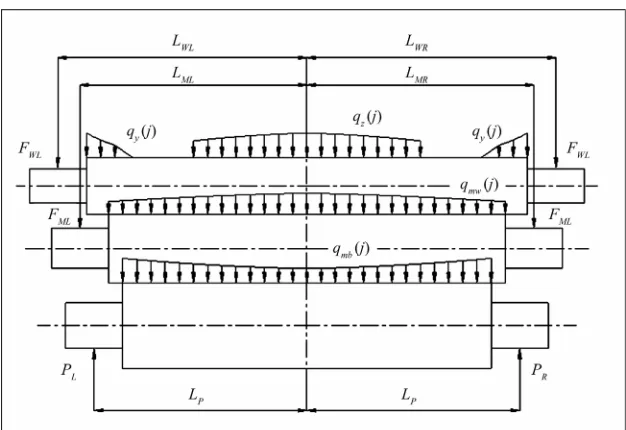
What is different is an additional pressure stress should be applied to the section of working roll which is outside the plate width in the load-carrying model of roller system if theforced-contact of roller ends is con-sidered. As shown in Figure 2.
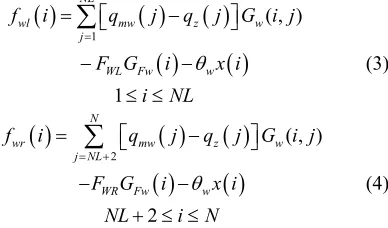
The model for elastic deformation of rolls still adopt the section dispersed way when the forced-contact of roller ends is considered, as shown in Figure 2. Assum-ing that the rollAssum-ing force along the axis of roller is q xz( ), the pressure between intermediate roll and working roll is qmw( )x , the pressure between intermediate roll and back-up roll is qmb( )x , ,the contacting pressure between working roll and working roll is q xz( ). Assuming that the face length of working roll is lw and be divided into N sections (N is odd), the number of sections correspond to working roll’s left is NL, and the lengthof each sec- tion is x lw
N
. In order to analyze conveniently, the pressure between rolls are expressed with q iz( ), qmw( )i ,
( ) mb
q i , q iy( ) respectively. The bending deflection equation for the left and right sides of working roll can be expressed as follows [2]:
1
( , )
1 NL
wl mw z w
j
WL Fw w
f i q j q j G i j
F G i x i
i NL
(3)
2
( , )
2 N
wr mw z w
j NL
WR Fw w
f i q j q j G i j
F G i x i
NL i N
(4)
[image:2.595.344.538.555.669.2]Figure 2. The Schematic diagram of force analysis of roller system when consider the forced-contact of roller ends.
pressure of i point between working roll and working roll, w
is the rigid corner of working roll which is relative to the rigid corner of back-up roll, NL is the number of sections which are correspond to the left part of working
roll’s medium line. G i jw( , ) is the influence coefficient that the load of j section to the deflection of working roll’s i section, it is the function of x
i NL 1
x and x
j NL 1
x:
2 2
1
2 2
1
2
2 3 2 2 1 3 2 , 0
4 ,
2
2 3 2 2 1 3 2 , '
4 2
w
W W W W W
w
w W
W W W W W
D
x x x k x
k x x
L L L L L
G i j
D L
x x x k x
k x x
L L L L L
(5)
where
3
1 48W
w
L k
EI
,
4 π
64
w W
D
I , k1.11, LW is the face length of working roll; GFw( )i is the influence
coefficient that the bending load Fw to the deflection of working roll’s i section, the expression of GFw( )i as follows:
1 2
22
2 2 3 2
3 1 0
4 2
x w W
Fw
W W W W W
l D L
x x k x
G i k x
L L L L L
(6)
where lx is the length of from working roll’s one end to the center line (the length of actuating arm) To the FWL,
x WL
l L , but to the FWR, lx LWR.
In addition, the bending deflection equation along the vertical direction of intermediate roll is
Left side:
1
, 1
NL
ml mb mw m ML Fm m
j
f i q j q j G i j F G i x i i NL
(7)Right side:
2
, 2
N
mr mb mw m MR Fm m
j NL
f i q j q j G i j F G i x i NL i N
(8)where FML,FMR is the bending force acting on the left and right sides of intermediate roll; qmb( )j the pressure between intermediate roll and back-up roll; m is the
739
coefficient that the bending load of intermediate roll to the deflection of intermediate roll’s i section.
Here, the expressions of G i jm( , ) and GFm( )i ap-proximate to the expressions of G i jw( , ) and GFw( )i . So, the expressions of G i jm( , ) and GFm( )i can be obtained through the replacement of intermediate roller’s parameters and working roller’s parameters [3].
So, the bending deflection equation along the vertical direction of back-up roll is:
Left side:
1 , 1 NLbl mb b L P j
f i q j G i j P G i
i NL
(9)Right side:
2 , 2 Nbr mb b R P j NL
f i q j G i j P G i
NL i N
(10)where P PL, R is the support force acting on the left and right sides of back-up roll; G i jb( , ) is the influence coefficient that the load of j section to the deflection of back-up roll’s i section; G iP( ) is the influence coeffi-cient that the support force to the deflection of back-up roll’s i section
Here, G i jb( , ) and G iP( ) approximate to the ex-pressions of G i jw( , ) and GFw( )i , So, they can be ob-tained through the replacement of back-up roller’s pa-rameters and working roller’s papa-rameters.
The deformation compatibility equation of working roll and intermediate roll:
1
2
wi mi mw mw mw
wi mi
f f K q NL q i
D D
(11)
where DwiDw1Dwi , Dmi Dm1Dmi , Kmw is flattening coefficient between working roll and interme-diate roll, and its expression is:
2
2
2 1
2 ln 0.407
π 2 1 ln 0.036 π w mw mw m mw R K E b R E b (12)
where bmw is half the contacting width of intermediate roll and working roll, and its expression can be obtained from Hertz formula:
2 2
* 1 2
1 1 1 4 π w m mw mw w m R R v v b q
E E R R
(13)
where *
mw
q is contacting pressure per unit of face length between intermediate roll and working roll, v v1, 2 are the poisson’s ratio of working roll and intermediate roll,
1, 2
E E are young modulus of working roll and interme-diate roll, R Rw, m are radius of working roll and inter-mediate roll.
Considering that the material of working roll and inter-mediate roll is same, so the above formula can be written as follows:
2
*4 1
π
mw w m mw
w m
v q D D b
E D D
(14)
The deformation compatibility equation of intermediate roll and back-up roll:
1
2
mi bi mb mb mb
bi mi
f f K q NL q i
D D
(15)
where Kmb is the flattening coefficient between inter-mediate roll and back-up roll, its expression approximate to the expression of Kmw and can be obtained through the replacement of Rw and Rm, Rm and Rb. Substi-tuting each deflection and flattening coefficient into the two above deformation compatibility equation. For the deformation compatibility equation of working roll and intermediate roll: Left side:
1 1 1, , 1 ,
, 1
2
NL NL
mw w m mw mw mw mw mb m w m i
j j
nz
wi mi i w z WL Fw ML Fm
j
q j G i j G i j K q i K q NL q j G i j x i C
D D
C G i j q j F G i F G i i NL
(16)Right side:
2 2
2
, , 1 ,
, 2
2
N N
mw w m mw mw mw mw mb m w m i
j NL j NL
N
wi mi i w z WR Fw MR Fm
j NL
q j G i j G i j K q i K q NL q j G i j x i C
D D
C G i j q j F G i F G i NL i N
(17)
1 1
, , 1 ,
1 2
NL NL
mb m b mb mb mb mb mw m m i
j j
mi bi
i ML Fm L Fb
q j G i j G i j K q i K q NL q j G i j x i D
D D
D F G i P G i i NL
(18) Right side:
2 2, , 1 ,
2 2
N N
mb m b mb mb mb mb mw m m i
j NL j NL
mi bi
i MR Fm R Fb
q j G i j G i j K q i K q NL q j G i j x i D
D D
D F G i P G i NL i N
(19)And then, the number of unknown number is 2N2 in the above system of equations, but the number of equations is 2N2 in the above system of equations, there are lack of two equations of force equilibrium and two equations of momental equilibrium.
The equations of force equilibrium as follows:
1 1
N N
z WL WR mw
j j
q j F F q j
(20)
1 1
N N
mw ML MR mb L R
j j
q j F F q j P P
(21)The equation of momental equilibrium for working rolls as follows:
1 1
N N
mw z WR WR WL WL
i i
q i x i q i x i F L F L
(22)The equation of momental equilibrium for back-up rolls as follows:
1N
mb R PR L PL i
q i x i P L P L
(23)And then, both the number of unknown number and the number of equations are 2N2, so, the solutions can be obtained.
The deflection of working roll can be computed after getting the above solutions, and then hi can be com-puted as well based on the following formulas:
1 1
2 1 , (without contact)
2
2 1 2 , (having contact)
2
u d wi
wi wi z z
i
u d wi
wi wi z ww y
D
h f f K q NL q i
h
D
h f f K q NL K q i
(24)
where K is the flattening coefficient between working roll and rolled piece , and its expression is [4]:
4 32 ln 16 16 w R q K
h q h q
(25)
Here,
2
1 πE
, h is absolute gauge reduction, q is the force that acts on per unit of face length. Kww is the flattening coefficient between working roll and working roll, its expression is similar to the expression of
K.
It should be noted that hi is the concept of roll gap broadly. Within the width of strip, hi represents the gauge distribution of strip in exit; but in the section of roll’s contact, hi is a negative and its absolute value represents the level of roll’s forced-contact; outside the width of strip represents apparent roll gap.
Then, based on the above analysis, the following for-mula existed:
0
2
, i 00y
i ww i
h q i
h K h
1 i N (26)
Obviously, if hi0 existed from k point, which means the forced-contact between rolls appeared from k point. Assuming that the number of hi0 is k1 on
the left, and the number of hi0 is k2 on the right,
the width of roll’s forced-contact is By, By satisfy the following formula:
1 2
y
B k k x (27)
i
, the amount of roll’s forced-contact can be expressed with the following formula:
2 i i
h
1 i k1 or N k 2 i N (28) Now, PZ, the actual rolling force is:
1N Z Z y
i
P P q i
(29)741
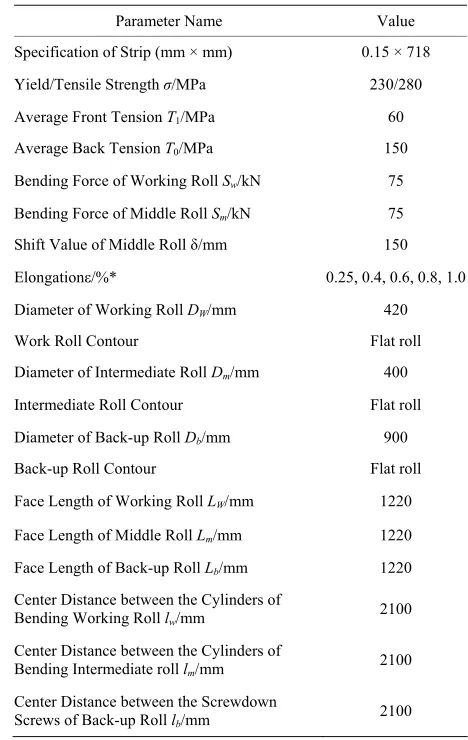
2.3. The Field Test of the Model of Roller Ends Forced-Contact and the Computational Model of Flatness for UCM Temper Mill In order to verify the correctness of relevant models in-troduced in 2.2, the second stand of 1220 UCM temper mill of Baosteel was taken as research object particularly. The working roll, intermediate roll and back-up roll were all flat roll. 0.15 × 718 mmwas chosen as specimen to do the forced-contact test (related equipments and proc-ess parameters as shown in the following Table 1). The value of contact width, actual rolling force and strip shape were given though test and also computed through the models at the same time.(It should be noted that the cutting method was adopted for the temper mill don’t have shape meter.) And then, error analysis was pro-ceeded through the comparison of test value and com-puted value, the results of error analysis are shown in the following Table 2. After the forced-contact test, the pro-duction of this specification proceeded with the elonga-tion of 1.0% until roll changing. The length of rolling this moment was recorded in the following Table 2 as well. It should be noted that the way to compute flatness errors is the following Equation (30). The following Equation (31) and Equation (32) are used to compute the maximum of computed shape value and actual shape value.
20
2
1 1
1 i i
i
I I I
(30)
max max 1i min 1i
I I I (31)
max max 1i min 1i
[image:6.595.303.537.103.473.2]I I I (32) where I is the flatness errors, I1i is the actual shape
Table 1. Equipments and process parameters of forced- contact test.
Parameter Name Value
Specification of Strip (mm × mm) 0.15 × 718
Yield/Tensile Strength σ/MPa 230/280
Average Front Tension T1/MPa 60
Average Back Tension T0/MPa 150
Bending Force of Working Roll Sw/kN 75
Bending Force of Middle Roll Sm/kN 75
Shift Value of Middle Roll δ/mm 150
Elongationε/%* 0.25, 0.4, 0.6, 0.8, 1.0
Diameter of Working Roll DW/mm 420
Work Roll Contour Flat roll
Diameter of Intermediate Roll Dm/mm 400
Intermediate Roll Contour Flat roll
Diameter of Back-up Roll Db/mm 900
Back-up Roll Contour Flat roll
Face Length of Working Roll LW/mm 1220
Face Length of Middle Roll Lm/mm 1220
Face Length of Back-up Roll Lb/mm 1220
Center Distance between the Cylinders of
Bending Working Roll lw/mm 2100
Center Distance between the Cylinders of
Bending Intermediate roll lm/mm 2100
Center Distance between the Screwdown
Screws of Back-up Roll lb/mm 2100
[image:6.595.114.484.532.723.2]Annotate: the setting elongation was ranked into five grades based on size for getting the contact conditions of the same specification in different elongations.
Table 2. Comparison between test results and computed results.
Elongationε/% 0.25 0.4 0.6 0.8 1.0 1.2
Measured Value /mm 0 20.5 132 146 173 −
Calculated Value/mm 0 18.2 121.1 137.9 181.2 −
Contact Width By
error/% 0 8.78 8.26 5.55 4.74 −
Measured Value /kN 1020 1750 4420 6540 9300 −
Calculated Value /kN 940 1920 4310 6750 9980 −
Rolling ForcePZ
Error /% 7.84 9.71 2.49 3.21 7.31 −
max
I /I-Unit 7.2 6.7 5.3 11.2 16.2 −
max
I /I-Unit 5.9 8.9 4.0 13.8 19.5 −
Shape Value
I
/I-Unit 1.2 2.1 1.2 2.3 2.8 −
Rolling Length L/km − − − − 26 −
value, I1i is the computed shape value,
2
1 1 5
1
1
10 i
i
v T
I
E
(where E and v are the
young modulus and poisson’s ratio respectively). Imax
is the maximum of actual shape value Imax is the
maximum of computed shape value.
First of all, it can be seen through Table 2 that there isn’t roller ends’ forced-contact when the elongation is 0.25% (the contact width is zero); and the roller ends’ forced-contact begin to appear when the elongation is increased to 0.4%; later on, with the increase of elonga-tion, the roller ends’ forced-contact become worse and worse; when the elongation increased to 1.11%, the roll-ing force reach to the limit value 12000KN of temper mill and the elongation will not reach to 1.2%.
In addition, it also can be seen clearly through Table 2 that the error is within 10% compared with test results
when the model of Section 2.2 is adopted, and the error of shape value is within 3I. So, the model can fully sat-isfy the precision request in the engineering application.
3. References
[1] Z. H. Bai, “Development and Research of Shape Control Technology about Skin Mill,” Doctoral Dissertations, Yanshan University, Qinhuang Island, 2002.
[2] J. C. Lian and H. M. Liu, “Guage and Shape Control,” Weapon Industry Press, Beijing, 1995.
[3] Z. H. Bai, X. P. Kang and R. B. Long, “Practical Temper Rolling Force Model and Its Self Study Technology,”
Steel, Vol. 43, No. 10, 2008, pp. 51-54.
[4] Z. H. Bai, Y. F. Jiang and X. D. Li, “Kiss between Roller Ends in Skin Rolling Process of Super Thin Strip,” Chi-nese Journal of Mechanical Engineering, Vol. 42, No. 8,