Pre-Translation for Neural Machine Translation
Jan Niehues, Eunah Cho, Thanh-Le Ha and Alex Waibel Institute for Anthropomatics
Karlsruhe Institute of Technology, Germany
Abstract
Recently, the development of neural machine translation (NMT) has significantly improved the translation quality of automatic machine translation. While most sentences are more accurate and fluent than translations by statistical machine translation (SMT)-based systems, in some cases, the NMT system produces translations that have a completely different meaning. This is especially the case when rare words occur.
When using statistical machine translation, it has already been shown that significant gains can be achieved by simplifying the input in a preprocessing step. A commonly used example is the pre-reordering approach.
In this work, we used phrase-based machine translation to pre-translate the input into the target language. Then a neural machine translation system generates the final hypothesis using the pre-translation. Thereby, we use either only the output of the phrase-based machine translation (PBMT) system or a combination of the PBMT output and the source sentence.
We evaluate the technique on the English to German translation task. Using this approach we are able to outperform the PBMT system as well as the baseline neural MT system by up to 2 BLEU points. We analyzed the influence of the quality of the initial system on the final result.
1 Introduction
In the last years, statistical machine translation (SMT) system generated state-of-the-art performance for most language pairs. Recently, systems using neural machine translation (NMT) were able to outper-form SMT systems in several evaluations. These models are able to generate more fluent and accurate translation for most of sentences.
Neural machine translation systems provide the output with high fluency. A weakness of NMT sys-tems, however, is that they sometimes lose the original meaning of the source words during translation. One example from the first conference on machine translation (WMT16) test set is the segment in Table 1.
The English wordgoalieis not translated to the correct German wordTorwart, but to the German word
Gott, which meansgod. One problem could be that we need to limit the vocabulary size in order to train the model efficiently. We used Byte Pair Encoding (BPE) (Sennrich et al., 2016) to represent the text using a fixed size vocabulary. In our case the wordgoaliis splitted into three partsgo,alandie. Then it is more difficult to transport the meaning to the translation.
In contrast to this, in phrase-based machine translation (PBMT), we do not need to limit the vocabulary and are often able to translate words even if we have seen them only very rarely in the training. In the example mentioned before, for instance, the PBMT system had no problems translating the expression correctly.
On the other hand, official evaluation campaigns (Bojar et al., 2016) have shown that NMT system often create grammatically correct sentence and are able to model the morphologically agreement much better in German.
Table 1: Example translation of NMT
English: the goalie parried
NMT: der Gott
NMT(gloss): the god
The goal of this work is to combine the advantages of neural and phrase-based machine translation systems. Handling of rare words is an essential aspect to consider when it comes to real-world applica-tions. The pre-translation framework provides a straightforward way to support such applicaapplica-tions. In our approach, we will first translate the input using a PBMT system, which can handle the rare words well. In a second step, we will generate the final translation using an NMT system. This NMT system is able to generate a more fluent and grammatically correct translation. Since the rare words are already handled by the PBMT system, there should be less problems to generate the translation of these words. Using this approach naturally introduces a necessity to handle the potential errors by the PBMT systems.
The remaining of the paper is structured as follows: In the next section we will review the related work. In Section 3, we will briefly review the phrase-based and neural approach to machine translation. Section 4 will introduce the approach presented in this paper to pre-translate the input using a PBMT system. In the following section, we will evaluate the approach and analyze the errors. Finally, we will finish with a conclusion.
2 Related Work
The idea of linear combining of machine translation systems using different paradigms has already been used successfully for SMT and rule-based machine translation (RBMT) (Dugast et al., 2007; Simard et al., 2007). They build an SMT system that is post-editing the output of an RBMT system. Using the combination of SMT and RBMT, they could outperform both single systems.
Those experiments promote the area of automatic post-editing (Bojar et al., 2015). Recently, it was shown that models based on neural MT are very successful in this task (Junczys-Dowmunt and Grund-kiewicz, 2016).
For PBMT, there has been several attempts to apply preprocessing in order to improve the performance of the translation system. A commonly used preprocessing step is morphological splitting, like com-pound splitting in German (Koehn and Knight, 2003). Another example would be to use pre-reordering in order to achieve more monotone translation (Rottmann and Vogel, 2007).
In addition, the usefulness of using the translations of the training data of a PBMT system has been shown. The translations have been used to re-train the translation model (Wuebker et al., 2010) or to train additional discriminative translation models (Niehues and Waibel, 2013).
In order to improve the translation of rare words in NMT, authors try to translate words that are not in the vocabulary in a post-processing step (Luong et al., 2015). In (Sennrich et al., 2016), a method to split words into sub-word units was presented to limit the vocabulary size. Also the integration of lexical probabilities into NMT was successfully investigated (Arthur et al., 2016).
3 Phrase-based and Neural Machine Translation
Starting with the initial work on word-based translation system (Brown et al., 1993), phrase-based ma-chine translation (Koehn et al., 2003; Och and Ney, 2004) segments the sentence into continuous phrases that are used as basic translation units. This allows for many-to-many alignments.
Based on this segmentation, the probability of the translation is calculated using a log-linear combina-tion of different features:
P(eI, fI) = Pexp(PNn=1λnhn(eI, fI))
e0Iexp(PNn=1λnhn(e0I, fI)) (1)
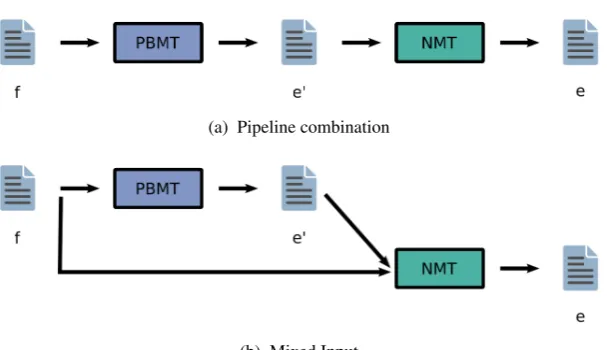
Figure 1: Pre-translation methods
(a) Pipeline combination
(b) Mixed Input
translation process have been developed. Especially models using neural networks were able to increase the translation performance.
Recently, state-of-the art performance in machine translation was significantly improved by using neural machine translation. In this approach to machine translation, a recurrent neural network (RNN)-based encoder-decoder architecture is used to transform the source sentence into the target sentence.
In the encoder, an RNN is used to encode the source sentence into a fixed size continuous space repre-sentation by inserting the source sentence word-by-word into the network. In a second step, the decoder is initialized by the representation of the source sentence and is then generating the target sequence one word after the other using the last generated word as input for the RNN (Sutskever et al., 2014).
One main drawback of this approach is that the whole source sentence has to be stored in a fixed-size context vector. To overcome this problem, (Bahdanau et al., 2014) introduced the soft attention mechanism. Instead of only considering the last state of the encoder RNN, they use a weighted sum of all hidden states. Using these weights, the model is able to put attention on different parts of the source sentence depending on the current status of the decoder RNN. In addition, they extended the encoder RNN to a bi-directional one to be able to get information from the whole sentence at every position of the encoder RNN. A detailed description of the NMT framework can be found in (Bahdanau et al., 2014).
4 PBMT Pre-translation for NMT (PreMT)
In this work, we want to combine the advantages of PBMT and NMT. Using the combined system we should be able to generate a translation for all words that occur at least once in the training data, while maintaining high quality translations for most sentences from NMT. Motivated by several approaches to simplify the translation process for PBMT using preprocessing, we will translate the source as a preprocessing step using the phrase-base machine translation system.
The main translation task is done by the neural machine translation model, which can choose between using the output of the PBMT system or the original input when generate the translation.
4.1 Pipeline
In our first attempt, we combined the phrase-based MT and the neural MT in one pipeline as shown in Figure 1a. The input is first processed by the phrase-based machine translation system from the input languagef to the target languagee0. Since the machine translation system is not perfect, the output of
the system may not be correct translation containing errors possibly. Therefore, we will call the output language of the PBMT systeme0.
4.2 Mixed Input
One drawback of the pipelined approach is that the PBMT system might introduce some errors in the translation that the NMT can not recover from. For example, it is possible that some information from the source sentence gets lost, since the word is entirely deleted during the translation of the PBMT system.
We try to overcome this problem by building an NMT system that does not only take the output of the PBMT system, but also the original source sentence. One advantage of NMT system is that we can easily encode different input information. The architecture of our system is shown in Figure 1b.
The implementation of the mixed input for the NMT system is straight forward. Given the source inputf =f1, . . . fI and the output of the PBMT systeme0 =e01, . . . e0J0, we generated the input for the
NMT system. First, we ensured a non-overlapping vocabulary off ande0 by marking each token inf
by a character ande0 by different ones. Then both input sequences are concatenated to the inpute∗ of
the NMT system.
Using this representation, the NMT can learn to focus on source wordfj and wordse0i0 when
generat-ing a worde0
j.
4.3 Training
In both cases, we can no longer train the NMT system on the source language and target language data, but on the output of the PBMT system and the target language data. Therefore, we need to generate translations of the whole parallel training data using the PBMT system.
Due to its ability to use very long phrases, a PBMT system normally performs significantly better on the training data than on unseen test data. This of course will harm the performance of our approach, because the NMT system will underestimate the number of improvements it has to perform on the test data.
In order to limit this effect, we did not use the whole phrase tables when translating the training data. If a phrase pair only occurs once, we cannot learn it from a different sentence pair. Following (Niehues and Waibel, 2013), we removed all phrase pairs that occur only once for the translation of the corpus.
5 Experiments
We analyze the approach on the English to German news translation task of the Conference on Statistical Machine Translation (WMT). First, we will describe the system and analyze the translation quality mea-sured in BLEU. Afterwards, we will analyze the performance depending on the frequency of the words and finally show some example translations.
5.1 System description
For the pre-translation, we used a PBMT system. In order to analyze the influence of the quality of the PBMT system, we use two different systems, a baseline system and a system with advanced models. The systems were trained on all parallel data available for the WMT 20161. The news commentary
corpus, the European parliament proceedings and the common crawl corpus sum up to 3.7M sentences and around 90M words.
In the baseline system, we use three language models, a word-based, a bilingual (Niehues et al., 2011) and a cluster based language model, using 100 automatically generated clusters using MKCLS (Och, 1999).
The advanced system use pre-reodering (Herrmann et al., 2013) and lexicalized reordering. In addi-tion, it uses a discriminative word lexicon (Niehues and Waibel, 2013) and a language model trained on the large monolingual data.
Both systems were optimized on the tst2014 using Minimum error rate training (Och, 2003). A de-tailed description of the systems can be found in (Ha et al., 2016).
The neural machine translation was trained using Nematus2. For the NMT system as well as for the
PreMT system, we used the default configuration. In order to limit the vocabulary size, we use BPE as 1http://www.statmt.org/wmt16/translation-task.html
described in (Sennrich et al., 2016) with 40K operations. We run the NMT system for 420K iterations and stored a model every 30K iterations. We selected the model that performed best on the development data. For the ensemble system we took the last four models. We did not perform an additional fine-tuning.
The PreMT system was trained on translations of the PBMT system of the corpus and the target side of the corpus. For this translation, we only used the baseline PBMT system.
5.2 English - German Machine Translation
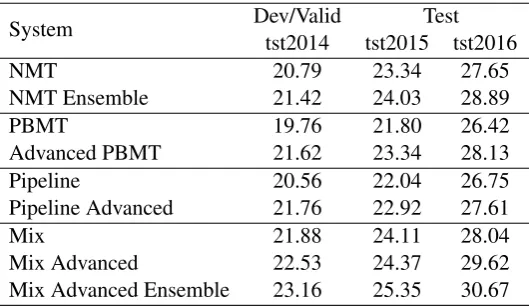
The results of all systems are summarized in Table 2. It has to be noted, that the first set, tst2014, has been used as development data for the PBMT system and as validation set for the NMT-based systems.
System Dev/Validtst2014 tst2015 tst2016Test
NMT 20.79 23.34 27.65
NMT Ensemble 21.42 24.03 28.89
PBMT 19.76 21.80 26.42
Advanced PBMT 21.62 23.34 28.13
Pipeline 20.56 22.04 26.75
Pipeline Advanced 21.76 22.92 27.61
Mix 21.88 24.11 28.04
Mix Advanced 22.53 24.37 29.62
[image:5.595.167.432.201.354.2]Mix Advanced Ensemble 23.16 25.35 30.67
Table 2: Experiments for English→German
Using the neural MT system, we reach a BLEU score of 23.34 and 27.65 on tst2015 and tst2016. Using an ensemble system, we can improve the performance to 24.03 and 28.89 respectively. The baseline PBMT system performs 1.5 to 1.2 BLEU points worse than the single NMT system. Using the PBMT system with advanced models, we get the same performance on the tst2015 and 0.5 BLEU points better on tst2016 compared to the NMT system.
First, we build a PreMT system using the pipeline method as described in Section 4.1. The system reaches a BLEU score of 22.04 and 26.75 on both test sets. While the PreMT can improve of the baseline PBMT system, the performance is worse than the pure NMT system. So the first approach to combine neural and statistical machine translation is not able the combine the strength of both system. In contrast, the NMT system seems to be not able to recover from the errors done by the SMT-based system.
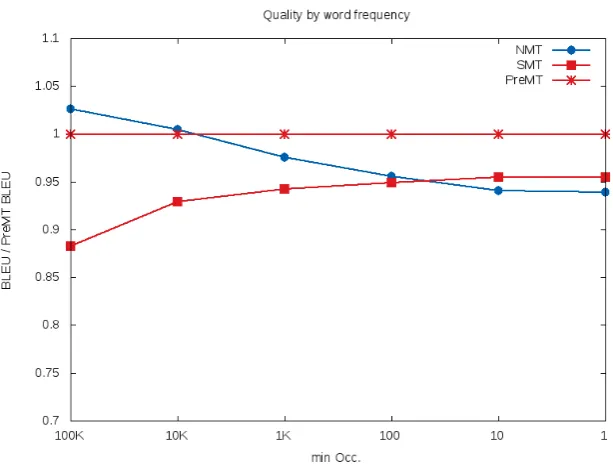
Figure 2: Compare BLEU score by word frequency
Using the advanced PBMT system for input, we can get additional gains of 0.3 and 1.6 BLEU points The system even outperforms the ensemble system on tst2016. The experiments showed that deploying a pre-translation PBMT system with a better quality improves the NMT quality in the mixed input scheme, even when it is used only in testing, not in training.
By using an ensemble of four model, we improve the model by one BLEU point on both test sets, leading to the best results of 25.35 and 30.67 BLEU points. This is 1.3 and 1.8 BLEU points better than the pure NMT ensemble system.
5.3 System Comparison
After evaluating the approach, we further analyze the different techniques for machine translation. For this, we compared the single NMT system, the advanced PBMT system and the mixed system using the advanced PBMT system as input.
Out initial idea was that PBMT systems are better for translating rare words, while the NMT is gen-erating more fluent translation. To confirm this assumption, we edited the output of all system. For all analyzed systems, we replaced all target words, which occur in the training data less thanN times, by theUNKtoken. For largeN, we have therefore only the most frequent words in the reference, while for lowerN more and more words are used.
The results for N ∈ {1,10,100,1K,10K,100K} are shown in Figure 2. Of course, with lower N we will have fewer UNK tokens in the output. Therefore, we normalized the BLEU scores by the performance of the PreMT system.
We can see in the figure, that whenN = 100K, where only the common words are used, we perform best using the NMT system. The PreMT system performs similar and the PBMT system performs clearly worse. If we now decreaseN, more and more less frequent words will be considered in the evaluation of the translation quality. Although the absolute BLEU scores raise for all systems, on these less frequent words the PBMT performs better than the NMT system and therefore, finally it even achieves a better performance.
Table 3: Example sentence translated by different techniques
English: Then with a shot which thegoalie parriedwith his knee in the 35th minute.
PBMT: Dann mit einem Schuss, die derTorwart pariertmit seinem Knie in der 35. Minute. NMT: Dann mit einem Schuss, den derGottmit seinem Knie in der 35. Minute.
[image:7.595.75.525.181.447.2]Pre: Dann mit einem Schuss, das derTorwartmit seinem Knie in der 35. Minutepariert. Pre(gloss): Then with a shoot, that the goali with his knee in the 35th minute parried.
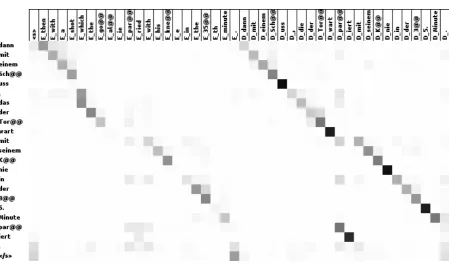
Figure 3: Alignment generated by attention model
5.4 Examples
In Table 3 we show the output of the PBMT, NMT and PreMT system. First, for the PBMT system, we see a typical error when translating from and to German. The verb of the subclauseparriedis located at the second position in English, but in the German sentence it has to be located at the end of the sentence. The PBMT system is often not able to perform this long-range reordering.
For the NMT system, we see two other errors. Both, the words goalieandparried are quite rarely in the training data and therefore, they are splitted into several parts by the BPE algorithm. In this case, the NMT makes more errors. For the first word, the NMT system generates a complete wrong translationGott (engl. god)instead ofTorwart. The second word is just dropped and does not appear in the translation.
The example shows that the pre-translation system prevents both errors. It is generating the correct wordsTorwartandpariertand putting them at the correct position in the German sentence.
To better understand how the pre-translation system is able to generate this translation, we also gener-ated the alignment matrix of the attention model as shown in Figure 3. The x-axis shows the input, where the words from the pre-translation are marked byD and the words from the original source byE . The y-axis carries the translation. The symbol@@marks subword units generated by the BPE algorithm. First, as indicated by the two diagonal lines the model is considering as both inputs, the original source and the pre-translation by the two diagonal lines.
Secondly, we see that the attention model is mainly focusing on the pre-translation for words that are not common and therefore got splitted into several parts by the BPE, such asshoot,goalieandparried.
Table 4: Example of rare word translation
English: ... a riot in the stadium. PBMT: ... einen Aufruhr im Stadion. NMT: ... einen Riot im Stadion. Pre: ... einen Aufruhr im Station. Pre (gloss): ... a riot in the stadium.
behaviour is helpful for rare words like named entities, but the NMT system is using it also for many words that are not named entities. Other examples for words that were just passed through and not translated arecrossbarorvigil.
6 Conclusion
In this paper, we presented a technique to combine phrase-based and neural machine translation. Mo-tivated by success in statistical machine translation, we used phrase-based machine translation to pre-translate the input and then we generate the final translation using neural machine translation.
While a simple serial combination of both models could not generate better translation than the neural machine translation system, we are able to improve over neural machine translation using a mixed input. By simple concatenation of the phrase-based translation and the original source as input for the neural machine translation, we can increase the machine translation quality measured in BLEU. The single pre-translated system could even outperform the ensemble NMT system. For the ensemble system, the PreMT system could outperform the NMT system by up to 1.8 BLEU points.
Using the combined approach, we can generate more fluent translation typical for the NMT system, but also translate rare words. These are often more easily translated by PBMT. Furthermore, we are able to improve the overall system performance by improving the individual components.
Acknowledgments
The project leading to this application has received funding from the European Union’s Horizon 2020 research and innovation programme under grant agreement n◦645452. This work was supported by the
Carl-Zeiss-Stiftung.
References
Philip Arthur, Graham Neubig, and Satoshi Nakamura. 2016. Incorporating discrete translation lexicons into
neural machine translation. InConference on Empirical Methods in Natural Language Processing (EMNLP),
Austin, Texas, USA, November.
Dzmitry Bahdanau, Kyunghyun Cho, and Yoshua Bengio. 2014. Neural machine translation by jointly learning to align and translate. CoRR, abs/1409.0473.
Ondˇrej Bojar, Rajen Chatterjee, Christian Federmann, Barry Haddow, Matthias Huck, Chris Hokamp, Philipp Koehn, Varvara Logacheva, Christof Monz, Matteo Negri, Matt Post, Carolina Scarton, Lucia Specia, and
Marco Turchi. 2015. Findings of the 2015 workshop on statistical machine translation. InProceedings of the
Tenth Workshop on Statistical Machine Translation, pages 1–46, Lisbon, Portugal, September. Association for Computational Linguistics.
Ondˇrej Bojar, Rajen Chatterjee, Christian Federmann, Yvette Graham, Barry Haddow, Matthias Huck, Antonio Ji-meno Yepes, Philipp Koehn, Varvara Logacheva, Christof Monz, Matteo Negri, Aurelie Neveol, Mariana Neves, Martin Popel, Matt Post, Raphael Rubino, Carolina Scarton, Lucia Specia, Marco Turchi, Karin Verspoor, and
Marcos Zampieri. 2016. Findings of the 2016 conference on machine translation. InProceedings of the First
Conference on Machine Translation, pages 131–198, Berlin, Germany, August. Association for Computational Linguistics.
Lo¨ıc Dugast, Jean Senellart, and Philipp Koehn. 2007. Statistical post-editing on systran’s rule-based translation
system. InProceedings of the Second Workshop on Statistical Machine Translation, pages 220–223, Prague,
Czech Republic, June. Association for Computational Linguistics.
Thanh-Le Ha, Eunah Cho, Jan Niehues, Mohammed Mediani, Matthias Sperber, Alexandre Allauzen, and Alexan-der Waibel. 2016. The karlsruhe institute of technology systems for the news translation task in wmt 2016. In Proceedings of the First Conference on Machine Translation, pages 303–310, Berlin, Germany, August. Association for Computational Linguistics.
Teresa Herrmann, Jan Niehues, and Alex Waibel. 2013. Combining Word Reordering Methods on different Linguistic Abstraction Levels for Statistical Machine Translation. InProceedings of the Seventh Workshop on Syntax, Semantics and Structure in Statistical Translation, Altanta, Georgia, USA.
Marcin Junczys-Dowmunt and Roman Grundkiewicz. 2016. Log-linear combinations of monolingual and bilin-gual neural machine translation models for automatic post-editing. InProceedings of the First Conference on Machine Translation, pages 751–758, Berlin, Germany, August. Association for Computational Linguistics.
Philipp Koehn and Kevin Knight. 2003. Empirical Methods for Compound Splitting. InEACL, Budapest,
Hun-gary.
Philipp Koehn, Franz Josef Och, and Daniel Marcu. 2003. Statistical phrase-based translation. InProceedings
of the 2003 Conference of the North American Chapter of the Association for Computational Linguistics on Human Language Technology - Volume 1, NAACL ’03, pages 48–54, Stroudsburg, PA, USA. Association for Computational Linguistics.
Thang Luong, Ilya Sutskever, Quoc V. Le, Oriol Vinyals, and Wojciech Zaremba. 2015. Addressing the rare
word problem in neural machine translation. InProceedings of the 53rd Annual Meeting of the Association
for Computational Linguistics and the 7th International Joint Conference on Natural Language Processing of the Asian Federation of Natural Language Processing, ACL 2015, July 26-31, 2015, Beijing, China, Volume 1: Long Papers, pages 11–19.
Jan Niehues and Alex Waibel. 2013. An MT Error-Driven Discriminative Word Lexicon using Sentence Structure Features. InProceedings of the Eighth Workshop on Statistical Machine Translation, Sofia, Bulgaria.
Jan Niehues, Teresa Herrmann, Stephan Vogel, and Alex Waibel. 2011. Wider Context by Using Bilingual
Language Models in Machine Translation. InSixth Workshop on Statistical Machine Translation (WMT 2011),
Edinburgh, Scotland, United Kingdom.
Franz Josef Och and Hermann Ney. 2004. The alignment template approach to statistical machine translation. Comput. Linguist., 30(4):417–449, December.
Franz Josef Och. 1999. An Efficient Method for Determining Bilingual Word Classes. InProceedings of the Ninth
Conference of the European Chapter of the Association for Computational Linguistics (EACL 1999), Bergen, Norway.
Franz Josef Och. 2003. Minimum Error Rate Training in Statistical Machine Translation. In41st Annual Meeting
of the Association for Computational Linguistics (ACL), Sapporo, Japan.
Kay Rottmann and Stephan Vogel. 2007. Word Reordering in Statistical Machine Translation with a POS-Based
Distortion Model. In Proceedings of the 11th International Conference on Theoretical and Methodological
Issues in Machine Translation (TMI 2007), Sk¨ovde, Sweden.
Rico Sennrich, Barry Haddow, and Alexandra Birch. 2016. Neural machine translation of rare words with subword units. InProceedings of the 54th Annual Meeting of the Association for Computational Linguistics, ACL 2016, August 7-12, 2016, Berlin, Germany, Volume 1: Long Papers.
Michel Simard, Cyril Goutte, and Pierre Isabelle. 2007. Statistical phrase-based post-editing. InIn Proceedings of NAACL.
Ilya Sutskever, Oriol Vinyals, and Quoc V Le. 2014. Sequence to sequence learning with neural networks. In
Z. Ghahramani, M. Welling, C. Cortes, N. D. Lawrence, and K. Q. Weinberger, editors,Advances in Neural
Information Processing Systems 27, pages 3104–3112. Curran Associates, Inc.