Question Answering Using Encyclopedic Knowledge
Generated from the Web
Atsushi Fujii University of Library and
Information Science 1-2 Kasuga, Tsukuba
305-8550, Japan CREST, Japan Science and
Technology Corporation [email protected]
Tetsuya Ishikawa University of Library and
Information Science 1-2 Kasuga, Tsukuba
305-8550, Japan [email protected]
Abstract
We propose a question answering sys-tem which uses an encyclopedia as a knowledge base. However, since ex-isting encyclopedias lack technical/new terms, we use an encyclopedia automat-ically generated from the World Wide Web. For this purpose, we first search the Web for pages containing a term in question. Then linguistic patterns and HTML structures are used to ex-tract text fragments describing the term. Finally, extracted term descriptions are organized based on word senses and domains. We also evaluate our sys-tem by way of experiments, where the Japanese Information-Technology En-gineers Examination is used as a test collection.
1 Introduction
Motivated partially by the TREC-8 QA collec-tion (Voorhees and Tice, 2000), quescollec-tion answer-ing has of late become one of the major topics within the natural language processing and infor-mation retrieval communities, and a number of QA systems targeting the TREC collection have been proposed (Harabagiu et al., 2000; Moldovan and Harabagiu, 2000; Prager et al., 2000).
Although Harabagiu et al. (2000) proposed a knowledge-based QA system, most existing sys-tems rely on conventional IR and shallow NLP methods. However, question answering is
inher-ently a more complicated procedure that usually requires explicit knowledge bases.
In this paper, we propose a question answering system which uses an encyclopedia as a knowl-edge base. However, since existing (published) encyclopedias usually lack technical/new terms, we generate one based on the World Wide Web, which includes a number of technical and recent information. For this purpose, we use a modified version of our method to extract term descriptions from Web pages (Fujii and Ishikawa, 2000).
Intuitively, our system answers interrogative questions like “What is X?” in which a QA sys-tem searches an encyclopedia database for one or more descriptions related to term X.
The performance of QA systems can be evalu-ated based on coverage and accuracy. Coverage is the ratio between the number of questions an-swered (disregarding their correctness) and the to-tal number of questions. Accuracy is the ratio be-tween the number of correct answers and the total number of answers made by the system. While coverage can be estimated objectively and sys-tematically, estimating accuracy relies on human subjects (because it is difficult to define the abso-lute description for term X), and thus is expensive. In view of this problem, we use as a test col-lection Information Technology Engineers Exam-inations1, which are biannual examinations nec-essary for candidates to qualify to be IT engineers in Japan.
Among a number of classes, we focus on the “Class II” examination, which requires
funda-1
mental and general knowledge related to informa-tion technology. Approximately half of quesinforma-tions are associated with IT technical terms. Since past examinations and answers are open to the pub-lic, we can objectively evaluate the performance of our QA system with minimal cost.
Our system is not categorized into “open-domain” systems, where questions expressed in natural language are not limited to explicit axes including who, what, when, where, how and why. However, Moldovan and Harabagiu (2000) found that each of the TREC questions can be re-cast as either a single axis or a combination of axes. They also found that out of the 200 TREC questions, 64 questions (approximately one third) were associated with the what axis, for which our encyclopedia-based system is expected to im-prove the quality of answers.
Section 2 analyzes the Japanese IT Engineers Examination, and Section 3 explains our question answering system. Then, Sections 4 and 5 elab-orate on our Web-base method for encyclopedia generation. Finally, Section 6 evaluates our sys-tem by way of experiments.
2 IT Engineers Examinations
The Class II examination consists of quadruple-choice questions, among which technical term questions can be subdivided into two types.
In the first type of question, examinees choose the most appropriate description for a given tech-nical term, such as “memory interleave” and “router.”
In the second type of question, examinees choose the most appropriate term for a given question, for which we show examples collected from the examination in the autumn of 1999 (translated into English by one of the authors) as follows:
1. Which data structure is most appropriate for FIFO (First-In First-Out)?
a) binary trees, b) queues, c) stacks, d) heaps
2. Choose a LAN access method where mul-tiple terminals transmit data simultaneously and thus they potentially collide.
a) ATM, b) CSM/CD, c) FDDI, d) token ring
In the autumn of 1999, out of 80 question, the number of the first and second types were 22 and 18, respectively.
3 Overview of our QA system
For the first type of question (see Section 2), human examinees would search their knowledge base (i.e., memory) for the description of a given term, and compare that description with four can-didates. Then they would choose the candidate that is most similar to the description.
For the second type of question, human exam-inees would search their knowledge base for the description of each of four candidate terms. Then they would choose the candidate term whose de-scription is most similar to the question.
The mechanism of our QA system is analogous to the above human methods. However, our sys-tem uses as a knowledge base an encyclopedia generated from the Web.
To compute the similarity between two de-scriptions, we use techniques developed in IR re-search, in which the similarity between a user query and each document in a collection is usu-ally quantified based on word frequencies. In our case, a question and four possible answers corre-spond to query and document collection, respec-tively. We use one of the major probabilistic IR method (Robertson and Walker, 1994).
To sum up, given a question, its type and four choices, our QA system chooses as the answer one of four candidates, in which resolution algo-rithm varies depending on the question type.
4 Encyclopedia Generation 4.1 Overview
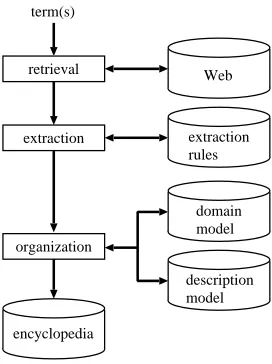
Figure 1 depicts the overall design of our method to generate an encyclopedia for input terms. This figure consists of three modules: “retrieval,” “ex-traction” and “organization,” among which the organization module is newly introduced in this paper. In principle, the remaining two modules (“retrieval” and “extraction”) are the same as pro-posed by Fujii and Ishikawa (2000).
dynamically processed in real-time usage. In ei-ther case, our system processes input terms one by one. We briefly explain each module in the following three sections, respectively.
domain model
Web
extraction rules
organization
encyclopedia retrieval
extraction term(s)
description model
Figure 1: The overview of our Web-based ency-clopedia generation process.
4.2 Retrieval
The retrieval module searches the Web for pages containing an input term, for which existing Web search engines can be used, and those with broad coverage are desirable.
However, search engines performing query ex-pansion are not always desirable, because they usually retrieve a number of pages which do not contain a query keyword. Since the extraction module (see Section 4.3) analyzes the usage of the input term in retrieved pages, pages not con-taining the term are of no use for our purpose.
Thus, we use as the retrieval module “Google,” which is one of the major search engines and does not conduct query expansion2.
4.3 Extraction
In the extraction module, given Web pages con-taining an input term, newline codes, redundant white spaces and HTML tags that are not used in the following process are discarded so as to stan-dardize the page format.
Second, we (approximately) identify a region describing the term in the page, for which two rules are used.
2
http://www.google.com/
The first rule is based on Japanese linguis-tic patterns typically used for term descrip-tions, such as “X toha Y dearu (X is Y).” Following the method proposed by Fujii and Ishikawa (2000), we semi-automatically pro-duced 20 patterns based on the Japanese CD-ROM World Encyclopedia (Heibonsha, 1998), which includes approximately 80,000 entries re-lated to various fields.
It is expected that a region including the sen-tence that matched with one of those patterns can be a term description.
The second rule is based on HTML layout. In a typical case, a term in question is highlighted as a heading with tags such as <DT>, <B> and
<Hx> (“x” denotes a digit), followed by its
de-scription. In some cases, terms are marked with the anchor<A>tag, providing hyperlinks to pages where they are described.
Finally, based on the region briefly identified by the above method, we extract a page frag-ment as a term description. Since term descrip-tions usually consist of a logical segment (such as a paragraph) rather than a single sentence, we extract a fragment that matched with one of the following patterns, which are sorted according to preference in descending order:
1. description tagged with <DD> in the case where the term is tagged with<DT>3,
2. paragraph tagged with<P>,
3. itemization tagged with<UL>,
4. N sentences, where we empirically set
N = 3.
4.4 Organization
For the purpose of organization, we classify ex-tracted term descriptions based on word senses and domains.
Although a number of methods have been pro-posed to generate word senses (for example, one based on the vector space model (Sch¨utze, 1998)), it is still difficult to accurately identify word senses without explicit dictionaries that predefine sense candidates.
3<DT>
Since word senses are often associated with domains (Yarowsky, 1995), word senses can be consequently distinguished by way of determin-ing the domain of each description. For ex-ample, different senses for “pipeline (processing method/transportation pipe)” are associated with computer and construction domains (fields), re-spectively.
To sum up, the organization module classifies term descriptions based on domains, for which we use domain and description models. In Section 5, we elaborate on the organization model.
5 Statistical Organization Model
5.1 Overview
Given one or more (in most cases more than one) descriptions for a single term, the organization module selects appropriate description(s) for each domain related to the term.
We do not need all the extracted descriptions as final outputs, because they are usually similar to one another, and thus are redundant. For the moment, we assume that we know a priori which domains are related to the input term.
From the viewpoint of probability theory, our task here is to select descriptions with greater probability for given domains. The probability for descriptiondgiven domainc,P(d|c), is com-monly transformed as in Equation (1), through use of the Bayesian theorem.
P(d|c) = P(c|d)·P(d)
P(c) (1)
In practice,P(c)can be omitted because this fac-tor is a constant, and thus does not affect the rela-tive probability for different descriptions.
In Equation (1), P(c|d) models a probability that dcorresponds to domain c. P(d) models a probability thatdcan be a description for the term in question, disregarding the domain. We shall call them domain and description models, respec-tively.
To sum up, in principle we selectd’s that are strongly associated with a certain domain, and are likely to be descriptions themselves.
Extracted descriptions are not linguistically un-derstandable in the case where the extraction pro-cess is unsucpro-cessful and retrieved pages
inher-ently contain non-linguistic information (such as special characters and e-mail addresses).
To resolve this problem, we previously used a language model to filter out descriptions with low perplexity (Fujii and Ishikawa, 2000). How-ever, in this paper we integrated a description model, which is practically the same as a lan-guage model, with an organization model. The new framework is more understandable with re-spect to probability theory.
In practice, we first use Equation (1) to com-pute P(d|c) for all thec’s predefined in the do-main model. Then we discard such c whose
P(d|c)is below a specific threshold. As a result, for the input term, related domains and descrip-tions are simultaneously selected. Thus, we do not have to know a priori which domains are re-lated to each term.
In the following two sections, we explain meth-ods to realize the domain and description models, respectively.
5.2 Domain Model
The domain model quantifies the extent to which descriptiondis associated with domainc, which is fundamentally a categorization task.
Among a number of existing categorization methods, we experimentally used one proposed by Iwayama and Tokunaga (1994), which formu-latesP(c|d)as in Equation (2).
P(c|d) =P(c)·
t
P(t|c)·P(t|d) P(t) (2)
Here,P(t|d), P(t|c) andP(t) denote probabili-ties that wordtappears ind,cand all the domains, respectively. We regardP(c)as a constant. While
P(t|d)is simply a relative frequency oftind, we need predefined domains to computeP(t|c) and
P(t). For this purpose, the use of large-scale
cor-pora annotated with domains is desirable.
However, since those resources are pro-hibitively expensive, we used the “Nova” dic-tionary for Japanese/English machine translation systems4, which includes approximately one mil-lion entries related to 19 technical fields as listed below:
4
aeronautics, biotechnology, business, chemistry, computers, construction, de-fense, ecology, electricity, energy, fi-nance, law, mathematics, mechan-ics, medicine, metals, oceanography, plants, trade.
We extracted words from dictionary entries to estimate P(t|c) and P(t). For Japanese en-tries, we used the ChaSen morphological ana-lyzer (Matsumoto et al., 1997) to extract words. We also used English entries because Japanese descriptions often contain English words.
It may be argued that statistics extracted from dictionaries are unreliable, because word frequen-cies in real word usage are missing. However, words that are representative for a domain tend to be frequently used in compound word entries associated with the domain, and thus our method is a practical approximation.
5.3 Description Model
The description model quantifies the extent to which a given page fragment is feasible as a scription for the input term. In principle, we de-compose the description model into language and quality properties, as shown in Equation (3).
P(d) =PL(d)·PQ(d) (3)
Here, PL(d) and PQ(d) denote language and quality models, respectively.
It is expected that the quality model discards incorrect or misleading information contained in Web pages. For this purpose, a number of qual-ity rating methods for Web pages (Amento et al., 2000; Zhu and Gauch, 2000) can be used.
However, since Google (i.e., the search engine we used in the retrieval module) rates the quality of pages based on hyperlink information, and se-lectively retrieves those with higher quality (Brin and Page, 1998), we tentatively regarded PQ(d)
as a constant. Thus, in practice the description model is approximated solely with the language model as in Equation (4).
P(d)≈PL(d) (4)
Statistical approaches to language modeling have been used in much NLP research, such as machine translation (Brown et al., 1993) and
speech recognition (Bahl et al., 1983). Our lan-guage model is almost the same as existing mod-els, but is different in two respects.
First, while general language models quantify the extent to which a given word sequence is lin-guistically acceptable, our model also quantifies the extent to which the input is acceptable as a term description. Thus, we trained the model based on an existing machine readable encyclo-pedia.
We used the ChaSen morphological analyzer to segment the Japanese CD-ROM World Ency-clopedia (Heibonsha, 1998) into words (we re-placed headwords with a common symbol), and then used the CMU-Cambridge toolkit (Clark-son and Rosenfeld, 1997) to model a word-based trigram. Consequently, descriptions in which word sequences are more similar to those in the World Encyclopedia are assigned greater proba-bility scores through our language model.
Second, P(d), which is generally a product of probabilities for N-grams in d, is quite sen-sitive to the length ofd. In the cases of machine translation and speech recognition, this problem is less crucial because multiple candidates com-pared based on the language model are almost equivalent in terms of length. For example, in the case of machine translation, candidates are trans-lations for a single input, which are usually com-parable with respect to length.
However, since in our case length of tions are significantly different, shorter descrip-tions are more likely to be selected, regardless of the quality. To avoid this problem, we normalize
P(d)by the number of words contained ind.
6 Experimentation
6.1 Methodology
We evaluated the performance of our question an-swering system, for which we used as test in-puts 40 technical term questions collected from the Class II examination (the autumn of 1999).
1,000 pages, the remaining pages were not used in our experiments.
For each test term, we computed P(d|c) us-ing Equation (1) and discarded domains whose
P(d|c) was below 0.05. Then, for each remain-ing domain, the top three descriptions with higher
P(d|c)values were selected as the final outputs, because a preliminary experiment showed that a correct description was generally found in the top three candidates.
In addition, to estimate a baseline perfor-mance, we used the “Nichigai” computer nary (Nichigai Associates, 1996). This dictio-nary lists approximately 30,000 Japanese techni-cal terms related to the computer field, and con-tains descriptions for 13,588 terms. In this dictio-nary 42 out of 96 test terms were described.
We compared the following three different re-sources as a knowledge base:
• the Nichigai dictionary (“Nichigai”),
• the descriptions generated in the first experi-ment (“Web”),
• combination of both resources (“Nichigai + Web”).
6.2 Results
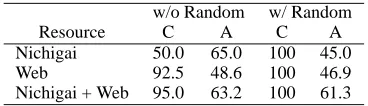
Table 1 shows the result of our comparative ex-periment, in which “C” and “A” denote coverage and accuracy, respectively, for variations of our QA system.
Since all the questions we used are quadruple-choice, in case the system cannot answer the question, random choice can be performed to im-prove the coverage to 100%.
Thus, for each knowledge resource we com-pared cases without/with random choice, which are denoted “w/o Random” and “w/ Random” in Table 1, respectively.
Table 1: Coverage and accuracy (%) for different question answering methods.
w/o Random w/ Random
Resource C A C A
Nichigai 50.0 65.0 100 45.0 Web 92.5 48.6 100 46.9 Nichigai + Web 95.0 63.2 100 61.3
In the case where random choice was not per-formed, the Web-based encyclopedia noticeably improved the coverage for the Nichigai dictio-nary, but decreased the accuracy. However, by combining both resources, the accuracy was no-ticeably improved, and the coverage was compa-rable with that for the Nichigai dictionary.
On the other hand, in the case where random choice was performed, the Nichigai dictionary and the Web-based encyclopedia were compara-ble in terms of both the coverage and accuracy. Additionally, by combining both resources, the accuracy was further improved.
We also investigated the performance of our QA system where descriptions related to the com-puter domain are solely used. For example, the description of “pipeline (transportation pipe)” is in principle irrelevant or misleading to answer questions associated with “pipeline (processing method).”
However, coverage/accuracy did not change, because approximately one third of the resultant descriptions were inherently related to the com-puter domain, and thus those related to minor do-mains did not affect the result.
7 Conclusion
In this paper, we proposed a question answering system which uses an encyclopedia as a knowl-edge base. For this purpose, we reformalized our Web-based extraction method, and proposed a new statistical organization model to improve the quality of extracted data.
Given a term for which encyclopedic knowl-edge (i.e., descriptions) is to be generated, our method sequentially performs a) retrieval of Web pages containing the term, b) extraction of page fragments describing the term, and c) organiz-ing extracted descriptions based on domains (and consequently word senses).
Acknowledgments
The authors would like to thank NOVA, Inc. for their support with the Nova dictionary and Katunobu Itou (The National Institute of Ad-vanced Industrial Science and Technology, Japan) for his insightful comments on this paper.
References
Brian Amento, Loren Terveen, and Will Hill. 2000. Does “authority” mean quality? predicting expert quality ratings of Web documents. In Proceedings of the 23rd Annual International ACM SIGIR Con-ference on Research and Development in Informa-tion Retrieval, pages 296–303.
Lalit. R. Bahl, Frederick Jelinek, and Robert L. Mer-cer. 1983. A maximum linklihood approach to continuous speech recognition. IEEE Transac-tions on Pattern Analysis and Machine Intelligence, 5(2):179–190.
Sergey Brin and Lawrence Page. 1998. The anatomy of a large-scale hypertextual Web search engine. Computer Networks, 30(1–7):107–117.
Peter F. Brown, Stephen A. Della Pietra, Vincent J. Della Pietra, and Robert L. Mercer. 1993. The mathematics of statistical machine translation: Pa-rameter estimation. Computational Linguistics, 19(2):263–311.
Philip Clarkson and Ronald Rosenfeld. 1997. Statisti-cal language modeling using the CMU-Cambridge toolkit. In Proceedings of EuroSpeech’97, pages 2707–2710.
Atsushi Fujii and Tetsuya Ishikawa. 2000. Utilizing the World Wide Web as an encyclopedia: Extract-ing term descriptions from semi-structured texts. In Proceedings of the 38th Annual Meeting of the Association for Computational Linguistics, pages 488–495.
Sanda M. Harabagiu, Marius A. Pas¸ca, and Steven J. Maiorano. 2000. Experiments with open-domain textual question answering. In Proceedings of the 18th International Conference on Computational Linguistics, pages 292–298.
Hitachi Digital Heibonsha. 1998. CD-ROM World Encyclopedia. (In Japanese).
Makoto Iwayama and Takenobu Tokunaga. 1994. A probabilistic model for text categorization: Based on a single random variable with multiple values. In Proceedings of the 4th Conference on Applied Natural Language Processing, pages 162–167.
Yuji Matsumoto, Akira Kitauchi, Tatsuo Yamashita, Yoshitaka Hirano, Osamu Imaichi, and Tomoaki Imamura. 1997. Japanese morphological analysis system ChaSen manual. Technical Report NAIST-IS-TR97007, NAIST. (In Japanese).
Dan Moldovan and Sanda Harabagiu. 2000. The structure and performance of an open-domain ques-tion answering system. In Proceedings of the 38th Annual Meeting of the Association for Computa-tional Linguistics, pages 563–570.
Nichigai Associates. 1996. English-Japanese com-puter terminology dictionary. (In Japanese).
John Prager, Eric Brown, and Anni Coden. 2000. Question-answering by predictive annotation. In Proceedings of the 23rd Annual International ACM SIGIR Conference on Research and Development in Information Retrieval, pages 184–191.
S. E. Robertson and S. Walker. 1994. Some simple effective approximations to the 2-poisson model for probabilistic weighted retrieval. In Proceedings of the 17th Annual International ACM SIGIR Confer-ence on Research and Development in Information Retrieval, pages 232–241.
Hinrich Sch¨utze. 1998. Automatic word sense dis-crimination. Computational Linguistics, 24(1):97– 123.
Ellen M. Voorhees and Dawn M. Tice. 2000. Building a question answering test collection. In Proceed-ings of the 23rd Annual International ACM SIGIR Conference on Research and Development in Infor-mation Retrieval, pages 200–207.
David Yarowsky. 1995. Unsupervised word sense dis-ambiguation rivaling supervised methods. In Pro-ceedings of the 33rd Annual Meeting of the Asso-ciation for Computational Linguistics, pages 189– 196.