BULLETIN OF
MATHEMATICAL BIOLOGY VOLUME 35, 1973
ON ADJOINT DYNAMICAL SYSTEMS
Io~ B ~ u *
Faculty of Physics, Biophysics Laboratory, 14 Academiei Street, Bucharest
DRAGO~ SCRIPCARIU Faculty of Biology,
Laboratory of Embryology and Cell Biology, Splaiul Independentei nr. 92,
Bucharest
Transformations of dynamical systems are discussed in terms of adjoint, simple adjoint and weak adjoint functors. The relevance of this approach to interpretations of nuclear transplant experiments is suggested, and three new theorems concerning the development of biological systems are presented. Another three theorems concerning adjoint dyna- mical systems are proved. The connection of these results with the theory of organismic sets developed b y Rashevsky (1966, 1967a-c, 1968a-c, 1969a-c, 1971a, b) is also investigated.
1. Introduction.
In a previous paper (B~ianu, 1971) a comparison of qualita- tive dynamics of systems was made. Also, new definitions ofanalogy and
simple analogy
between two dynamical systems were introduced, and they are formally different from those introduced by Rosen (1968). Consequently, it would be more convenient to use the terms "adjointness" and "simple adjoint- ness" for denoting these concepts. The adjointness relations represent a certain similarity in the development of two systems.One of the central problems of modern embryology is the manner in which * Presently at Queen Elizabeth College, Physics Department, Campden Hill Road, London W.8.
476 ION BAIANU AND DRAGO~ SCRIPCARIU
nueleoeytoplasmic interactions determine eel] differentiation during embryo- genesis. For a recent review of these problems the reader is referred to Di Berardino and Hoffner (1970), and to Denis (1970). The main experimental approach to this problem was initiated by Briggs and King (1952) which developed a successful nuclear transplantation technique for the amphibian
Rana 19ipiens. It must be remarked that these experiments are essentially
relational, and that quantitative aspects of these experiments are of a secondary interest. Thus, it was possible by this technique to test for nuclear equivalence
in cells. A series of studies of this type have shown that somatic nuclei from blastula stage to early stages of organogenesis become progressively restricted in their ability to promote normal development when transplanted into enu- cleated eggs. However, there are some other experiments which have shown that certain nuclei of blastula cells of Pleurodeles waltlii Michah are able to replace the zygote nucleus, subsequently producing a normal gastrulation and neurulation (Signoret and Picheral, 1962; Signoret, 1965). Also, some experi- ments of Smith (1965) show that a significant number of normal larvae of
ON A D J O I N T DYNAMICAL SYSTEMS 477
2. Adjointness and Limits. An adjointness relation between two dynamical systems implies the existence of a certain similarity in the development of the two systems. A dynamical system D was previously defined by us as a com- mutative diagram which contains:
(i) the state space X of D;
(ii) the aggregate of all temporal events in D which produce the change from a given stage to the next;
(iii) the aggregate S of generating classes of D;
(iv) observables of D-defined as functors from X to a category of k-tuples of real numbers, with/c = 1, 2 , . . . , n.
(For further mathematical details see p. 556 in B~ianu, 1970, hereafter referred to as I.)
478 ION B/I_IANU AND DRAGO~ SCRIPCARIU
The initial organismic class corresponding to a nucleus in the Gl-stage can be separated, as shown by nuclear transplant experiments. This separability property for organismic classes of zeroth order is expressed by the equality
(C0, l-l, No) -- IIo (1)
with Co and No being void, and with II 0 corresponding to the organismic class assigned to the nucleus (see also axiom K 1 on p. 547 in I). Now, the precise definition of adjointness relation between two dynamical systems can be intro- duced.
(D1). Let D and D' be two dynamical systems. Their aggregates of tem- poral events are denoted respectively by T and T'. Also denote by S and S' the supercategories of generating classes of D, and respectively, of D'. D is adjoint
to D' if there exists:
(A) an isomorphism T ~ > T';
(A') two adjoint functors S K ~, ~ S, with K being the left adjoint of U.
The condition that K is a left adjoint of U is equivalent to the existence of the isomorphisms
S[A, U(B)] ~> S'[K(A), B] (2)
with A being an arbitrary object in S and with B being an arbitrary object in S' (Kan, 1958). U(B) is the image of B in S under the action of U, and K(A)
is the image of A in S' under the action of the functor K. S[A, U(B)] represents the set of all possible transformations in S from the generating class A to the generating class U(B). S'[K(A), B] represents the set of all possible transfor- mations in S' from the generating class K(A) to the generating class B. The isomorphism in (2) represents the equivalence between A and K(A), that is, it shows that the number of possible transformations of A in S is equal to the number of the possible transformations of K(A) in S'. It may be also said that A is totipotent if K(A) is so.
(D2). Let S~ be a full subsupercategory of S', from D'. Two dynamical systems D and D' are simply adjoint if there exists an isomorphism T ~ > T ~ with T ~ ~ T', and two adjoint functors S My No L ~ N, with M being a left adjoint of L.
This definition introduces in fact an adjointness relation between a dynamical system D(T, S) and a dynamical system D~ ~ S~ which is induced by S~
ON A D J O I N T D Y N A M I C A L SYSTEMS 479
The condition t h a t W and V are weak adjoint functors means that there exists an epimorphism
S[X, V(Y)] > > S'[W(X), Y] (3)
for any X in S, and any object Y in S', (Kainen, 1971). A weak adjoint is not necessarily a proper functor, that is, it m a y be multi-valued on morphisms.
Adjoint functors of supercategories can be introduced in a different way by natural equivalences (functorial isomorphisms), as follows. I f C is some cate- gory in S, and if C' is a category in S', then consider the functor Home(U): C ~ • C' > Ens, with C ~ being the dual of C and with Ens being the category of all sets and maps among sets. The functor Hom e (U) associates with each object (A, B) in C ~ • C' a set C[A, U(B)] of morphisms of C, with U: C' > C being a certain functor which carries B from C' to U(B) in C. Similarly, define a funetor Home, (K): C ~ • C' > Ens which associates to each object (A, B) of C ~ • C' the set C' [K(A), B], with K: C > C' being a functor. In these con- ditions, K is a left adjoint of U if there exists a natural equivalence
~o: Hom e, (K) > Hom e (U) (4)
(Bucur and Deleanu, 1968).
Now, if C is varied in S, and if C' is varied in S', then adjoint functors of supercategories
are induced by the underlying natural equivalences (4). Equivalently, it will be denoted as
~: Hom~ (K) > Hom~,(U), (5)
where ~ is explicitly determined by the family
{~: Home, (Kt) > Homei (U~)},
with C~ varying in S, and C; varying in S' (K,, Ut and ~ v a r y following C, and C[). From the above definition the following statement is directly obtained.
Proposition 1
I f an adjointness relation exists between two dynamical systems, then it is unique up to an isomorphism.
Since the unicity of adjointness relation is shown we can now proceed to present some results concerning adjoint dynamical systems.
Theorem 1
480 ION B.~IANU AND DRAGO~ SCRIPCARIU
K> ~, ~> S which are present in (A') of (D1).
tions are valid:
(1) K preserves inductive superlimits of S; (2) U preserves projective superlimits of S'.
Then, the following asser-
Proof
The result is obtained on the basis of condition (5). The underlying functors K preserve inductive limits (colimits) of the categories C~. Also, the underlying functors U preserve projective limits (or limits) of C~ (see Theorem 5.5, on p. 19 in Popescu, N., 1971). The existence of supercolimits (injective superlimits) or of superlimits in S' is ensured by the existence of colimits in categories C~ of S, and respectively, by the existence of limits in categories C~ of S'. One also has that K preserves all colimits in S through the simultaneous action of the underlying functors K. Similarly, U preserves all limits in S' through the actions of underlying functors U. Consequently, K preserves supercolimits of S, and U preserves superlimits of S'. Q.E.D.
The following corollary introduces an even stronger condition on adjoint functors, and it is a consequence of certain corresponding algebraic properties of adjoint functors of categories.
Corollary 1
Let F: S ) S' be a functor of supercategories, and let G be its fight adjoint. Also, consider G: S' > S to be full and faithful. Then the two following assertions are true:
(i) if S has projective superlimits then S' also has superlimits; (ii) if S' has inductive superlimits then S also has supercolimits.
Proof
The result is obtained on the basis of Corollary 5.6 of Popescu, N. (1971, p. 19), and the reasoning is similar to that of the previous theorem.
Note
The above results are referring only to generating supercategories S of adjoint dynamical systems, while Proposition 3 in I is referring to the "state space" X~ (organismic supercategory) of biological systems which is subject to the principle of choice (asserting the existence of limits or colimits in organismic supereategories). The relation between Xo and So for adjoint biological sys- tems is shown by the following theorem.
Theorem 2
ON A D J O I N T DYNAMICAL SYSTEMS 481
organismic supercategory X~ (associated with D~ ), is carried on a corresponding superpushout of the organismic supercategory X~--whieh is associated with Do, if and only if the right adjoint G: X~ ) X~ of F: Xr ~ X~ is full and faithful.
Proof
Corollary 1 holds for any supercategory and, in particular, it is true for or- ganismic supercategories. We have only to use statement (ii) of this corollary since the presence of inductive limits (superlimits) ensures the existence of pushouts (superpushouts). As in Proposition 2 of I, Corollary 1 requires that G: X'~ > Xr be full. In addition, it requires that U be faithful. Proposition 3 in I (see p. 559) requires the existence of a coadjoint L: [~, X] ) X of I: X > [~., X], with [~, X] being the class of all superdiagrams in X over the superscheme ~. The construction of the functor I is realized by considering S~ to be a superscheme of diagrams in X~. Then we get I: X ~ [Sr Xr and L: [Sr Xr > X~ (the eoadjoint of I). Similarly, one has certain functors I': [S'~, X'o ] > X~. The theorem is proved by the fact that the following diagram is commutative
[3~,x~]
L) x~ I)[S~,x~]
I
- - t I
[s~,x~] L', x~ ~', [~'o,x~]
(6)
where one actually needs only the right square of this diagram. In the above diagram K ~ is induced by K: So - - ~ -' S~, and by F: X~ ~ X~. Similarly, U ~ is induced by U: S~ > S~ and by G: X~ ~ X~. G is the functor which con- forms to conditions of Corollary 1, and which, as a consequence of the above construction, carries a superpushout of X'~ on a corresponding superpushout of Xo. Q.E.D.
Theorem 1 and Corollary 1 apply in a specific manner to the theory of organis- mic sets and to the theory of (M, R)-systems. For applications concerning (M, R)-systems see B~ianu (1973) and B~ianu and Marinescu (1973).
482 I O N B/~IANU AND DRAGO~ S C R I P C A R I U
Consider t h a t the first stage of development of an organism is represented by an
organismic set So ~. The next stage would be represented by a larger organismic
set So 2, and so on. These organismic sets form a directed system if we assume
t h a t there exist the canonical inclusions
So ~ ~1~> So ~ ~ > . . . ~_~So ~ ~ , o > So. (7)
A directed system A is a commutative diagram over a scheme I, which is a directed set. A morphism in A is drawn between objects A t and Aj if i < j,
with i, j E I. Commutativity of the diagram requires t h a t if i < j there is only
one morphism A t ~,> A s in A, such t h a t rj~ o r~j = rtk for i < j < /c, and
rt~ = 1A,, for all i e I (Mitchell, 1965). The direct limit L of this directed system
is the set which is the disjoint union of all preceding sets, and is denoted by
lim A t
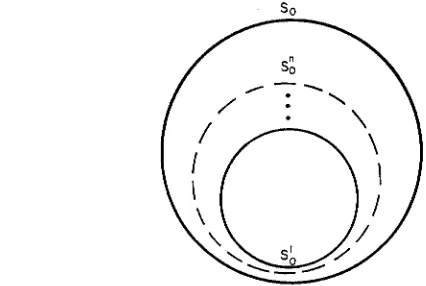
~i > 9 An intuitive image of the above introduced directed system of organis-
mic sets is given in Figure 1, where the direct limit So is indicated by the outer circle. Naturally, this situation is only an oversimplification of the develop- ment of an organismic set, and is only a particular case of a eolimit. In the same manner, a directed system R of sets of relations can be defined. Consider these relations to be those which appear as an organismic set develops. I t is obvious t h a t the principle which determines the course of development of an organismic set (Rashevsky, 1969c) can be restated by requiring t h a t the directed limit of R does exist. Then, the direct limit of R is the maximal set of relations of the developing organismic set (it is in fact the disjoint union of sets of rela- tions in R).
So
F i g u r e 1. T h e d i r e c t l i m i t S o o f o r g a n i s m i c s e t s S o l , . . . , S~
ON ADJOINT DYNAMICAL SYSTEMS 483
R is maximized in the direct limit. I t can be easily proved t h a t a particular realization of our theorem in I--showing the existence of projective limits in SoS--implies t h a t one can define the set of observables of an organismic set S o
as the cartesian product of the sets of observables of its elements e,. This is justified by the fact that, in a category of sets, the projective limit of a family of sets can be introduced as the cartesian product of the sets in that family. I f one transforms an organismic set S O into an organismic set So, then the set of observables of So is isomorphically mapped on the set of corresponding observ- ables of So, if and only if there exist adjoint functors K: So s ) -o'~'s', -o'q's" ~ > SoS. According to Theorem 1, U preserves projective limits of So s', that is, U maps the set of all observables of So on the set of corresponding observables of So. I n the case of a simple adjointness between So s' and So s, the set of observables of the organismic set So is isomorphic to a subset of observables of the organismic set So.
3. Adjointness Theorems for Nuclear Equivalence. The folIowing result refers to weakly adjoint dynamical systems, and is a direct consequence of the realiza- tion theorem of Kainen (1971), (see Theorem and Corollary on p. 8).
Theorem 3
Let D and D" be two weakly adjoint dynamical systems. Suppose that the generating supercategory S of D has weak pushouts. Also suppose that the weak, right adjoint U: S ' . > S of K: S > S' preserves weak pushouts. In these conditions, given any commutative square diagram q in S, there exists a
commutative square diagram q' in S' such that U(q') = q if U o K = 1 s. The commutative diagrams can be considered to represent equivalent possible ways in which the nuclei m a y develop. In the case of nuclear transplants, weak adjoint "functors" map the possible equivalent developments of the trans- planted nucleus onto the possible equivalent developments of the replaced nucleus. This equivalence m a y be preserved until a limiting given stage of development of the embryo. After that stage the transplanted nuclei would produce sharp differences in development as compared to the normal course of development. Experiments indicate blastula stage to be the limiting stage.
Theorem 4
484 ION B.~IARTU AND DRAGO~ SCRIPCARIU
(i) the inclusion functors C~ ~ C~ preserve inductive limits and cogenerate
e;;
(ii) all C~ have inductive and projective limits, and all inclusion functors C; ~ C~ have left adjoints;
(iii) the generating supercategories S ^ , induced by the categories C~, lead to the generation of a dynamical system D ^ , such t h a t D and D ^ are adjoint.
Proof
The first two sentences are only reformulations of a result of Popescu, D. (1970). The third results from the second sentence by taking into account the definition of adjointncss and the definition of adjoint "functors" of super- categories.
A particular case of the above theorem is realized by the nuclear clones (King and Briggs, 1956) when the generating classes, which represent nuclei in a serial transplantation experiment, lead to generating supercategorics which are adj oint. (In fact, it is the dynamical systems, induced by these generating supercategories, which are the adj oint entities.) It m a y be easily checked t h a t the other conditions of the theorem are fulfilled for nuclear clones. The fact t h a t all nuclei in the clone result in the same type of development appears as a consequence of par- ticular adjointness relations between nuclei which are subject to the conditions of the above theorem.
Without any further restrictions it would be difficult to obtain results con- cerning weak adjoint nuclei. The addition of the principle of relational invariance (Rashevsky, 1968b), as a restriction to the weak adjointness con- ditions for the transplanted and replaced nuclei, points toward the following theorem.
Proposition 2
The nucleus of a fertilized ovum is weak adjoint with any other nucleus, directly, or indirectly, resulting from it.
This proposition states in fact t h a t all possible transformations of the gene- rating classes of the fertilized ovum are mapped onto the possible transfor- mations of any nucleus resulting from the nucleus of the fertilized ovum.
Corollary 2
Any nucleus has the potential ability of inducing the self-reproduction (division) of cells.
ON ADJOINT DYNAMICAL SYSTEMS 485
important possible transformations of a nucleus is the one leading to DNA re- duplication, and to subsequent replication of chromosomes. The corollary states t h a t transformations of a nucleus which lead to DNA synthesis aremap- ped onto corresponding transformations of a n y nucleus which results as a consequence of sequential divisions of the fertilized ovum. This statement is in agreement with the axiomatic introduction of self-reproducing entities in
(D1) of I (see p. 546), and with the fact t h a t only some pairs of such entities can be eventually transformed into non-reproducible entities. Experimental
results of Graham et al. (1966) and of Gurdon (1967) show t h a t this is the case.
They have experimentally p r o v e d - - b y means of nuclear transplant experiments - - t h a t nuclei of brain ceils (which never divide inside the brain) begin to syn- thetize DNA immediately after their implantation in the oocyte wall.
The results of this section are referring only to transformations which occur at the functional-physiological level. I t becomes of greater and greater in- terest to have a fruitful approach to the molecular and submolecular levels of organization of the transplanted nuclei. Therefore it would be interesting to study theoretically the adjointness relations which exist at the molecular and q u a n t u m levels. This is the aim of a subsequent paper.
The authors would like to devote this paper to the memory of Professor Nicolas Rashevsky who, in more t h a n one way, initiated this approach.
L I T E R A T U R E
B~ianu, I. 1970. "Organismic Supercategories: II. O n Multistable Systems." Bull. Math. Biophysics, 32, 540-561.
1971. "Organismic Supercategories and Qualitative Dynamics of Systems."
Ibid., 33, 339-354.
- - and M. Marinescu. 1968. "Organismic Supercategories: I. Proposals for a
General Unitary Theory of Systems." Ibid., 30, 625-636.
- - and 1973. "A Functorial Construction of (M, R)-Systems." Rev.
Roum. Math. Purcs et Appl. (in press).
1973. "Some Algebraic Properties of (M, R)-Systems." Bull. Math. Biology,
3 5 , 213-217.
Briggs, R. and T. King. 1952. "Transplantation of Living Nuclei from Blastula Cells
into Enucleated Frogs' Eggs." Proc. Natl. Acad. Sei. U.S., 38, 455~463.
Bueur, I. and Deleanu, A. 1968. Introduction to the Theory of Categories and t~unetors,
pp. 16-52. London, New York, Sydney: Wiley.
Burgess, M.A. 1967. "The Developmental Potentialities of Regeneration Blastema Cell
Nuclei as Determined by Nuclear Transplantation." J. Embryol. Exp. Morph., 18,
27-41.
Denis, H. 1970. "Importance des Interactions Nucleo-Cytoplasmiques au Cours du
Dbveloppement Embryonnaire." Arch. Int. Physiol. Biochim., 78, 367-380.
Di Berardino, A. M. and Nancy Hoffner. 1970. "Origin of Chromosomal Abnormalities in Nuclear Transplants--A Reevaluation of Nuclear Differentiation and Nuclear
486 ION B~IANU AND DRAGO~ SCRIPCARIU
Graham, C. F. et al. 1966. "The Induction of DNA Synthesis by Frog Egg Cytoplasm."
Develop. Biol., 14, 349-381.
Gurdon, J . B . 1967. "On the Origin and Persistence of a Cytoplasmic State Inducing Nuclear DNA Synthesis in Frogs' Eggs." Proc. Natl. Acad. Sci. U.S., 58, 545-552. Kainen, P. 1 9 7 1 . "Weak Adjoint Functors." Math. Z., 122, 1-9.
Kan, D.M. 1 9 5 8 . "Adjoint Functors." Trans. A.M.S., 87, 294-330.
King, T. J. and R. Briggs. 1956. "Serial Transplantation of Embryonic Nuclei."
Cold Spring Harbor Symp. Quant. Biol., 21, 271-290.
Mitchell, Barry. 1 9 6 5 . The Theory of Categories. New York and London: Academic Press.
Popescu, D. 1 9 7 0 . "Some Remarks on Complete Cogenerated Categories." Rev. Roum. Math. Pures et Appl., 15, 1027-1033.
Popeseu, N. 1971. Abelian Categories (in Romanian). Bucharest: Ed. Academy of R.S. Romania.
Rashevsky, Nicolas. 1966. "Physics, Biology and Sociology: A Reappraisal." Bull. Math. Biophysics, 28, 283-308.
1967a. "Organismic Sets: Outline of a General Theory of Biological and Social Organisms." Ibid., 29, 139-152.
1967b. "Physics, Biology and Sociology: I I . Suggestions for a Synthesis."
Ibid., 29, 643-648.
1967c. "Organismic Sets and Biological Epimorphism." Ibid., 29, 389-393. 1968a. "Organismic Sets: II. Some General Considerations." Ibid., 30, 163-173.
1968b. "Neurocybernctics as a Particular Case of General Regulatory Mecha- nisms in Biological and Social Organisms." Concepts de l'Age de la Science, 3, 243-258. 1968c. "A Note on the Development of Organismic Sets." Bull. Math. Biophysics, 30, 355-358.
1969a. "Outline of a Unified Approach to Physics, Biology and Sociology."
Ibid., 31, 159-198.
1969b. "Multiple Relational Equilibria: Polymorphism, Metamorphosis and Other Possibly Similar Phenomena." Ibid., 31, 417-427.
1969c. "Some Considerations of Relational Equilibria." Ibid., 31, 605-617. ~ . 1971a. "Two Definitions of Stability of Equilibria." Ibid., 33, 157-164. - - . 1971b. "Relational Forces and Structures Produced b y Them." Ibid., 33,
321-338.
Rosen, Robert. 1958. "The Representation of Biological Systems from the Standpoint of the Theory of Categories." Ibid., 20, 317-342.
1968. "On Analogous Systems." Ibid., 30, 481-492.
1971. "Some Realizations of (M, R)-Systems and Their Possible Interpreta- tions." Ibid., 33, 303-320.
Signoret, J. and B. Picheral. 1962. "Transplantations de Noyaux chez Pleurodeles Waltlii Michah." C.R. Aead. Sci. Paris, 254, 1150-1151.
1965. "Transplantations Nuel~aires et Diff6renciation Embryonnaire." Ar- chives de biologic (T_fiege), 76, 591-606.
Smith, L. ]D. 1965. "Transplantation ofl~uclei of Primordial Germ Ceils into Enucleated Eggs of Rana pipiens." Proe. Nat. Acad. Sci. U.S., 54, 101-107.