Architectural Considerations for
Managing Mobility
by
Athanassios (Thanassis) Tiropanis
A dissertation submitted in partial fulfilment of the requirements for the degree of
Doctor of Philosophy
of the
University of London
Department of Computer Science University College London
University of London
ProQuest Number: 10010405
All rights reserved
INFORMATION TO ALL USERS
The quality of this reproduction is dependent upon the quality of the copy submitted.
In the unlikely event that the author did not send a complete manuscript and there are missing pages, these will be noted. Also, if material had to be removed,
a note will indicate the deletion.
uest.
ProQuest 10010405
Published by ProQuest LLC(2016). Copyright of the Dissertation is held by the Author.
All rights reserved.
This work is protected against unauthorized copying under Title 17, United States Code. Microform Edition © ProQuest LLC.
ProQuest LLC
789 East Eisenhower Parkway P.O. Box 1346
Abstract
Ever since the first communication systems were deployed, requirements for mobility have been one of the most important causes of architectural changes. For instance, it has taken a long period of research and standardisation to arrive at the deployment of mobile telephony, the architecture of which is very different fi*om that of the traditional/fixed telephony. Similarly, in the Internet, the proposed architecture of Mobile-IP adopts different methods of IP address allocation and routing, among other changes.
On the other hand, the mobile system architectures introduced by the different communities, e.g. telephony, Internet, data management, nomadic computing, and wireless communications, all differ significantly. They provide different kinds of mobility, they adopt different approaches to managing mobility and each of them has certain architectural problems. For example, the problem of triangular routing in Mobile- IP is an important drawback of its architecture.
Existing mobile system architectures are restricted by their legacy. Also, their scope is confined to particular aspects of mobility. For these two reasons, these architectures are not generic, and they cannot be extended to support additional kinds of mobility.
In this thesis, we firstly discuss the problems o f existing mobile system architectures. Then, we abstract mobile systems to a generic level and we define the common denominator of mobile systems in a framework o f terms. Using the terminology of this fi-amework we examine the problem of managing mobility on an abstract level and we arrive at architectural requirements for mobile systems deployment, which are incorporated into the fi’amework.
number of entities that a system should feature in order to support mobility. The computational viewpoint requirements are specified following a design pattern template.
The hypothesis that motivated this thesis is that a technology independent framework for mobile systems is feasible. Also, that it can be generic enough to represent a variety of mobile systems and that at the same time it can be of practical value. Finally, there is a claim that such a generic and technology independent framework for mobile systems can help to consider many aspects of mobility and therefore assist to building coherent systems that avoid pitfalls common in existing mobile system architectures.
In order to investigate the validity of this hypothesis a framework of terms for mobile systems is specified. Using the terminology that this framework provides architectural requirements for mobility are investigated from the information and the computational OOP viewpoints. To test their generality, the terms of this framework are mapped to a range of real systems such as Mobile IP and GSM. A system for the novel area of role mobility that respected the specified requirements of the framework was deployed in a TINA environment in order to investigate the practical value of this framework and the requirements that are expressed in its terms. The design and implementation of the role mobility system is presented in this thesis. Additional to this, this framework was used to investigate some well-known problems of existing mobile systems like GSM and Mobile IP. In this way, the practical value of the framework and the architectural requirements that where expressed in its terms are validated further and the claim that this framework can assist in building coherent systems is substantiated.
This thesis, therefore, is intended to provide an insight into the problem of mobility and further directions to carry this research forward are suggested.
-Acknowledgements
I would like to thank my fiancée Monica Assetta Binda, without whose constant support, encouragement and tolerance this thesis would not have been completed. Monica, this thesis is dedicated to you.
My supervisors Jon Crowcroft and Stephen Hailes for their useful feedback and continuous support through all the stages of preparing this work. Thank you for trusting this area to me and for believing in me.
The people who have fimded my working at UCL and provided an excellent environment to work in: David Lewis, George Pavlou and Peter Kirstein. Also, David Lewis and Chris Malbon for providing me with useful comments on drafts of this thesis.
The team of the European ACTS project Prospect (contract number AC052) for providing the environment to develop and test many of the ideas in this thesis. In particular, many thanks to Lennart Bj erring, Alexander Richter and Sven Krause for the endless discussions on the different kinds of mobility. Many thanks to Chris Malbon, Hervé Karp, Nelly Cardinale and Catherine Burvelle for their useful feedback and for implementing the role management component. Many thanks to the PCS group of Prospect and the entire Prospect team for ensuring the successful demonstration of the role management component.
I would like to thank my parents and my family for encouraging my starting and completing this thesis.
Many thanks to friends with whom I have worked or who provided me with moral support through this period. Particularly to Kevin McCarthy, Thurain Tin, Alina DaCruz, David Griffin, Saleem Bhatti, Isidor Kouvelas, Giannis Koufakis, Natascha Vassila, Yiorgos Chrysanthou, Panos Gevros and Theodor Pagtzis.
Notes
Throughout this thesis the author chose to employ the first person in plural to address the reader. However, this does not imply collaborative work. Expressions such as “our hypothesis”, “our thesis”, “our approach”, “we investigated” or “we claim” should not be perceived as indications of collaborative work. They should only be seen as a choice of style of the author. The work presented in all the chapters of this thesis is the author’s, including the design of the role management component.
The content of Appendix A is a summary of the description of the CORBA design pattern template by Thomas J. Mowbray and Raphael C. Malveau based on their book “CORBA Design Patterns”.
The only part of this document that presents collaborative work is section 5.2 which describes the implementation of the role management component in the European ACTS project Prospect (project number AC052). The implementation and demonstration of this component was carried out by the Prospect team as acknowledged in the acknowledgements section.
-Table of Contents
Page
1. Introduction... 13
1.1 Current standards and research... 16
1.1.1 Internet...16
1.1.2 Telecom...16
1.1.3 Other research...19
1.2 The problem area...21
1.3 Hypothesis... 26
1.4 Thesis structure and approach... 27
1.4.1 Overall approach... 27
1.4.2 Concepts and tools... 28
1.4.3 Detailed approach... 31
1.5 Outline of dissertation... 34
2. Current mobile system architectures and related w ork...36
2.1 Mobile IP ... 37
2.1.1 Criticism...39
2.2 G SM ... 42
2.2.1 Criticism...46
2.3 Other Telecom standards... 49
2.4 Related work...49
2.4.1 ODP and multimedia systems...49
2.4.2 The OSl reference model...50
2.4.3 Addressing and locating network entities... 50
2.4.4 Formal models for mobility...50
2.4.5 Other related work... 56
3. A Framework of Terms (FoT) for Mobile Systems... 57
3.1 Communications network... 58
3.3 Medium... 62
3.4 Communications network topology (CNT)... 64
3.5 Communications path (C P)... 64
3.6 Message exchange (exchange) 66 3.7 Entity location (location)... 67
3.7.1 Local network entity (local entity)...67
3.7.2 Remote network entity (remote entity)... 67
3.8 Fixed network entity (FE )... 69
3.9 Mobile network entity (ME)... 71
3.9.1 Location space...72
3.10 A definition of mobility...72
3.10.1 Relative speed of a mobile entity...73
3.11 Mobile entity classes... 73
3.11.1 Mobile entity class (MEC)... 74
3.11.2 Network entity class (NEC)... 75
3.11.3 Complete Entity Class (CEC)...75
3.12 Entity identifiers (ID )...77
3.12.1 Fixed entity identification (FID )...77
3.13 Relating the FoT to existing models for mobility... 82
3.13.1 Relating the FoT to the 7i-calculus... 82
3.13.2 Relating the FoT to Mobile Ambients... 85
3.13.3 Relating the FoT to Mobile UNITY... 86
3.14 Expressing the FoT in 7i-calculus terms... 86
3.14.1 Communications Network... 87
3.14.2 Network Entity...87
3.14.3 Media... 87
3.14.4 Communications Network Topology... 88
3.14.5 Message exchange... 88
3.14.6 Communication path ... 88
3.14.7 Location... 89
3.14.8 Fixed network entity... 89
3.14.9 Mobile entity...90
3.14.10 Mobile entity class... 90
-3.14.12 Complete entity class...91
3.15 Summary...91
4. Managing mobility in the Framework of Terms...93
4.1 Information v i e w p o i n t . . ...94
4.1.1 Identity of mobile network entities...94
4.1.2 Unique identifier (UID)... 96
4.1.3 Scope of uniqueness...98
4.2 Computational viewpoint... 100
4.2.1 Mobile-Entity-Locator (MEL) Design Pattern...102
4.2.2 Mobile Entity Agent (MEA) Design Pattern...107
4.2.3 Combining the MEL and MEA design patterns...113
5. Mapping the Framework of Terms to real environments...116
5.1 A specification for Role Mobility in Prospect... 117
5.1.1 The service environment in Prospect... 117
5.1.2 Service roles and role mobility...119
5.1.3 Mapping the FoT to the Prospect environment...124
5.1.4 A specification of a role management component...126
5.1.5 Mapping the FoT requirements to the Prospect environment... 135
5.2 An implementation of Role Mobility in Prospect... 138
5.2.1 Mobility modelling in Prospect...138
5.2.2 Implementation use cases...139
5.2.3 Role Management sub-system...140
5.2.4 The Provider administrator Management User Application (PMUAP).... 144
5.3 Mobile IP ... 145
5.3.1 Mapping the FoT to the Mobile IP architecture...145
5.3.2 Information viewpoint requirements... 148
5.3.3 Computational viewpoint requirements... 148
5.4 G SM ... 150
5.4.1 Mapping the FoT to the GSM architecture... 150
5.4.2 Information viewpoint requirements...154
5.4.3 Computational viewpoint requirements... 156
5.5 The TINA Architecture... 157
6. Discussion... 159
6.2 Requirements on the F oT ...162
6.3 Mapping the FoT to real systems... 163
6.4 Mapping the FoT requirements to real systems... 164
6.5 D r a w b a c k s 165 7. Conclusions and further w ork... 167
7.1 Conclusions... 167
7.1.1 Experiences from the design of the role mobility component in Prospect 170 7.2 Further work... 171
Glossary...173
References...179
Appendix A: CORBA design pattern template...199
Appendix B: Brief tour of the 7i-calculus notation... 204
-List o f figures
Page
Figure 1-1: Schematic of the thesis approach...33
Figure 2-1: The operation of Mobile IP...38
Figure 2-2: The operation of GSM - registration in a visiting country... 45
Figure 2-3: The operation of GSM - call to a mobile station in a visiting country and originating from the visiting country...46
Figure 3-1: Three different communications networks as perceived in the same communications environment: (a) home user’s view, (b) Internet Service Provider’s view, (c) Telecom provider’s view...59
Figure 3-2: Different media between two hosts with an Ethernet physical connection. .63 Figure 3-3: Example of CPs between network entities in different point-to-point topologies: (a) Star, (b) Ring, (c) Tree, (d) Complete, (e) Irregular... 65
Figure 3-4: The location of an entity (B) when another entity (A) initiates a message exchange with it: (a) entity (B) is local to entity (A); (b) entity (B) is remote to entity (A)...68
Figure 3-5: Example of Fixed and Mobile network entities...71
Figure 3-6: Steps 1 ... n of the analysis for fixed network entity identification requirements...81
Figure 4-1: CP without network entities, where the sink entity is mobile...94
Figure 4-2: CP with one network entity, where the sink entity is mobile...95
Figure 4-3: CP with two network entities, where the sink entity is mobile... 96
Figure 4-4: CPs between network entities of different NECs and MECs...98
Figure 4-5: A recommended combination of the MEL and the MEA design patterns. 113 Figure 5-1 : Prospect Enterprise Model... 118
Figure 5-2: Example of network entities and their locations including roles... 122
Figure 5-3: States of a role-holder...124
Figure 5-5: MECs and their corresponding CECs in a communications network of
Prospect... 127
Figure 5-6: Role mobility and role management use cases...129
Figure 5-7: Computational view of the role management system...133
Figure 5-8: Exchange initiation between user and role in Prospect... 136
Figure 5-9: Role mobility and role management implementation use cases...139
Figure 5-10: Component view of the role management system... 141
Figure 5-11 : Main panel of the Provider Management UAP for Role Management.... 143
Figure 5-12: Panel of the Provider Management UAP for setting-up roles...144
Figure 5-13: Example of a Mobile IP communications network...146
Figure 5-14: Example of MECs and corresponding CECs in a Mobile IP communications network... 147
Figure 5-15: Example of a GSM communications network... 152
Figure 5-16: Example of MECs and corresponding CECs in a GSM communications network...153
-List o f tables
Page
Table 1-1 : Mapping of terms used by different standards bodies. 22
Table 3-1 : Identifiable FEs per message exchange per medium. 79
Table 4-1 : Requirements for the identification of mobile network entities in the ANM. 100 Table 5-1 : Information to support invitations and role-holder state management. 131
Table 5-2: Role description. 132
1. Introduction
The recent success of mobile telephony has given a clear indication that the users of communications services consider mobility a very important feature. Since then, there has been considerable effort from standards bodies to provide guidance on the deployment of mobile services. This effort comes from both the Internet and the Telecom communities and is discussed in the following section.
The starting point of the efforts of these communities has been the definition of the architecture of mobile systems and, at the same time, the interworking between these mobile systems and legacy systems. The Internet community deployed an architecture for the support of mobile IP nodes. Similarly, the Telecom community deployed architectures for the support of mobile telephony. The architectures of these mobile systems present many problems to be investigated and resolved.
First of all, most legacy communication systems were designed without consideration of mobility. The design of early communication services was based on the assumption that the parties involved in these services were fixed. For example, in traditional telephony it was assumed that the telephone terminals would be fixed in one building. Similar assumptions were made by the Internet community regarding Internet nodes. Trying to extend the architecture of these existing systems to support mobile communication parties often led to a trade-off between extensive re-design and continued support of legacy systems. As a result of this trade-off the mobile systems that emerged based on these legacies had certain problems. Many of these problems are common in the design of
-systems that come from completely different communities. For example, the problem of triangular routing is common in both the GSM architecture of the Telecom community and the Mobile IP architecture of the Internet community.
The initial assumption that the communication services would involve fixed parties is evident in different aspects of the design of the early communication systems. Since a communication party was assumed to be fixed to a particular location, the identifiers for these parties were also used to identify their location. The mechanisms for conveying communication messages to these parties relied heavily on the identification of their location and, as a consequence, to the identification of the parties themselves. Because of this, when a communication party changed location, they had to be given a new identity, which was the identity of their new location. For example, a home telephone number in traditional telephony is used to identify the person who is occupying the house were the telephone equipment is installed and also the telephone terminal and the end-point were the terminal is attached. The common practice of the Telecom companies has been that if a person moves to another home in another area they will have to be assigned a new telephone number, the number of the telephone of their new home.
Because of this coupling between the identity of a communications party and its location locating mobile parties was not supported efficiently. In our example of traditional telephony if a person moved home someone would have to obtain their new home telephone number manually, via the telephone directory, before being able to contact them.
Eventually, this requires an exchange o f ideas and a consensus on what m obility really is
regardless o f specific technologies and m arket background. In other words, a generic and
technology independent definition o f m obility is required.
Only at a generic level is it possible to investigate the essence o f mobility. Also, only at a
technology independent level is it possible for the different comm unities to discuss the
problems o f m obile system design. A generic and technology independent fram ework o f
terms for m obile systems could provide a common ground for the exchange o f ideas.
Trying to define a fram ework o f terms for m obile systems and investigating the
requirements that m obility poses using the term inology o f this framework leaves some
open questions:
Q l. Can such a generic and technology independent framework o f terms be defined?
Q2. Can this framework be generic enough to express a variety o f systems and at the
same tim e be o f practical value?
Q3. W ould any conclusions for m obility in this framework map to real systems?
Q4. W ould such a fram ework assist to avoiding common pitfalls and problem s o f
existing architectures in supporting mobility?
Our belief that the answer to the above questions can be positive inspired the hypothesis
for this work.
In this thesis we provide a generic and technology independent framework
o f terms for mobile systems and we discuss the architectural aspects o f
mobile systems in this framework. Then, we investigate the hypothesis that
this framework:
HI. Can express a variety o f real mobile systems,
H2. Is o f practical value, and
MS. Can provide for systems that avoid common problems o f existing
mobile system architectures.
In this chapter we look at the different approaches that different comm unities follow to
identify mobility and to define m obile systems. We identify the problems that arise from
the diverse definitions o f m obility and m obile system architectures by the different
-communities. We then describe the hypothesis that motivated this thesis and the approach that was followed to investigate its validity.
1.1 Current standards and research
1.1.1 Internet
Starting with the Internet, a group of the IETF (Internet Engineering Task Force) has been working on the specification of the Mobile IP [RFC2002] protocol and the Mobile IP architecture, which provides for transparent routing of IP [RFC0791, RFC1883] datagrams to mobile nodes in the Internet. This work has influenced or encouraged other mobility-related activities and standards within the IETF [RFC2103, BPP96, PJOO, PJ98,Penn93, RFC2041]. Protocol extensions were suggested and protocol optimisations were proposed to cope with mobile nodes and Mobile IP [PJOO, PJ98].
1.1.2 Telecom
1.1.2.1 ETSI
On the Telecom side, the success of the Global System for Mobile communications (GSM) [GSM03.02] in delivering mobile telephony on a fully deployed commercial base in Europe and Japan has been one the most impressive achievements of the European Telecommunications Standards Institute (ETSI). The third-generation mobile systems as they are envisaged in Europe, will integrate the current second-generation systems and provide a new range of broadband services, which will also be compatible with the bearer and advanced services of the fixed telecommunication networks [DF95].
In order to do that, ETSI recognises that very soon GSM will have to be extended or integrated into a more generic framework that will allow for a wider variety of services. This requires more bandwidth and a network that will have to be better integrated and managed with the fixed core network and satellite systems [UMTSsat, UMTSmgmt, DF95, Rapel95]. The proposed standard is called Universal Mobile Telecommunications System (UMTS) and ETSI expects that it will be developed in some form during the first decade of the 21®* century. There is ongoing work on the standardisation of the UMTS architecture [KPMF98, FHVN98].
1.1.2.2 ITU
System (FPLMTS) [M.687-1], which was recently renamed to International Mobile Telecommunications 2000 (IMT-2000) [M.687-2]. These standards are the work of the ITU Radiocommunications Standardization Sector (ITU-R) and of the ITU Telecommunications Standardization Sector (ITU-T). ITU expects to complete this family o f standards around the year 2000. IMT-2000 envisages an environment where users will be able to access a wide range of voice or data services anywhere, anytime by means of a small pocket communicator. Apart from this, IMT-2000 tries to unify existing diverse systems (fixed or mobile) so that the user perceives a Virtual Home Environment (VHE) where the same services can be received regardless of the media or terminals used [BFMC97]. ETSI and ITU have been exchanging ideas about the future deployment of third-generation mobile systems. This exchange is apparent in the work of the Special Mobile Groups of ETSI, where ideas of IMT-2000 on numbering and the VHE are discussed. Also, ETSI is considering the use of the Telecommunications Management Network (TMN) ITU-T standard [M.3010] for the management of mobile services [UMTSmgmt].
An earlier standard from ITU-T on Universal Personal Telephony (UPT) [F.850, E.168, 1.114] has provided guidelines on how users can access services regardless of the terminal used by means of a unique identifier that is associated with each user and which is used to make and receive calls. UPT was initially intended to provide personal mobility on the fixed telephone network. It was part of the ITU standardisation work for the support of UPT in the Intelligent Network Architecture (IN) [1.373, 1.312, 1.318, Q.1290]. The IN architecture has already achieved the provision of additional capabilities in telecommunication services independent of service, network implementation, or vendor equipment. Examples are the multi-party conference and the freephone services. IN achieves this by introducing a separation between service logic and the network.
1.1.2.3 The TINA Consortium
Influenced by the IN and the UPT standards, the Telecommunications Information Networking Architecture (TINA) consortium [DNI95] has worked for the past five years on an object-oriented Service Architecture [TINA-SA5, TINA-SAA5] that provides a set of concepts, principles and guidelines for the deployment and operation of advanced communications services. The TINA consortium (TINA-C) tried to build on previous standardisation efforts such as the Telecommunications Management Network (TMN)
-and the Intelligent Network architecture of ITU. TINA attempts to bring into the Telecom community the ideas and concepts of the Open Distributed Processing Reference Model (RM-ODP) [ISO-GDP 1, ISO-ODP2]. For this reason, TINA suggests an integration of telecommunications systems with the recent advances of distributed computing such as the Common Object Request Broker Architecture (CORBA) standards by the Object Management Group (OMG) [CORVAvl, C0RBAv2, CORBAsvc, Kitson95]. The TINA proposals advocate object oriented design and reusable software components for the rapid deployment and management of “open” services.
The TINA Service Architecture (SA) is part of an overall architecture [TINA-overv], which clearly separates services ft"om communication networks, so that communications services can be introduced and deployed regardless of the underlying communications network technologies. These separations come firom a requirement analysis that the TINA consortium has produced [TINA-req]. The TINA SA provides for personal and session mobility support. The former provides for users being allowed to use the TINA services regardless of the terminal that they are attached to. The latter provides for users to be able to suspend their service sessions and later resume them fi*om another terminal. From its beginning, TINA addressed the management requirements for mobility. The scope however, has been how the next generation services can be managed in the TINA fi*amework [RF95].
Many European projects of the ACTS (Advanced Communications Technologies & Services) European research framework such as VITAL and Prospect have realised TINA or TINA-like systems. In VITAL TINA has been extended with a Discrete Terminal Mobility (DTM) service which allows for terminals to be detached from one network access point and attached to another, while maintaining the facilities that they offer [VITAL-D13].
BB-ISDN [HC95]. Many of these projects contributed towards evolving the IN architecture to the TINA architecture but their approach applies mostly to Telecom environments.
The TINA work on mobility is now continuing a special TINA Next Generation Mobility Work Group (TINA-ngm-wg).
1.1.3 Other research
1.1.3.1 ODP
The series of standards for Open Distributed Processing (ODP) by the International Organisation for Standardisation (ISO) and ITU-T provides a meta-model for open distributed systems [ISO-ODPl, IS0-0DP2, IS0-0DP3, IS0-0DP4].
This model suggests an object-oriented approach for deploying distributed systems. The term object-orientated refers to objects that encapsulate functionality in their implementation, and that, through interfaces, offer an abstract view of this functionality in a system. In their book on “Open Distributed Processing and Multimedia”, Gordon Blair and Jean-Bemard Stefani give a definition of a distributed system as one that is: ‘"''designed to support the development o f applications and services which can exploit a
physical architecture consisting o f multiple, autonomous processing elements that do not
share primary memory but cooperate by sending asynchronous messages over a
communications network!’ [BS98]. The attribute open in a distributed system implies certain rules to ensure interoperability and portability by having the objects of this system conform to well-defined interfaces.
The ODP architecture identifies five viewpoints from which a distributed system can be described or specified and a number of transparencies that open distributed systems can support. Among those, there are location transparency, migration transparency and relocation transparency. Location transparency hides the physical location of an object by means of a unique identifier. Migration transparency allows an object to move to another location transparently to its client, while relocation transparency allows the object to migrate even while it is involved in an interaction with other objects.
ODP is a meta-model [BS98] that does not elaborate on how these transparencies will be implemented; it only intends to provide a framework for specifying open distributed
-systems. Therefore, apart from the suggestion of unique identifiers, no other aspects for mobility are presented or justified.
1.1.3.2 MobileAgents
The term mobile agent has been used extensively by the Internet community, by the distributed computing community and by the Telecom community [PK98]. Although there is no clear definition of a mobile agent, it is certain that there are two aspects to it: agency and mobility [VT97].
Starting with the agency aspect, it is implied that a mobile agent as a software entity can act on behalf of a user or another entity. In other words, a mobile agent can delegate for a user or another entity. It may be an intelligent agent [PK98] or it may have to do mundane tasks on behalf of the other entity or user that delegates to it. Agents have been suggested for network management [Yemini91], for delivering services [KM96, BM98], or for service engineering [GD98]. Agents have also been deployed to offer personalisation to users and personal mobility over wireless or wireline networks [INM95]. From the mobility perspective though, these approaches focused exclusively on personal mobility and they were not intended to address mobility in a wider scope.
The aspect of agent mobility refers to allowing an agent to migrate, on its own, closer to the source of the data that it has to process. There have been several proposals for how this would benefit network management or service delivery [PK98]. However, the main objective of all the approaches to agent mobility is to reduce the network traffic, increase fault resilience, or allow local access of data, by moving the agent closer to the source of the data. This work relates to the research for process migration [ANSA, CORBAsvc] but it focuses to solving these specific problems.
1.1.3.3 European research on mobility
The two recent European research frameworks ACTS and RACE have endorsed the concepts that ETSI and ITU are jointly working on and they have commissioned several projects with the objective to contribute to this work. In the ACTS framework a user-trial driven approach was used in order to assess advanced mobile services. Many of the ACTS and RACE projects investigated how technological problems can be overcome in order to deploy these advanced services as envisaged in UMTS and FPLMTS [DIE97, FHVN98, DF95].
The RACE project MOBILISE defined the concept of the Personal Service Communications Space (PSCS) that was reused in other projects of the RACE and of the later ACTS European frameworks [GKGF95]. The PSCS architecture is based on the Intelligent Network (IN) architecture and it aims to provide personal mobility and personalisation on a variety of communication services over different technologies.
Other European projects like the ACTS project Multicube provided solutions to how UPT concepts of personal mobility and personalisation can be supported in Internet-based multimedia conferencing services [Schul96].
Projects of the ACTS framework that investigate personal or terminal mobility have collaboratively produced a number of guidelines for mobile systems. These guidelines were produced under the NIF (Fixed and Mobile Interworking) chain activity of the NI (Network Interworking) chain group of ACTS. The chain groups o f ACTS offer a forum for the exchange of ideas across ACTS projects in certain areas. The NIF chain guideline number 3 (NIF-G3) [NIF-G3] addresses personal and terminal mobility requirements in a TIN A/IN like Service Architecture under the name Common Service Architecture (CSA). A service engineering approach to the deployment of mobile services is discussed in this guideline.
1.2 The problem area
From this brief overview of the standardisation efforts by various communities it becomes evident that different paths are being followed for the specification and provision of mobile services. A study of the existing standards makes it clear that there is lack of communication between the different bodies, which are using different languages to address mobility, the problems that mobility implies and the solutions for these problems.
-Table 1-1 attempts a m apping among different terms used by different standards
communities in relation to mobility.
Internet
(Mobile IP) ETSI (GSM)
ITU (UPT)
ITU
(IMT-2000) RM-ODP TINA
user subscriber user user n/a user
node station terminal station node terminal
router location area n/a n/a n/a
network access point
n/a IMSI UPT number IMUl identifier user ID
mobile node
IP-address MSISDN n/a IM SISDN identifier terminal ID mobile node
care-of-addr. MSRN n/a IMSRN n/a
network address
MAC address IMEI n/a IMEI n/a n/a
Table 1-1: M apping of terms used by different standards bodies.I 2 Problem 1: The different standards communities define mobility
differently and they employ different language/terminology when
referring to mobility.
The Internet comm unity addresses only the problem o f IP node mobility. The M obile IP
protocol aims to provide for the mobility o f IP nodes in an IP network. Currently, there
are no recommendations to address other m obility areas. For example, the problem o f
personal mobility and how to allow Internet users to use different Internet terminals
without problems is not addressed by the Internet community.
On the other hand, the standards o f the Telecom community perceive m obility differently.
The ETSI GSM recom m endation provides partly for personal mobility by allowing a user
to change terminal by means o f a Subscriber Identity M odule (SIM) card [GSM02.17]. It
provides for terminal m obility by prescribing the hand-off and signalling procedures
when a mobile terminal m oves from one cell to another or from one m obile network to
' Som e o f the mappings am ong UPT, G SM and IM T -2000 were taken from the paper “IM T-2000 Standards: Network
A spects” [PGLM 97].
^ The mapping o f a GSM IMEI to an IM T -2000 IMEI is based on the assumption that the GSM IM EIs w ill be supported
in the framework o f IM T-2000. H ow ever, ITU has no intention at the m oment to produce an international standard for
IMEIs [PGLM 97],
-another. This approach is confined within the domain o f the mobile telephony since there
is no provision for the users or the mobile term inals to flexibly attach to the fixed
network.
The communities that are active in the mobile agent field examine the problem o f
mobility only in the narrow scope o f process migration. M obility is not addressed in a
generic way. Mobile agent platforms and technologies are m ainly envisaged as an
infrastructure that will extend the client-server paradigm [PK98, RLV95] in various
applications.
Problem 2: Each community addresses only some kinds o f mobility and
they follow a parochial approach to the problem.
The differences between the proposed architectures can be attributed to the legacies o f
each side and the bottom up approach that has been followed. Both ETSI and ITU state
that a top-down approach is being followed for the specification o f UM TS and IMT-2000,
but they have not provided concrete output yet. Also, the approaches that were followed
in both the specification o f M obile IP and the GSM have certain problems, which are
described in the following chapter.
Problem 3: Many o f the current mobile system architectures have
problems.
There is a striking difference between the Telecom and the Internet communities in the
scope over which they address each kind o f mobility. For example, in the GSM standard
it is implied that the problem o f terminal m obility is addressed by allowing mobile
terminals to move from one cell to another or from one area to another. However,
terminal mobility for wireline terminals is not addressed. Also, in the GSM standards the
identity that is used in order to locate a terminal is an International Mobile Station
Identifier (IMSI). But in the same standards, the IMSI is also associated with a user.
Therefore, it is not clear whether GSM allows for terminal m obility or for mobility o f a
“subscriber - terminal” tuple.
Similarly, in the Mobile IP specification an IP address is used to identify a node uniquely.
This seamlessly allows a Mobile IP node to change its point o f attachm ent to the Internet.
But on the other hand, the examples o f IP usage in the specification are about how to
-allow a user to move with a laptop terminal to a different point o f attachm ent to the
Internet [RFC2002, PJOO]. It is not clear again whether this is for terminal m obility or for
personal-term inal mobility. W hat is certain, is that there is no Internet standard to allow a
user to m ove to a different terminal on another network without having to set up a new
environm ent. That could be seen as a basic requirem ent for personal mobility.
Some o f the concepts from the mobile agents research community, such as unique
identification for m obile agents or security issues regarding agent execution in visiting
environm ents, could address generic aspects o f m obility. However, the objectives o f the
m obile agent work, which are m ostly concerned with reducing netw ork traffic [PK98],
certainly place a limit to the scope in which these m obility-related areas are addressed.
Problem 4: The current mobile system architectures are not only
parochial in the kinds o f mobility that they address, but also in the scope
in which they address each o f these kinds o f mobility.
For these reasons, we consider that a generic and technology independent definition o f
m obility is m issing today. Standards bodies use different language to define m obility and
they have provided partial solutions and o f a limited scope. We believe that a common
language and a comm on perception o f mobility are essential.
A generic and technology independent framework for mobile systems
could provide the infrastructure for addressing mobility in its whole and
for exchanging ideas and experiences on solving mobility problems
regardless o f technologies and architectural legacies.
A generic and technology independent framework o f terms could provide solutions for the
problem s that are mentioned above in the following way:
S I. W ith regard to the different term inology that is employed by different
com m unities when addressing m obility (problem 1), a framework o f terms could
provide a basis on which comm unities can agree on a definition o f m obility and it
could provide a comm on language and term inology that allows them to discuss
m obility in common, generic terms.
-52. Also, by addressing mobility in generic terms the different aspects and kinds of mobility can be defined in a generic way. This way, parochial definitions of the kinds of mobility that individual communities make (problem 2) can be avoided.
53. As far as the architectural problems of existing mobile systems are concerned (problem 3), a common framework could provide the basis on which solutions to common mobility problems can be expressed and exchanged between different communities in a generic form. This could assist in building coherent systems that avoid the common pitfalls of existing mobile system architectures.
54. Finally, defining different kinds of mobility in terms of a common framework will make it easier for communities to identify the scope in which they address each kind of mobility (problem 4).
The approach of a common terminology framework for mobility could provide a common point of reference when addressing mobility issues. Experiences and approaches could be expressed and understood between different cultures, such as the Internet and the Telecom.
A generic and technology independent framework would have a longer lifecycle than technology dependent ones and, therefore, it is expected that it would serve its purpose in the long term. In this way, we could hope that customers would receive better services and that the mobile service providers would be able to be more competitive.
There are also advantages in keeping the definitions of this framework informal rather than providing formal definitions. First of all, formal definitions could be of limited practicality. Not every mobile systems designer is familiar with formal methods and not everybody understands a formal specification. By providing an informal terminology it is possible to communicate ideas to a wider audience and also to receive feedback from an audience that may have valuable experience in mobile systems design. On the other hand, informal definitions have the problem that they can be ambiguous and that they cannot provide ground for rigorous theoretical work.
The idea of providing a framework of terms for mobile systems on which we can outline solutions to building efficient mobile systems inspired our hypothesis and initiated the work towards investigating its validity. In particular, a number of questions arose regarding the use of a framework of terms.
-Questions:
Q l. Would a framework o f terms for mobile systems offer a generic definition o f mobility? Would it provide a common language and terminology for
mobility?
Q2. Is it possible to construct a generic and technology independent framework that is sufficiently expressive to be capable o f describing/representing a
generalised model o f mobility but not so loose that it is o f no practical
value?
Q3. Would any conclusions for mobility on this framework map to real systems?
Q4. Would such a framework assist to avoiding common pitfalls and problems o f existing architectures in supporting mobility?
By believing that the answer to the above questions can be positive, we expressed a
hypothesis and we planned the work to be done towards validating it. The hypothesis is
presented in the following section.
1.3 Hypothesis
Starting from the realisation that the existing standards fail to provide generic solutions to
the problem o f m obility, it was decided to investigate if mobility issues can be described
and solved in a generic and technology independent way. This was needed to gain an
insight into the essence o f mobility. In order to address mobility in this way, m obility had
to be studied at an abstract level. The hypothesis that motivated this work was that;
A framework o f terms fo r mobile systems can be deployed, which:
HI. Is capable o f providing a generalised model fo r mobility, on which mobility can be defined and requirements for it can be
investigated.
H2. Although generic and technology independent, it is o f practical value. It can sufficiently express real systems and it can show where
a real system may fail in supporting mobility, and why.
-H3. Can provide fo r building coherent mobile systems that avoid common pitfalls o f existing mobile system architectures.
Investigating the validity o f this hypothesis would open the way for the exchange o f ideas
on mobile systems at a generic level, with the anticipation that these ideas would also
apply to the real systems to which the terms o f the framework can map.
The approach that was planned and followed to investigate the validity o f this hypothesis
is described in the following section.
1.4 Thesis structure and approach
In this section the structure o f this thesis and the approach that was followed in
investigating the validity o f the hypothesis are discussed. A short introduction to the
concepts and tools that were employed for this investigation is also provided.
1.4.1 Overall approach
In this thesis we will describe generic Framework o f Terms (FoT) for m obile systems
which is technology independent. W ithin this fram ework we consider a num ber o f mobile
entities and we investigate the requirem ents for allowing mobile entities to contact or be
contacted by other network entities, fixed or mobile. Instead o f describing m obility in
terms o f “fixed internet host”, “m obile term inal”, “wireless link” or “protocol” we discuss
mobility in terms o f “netw ork entity” , “m obile network entity”, “m edium ” or “m essage
exchange” . It is within this generic framework that we outline the concept o f mobility.
This allows us to investigate m obility at a high level and to have a broad view o f the
problem. The intention at this level is to discuss the m inimum requirements for m obility
and to induce a num ber o f requirem ents that must be considered for the deploym ent o f
mobile systems. It is not intended to provide prescriptive guidelines or a m ethodology for
deploying mobile systems. The intention has been to provide a kind o f checklist for
potential problems in systems that are to provide mobility.
Apart from providing a fram ework for mobile systems, another goal o f this thesis was to
test the generality and practical value o f such a framework. A first test was to map this
framework of terms to a num ber o f real mobile systems from different com m unities in
order to investigate its generality. A second test was to investigate the practical value o f
this framework by investigating if a real system can be deployed based on this framework
-and respecting its requirements -and if the real system could support mobility efficiently. Additional to this, it was tested if well-known problems of existing mobile systems can be justified by looking at them through this framework. This would further enhance the practical value of our framework and also demonstrate that it can provide for coherent systems that avoid common pitfalls of existing architectures. In order to reduce the ambiguity of some definitions in this framework, which is due to its informal nature, some of its concepts are also expressed using a formal notation.
1.4.2 Concepts and tools
The OSI reference model, the ODP viewpoints and UML were the essential tools and the background for the approach that was followed. A short description of these and how they were employed in this thesis is given in this section.
1.4.2.1 OSI Reference Model
The Open Systems Interconnection (OSI) Reference Model (OSI-RM) [OSI-RM] of the International Organisation for Standardisation (ISO) and ITU-T addresses interconnection issues between heterogeneous systems. The model is structured in seven layers that provide different levels of abstraction for a network connection. Since the scope of the OSI-RM is limited to inter-connection issues between different systems [FLM95], the OSI-RM is not necessarily related to mobility. However, it is an example of a generic model that has succeeded as a platform for the exchange of ideas and specification of system inter-connection both in the Internet and the Telecom communities.
The Framework of Terms (FoT) of this thesis is orthogonal to the OSI-RM. The FoT intends to subsume mobility in an abstract communication environment, where the connections between entities are taken for granted and they are not described as in the OSI-RM.
1.4.2.2 ODP viewpoints
enterprise entities in a distributed system and the business roles and responsibilities between them. The information viewpoint focuses on the structure and the transformation of information in a distributed system. The computational viewpoint addresses the logical partitioning of distributed applications into components and the interfaces between them. The engineering viewpoint gives a system oriented view of distributed applications and distribution transparencies, while the technology viewpoint is concerned with the technologies that implement the engineering mechanisms [FLM95]. It is considered that the five viewpoints of ODP can capture any concern of a distributed system [FLM95]. The RM-ODP is intended to provide an application oriented reference model, while the OSI-RM has a scope that is limited to the communication protocols of networks.
From the definition of distributed systems of section 1.1.3.1 it can be concluded that a mobile system is by its nature distributed, since the mobile entities of any system will have to be autonomous processing elements that cooperate via messages with other entities. Should the “mobile entities” share resources with the other entities that they communicate with, mobility is not an issue.
It is considered that the requirements for mobility that are investigated in the FoT can be described and understood if they are examined from the ODP viewpoints.
However, the use of ODP viewpoints in this approach to a mobile system does not imply that a mobile system expressed in the proposed framework of terms has to be an open distributed system, and it is not required or attempted to investigate ODP conformance in the FoT. Also, it was not considered necessary to adhere to object-orientation principles as defined in programming languages like C++ and Java or in standards like ODP or CORBA.
1.4.2.3 The use o f UML
The Unified Modelling Language (UML) serves as a tool for object-oriented modelling for different kinds of systems [UMLvls97, UMLvln97]. It unifies similar modelling languages and techniques, like the Object Modelling Technique (OMT) [Rumb91] or the Booch method [Booch94]. It is also intended to cover all the aspects and stages of systems development, from the requirements analysis to the final implementation. In this thesis UML notation was used to describe a mobile system. However, the methodology of the design did not strictly follow the UML proposals. Here, UML is only used as a tool
-for describing systems. Methodologies -for mobile system deployment are out of the scope of this work.
L4.2Â Design Patterns
It can be observed that certain problems recur during a design process, like in the design of a building or in the design of a system, even in the writing of a novel. Gamma et al [GHJV97] note that, during the design of an object oriented system, certain problems keep reappearing. In order to solve these problems, the system designers reuse solutions that they employed for similar problems in the past. Since these solutions come from past experience, they have been tested, and their pros and cons are known to the system designers. These reusable solutions constitute the experience of a systems designer.
Gamma et al point out that if these problems and their solutions could be described in a generic way, then it would be easier for systems designers to exchange experiences on common design problems [GHJV97]. Also, they could create a knowledge base of common solutions for these common problems. What is suggested is a template for describing the problems and their solutions. These “solutions” are called design patterns. A design pattern template allows for identifying a pattern, classifying it, describing the problem it solves, describing the solution, and presenting the pros and cons of that solution. Gamma et al started a catalogue of design patterns by providing a set of approaches for common object-oriented software development problems [GHJV97].
Later on, Mowbray and Malveau point out that scale is very important in design patterns [MM97]. Design patterns could be used to address software architectures at different levels, from a microarchitecture level that concerns patterns for fixing small problems in software applications up to a global level that addresses software that crosses the boundaries between enterprises. Mowbray and Malveau specify a special design pattern template that accommodates this concept of scale, and they present a number of design patterns, each of which can apply to one or more levels of this scale. Their work presents design patterns for applications of the Common Object Request Broker Architecture (CORBA) by the Object Management Group (OMG) or Java applications [GJS96].
the FoT are necessarily distributed software entities. Also, although it does not imply any association with CORBA or Java, these could be natural implementations of instances of the design.
Another difference in the design patterns of this thesis is that they describe requirements for mobility rather than experience with mobility problems. They are the result of a top- down approach to the problem of mobility at an abstract level, rather than the result of bottom-up experience with mobile system deployment. This type of design patterns are often called Analysis Patterns. Part of this thesis work is to apply them to real systems, and to see how these systems then perform.
1.4.3 Detailed approach
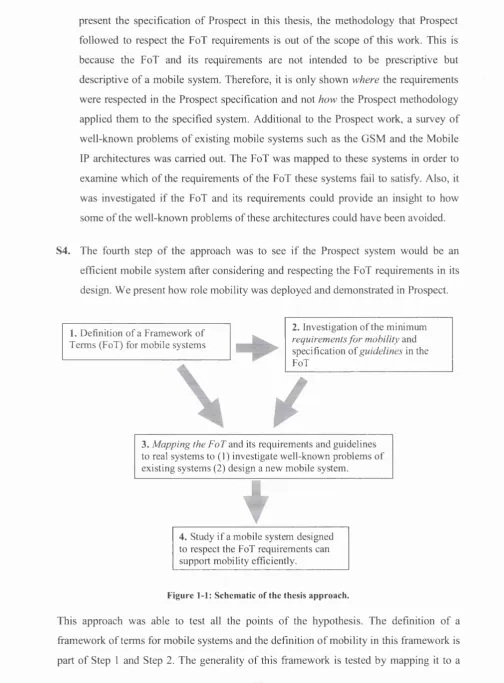
The approach that was followed to investigate the validity of the hypothesis that motivated this thesis consists of four steps as illustrated in Figure 1-1.
51. The first step was to specify a Framework of Terms (FoT). This framework was designed to be generic enough to encompass concepts found in a variety of existing mobile systems. The definitions of this fi*amework were also intended to be technology independent. This fi*amework was intended to provide the base for a discussion on mobility and not to abstract the concept of a network connection like the OSI-RM. It describes the bare characteristics of a communications environment that features mobile entities. The requirements for mobility support that are expressed in this framework of terms is only concerned with how mobile entities can contact or be contacted by other fixed or mobile network entities, where the connectivity and the data-transport between them are assumed. The term entity is generic enough to include network equipment (such as terminal equipment), persons, or applications. Due to its informal nature the definitions of framework can be ambiguous. In order to reduce the ambiguity in the fi*amework its definitions are also expressed using a formal notation.
52. The second step of the approach was to discuss mobility in the FoT and to see what are the minimum requirements for mobile entities. This discussion is based on the Open Distributed Processing (ODP) viewpoints of the RM-ODP.
-In this thesis, requirements for mobility in the proposed FoT are investigated from two different ODP viewpoints mainly: the information viewpoint and the computational viewpoint. The enterprise viewpoint is not addressed; the main reason for this is that potential requirements regarding the enterprise configuration of a mobile system expressed in the FoT would take a lot of effort to test. It would take a thorough investigation of a variety of existing enterprise configurations. For the scope of this thesis, the FoT was intended to be generic enough so that it can map to single-enterprise mobile systems as well as to mobile systems with complex enterprise models. Only a few issues from the engineering viewpoint are discussed together with the computational issues. These issues are only discussed as different distribution options for the computational entities of the proposed design patterns and the potential advantages or disadvantages that these options may hold. The technology viewpoint is not included in the FoT since the FoT is technology independent.
Within the information viewpoint the use of identifiers for mobile entities and the necessity for unique identifiers are discussed. Also, a high-level description of the format they need to have is proposed. On the computational viewpoint the niinimum number computational entities that are required in order to support mobility efficiently are examined. These entities and their minimum fimctionality are presented in the form of Design Pattern templates. In particular, the CORBA design pattern template of Mowbray and Malveau [MM97] is used, since that one seemed most adequate for expressing design patterns of a very wide scope and applicability. Using these design patterns some additional issues of an engineering level nature are briefly discussed. These are the different distribution options that can be used for some computational entities and the pros and cons of each option.
present the specification of Prospect in this thesis, the methodology that Prospect followed to respect the FoT requirements is out of the scope of this work. This is because the FoT and its requirements are not intended to be prescriptive but descriptive of a mobile system. Therefore, it is only shown where the requirements were respected in the Prospect specification and not how the Prospect methodology applied them to the specified system. Additional to the Prospect work, a survey of well-known problems of existing mobile systems such as the GSM and the Mobile IP architectures was carried out. The FoT was mapped to these systems in order to examine which of the requirements of the FoT these systems fail to satisfy. Also, it was investigated if the FoT and its requirements could provide an insight to how some of the well-known problems of these architectures could have been avoided.
S4. The fourth step of the approach was to see if the Prospect system would be an efficient mobile system after considering and respecting the FoT requirements in its design. We present how role mobility was deployed and demonstrated in Prospect.
1. Definition of a Framework of Terms (FoT) for mobile systems
2. Investigation of the minimum
requirements fo r mobility and specification o ï guidelines in the FoT
/
3. Mapping the FoT and its requirements and guidelines
to real systems to (1) investigate well-known problems of existing systems (2) design a new mobile system.
4. Study if a mobile system designed to respect the FoT requirements can support mobility efficiently.
Figure 1-1: Schematic of the thesis approach.
This approach was able to test all the points of the hypothesis. The definition of a framework of terms for mobile systems and the definition of mobility in this framework is part of Step 1 and Step 2. The generality of this framework is tested by mapping it to a
-number of mobile systems coming from different communities (Step 3). The practical value of this framework is investigated by designing and demonstrating a real mobile system according to the requirements of the FoT; this system is the role mobility component in Prospect (Step 3 and Step 4). Also, the practical value of the FoT was further investigated by justifying well-known problems of existing mobile systems by showing where these systems fail the requirements of the FoT; the problems of Mobile IP and GSM are investigated in this way (Step 3). By showing that well-known problems of existing mobile system architectures can be justified by their failing certain requirements of the FoT, the claim that the FoT and its requirements provide for building coherent mobile systems that avoid pitfalls that are common in existing ones was substantiated.
Having demonstrated and investigated the validity of the hypothesis some conclusions are drawn regarding the FoT and the specified requirements and further directions are identified to carry this research forward.
The following section provides an outline of this thesis that documents this work in detail.
1.5 Outline of dissertation
In Chapter two and Chapter three we examine the problems with existing mobile system architectures and we present a generic and technology independent Framework of Terms (FoT), which is the first step of the thesis approach:
• In Chapter two we examine the architectures of GSM and Mobile IP and we point out the flaws and the problems that they present. We show why the scope of mobility is limited in these architectures. We point out the restricting role of legacy technologies in the existing standards and we also discuss how this legacy is passed on to the most recent standardisation work of the Telecom community. In the same chapter we also present other work that is relevant to this thesis, including existing abstract network models and mathematical models for mobility.
mathematical models for mobility. Since the FoT provides informal definitions that are expressed in plain English it can be ambiguous. In order to reduce this ambiguity we express FoT definitions using a formal notation at the end of this chapter.
• Then, we proceed with the documentation of the second step of the approach, in
Chapter four. In this chapter we present a set of requirements for mobility based on the FoT. We present and discuss these requirements from two different ODP viewpoints: the information viewpoint and the computational viewpoint. Based on these requirements we proceed with defirdng architectural requirements for mobility at this generic level. From the information viewpoint we investigate the necessity and the scope of unique identifiers for mobile entities and we give a high level view of the structure that mobile entity identifiers should have. From the computational viewpoint we outline different kinds of computational entities that can assist in managing mobility efficiently. These are described by means of design pattern templates. Together with the computational viewpoint considerations we discuss engineering viewpoint issues.
We then go on to show how the requirements of Chapter four were met in the design of a real system and we present how this system was implemented and demonstrated. These are the last two steps of the followed approach and they are presented in Chapter five:
• In Chapter five we describe the deployment of a role mobility system that was designed and implemented under the European ACTS project Prospect. We show how the FoT of Chapter three maps to the Prospect environment and we present how the FoT requirements of Chapter four were considered in the design of this system. Finally, we present how role mobility was implemented and demonstrated in Prospect. Apart from the Prospect architecture, we show, in the same chapter, how the FoT maps to the GSM and IP architectures that were discussed in Chapter two. We show which of the FoT requirements these architectures fail to respect, and we explain how respecting these requirements in their design could cure the well-known problems of these architectures.
We discuss the results of this investigation with respect to the hypothesis in Chapter six,
where we also investigate the contribution and the limitations of this work. The conclusions are presented in Chapter seven together with other aspects of this work that can be addressed in the future.
-2. Current mobile system architectures
and related work
In this chapter we describe two current m obile system architectures that originate from
different comm unities:
Al. The M obile IP architecture o f the Internet.
A2. The GSM architecture o f ETSI.
These two architectures are considered to be representative o f each o f the two cultures
from the Internet and the Telecom communities. Both o f these architectures evolved from
legacy architectures. In both cases, mobility support had to be added to existing fixed
network architectures.
For each o f these architectures we present their problem s and we discuss how their legacy
led to their respective problems with regard to m obility support. Then, we extend our
criticism to other architectures that are currently considered by the Telecom community.
We focus this criticism on the following points:
PI. They address only some kinds o f mobility.
P2. They approach each kind o f m obility in a parochial way.
P3. Their approaches cannot be easily adopted for m obility in other environments.
P4. They have certain architectural drawbacks.
-In this chapter we also discuss other approaches to architectural requirements for communication systems, which relate to this thesis. We present how the ODP viewpoints have been used for identifying requirements for multi-media systems, the relevance of our work to the OSI reference model and other work on the use of unique identifiers for addressing and locating network entities.
Finally, we present existing formal and mathematical models for mobility. In particular we present the 7i-calculus, the mobile ambients calculus and the Mobile UNITY.
2.1 Mobile IP
The Mobile IP protocol and its architecture [RFC2002, RFC2005] allow for transparent routing of IP datagrams to mobile nodes in the Internet. The architecture introduces the following new entities to IP networks for mobility support:
E l. A mobile node, which is an IP host or router that changes point of attachment from one IP network or subnetwork to another but can still communicate with other Internet nodes. The mobile agent maintains its IP address at all times. The IP address is used to identify the mobile node [RPC2002].
E2. A Home Agent (HA), which is a router on the home network of a mobile node, which, when the mobile node is not in its home network, “tunnels” the IP datagrams to it at its remote location.
E3. A Foreign Agent (FA), which is a router on a network where a mobile node can visit and it provides routing services to the mobile node while visiting. In this way, the mobile node can send datagrams to other Internet nodes via the FA. The FA can also “detunnel” all the traffic destined to the mobile node (this traffic arrives via the HA), and forward it to it to the mobile node.
Both the Home Agent and the Foreign Agent can be described with the term Mobility Agents.
When a mobile node moves from its home network to a foreign network the following steps take place:
51. The mobile node realises that it is in a foreign network either by receiving the FA advertisements or by soliciting an advertisement from the F As.
52. The mobile node then obtains a care-of-address from the foreign network that can be used to receive IP datagrams.