R E S E A R C H
Open Access
Rate-splitting multiple access for
downlink communication systems: bridging,
generalizing, and outperforming SDMA and
NOMA
Yijie Mao
1*, Bruno Clerckx
2and Victor O.K. Li
1Abstract
Space-division multiple access (SDMA) utilizes linear precoding to separate users in the spatial domain and relies on fullytreating any residual multi-user interference as noise. Non-orthogonal multiple access (NOMA) uses linearly precoded superposition coding with successive interference cancellation (SIC) to superpose users in the power domain and relies on user grouping and ordering to enforce some users to fully decode and cancel interference created by other users.
In this paper, we argue that to efficiently cope with the high throughput, heterogeneity of quality of service (QoS), and massive connectivity requirements of future multi-antenna wireless networks, multiple access design needs to depart from those two extreme interference management strategies, namely fully treat interference as noise (as in SDMA) and fully decode interference (as in NOMA).
Considering a multiple-input single-output broadcast channel, we develop a novel multiple access framework, called rate-splitting multiple access (RSMA). RSMA is a more general and more powerful multiple access for downlink multi-antenna systems that contains SDMA and NOMA as special cases. RSMA relies on linearly precoded rate-splitting with SIC to decode part of the interference and treat the remaining part of the interference as noise. This capability of RSMA topartiallydecode interference and partially treat interference as noise enables to softly bridge the two extremes of fully decoding interference and treating interference as noise and provides room for rate and QoS enhancements and complexity reduction.
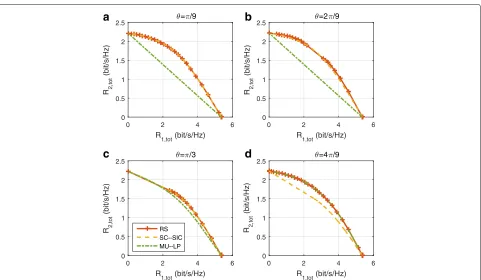
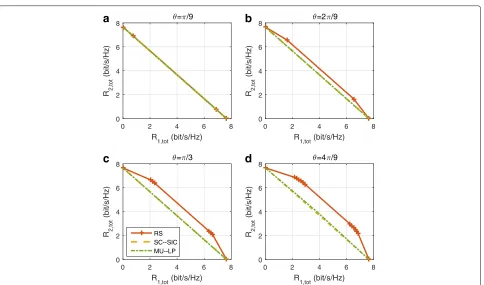
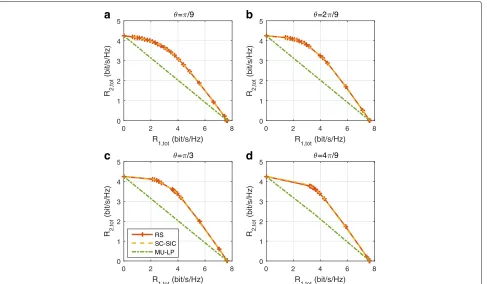
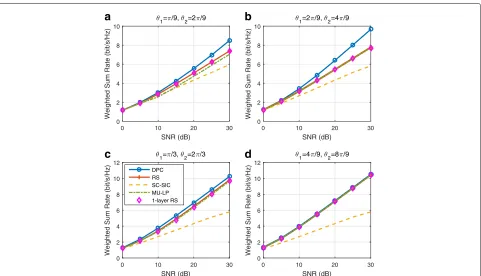
The three multiple access schemes are compared, and extensive numerical results show that RSMA provides a smooth transition between SDMA and NOMA and outperforms them both in a wide range of network loads (underloaded and overloaded regimes) and user deployments (with a diversity of channel directions, channel strengths, and qualities of channel state information at the transmitter). Moreover, RSMA provides rate and QoS enhancements over NOMA at a lower computational complexity for the transmit scheduler and the receivers (number of SIC layers).
Keywords: RSMA, NOMA, SDMA, MISO BC, Linear precoding, Rate region, Weighted sum rate, Rate splitting
1 Introduction
With the dramatic upsurge in the number of devices expected in 5G and beyond, wireless networks will be operated in a variety of regimes ranging from underloaded to overloaded (where the number of scheduled devices is smaller and larger than the number of transmit antennas
*Correspondence:[email protected]
1Department of Electrical and Electronic Engineering, The University of Hong Kong, Pok Fu Lam Road, Hong Kong, China
Full list of author information is available at the end of the article
at each access point, respectively). Moreover, due to the heterogeneity of devices (high-end such as smartphones and low-end such as Internet of Things and Machine-Type Communications devices), deployments, and applications in 5G and beyond, the transmitter will need to serve simultaneously users with different capabilities, deploy-ments, and qualities of channel state information at the transmitter (CSIT). This massive connectivity problem together with the demands for high throughput and het-erogeneity of quality of service (QoS) has recently spurred
interests in re-thinking multiple access for the downlink of communication systems.
In this paper, we propose a new multiple access called rate-splitting multiple access (RSMA). In order to fully assess the novelty of the proposed multiple access paradigm and the design philosophy, we first review the state of the art of two major multiple accesses, namely non-orthogonal multiple access (NOMA) [1], also called Multi-User Superposition Transmission (MUST) in 3GPP LTE Rel-13 [2] and space-division multiple access (SDMA). We identify their benefits and limitations and make critical observations, before motivating the intro-duction of the novel and more powerful RSMA.
1.1 SDMA and NOMA: the extremes
Contrary to orthogonal multiple access (OMA) that schedules users or groups of users in orthogonal dimen-sions, e.g., time (TDMA) and frequency (FDMA), NOMA superposes users in the same time-frequency resource via the power domain or the code domain, leading to the power-domain NOMA (e.g., [1]) and code-domain NOMA (e.g., sparse code multiple access (SCMA) [3]). Power-domain NOMA1 relies on superposition coding (SC) at the transmitter and successive interference cancel-lation (SIC) at the receivers (denoted in short as SC–SIC) [1,4–6]. Such a strategy is motivated by the well-known result that SC–SIC achieves the capacity region of the single-input single-output (SISO) (Gaussian) broadcast channel (BC) [7,8]. It is also well known that the capac-ity region of the SISO BC is larger than the rate region achieved by OMA (e.g., TDMA) when users experience a disparity of channel strengths [8]. On the other hand, when users exhibit the same channel strengths, OMA based on TDMA is sufficient to achieve the capacity region [8].
The benefit of a single-antenna NOMA using SC–SIC is therefore to be able, despite the presence of a single transmit antenna in a SISO BC, to cope with an over-loaded regime in a spectrally efficient manner where mul-tiple users experience potentially very different channel strengths/path losses (e.g., cell-center users and cell-edge users) on the same time/frequency resource.
The limitation of a single-antenna NOMA lies in its complexity as the number of users grows. Indeed, for a K-user SISO BC, the strongest user needs to decode using SIC theK −1 messages of all co-scheduled users and therefore peel off K − 1 layers before accessing its intended stream. Though SIC of a small number of layers should be feasible in practice2, the complexity and likeli-hood of error propagation becomes quickly significant for a large number of users. This calls for ways to decrease the number of SIC layers at each user. One could divide users into small groups of users with disparate channels and apply SC–SIC in each group and schedule groups on
orthogonal resources (using OMA), but that may lead to some performance loss and latency increase.
In nowadays wireless networks, access points are often equipped with more than one antenna. This spatial dimension opens the door to another well-known type of multiple access, namely SDMA. SDMA superposes users in the same time-frequency resource and sepa-rates user via a proper use of the spatial dimensions. Contrary to the SISO BC, the multi-antenna BC is non-degraded, i.e., users cannot be ordered based on their channel strengths in general settings. This is the reason why SC–SIC is not capacity-achieving, and the com-plex dirty paper coding (DPC) is the only strategy that achieves the capacity region of the multiple-input single-output (MISO) (Gaussian) BC with perfect CSIT [9]. DPC, rather than performing interference cancellation at the receivers as in SC–SIC, can be viewed as a form of enhanced interference cancellation at the transmitter and relies on perfect CSIT to do so. Due to the high computa-tional burden of DPC, linear precoding is often considered the most attractive alternative to simplify the transmitter design [10]. Interestingly, in a MISO BC, multi-user linear precoding (MU–LP), e.g., either in closed form or opti-mized using optimization methods, though suboptimal, is often very useful when users experience relatively sim-ilar channel strengths or long-term signal-to-noise ratio (SNR) and have semi-orthogonal to orthogonal channels [11]. SDMA is therefore commonly implemented using MU–LP. The linear precoders create different beams with each beam being allocated a fraction of the total trans-mit power. Hence, similarly to NOMA, SDMA can also be viewed as a superposition of users in the power domain, though users are separated at the transmitter side by spa-tial beamformers rather than by the use of SIC at the receivers.
SDMA based on MU–LP is a well-established multi-ple access that is nowadays the basic princimulti-ple behind numerous techniques in 4G and 5G such as multi-user multiple-input multiple-output (MU–MIMO), coor-dinated multipoint (CoMP) coorcoor-dinated beamforming, network MIMO, millimeter-wave MIMO, and massive MIMO.
Thebenefit of SDMAusing MU–LP is therefore to reap all spatial multiplexing benefits of a MISO BC with perfect CSIT with a low precoder and receiver complexity.
Thelimitations of SDMAare threefold.
group, which may increase latency and decrease QoS depending on the application.
Second, its performance is sensitive to the user channel orthogonality and strengths and requires the scheduler to pair semi-orthogonal users with similar channel strengths together. The complexity of the scheduler can quickly increase when an exhaustive search is performed, though low-complexity (suboptimal) scheduling and user-pairing algorithms exist [10].
Third, it is optimal from a degrees of freedom3(DoF), also known as spatial multiplexing gain, perspective in the perfect CSIT setting but not in the presence of imperfect CSIT [12]. The problem of SDMA design in the presence of imperfect CSIT has been to strive to apply a framework motivated by perfect CSIT to scenarios with imperfect CSIT, not to design a framework motivated by imperfect CSIT from the beginning [12]. This leads to the well-known severe performance loss of MU–LP in the presence of imperfect CSIT [13].
In view of SC–SIC benefits in a SISO BC, attempts have been made to study multi-antenna NOMA. Two lines of research have emerged that both rely on linearly precoded SC–SIC.
Thefirst strategy, which we simply denote as “SC–SIC,” is a direct application of SC–SIC to the MISO BC by degrading the multi-antenna broadcast channel. It con-sists in ordering users based on their effective scalar channel (after precoding) strengths and enforce receivers to decode messages (and cancel interference) in a suc-cessive manner. This is advocated and exemplified for instance in [14–17]. This NOMA strategy converts the multi-antenna non-degraded channel into an effective single-antenna degraded channel, as at least one receiver ends up decoding all messages. While such a strategy can cope with the deployment of users experiencing aligned channels and different path loss conditions, it comes at the expense of sacrificing and annihilating all spatial mul-tiplexing gains in general settings. By forcing one receiver to decode all streams, the sum DoF is reduced to unity4. This is the same DoF as that achieved by TDMA/single-user beamforming (or OMA). This is significantly smaller than the sum DoF achieved by DPC and MU–LP in a MISO BC with perfect CSIT, which is the minimum of the number of transmit antennas and the number of users5. Moreover, this loss in multiplexing gain comes
with a significant increase in receiver complexity due to the multi-layer SIC compared to the treat interference as noise strategy of MU–LP. As a remedy to recover the DoF loss, we could envision a dynamic switching between NOMA and SDMA, reminiscent of the dynamic switch-ing between SU–MIMO and MU–MIMO in 4G [18]. One would dynamically choose the best option between NOMA and SDMA as a function of the channel states. A particular instance of this approach is taken in [19] where
a dynamic switching between SC–SIC and zero-forcing beamforming (ZFBF) was investigated.
Thesecond strategy, which we denote as “SC–SIC per group,” consists in groupingKusers intoGgroups. Users within each group are served using SC–SIC, and users across groups are served using SDMA so as to mitigate the inter-group interference. Examples of such a strategy can be found in [1, 20–24]. This strategy can therefore be seen as a combination of SDMA and NOMA where the multi-antenna system is effectively decomposed into Ghopefully non-interfering single-antenna NOMA chan-nels. For this “SC–SIC per group” approach to perform at its best, users within each group need to have their channels aligned and users across groups need to be orthogonal.
Similarly to SDMA, multi-antenna NOMA designs also rely on accurate CSIT. In the practical scenario of imper-fect CSIT, NOMA design relies on the same above two strategies but optimizes the precoder so as to cope with CSIT imperfection and resulting extra multi-user inter-ference. As an example, the MISO BC channel is again degraded in [17] and precoder optimization with imper-fect CSIT is studied.
The benefit of multi-antenna NOMA, similarly to the single-antenna NOMA, is the potential to cope with an overloaded regime where multiple users experience dif-ferent channel strengths/path losses and/or are closely aligned with each other.
Thelimitations of multi-antenna NOMAare fourfold. First, the use of SC–SIC in NOMA is fundamentally motivated by a degraded BC in which users can be ordered based on their channel strengths. This is the key property of the SISO BC that enables SC–SIC to achieve its capacity region. Unfortunately, motivated by the promising gains of SC–SIC in a SISO BC, the multi-antenna NOMA lit-erature strives to apply SC–SIC to a non-degraded MISO BC. This forces to degrade a non-degraded BC and there-fore leads to an inefficient use of the spatial dimensions in general settings, leading to a DoF loss.
Second, NOMA is not suited for general user deploy-ments since degrading a MISO BC is efficient when users are sufficiently aligned with each other and exhibit a disparity of channel strengths, not in general settings.
each user, along with the six possible decoding orders. Increasing the number of users leads to an exponential increase in the number of possible decoding orders. “SC–SIC per group” divides users into multiple groups but that approach leads to a joint design of user order-ing and user grouporder-ing. To decrease the complexity in user ordering and user grouping, multi-antenna NOMA (SC–SIC and SC–SIC per group) forces users belonging to the same group to share the same precoder (beam-forming vector) [1]. Unfortunately, such a restriction can only further hurt the overall performance since it shrinks the overall optimization space.
Fourth, multi-antenna NOMA is subject to the same drawback as SDMA in the presence of imperfect CSIT, namely its design is not motivated by any fundamental limits of a MISO BC with imperfect CSIT.
The key is to recognize that the limitations and draw-backs of SDMA and NOMA originate from the fact that those two multiple accesses fundamentally rely on two extreme interference management strategies, namely fully treat interference as noise and fully decode interference. Indeed, while NOMA relies on some users to fully decode and cancel interference created by other users, SDMA relies on fully treating any residual multi-user interference as noise. In the presence of imperfect CSIT, CSIT inaccu-racy results in an additional multi-user interference that is treated as noise by both NOMA (SC–SIC per group) and SDMA.
1.2 RSMA: bridging the extremes
In contrast, with RSMA, we take a different route and depart from the SDMA and NOMA literature and those two extremes of fully decode interference and treat inter-ference as noise. We introduce a more general and power-ful multiple access framework based on linearly precoded rate splitting (RS) at the transmitter and SIC at the receivers. This enables to decode part of the interference and treat the remaining part of the interference as noise [12]. This capability of RSMA to partially decode inter-ference and partially treat interinter-ference as noise enables to softly bridge the two extreme strategies of fully treating interference as noise and fully decoding interference. This contrasts sharply with SDMA and NOMA that exclusively rely on the two extremes or a combination thereof.
In order to partially decode interference and partially treat interference as noise, RS splits messages into com-mon6and private messages and relies on a superimposed transmission of common messages decoded by multiple users and private messages decoded by their correspond-ing users (and treated as noise by co-scheduled users). Users rely on SIC to first decode the common messages before accessing the private messages. By adjusting the message split and the power allocation to the common and private messages, RS has the ability to softly bridge the
two extreme of fully treat interference as noise and fully decode interference.
The idea of RS dates back to Carleial’s work and the Han and Kobayashi (HK) scheme for the two-user single-antenna interference channel (IC) [25]. However, the use of RS as the building block of RSMA is motivated by recent works that have shown the benefit of RS in multi-antenna BC and the recent progress on characterizing the fundamental limits of a multi-antenna BC (and IC) with imperfect CSIT. Hence, importantly, in contrast with the conventional RS (HK scheme) used for the two-user SISO IC, we here use RS in a different setup, namely (1) in a BC and (2) with multiple antennas. The use and benefits of RS in a multi-antenna BC only appeared in the last few years7.
The capacity region of theK-user MISO BC with imper-fect CSIT remains an open problem. As an alternative, recent progress has been made to characterize the DoF region of the underloaded and overloaded MISO BC with imperfect CSIT. In [26], a novel information theoretic upperbound on the sum DoF of theK-user underloaded MISO BC with imperfect CSIT was derived. Interestingly, this sum DoF coincides with the sum DoF achieved by a linearly precoded RS strategy at the transmitter with SIC at the receivers [27,28]. RS (with SIC) is therefore optimum to achieve the sum DoF of the K-user under-loaded MISO BC with imperfect CSIT, in contrast with MU–LP that is clearly suboptimum (and so is SC–SIC since it achieves a sum DoF of unity8) [28]. It turns out that RS with a flexible power allocation is not only opti-mum for the sum DoF but for the entire DoF region of an underloaded MISO BC with imperfect CSIT [29]. The DoF benefit of RS in imperfect CSIT settings were also shown in more complicated underloaded networks with multiple transmitters in [30] and multi-antenna receivers [31]. Considering user fairness, the optimum symmetric DoF (or max-min DoF), i.e., the DoF that can be achieved by all users simultaneously, of the underloaded MISO BC with imperfect CSIT with MU–LP and RS was studied in [32]. RS symmetric DoF was shown to outperform that of MU–LP. Finally, moving to the overloaded MISO BC with heterogeneous CSIT qualities, a multi-layer power parti-tioning strategy that superimposes degraded symbols on top of linearly precoded rate-splitted symbols was shown in [33] to achieve the optimal DoF region.
The benefits of RS have also appeared in multi-antenna settings with perfect CSIT. In an overloaded multigroup multicast setting with perfect CSIT, considering again fairness, the symmetric DoF achieved by RS, MU–LP, and degraded NOMA transmissions (where receivers decode messages and cancel interference in a successive manner as in SC–SIC) was studied in [34]. It was shown that RS here again outperforms both MU–LP and SC–SIC.
the diversity of channel strengths among users. This limi-tation is countered by the generalized DoF (GDoF) frame-work, which inherits the tractability of the DoF framework while capturing the diversity in channel strengths [35]. In [36,37], the GDoF of an underloaded MISO BC with imperfect CSIT is studied, and here again, RS is used as part of the achievability scheme.
The DoF (GDoF) superiority of RS over MU–LP and SC–SIC in all those multi-antenna settings (with perfect and imperfect CSIT) comes from the ability of RS to better handle the multi-user interference by evolving in a regime in between the extremes of fully treating it as noise and fully decoding it.
Importantly, the rate enhancements of RS over MU– LP, as predicted by the DoF analysis, are reflected in the finite SNR regime as shown in a number of recent works. In [38], finite SNR rate analysis of RS in MISO BC in the presence of quantized feedback was analyzed and it was shown that RS benefits from a CSI feedback overhead reduction compared to MU–LP. Using opti-mization methods, the precoder design of RS at finite SNR was investigated in [28] for the sum rate and rate region maximization with imperfect CSIT, in [32] for max-min fair transmission with imperfect CSIT, and in [34] for multi-group multi-cast with perfect CSIT. More-over, the benefit of RS over MU–LP in the finite SNR regime was shown in massive MIMO [39], millimeter-wave systems [40] and multi-antenna deployments subject to hardware impairments [41]. Finally, the performance benefits of the power-partitioning strategy relying on RS in the overloaded MISO BC with heterogeneous CSIT was confirmed using simulations at finite SNR in the presence of a diversity of channel strengths [33]. In particular, in contrast to the RS used in [12,28,29,32–34,38,40,41] that relies on a single common message, [39] (as well as [30]) showed the benefits in the finite SNR regime of a multi-layer (hierarchical) RS relying on multiple common messages decoded by various groups of users.
In this paper, in view of the limitations of SDMA and NOMA and the above literature on RS in multi-antenna BC, we design a novel multiple access, called rate-splitting multiple access (RSMA) for downlink communication system9. RSMA is a much more attractive solution (per-formance and complexity-wise) that retains the benefits of SDMA and NOMA but tackles all the aforementioned limitations of SDMA and NOMA. Considering a MISO BC, we make the following contributions.
First, we show that RSMA is a more general class/framework of multi-user transmission that encom-passes SDMA and NOMA as special cases. RSMA is shown to reduce to SDMA if channels are of similar strengths and sufficiently orthogonal with each other and to NOMA if channels exhibit sufficiently diverse strengths and are sufficiently aligned with each other. This
is the first paper to explicitly recognize that SDMA and NOMA are both subsets of a more general transmission framework based on RS10.
Second, we provide a general framework of multi-layer RS design that encompasses existing RS schemes as special cases. In particular, the single-layer RS of [28,29,32–34,38,40,41] and the multi-layer (hierarchical and topological) RS of [30,39] are special instances of the generalized RS strategy developed here. Moreover, the use of RS was primarily motivated by multi-antenna deploy-ments subject to multi-user interference due to imperfect CSIT in those works. The benefit of RS in the presence of perfect CSIT and/or a diversity of channel strengths in a multi-antenna setup, as considered in this paper, is less investigated. RS was shown in [34] to boost the perfor-mance of overloaded multi-group multi-cast. However, no attempt has been made so far to identify the benefit of RS in multi-antenna BC with perfect CSIT and/or a diversity of channel strengths.
Third, we show that the rate performance (rate region, weighted sum-rate with and without QoS constraints) of RSMA is always equal to or larger than that of SDMA and NOMA. Considering a MISO BC with perfect CSIT and no QoS constraints, RSMA performance comes closer to the optimal DPC region than SDMA and NOMA. In sce-narios with QoS constraints or imperfect CSIT, RSMA always outperforms SDMA and NOMA. Since it is moti-vated by fundamental DoF analysis, RSMA is also optimal from a DoF perspective in both perfect and imperfect CSIT and therefore optimally exploit the spatial dimen-sions and the availability of CSIT, in contrast with SDMA and NOMA that are suboptimal.
Fourth, we show that RSMA is much more robust than SDMA and NOMA to user deployments, CSIT inaccu-racy, and network load. It can operate in a wide range of practical deployments involving scenarios where the user channels are neither orthogonal nor aligned and exhibit similar strengths or a diversity of strengths, where the CSI is perfectly or imperfectly known to the transmitter, and where the network load can vary between the under-loaded and the overunder-loaded regimes. In particular, in the overloaded regime, the RSMA framework is shown to be particularly suited to cope with a variety of device capa-bilities, e.g., high-end devices along with cheap Internet-of-Things (IoT)/Machine-Type Communications (MTC) devices. Indeed, the RS framework can be used to pack the IoT/MTC traffic in the common message, while still delivering high-quality service to high-end devices.
scheduler and multiple layers of SIC at the receivers, a simple one-layer RS that does not require any user ordering, grouping, or dynamic switching at the transmit scheduler and a single layer of SIC at the receivers still significantly outperforms NOMA. In contrast to SDMA, RSMA is less sensitive to user pairing and therefore does not require complex user scheduling and pairing11. How-ever, RSMA comes with a slightly higher encoding com-plexity than SDMA and NOMA due to the encoding of the common streams on top of the private streams.
Sixth, though SC–SIC is optimal to achieve the capacity region of SISO BC, we show that a single-layer RS is a low-complexity alternative that only requires a single layer of SIC at each receiver and achieves close to SC–SIC (with multi-layer SIC) performance in a SISO BC deployment.
As a takeaway message, we note that the ability of a wireless network architecture to partially decode inter-ference and partially treat interinter-ference as noise can lead to enhanced throughput and QoS, increased robustness, and lowered complexity compared to alternatives that are forced to operate in the extreme regimes of fully treating interference as noise and fully decoding interference.
It is also worth making the analogy with other types of channels where the ability to bridge the extremes of treating interference as noise and fully decoding inter-ference has appeared. Considering a two-user SISO IC, interference is fully decoded in the strong interference regime and is treated as noise in the weak interference regime. Between those two extremes, interference is nei-ther strong enough to be fully decoded nor weak enough to be treated as noise. The best known strategy for the two-user SISO IC is obtained using RS (so-called HK scheme). RS in this context is well known to be superior to strategies relying on fully treating interference as noise, fully decoding interference, or orthogonalization (TDMA, FDMA) [25, 35]. Limiting ourselves to those extremes strategies is suboptimal [25,35].
The rest of the paper is organized as follows. The sys-tem model is described in Section2. The existing multiple accesses are specified in Section 3. In Section 4, the proposed RSMA and its low-complexity structures are described and compared with existing multiple accesses. The corresponding weighted sum rate (WSR) problems are formulated, and the weighted MMSE (WMMSE) approach to solve the problem is discussed. Numerical results are illustrated in Section5, followed by conclusions and future works in Section6.
Notations: The boldface uppercase and lowercase letters are used to represent matrices and vectors. The super-scripts (·)T and (·)H denote transpose and conjugate-transpose operators, respectively. tr(·)and diag(·)are the trace and diagonal entries, respectively.|·|is the absolute value, and·is the Euclidean norm.E{·}refers to the sta-tistical expectation.Cdenotes the complex space.Iand0
stand for an identity matrix and an all-zero vector, respec-tively, with appropriate dimensions.CN(δ,σ2)represents a complex Gaussian distribution with meanδand variance σ2.|A|is the cardinality of the setA.
2 System model
Consider a system where a base station (BS) equipped withNtantennas servesKsingle-antenna users. The users
are indexed by the set K = {1,. . .,K}. Letx ∈ CNt×1 denotes the signal vector transmitted in a given channel use. It is subject to the power constraintE{x2} ≤ Pt.
The signal received at user-kis
yk=hHkx+nk,∀k∈K (1)
is the additive white Gaussian noise (AWGN) at the receiver. Without loss of generality, we assume the noise variances are equal to one for all users. The transmit SNR is equal to the total power consumptionPt.
We assume CSI of users is perfectly known at the BS in the following model. The imperfect CSIT scenario will be discussed in the proposed algorithm and the numerical results. Channel state information at the receivers (CSIR) is assumed to be perfect.
In this work, we are interested in beamforming designs for signalxat the BS. Specifically, the objective of beam-forming designs is to maximize the WSR of users subject to a power constraint of the BS and QoS constraints of each user. We firstly state and compare two baseline multi-antenna multiple accesses, namely SDMA and NOMA. Then, RSMA is explained. The WSR problem of each strategy will be formulated, and the algorithm adopted to solve the corresponding problem will be stated in the following sections.
3 SDMA and NOMA
In this section, we describe two baseline multiple accesses. The messages W1,. . .,WK intended for users 1 to K,
respectively, are encoded intoKindependent data streams s =[s1,. . .,sK]T independently. Symbols are mapped
to the transmit antennas through a precoding matrix denoted by P =[p1,. . .,pK], where pk ∈ CNt×1 is the
precoder for user-k. The superposed signal isx = Ps =
k∈Kpksk. Assuming that E{ssH} = I, the transmit
power is constrained by tr(PPH)≤Pt.
3.1 SDMA
SDMA based on MU–LP is a well-established multiple access. Each user only decodes its desired message by treating interference as noise. The signal-to-interference-plus-noise ratio (SINR) at user-kis given by
γk =
|hHkpk|2
j=k,j∈K|hHkpj|2+1
For a given weight vectoru = [u1,. . .,uK], the WSR uk is a non-negative constant which allows resource allo-cation to prioritize different users.Rthk accounts for any potential individual rate constraint for user-k. It ensures the QoS of each user. The WMMSE algorithm proposed in [42] is adopted to solve problem (3). The main idea of the WMMSE algorithm is to reformulate the WSR problem into its equivalent WMMSE problem and solve it using the alternating optimization (AO) approach. The rate region of the MU–LP strategy is approximated byRMU−LP(u)for
different rate weight vectorsu. The resulting rate region RMU−LPis the convex hull enclosing the resulting points.
In general, solution to problem (3) would provide the optimal MU–LP beamforming strategy for any channel deployment (in between aligned and orthogonal channels and with similar or diverse channel strengths).
3.2 NOMA
NOMA relies on superposition coding at the transmitter and successive interference cancellation at the receiver. As discussed in the introduction, the two main strategies in multi-antenna NOMA are the SC–SIC and SC–SIC per group. SC–SIC can be treated as a special case of SC–SIC per group where there is only one group of users.
3.2.1 SC–SIC
In SC–SIC, the precoders and decoding orders have to be optimized jointly. The decoding order is vital to the rate obtained at each user. To maximize the WSR, all possible decoding orders of users are required to be con-sidered. Denote π as one of the decoding orders, the message of user-π(k) is decoded before the message of user-π(j),∀k ≤ j. The messages of user-π(k),∀k ≤ iare decoded at user-π(i)using SIC. The SINR experienced at user-π(i) to decode the message of user-π(k),k ≤ i is
decoding orderπ, the WSR achieved by SC–SIC is
RSC−SIC(u,π)=max algorithm (MMA). To keep a single and unified approach to solve the WSR problem of different beamforming strategies, we still use the WMMSE algorithm to solve it. By approximating the rate region with a set of rate weights, the rate regionRSC−SIC(π)with a certain
decod-ing order π is attained. To achieve the rate region of SC–SIC, all decoding orders should be considered. The largest achievable rate region of SC–SIC is defined as the convex hull of the union over all decoding orders as RSC−SIC=conv(∪πRSC−SIC(π)).
3.2.2 SC–SIC per group
Assuming theKusers are divided intoGgroups, denoted asG= {1,. . .,G}. In each group, there is a subset of users
message of user-πg(k) is decoded before the message of
user-πg(j),∀k≤j. The messages of user-πg(k),∀k≤iare
decoded at user-πg(i)using SIC. The SINR experienced at
user-πg(i)to decode the message of user-πg(k),k ≤ iis
group interference suffered at user-πg(i). For a given
weight vectoru =[u1,. . .,uK], a fixed grouping method
Gand a fixed decoding orderπ = {π1,. . .,πG}, the WSR
achieved by SC–SIC per group is
RgroupSC−SIC(u,G,π)=max larly to the SC–SIC strategy, the problem can be solved by using the WMMSE algorithm. To maximize the WSR, all possible grouping methods and decoding orders should be considered.
message is precoded by its own precoder. Hence, we here do not constrain symbols to be superimposed on the same precoder as this would further reduce the performance of NOMA strategies and therefore leading to even lower per-formance. Hence, the performance obtained with NOMA in this work can be seen as the best possible performance achieved by NOMA.
4 Methods—proposed rate-splitting multiple access
In this section, we firstly introduce the idea of RS by introducing a two-user example (K = 2) and a three-user example (K = 3). Then, we propose the general-ized framework of RS and specify two low-complexity RS strategies. We further compare RSMA with SDMA and NOMA from the fundamental structure and complex-ity aspects. Finally, we discuss the general optimization framework to solve the WSR problem.
4.1 Two-user example
We first consider a two-user example. There are two messages W1 and W2 intended for user-1 and user-2,
respectively. The message of each user is split into two parts, W112,W11 for user-1 andW212,W22 for user-2. The messagesW112,W212are encoded together into a com-mon streams12 using a codebook shared by both users.
Hence,s12is a common stream required to be decoded by
both users. The messagesW11 andW22are encoded into the private streams1for user-1 ands2for user-2,
respec-tively. The overall data streams to be transmitted based on RS iss =[s12,s1,s2]T. The data streams are linearly
pre-coded via precoderP=[p12,p1,p2] , wherep12 ∈CNt×1
is the precoder for the common streams12. The resulting
transmit signal isx=Ps=p12s12+p1s1+p2s2.
We assume that trssH = I, and the total transmit power is constrained by trPPH≤Pt.
At user sides, both user-1 and user-2 firstly decode the data streams12by treating the interference froms1ands2
as noise. Therefore, each user decodes part of the message of the other interfering user encoded ins12. The
interfer-ence is partially decoded at each user. The SINR of the common stream at user-kis
γ12
k =
hHkp122 hHkp12+hHkp22+1
. (8)
Onces12is successfully decoded, its contribution to the
original received signalykis subtracted. After that, user-k
decodes its private streamskby treating the private stream
of user-j (j = k) as noise. The two-user transmission model using RS is shown in Fig.1. The SINR of decoding the private streamskat user-kis
γk =
hHkpk2
hHkpj2+1
. (9)
The corresponding achievable rates of user-k for the streams s12 and sk are R12k = log2
1+γk12 and Rk = log2(1+γk). To ensure that s12 is successfully
decoded by both users, the achievable common rate shall not exceedR12= min
R121 ,R122 . All boundary points for the two-user RS rate region can be obtained by assuming thatR12is shared between users such thatCk12is thekth
user’s portion of the common rate withC112+C212=R12.
Following the two-user RS structure described above, the total achievable rate of user-kisRk,tot = Ck12+Rk. For a
given pair of weightsu = [u1,u2], the WSR achieved by
the two-user RS approach is
RRS2(u)=max
P,c u1R1,tot+u2R2,tot (10a)
s.t. C112+C122 ≤R12 (10b)
trPPH≤Pt (10c)
Rk,tot≥Rthk ,k∈ {1, 2} (10d)
c≥0 (10e)
wherec=C112,C212is the common rate vector required to be optimized in order to maximize the WSR. For a
fixed pair of weights, problem (10) can be solved using the WMMSE approach in [28], except we have perfect CSIT here. By calculatingRRS2(u)for a set of different rate
weightsu, we obtain the rate region.
In contrast to MU–LP and SC–SIC, the RS scheme described above offers a more flexible formulation. In par-ticular, instead of hard switching between MU–LP and SC–SIC, it allows both to operate simultaneously if neces-sary, and hence smoothly bridges the two. In the extreme of treating multi-user interference as noise, RS boils down to MU–LP12 by simply allocating no power to the com-mon streams12. In the other extreme of fully decoding
interference, RS boils down to SC–SIC by forcing one user, say user-1, to fully decode the message of the other user, say user-2. This is achieved by allocating no power tos2,
encodingW1intos1and encodingW2intos12, such that
x=p12s12+p1s1. User-1 and user-2 decodes12by
treat-ings1as noise and user-1 decodess1after cancelings12. A
physical-layer multicasting strategy is obtained by encod-ing bothW1andW2intos12and allocating no power tos1
ands2.
Remark 2: It should be noted that while the RS transmit signal model resembles a broadcasting system with uni-cast (private) streams and a multi-uni-cast stream, the role of the common message is fundamentally different. The com-mon message in a unicast-multi-cast system carries public information intended as a whole to all users in the sys-tem, while the common message s12 in RS encapsulates
parts of private messages, and is not entirely required by all users, although decoded by the two users for interference mitigation purposes[12].
Remark 3: A general framework is adopted where poten-tially each user can split its message into common and private parts. Note however that depending on the objec-tive function, it is sometimes not needed for all users to split their messages. For instance, for sum-rate maximization subject to no individual rate constraint, it is sufficient to have only one user to split its message[28]. However, when it comes to satisfying some fairness (WSR, QoS constraint, max-min fairness), splitting the message of multiple users appears necessary[28,32,34].
4.2 Three-user example
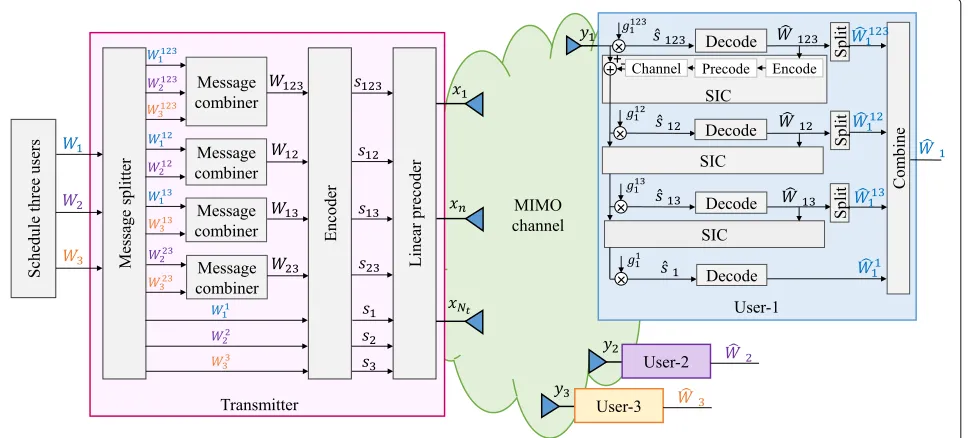
We further consider a three-user example. Different from the two-user case, the message of user-1 is split into
W1123,W112,W113,W11 . Similarly, the message of user-2 and user-3 is split into W2123,W212,W223,W22 and
W3123,W313,W323,W33 , respectively. The superscript rep-resents a specific group of users whose messages with the same superscript are going to be encoded together. For example,W1123,W2123, andW3123are encoded into the com-mon streams123intended for all the three users.W112and
W113are correspondingly encoded with the split messages of user-2W212 and user-3W313into data streamss12 and
s13.s12is the partial common stream intended for user-1
and user-2. Hence, user-1 and user-2 will decodes12while
user-3 will decode its intended streams by treatings12as
noise. Similarly, we obtains23partially encoded for
user-2 and user-3.W11,W22, andW33 are encoded into private streamss1,s2, ands3, respectively.
The vector of data streams to be transmitted is s = [s123,s12,s13,s23,s1,s2,s3]T. After linear precoding
using precoder P= [p123,p12,p13,p23,p1,p2,p3], the
signals are superposed and broadcast. The decoding procedure whenK=3 is more complex comparing with that in the two-user example. The main difference lies in decoding partial common streams for two-users. Define the streams to be decoded by l users as l-order streams. The 2-order streams to be decoded at user-1 are s12ands13. The 2-order streams to be decoded at user-2
and user-3 are s12ands23 ands13ands23, respectively. As
the 1-order and 2-order streams to be decoded at differ-ent users are not the same, we take user-1 as an example. The decoding procedure is the same for other users. User-1 decodes four streamss123,s12,s13, ands1based on
SIC while treating other streams as noise. The decoding procedure starts from the 3-order stream (common stream) and progresses downwards to the 1-order stream (private stream). Specifically, user-1 first decodess123and
subtracts its contribution from the received signal. The SINR of the streams123at user-1 is
γ123
1 =
hH1p1232
i∈{12,13,23}hH1pi2+3k=1hH1pk2+1
.
(11)
After that, user-1 decodes two streams s12,s13 and
treats interference ofs23 as noise. Both decoding orders
of decoding s12 followed bys13 ands13 followed by s12
should be considered in order to maximize the WSR. Denote πl as one of the decoding order to decode l-order streams. There is only one 1-order stream and one 3-order stream to be decoded at each user. Therefore, only one decoding order exists for both π1 and π3. In
con-trast, each user is required to decode two 2-order streams. Denote sπ2,k(i) as the ith data stream to be decoded at
user-kbased on the decoding orderπ2. One instance of
π2 is 12 → 13 → 23, where s12 is decoded before
s13 and s13 is decoded before s23 at all users. Since
only data streams s12 and s13 are decoded at user-1,
the decoding order at user-1 based on π2 is π2,1 =
12 → 13. Hence, sπ2,1(1) = s12 and sπ2,1(2) = s13.
The data stream sπ2,1(1) is decoded before sπ2,1(2). The
γπ2,1(1)
1 =
hH1pπ2,1(1) 2 hH1pπ2,1(2)
2+
hH1p232+3k=1hH1pk2+1
.
(12)
γπ2,1(2)
1 =
hH1pπ2,1(2) 2
hH1p232+3k=1hH1pk2+1
. (13)
User-1 finally decodess1by treating other data streams
as noise. The three-user RS transmission model with the decoding orderπ2 = 12→ 13 →23 is shown in Fig.2.
The SINR of decodings1at user-1 is
γ1=
hH1p12
hH1p232+3k=2hH1pk2+1
. (14)
The corresponding rate of each data stream is cal-culated in the same way as in the two-user exam-ple. To ensure that s123 is successfully decoded by all
users, the achievable common rate shall not exceed R123 = min
R1231 ,R1232 ,R1233 . To ensure thats12 is
suc-cessfully decoded by user-1 and user-2, the achievable common rate shall not exceed R12 = min
R121 ,R122 . Similarly, we have R13 = min
R131 ,R133 and R23 =
minR232 ,R233 . All boundary points for the three-user RS rate region can be obtained by assuming that R123, R12,
R13, and R23 are shared by the corresponding group of
users. Denote the portion of the common rate allocated to user-k for the message s123 as Ck123, we have C1123 +
C2123+C3123= R123. Similarly, we haveC112+C212 =R12,
C113+C133 = R13, andC223+C233 = R23. Following the
three-user RS structure described above, the total achiev-able rate of each user isR1,tot = C1123+C112+C113+R1,
R2,tot=C2123+C122 +C223+R2, andR3,tot=C3123+C133 +
C323+R3. For a given weight vectoru=[u1,u2,u3] and a
fixed decoding orderπ =[π1,π2,π3], the WSR achieved
by the three-user RS approach is
RRS3(u,π)=max
P,c
3
k=1
ukRk,tot (15a)
s.t. C1123+C2123+C3123≤R123 (15b)
C112+C122 ≤R12 (15c)
C113+C133 ≤R13 (15d)
C223+C233 ≤R23 (15e)
trPPH≤Pt (15f)
Rk,tot≥Rthk,k∈ {1, 2, 3} (15g)
c≥0 (15h)
where c = C1231 ,C2123,C3123,C112,C212,C113,C313,C232 ,C233 is the common rate vector required to be optimized in order to maximize the WSR. By calculating RRS3(u,π)
for a set of different rate weights u, we obtain the rate region RRS3(π) of a certain decoding orderπ. The
rate region of the three-user RS is achieved as the convex hull of the union over all decoding orders as RRS=convπRRS(π)
.
Similar to the two-user case, SC–SIC and MU–LP are again easily identified as special sub-strategies of RS by switching off some of the streams. Problem (15) is non-convex and non-trivial. We propose an optimization algorithm in Section4.7to solve it based on the WMMSE approach.
4.3 Generalized rate-splitting
We further propose a generalized RS framework for Kusers. The users are indexed by the setK= {1,. . .,K}. For any subsetAof the users,A ⊆ K, the BS transmits a data streamsAto be decoded by the users in the subset Awhile treated as noise by other users.sAloads messages of all the users in the subsetA. The message intended for user-k(k∈K) is split as{WkA|A⊆K,k∈A}. The mes-sages{WkA|k ∈A}of users with the same superscriptA
are encoded together into the streamsA.
The stream order defined in Section 4.2 is applied to the generalized RS. The stream order of data streamsA is|A|. For a given l ∈ K, there areKldistinct l-order streams. For example, we have only oneK-order stream (traditional common stream) while we have K 1-order streams (private steams). Define sl ∈ C(
K
l)×1 as the
l-order data stream vectorformed by alll-order streams in{sA|A ⊆ K,|A| = l}. Note that whenl = K, there is a singleK-order stream.sKreduces tosK. For example,
whenK = 3, the 3-order stream vector iss3= s123. The
1-order and the 2-order stream vectors ares1=[s1,s2,s3]T
ands2=[s12,s13,s23]T, respectively. The data streams are
linearly precoded via the precoding matrixPl formed by
pA|A⊆K,|A| =l . The precoded streams are super-posed and the resulting transmit signal is
x=
At user sides, each user is required to decode the intended streams based on SIC. The decoding proce-dure starts from the K-order stream and then goes down to the 1-order stream. A given user is involved in multiple l-order streams with an exception of the K-order and 1-order streams. Denote πl as one of the
decoding orders to decode the l-order data streams sl
for all users. The l-order stream vector to be decoded at user-k based on a certain decoding order πl is
sπl,k =
2 is the interference from the
remaining non-decoded l-order streams in sπl,k.
l−1
l=1 |Sl,k|
j=1 |hHkpπl,k(j)|
2 is the interference from lower
order streams sπl,k,∀l < l to be decoded at user-k.
A⊆K,k∈/A|hHkpA|2is the interference from the streams that are not intended for user-k. The corresponding achievable rate of user-k for the data stream sπl,k(i) is
. To ensure that the streams shared by more than two users are successfully decoded by all users, the achievable rate of each user in the subset A(A∈K, 2≤ |A| ≤K)to decode the|A|-order stream sAshall not exceed
RA=min
k
RAk |k∈A . (18)
For a givenl ∈ K, thel-order streams to be decoded at different users are different. sA is decoded at user-k (k ∈A)based on the decoding orderπ|A|,k.RAbecomes
the rate of receiving stream sA at all users in the user groupAwith a certain decoding orderπ|A|. All boundary points for theK-user RS rate region can be obtained by assuming thatRAis shared by all users in the user group A. Denote the portion of the common rate allocated to user-k(k∈A)asCAk , we havek∈ACkA =RA.
Follow-ing the RS structure described above, the total achievable rate of user-kis
for user-k only. No common rate sharing is required for Rk. For a given weight vector u = [u1,· · ·,uK] and can be solved using the WMMSE approach discussed in Section4.7by establishing rate-WMMSE relationships for all data streams. By calculatingRRS(u,π)for a set of
dif-ferent rate weightsu, we obtain the rate regionRRS(π)
region of RS is defined as the convex hull of the union over all decoding orders as
RRS=conv
π
RRS(π)
. (21)
4.4 Structured and low-complexity rate-splitting
The generalized RS described in Section4.3is able to pro-vide more room for rate and QoS enhancements at the expense of more layers of SIC at receivers. Hence, though the generalized RS framework is very general and can be used to identify the best possible performance, its imple-mentation can be complex due to the large number of SIC layers and common messages involved. To overcome the problem, we introduce two low-complexity RS strategies forKusers, 1-layer RS and 2-layer hierarchical RS (HRS). Those two RS strategies require the implementation of one and two layers of SIC at each receiver, respectively.
4.4.1 1-layer RS
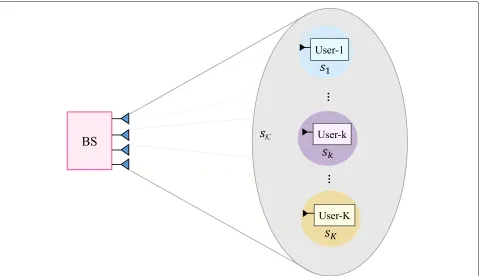
Instead of transmitting all order streams, 1-layer RS trans-mits the K-order common stream and 1-order private streams. Only one SIC is required at each receiver. The message of each user is split into two parts
WkK,Wkk ,∀k ∈ K. The messages W1K,. . .,WKK are jointly encoded into theK-order stream sK intended to be decoded by all users. Wkk is encoded into sk to be
decoded by user-k only. The overall data streams to be transmitted based on 1-layer RS iss = [sK,s1,. . .,sK]T.
The data streams are linearly precoded via precoder P = [pK,p1,. . .,pK]. The resulting transmit signal is
x=Ps=pKsK+k∈Kpksk. Figure3shows a 1-layer RS
model. Readers are referred to Fig. 1 in [12] for a detailed illustration of the 1-layer RS architecture.
At user sides, all users firstly decode the data streamsK by treating the interference froms1,. . .,sK as noise. The
SINR of theK-order stream at user-kis
γK
k =
hHkpK2
j∈KhHkpj
2+
1. (22)
OncesKis successfully decoded, its contribution to the original received signalykis subtracted. After that, user-k
decodes its private streamsk by treating the 1-order
pri-vate streams of other users as noise. The SINR of decoding the private streamskat user-kis
γk =
hHkpk2
j∈K,j=khHkpj
2
+1. (23)
The corresponding achievable rates of user-k for the streams sK and sk are RKk = log2
1+γkK and Rk =
log2(1+γk). To ensure thatsK is successfully decoded
by all users, the achievable common rate shall not exceed RK = minRK1,. . .,RKK .RK is shared among users such that CkK is the kth user’s portion of the common rate withk∈KCkK = RK. Following the two-user RS struc-ture described above, the total achievable rate of user-k
is Rk,tot = CkK + Rk. For a given weight vector u = problem (24) can be solved using the WMMSE approach in [28].
In contrast to NOMA, this 1-layer RS does not require any user ordering or grouping at the transmitter side since all users decode the common message (using single layer of SIC) before accessing their respective private mes-sages. We also note that the 1-layer RS is a sub-scheme of the generalized RS and is a super-scheme of MU– LP (since by not allocating any power to the common message, the 1-layer RS boils down to MU–LP). How-ever, forK > 2, SC–SIC and SC–SIC per group are not schemes of 1-layer RS (even though they were sub-schemes of the generalized RS). This explains why, in [12], the authors already contrasted 1-layer RS and NOMA and expressed that the two strategies cannot be treated as extensions or subsets of each other. This 1-layer RS appeared in many scenarios subject to imperfect CSIT in [28,29,32–34,38,40,41].
4.4.2 2-layer HRS
The K users are divided into Ggroups G = {1,. . .,G} withKg,g ∈ Gusers in each group. The user groups
sat-isfy the same conditions as in Section3.2.2. Besides the K-order stream and 1-order streams, 2-layer HRS also allows the transmission of a|Kg|-order stream intended
for users inKg. The overall data streams to be transmitted
based on 2-layer RS iss = sK,sK1,. . .,sKG,s1,. . .,sK
T
. The data streams are linearly precoded via precoder P = pK,pK1,. . .,pKG,p1,. . .,pK
Figure4shows an example of 2-layer HRS. The users are divided into two groups,K1= {1, 2},K2= {3, 4}.s1234is a
4-order stream intended for all the users whiles12ands34
are 2-order streams for users in each group only.
Each user is required to decode three streamssK,sKg, andsk. We assumek∈Kg. The data streamsKis decoded
first by treating the interference from all other streams as noise. The SINR of theK-order stream at user-kis
γK
OncesKis successfully decoded, its contribution to the original received signalykis subtracted. After that, user-k
decodes its group common streamsKg by treating other group common streams and 1-order private streams as noise. The SINR of decoding the|Kg|-order streamsKgat
After removing its contribution to the received sig-nal, user-k decodes its private stream sk. The SINR of
decoding the private streamskat user-kis
γk=
The corresponding achievable rates of user-k for the streams sK, sKg, and sk are RKk = log2
1+γkK,
RKkg = log21+γkKg and Rk = log2(1+γk). The achievable common rate of sK andsKg shall not exceed
RK=minRK1,. . .,RKK andRKg=mink
RKkg |k∈Kg
, respectively.RKis shared among users such thatCKk is the kth user’s portion of the common rate withk∈KCkK = ture described above, the total achievable rate of user-kis Rk,tot=CkK+CkKg+Rk, wherek∈Kg. For a given weight
where c is the common rate vector formed by
Fig. 4Two-layer HRS example,K=4,G=2,K1= {1, 2},K2= {3, 4}
vector, problem (28) can be solved by simply modifying the WMMSE approach discussed in Section4.7.
Comparing with SC–SIC per group where|Kg|−1 layers
of SIC are required at user sides, 2-layer HRS only requires two layers of SIC at each user. Moreover, the user order-ing issue in SC–SIC per group does not exist in 2-layer HRS. The streams of a higher stream order will always be decoded before the streams of a lower stream order. One-layer RS is the simplest architecture since only one SIC is needed at each user and it is a sub-scheme of the 2-layer HRS. We also note that we can obtain a 1-layer RS per group from the 2-layer HRS by not allocating any power to sK. Note that SC–SIC and SC–SIC per group are not nec-essarily sub-schemes of the 2-layer HRS. The 2-layer HRS strategy was first introduced in [39] in the massive MIMO context.
4.5 Encompassing existing NOMA and SDMA
A comparison of NOMA, SDMA and RSMA are shown in Table 1. Comparing with NOMA and SDMA, the most important characteristic of RSMA is that it partially decodes interference and partially treats interference as noise through the split into common and privates mes-sages. This capability enables RSMA to maintain a good performance for all user deployment scenarios and all network loads, as it will appear clearer in the numerical results of Section5.
Let us further discuss how the proposed framework of generalized RS in Section4.3contrasts and encompasses NOMA, SDMA, and RS strategies. We first compare the four-user MIMO–NOMA scheme illustrated in Fig. 5 of [1] with the four-user 2-layer HRS strategy illustrated in Fig.4. In Fig. 5 of [1], user-1 and user-2 are superposed in the same beam. User-3 and user-4 share another beam. The users are decoded based on SC–SIC within each beam. As for the four-user 2-layer HRS strategy in Fig.4, the encoded streams are precoded and transmitted jointly to users. If we set the common messages12to be encoded
by the message of 2 only and decoded by both user-1 and user-2, the common messages34 to be encoded by
the message of 4 and decoded by 3 and user-4, we also set the precoders p12 andp1 to be equal, the
precoders p34 andp3 to be equal, and the precoders of
other streams to be 0, then the proposed RS scheme reduces to the scheme illustrated in Fig. 5 of [1]. Simi-larly, theK-user RS model can be reduced to theK-user MIMO–NOMA scheme. Therefore, the MIMO–NOMA scheme proposed in [1] is a particular case of our RS framework.
Table 1Comparison of different strategies
Multiple access
NOMA SDMA RSMA
Strategy SC–SIC SC–SIC per group MU–LP All forms of RS
Design principle
Fully decode interference Fully decode interference in each group and treat interference
SIC at receivers SIC at receivers Treat interference as noise SIC at receivers
User
Users in each group experience aligned channel directions and a large disparity in channel strengths. Users in different groups
Network load More suited to overloaded network
More suited to overloaded network More suited to underloaded network
Suited to any network load
In the proposed generalized K-user RS model, if we setPl=0,∀l ∈ {2,· · ·,K}, only 1-order streams (private
streams) are transmitted. Each user only decodes its intended private stream by treating others as noise. Problem (20) is then reduced to the SDMA problem (3). If the message of each user is encoded into one stream of distinct stream order, problem (20) is equivalent to the SC–SIC problem (5). By keeping 1-order and K-order streams, we have the 1-layer RS strategy whose perfor-mance benefit in the presence of imperfect CSIT was highlighted in various scenarios in [28,29,32–34,38,40,41]. There is only one common data stream to be transmitted and decoded by all users before each user decodes its private stream. By keeping 1-order,K-order, andl-order streams, where l is selected from {2,· · ·,K − 1}, the problem becomes the 2-layer HRS originally proposed in [39] with two layers of common messages to be transmit-ted. Another example of such a multi-layer RS has also appeared in the topological RS for MISO networks of [30]. Therefore, the formulated K-user RS problem is a more general problem. It encompasses SDMA, NOMA, and existing RS methods as special cases.
Though the current work focuses on MISO BC, the RS framework can be extended to multi-antenna users and the general MIMO BC [31] as well as to a general network scenario with multiple transmitters [30]. Nevertheless, the optimization of the precoders in those scenarios remain interesting topics for future research. Applications of this RS framework to relay networks is also worth explor-ing. Preliminary ideas have appeared in [43], though joint encoding of the splitted common messages are not taken into account.
4.6 Complexity of RSMA
We further discuss the complexity of RSMA by paring it with NOMA and SDMA. A qualitative com-parison of NOMA, SDMA, and RSMA is shown in
Table 2. In Table 2, RS refers to the generalized RS of Section4.3.
As mentioned in the introduction, the complexity of NOMA in the multi-antenna setup is increasing signif-icantly at both the transmitter and the receivers. The optimal decoding order of NOMA is no longer fixed based on the channel gain as in the SISO BC. To maxi-mize the WSR, the decoding order should be optimaxi-mized together with precoders at the transmitter. Moreover, SC– SIC is suitable for aligned users with large channel gain difference. A proper user scheduling algorithm increases the scheduler complexity. At user sides,K −1 layers of SIC are required at each user for aK-user SC–SIC sys-tem. Increasing the number of users leads to a dramatic increase of the scheduler and receiver complexity and is subject to more error propagation in the SICs.
SC–SIC per group reduces the complexity at user sides. Only
K G
layers of SIC are required at each user if we uniformly group theKusers intoGgroups. However, the complexity at the transmitter increases with the number of user groups. A joint design of user ordering and user grouping for all groups is necessary in order to maximize the WSR. For example, for a 4-user system, if we divide the users into two groups with two users in each group, we should consider three different user grouping meth-ods and four different decoding orders for each grouping method.
The complexity of MU–LP is much reduced as it does not require any SIC at user sides. However, as MU–LP is more suitable for users with (semi-)orthogonal channels and similar channel strengths, the transmitter requires accurate CSIT and user scheduling should be carefully designed for interference coordination. The scheduler complexity at the transmitter is still high.
Table 2Qualitative comparison of the complexity of different strategies
Multiple access
NOMA SDMA RSMA
Strategy SC–SIC SC–SIC per group MU–LP RS 1-layer RS
Encoder complexity
EncodeKstreams EncodeKstreams EncodeKstreams EncodeKprivate streams plus additional common streams
EncodeK+1 streams
Scheduler
Very complex as it requires to divide users into
Complex as it requires to decide upon suitable decoding order of the streams with the same stream order
Simpler user scheduling as RS copes with any user deployment scenario, does not rely on user grouping and user SIC in each group and a single layer of SIC if groups are made of 2 users. Subject to error propagation
Does not require any SIC Requires multiple layers of SIC. Subject to error propagatio
Requires a single layer of SIC for all users. Less subject to error propagation
difference and any channel angle in between, though a multi-layer RS would have more flexibility. Considering the generalized RS, the decoding order of multiple streams with the same stream order should be optimized together with the precoders when there are multiple streams of the same stream order intended for each user (e.g., each user decodes two 2-order streams in the 3-user example of Section4.2.). But its special case, 1-layer RS, simplifies both the scheduler and receiver design, and it is still able to achieve a good performance in all user deployment sce-narios. One-layer RS requires only one SIC at each user. It does not rely on user grouping and user ordering for user scheduling. Therefore, the complexity of the scheduler is much simplified.
The cost of RSMA comes with a slightly higher encoding complexity since private and common streams need to be encoded. For the 1-layer RS in aK-user MISO BC,K+1 streams need to be encoded in contrast toK streams for NOMA and SDMA.
4.7 Optimization of RS
The WMMSE approach proposed in [42] is extended to solve the problem. The WMMSE algorithm to solve the sum rate maximization problem with 1-layer RS (dis-cussed in Section4.4.1) is proposed in [28]. We further extend it to solve the generalized RS problem (20). To sim-plify the explanation, we focus on the 3-user problem (15). It can be easily extended to solve theK-user generalized RS problem.
As the 1-order and 2-order streams to be decoded at different users are not the same, we take user-1 as an example. The procedure of the WMMSE algorithm is the same for other users. The signal received at user-1 is y1 = hH1Ps + n1. It decodes
four streams s123,sπ2,1(1),sπ2,1(2),s1 sequentially using
SICs. The 3-order stream s123 is decoded first. It is
estimated as ˆs123 = g1231 y1, where g1123 is the
equal-izer. After successfully decoding and removing s123
They are calculated by solving ∂ε1123
ing the intended streams at user-1 can be expressed as γ123 The corresponding rates are rewritten asR1231 = −log2
. The augmented WMSEs are
ξ123
1 , andu11 are weights associated
with each stream at user-1. By solving∂ξ1123
∂g123 Substituting the optimum equalizers into (32), we obtain
ξ123
By further solving the equations ∂ξ
123
0, we obtain the optimum MMSE weights as
Substituting (34) into (33), we establish the rate WMMSE relationship as
min is the transformation of the common rate c. u = u1231 ,u1232 ,u3123,u121 ,u122 ,u131 ,u133 ,u232 ,u233 ,u11,u22,u23.
achievable WMSEs of the corresponding streams. It can be easily shown that by minimizing (36a) with respect to u and g, respectively, we obtain the MMSE solutionsuMMSE,gMMSEformed by the corresponding MMSE equalizers and weights. They satisfy the KKT opti-mality conditions of (36) for P. Therefore, according to the rate-WMMSE relationship (35) and the common rate transformationc= −x, problem (36) can be transformed to problem (15). For any point (x∗,P∗,u∗,g∗) satisfying the KKT optimality conditions of (36), the solution given by (c∗= −x∗,P∗) satisfies the KKT optimality conditions fixed, the optimal weight is the MMSE weight uMMSE. When (u,g) are fixed,(x,P)is coupled in the optimization problem (36), closed-form solution cannot be derived. But it is a convex quadratically constrained quadratic pro-gram (QCQP) which can be solved using interior-point methods. These properties motivates us to use AO to solve the problem. Innth iteration of the AO algorithm, the equalizers and weights are firstly updated using the precoders obtained in the