A Code-Based Group Signature Scheme
Quentin Alamélou1,2 Olivier Blazy1 Stéphane Cauchie2 Philippe Gaborit1,
1 Université de Limoges, XLIM-DMI, Limoges, France, {quentin.alamelou, olivier.blazy, philippe.gaborit}@xlim.fr,
2 Worldline, R&D Department, Seclin, France, {quentin.alamelou, stephane.cauchie}@worldline.com.
August 24, 2016
Abstract
This work is the extended version of [1] which proposed the first code-based group sig-nature. The new group signature scheme we present here has numerous advantages over all existing post-quantum constructions and even competes (in terms of properties) with pairing based constructions: it allows to add new members during the lifetime of the group (dynamic). Plus, it appears that our scheme might be extended into a traceable signature according to the definition of Kiayias, Tsiounis and Yung [2] (KTY model) while handling membership revo-cation. Our security is based on a relaxation of the model of Bellare, Shi and Zhang [3] (BSZ model) verifying the properties ofanonymity,traceabilityandnon-frameability. The main idea of our scheme consists in building an offset collision of two syndromes associated to two dif-ferent matrices: a random one which enables to build a random syndrome from achosensmall weight vector; and atrapdoor matrixfor the syndrome decoding problem, which permits to find a small weight preimage of the previous random syndrome to which a fixed syndrome is added. These two small weight vectors will constitute the group member’s secret signing key whose knowledge will be proved thanks to a variation of Stern’s authentication protocol. For appli-cations, we consider the case of the code-based CFS signature scheme [4] of Courtois, Finiasz and Sendrier. If one denotes byN the number of group members, CFS leads to signatures and
public keys sizes inN1/
√
log(N). Along with this work, we also introduce a new kind of proof
of knowledge,Testable weak Zero Knowledge(TwZK), implicitly covered in the short version of this paper [1]. TwZK proofs appear particularly well fitted in the context of group signature schemes: it allows a verifier to test whether a specific witness is used without learning anything more from the proof. Under the Random Oracle Model (ROM), we ensure the security of our scheme by defining theOne More Syndrome Decodingproblem, a new code-based problem related to the Syndrome Decoding problem [5].
Keywords. Code-Based Cryptography, Group Signature, Proof of Knowledge, Random Oracle Model.
1
Introduction
A group signature scheme allows members of a group to issue signatures on behalf of the group in an anonymous but revocable way: an opener is able to revoke anonymity of the actual signer in case of abuse. Since its introduction by Chaum and van Heyst [6], group signatures have been extensively studied. Bellare et al. [7] (BMW model) first gave formal security properties of group signature. Later, Bellare, Shi and Zhang [3] extended this model to dynamic groups (BSZ model). Numerous efficient group signatures such as [8, 9, 10] were proposed but only proven secure in a relaxation security of [7]. Delerablée and Pointcheval [11] proposed the first practical scheme fully fitting BSZ in the random oracle model (ROM) whereas Groth [12] also provided such a scheme but secure in the standard model. Then, as an improvement of group signatures, Kiayias, Tsiounis and Yung, suggested traceable signatures schemes in [2]. In addition to classic properties of a group signature scheme, a traceable signature enables the opening authority to delegate its revoking (or opening) capability to openers but only against specific users. This gives two crucial advantages: sub-openers can run in parallel and authorities can monitor misbehaving users and then preserve honest users anonymity. The first efficient traceable signatures, provably secure in the standard model, were introduced by Libert and Yung in [13].
All these aforesaid schemes are pairing-based constructions. It was then worth looking for alternative since their security might collapse in front of quantum computers and that they involve heavy computations. Thus, many lattice-based constructions have been proposed such as [14] who first designed a lattice-based group signature scheme with both public key and signature size linear in the number of group membersN. Recently, numerous works such as [15, 16, 17, 18] proposed more efficient lattice-based constructions where both sizes the group public keys and signatures are proportional tolog(N). In a concurrent and posterior work, Ezerman et al. [19] also designed a code based group signature that suffers weaker features in terms of size of parameters and properties. Plus, it is interesting to notice that, with the recent exception of [20], all lattice and code based constructions base their security on the static model of [7] meaning that our scheme constituted the first post-quantum dynamic group signature scheme.
Because of a restriction for adding new users (procedure Join), our scheme ensures security properties of traceability, anonymity and non-frameability in a relaxation of the BSZ model. Indeed, the security of our protocol is ensured only when an adversary can add honest users (oraclejoinP) that may be corrupted later while the BSZ model requires to fulfill security even in presence of an adversary adding already corrupted users: it led us to define our construction asweakly dynamic.
The main idea of our scheme consists in building an offset collision of two syndromes associated to two different matrices: a random one which enables to build a random syndrome from achosen small weight vector; and atrapdoor matrix, which permits to find a small weight preimage of the previous random syndrome to which a fixed syndrome is added. These two small weight vectors will constitute the group member’s secret signing key whose knowledge will be proved thanks to a variation of Stern’s protocol.
Our contributions In this work, we propose a generic construction for designing the first code-based group signature. In a concurrent and independent work, [19] proposed a group signature scheme based on coding assumptions but only fitting the limited BMW model and with signatures and public key sizes linear in the number of group members.
traceabilityandnon-frameability. Furthermore, it has numerous advantages over all existing post-quantum constructions and even some pairing based constructions: it allows to dynamically add new members (weakly dynamic) and enjoys nice features such as traceability in the sense of the KTY model and membership revocation. When instantiated with the CFS scheme [4], it leads to signatures and public keys sizes proportional toN1/
√
log(N)forN the number of group members,
which is greater than a logarithmic complexity but asymptotically smaller than N1/d for any d. Plus, the proposed scheme can easily be extended into a traceable signature (according to the KTY model) handling membership revocation. In order to reach our goal, we introduce a new kind of proof of knowledge,Testable weak Zero Knowledge(TwZK), implicitly covered in [1]. It can be seen as a weaker version of zero-knowledge proofs [21]: it allows a verifier to test whether a spe-cific witness is used without learning anything more from the proof. This new notion, that could be of independent interest, appears particularly well-fitted in the context of group signature schemes. Under the Random Oracle Model (ROM), we ensure the security of our scheme by defining theOne More Syndrome Decodingproblem, a new code-based problem related to the Syndrome Decoding problem [5].
Organization The following Section is dedicated to notations and background; Section3deals with the building blocks of our construction. In Section 4, we give formal definition for group signature while our construction is described in Section5. Section6is concerned with the security of our scheme and we finally give an example and parameters for building an instance of our scheme in Section7.
2
Preliminaries
In this section, we first present the notation used throughout this work and then make a focus on code-based cryptography.
2.1 Notation
µdenotes some randomness and we use the symbolkfor concatenation. crsdenotes the common string shared by involved parties in the Common Reference String (CRS) model.
For a vector (resp. a string) v, v[r] denotes the r-th coordinate (resp. symbol) of v. The set {1,2, . . . , n} is denoted by [n]. Fq denotes the finite field of cardinality q. Mm×n(Fq) denotes
matrices overFqofmrows andncolumns. Sωnis the set of vectors of weightω lying inFn2. Σn
denotes the set of permutations over[n].
We denote byλa security parameter. For a protocol,lλdenotes the number of iterations needed
to reach the level of security required byλ.
H,Hλ :F∗2 −→ {0,1,2}lλ, h :F∗2 −→ Fn2 andh0 :F∗2 −→ Mk×n(F2)model random oracles.
Except stated otherwise,log denotes the logarithm in base 2. For any entityE, we denote byE(I)
the fact thatE has knowledge ofI. A(z :O)denotes that entityAhas knowledge ofzand access to oracleO. For protocols, we denote byPandV respectively the prover and the verifier.
We use usual coding theory notation, whereGandHrespectively denote generator and parity check matrices of a code. LetH∈ Mk×n(Fq)andx∈Fnq. The productHxT is calleda syndrome
andωt(x)refers to the Hamming weight ofx.
2.2 Code-based Cryptography Background
In this subsection, we only give necessary recalls for the well understanding of our work; for more details on coding theory, see [22].
Syndrome Decoding Problem The Syndrome Decoding problem (SD-problem) is a problem based on coding theory shown NP-complete [5]. It consists in finding a small weight word for a given syndromes.
Definition 1. LetH be a random matrix fromM(n−k)×n(Fq), ωan integer ands ∈ Fqn−k. The
Syndrome Decoding problem consists in findingeof weight below or equal toωsuch asHeT =s.
The case where one is asked to find a small solution where the weight is approximated within a constant was also proven to be computationally intractable in [23].
One More Syndrome Decoding problem We now define a related problem, that we call the One-More Syndrome Decoding (OMSD) problem which we believe difficult. Let H a(n−k)×n
random binary matrix,sa random syndrome andlvectorsx1, x2, . . . , xl of weightω such as for
anyi= 1. . . l,HxTi =s.
Question Is it possible to find a(l+ 1)-th vectorxl+1 such asxl+1 6=xi for anyi= 1. . . l,
of weightωand verifyingHxTl+1 =s?
We denote(H, s, ω,{xi}i=1...l)such an OMSD instance where the goal is to find a validxl+1.
Discussion on the problem This problem corresponds to a code version of problems which are well known in number theory based cryptography [24]. In the case of coding theory and the Syn-drome Decoding problem, the best known attacks are direct retrieval of independent synSyn-dromes, and it is widely believed that having an oracle which give you information onlindependent syndromes does not help the attacker in finding a(l+ 1)-th solution to a syndrome decoding problem.
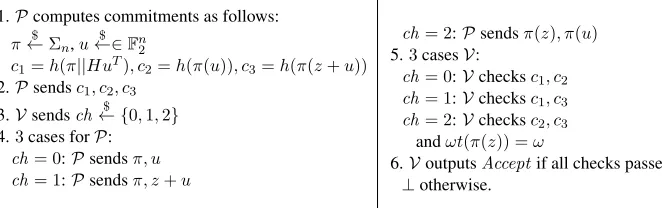
Stern’s protocol With security based on the SD-problem, Stern first proposed an efficient code-based ZK protocol [25]. Stern’s protocol (Figure 1) is a 3-pass prover-verifier protocol with cheating probability equal to 2/3 during which P makes a zero-knowledge proof toV on a small weight secretzsolving an SD-instance(H, s, ω).
Remark 1. The protocol presented here is the original one as introduced in [25]. It suffers a distinguishability issue since a verifier with knowledge of z is able to check whether this given witnesszwas actually involved during the protocol. Indeed, whench= 0(respectivelych = 1): in addition to checkingc1andc2(resp.c1andc3), such a verifierV(z)can also computec3 =h(π(z+
u))(resp. c2 = h(π(z+u+z))and then deduces involment ofz. To fix this distinguishability
issue, Stern then proposed a randomized version of its protocol for which commitments c1, c2, c3
are computed by concatenating inputs to random seeds [26].
Public data:(H, s, ω)∈ M(n−k)×n(F2)×F2n−k×N Pproves knowledge ofz∈Fn2 such asHzT=sandωt(z) =ω
1.Pcomputes commitments as follows:
π←$ Σn,u $
←∈Fn 2
c1=h(π||HuT), c2=h(π(u)), c3=h(π(z+u)) 2.Psendsc1, c2, c3
3.Vsendsch← {$ 0,1,2}
4.3cases forP:
ch= 0:Psendsπ, u
ch= 1:Psendsπ, z+u
ch= 2:Psendsπ(z), π(u)
5.3casesV:
ch= 0:Vchecksc1, c2
ch= 1:Vchecksc1, c3
ch= 2:Vchecksc2, c3 andωt(π(z)) =ω
6.VoutputsAcceptif all checks passed
⊥otherwise.
Figure 1: Stern’s protocol
Fiat-Shamir Paradigm Fiat and Shamir proposed in [27] a general paradigm for designing a signature scheme from a secure identification scheme. The idea is to start from a secure 3-round public coin identification scheme (withcmt a commitment from the prover,cha random challenge from the verifier, andrsp the response toch), and then turn it into a digital signature scheme with the help of a random oracleH. Indeed, to sign a message m, the signer (who knows the secret) produces a valid transcript(cmt,ch,rsp)of the interactive protocol wherech =H(cmt, m).
Trapdoor Matrix In this work, we propose a generic construction of a code-based group signature scheme through the use of what we call atrapdoor matrix. Such a matrix is actually hard to find and the only current candidate for instantiating our construction is the CFS matrix (see Section 7).
Definition 2. A trapdoor matrix family is a couple of polynomial algorithms
(TrapGen,Inv)such that:
• TrapGen(1λ): outputs a pair (Q,trk) ∈ M(n−k)×n(F2)× T RK according to security
parameterλ;
• Inv(Q, trk, s, ω): outputs, with non negligible probability, some x ∈Snω such asQxT =s
assuming(Q, trk)← TrapGen(1λ),s∈
Fn−k2 andω ∈N. xhas to appear random inSnω.
If no such solution is found, it returns⊥;
• (Correctness): for all(Q, trk) output by TrapGen(1λ), and all s ∈
Fn−k2 , we have that
Q(Inv(Q, trk, s, ω))T =s;
• (One-wayness): for all polynomial adversaryA, the following is negligible: P r[(Q, trk) ← Gen(1λ);s∈Fn−k2 ;x← A(1λ, Q, s, ω) : (QxT =s and ωt(x) =ω)].
We say that Q is a trapdoor matrix and trk a trapdoor key if (Q, trk) was generated by TrapGen.
3
Cryptographic Primitives Revisited
3.1 A variation on Stern’s Protocol: Concatenated Stern’s protocol
We propose a variation of Stern’s protocol, referred as Concatenated Stern’s protocol (CSP) and depicted in Figure 2. The main idea consists in splitting the small weight secretzthe prover will be challenged on and to run two related instances of Stern’s protocol in parallel.
Let us consider the following SD-instance :(H, s,2ω)for whichzis said to be avalidsolution ifz = (xky)wherexandyhave the same length andωt(x) = ωt(y) = ω. ThenH can also be written asH = (RkQ) such asHzT = s ⇔ RxT +QyT = s. We additionally assume that the verifierVcan be given somey0. As exhibited at step 6 of Figure 2, he is then able to check in two out of three cases (ch= 0andch= 1) ify0 =ywithout learningx.
Public data:(H, s, ω)∈ M(n−k)×2n(F2)×Fn2−k×N
Pproves knowledge of a validz= (xky)∈F22ntoV(y0)
1.Pcomputes commitments as follows:
(π, σ)←$ Σn×Σn,(u, v) $
←∈Fn2×Fn2
c1=h(π||RuT+QvT), c2=h(π(u)), c3=h(π(x+u)) d1=h(σ||RuT+QvT), d2=h(σ(v)), d3=h(σ(y+v)) 2.Psendsc1, c2, c3, d1, d2, d3.
3.Vsendsch← {$ 0,1,2}
4. 3 cases forP:
ch= 0.Psends{π, σ, u, v}
ch= 1.Psends{π, σ, x+u, y+v}
ch= 2.Psends{π(x), π(u), σ(y), σ(v)}
5. 3 cases forV:
ch= 0:Vchecksc1, c2, d1, d2
ch= 1:Vchecksc1, c3, d1, d3
ch= 2:Vchecksc2, c3, d2, d3 andωt(π(x)) =ωt(σ(y)) =ω
If all checks passed,VacceptsP’s knowledge.
6. Additional checks forV(y0):
ch= 0: checks ifd3=h(σ(y0+v))
ch= 1: checks ifd2=h(σ(y0+ (y+v)))
ch= 2: no additional check
If additional check passed,Vacceptsy0.
Figure 2: Concatenated Stern’s Protocol (CSP)
Compared to classic Stern’s protocol, the interest ofCSP is twofold: it enables to check inde-pendently the weight of each half of a small weight secret while a part of the secret can be com-promised without revealing the entire secret. From now, byCSP-instance, we refer to(H, s, ω)for which one is asked to findz = (xky)such asHzT =s∧ωt(x) =ωt(y) =ω. Relying on Stern’s protocol (Figure 1), we prove the security ofCSP in subsection 3.4.
3.2 Testable weak Zero Knowledge
Introduced in [21], ZK proofs allow a proverPto convince a verifierVof the veracity of a statement S, without leaking any additional information on the proof but its length. Since its introduction, this kind of proofs has been widely applied to digital identification protocols, and by extension signature schemes using the Fiat-Shamir paradigm [27]. These proofs satisfy the following three properties:
• Completeness: ifSis true, the honest verifier will be convinced except with negligible prob-ability,
• Soundness: if S is false, no cheating prover can convince the honest verifier that it is true except with negligible probability,
A classical variant of ZK proofs generally used is Witness-Indistinguishable (WI) proofs [28], where the ZK requirement is roughly weakened into “seeing the proof does not provide any in-formation on the witness used”. More formally, assuming a languageL and witnessesz0, z1
sat-isfying the language, WI requires distributions D0 and D1 to be indistinguishable where Db =
{(z0, z1,Prove(zb,L;µ)), for random stringµ}, while not requiring proof simulatability anymore.
Nevertheless, our construction is going to need somewhat opposite requirements: we want to be able to build a simulator capable of simulating proofs, while allowing anyone possessing informa-tion to test if this piece of informainforma-tion is related to the witness used for generating the proof. Proofs of knowledge meeting these requirements will be called Testable weak Zero-Knowledge (TwZK for short). The general idea behind TwZK is that there is a little information leaking compared to clas-sical ZK: the fact that an attacker can test whether a particular information is related to the witness used in a proof. If this value is not known, an attacker should either test all possible values or find a particular one which, in both cases has to be hard. Hence an attacker who breaks the security of our model either breaks ROM security or is able to solve a computational problem.
As an example, considering Stern’s protocol (Figure 1), this particular information about the witness is the witness itself. Indeed, as exhibited in Remark 1, ifV knows the prover’s secretz, he is able to trace this witnesszby checking more requirements for casesch = 0andch = 1.
We then propose the following definition.
Definition 3(Testable weak Zero-Knowledge Proofs). A Testable weak Zero-Knowledge proof is defined through the following algorithms:
• TSetup(1λ): generates the public parameters of the system among which some functionf
and possibly a simulation trapdoorstk;
• Prove(z,L;µ): generates a proofΠthat a wordzis in the languageLusing some random stringµ;
• TVerif(Π,L): checks that the validity of a proofΠwith respect to the languageL;
• TestWit(y0,Π,L): for a valid proofΠ← Prove(z,L;µ)andf generated duringTSetup, this algorithm checks, with negligible failure probability, ify0 =f(z);
• SProve(stk,L;µ): generates a simulated proof of knowledge of a word inLusing a trapdoor stk.
In addition to classical correctness and soundness properties, we want weak indistinguishability of proof simulation:
for a non empty language L, a proof generated using a witness (case S0) must
be indistinguishable from one using the trapdoor (case S1) meaning that S0 =
{Prove(z,L;µ)|w ∈ L} and S1 =
{SProve(stk,L;µ)} have to be indistin-guishable.
ExpwSP,A−b(λ)
1.params←TSetup(1λ)
2.if(b= 0),Π∗ ←Prove(z,L;µ)
3.elseΠ∗← {SProve(stk,L;µ)} 4.b0← A(Π∗,TestWit(.))
5.Returnb0
Compared to what might be expected for Classical Zero-Knowledge, the previous property can only be achieved for some languages. Namely those where guessing the correct related information
Original Stern’s protocol is TwZK We consider here the particular case of the non randomized version of Stern’s protocol to exhibit that it is TwZK instead of ZK. We do not formally describe here how Stern’s original protocol fulfills Definition 3 since the goal is only to highlight that it satisfies the property of TwZK encompassed in weak indistinguishability of proof simulation described above. To cope with step 6 of protocolCSP (Figure 2), we propose the following additional checks for a verifier, with additional knowledge a vectorz0, to Stern’s protocol (Figure 1):
• casech = 0.V(z0)checks if commitmentc3=h(π(z0+u));
• casech = 1.V(z0)checks if commitmentc2=h(π(z+u+z0));
• casech = 2. No additional test in this case.
In two out of three cases (ch = 0andch = 1), an additional check can be processed so that this step has a failure probability 6 1/3. Hence, in the non-interactive case where several repetitions of the protocol are demanded, this failure probability can be made as small as wished to design an algorithmTestWit. For a dishonest prover, there are 3 different cheating strategies depending on the value computed forc. We are going to focus onc= 0, the others are left to the sagacity of the reader. (It should be noted that forc= 2no test is possible so the indistinguishability proof is even easier.)
We use the Random Oracle programmability on Hto force the hash value to be 0. Following Stern’s framework, in this case theSProve algorithm would have to pick an honest π andu, and a random vectorzof weightω (not satisfying the equationHzT = s), and proceeds as expected. The difference in distributions between honestly generated proofs and simulated one comes from
h(π(z+u)), which in the first case is correctly generated while in the other one is not. Assuming
his also a random oracle the valueh(π(z+u))is random compared to the rest of the view of the adversary.
Now the only way the adversary could possibly distinguish a valueh(π(z+u))computed for azin the language from a random value, would be by queryingπ(z+u)to the ROM. (Until now, the ROM programmability allows us to argue that the two visions are indistinguishable).
Using Random Oracle Observability, one can then monitor the calls to the random oracles made by the adversary, and for theπ, uused in the challenge, parse his calls to define valueszis. In the
eventuality the adversary queries the ROM on azi in the language (i.e. HzTi = sandωt(zi) = ω), a simulator generating a random proof without knowing a word in the language can use the adversary’s query to solve the Syndrome Decoding challenge.
Formal transform into TwZK proofs and security of protocol CSP are respectively studied in subsection 3.3 and 3.4. Similar results for Stern’s non randomized protocol could then easily be deduced.
3.3 From CSP to Testable weak Zero Knowledge Proofs
Even if some points may appear straightforward, we detail here how our protocolCSP (Figure 2) can be seen as TwZK proofs satisfying Definition 3.
Hzt =s∧ωt(x) = ωt(y) = ω}. The functionf stipulates how much informationf(z)could be tested aboutzwhile knowing some side information (algorithmTestWit).
TSetup(1λ)
1.(H, s, ω, f)←$ 1λwhere:
-H = (RkQ)withR, Q∈ M(n−k)×n(F2)
-s∈Fn2−k,ω∈N
-f :F22n→Fn2such asf(xky) :=y
2. SetL={z= (xky), x, y∈Fn2 :
Hzt=s∧[ωt(x) =ωt(y) =ω]} Return(H, s, ω, f,L).
Figure 3: TSetup protocol
In the following, we denote byparams the quantity(H, s, ω, f,L)←TSetup(1λ).
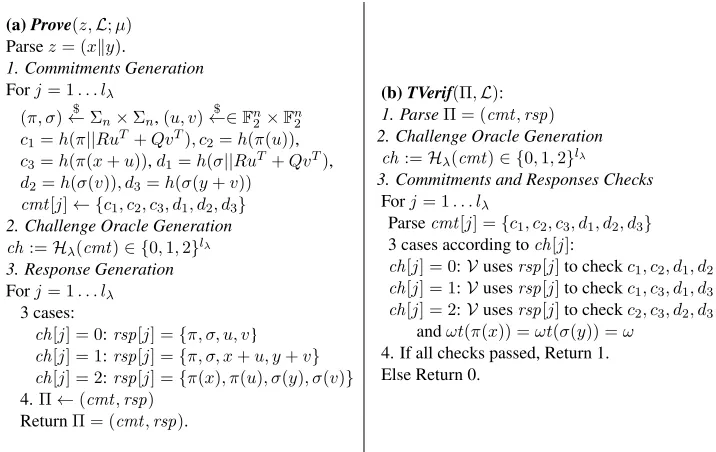
Description of Proveand TVerif Algorithm Prove enables anyone that possesses an element ofL to prove such a knowledge without revealing it. Nevertheless, contrary to ZK proofs, some controlled information can be leaked and later be tested through algorithm TestWit. Through Fiat-Shamir paradigm, algorithmProve reaps benefit of the interactive protocolCSP to generate a proof of knowledge on an element of L. It then processes as follows: it first pre-computes6×
lλ commitments to be stored in cmt on which the random oracle is then applied. Finally, for
each ternary symbolch[j], algorithmProvesets the corresponding responsersp[j], as specified by protocolCSP, and outputs the proof(cmt,rsp)that will later be given toTVerif.
This latter unfolds the proof, computes ch = Hλ(cmt) and checks consistency according to interactive protocol CSP. We recall here that lλ is the number of times protocol CSP should
be repeated to ensure negligible error probability. AlgorithmsProve andTVerif are depicted in Figure 4.
Description ofTestWit Contrary to classical ZK proofs, the newly introduced concept of Testable weak Zero Knowledge (Definition 3) states that some controlled information can leak. Indeed, algorithmTestWit will be able to decide if some side information (y0 here) is related to the secret witness (zhere), as stipulated byf, used to generate a valid proofΠ ←Prove(z,L;µ). Similarly to the non randomized version of Stern’s protocol (see Remark 1), it is possible to trace proofs outputted by Prove. Before depicting the algorithmTestWit, we first give the general idea. Let us consider a witnessz = (xky)used to generate a proof. Now, usingf defined such asf(z) =y
(Figure 3), algorithmTestWit can check iff(z) = y0 without knowing zby running additional checks when unfolding a proof(cmt,rsp). Indeed, according to the value ofch[j],TestWitworks as follows:
• ch[j] = 0, parsersp[j] ={π, σ, u, v}and check ifd3 =h(σ(y0+v));
• ch[j] = 1, parsersp[j] ={π, σ, x+u, y+v}and check ifd2=h(σ(y0+y+v));
(a)Prove(z,L;µ)
Parsez= (xky).
1. Commitments Generation Forj= 1. . . lλ
(π, σ)←$ Σn×Σn,(u, v) $
←∈Fn 2×F
n 2 c1=h(π||RuT+QvT), c2=h(π(u)), c3=h(π(x+u)),d1=h(σ||RuT+QvT), d2=h(σ(v)), d3=h(σ(y+v))
cmt[j]← {c1, c2, c3, d1, d2, d3}
2. Challenge Oracle Generation ch:=Hλ(cmt)∈ {0,1,2}lλ
3. Response Generation Forj= 1. . . lλ
3 cases:
ch[j] = 0:rsp[j] ={π, σ, u, v}
ch[j] = 1:rsp[j] ={π, σ, x+u, y+v}
ch[j] = 2:rsp[j] ={π(x), π(u), σ(y), σ(v)}
4.Π←(cmt,rsp)
ReturnΠ = (cmt,rsp).
(b)TVerif(Π,L): 1. ParseΠ = (cmt,rsp)
2. Challenge Oracle Generation ch:=Hλ(cmt)∈ {0,1,2}lλ
3. Commitments and Responses Checks Forj= 1. . . lλ
Parsecmt[j] ={c1, c2, c3, d1, d2, d3}
3 cases according toch[j]:
ch[j] = 0:Vusesrsp[j]to checkc1, c2, d1, d2
ch[j] = 1:Vusesrsp[j]to checkc1, c3, d1, d3
ch[j] = 2:Vusesrsp[j]to checkc2, c3, d2, d3 andωt(π(x)) =ωt(σ(y)) =ω
4. If all checks passed, Return 1. Else Return 0.
Figure 4: AlgorithmsProveandTVerif
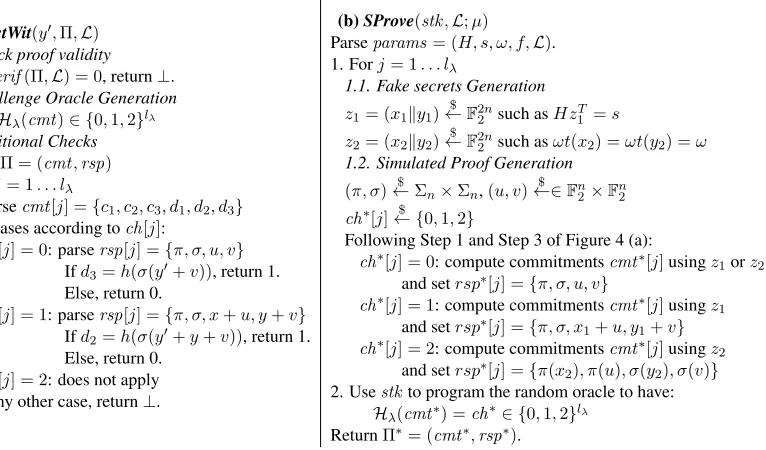
These additional checks pass if and only if y = y0 which means that some verifierV(y)can trace a user owning the secret witness z = (xky). As in Stern’s protocol, an additional check is possible in two out of three cases (ch = 0andch = 1) whereas no such test in proposed when ch = 2. The failure probability of this additional checking step is then61/3. In the non-interactive case where several repetitions of the protocol are demanded, this failure probability can be made as small as wished to design algorithmTestWit. We refer the reader to Figure 5 (a) for a description ofTestWit.
Remark 2. As it will be proven in next subsection,CSP is a prover verifier protocol with cheating probability of2/3. To provide convincing proofs, with negligible error probability, we then have to setlλ =λ/log(3/2). On the other hand, additional checks do not apply only whench = 2so that
proofs simulating lλ iterations ofCSP will also also lead to a negligible error probability in the
case ofTestWit.
Description ofSProve It enables anyone with the trapdoor simulationstkto program the random oracle to generate a proof without knowledge of the secret keyzthat appears indistinguishable to a fair one i.e. as if it was an output ofProve.
According to the SD-problem, it is difficult to find a vector z both of small weight 2ω and verifyingHzt =s. Nevertheless, it is easy to independently find az1 = (x1||y1), with no weight
constraint, such as Hz1T = sand a z2 = (x2||y2)such as ωt(x2) = ωt(y2) = ω. Let us now
consider a simulator not knowing a valid secret that can set the value of ch∗ by programming the random oracle. Following algorithmProve, the simulator randomly picksπ, σ, uandv and accordingly sets the valuecmt∗.
• ch∗ = 0: the simulator computes commitments withz1orz2 playing the role ofzand stores
• ch∗ = 1: the simulator computes commitments withz1 playing the role ofzand stores the
following values inrsp∗:π,σ,x1+u,y1+v
• ch∗ = 2: the simulator computes commitments withz2 playing the role ofzand stores the
following values inrsp∗:π(x2),π(u),σ(y2),σ(v).
When called by AlgorithmTVerif, because of programmability the random oracleHλwill output ch∗ on input cmt∗ so that the simulated proof Π∗ set to (cmt∗,rsp∗) clearly passes algorithm TVerif.
AlgorithmSProveis formally described in Figure 5 (b).
(a)TestWit(y0,Π,L)
1. Check proof validity IfTVerif(Π,L) = 0, return⊥. 2. Challenge Oracle Generation ch:=Hλ(cmt)∈ {0,1,2}lλ
3. Additional Checks ParseΠ = (cmt,rsp)
Forj= 1. . . lλ
Parsecmt[j] ={c1, c2, c3, d1, d2, d3}
3 cases according toch[j]:
ch[j] = 0: parsersp[j] ={π, σ, u, v}
Ifd3=h(σ(y0+v)), return 1. Else, return 0.
ch[j] = 1: parsersp[j] ={π, σ, x+u, y+v}
Ifd2=h(σ(y0+y+v)), return 1. Else, return 0.
ch[j] = 2: does not apply 4. In any other case, return⊥.
(b)SProve(stk,L;µ)
Parseparams= (H, s, ω, f,L). 1. Forj= 1. . . lλ
1.1. Fake secrets Generation
z1= (x1ky1)←$ F2n
2 such asHz T 1 =s
z2= (x2ky2)←$ F22nsuch asωt(x2) =ωt(y2) =ω
1.2. Simulated Proof Generation
(π, σ)←$ Σn×Σn,(u, v) $
←∈Fn2×Fn2
ch∗[j]← {$ 0,1,2}
Following Step 1 and Step 3 of Figure 4 (a):
ch∗[j] = 0: compute commitmentscmt∗[j]usingz1orz2 and setrsp∗[j] ={π, σ, u, v}
ch∗[j] = 1: compute commitmentscmt∗[j]usingz1 and setrsp∗[j] ={π, σ, x1+u, y1+v}
ch∗[j] = 2: compute commitmentscmt∗[j]usingz2 and setrsp∗[j] ={π(x2), π(u), σ(y2), σ(v)}
2. Usestkto program the random oracle to have:
Hλ(cmt∗) =ch∗∈ {0,1,2}lλ ReturnΠ∗= (cmt∗,rsp∗).
Figure 5: AlgorithmsTestWit andSProve
3.4 Security of the Concatenated Stern’s protocol
In this subsection we show that protocolCSPpresented in Figure 2 is a TwZK protocol that ensures completeness, soundness and testable weak zero-knowledge. This protocol is a prover-verifier pro-tocol with cheating probability equal to2/3that needs to be repeated several times to decrease this cheating probability close to0.
By design, it is straightforward that proving the security of protocolCSP enables to prove that algorithms defined in previous subsection fulfill Definition 3. Indeed, completeness and soundness of protocolCSPimply that algorithmsProve,TVerif andTestWitare well defined while showing that proofs outputted byProve andSProveare indistinguishable ensures TwZK of protocolCSP. Let us notice that we extend methodology of subsection 3.2 about TwZK of non randomized Stern’s protocol to prove the TwZK of protocolCSP.
Proof We prove Theorem 1 through 3 lemmas in which we respectively discuss completeness, soundness and Testable weak Zero-Knowledge.
Completeness To ensure the completeness of our scheme, we exhibit that for a prover and a verifier honestly proceedingCSP, it always succeeds.
Lemma 1. IfPandVhonestly executeCSP, we have for any round thatP r[CSPP,V =Accept] =
1.
Proof. The proof of the completeness is straightforward. The only subtlety might be to notice thatz
is a valid secret, which means thatRxT+QyT =s. Then, for checkingc1andc2in the casech= 1,
we have to use thatR(x+u)T+Q(y+v)T−s=RxT+RuT+QyT+QvT−s=RuT+QvT.
Soundness To ensure the soundness of our scheme, we ensure that a cheating proverP cannot convinceVthat he knows a valid secretzwhen he does not.
Lemma 2. If a cheating proverP and an honest verifierV executeCSP, then for any round, we have that:P r[CSPP,V =Accept] = 2/3.
Proof. We will prove thatP has a maximum probability probability2/3to cheat. ForP to cheat, he must be able to answer correctly to any challengech at each round whereas he does not know a validz. To accept the protocol, V should be able to verify all the hash values at the end of the interaction.
• ch = 0:P reveals two permutationsπ1,σ1and two vectorsuandvrespectively simulating
values ofπ,σ,uandvin a fair protocol (we do not make this precision in the following). • ch = 1:Preveals two permutationsπ2,σ2and two vectorsu0andv0.
• ch = 2:Preveals vectorsX,U,Y,V withωt(X) =ωt(Y) =ω
Those values must verify hash values involved in the protocol. Let us consider a knowledge extractor E rewinding the random oracle. Sincehis a random oracle (one cannot find a collision on it), we have the following straightforward results:π1 =π2,σ1=σ2andRuT +QvT =Ru0T +Qv0T−s
which leads toR(u0−u)T +Q(v0−v)T =s.
By exploiting consistency between different forms ofc2 andd2, E gets that: U = π(u)andV =
σ(v). Thanks to d3 and c3, we get: π(u0) = X +U andσ(v0) = Y +v. Finally, by setting
z∗ = (u0−u||v0−v),P enabledEto findz∗verifyingHz∗T =sandωt(z∗) = 2ωi.e. E solved the SD-problem.
Testable weak Zero-Knowledge We will now prove the Testable weak Zero-Knowledge property of our scheme. The idea is to prove that a verifier cannot learn nothing more from a fair execution than prover’s secret is correct and whether the auxiliary value he knows is related to prover’s secret or not.
Lemma 3. The Concatenated Stern’s protocol CSPP,V depicted in Figure 2 is a Testable weak
Zero-Knowledge proof in the random oracle model assuming the hardness of the SD-problem.
Proof. Given a valid proof Π∗ (i.e. for which TVerif outputs 1), there are two possibilities for an adversary A: algorithm TestWit either outputs 0 or 1. In the first case, honestly generated proofs and simulated ones are clearly random since commitments stored in cmt are obtained via the random oracleh and values to be revealed, stored inrsp, are designed to appear random (the security of all Stern like protocols relies on this fact).
We now focus on the case where caseTestWit outputs 1.
IfΠ∗was generated by algorithmSProve, there are three different cheating strategies:
• ch = 0: the simulator runsSProve to outputΠ∗. While generating this proof (see Figure 5 (b)), the simulator implicitly defined the SD-instance(Q, s1, ω)wheres1=QyT1 for a certain
y1with no constraint on the weight (ωt(y1)6=ωa priori). The adversary will first check the
proof by runningTVerif and he additionally runsTestWit using its auxiliary knowledgey0
to check the consistency ofd3. Thanks to RO observability, the simulator can monitor the
calls made by the adversary toh. Now when Acalls hto run TestWit, the simulator can parse these calls to identifyy0. Sincey0 is such as TestWit(y0,Π∗,L) = 1, the simulator is able to find a vectory0 of weight ωsuch ass1 =Qy0T and thus solving the SD-instance
(Q, s1, ω).
• ch = 1: this time, the simulator implicitly defined the SD-instance(Q, s2, ω)while
gener-atingΠ∗, wheres2 = QyT2 for a certainy2 withQyT2 6= QyT a priori. Once again, the RO
observability enables the simulator to monitor the calls made by the adversary toh. Now when the adversary callshto runTestWit to additionally checkd2, the simulator can parse
these calls to identifyy0. Sincey0is such asTestWit(y0,Π∗,L) = 1, the simulator is able to find a vectory0of weightωsuch ass2 =Qy0T and thus solving the SD-instance(Q, s2, ω).
• ch = 2: the algorithmTestWitdoes not apply in this case and indistinguishability is straight-forward.
Now, if this valid proofΠ∗was generated by algorithmProve, we consider the following game.
G The challenger supposed to runProvewill attribute random values to commitments stored in cmt except for the values ofd3 in the casech = 0andd2 in the casech = 1for which he
computes values according toCSP.
Because ofh modeled as a random oracle, toA0s view, this gameG is indistinguishable from an honestProveprocedure. Plus, for the same reason, it is also indistinguishable from the previous case withSProve (all commitments stored incmt always appear random).
Hence, we can consider that Awill never provide a wordy0 such asTestWit(y0,Π∗,L) = 1
4
Definition and Security Model
In this section, we give the definition of the group signature we will rely on and the associated security model.
A group signature scheme [6] is a protocol which allows members of a group to individually issue signatures on behalf of the group in an anonymous but revocable way: an opener is able to revoke anonymity of the actual signer in case of abuse. Several steps have been made in the study of those protocols: Bellare et al. [7] first gave formal security properties of group signature. Later, Bellare, Shi and Zhang (BSZ model) [3] extended this model to dynamic groups, emphasizing the importance of unforgeability and anonymity. Numerous efficient group signatures schemes such as [8, 9, 10] using bilinear maps were proposed but only secure in a relaxation of these models. While recent post-quantum group signature schemes, namely lattice-based, such as [14, 15, 16, 17, 18] only satisfy the static model of [7], we propose a scheme that we will define as weakly dynamic with the classic properties ofanonymity,traceabilityandnon-frameability.
4.1 Definition
Let us precise that our scheme only involves three entities with a single authority: the group man-ager. Indeed, in our model, the group manager will both participate in issuing users’ secret keys and revoking anonymity (see Section5) without impacting security (see Section6). Consequently, the algorithmJudgepresent in dynamic models does not appear in our model. Adapting the BSZ model, we propose the following definition.
Definition 4. A group signature scheme GS = (GSetup,Join,GSign,GVerif,Open) is a se-quence of protocols such as:
• GSetup(1λ): this algorithm generates public parameters of the systemgparams, the group public keygpk and the group manager secret keygmsk = (trk,skO)made of a trapdoor key trk and the opening keyskO;
• Join(Ui): this is an interactive protocol between a userUi and the group manager owning
trk. At the end of the protocol, the user obtains a secret signing keysk[i]. The group manager adds the new userUiand updatesskO;
• GSign(gpk,sk[i], m;µ): to sign a message m, the user uses his secret key sk[i]and some randomnessµto output a signatureΣvalid under the group public keygpk;
• GVerif(gpk, m,Σ): anybody should be able to verify the validity of the signatureΣon the messagemwith respect togpk. It thus outputs1if the signature is valid, and 0 otherwise; • Open(skO,gpk, m,Σ): for a valid signatureΣwith respect togpk, the group manager can
provide the signer identity : it thus outputs the userUiwhen it succeeds and 0 otherwise.
4.2 Security Model
Correctness Thecorrectnessnotion guarantees that honest users should be able to generate valid signatures, and the opener should then be able to revoke anonymity of the signers.
Unforgeability Informally, the unforgeability notion guarantees that no one can produce a valid signature that cannot be opened in convincing way (traceability) and that no one can produce a signature on behalf of some group member (non-frameability).
In the following experiments, to join the group, an adversary runs the oracle joinP (passive join) to create an honest user for whom it does not know the secret key: the index iis added to the HU (Honest Users) list. For users whose secret keys are known to the adversary, we let the adversary play on their behalf. For honest users, the adversary can interact with them, granted some oracles:
• corrupt(i), if i ∈ HU, provides the secret key sk[i]of this user. The adversary can now control it. The indexiis then moved fromHU to the list of corrupted usersCU;
• sign(i, m), ifi∈HU, plays as the honest userUiwould do in the signature process. Theni
is appended to the listS[m];
• the oracleopenwhich, on input(m,Σ)returnsOpen(skO, gpk, m,Σ).
(a) ExperimentExptr GS,A(λ)
1.(gpk,gmsk= (trk,skO))←GSetup(1λ)
2.(m,Σ)← A(gpk:joinP,corrupt,sign,open)
3. IfGVerif(gpk, m,Σ) = 0, return0. 4. If∃j6∈CU ∪S[m],
Open(skO,gpk, m,Σ) =j, Return1.
5.Else return0.
AdvGS,Atr (λ) =P r[ExptrGS,A(λ) = 1]
(b) ExperimentExpnfGS,A(λ)
1.(gpk,gmsk= (trk,skO))←GSetup(1λ)
2.(m,Σ)← A(gpk,skO :joinP,corrupt,sign)
3. IfGVerif(gpk, m,Σ) = 0, return 0. 4. If∃i∈HU \S[m],
Open(skO,gpk, m,Σ) =i, Return 1.
5. Else return 0.
AdvnfGS,A(λ) =P r[ExpnfGS,A(λ) = 1]
Figure 6: Unforgeability Notions
Traceability and Non-Frameability
Traceability (Figure 6 (a)) says that nobody should be able to produce a valid signature that cannot be opened in a convincing way. Furthermore, non-frameability (Figure 6 (b)) guarantees that no dishonest player (even the authorities, i.e. the Group Manager GM) will be able to frame an honest user: an honest user that does not sign a messagemshould not be convincingly declared as a possible signer, non-frameability also shows that the group manager cannot cheat. We thus say that:
• GSistraceableif, for any polynomial adversaryA, the advantageAdvtrGS,A(λ)is negligible;
• GSisnon-frameableif, for any polynomial adversaryA, the advantageAdvnfGS,A(λ)is neg-ligible.
Anonymity
Given two of honest usersi0 andi1, the adversary should not have any significant advantage in
guessing which one of them have issued a valid signature.
ExperimentExpanon−bGS,A (λ)
1.(gpk,gmsk = (trk,skO))←GSetup(1λ) 2.(m, i0, i1)← A(gpk:joinP,corrupt,sign,open) 3.Σ←GSign(gpk, ib, m, sk[i])
4.b0← A(Σ :joinP,corrupt,sign)
5.Ifi06∈HUori16∈HU, return 0. 6.Returnb0.
AdvanonGS,A(λ) =P r[Expanon−GS,A 1(λ) = 1]−P r[Expanon−GS,A 0(λ) = 1]
Figure 7: Anonymity Notion
The adversary can interact with honest users as before (withsignandcorrupt), but the challenge signature is generated using the interactive signature protocolGSign, where the adversary plays the role of the corrupted users, but honest users are activated to play their roles.
GS isanonymousif, for any polynomial adversaryA, the advantageAdvanonGS,A(λ)is negligible
(Figure 7). We will see that our anonymity notion can be related toselfless-anonymityintroduced in [9] where a user can check if he is the signer of a given signature and learns nothing about it else. Thefull-anonymitynotion, required by the BSZ model, means that anonymity is guaranteed even if the adversary is granted access to all users’ private keys (even the challenged one) and the oracle open(excepted on the challenge signature).
A weakly dynamic model The BSZ model [3] basically defines two ways for an adversary A to add new group members: a passive one where an honest user is added and might be corrupted later while a kind of active join protocol enablesAto add an already corrupted member (this user is immediately added toCU), for which he knows its secret key. In this latter case, the BSZ model can still provide non-frameability. Giving such an active join to an adversaryAin our case is equivalent to assuming thatAknows the trapdoor keytrk. Nevertheless, in Section 6, we ensure the security of our scheme in a scenario in whichAshould never access totrk. This explains whyAis only givenskOinstead ofgmskin the non-frameability case. This difference between our model and the BSZ model led us to define our scheme asweakly-dynamic.
Definition 5. A group signature scheme verifying security notions of Figures 6 and 7 is said to be securely weakly-dynamic.
5
Our Code-Based Group Signature
We now present our group-signature scheme satisfying Definition 4. To fix ideas, we first present an high level overview and then, we describe more precisely the operation of the different algorithms.
5.1 High Level Overview
• a group manager (GM): the single authority of our scheme. It runs theGSetupalgorithm, adds new members to the group (algorithmJoinprotocol) and opens signatures (algorithmOpen);
• group members: also referred as users who can sign on behalf of the group (algorithmGSign);
• outsiders: they do not belong to the group but can verify a signature granted the group public keygpk (algorithmGVerif).
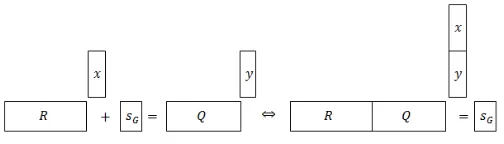
The main idea of our scheme consists in building an offset collision of two syndromes associated to two different matrices to instantiateCSP. We recall here that the trapdoor matrixQenables to invert syndromes so that a classic scenario could be as follows.
First Step GM generatesQ a trapdoor matrix with trk the corresponding trapdoor key and a random syndromesG. U chooses a random vectorxof weightωand computess=RxT. U then
sendsstoGM who uses its trapdoor key to compute, via algorithmInv,ysuch as:QyT =s+sG
andωt(y) = ω. If this steps fails,U chooses a new random value forxuntil a valid antecedenty
can be found.
Then,GM returnsytoUwho finally forms its secret signing keyz= (xky). It is important to notice that half of the secret key, namelyx, is only known byU himself; it will ensure non-frameability of our scheme.
Second Step U owns a secret keyz = (xky)such asωt(x) = ωt(y) = ω andHzT =RxT + QyT = sG. This situation fits within the model of the protocolCSP. Every group member then
owns its secret key which leads to the group common syndromesG, as depicted in Figure8.
Figure 8: High level Overview
Third Step In case of doubt,GM should be able to revoke anonymity of group signatures. In the present case,GM knowsy, the second part of the secret key of every userU; this point will enable him to open signatures (algorithmOpen).
5.2 Operation of our Scheme
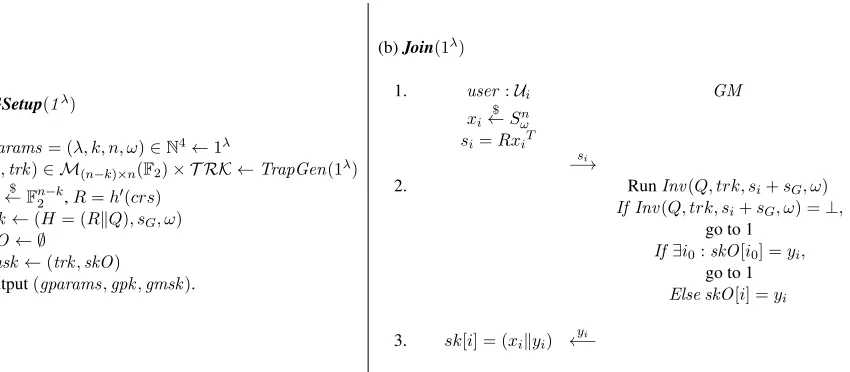
In the CRS model, anyone is able to to generateR=h0(crs).
We first describe algorithmsGSetup,Join and summed them up in Figure 9.
GSetup is performed by the group manager whileJoin(Ui) is an interactive protocol between a
(a)GSetup(1λ)
1.gparams= (λ, k, n, ω)∈N4←1λ
2.(Q,trk)∈ M(n−k)×n(F2)× T RK ←TrapGen(1λ) 3.sG←$ Fn−k2 ,R=h0(crs)
4.gpk←(H= (RkQ), sG, ω)
5.skO← ∅
6.gmsk←(trk,skO)
7.Output(gparams,gpk,gmsk).
(b)Join(1λ)
1. user:Ui GM
xi←$ Sn ω si=RxiT
si
−→
2. RunInv(Q, trk, si+sG, ω)
If Inv(Q, trk, si+sG, ω) =⊥, go to 1
If∃i0:skO[i0] =yi, go to 1
Else skO[i] =yi
3. sk[i] = (xikyi) ←−yi
Figure 9:GSetupandJoinalgorithms
On adapting our TwZK protocol Our group signature scheme will mainly rely on the TwZK proofs described in Section 3. To cope with Fiat-Shamir paradigm in the context of a group signature scheme, we adapt algorithmsProve,TVerif andTestWit(Figures 4 and 5 (a)) so that step 2 of all these algorithms takes into account the message to signmduring the challenge generation. More precisely, algorithmsProve,TVerif andTestWit will take as additional input the messagemso thatch is now equal toch = Hλ(m,cmt) instead of simplyHλ(cmt). We respectively denote these (slightly) modified algorithmsProvegs(m, ., .;.),TVerifgs(m, ., .)andTestWitgs(m, ., .).
GSetup TheGSetup algorithm is executed by the group managerGM taking as input a security parameter λ. It randomly generates atrapdoor matrix(according to Definition 2) Qand the cor-responding trapdoor keytrk. It also chooses a random syndromesG ∈ Fn−k2 that will constitute
the group public identity and initializesgmsk = (trk,skO) where skO will be its opening key. Finally,GM publishes global parametersgparams = (λ, n, k, ω) ∈ N4 and the group public key
gpk = (H = (RkQ), sG, ω)whereRandQ ∈ M(n−k)×n(F2). This algorithm implicitly covers
the run of aTSetupalgorithm.
Join To proceed the Join protocol, GM and Ui behave as following: Ui randomly chooses a vectorxi ∈Sωnand computessi =RxiT. Then, he sendssitoGM who uses its trapdoor keytrk
to computeyiverifying: si+sG=QyiT andωt(yi) =ω.GM respondsyitoUi. Finally,Uiforms sk[i] = (xikyi) andGM updatesskO[i] = yi. The reader should notice that this methodology
may fail for two reasons. On the one hand, algorithm Inv can fail when computing antecedent
yi. On the other hand, when such anyi is successfully computed, GM should first check thatyi
was not already attributed to another user (GM ensures that allyi’s are different to further revoke
anonymity). In both cases,GM tellsUito choose another secretxi.
In the end of this protocol, each user is given a secret key zi = (xikyi) of weight 2ω and
verifyingHziT =RxTi +QyTi =si+si+sG=sG.
As already mentioned, we use Fiat-Shamir paradigm to get a signature scheme. Signing then basically consists in outputting a proof of knowledge on a secret key that is linked to the message to sign m. Namely a group member Ui has to produce a signature Σ seen as a transcriptΣ =
(cmt,rsp)of the protocolCSPexecuted on public keygpkand small weight secretsk[i]for which each tuple(cmt[j],ch[j],rsp[j])simulates a fair execution ofCSP. It then suffices to run protocol Provegs on inputsm,sk[i]andL.
For verification (algorithm GVerif), one has only to check a signature outputted by GSign which means checking the validity of some Σ ← Provegs(m,sk[i],L;ρ). We then apply algo-rithmTVerifgs since it precisely aims at checking the validity of a proof outputted byProvegs.
OpenAlgorithm We first recall thatGM’s opening keyskOconsists in the pool ofyis
constitut-ing half parts of users’ secret keys made of(xi||yi). According to Figure 5 (a), the knowledge of
such values permits to run (potentially successfully) algorithmTestWit and then to decide if the tested value was the one used for generating the proof. The algorithmOpenis then straightforward: given a messagemand a signatureΣ = (cmt,rsp),GM reads through the opening keyskO until for some indexi0,sk[i0] = yi0 passes algorithmTestWit
gs. In this case,GM is ensured that the
actual signer isUi0.
Remark 3. By design of our scheme, any group member will then be able to open its own signatures which was referred to selfless-anonymity in [9].
AlgorithmsGSign,GVerif andOpenare depicted in Figure 10.
(a)GSign(gpk,sk[i], m, lλ;µ)
1. Parsegpk= (H, sG, ω). 2. SetL={z= (xky), x, y∈Fn
2 :
HzT=sG∧ωt(x) =ωt(y) =ω} 3.Σ = (cmt,rsp)←Provegs(m,sk[i],L;µ). 4. Return(m,Σ).
(b)GVerif(gpk, m,Σ, lλ)
1. Parsegpk= (H, sG, ω). 2. SetL={z= (xky), x, y∈Fn
2 :
HzT=sG∧ωt(x) =ωt(y) =ω} 3.b←TVerifgs(m,Σ,L)
4. Returnb.
(c)Open(skO,gpk, m,Σ)
1. If (GVerif(gpk, m,Σ, lλ) = 0), return 0. 2. Parsegpk= (H, sG, ω)
3. SetL={z= (xky), x, y∈Fn 2:
HzT =sG∧ωt(x) =ωt(y) =ω} 4. Fori= 1. . . N
b←TestWitgs(m,skO[i],Σ,L)
If(b= 1), returnUi. 5. If noneskO[i]succeeds,
return0.
Figure 10:GSign,GVerif andOpen
5.3 Additional Properties
In this subsection, we briefly explain how the design of our group signature scheme might enable us to turn it into a traceable signature following the definition of [2] and how to handle revocation.
trace others. Usually, such a scheme provides two additional protocols compared to a classic group signature scheme:TraceandClaim.
Due to its construction, our scheme can easily be extended into traceable signature. Indeed if GM wants a sub-openerSoto trace or look afterUi0with secret keyz= (xi0||yi0), he just needs to
reveal himyi0. Now, wheneverSois given a signatureΣ, he usesyi0 to apply algorithmTrace on
Σ: it outputs 1 if and only if the issuer was indeedUi0. In fact, he has to apply the methodology of
algorithmOpenbut since he does not knowskO, he cannot look over all users’ tracing keys, then he will only be able to open the signature if it was issued byUi0.
Furthermore, as pointed when defining anonymity, our scheme provides selfless-anonymity since any user will be able to prove that he is the actual signer of his own signature: this is ex-actly what algorithmClaimis meant to do.
Membership Revocation A crucial requirement for group signature schemes should be member-ship revocation. Indeed, once a group has been set up, one must be able to keep on trusting a group even in presence of misbehaving users; else, it means a new group should be regenerated to exclude them. When it comes to post-quantum constructions, only few lattice-based schemes [16, 18] han-dle this property by proceeding with verifier local revocation (VLR). VLR requires the verifiers to possess some up-to-date revocation information, but not the signers. We follow the same method-ology to provide membership revocation. As for the case of traceable signature, this revocation information, in our case, simply consists in the revoked user’s tracing keysyis.
We neither provide formal definitions nor detailed proofs here but the conversion of our scheme into in a traceable signature with membership revocation is rather straightforward. In particular, we refer the reader to the non-frameability property of our scheme to ensure that information released to potentials sub-openers or in the revocation list does not impact the security of our scheme.
6
Formal Security Analysis
In this section, we study the three requirements of anonymity, traceability and non-frameability previously defined (Figures 6 and 7) in order to claim secure our scheme (Definition 5). In the following, we considerA an adversary to our scheme andB, an adversary to a difficult problem using advantage ofA’s possibilities.
Recalls on our group signature A signature consists in a transcript representing several repeti-tions of our Concatenated Stern’s protocol (Figure 2). Then a signatureΣis a couple(cmt,rsp)
such as:
(cmt,rsp) = (cmt[1], . . . ,cmt[lλ],rsp[1], . . . ,rsp[lλ]) (1)
• cmt[j]consists in commitments of our Concatenated Stern’s protocol (Figure 2) generated at
j-th iteration;
• ch[j]the j-th symbol ofch = Hλ(m,cmt) ∈ {0,1,2}lλ. It plays the role of the random
How to generate a simulated signature The methodology for a simulator, without knowledge of a secret key, to generate a signatureΠ∗that appears valid (i.e. that passes algorithmGVerif) is the one used inSProve. For each iterationj= 1. . . lλ, the simulator chooses a value forch[j]and
stores commitments and responses respectively incmt andrspaccording to methodology described in protocolSProve. Finally, the simulator programs the RO to setHλ(m,cmt)tochand outputs
Σ∗= (cmt,rsp).
Hence, such a simulator will then produce a transcript looking fair to any verifier, without know-ing any valid secretz.
6.1 Anonymity
We begin with the anonymity property.
Theorem 2. If there exists an adversary Athat can break the anonymity property of the scheme (Figure 7), then there exists an adversary B that can break the Testable weak Zero-Knowledge (TwZK) property of our Concatenated Stern’s protocolCSP.
Proof. Through a sequence of games, we will exhibit that an adversary against our anonymity property would be able to break the TwZK property of our scheme.
G0 Bfirst runs GSetup(λ). He gives gpk toA who has also access to oraclesjoinP, corrupt, signandopen. NowBandAact as described inExpanon−GS,A 0(λ)(Figure 7). In this game,B will honestly challenge the adversaryAonb= 0. At some point,Aproduces(m, i0, i1). B
will then behave honestly by signingmoutputtingΣ0=GSign(gpk,sk[i0], m;µ).
G1 In this game, AandB behave the same way than in G0 with same knowledge and oracles provided toAwith the exception of queries aboutUi0. Indeed, whenAproduces(m, i0, i1),
instead of generatingΣ0,Bgenerates a simulated signatureΣ∗by programming the random
oracleHλaccordingly.
G2 This game is the version of game G0 in which B challenges A on challenge b = 1; the rest consists in Expanon−GS,A 1(λ) (Figure 7). So, when A produces (m, i0, i1), B responds
Σ1=GSign(gpk,sk[i1], m;µ).
Since the Concatenated Stern’s protocolCSP is TwZK, we have, on the one hand,Σ0 andΣ∗
are statistically close to each other. On the other hand, for the exact same reason,Σ∗ andΣ1 are
statistically close thenΣ1 is statistically close toΣ0. Finally, we can deduce that Expanon−GS,A 0(λ)
and Expanon−GS,A 1(λ) are indistinguishable which leads to that AdvGS,Aanon(λ) = Expanon−GS,A 0(λ) −
Expanon−GS,A 1(λ)is negligible. This terminates the proof.
6.2 Soundness
The soundness analysis consists in proving traceability and non-frameability.
Forging a signature
Let us suppose thatAcan forge a signature on userUi0 supposed to be uncorrupted. It follows thatAcan produceΣ = (cmt,rsp)such asGVerif(gpk, m,Σ) = 1without knowingsk[i0]. As
recalled in (1),Σis the following transcript(cmt[1], . . . ,cmt[lλ],rsp[1], . . . ,rsp[lλ])simulatinglλ
fair iterations of protocolCSP.
IfAcan produce such a forgery, thenAmust have been able to successfully runlλ iterations
ofCSPwithout knowing a valid secret whereas the cheating probability ofCSPis 2/3 (Lemma 2). ThenAhas either broken the soundness of CSP or enabled the design of a knowledge extractor reaping benefits of the forgery to produce a valid solutionzof the related SD instance.
Soundness Since traceability and non-frameability are two notions closely related, we treat them simultaneously. Indeed, both notions require the adversaryAto produce a valid forgeryΣverifying GVerif(gpk, m,Σ) = 1. Nevertheless, breaking traceability implies forA to produceΣsuch as the group manager could not trace it back to any group member whereas non-frameability requires to produce a signature that does trace back to an actual group member.
More precisely, if we consider thatAattacks an honest userUi0: to attack traceability,Ashould
produce a forgeryΣonmsuch as:
GVerif(gpk, m,Σ) = 1∧Open(skO, gpk, m,Σ) = 0, (2)
whereas to attack non-frameability its forgeryΣshould verify:
GVerif(gpk, m,Σ) = 1∧Open(skO, gpk, m,Σ) =i0, (3)
with the obvious constraint in both cases thatΣ6=GSign(gpk,sk[i0], m;µ).
We now prove the traceability and the non-frameability of the proposed group signature scheme.
Theorem 3. If there exists an adversaryAagainst the traceability (Figure 6 (a)) (resp. the non-frameability, Figure 6 (b)) of the scheme, then we can build an adversaryBthat can either break the security of the Concatenated Stern’s protocolCSP or the OMSD (resp. SD) problem.
Proof. LetAbe a PPT adversary attacking the traceability (resp. non-frameability) property of our scheme with advantage(λ). Through a sequence of games, we will show that ifAis efficient, then it is possible for a simulatorBto solve a difficult problem with non negligible probability related to
.
G0 Following our group signature scheme, a simulatorBruns algorithm GSetup(λ). He then
chooses a userUi0 on whichAwill be challenged. The following consists in the traceability (resp. non-frameability) game defined in Figure 6 (a) (resp. Figure 6 (b));B then provides gpk = ((R||Q), ω)(resp.gpk = ((R||Q), ω)andskO) toA, which has also access to oracles joinP,sign,openandcorrupt(resp.joinP,signandcorruptsince in this case,AknowsskO and has no need for oracleopen). For any query ofA, B responds honestly but the game aborts ifAtries to corruptUi0.
G1 In this game, Bstill runs algorithmGSetup(λ)and chooses a userUi0. A still knowsgpk (resp. gpk andskO) with the same respective oracle accesses. The only difference from previous game is that wheneverAqueries oracle signon userUi0, Bgenerates a simulated
valid signature. Like previously, the game abortsAtries to corruptUi0.
At some point, Aproduces a forgery(m,Σ) under the condition that for alli ∈ CU, sig-natures onmwere never queried. Similarly to anonymity game (subsection 6.1), signatures honestly produced on behalf ofUi0 in gameG0 are indistinguishable from random ones
pro-duced in this game.
Hence, toA’s view, gamesG0andG1are indistinguishable and we get that the probability for Ato haveGVerif(gpk, m,Σ) = 1is still.
Under the soundness of CSP, we now treat separately traceability (game Gtrac
1 ) and
non-frameability (gameG1nf).
Gtrac
1 A has been given a forgeryΣ verifying(2). Under the soundness of CSP, B could
thus apply the knowledge extractor algorithm E on Σ to generate a vector z∗ pass-ing protocolCSP. All through this game, Amay have queried for oraclecorrupt on all users exceptUi0 meaning that he may have obtained many secret keys solving the
instance(H, sG,2ω). In other words, A has obtained the following OMSD instance
(H, sG,2ω,{usk[i]}i∈CU). Ifz∗ ∈ {/ usk[i]}i∈CU, Ahas then enabled Bto find one more solution to the previous OMSD instance with probability directly related to . Else,Areplays the game untilBgets a new solution to the aforesaid OMSD instance.
G1nf In the case of non-frameability,Ahas also been given a forgeryΣverifying(3). This time, the knowledge ofskO provides more information toAabout users’ secret keys. IndeedskO consists in all tracing keys (yis), that is, half of every user’s secret key.
Writingusk[i] = (xi||yi) for all i, we have thatAcan computesi = QyTi (= RxTi ).
Through oracle corrupt, A can learn the entire zi for every user (different from Ui0)
he might corrupt. We recall here that every si, originally computed during the join
procedure byRxT
i =si appears random since everyxi is randomly chosen inSωn. In
fact,Ahas obtained the following unsolved SD-instances(R, si, ω)i∈HU containing the particular one(R, si0, ω).
Now, under the soundness ofCSP, B, by programming the ROM, exploitsΣto get a vectorz∗ = (x∗||y∗)from which he can issues signatures verifying (3) just likeΣ. In particular, it means that applying algorithmOpen on signatures issued withz∗ returns
i0. It leads toy∗ =yi0 and then thatx
∗ is a solution to the SD instance(R, s i0, ω).
At the end of game G1, A has either broken the soundness of CSP or been able to solve a
computational problem with non negligible probability related to. This terminates the proof.
7
Instantiation with the CFS scheme
7.1 CFS Distinguishability and Security
The main idea of the CFS signature is to hide a Goppa code matrix with parameters [2m,2m − mω,2ω+ 1]correcting up toω errors. Parameters are chosen such that the probability to invert a syndrome is in1/ω!; in practice,ωis of orderO(log(2m)) =O(m). From the security discussion, the parameters have to be chosen so that the Syndrome Decoding problem for the matrix H = (RkQ)is difficult for a weight2ω.
A recent result has proven that the public matrix of the CFS scheme was distinguishable [29] from a random matrix. Nevertheless, this result did not give rise to any attack on the scheme which then remains usable. Indeed, in practice and despite the aforesaid distinguisher, best attacks to the CFS problem are generic and treat the CFS matrix as a random one.
CFS-based problems and augmented-CFS matrix To be claimed secure (Section 6), our generic scheme does not require the public matrix to be indistinguishable from random but only to be secure against some computational problems defined in Section 2 (namely SD and OMSD problems). In the case of random codes, these problems are either proven hard (SD problem) or assumed to be (OMSD problem). Assuming the putative security of the CFS scheme, we also consider that these problems are hard when instantiated with a CFS public matrix which can then be seen as a trapdoor matrix satisfying Definition 2.
This leads us to deal with a global public matrix of the formH˜ = (RkQ)whereRis random andQis CFS public matrix; we then defineaugmented-CFSmatrices as follows:
Definition 6. LetQ ∈ M(n−k)×n(F2) a CFS public matrix andR ∈ M(n−k)×n(F2) a random
binary matrix. We say that the following matrixH˜ = (RkQ)is an augmented-CFS matrix.
Since computational problems defined in Section 2 are also assumed to be hard using the CFS scheme, we can naturally extend this hardness toaugmented-CFSmatrices.
Remark 4. K. P. Mathew et al. recently proposed a provably secure code-based signature scheme [30]. Their work roughly consists in masking the public matrix of the original CFS scheme so that there exists no distinguisher with random matrices. Nevertheless, since their scheme leads to greater keys sizes and ours does not require indistinguishabilty from random to fulfill security (Section 6), we focus on the classic CFS scheme when studying parameters.
7.2 Parameters
We then instantiate our generic scheme with augmented-CFS matrices and consider, relying on previous subsection, the choice of parameters as if we were dealing with random ones. From the best known attacks [31, 32] we can choosem= 20andω = 10. It leads to a matrixH˜ of length221
and dimension200, with a security of 80 bits. The level of security can be improved over 80 bits by taking parameters withm= 20andω= 11. The fact that the searched small weight vectors have a particular form since they have to be of same weightωon the two parts of the matrix only decreases the complexity of the attacks at the margin. Indeed it decreases the number of possible solutions to the Syndrome Decoding problem only by a small factor, since random solutions of weight2ωto the problem have a good probability to be of equal weight on each part of the matrix.
random syndromes which is equivalent to2mω/ω!. In practice, one considersω = O(m); hence, from the Stirling formula, it gives2O(m2)possible users. Since public keys matrices and signatures
sizes are proportional to the length of code 2m, this leads sizes of order N1/
√
log(N), for N the
number of group members.
Finally, parameters as chosen above lead to a signature (a transcript of proof of knowledge of a small word associated toH˜) of length roughly20megabytes and a public key of size2.5megabytes. Notice that what takes time in the protocol is the computation of the CFS signature by the signer, but this is done only once for each member of the group when he enters the groups, and hence it is less important that this signature takes a little more time than usual signatures. At last the CFS signature scheme cannot find a preimage for any syndromes, it does it only with probability1/ω!, this fact can be managed through the sending of ω!different syndromessin the Join process so that, on average, a preimageyby the CFS public matrixQis found with a small failure probability, in which case the set-up process is started over. Since the syndromesis computed randomly, it does not affect the security of the scheme.
As a final remark, let us also notice that in the quantum setting, it would be required to consider a security parameterλgreater than80. Even if theoretically feasible, this may to lead extreme sizes of parameters in the case of CFS.
8
Conclusion
This work is the extended version of the code-based group signature scheme proposed in [1]. To fulfill security, we introduced a new problem in code-based cryptography referred as theOne More Syndrome Decoding problem and a new kind of proof of knowledge, referred as Testable weak Zero-Knowledge, for which a verifier is able to test whether some specific information is related to the prover’s secret, without learning anything more from the proof. The main idea of our work was to build an offset collision of two syndromes associated to two different matrices: a random one which enables to build a random syndrome from achosensmall weight vector; and atrapdoor matrix, which permits to find a small weight preimage of the previous random syndrome to which a fixed syndrome is added. Applying a variation of Stern’s protocol on these two small weight vectors led us to design our group signature scheme, secure under the ROM, through the use of Fiat-Shamir paradigm. In spite of great sizes of keys, common to all post-quantum group signatures, our instantiation proposes satisfying asymptotic performances since group public key and signatures sizes are proportional to N1/
√
log(N). In particular, our scheme compares well with [19] which
is based on the static BMW model and presents size of parameters linear in the number of users. Finally, we assume that the elegance, the simplicity and the large range of properties it fulfills make this scheme a good alternative to all other post-quantum constructions. Indeed, not only does it allow to dynamically add new members but it should be noted that its extension into a traceable signature (KTY model) handling member revocation appears rather straightforward.