Continuous-Source Fuzzy Extractors:
Source uncertainty and security
Benjamin Fuller∗ Lowen Peng† December 20, 2018
Abstract
Fuzzy extractors (Dodis et al., Eurocrypt 2004) convert repeated noisy readings of a high-entropy source into the same uniformly distributed key. The functionality of a fuzzy extractor outputs the key when provided with a value close to the original reading of the source. A necessary condition for security, called fuzzy min-entropy, is that the probability of every ball of values of the noisy source is small.
Many noisy sources are best modeled using continuous metric spaces. To build continuous-source fuzzy extractors, prior work assumes that the system designer has a good model of the distribution (Verbitskiy et al., IEEE TIFS 2010). However, it is impossible to build an accurate model of a high entropy distribution just by sampling from the distribution.
Model inaccuracy may be a serious problem. We demonstrate a family of continuous distributions W that is impossible to secure. No fuzzy extractor designed forW extracts a meaningful key from an average element ofW. This impossibility result is despite the fact that each elementW ∈ W has high fuzzy min-entropy. We show a qualitatively stronger negative result for secure sketches, which are used to construct most fuzzy extractors.
Our results are for the Euclidean metric and are information-theoretic in nature. To the best of our knowledge all continuous-source fuzzy extractors argue information-theoretic security.
Fuller, Reyzin, and Smith showed comparable negative results for a discrete metric space equipped with the Hamming metric (Asiacrypt 2016). Continuous Euclidean space necessitates new techniques.
1
Introduction
Many physical processes have entropy but exhibit noise between readings of the same process [BBR88, BS00, Dau04, EHMS00, GCVDD02, MG09, PRTG02, SD07, TSS+06]. When a secret is read multiple times, readings are close (according to some metric dis) but not identical. In particular, most instanti-ations of physical uncloneable functions (PUFs) [PRTG02, AMS+11, KKR+12] are entropic and noisy. To use such noisy secrets in cryptographic applications, Wyner [Wyn75] and Bennett, Brassard, and Robert [BBR88] identified two fundamental tasks: 1)Information-reconciliation: removing noise without leaking information and 2)Privacy amplification: converting an entropic secret to uniformly random. We focus on non-interactive protocols that provide information-theoretic security.
In this setting, information reconciliation is performed by a secure sketch [DORS08]. A secure sketch is a pair of algorithms (SS,Rec). The SS or sketch algorithm takes an initial reading w and produces a
∗
University of Connecticut. Email: [email protected] †
nonsecret helper valuess. Lettbe an error parameter. The Recor recover algorithm takes a subsequent readingw0 along with ss and outputs w ifdis(w, w0)≤t. The security requirement for a secure sketch is thatw is hard to predict given ss.
A fuzzy extractor performs information reconciliation and privacy amplification simultaneously, pro-ducing a stable and nearly uniform key [DORS08]. Fuzzy extractors similarly consist of two algorithms. The generate algorithm (Gen) takes an initial reading w, producing a key along with a nonsecret helper value pub. The reproduce (Rep) algorithm takes w0 and pub, reproducing key if dis(w, w0) ≤ t. The security requirement for fuzzy extractors is that key is statistically close to uniform knowingpub. Most fuzzy extractors combine a secure sketch and a randomness extractor [NZ93].
We consider sources W taking values in a continuous metric space. To distinguish from the discrete case, a fuzzy extractor for such sources is known as a continuous-source fuzzy extractor [BDHV07]. Multiple PUFs produce such features including optical [PRTG02, SFIC14] and capacitance [TSS+06] PUFs. We consider ann-dimension space with Euclidean distance: dis(x, y) =pPni=1(xi−yi)2.
The key question in designing a fuzzy extractor is which distributions W can be “secured.” A distri-bution W has min-entropy, denoted H∞(W), if every outcome has low probability. That is: H∞(W)≥k
if∀w,Pr[W =w]≤2−k. There are two problems with applying min-entropy in continuous metric spaces
1) min-entropy is inherently a discrete notion and 2) there are discrete distributions with min-entropy where key derivation is impossible. For example, arbitrary distributions with more errors than entropy
are impossible to secure [KLRW14, DGSV15, MvdLvdSW15, CFP+16].
Fuller, Reyzin, and Smith [FRS16] introduced a more precise notion to measure a noisy distribution’s suitability for stable key derivation called fuzzy min-entropy. Fuzzy min-entropy codifies the adversary’s success when provided with only thefunctionality of a fuzzy extractor (or secure sketch). Consider some known distributionW. The adversary’s best strategy is to findw0 that maximizes the weight of possible
w∈W within distancetofw0. Denote byBt(w0) the closed ball of radiustaroundw0. Fuzzy min-entropy
is formally defined as
Hfuzzt,∞(W)
def = −log
max
w0 Pr[W ∈Bt(w
0
)]
.
Since fuzzy extractors are designed for entropic distributions, the system designer only has a model of the underlying physical process. As the designer can only work with a limited number of samples from the distribution, this model is inherently limited. After deployment, the adversary spend more time modeling, resulting in a more accurate model. As a result fuzzy extractors work for all distributions in a familyW. Ensuring security for a whole family is called the distributional uncertainty setting.
The discrete case Fuller, Reyzin, and Smith presented a family of distributionsW where each element
W ∈ W has fuzzy min-entropy such that no fuzzy extractor (GenW,RepW) can simultaneously secure the
familyW. That is, any fuzzy extractor (GenW,RepW) must be insecure for at least one element W ∈ W
assuming the adversary knows the probability distribution W and the public helper value. Their result is for discrete Hamming space. We ask a natural question:
Do continuous source fuzzy extractors exist for all familiesW with fuzzy min-entropy?
1.1 Our Contribution and Techniques
these results are negative, their form is slightly difficult to understand. We show a family W such that for any cryptographic construction designed forW there exists an adversary that breaks security.
Our result holds for a uniform randomW ← W$ . We note the nonstandard notation, we are sampling a probability distribution from a set of probability distributions. To give intuition we consider the case of a secure sketch (SS,Rec). Our result relies on the following asymmetry: SS sees only w sampled from
W while the adversary knows which distribution W was used to samplew←W. For error tolerance the public outputssmust have some information aboutw. If the familyW is carefully designed we can argue the adversary gains independent knowledge from ss and the distribution W. Together this independent knowledge can be used to break security. In both negative results there are two key components:
1. Leakage: Arguing that the public valuess restricts the set of possible w.
2. Independence: Showing that knowing the distribution W provides independent (and therefore new) information about the pointw.
The core of both proofs is constructing a family where these two properties hold.
Secure sketches To illustrate techniques we first focus on secure sketches.
1. Leakage: For a secure sketch to be correct forwit must hold that for most nearbyw0,Rec(w0, ss) =
w. Denote by C the set of all pointsw whereRec of nearby points is w. More formally,
C =
w
Pr
w0|dis(w,w0)≤t[Rec(w
0, ss) =w]≥1/2
.
The points inC form a Shannon error correcting code. This implies that∀x, y∈C,dis(x, y)≥t/2. Since C forms a code, one can bound the size ofC using packing arguments.
2. Independence: To show that learning the distribution W gives fresh information, we consider distributionsW that are the set of all points with the same output of a universal hash family [CW79]. That is, the description ofW has two parts, the description of a hash functionhand an outputy. A distributionWh,y is the uniform distribution over the set{w|h(w) =y}. Since the hash is universal
and h is not known to the SSalgorithm, given w, the rest of the support ofW is unknown. Thus, the information in h(y) reduces the uncertainty on the point w.
In order for each distribution W to have fuzzy min-entropy it is also necessary for the universal hash family H to have preimage sets with minimum distance. That is, for h ∈ H and all x, x0 such that
h(x) = h(x0) then dis(x, x0) ≥t. The hash function we use is all points in the coset of a random p-ary lattice with minimum distancet. This hash function and the resulting family of distributions is described in detail in Section 3.
Fuzzy extractor For a fuzzy extractor, showing theLeakage property is more delicate:
Challenges of continuous metric spaces Euclidean space is challenging for two reasons:
1. Volume grows exponentially with the radius of the ball in Euclidean space. This growth is super exponential in Hamming space, growing exponentially in the binary entropy of the radius (see for example [Gur10]). This slower rate of volume growth increases the size of C (resp. the size of the interior of parts ofQkey) for secure sketches (resp. for fuzzy extractors).
2. In the fuzzy extractor case, the interior of the parts inQkey is continuous which precludes the use of counting techniques. In place of counting techniques, we show the volume of the interior is smaller than the “volume” of different distributions. That is, we show that any region V of fixed volumev
must not include some distributions in W. As mentioned, each distributionW ∈ W is a coset of a random lattice with minimum distance. For region V to contain a point from every coset, v must be as large as the Voronoi cell of the lattice. The fraction of distributions not represented in V is at least the ratio ofv to the volume of the Voronoi cell.
Prior Positive Results for a single distribution W Recent work [FRS16, WCD+17] shows that for any discrete distribution W with (super-logarithmic) fuzzy-min entropy there is a secure discrete fuzzy extractor (GenW,RepW). These constructions need to know the probability distribution function of W
exactly and are not instantiable in polynomial time. This is called the precisely known distribution or distribution sensitive setting. However, these techniques are inherently limited to discrete metric spaces. Prior continuous-source fuzzy extractors applied quantization or partition the input space. As an example, Verbitskiy et al. [VTO+10] construct a continuous-source fuzzy extractor in the precisely known distribution model. Their construction partitions the input metric into A and then subpartitions the parts of Ausing a second partition B. That is, every part ofA intersects with every part ofB.
The input w’s part inA is thekey while w’s part inB is the public valuepub. The system is correct if for all w, w0 such that dis(w, w0) ≤t either 1) w and w0 are in the same part ofA or 2) w and w0 are in different parts of both A and B. If w and w0 are in different parts of B, w0 can be “pushed” in the direction of the part ofw inB. This shift will make it so that w0 is pushed to right part ofA.
For security, the probability mass in Akey ∩Bpub must be the same for all key,pub. If so, knowledge of pubgives no information about key. The resulting key length is |key|= log|A|.
Verbitskiy et al. describe how to choose A and B for a distribution over [0,1]. However, it is not clear how their technique extends to multiple dimensions or how large A can be for a fixed error tolerance t.1 To the best of our knowledge it is not known how to build a continuous-source fuzzy extractor for each distribution with fuzzy min-entropy. Prior work either considers a small constant number of dimensions [VTO+10] or requires dimensions of the input to be uniform or independently distributed [LSM06]. The major open question resulting from this work is whether continuous-source fuzzy extractors exist for each distribution with fuzzy min-entropy.
Correlated random variables A rich line of research views w and w0 as samples from a correlated pair of random variables [Wyn75, CK78, AC93, Mau93, RW05, TW15, HTW14]. Key length is bounded based on mutual information. These works consider theprecisely known distribution setting.
Organization The remainder of this paper is organized as follows, Section 2 covers basic notation and mathematical prerequisites, Section 3 shows the family of distributionsW that is used in both negative results, Section 4 shows our fuzzy extractor negative result, and Section 5 shows our secure sketch negative result. We focus on the fuzzy extractor negative result as it is more challenging.
1Verbitskiy et al. [VTO+10] extend their construction to work in the distributional uncertainty setting. They show
2
Preliminaries
Random Variables We use uppercase letters for random variables and corresponding lowercase letters for their samples. Multiple occurrence of the same random variable in an expression signifies the same value of the random variable: for example (W,SS(W)) is a pair of random variables obtained by sampling
waccording toW and applying the algorithmSStow. Thestatistical distancebetween random variables
A and B with the same domain is
SD(A, B) = 1 2
X
a
|Pr[A=a]−Pr[B =b]|= max
S Pr[A∈S]−Pr[B ∈S].
Entropy All logarithms in this work are base 2. Let (X, Y) be a pair of random variables. Define min-entropy of X as H∞(X) = −log (maxxPr[X =x]). The average (conditional) min-entropy [DORS08,
Section 2.4] of X given Y is
˜
H∞(X|Y) =−log
E
y∈Ymaxx Pr[X=x|Y =y]
.
Define Hartley entropy H0(X) to be the logarithm of the size of the support of X, that is H0(X) = log|{x|Pr[X =x]>0}|. Define average-case Hartley entropy by averaging the support size:
˜
H0(X|Y) = log
E
y∈Y |{y|Pr[X=x|Y =y]>0}|
.
Metric Spaces and Balls For a metric space (M,dis), the(closed) ball of radius t aroundw is the set of all points within radiust, that is,Bt(w) ={w0|dis(w, w0)≤t}. In this work we consider the Euclidean
distance (L2 metric) over vectors defined viadis(w, w0) =
p
(Pn
i=1(wi−w
0 i)2).
Mod space (R/Z)n Our first result considers vectors in (R/Z)n in this metric the maximum distance
between any two points is pn/2 (the distance between (0,0, ...,0) and (1/2, ...,1/2)). Volume in this space is
|Bt|=
πn/2tn
Γ(n/2 + 1). (1)
as long as t∈[0,√n/2]. Here Γ is the Γ function. For simplicity we restrict our results ton= 2kwhere Γ(2k/2 + 1) =k!.
Unit Cube Our second result considers vectors in the unit cube [0,1]n. In this metric the maximum distance between any two points is√n(the distance between (0,0, ...,0) and (1,1, ...,1)). The volume of a ball in this space depends on whether the point is near a “boundary.” We use|Bt|to denote the volume
of a ball of radius taround an arbitrary point. This volume is bounded by:
Lemma 2.1. When n is even the volume |Bt| of the ball of radius in t ∈[0,
√
n]in the L2 metric over [0,1]n satisfies
πn/2tn
(n/2)!2n ≤ |Bt| ≤
πn/2tn
2.1 Fuzzy Extractors
Fuzzy extractors derive stable keys from noisy sources.
Definition 2.2. [DORS08] An (M,W, κ, t, )-fuzzy extractor is a pair(Gen,Rep). Genon inputw∈ M
outputs an extracted string key ∈ {0,1}κ and a helper string pub ∈ {0,1}∗. Rep takes w0 ∈ M and
pub∈ {0,1}∗ as inputs. (Gen,Rep) have the following properties:
1. Correctness: if dis(w, w0)≤t and(key,pub)←Gen(w), Pr[Rep(w0,pub) =key] = 1.
2. Security: ∀W ∈ W, if(Key,Pub)←Gen(W), SD((Key,Pub),(Uκ,Pub))≤.
Often designers consider the family containing all distributions with a certain amount of (fuzzy) min-entropy instead of an arbitrary family W. Every element in our family has fuzzy min-entropy so our results hold if the fuzzy extractor secures all distributions with enough fuzzy min-entropy.
Recovering w from w0 forms the core of many fuzzy extractor constructions. The primitive that performs just recovery is called a secure sketch. We recall the definition from [DORS08, Section 3.1]:
Definition 2.3. An (M,W,m, t˜ )-secure sketch with error δ is a pair (SS,Rec). SS on input w ∈ M
returns a bit string ss ∈ {0,1}∗. Rec takes an element w0 ∈ M and ss ∈ {0,1}∗. (SS,Rec) have the following properties:
1. Correctness: ∀w, w0 ∈ M if dis(w, w0)≤tthen Pr[Rec(w0,SS(w)) =w]≥1−δ.
2. Security: for any distribution W ∈ W, H˜(W|SS(W))≥m˜.
Note: The functionality of secure sketches ensures that when w1, w2 ∈W|SS(W) the points w1 and w2 cannot be too close to each other. In particular, this implies that the set W|SS(W) is discrete and thus
˜
H(W|SS(W)) is well defined. This is not true for fuzzy extractors whereW|P can be continuous. Fuller, Smith, and Reyzin [FRS16] proposed fuzzy min-entropy to measure suitability of a noisy distribution for key extraction. Fuzzy min-entropy captures the adversary’s success probability when provided with the functionality of the primitive. Fuzzy min-entropy measures ideal security. We adopt this notion:
Definition 2.4. Thet-fuzzy min-entropy of distribution W in a metric space (M,dis) is:
Hfuzzt,∞(W) =−log max w0
Z
w∈M|dis(w,w0)≤t
dw
!
.
In the above, the measure assigns probability 1 to M and for any setX assigns probability |X|/|M|.
Prior work on continuous source fuzzy extractors uses one of two approaches to deal with the fact that entropy does not easily translate to continuous spaces [LSM06, BDHV07, VTO+10]. They either provide security for specific distributions or introduce a quantization step in the definition of security. The first approach is undesirable as it is difficult to model uncertain distributions. In the second approach, security is measured with respect to some quantization of the input space. That is, the metric space is partitioned into different values of key. Li et al. [LSM06, Theorem 6] showed that the choice of quantization may decrease the length of the derived key by a factor linear in the dimension of the space (Θ(n)) compared to the optimal quantization. When the metric space is a bounded subset of Rn the desired security level is
3
The family of distributions
W
In this section we describe the family of distributions W used in our negative results for both fuzzy extractors and secure sketches. We use different properties of this family in the two negative results, however, all of the properties are achieved by the same family of functions. Our negative results are for an average element ofW. Thus, instead of thinking of the adversary as receiving the description ofW we think of the adversary receivingZ whereZ describes the uniform choice of W fromW and we useWZ to
refer to an individual distribution. We defineZ to be the restriction of the uniform distribution to points that have a particular output for a specified element of a hash family. Z consists of two components
z= (A,h) and Wz ={w|HashA(w) =h}.
The key to both results is showing that it is hard to recover A,h from a single w and that the hash has good geometric properties. The required properties are: 1) universality 2) regularity 3) the set Wz
minimum distance and 4) a large volume is required to cover every possible output of the hash family for every fixed A.
The Hash Function The hash function we use is the coset of the input point with respect to a random
p-ary lattice with minimum distance ≥t. Let K be the set of lattices of all p-ary lattices Λp(A) where
A ∈ Znp×m with minimum distance t defined by Λp(A) = {y ∈ Znp : y = As mod p for somes ∈ Zm}.
Define HashA∈A: (R/Z)n→(R/pZ)m/Λp(A) be defined by
x7→[px]Λp(A)
where we understand [px]Λp(A) to be a coset containingpxwith respect to the lattice. Scaling a random lattice to the unit cube is known as Construction A and is well studied in the lattice packing literature (Conway and Sloane [CS13]). In our presentation we expand the input point rather than compressing the lattice.
Note: The family is stated with respect to the input space (R/Z)n. This metric space will be used in
Section 4. Section 5 uses the metric [0,1]n. We only use the first three properties in Section 5 and these properties carry over to [0,1]n.
Theorem 3.1. Let p be some prime and let n, m ∈ Z+ such that m = µn for some µ ∈ (0,1/2). For
some matrix A ∈ Zn×m
p define the lattice Λp(A) = {Ax|x ∈ Zmp }. Let A be the set of all lattices with
minimum distance t0 =tp=τ p√n where τ = 1
6pµ√2e. Define HashA∈A(w) = [pw]A. If p≥(3
√
2e)1/(1−µ)
the following are simultaneously achieved:
1. is 2−a-universal for a= (n−m) logp−1, that is
∀v1 6=v2 ∈(R/Z)n, Pr
A←A[HashA(v1) =HashA(v2)]≤2
(n−m) logp−1,
2. is pm regular, that is
∀A∈ A, h∈Range(HashA),|HashA−1(h)| ≥pm,
3. preimage sets have minimum distance tfor t=τ√n, that is
∀A∈ A, v1 6=v2, ifHashA(v1) =HashA(v2) then dis(v1, v2)≥t,
4. and has p−µn-preimage volume, that is ∀A∈ A, V ⊆(R/Z)n,
Pr
h←$Range(HashA)
Hash−A1(h)∩V 6=∅
≤ Vol(V)
Proof. LetA be the the set of allp-ary lattices of ratem=µn, lengthn, and minimum distancet0 =tp. That is,
A=
A|A∈Zn×m
p ,dim(A) =m, min
k∈K−{0n}dis(k,0
n)> t0
.
Universality We show 2p−(m−n)-universality by first considering a slightly larger hash family. Let A0
be the set of all m-dimensional lattices over [0,1]n. That is, considerA0 where A0 ={A|A∈Zpm×n,dim(A) =m}.
Define HashA0 as a hash function with this larger set of keys where the evaluation is still the coset after
multiplication by p. This hash function is universal. Fix v6=w and write Pr
K∈K0[HashK(v) =HashK(w)] = PrK [HashK(v−w) = 0]
= Pr
K [v−w∈kerHashK] = Pr
K [[p(v−w)]K= 0] =p
m−n
The last equality follows because the elements of A ∈ A0 are all m-dimensional subspaces. Thus, every nonzero point is included in the null space with probability pm−n. We now show that the set A0 is not
much bigger thanA.
We now show most p-ary lattices of dimension m have minimum distance > t. Our theorem is based on the result of Erez et al. which show this construction (known as Construction A) is good for packing in Euclidean space [ELZ05].
Lemma 3.2. Let nbe an even integer. Let p be a prime, let µ∈(0,1/2) and letm=µn. Suppose that
t≤ √
n
3(2e)1/2pµ−
√
n
2p
Then the defined hash function has minimum distance twith high probability across A. That is,
Pr A←A$
HashA has minimum distancet0
≥1/2.
In particular, when p≥(3√2e)1/(1−µ) then the conditions are fulfilled whent=
√ n
6pµ√2e.
Proof. First note that we consider even n, this restriction is done to simplify calculations with the Γ function but is not key to the result. By the Theorem statement and Stirling’s formula,
t≤ √
n
3(2e)1/2pµ−
√ n 2p ≤ n q√
2π(n/2)n/2e−(n/2) 3pµπ1/2 −
√ n 2p ≤ n p
(n/2)! 3pµπ1/2 −
√ n 2p = n p
Γ(n/2 + 1) 3pµπ1/2 −
√
n
Erez et al. [ELZ05, Theorem 1] show that this lattice achieves this packing radius with good probability.
In particular, definer =
n
√
Γ(n/2+1)
pµπ1/2 and d= √
n/(2p). Our requirement on t implies thatt≤r/3−d/2. Their proof shows that,
Pr A←A$
HashA has minimum distancet0
≥1−
2t+d r
n
≥1−
2(r/3−d/2) +d r
n
= 1−(2/3)n
The fact that this value is at least 1/2 follows as nis even. We note that when p1−µ ≥3(2e)1/2 then for the maximum value oft,
t= √
n
3(2e)1/2pµ−
√
n
2p ≥
√
n
3(2e)1/2pµ −
√
n
2p1−µpµ
≥ √
n
3(2e)1/2pµ−
√
n
6(2e)1/2pµ ≥
√
n
6(2e)1/2pµ.
This completes the proof of Lemma 3.2.
Regularity To show pm-regularity, fixK, hand write
|Hash−K1(h)| ≥ |kerHashK|=|{v:HashK(v) = 0}| ≥pm
Since there are m linearly independent lattice vectors in Zmp and p possible coefficients that produce
distinct vectors (by linear independence).
Minimum distance This condition is immediately implied by the minimum distance of the lattice.
Preimage Volume Finally, note that any µndimensional lattice has pµn points. The Voronoi region
of every lattice point in (R/Z)nis the same. Since the volume of the unit cube is 1 this means each region
has volumep−µn. This completes the proof that a hash function with the required parameters exists and completes the proof of Theorem 3.1.
4
No fuzzy extractor can secure
W
We now prove it is impossible to build a fuzzy extractor that securesW. As discussed in the introduction we use (R/Z)n as the input space equipped with the Euclidean metric.
Theorem 4.1. Let γ ≥ 1 be a constant. Let M = (R/Z)n. Let µ ∈ [0,1/2) be a constant and define
m =µn. Then there exists a family W such that, for all W ∈ W, Hfuzz
t,∞ = H∞(W) ≥m. Let (Gen,Rep)
be a (M,W, κ, t, )-fuzzy-extractor with perfect correctness with noise rate τ =d t/√n where the following conditions hold:
2. Noise rate τ = 1 6pµ√2e 3. The key length
κ≥1 + max
0,logγ+n
logpµ−log(6 √
e+√π
6√e )
.
Then ≥ 12 − e 2√2πγ.
We show the impossibility for an average member of W. Recall that we think of the distribution
W ∈ W as being described by an auxiliary variableZ that is a pair (A,h) whereWz ={w|HashA(w) =h}. The hash function we use is HashA∈A: (R/Z)n→(R/pZ)m/Λp(A) be defined by
x7→[px]Λp(A)
where [px]Λp(A) the coset of the input point with respect to A. The conditions of Theorem 4.1 implies those of Theorem 3.1 and thus we can use Theorem 3.1. For this proof we need the regularity, minimum distance, and preimage volume conditions. By the 2m-regularity and minimum distance properties of Hash,∀z∈Z,H∞(Wz) = Hfuzzt,∞(Wz) =m.
We now want to show that for a random z←Z, if (key,pub) is the output ofGen(Wz), then key can
be easily distinguished from uniform in the presence ofpuband z. The outline for the proof is as follows: • In the absence of information about z, the value wis uniform.
• pub partitions the key space (since there is perfect correctness).
• Each part is the partition created bypub is bounded in size.
• Valid w can only come from the interior of a part (by correctness of Rep, every candidate input w
toGenmust have all of its neighborsw0 produce the same output of Rep(w0,pub)). • The volume of the interior of a part is smaller than the volume of a part.
• For many parts have interior volume smaller than the preimage volume of the lattice (the volume of the Voronoi region of the lattice).
• Many elements W ∈ W have no point in the interior of the part.
• By averaging across parts, the average distribution W has no points in the interior of many parts. • It is possible to distinguish a random key from one produced by Genby checking if it comes from a
part whose interior has no preimage in W.
Proof. We now proceed with the formal proof. The following lemma bounds the volume of the smallest parts.
Lemma 4.2. Suppose Mis (R/Z)n with the Euclidean metric, κ ≥2, 0≤t≤ √
n
2 , and ≥0. Suppose (Gen,Rep)is a(M,W, κ, t, )-fuzzy extractor for distribution family W over M. For any fixed pub, there is a set GoodKeypub⊂ {0,1}κ of size 2κ−1 such that,
Proof of Lemma 4.2. Recall that Vol([0,1]n) = 1. The setGoodKeypub consists of the 2κ−1 keys with the smallest volume (breaking ties arbitrarily). Note that for
∀key∈GoodKeypub,Vol({v∈ M|Rep(v,pub) =key)})≤2−κ+1.
If not, then∪keyVol(Qpub,key)>1 because for everykey 6∈GoodKeypub,
Vol({v∈ M|Rep(v,pub) =key)})>2−κ+1.
This completes the proof of Lemma 4.2.
We now proceed to show onkey∈GoodKeypubthe size of the interior is bounded. By perfect correctness of Rep, the input w toGen has the following property: for allw0 within distancet of w, Rep(w0,pub) = Rep(w,pub). Thus, if we partition M according to the output of Rep, the true w is t away from the boundary of a part. Interior sets are small, which means the set of possible ofwvalues is small. (Rephas a deterministic output even if the algorithm is randomized, so this partition is well-defined.)
To formalize this intuition, fix puband partition Maccording to the output ofRep(·,pub) as follows: let Qpub,key ={w0 ∈ M|Rep(w0,pub) =key}. Note that there are 2κ keys and thus 2κ partsQpub,key. For
the remainder of the proof we focus on elements in GoodKeypub. As explained above, ifwis the input to Gen, then every pointw0 within distancetofw must be in the same partQpub,key asw, by correctness of Rep. Thus, w must come from the interior of someQpub,key, where interior is defined as
Inter(Qpub,key) ={w∈Qpub,key|∀w0 s.t. dis(w, w0)≤t, w0 ∈Qpub,key}.
We now use the isoperimetric inequality to bound the size of Inter(Qpub,key). The bounds on κ from the theorem statement and the volume of the Voronoi region of the lattices contained in W are crucial for this proof.
Lemma 4.3. Define all parameters as in Theorem 4.1. Then for any fixed
∀p,∀key∈GoodKeypub,Vol(Inter(Qp,key))≤
e
√
2π·γ·pµn.
Proof of Lemma 4.3. Fix somepub and some key∈GoodKeypub and consider Qp,key. Recall that
κ≥1 + log(γ) +n
logpµ−log(6 √
e+√π
6√e )
.
By substitution one has,
Vol(Qpub,key)≤2−κ+1 ≤
1
(γ)·2n
logpµ−log(6√e+√π
6√e )
=
2nlog(
6√e+√π
6√e )
(γ)·pµn· .
Define α to be the radius of a ball with that volume. Using Equation 1 we have that
πn/2αn
(n/2)! ≤ 2nlog(
6√e+√π
6√e )
Rearranging terms gives a bound on α:
α≤
n
p
(n/2)! √
π ·
1
n
√
γ·pµ ·
6√e+√π
6√e
The isoperimetric inequality says that the interior of this part is maximized in the setting when Qpub,key is a ball. Thus, for allkey∈GoodKeypub
Vol(Inter(Qp,key))≤Vol(Bα−t).
We know the quantity α−tis bounded by:
α−t≤
n
p
(n/2)! √
π ·
1
n
√
γ·pµ ·
6√e+√π
6√e
− 1
6√2epµ
√ n ≤ 1 pµ n p
(n/2)!
n
√
γ√π ·(
6√e+√π
6√e )−
1 6√e
r n 2 ! (2) ≤ 1 pµ
(n2)(n+12 )·e( 1 n− 1 2) n √ γ · 1 √ π + 1 6√e
− 1
6√e
r n 2 ! (3) ≤ n 2
(n+12 )
en1−
1 2 √
πpµγ1/n (4)
Here equation 3 follows from 2 by use of Stirling’s upper bound that (n/2)! ≤e(n/2)n/2+1/2·e−n/2. As
γ ≥1 and n∈Z+, it is always true that
e2n
2 ≤(γ) 2en.
Thus, Equation 4 follows by noting that the quantity
n
2
1 2ne12−
1 2n
γ1/n ≤1
This gives us the desired bound on the volume of this interior:
Vol(Inter(Qp,key))≤
πn/2 (
n
2) (n+12 )
en1−12 √
πpµγ1/n
!n
(n/2)!
≤ (
n
2)
n+1
2 p−µn·e·e
−n
2 γ−1 √
2π(n2)n+12 e
−n
2
= √ e
2π·γ·pµn.
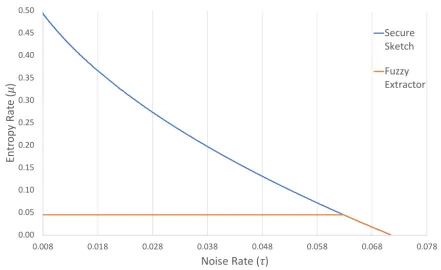
Figure 1: Tradeoff between entropy rate µ and noise rate τ for both fuzzy extractors (red) and secure sketches (blue). Illustration of parameters in Theorem 4.1 and Theorem 5.1. In this analysis we assume that there always exists a prime of size exactly 3(2e)1/(1−µ). The allowed noise rate τ may be reduced to find such a prime. Recall that Bertrand’s postulate state’s that a prime exists betweennand 2n for any integern >1.
Lemma 4.3 implies that for each key∈GoodKeypub, the interior Vol(Inter(Qp,key)) is smaller than the
volume of the Voronoi region by a factor of √e
2πγ. This means that for an averageW ∈ W,
Pr
W←W,κ←$GoodKeypub
[Inter(Qpub,key)∩W =∅]≥1−
e
√ 2πγ.
Thus, on average across z= (k, h) a 1−√e
2πγ fraction of keys inGoodKeypub (that is, overall
1 2 −
e
2√2πγ
fraction of keys cannot be produced). Define the set Implausible={key,pub, z|Inter(Qpub,key)∩Wz =∅}.
Triples drawn by creating a key using the fuzzy extractor never come from the set implausible. However, a uniformly random key will land in this set with probability 12 − e
2√2πγ. Thus, ≥
1 2 −
e
2√2πγ. This
completes the proof of Theorem 4.1.
Parameter discussion: There are settings of µ, τ, κ = Θ(1) such that the statistical distance is a constant. Taking logp−µ ≤ log(6
√ e+√π
6√e ) ≈ −.1334 implies that κ only needs to satisfy κ ≥ 1 + logγ.
Substituting p ≥(3√2e)1/(1−µ) and ignoring factors due to finding a primep this condition holds when
5
No Secure Sketch can secure
W
We now show no secure sketch can be secure for an average member ofW. We consider the metric space [0,1]n but we can embed other bounded, continuous spaces of finite dimension into the unit cube.
Theorem 5.1. Let M = [0,1]n with the Euclidean metric dis where n is even positive integer. Let
µ ∈ [0,12) be a constant and define m =d µn. There is a family W where for all W ∈ W, Hfuzzt,∞(W) = H∞(W) ≥ m, such that for any (M,W,m, t˜ )-secure sketch with error δ, we have m˜ ≤ 3 provided the
following conditions hold:
1. n≥2(h2(2δ) + loge). Note that n≥6 suffices.
2. Let p be a prime integer parameter such that p≥(3√2e)
1 (1−µ)
3. Define the noise rate τ =d t/√nwhere τ = 1 6pµ√2e. 4. The error parameter δ satisfies
δ∈
0,1
2−
log(1/τ) 2(1−µ) logp
Parameters: As an example, µ = .3 implies that p ≥ 129, so if we consider p = 131, we have that
τ ≤ .017 and δ ≤.08. That is, there is a family with constant fuzzy entropy, constant error rate, and constant error where no good secure sketch exists. The trade-off betweenµandτ is illustrated in Figure 1.
Interpreting the result: A secure sketch “discretizes” the input space into regions that produce a consistent value. Thus it is not surprising that, like the discrete case, a continuous secure sketch is not always possible. As stated in the introduction, the geometry of the Euclidean metric is more challenging than the Hamming metric due to the slower growth of volume.
Proof of Theorem 5.1. Recall that we use the family described in Theorem 3.1, the uniform distribution over the support of a coset h of a random lattice with minimum distancet. In this proof we will use the fact that for each W ∈ W the hash family is universal, regular, and has minimum distance.
We will define Z = (A,h) to be the pair of the lattice and coset and consider W = {Wz}. Let
n, m, µ, t, τ andpbe defined as in the theorem statement. The core of the proof is showing two properties of this hash function:
1. The family restricted to a hash function and output value has fuzzy min-entropy. This is because the hash function is regular and has minimum distance.
2. The adversary learns from sketch value SS(WZ) and new information by seeing the hash function
and value. This is because the hash function is universal.
The first property is immediate, by the 2mlogp-regularity and minimum distance properties of HashA,
H∞(Wz) = Hfuzzt,∞(Wz) = mlogp ≥m. We now proceed to show that some values of sketch that occur
Lemma 5.2. Let M denote the Euclidean mod-space [0,1]n and |Bt| denote the volume of a sphere of
radiustinM. Suppose(SS,Rec)is a(M,W,m, t˜ )secure sketch with errorδ, for some distribution family
W over M. Then for every v∈ M there exists a set GoodSketchv such that Pr[SS(v)∈GoodSketchv]≥
1/2 and for any fixed ss,
log|{v∈ M|ss∈GoodSketchv}| ≤
h2(2δ)−log|Bt|
1−2δ ,
and, therefore, for any distribution DM over M,
H0(DM|ss∈GoodSketchDM)≤
h2(2δ)−log|Bt|
1−2δ .
Proof. For any v∈M, define Neight(v) be the uniform distribution on the ball of radiust aroundv and let
GoodSketchv ={ss| Pr v0←Neigh
t(v)
[Rec(v0, ss)6=v]≤2δ]}.
We prove the lemma by showing two propositions. The first is a simple application of the Markov inequality shown by Fuller et al. [FRS16, Proposition D.2]
Proposition 5.3. Forv∈ M, Pr[SS(v)∈GoodSketchv]≥1/2.
To finish the proof of Lemma 5.2, we show that the set {v ∈ M|ss ∈ GoodSketchv} forms an
error-correcting code and bound the size of the code.
Definition 5.4. We say that a set C is an (t, δ)-Shannon code if there exists a (possibly randomized) functionDecode such that for all c∈C,
Pr
c0←Neigh
t(c)
[Decode(c0)6=c]≤δ.
The set{v∈ M|ss∈GoodSketchv}forms (t,2δ) Shannon code if we setDecode(y) =Rec(y, ss). We now
bound the size of such a code.
Lemma 5.5. If C⊂[0,1]n is a (t, δ)-Shannon code for any t >0, then |C|<∞ and
log|C| ≤ h2(δ)−log|Bt|
1−δ (5)
Proof of Lemma 5.5. First we show|C|<∞. Suppose for contradiction that|C|=∞. For any >0, we can findp, q∈C such that|p−q|< . LetBt(p), Bt(q) be thet-radius balls centered on p, qrespectively.
Then we can choose p, q, such that |Bt(p)∩Bt(q)| ≥ 2δ and |p−q| < < t. Let R be a uniform
distribution on Bt(p)∩Bt(q). Clearly
Pr[dis(R, p)≤t] Pr[dis(R, q)≤t] = 1.
If Pr[Decode(R) 6=p]≤ 1/2, we necessarily have Pr[Decode(R) 6= q] ≥1/2. Without loss of generality assume that Pr[Decode(R)6=q]≥1/2. Then we have that
Pr
c0←Neigh
t(q)
[Decode(c0)6=c]≥ Pr
c0←R[Decode(c
0)6=c] Pr[c0 ∈R]> 2δ
By contradiction, we know |C|<∞.
This we can assume thatCis finite. LetXbe a uniform distribution onCandY a uniform distribution on the t-radius ball centered on X. Here we use a variant of Fano’s inequality [Fan61] when Y is a continuous random variable. This formulation is different from most continuous formulation’s of Fano’s inequality which point the Euclidean norm of the estimate [CD09, Lemma 2]. We do not prove this formulation, the proof is the same as the standard discrete formulation of Fano’s which only relies on ˆX
and X.
Lemma 5.6. LetX be a discrete random variable onM, Y be a continuous random variable onMwith
ˆ
X(Y) a discrete estimator ofX based on Y. Then,
H1(X|Xˆ)≤h2(δ) +δ(log|C|).
where δ = Pr[X6= ˆX].
In particular, we consider the following estimator ˆX(y), if there exists a single x ∈ C such that dis(x, y)≤toutput x. If there are multiplexi such that ∀i,dis(xi, y)≤tthen output a random y. Then
we have that
H1(X|Xˆ)≥H0(X|Xˆ)≥log
(|C| ∗ |Bt|)
|[0,1]n
= log|C|+ log|Bt|.
Here the second inequality proceeds by noting that that |C| ∗ |Bt|/|[0,1]n measures the thickness of the
space and thus the average number of possible pointsx∈Cwithin distancetfor a uniform pointyaround a codeword. Thickness is usually used to describe the quality of a covering radius. Here by thickness we simply mean the total volumes of the balls of radius tdivided by the size of the space. Combining these two facts yields that Equation 5. This completes the proof of Lemma 5.5.
Lemma 5.2 follows from Lemma 5.5.
Since the hash is universal, entropy drops further when the adversary learns A,h. LetM denote the uniform distribution onMand K denote the uniform distribution onK. We first recall that a universal hash function reduces entropy of any distribution with small enough support:
Lemma 5.7. [FRS16, Lemma B.2] LetLbe a distribution. Let{HashA}A∈K be a family of2−a-universal
hash functions on the support of L. AssumeA is uniform in K and independent of L. Then
˜
H0(L|A,HashA(L))<log(1 +|supp(L)| ·2−a)≤max(1,1 +H0(L)−a).
Applying Lemma 5.7 to Lemma 5.2, we get that for any ss,
˜
H0(M|ss∈GoodSketchM,A,HashA(M))
<max
1,2 +h2(2δ)−log|Bt|
1−2δ −(n−m) logp
. (6)
We note that ˜H0 serves as a bound on ˜H∞ (see [FRS16, Lemma D.5]). That is,
˜
H∞(M|ss∈GoodSketchM,A,HashA(M))
<max
1,2 +h2(2δ)−log|Bt|
1−2δ −(n−m) logp
.
Lemma 5.8. [FRS16, Lemma D.6] For any pair of random variables (X, Y) and event η that is a (possibly randomized) function of (X, Y), H˜∞(X|η, Y)≥H˜∞(X|Y)−log 1/Pr[η].
The second technical lemma bounds the size of ball in the Euclidean space:
Lemma 5.9. Let p be a prime such that p≥(3√2e)1/(1−µ) then
α=d h2(2δ)−log|Bt|
1−2δ −(1−µ)nlogp≤0.
Proof. Due to Lemma 2.1 and Stirling’s formula, we have that
α= h2(2δ)−log|Bt|
1−2δ −(1−µ)nlogp
≤ h2(2δ) +n+ log((n/2)!)−n/2 logπ−nlogt
1−2δ −(1−µ)nlogp
≤ h2(2δ) +n(1− logπ
2 ) + loge(n/2)n/2+1/2e
−n/2−nlogt
1−2δ −(1−µ)nlogp
= h2(2δ) + loge+n(1− logπ
2 −
loge
2 ) + log(n/2)n/2+1/2−nlogt
1−2δ −(1−µ)nlogp (7)
≤ h2(2δ) + loge+
n
2log
n
2 −nlogt
1−2δ −(1−µ)nlogp (8)
=
h2(2δ) + loge+nlog(n/2)
1/2
τ√n
1−2δ −(1−µ)nlogp
= h2(2δ) + loge+nlog 1
√
2τ
1−2δ −(1−µ)nlogp
≤ nlog 1
τ
1−2δ −
(1−2δ)(1−µ)nlogp
1−2δ (9)
≤ nlog 1
τ
1−2δ −
log(1/(τ))
(1−µ) logp(1−µ)nlogp
1−2δ (10)
≤ nlog 1
τ
1−2δ −
nlogτ1 (1−2δ) = 0
Putting these facts together allows us to conclude the theorem statement:
˜
H∞(WZ|Z,SS(WZ)) = ˜H∞(M|SS(M),A,HashA(M))
≤log 1
Pr[SS(M)∈GoodSketchM]+ ˜
H∞(M|ss s.t. ss =SS(M) and ss∈GoodSketchM,A,HashA(M))
≤log 1
Pr[SS(M)∈GoodSketchM] +
˜
H0(M|ss s.t. ss =SS(M) and ss∈GoodSketchM,A,HashA(M))
<log 1
Pr[SS(M)∈GoodSketchM]
+ max
1,2 +h2(2δ)−log|Bt|
1−2δ −mlogp
<log 2 + max
1,2 +h2(2δ)−log|Bt|
1−2δ −mlogp
≤log 2 + max
1,2 +h2(2δ)−log|Bt|
1−2δ −(1−µ)nlogp
≤log 2 + max(1,2) ≤3
This completes the proof of Theorem 5.1.
6
Conclusion
Our two results show that model inaccuracy may be a major hurdle to constructing a continuous source fuzzy extractor. There are three ways to overcome our results:
1. Our results use distributions W that have fuzzy min-entropy at most .5n and algorithms that correct t ≈.07√n errors (see Figure 1). One may be able to avoid these results when more fuzzy min-entropy is present or less error tolerance is required.
2. One could use properties of a distribution beyond (fuzzy) min-entropy. For example, Li et al. [LSM06] assumed that dimensions were independently distributed.
3. Some discrete fuzzy extractors provide computational security [FMR13, CFP+16, HRvD+17, ACEK17, ABC+18, WLH18, WL18]. One could provide computational security instead of information-theoretic security. We are not aware of any prior continuous-source fuzzy extractors that argue computational security.
For secure sketches we considered the metric space [0,1]n. Our results can be extended to other bounded subsets ofRn. Our fuzzy extractor result instead considers (R/Z)n. This is due to a technical
limitation of the proof technique. We show that the volume of the interior of Qkey is smaller than the volume of Qkey. Roughly, maximum security drops by a factor proportional to the ratio between these volumes. To get a o(n) bound on key length this ratio must be exponential in the dimension n. In the metric space [0,1]n most parts of Qkey can be on a boundary of the unit cube. In the worst case these objects can be 1-dimension so their interior volume is only a constant factor smaller than their total volume.
complicate error-correction, a system designer would first reduce dimensionality (see for example [LPV11]) to find a representation that varies across all dimensions. This transformed distribution would be used for stable key derivation. In the “mod” space there are no boundary points, the entire region is “n -dimensional.”
References
[ABC+18] Quentin Alam´elou, Paul-Edmond Berthier, Chlo´e Cachet, St´ephane Cauchie, Benjamin Fuller, Philippe Gaborit, and Sailesh Simhadri. Pseudoentropic isometries: A new frame-work for fuzzy extractor reusability. In AsiaCCS, 2018.
[AC93] Rudolf Ahlswede and Imre Csisz´ar. Common randomness in information theory and cryptography - I: secret sharing. IEEE Transactions on Information Theory, 39(4):1121– 1132, 1993.
[ACEK17] Daniel Apon, Chongwon Cho, Karim Eldefrawy, and Jonathan Katz. Efficient, reusable fuzzy extractors from LWE. InInternational Conference on Cyber Security Cryptography and Machine Learning, pages 1–18. Springer, 2017.
[AMS+11] Frederik Armknecht, Roel Maes, Ahmad-Reza Sadeghi, Francois-Xavier Standaert, and Christian Wachsmann. A formalization of the security features of physical functions. In
2011 IEEE Symposium on Security and Privacy, pages 397–412. IEEE, 2011.
[BBR88] Charles H. Bennett, Gilles Brassard, and Jean-Marc Robert. Privacy amplification by public discussion. SIAM Journal on Computing, 17(2):210–229, 1988.
[BDHV07] Ileana Buhan, Jeroen Doumen, Pieter Hartel, and Raymond Veldhuis. Fuzzy extractors for continuous distributions. InProceedings of the 2nd ACM symposium on Information, computer and communications security, pages 353–355. ACM, 2007.
[BS00] Sacha Brostoff and M.Angela Sasse. Are passfaces more usable than passwords?: A field trial investigation. People and Computers, pages 405–424, 2000.
[CD09] Giacomo Como and Munther Dahleh. Lower bounds on the estimation error in problems of distributed computation. In Information Theory and Applications Workshop, 2009, pages 70–76. IEEE, 2009.
[CFP+16] Ran Canetti, Benjamin Fuller, Omer Paneth, Leonid Reyzin, and Adam Smith. Reusable fuzzy extractors for low-entropy distributions. InAdvances in Cryptology–EUROCRYPT, pages 117–146. Springer, 2016.
[CK78] Imre Csisz´ar and J´anos K¨orner. Broadcast channels with confidential messages. IEEE Transactions on Information Theory, 24(3):339–348, 1978.
[CS13] John Horton Conway and Neil James Alexander Sloane. Sphere packings, lattices and groups, volume 290. Springer Science & Business Media, 2013.
[Dau04] John Daugman. How iris recognition works. Circuits and Systems for Video Technology, IEEE Transactions on, 14(1):21 – 30, January 2004.
[DGSV15] Jeroen Delvaux, Dawu Gu, Dries Schellekens, and Ingrid Verbauwhede. Helper data algorithms for puf-based key generation: Overview and analysis. IEEE Transactions on Computer-Aided Design of Integrated Circuits and Systems, 34(6):889–902, 2015.
[DORS08] Yevgeniy Dodis, Rafail Ostrovsky, Leonid Reyzin, and Adam Smith. Fuzzy extractors: How to generate strong keys from biometrics and other noisy data. SIAM Journal on Computing, 38(1):97–139, 2008.
[EHMS00] Carl Ellison, Chris Hall, Randy Milbert, and Bruce Schneier. Protecting secret keys with personal entropy. Future Generation Computer Systems, 16(4):311–318, 2000.
[ELZ05] Uri Erez, Simon Litsyn, and Ram Zamir. Lattices which are good for (almost) everything.
IEEE Transactions on Information Theory, 51(10):3401–3416, 2005.
[Fan61] R.M. Fano.Transmission of Information: A Statistical Theory of Communications. MIT Press Classics. M.I.T. Press, 1961.
[FMR13] Benjamin Fuller, Xianrui Meng, and Leonid Reyzin. Computational fuzzy extractors. In
Advances in Cryptology-ASIACRYPT, pages 174–193. Springer, 2013.
[FRS16] Benjamin Fuller, Leonid Reyzin, and Adam Smith. When are fuzzy extractors possible? In Advances in Cryptology–ASIACRYPT, pages 277–306. Springer, 2016.
[GCVDD02] Blaise Gassend, Dwaine Clarke, Marten Van Dijk, and Srinivas Devadas. Silicon phys-ical random functions. In Proceedings of the 9th ACM conference on Computer and communications security, pages 148–160. ACM, 2002.
[Gur10] Venkatesan Guruswami. Introduction to coding theory - lecture 2: Gilbert-Varshamov bound. University Lecture, 2010.
[HRvD+17] Charles Herder, Ling Ren, Marten van Dijk, Meng-Day Mandel Yu, and Srinivas De-vadas. Trapdoor computational fuzzy extractors and stateless cryptographically-secure physical unclonable functions.IEEE Transactions on Dependable and Secure Computing, 14(1):65–82, 2017.
[HTW14] Masahito Hayashi, Himanshu Tyagi, and Shun Watanabe. Secret key agreement: Gen-eral capacity and second-order asymptotics. In 2014 IEEE International Symposium on Information Theory, pages 1136–1140. IEEE, 2014.
[KKR+12] Stefan Katzenbeisser, ¨Unal Kocaba¸s, Vladimir Roˇzi´c, Ahmad-Reza Sadeghi, Ingrid Ver-bauwhede, and Christian Wachsmann. Pufs: Myth, fact or busted? a security evaluation of physically unclonable functions (pufs) cast in silicon. In International Workshop on Cryptographic Hardware and Embedded Systems, pages 283–301. Springer, 2012.
[LPV11] Haiping Lu, Konstantinos N Plataniotis, and Anastasios N Venetsanopoulos. A survey of multilinear subspace learning for tensor data. Pattern Recognition, 44(7):1540–1551, 2011.
[LSM06] Qiming Li, Yagiz Sutcu, and Nasir Memon. Secure sketch for biometric templates. In
Advances in Cryptology – ASIACRYPT, pages 99–113. Springer, 2006.
[Mau93] Ueli M. Maurer. Secret key agreement by public discussion from common information.
IEEE Transactions on Information Theory, 39(3):733–742, 1993.
[MG09] Rene Mayrhofer and Hans Gellersen. Shake well before use: Intuitive and secure pairing of mobile devices. IEEE Transactions on Mobile Computing, 8(6):792–806, 2009.
[MvdLvdSW15] Roel Maes, Vincent van der Leest, Erik van der Sluis, and Frans Willems. Secure key generation from biased pufs. InInternational Workshop on Cryptographic Hardware and Embedded Systems, pages 517–534. Springer, 2015.
[NZ93] Noam Nisan and David Zuckerman. Randomness is linear in space. Journal of Computer and System Sciences, pages 43–52, 1993.
[PRTG02] Ravikanth Pappu, Ben Recht, Jason Taylor, and Neil Gershenfeld. Physical one-way functions. Science, 297(5589):2026–2030, 2002.
[RW05] Renato Renner and Stefan Wolf. Simple and tight bounds for information reconcili-ation and privacy amplificreconcili-ation. In Bimal K. Roy, editor, Advances in Cryptology -ASIACRYPT, volume 3788 ofLNCS, pages 199–216. Springer, 2005.
[SD07] G. Edward Suh and Srinivas Devadas. Physical unclonable functions for device authen-tication and secret key generation. InProceedings of the 44th annual Design Automation Conference, pages 9–14. ACM, 2007.
[SFIC14] Merrielle Spain, Benjamin Fuller, Kyle Ingols, and Robert Cunningham. Robust keys from physical unclonable functions. In 2014 IEEE International Symposium on Hardware-Oriented Security and Trust (HOST), pages 88–92. IEEE, 2014.
[TSS+06] Pim Tuyls, Geert Jan Schrijen, Boris Skoric, Jan van Geloven, Nynke Verhaegh, and Rob Wolters. Read-proof hardware from protective coatings. In Louis Goubin and Mitsuru Matsui, editors, Cryptographic Hardware and Embedded Systems - CHES 2006, volume 4249 of Lecture Notes in Computer Science, pages 369–383. Springer, 2006.
[TW15] Himanshu Tyagi and Shun Watanabe. Converses for secret key agreement and secure computing. IEEE Transactions on Information Theory, 61(9):4809–4827, 2015.
[VTO+10] Evgeny A Verbitskiy, Pim Tuyls, Chibuzo Obi, Berry Schoenmakers, and Boris Skoric. Key extraction from general nondiscrete signals. IEEE Transactions on Information Forensics and Security, 5(2):269–279, 2010.
[WCD+17] Joanne Woodage, Rahul Chatterjee, Yevgeniy Dodis, Ari Juels, and Thomas Risten-part. A new distribution-sensitive secure sketch and popularity-proportional hashing. In
[WL18] Yunhua Wen and Shengli Liu. Robustly reusable fuzzy extractor from standard assump-tions. In Advances in Cryptology – ASIACRYPT, 2018.
[WLH18] Yunhua Wen, Shengli Liu, and Shuai Han. Reusable fuzzy extractor from the decisional Diffie–Hellman assumption. Designs, Codes and Cryptography, pages 1–18, 2018.