A preliminary version of this paper appears in the proceedings of Pubic-Key Cryptography 2015. This is the full version.
Interactive message-locked encryption and
secure deduplication
Mihir Bellare1 Sriram Keelveedhi2
January 21, 2015
Abstract
This paper considers the problem of secure storage of outsourced data in a way that permits deduplication. We are for the first time able to provide privacy for messages that are both correlated and dependent on the public system parameters. The new ingredient that makes this possible is interaction. We extend the message-locked encryption (MLE) primitive of prior work to interactive message-locked encryption (iMLE) where upload and download are protocols. Our scheme, provid-ing security for messages that are not only correlated but allowed to depend on the public system parameters, is in the standard model. We explain that interaction is not an extra assumption in practice because full, existing deduplication systems are already interactive.
Keywords: deduplication, cloud storage, message-locked encryption.
1
Department of Computer Science & Engineering, University of California San Diego, 9500 Gilman Drive, La Jolla, California 92093, USA. Email: [email protected]. URL:http://cseweb.ucsd.edu/~mihir/. Supported in part by NSF grants CNS-1228890 and CNS-1116800.
2
Contents
1 Introduction 3
2 Preliminaries 6
3 Interactive message-locked encryption 7
4 The FCHECK scheme 10
5 Incremental updates 13
6 References 17
A Interactive protocols 20
B Deterministic MLE schemes cannot support incremental updates 20
C Incremental updates: Proofs and extensions 21
C.1 Proof of Theorem 5.1 . . . 21 C.2 Proof of Theorem 5.2 . . . 23
D The IRCE2 scheme 26
E Parameter-dependent security: Proofs and extensions 30
E.1 Proof of Theorem 4.2 . . . 31
F MLEWC: Proofs and extensions 31
1
Introduction
The secure deduplication problem. Cloud storage providers such as Google, Dropbox and
NetApp [31, 41, 51] derive significant cost savings from what is calleddeduplication. This means that if Alice and Bob upload the same data m, the service provider stores only one copy that is returned to Alice and Bob upon download.
Enter security, namely the desire of clients to keep their data private from the server. Certainly, Alice and Bob can conventionally encrypt their data under their passwords and upload the ciphertext rather than the plaintext. But then, even if they start from the same data m, they will end up with different ciphertexts CA, CB, foiling deduplication. The corresponding cost increase for the server would ultimately be passed to the clients in higher storage fees. It is thus in the interest of the parties to cooperate towards storage that is secure but deduplicatable.
Douceur et al. [30] provided the first solution, called convergent encryption (CE). The client en-crypts its plaintextmwith adeterministicsymmetric encryption scheme under akthat is itself derived as a deterministic hash of the plaintextm. If Alice and Bob start with the samem, they will arrive at the same ciphertext, and thus deduplication is possible. Despite lacking an analysis until recently [11], CE has long been used in research and commercial systems [2, 4, 5, 17, 25, 26, 28, 35, 39, 46, 47, 52, 54], an indication of practitioners’ interest in secure deduplication.
MLE.Bellare, Keelveedhi and Ristenpart (BKR) [11] initiated a theoretical treatment of secure
dedu-plication aimed in particular at answering questions like, what security does CE provide and what can one prove about it? To this end they defined a primitive they called message-locked encryption (MLE). An MLE scheme specifies algorithms K,E,D,T. To encrypt m, letk←$K(p, m), where pis a system-wide public parameter, and return ciphertext c←$E(k, m). Decryptionm←D(k0, c) recovers
m as long ask0←$K(p, m) is any key derived fromm. Tags, produced viat←T(c), are a way to test whether the plaintexts underlying two ciphertexts are the same or not, all encryptions of m having the same tag but it being hard to find differing plaintexts with matching tags.
Any MLE scheme enables deduplication. Alice, havingmA, computes and retains a keykA←$K(p, mA) and uploadscA←$E(k, mA). The server storescA. Now Bob, havingmB, computes and retains a key
kB←$K(p, mB) and uploadscB←$E(k, mB). If the tags ofcAandcBmatch, which meansmA=mB, then the server deduplicates, storing only cAand returning it to both Alice and Bob upon a download request. Both can decrypt to recover the common plaintext. CE is a particular MLE scheme in which key generation is done by hashing the plaintext.
MLE security. BKR [11] noted that MLE can only provide security for unpredictable data. (In
particular, it cannot provide semantic security.) Within this range, two data dimensions emerge: 1. Correlation: Security holds even when messages being encrypted, although individually
unpre-dictable, are related to each other.
2. Parameter-dependence: Security holds for messages that depend on the public parameters.
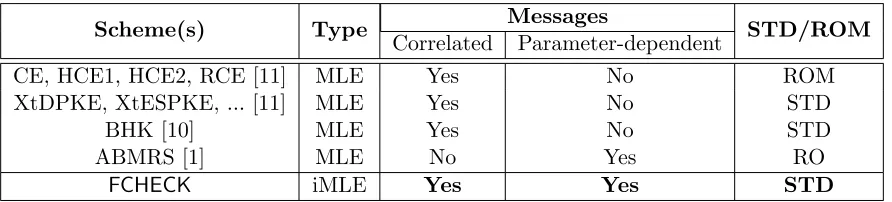
These dimensions are orthogonal, and the best would be security for correlated, parameter-dependent messages. This has not been achieved. What we have is schemes for correlated but parameter-independent messages [10, 11] and for non-correlated but parameter-dependent messages [1]. This past work is summarized in Figure 1 and we now discuss it in a little more detail.
Prior schemes. The definition of BKR [11], following [6], was security for correlated but
Scheme(s) Type Messages STD/ROM Correlated Parameter-dependent
CE, HCE1, HCE2, RCE [11] MLE Yes No ROM
XtDPKE, XtESPKE, ... [11] MLE Yes No STD
BHK [10] MLE Yes No STD
ABMRS [1] MLE No Yes RO
FCHECK iMLE Yes Yes STD
Figure 1: Features of prior schemes (first four rows) and our scheme (last row). We achieve security for the first time for messages that areboth correlatedand parameter dependent. Our scheme is in the standard model. The advance is made possible by exploiting interaction.
challenging. They gave a ROM solution that uses NIZK proofs to provide proofs of consistency. But to achieve security for parameter-dependent messages they were forced to sacrifice security for correlated messages. Their result assumes messages being encrypted are independently distributed.
Questions and goals. The question we pose and address in this paper is, is it possible to achieve the best of both worlds, meaning security for messages that are both correlatedand parameter dependent? This is important in practice. As indicated above, schemes for secure deduplication are currently deployed and in use in many systems [2, 4, 5, 17, 25, 26, 28, 35, 39, 46, 47, 52, 54]. In usage, messages are very likely to be correlated. For example, suppose Alice has uploaded a ciphertext c encrypting a paper m she is writing. She edits m to m0, and uploads the new version. The two plaintexts
m, m0 could be closely related, differing only in a few places. Also, even if messages of honest users are unlikely to depend on system parameters, attackers are not so constrained. Lack of security for parameter-dependent messages could lead to breaches. This is reflected for example in the BEAST attack on CBC in SSL/TLS [32]. We note that the question of achieving security for messages that are both correlated and parameter dependent is open both in the ROM and in the standard model.
Contributions in brief. We answer the above questions by providing a deduplication scheme secure
for messages that are both correlated and parameter dependent. Additionally, our scheme is standard-model, not ROM. The key new ingredient is interaction. In our solutions, upload and download are interactive protocols between the client and server. To specify and analyze these protocols, we define a new primitive, interactive MLE or iMLE. We provide a syntax and definitions of security, then specify and prove correct our protocols.
iMLE turns out to be interesting in its own right and yields some other benefits. We are able to provide the first secure deduplication scheme that permits incremental updates. This means that if a client’s message changes only a little, for example due to an edit to a file, then, rather than create and upload an entirely new ciphertext, she can update the existing one with communication cost proportional only to the distance between the new and old plaintexts. This is beneficial because communication is a significant fraction of the operating expenditure in outsourced storage services. For example, transferring one gigabyte to the server costs as much storing one gigabyte for a month or longer in popular storage services [3, 40, 49]. In particular, backup systems, an important use case for deduplication, are likely to benefit, as the operations here are incremental by nature. Incremental cryptography was introduced in [8, 9] and further studied in [13, 21, 34, 50].
Interaction? One might question the introduction of interaction. Isn’t a non-interactive solution
we are taking advantage of an existing resource rather than introducing an entirely new one.
MLE considered a single client. But in a full deduplication system, there are multiple clients concurrently executing uploads and downloads. Our iMLE model captures this. iMLE is thus going further towards providing security of the full system rather than just a cryptographic core. We know from experience that systems can fail in practice even when a “proven-secure” scheme is used if the security model does not encompass the full range of attacker capabilities or security goals of the implementation. Modeling that penetrates deeper into the system, as with iMLE, increases assurance in practice.
We view iMLE as a natural extension of MLE. The latter abstracted out an elegant primitive at the heart of the secure deduplication problem that could be studied in isolation. We study the full deduplication system, leveraging MLE towards full solutions with added security features.
Duplicate faking. In a duplicate faking attack, the adversary concocts and uploads a perverse
ciphertext c∗ with the following property. When honest Alice uploads an encryptionc of her message
m, the server’s test (wrongly) indicates that the plaintexts underlingc∗, c are the same, so it discards
c, returningc∗ to Alice upon a download request. But when Alice decryptsc∗, she does not get back her original plaintext.
Beyond privacy, BKR [11] defined an integrity requirement for MLE called tag consistency whose presence provides security against duplicate faking attacks. The important tag consistency property is possessed by the prior MLE schemes of Figure 1 and also by our new iMLE schemes.
Deterministic schemes provide tag consistency quite easily and naturally. But ABMRS [1] indicate that security for parameter-dependent messages requires randomization. Tag consistency now becomes challenging to achieve. Indeed, providing it accounts for the use of NIZKs and the corresponding cost and complexity of the ABMRS scheme [1].
In the interactive setting, we capture the requirement underlying tag consistency by a recovery condition that is part of our soundness definition and requirement. Soundness in particular precludes duplicate faking attacks in the interactive setting. Our scheme provides soundness, in addition to privacy for messages that are both correlated and parameter dependent. Our FCHECK solution uses composable point function obfuscation [16] and FHE [18–20, 27, 36, 38, 55].
Closer look. We look in a little more detail at the main definitional and scheme contributions of
our work.
Public parameters for an iMLE scheme are created by an Init algorithm. Subsequently, a client can register (Reg), upload (Put) and download (Get). Incremental schemes have an additional update (Upd). All these are interactive protocols between client and server. For soundness, we ask that deduplication happens as expected and that clients can recover their uploaded files even in the presence of an attacker which knows all the files being uploaded and also read the server’s storage at any moment. The latter condition protects against duplicate-faking attacks. Our security condition is modeled on that of BKR [11] and requires privacy for correlated but individually unpredictable messages that may depend on the public parameters.
Our FCHECK construction, described and analyzed in Section 4, achieves soundness as well as privacy for messages that are both correlated and parameter dependent, all in the standard model, meaning without recourse to random oracles. The construction builds on a new primitive we call MLE-Without-Comparison (MLEWC). As the name indicates, MLEWC schemes are similar to MLE schemes in syntax and functionality, except that they do not support comparison between ciphertexts. We show that MLEWC can be realized in the standard model, starting from point function obfuscation [16] or, alternatively, UCE-secure hash function families [10]. However, comparison is essential to enable deduplication. To enable comparison, FCHECK employs an interactive protocol using a fully homomorphic encryption (FHE) scheme [18–20, 27, 36, 38, 55], transforming the MLEWC scheme into an iMLE scheme.
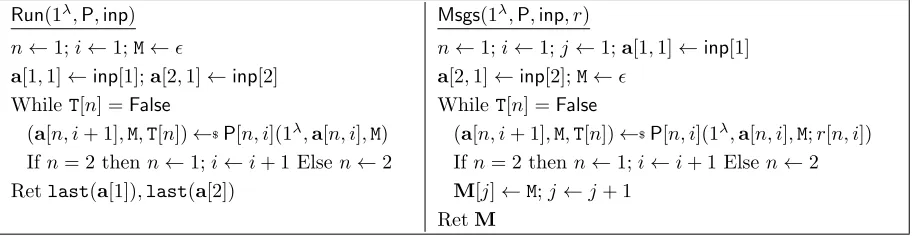
Run(1λ,P,inp)
n←1;i←1;M←
a[1,1]←inp[1];a[2,1]←inp[2]
WhileT[n] =False
(a[n, i+ 1],M,T[n])←$P[n, i](1λ,a[n, i],M)
Ifn= 2 thenn←1;i←i+ 1 Elsen←2 Retlast(a[1]),last(a[2])
Msgs(1λ,P,inp, r)
n←1;i←1;j←1;a[1,1]←inp[1] a[2,1]←inp[2];M←
WhileT[n] =False
(a[n, i+ 1],M,T[n])←$P[n, i](1λ,a[n, i],M;r[n, i])
Ifn= 2 thenn←1;i←i+ 1 Elsen←2 M[j]←M;j←j+ 1
RetM
Figure 2: Left: Running a two player protocol P. Right: The Msgs procedure returns the messages exchanged during the protocol when invoked with specified inputs and coins.
MLE schemes turns out to be challenging: deterministic MLE schemes cannot support incremental updates, as we show in Appendix B, while randomized MLE schemes seem to need complex machinery such as NIZK proofs of consistency [1] to support incremental updates while retaining the same level of security as deterministic schemes, which makes them unfit for practical usage. We show how interaction can be exploited to solve this problem. We describe an efficient ROM scheme IRCE that supports incremental updates. The scheme, in its simplest form, works like the randomized convergent encryption (RCE) scheme [11], where the message is encrypted with a random key using a blockcipher in counter (CTR) mode, and the random key is encrypted with a key derived by hashing the message. We show that this indirection enables incremental updates. However, RCE does not support strong tag consistency and hence cannot offer strong security against duplicate faking attacks. We overcome this inIRCEby including a simple response from the server as part of the upload process. We remark that IRCE is based off a core MLE (non-interactive) scheme permitting incremental updates, interaction being used only for tag consistency.
2
Preliminaries
We letλ∈Nand 1λ denote the security parameter and its unary representation. The empty string is denoted by . We let |S|denote the size of a finite set S and let s←$S denote sampling an element from S at random and assigning it to s. If a, b ∈ N and a < b, then [a] denotes the set {1, . . . , a}
and [a, b] denotes the set {a, . . . , b}. For a tuple x, we let |x| denote the number of components in x, and x[i] denote the i-th component, and last(x) = x[|x|], and x[i, j] = x[i]. . .x[j] for 1 ≤ i ≤ j ≤ |x|. A binary string s is identified with a tuple over {0,1}. The guessing probability of a random variable X, denoted by GP(X), is defined as GP(X) = maxxPr[X = x]. The conditional guessing probability GP(X|Y) of a random variable X given a random variable Y are defined via GP(X|Y) =P
yPr[Y =y]·maxxPr[X=x|Y =y].
The Hamming distance between s1, s2 ∈ {0,1}` is given by HAMM(s1, s2) = P`i=1(s1[i]⊕s2[i]). We let diffHAMM(s1, s2) ={i:s1[i]6=s2[i]} and patchHAMM(s1, δ) be the strings such thats[i] =s1[i] ifi6∈δ and s[i] =¬s1[i] ifi∈δ.
Algorithms are randomized and run in polynomial time (denoted by PT) unless otherwise indicated. We let y←A(a1, . . .;r) denote running algorithmA on a1, . . . with coinsr and assigning the output toy, and lety←$A(a1, . . .) denote the same operation with random coins. We let [A(a1, . . .)] denote the set of all y that have non-zero probability of being output by A on inputs a1, . . .. Adversaries are either algorithms or tuples of algorithms. A negligible function f approaches zero faster than the polynomial reciprocal; for every polynomial p, there exists np ∈ N such that f(n) ≤ 1/p(n) for all
n≥np.
A two playerq-round protocolPis represented through a 2×q-tuple (P[i, j])i∈[2],j∈[q]of algorithms whereP[i, j] represents the action of thei-th player invoked for thej-th time. We letP[1] denote the player who initiates the protocol, andP[2] denote the other player. Each algorithm is invoked with 1λ, an input a, and a message M∈ {0,1}∗, and returns a 3-tuple consisting of an output a0, an outgoing message M0 ∈ {0,1}∗, and a booleanTto indicate termination. TheRunalgorithm (Figure 2) captures the execution of P, and Msgs (Figure 2) returns the messages exchanged in an instance of P, when invoked with specified inputs and coins.
Adversarial model. A secure deduplication system (built from an iMLE scheme) will operate
in a setting with a server and several clients. Some clients will be controlled by an attacker, while others will be legitimate, belonging to honest users and following the protocol specifications. A resourceful attacker, apart from controlling clients, could gain access to server storage, and interfere with communications. Our adversarial model captures an iMLE scheme running in the presence of an attacker with such capabilities.
We now walk through an abstract game G, and explain how this is achieved. The games in the rest of the paper, for soundness, security, and other properties of iMLE largely follow this structure. The game G sets up and controls a server instance. The adversary A is invoked with access to a set of procedures. Usually, the objective of the game involves A violating some property guaranteed to legitimate clients like L, such as ability to recover stored files, or privacy of data.
TheMsg procedure can send arbitrary messages to the server and can be used to create multiple
clients, and run multiple instances of protocols, which could deviate from specifications.
The Init and Step procedures control a single legitimate client L. The Init procedure starts
protocol instances on behalf ofL, using inputs ofA’s choice. TheStepprocedure advances a protocol
instance by running the next algorithm. Together, these procedures let A run several legitimate and corrupted protocol instances concurrently.
TheState procedure returns the server’s state, which includes stored ciphertexts, public
param-eters, etc.. In some games, it also returns the state and parameters of L. State provides only read
access to the server’s storage. This restriction is necessary. If A is allowed to modify the storage of the server, then it can always tamper with the data stored by the clients, making secure deduplication impossible.
We assume that A can read, delay and drop messages between the server and legitimate clients. However, A cannot tamper with message contents, reorder messages within a protocol, or redirect messages from one protocol instance to another. This assumption helps us simplify the protocol descriptions and proofs. Standard, efficient techniques can be used to transform the protocols from this setting to be secure in the presence of an attacker that can tamper and reorder messages [7].
3
Interactive message-locked encryption
Definition. An interactive message-locked encryption schemeiMLEconsists of an initialization
algo-rithmInitand three protocolsReg,Put,Get. InitializationInitsets up server-side state: σS←$Init(1λ). Each protocolP consists of two players - a clientP[1] (meaning that the client always initiates), and a server P[2]. All server-side algorithms P[2,·] take server-side state σS as input, and produce an updated state σ0S as output. The Reg protocol registers new users; here, Reg[1] takes no input and returns client parameters σC ∈ {0,1}∗. The Putprotocol stores files on the server; here, Put[1] takes plaintext m ∈ {0,1}∗ and σC as inputs, and outputs an identifier f ∈ {0,1}∗. The Get protocol retrieves files from the server; here, Get[1] takes identifierf and σC as inputs, and outputs plaintext
m∈ {0,1}∗.
Soundness. We require two conditions. First is deduplication, meaning that if a client puts a
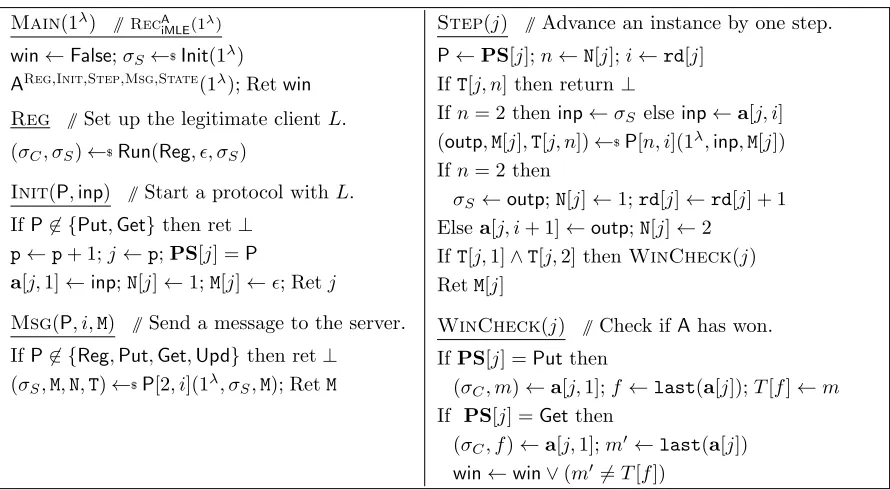
Main(1λ) //RecAiMLE(1λ)
win←False;σS←$Init(1λ)
AReg,Init,Step,Msg,State(1λ); Retwin
Reg //Set up the legitimate clientL.
(σC, σS)←$Run(Reg, , σS)
Init(P,inp) //Start a protocol withL.
IfP6∈ {Put,Get}then ret⊥
p←p+ 1;j←p;PS[j] =P
a[j,1]←inp;N[j]←1;M[j]←; Retj
Msg(P, i,M) //Send a message to the server.
IfP6∈ {Reg,Put,Get,Upd} then ret⊥
(σS,M,N,T)←$P[2, i](1λ, σS,M); RetM
Step(j) //Advance an instance by one step.
P←PS[j];n←N[j];i←rd[j] IfT[j, n] then return⊥
Ifn= 2 then inp←σS elseinp←a[j, i]
(outp,M[j],T[j, n])←$P[n, i](1λ,inp,M[j])
Ifn= 2 then
σS ←outp;N[j]←1;rd[j]←rd[j] + 1
Elsea[j, i+ 1]←outp;N[j]←2 IfT[j,1]∧T[j,2] thenWinCheck(j)
RetM[j]
WinCheck(j) //Check ifAhas won.
IfPS[j] =Putthen
(σC, m)←a[j,1];f ←last(a[j]);T[f]←m
If PS[j] =Getthen
(σC, f)←a[j,1];m0←last(a[j])
win←win∨(m06=T[f])
Figure 3: The Recgame. The State procedure returnsσS, σC.
A small increase towards book-keeping information, that is independent of the size of the file, is permissible. More precisely, there exists a bound ` : N → N such that for all server-side states
σS ∈ {0,1}∗, for all valid client parameters (derived through Reg with fresh coins) σC, σC0 , for all
m ∈ {0,1}∗, the expected increase in size of σS00 over σS0 when (f0, σS0)←$Run(Put,(σC, m), σS) and (f0, σS00)←$Run(Put,(σ0
C, m), σ
0
S) is bounded by `(λ).
The second condition is correct recovery of files: if a legitimate client puts a file on the server, it should be able to get the file later. We formalize this requirement by theRecgame of Figure 3, played
with an adversary A, which gets access to procedures Reg,Init,Step,Msg,State. We provide an
overview of these procedures here.
The Reg procedure sets up a legitimate client L by running Run(1λ,Reg,(, σS)) . The Init procedure lets A run protocols on behalf of L. It takes input inp and P, where P has to be one of Put,Get, and inp should be the a valid input for P[1,1]. A new instance of P is set up, and A is returned j ∈ N, an index to the instance. The Step procedure takes input j, advances the instance
by one algorithm unless the current instance has terminated. The outgoing message is returned to A. The inputs and outputs of the protocol steps are all stored in an array a. The State procedure
returns σS, σC.
If an instancejhas terminated, thenSteprunsWinCheck, which maintains a tableT. Ifj is an
instance of Put, then mand identifierf are recovered froma[j] andT[f] getsm. Ifj is an instance of Get, thenWinCheck obtainsf and the recovered plaintext m0, and checks if T[f] =m0. If this fails,
either becauseT[f] is some value different fromm0, or is undefined, thenWinChecksets thewinflag,
which is the condition forAto win the game. We associate advantageAdvreciMLE,A(λ) = Pr[RecAiMLE(1λ)]
withiMLEand A. For recovery correctness, we require that the advantage should be negligible for all PT A.
Security. The primary security requirement for iMLE schemes is privacy of unpredictable data.
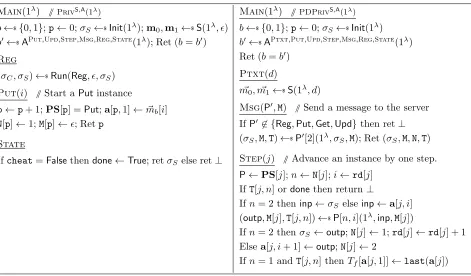
Main(1λ) //PrivS,A(1λ)
b←${0,1};p←0;σS←$Init(1λ);m0,m1←$S(1λ, )
b0←$APut,Upd,Step,Msg,Reg,State(1λ); Ret (b=b0)
Reg
(σC, σS)←$Run(Reg, , σS)
Put(i) //Start aPutinstance
p←p+ 1;PS[p] =Put;a[p,1]←m~b[i]
N[p]←1;M[p]←; Retp
State
Ifcheat=Falsethendone←True; retσS else ret⊥
Main(1λ) //PDPrivS,A(1λ)
b←${0,1};p←0;σS←$Init(1λ)
b0←$APtxt,Put,Upd,Step,Msg,Reg,State(1λ)
Ret (b=b0)
Ptxt(d)
~
m0, ~m1←$S(1λ, d)
Msg(P0,M) //Send a message to the server IfP0 6∈ {Reg,Put,Get,Upd}then ret⊥
(σS,M,T)←$P0[2](1λ, σS,M); Ret (σS,M,N,T)
Step(j) //Advance an instance by one step.
P←PS[j];n←N[j];i←rd[j] IfT[j, n] ordonethen return⊥
Ifn= 2 theninp←σS elseinp←a[j, i]
(outp,M[j],T[j, n])←$P[n, i](1λ,inp,M[j])
Ifn= 2 thenσS←outp;N[j]←1;rd[j]←rd[j] + 1
Elsea[j, i+ 1]←outp;N[j]←2
Ifn= 1 andT[j, n] thenTf[a[j,1]]←last(a[j])
Figure 4: ThePriv and PDPrivsecurity games. Apart fromMain, the games share the same code
for all procedures. ThePDPriv game has an additional Ptxtprocedure.
unpredictability as follows.
A source S is an algorithm that on input 1λ and a string d ∈ {0,1}∗ returns a pair of tuples (m0,m1). There exist m : N → N and ` : N ×N → N such that |m0| = |m1| = m(λ), and
|m0[i]|=|m1[i]|=`(λ, i) for all i∈[m(λ)]. All components ofm0 and m1 are unique. The guessing probability GPS(λ) ofSis defined as maxi,b,d(GP(mb[i])) when (m0,m1)←$S(1λ, d). We say thatS is unpredictable if GPS(·) is negligible. We say thatS is a single source if it only outputs one tuple,
but satisfies the other conditions. We say thatSis an auxiliary source if it outputs a stringz∈ {0,1}∗
along with m0,m1 and if it holds that guessing probability conditioned on z is negligible.
ThePrivgame of Figure 4, associated withiMLE, a sourceSand an adversaryA, captures privacy
for unpredictable messages independent of the public parameters of the system. As with Rec, the
game starts by running σS←$Init(1λ) to set up the server-side state. The game then runs S to get (m0,m1), picks a random bit b, and usesmb as messages to be put on the server. Then,Ais invoked with access to Reg,Put, Step,Msg and State. The Reg,State, and Msg oracles behave in the
same way as in Rec. TheStep oracle here is similar to that of Rec, except that it does not invoke WinCheck. Adversary Acan initialize an instance ofPut with a plaintextmb[i] by callingPut(i).
We associate advantageAdvpriviMLE,S,A(λ) = 2 Pr[PriviMLES,A (1λ)]−1 with a iMLE a source S and an
adversaryA. We require that the advantage should be negligible for all PTAfor all unpredictable PT S.
The PDPriv game of Figure 4 extends Priv-security to messages depending on the public
pa-rameters of the system, a notion termed lock-dependent security in [1]. Here, we term this parameter-dependent security. In this game, the adversary A gets access to a Ptxt procedure, which runs
S(1λ, σS) to get m0,m1. The other procedures follow Priv. A simpler approach is to run S withσS when the game starts (i.e. inmain) as inPriv. However, this leads to trivial constructions whereInit
is a dummy procedure, and the system parameters are generated when the first client registers. This is avoided inPDPriv by lettingAdecide, throughPtxt, when Sis to be run. We associate advantage
Put[1]((pk, sk), m) Put[2](σS, )
cf←$Epk(m) pk, c
f
−−−−−−−−−−−→ cr←$Ef(1λ, pk,0κ(λ));ci←$Ef(1λ, pk,0)
cn ←ci
For (p, c)∈fildo
cp←$Ef(1λ, pk, p);cc←$Ef(1λ, pk, c)
c0←$Evf(1λ, pk,cmp, cf, cp, cc, cr, cn, ci)
cr, cn, ci←c0
cr, cn
←−−−−−−−−−−−
p←Df(1λ, sk, cr);n←Df(1λ, sk, cn)
n
−−−−−−−−−−−→ (p, c)←fil[n]
p, c
←−−−−−−−−−−−
Ifn6= 0 then c1←;k←K(1λ, p, m)
IfD(1λ, k, c)6=mthen ret⊥
Else
p←$P(1λ);k←K(1λ, p, m)
c1←$E(1λ, k, m)
c2←Epk(k) c1, c2, p, u, n
−−−−−−−−−−−→ Ifc16=then
nf ←nf+ 1;i←nf;fil[i]←(p, c1) c2←SiffE(own,(u, i), c2)
i
←−−−−−−−−−−−
Ifn6= 0 and i6=nthen ret⊥else reti
Reg[1]() Reg[2](σS)
(pk, sk)←$Kf
−−−−→ u←${0,1}λ \
U
U←U∪ {u}
u
←−−−−
Ret (pk, sk, u)
Get[1]((pk, u, sk), f) Get[2](σS, )
u, f
−−−−−→ c2←own[u, i]
(p, c1)←fil[i]
Ifc2=⊥thenc1← ⊥ c1, c2
←−−−−−
If c1 = ⊥ then
ret⊥
k←Df(1λ, sk, c2)
RetD(1λ, k, c
1)
Figure 5: TheFCHECK iMLE scheme over FHE= (Kf,Ef,Df,Evf) andMLEWC= (P,E,K,D).
require that advantage should be negligible for all PT Afor all unpredictable PTS.
4
The
FCHECK
scheme
In this section, we describe the theFCHECKconstruction, which achieves soundness as well as security for messages that are both correlated and parameter-dependent, all in the standard model. As we noted in the introduction, prior to our work, achieving parameter-dependent correlated input security was open even in the random oracle model. We are able to exploit interactivity as a new ingredient to design a scheme that achieves security for parameter-dependent correlated messages.
Our approach starts by going after a new, seemingly weak primitive, one we call MLE-Without-Comparison (MLEWC). As the name indicates, MLEWC schemes are similar to MLE schemes in syntax and functionality, except that they do not support comparison between ciphertexts. We show that MLEWC can be realized in the standard model, starting from point function obfuscation [16] or, alternatively, UCE-secure hash function families [10]. However, comparison is essential to enable deduplication. To enable comparison, FCHECK employs an interactive protocol using a fully homo-morphic encryption (FHE) scheme [18–20, 27, 36, 38, 55], transforming the MLEWC scheme into an iMLE scheme. We view FCHECK as a theoretical construction, and not an immediately practical iMLE scheme.
MLE Without Comparison (MLEWC). A scheme MLEWC = (P,E,K,D) consists of four
m ∈ {0,1}µ(λ) is the plaintext. Encryption E takes p, k, m and returns a ciphertext c←$E(1λ, k, m). DecryptionDtakes inputk, cand returnsm←D(1λ, k, c), or⊥. Correctness requires thatD(1λ, k, c) =
m for all k ∈ [K(1λ, p, m)], for all c ∈ [E(1λ, k, m)], for all p ∈ [P(1λ)], for all m ∈ {0,1}κ(λ) for all
λ∈N.
The WPRIV game with MLEWC, an auxiliary source S and an adversaryA is described in
Fig-ure 17. The game runsSto get two vectorsm0,m1, and formscby encrypting one of the two vectors, using a fresh parameter for each component, or by picking random strings. A should guess which the case is. We associate advantage AdvwprivMLEWC,S,A(λ) = 2 Pr[WPRIVAMLEWC,S (1λ)]−1. ForMLEWC to
be WPRIV-secure, advantage should be negligible for all PT adversaries Afor all unpredictable PT auxiliary sources S. Note that unlike PRIV, here, a fresh parameter is picked for each encryption,
and although we will end up using WPRIV-secure schemes to build parameter-dependent iMLE, in
theWPRIV game, the source Sis not provided the parameters.
Fully homomorphic encryption (FHE) [36]. An FHE schemeFHE= (Kf,Ef,Df,Evf) is a 4-tuple
of algorithms. Key generation returns (pk, sk)←$Kf(1λ), encryption takespk, plaintext m ∈M(λ), and returns ciphertext c←$Ef(1λ, pk, m), and decryption returns m0 ←Df(1λ, sk, c) on inputsk and ciphertext c, where m=⊥indicates an error. The set of valid ciphertexts is denoted by C(λ) ={c: Df(1λ, sk, c)6=⊥,(pk, sk)∈[Kf(1λ)]}. Decryption correctness requires thatDf(1λ, sk,Ef(1λ, pk, m)) = m for all (pk, sk)∈[Kf(1λ)], for all m∈M(λ) for allλ∈N.
Let h.i denote an encoding which maps boolean circuits f to strings denoted by hfi such that there exists PT Eval which satisfies Eval(hfi, x) =f(x) for every valid input x ∈ {0,1}n, where n is the input length of f. Evaluation Evf takes input a public key pk, a circuit encoding hfi and a tuple
of ciphertexts c such that|c|is the input length of f and returns c0←$Evf(1λ, pk,hfi,c). Evaluation correctness requires that for random keys, on all functions and all inputs,Evf must compute the correct
output when run on random coins, except with negligible error. More precisely, for all boolean circuits
f, when (pk, sk)←$Kf(1λ) andc0←$[Evf(1λ, pk,hfi,c)], if |c|is the input length of f, then it holds that the probability thatEval(f,x)6=ywherey←Df(1λ, sk, c0) andx[i]←Df(1λ, sk,c[i]) is negligible
for all c[1], . . . ,c[|c|]∈C(λ)|c|.
The FCHECK scheme. LetFHE= (Kf,Ef,Df,Evf) be an FHE scheme, and letMLEWC= (P,E,K,D)
be a MLEWC scheme whereKis deterministic. TheFCHECK[FHE,MLEWC] iMLE scheme is described in Figure 5. The Initalgorithm is omitted: it lets U← ∅, and lets filand ownbe empty tables.
In FCHECK, clients encrypt their plaintexts with MLEWC to be stored on the server, but pick a fresh parameter each time. The server’s storage consists of a list of ciphertext-parameter pairs c[i],p[i]. When a client wants to put m, for each such c[i],p[i], the server should generate a key k[i]←K(1λ,p[i], m) and check if D(1λ,k[i],c[i]) =m.
A match means that a duplicate ciphertext already exists on the server, while no match means that
m is a fresh plaintext. The search for a match should be carried without the server learning m and is hence done over FHE ciphertexts of the components. The client sends pk and cf ←$Ef(1λ, pk, m) and the server encrypts each c[i],p[i] to getccandcp and runsEvf on thecmpcircuit described below
with these values. cmp(m, p, c, r, n, i)
IfD(1λ,K(1λ, p, m), c) =mand r= 0κ(λ) then returnp, i+ 1, i+ 1 Else return r, n, i+ 1
E(1λ, k
H, k, m)
c0←$Obf(1λ, k,0))
Fori∈[|m|] do
ci←$Obf(1λ, kkhi, `ikm[i],0)
Retc0, . . . c|m|
D(1λ, k
H, k, c0, . . . cn)
IfEval(1λ, c
0, k) =⊥then ret⊥
Fori∈[n] do
IfEval(1λ, c
i, kkhi, `ik0) = 1 then
mi ←0
else mi←1
Retm1k. . .kmn
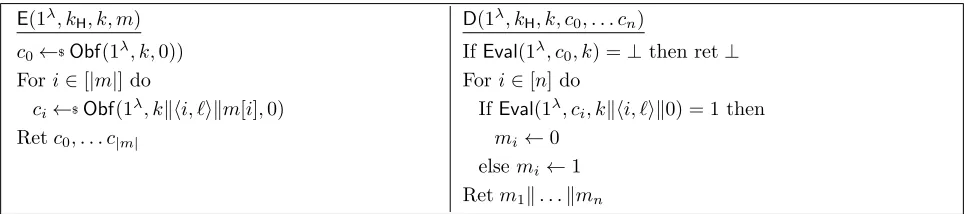
Figure 6: The HtOMLEWC scheme, with a CR hash HFand a point obfuscation scheme OS. Here, parameters are generated via P(1λ) which runsKh(1λ) and returns the output, while message-derived
keys are generated by letting K(1λ, kH, m) return k←H(1λ, kH, m).
Theorem 4.1. If MLEWC is a correct MLEWC scheme then FCHECK[MLEWC,FHE]is Rec-secure.
Proof sketch. Observe that that whenever a client puts m, and a match is found in Put[2,1], the client asks for the p, cpair corresponding to the index with the match, and checks by itself that this pair is a valid ciphertext form. This, combined with the immutability offiland ownleads to perfect recovery correctness.
Theorem 4.2. If MLEWC is WPRIV-secure and FHEis CPA-secure, then FCHECK[MLEWC,FHE] is PDPriv-secure.
Proof sketch. We replace thec2 components with encryptions of random strings, and use the CPA
security of FHE to justify this. Now, only the p,c pairs of the plaintexts reside on the server, and hence we can hope to show that if there exists an adversary A that can guess the challenge bit from only the p,cvalues, then such an Acan be used to build another adversary Bwhich breaksWPRIV
security of MLEWC.
But this cannot be accomplished right away. WhenA asks the game to run Putwith some mb[i], thenBcannot simulatePut[2,1] which looks throughp,cfor a match formb[i] without knowingmb[i]. The proof first gets rid of the search step inPut[2,1] and then buildsB. We argue that the search step can be avoided. The adversary A, with no knowledge of the messages that the unpredictable source S produced, would have been able to use Msg to put a ciphertext for a mb[i] only with negligible
probability.
Constructing MLEWC schemes. To get an iMLE scheme viaFCHECK, we still need to construct
a MLEWC scheme. The lack of comparison means that MLEWC schemes should be easier to construct compared to MLE schemes, but constructions must still overcome two technical challenges: encrypting messages with keys derived from the messages themselves, and dealing with correlated messages. We explore two approaches to overcoming these two challenges. The first utilizes a special kind of point-function obfuscation scheme, and the second uses a UCE-secure [10] hash function. This construction, which we relegate to Appendix F, is straightforward. We start with a hash function family, HF = (Kh,H). Parameter generation picks a hash key kH. Given m, the key is generated as k←H(1λ, kH, m,1λ), and ciphertext asc←H(1λ, kH, k,1|m|)⊕m. Decryption, on input k, c removes
the mask to recover m.
We now elaborate on the first approach, which builds a MLEWC scheme from a composable distri-butional indistinguishable point-function obfuscation scheme (CDIPFO) [16]. To give a high level idea for why CDIPFOs are useful, we note that point-function obfuscation is connected to encryption secure when keys and messages are related [24]. Moreover, CDIPFOs, due to their composability, remain secure even when obfuscations of several correlated points are provided and thus enable overcoming the two challenges described above.
function obfuscator OS = (Obf,Eval) is a pair of algorithms. Obfuscation takes (α, β) and outputs F←$Obf(1λ,(α, β)), while Eval takes F, and a point γ and returns y←$Eval(1λ,F, γ). Correctness requires thatEval(1λ,Obf(1λ, α, β), α) =β for allα, β ∈ {0,1}∗, for allλ∈
N.
A PF source S outputs a tuple of point pairs p, along with auxiliary information z. There exist
m :N→N and ` :N×N→ Nsuch that |p|=m(λ), and |p[i,0]|=`(λ,0) and |p[i,1]|=`(λ,1) for all i∈ [m(λ)]. Guessing probability GPS(λ) is defined as maxi(GP(p[i,0]|z)) when (p, z)←$S(1λ). We say that S is unpredictable ifGPS(·) is negligible.
Distributional indistinguishability for point function obfuscators is captured by the CDIPFO
game (Figure 17) associated with OS, an PF source S, and an adversary A. At a high level, the game either provides OS-obfuscations of point functions from S, or from a uniform distribution, and to win, the adversary A should guess which the case is. We associate advantage AdvcdipfoOS,S,A(λ) = 2 Pr[CDIPFOAOS,S(1λ)]−1 with OS,S and A and say that OS is CDIPFO-secure if advantage is
negligible for all PT Afor all unpredictable PT S. Bitansky and Canetti show that CDIPFOs can be built in the standard model, from the t-Strong Vector Decision Diffie Hellman assumption [16].
Let HF = (Kh,H) denote a family of CR hash functions. The Hash-then-Obfuscate transform
HtO[HF,OS] = (P,E,K,D) associates an MLEWC scheme with HF and OSas in Figure 6, restricting the message space to `-bit strings. At a high level, a key is generated by hashing the plaintext m
with HF, and m is obfuscated bit-by-bit, with the hash as the special input. Decryption, given the hash, can recover m from the obfuscations. Correctness follows from the correctness of OS, and the following theorem shows WPRIV-security.
Theorem 4.3. If HFis CR-secure, andOSisCDIPFO-secure, thenHtO[HF,OS]isWPRIV-secure.
The proof of the theorem and some remarks on HtOare provided in Appendix F.
5
Incremental updates
In this section, we define iMLE with incremental updates, and provide a construction which achieves this goal. Building MLE schemes which can support incremental updates turns out to be challenging. On the one hand, it is easy to show that deterministic MLE schemes cannot support incremental updates. We elaborate on this in Appendix B. . On the other hand, randomized MLE schemes seem to need complex machinery such as NIZK proofs of consistency [1] to support incremental updates while retaining the same level of security as deterministic schemes, which makes them unfit for practical usage. We show how interaction can be exploited to achieve incremental updates in a practical manner, by building an efficient ROM iMLE schemeIRCEthat supports incremental updates. We fix Hamming distance as the metric. In Appendix C, we define incremental updates w.r.t edit distance, and extend IRCE to work in this setting.
An interactive message-locked encryption schemeiMLEwith updates supports an additional proto-colUpdalong with the usual three protocolsReg,Put, andGet. TheUpdprotocol updates a ciphertext of a filem1 stored on the server to a ciphertext of an updated filem2. Here,Upd[1] (i.e. the client-side algorithm) takes inputsf,σC, and two plaintextsm1, m2, and outputs a new identifier f2 ∈ {0,1}∗.
Now, theRecgame (Figure 3) which asks for correct recovery of files also imposes conditions on
update, namely that if a legitimate client puts a file on the server, it should be able to get the file later along with updates made to the file. This is captured by letting the adversary pick Upd as the protocol in theInit procedure. TheWinCheck procedure, which checks if the adversary has won, is
now invoked at successful runs ofUpdadditionally. It infers the value off used in the update protocol as well as the updated plaintext m2 and sets T[f]←m2, thus letting the adversary to win if a get at
f does not return m2.
Init(1λ)
p←${0,1}κ(λ);U← ∅;fil← ∅;own← ∅
RetσS = (p,U,fil,own)
Reg[1]() Reg[2](σS)
k←${0,1}κ(λ)
−−−−→ u←${0,1}λ\U
U←U∪ {u}
u, p
←−−−−
Ret (k, u, p)
Get[1]((k, u, p), t) Get[2](σS)
u, t
−−−−−−→ (c1, c2)←fil[t]
c3←own[u, t]
Ifc3=⊥then
(c01, c02)←(⊥,⊥) c1, c2, c3
←−−−−−−
Ifc1=⊥then ret⊥
k2←D(1λ, k, c3)
RetD(1λ, k
2⊕c2, c1)
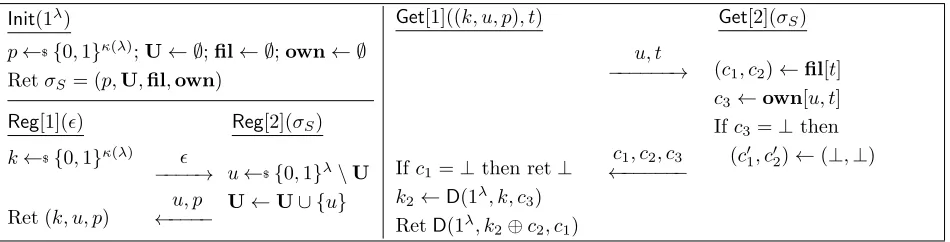
Figure 7: TheInitalgorithm, and Reg and Getprotocols of the IRCE iMLE scheme.
and log|m2|. More formally, there exists a linear function u:N×N→N such that for all client pa-rametersσC, for all server-side statesσS ∈ {0,1}∗, for all plaintextsm1, m2 ∈ {0,1}∗such that|m1|=
|m2|, for all coins r1, r2, for all f ∈ {0,1}∗, if (m1, σS0 ) ← Run(Get,(σC, f), σS;r1), and (f0, σS00) ← Run(Upd,(σC, m1, m2), σS;r2), and f0 6= ⊥, then
|Msgs(Upd,(σC, m1, m2), σS;r2)| ≤HAMM(m1, m2)u(log|m1|, λ).
Preliminaries. A deterministic symmetric encryption (D-SE) scheme SE= (E,D) is a pair of
algo-rithms, where encryption returnsc←E(1λ, k, m) on input plaintextm∈ {0,1}∗and keyk∈ {0,1}κ(λ), and decryption returns m← D(1λ, k, c). Correctness requires D(1λ, k,E(1λ, k, m)) = m for all plain-textsm∈ {0,1}∗for all keysk∈ {0,1}κ(λ)for allλ∈
N. We say thatSEsupports incremental updates w.r.t Hamming distance if there exists an algorithm U such that U(1λ,E(1λ, k, m1),diff(m1, m2)) = E(1λ, k, m2) for all plaintextsm1, m2 ∈ {0,1}∗ for all keysk∈ {0,1}κ(λ) for all λ∈N.
Key-recovery security is defined through game KRASE(1λ) which lets adversary A query an oracle Encwith a plaintextm then picks k←${0,1}κ(λ) and returnsE(1λ, k, m); Awins if it can guess k.
The CPA security game CPAASE(1λ), picksb←${0,1} and k←$κ(λ), runs A with access toEnc,
and responds to queries m by returning c←E(k, m) ifb= 1 and returning a random |c|-bit string if
b = 0. To win, the adversary should guessb. We define advantages AdvkrSE,A(λ) = Pr[KRASE(1λ)] and
AdvcpaSE,A(λ) = 2·Pr[CPAASE(1λ)]−1 and say that SE is KR-secure (resp. CPA-secure) if AdvkrSE,A(·)
(resp. AdvcpaSE,A(·)) is negligible for all PT A. The CTR mode of operation over a blockcipher, with a fixed IV is an example of a D-SE scheme with incremental updates, and KR and CPA security.
A hash function Hwith κ(λ)-bit keys is a PT algorithm that takes p∈ {0,1}κ(λ) and a plaintext
m returns hash h ← H(p, m). Collision resistance is defined through game CRAH(1λ), which picks
p←${0,1}κ(λ), runs adversary A(1λ, p) to get m0, m1, and returns True if m0 6=m1 and H(p, m1) = H(p, m2). We say thatHis collision resistant if AdvcrH,A(λ) = Pr[CRAH(1λ)] is negligible for all PT A.
A table T is immutable if each entry T[t] can be assigned only one value after initialization. Immutable tables supports the Set-iff-empty, or SiffE operation, which takes inputs a table T, an indexf, and a value m. IfT[f] =⊥thenT[f]←m and m is returned; otherwiseT[f] is returned.
The IRCE scheme. Let H denote a hash function with κ(λ)-bit keys and κ(λ)-bit outputs, and
let SE = (E,D) denote a D-SE scheme with κ(λ)-bit keys, where ciphertexts have same lengths as plaintexts and incremental updates are supported through an algorithm U. The IMLE scheme IRCE[SE,H] is described in figures 7 and 8. We call the construction IRCE, expanding to interactive randomized convergent encryption. since it resembles the randomized convergent encryption (RCE) scheme of [11].
To describe how IRCE works, let us consider a IMLE scheme built around RCE. In RCE, to put
m on the server, the client encrypts m with a random key ` to get c1, and then encrypts ` with
as `is picked at random. However, when this client sends t, c01, c02, the server knows that fil[t] is not empty, meaning a duplicate exists, and hence will drop c01, c02, thereby achieving deduplication. The second client should be able to recoverm by sendingtto the server, receivingc1, c2, recovering`from
c2 and decrypting c1. However, the problem with RCE is that, when the first client sends t, c1, c2, the server has no way of checking whether c1, c2 is a proper ciphertext of m, or a corrupted one. Thus, the second client, in spite of storing a ciphertext of m on the server might not be able to recover m
— this violates our soundness requirement. We will now fix this issue with interaction.
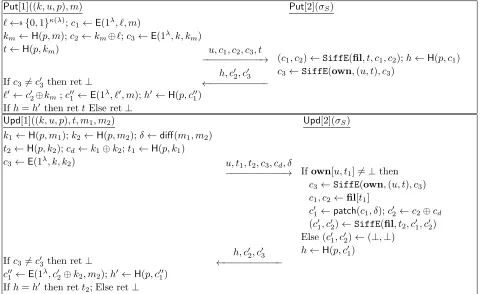
ThePutprotocol inIRCEdiffers in that, if the server finds thatfil[t]6=⊥then it responds withh, c02, where (c01, c02) ← fil[t] and h ← H(p, c01). Now, the client can check that H(p,E(1λ, c0
2⊕km, m)) = h which means that whenever deduplication happens, the client can check the validity of the duplicate ciphertext, which in turn guarantees soundness. ThePutprotocol is specified in Figure 8, and is a bit more involved than our sketch here. Specifically, the clients are assigned unique identifiers which are provided during Put. The message-derived keykm is also encrypted to get c3 (under per-client keys) and stored on the server, in a separate table own, which enables checking that a client starting a get protocol with an identifier did put the file earlier. If the client is the first to put a ciphertext with tag
t, then the server still returns H(p, c1), c2, c3 so that external adversaries cannot learn if deduplication occurred. We note that in Figure 8, thefilandowntables are immutable, and this will help in arguing soundness of the scheme.
TheInitalgorithm (Figure 7) sets up thefilandown tables, and additional server-side state, and picks a key p forH, which becomes the public-parameter of the system. The Reg protocol (Figure 8) sets up a new client by creating a unique client identifier u, and providing the client p. The client also picks a secret keyk without the involvement of the server. The Getprotocol (Figure 8) recovers a plaintext from the identifier, which in the case ofIRCE is the tag.
IRCE supports incremental updates, as described in Figure 8. If the client wants to update m to
m2, it does not have to resend all ofc1, c2, c3. Instead, it can use the same key ` and incrementally updatec1, and compute new values forc2 and c3, along with the new tag t2. If the server finds that fil[t2] is not empty, the same check as in Putis performed.
Propositions C.1 and C.2 of Appendix C show that IRCE performs deduplication, and supports incremental updates, and their proofs proceed in a straightforward manner. The following theorem, with proof in Appendix C shows thatIRCEisRec-secure (which, along with deduplication, establishes
soundness).
Theorem 5.1. If H is collision resistant andSEis a correct D-SE scheme, then IRCE[H,SE]isRec -secure.
Proof sketch. To win theRecgame, the adversary Amust put a plaintext mon the server, possibly
update it to somem0, complete aGetinstance with the identifier formorm0 and show that the result is incorrect.
The proof uses the immutability of fil and own to argue that the ciphertext stored in the server could not have changed between the failed Get instance and the last time the plaintext was put/updated. However, PutandUpdboth ensure that the hash of the ciphertext stored on the server matches with the hash of a correctly formed ciphertext for the plaintext being put/updated. Conse-quently, whenever Abreaks Rec-security, it is in effect finding a pair of colliding inputs, namely the
hash inputs involved in the comparison. A CR adversaryBcan be built which has the same advantage as theRec-advantage of A.
The following theorem (with proof in Appendix C) shows thatIRCE is Priv-secure in the ROM,
assuming that SE is secure. Let IRCERO denote the ROM analogue of IRCE, formed by modelling H
as a random oracle.
Theorem 5.2. If SE isCPA-secure and KR-secure, thenIRCERO[SE] isPriv-secure.
Put[1]((k, u, p), m) Put[2](σS)
`←${0,1}κ(λ);c1←E(1λ, `, m)
km←H(p, m);c2←km⊕`;c3←E(1λ, k, km)
t←H(p, km) u, c1, c2, c3, t
−−−−−−−−−−−→ (c1, c2)←SiffE(fil, t, c1, c2);h←H(p, c1)
c3←SiffE(own,(u, t), c3) h, c02, c03
←−−−−−−−−−−−
Ifc36=c03then ret⊥
`0←c02⊕km;c001 ←E(1λ, `0, m);h0 ←H(p, c001)
Ifh=h0 then rettElse ret⊥
Upd[1]((k, u, p), t, m1, m2) Upd[2](σS)
k1←H(p, m1);k2←H(p, m2);δ←diff(m1, m2) t2←H(p, k2);cd←k1⊕k2;t1←H(p, k1)
c3←E(1λ, k, k2) u, t1, t2, c3, cd, δ
−−−−−−−−−−−→ Ifown[u, t1]6=⊥then
c3←SiffE(own,(u, t), c3) c1, c2←fil[t1]
c01←patch(c1, δ);c02←c2⊕cd
(c0
1, c02)←SiffE(fil, t2, c01, c02)
Else (c01, c02)←(⊥,⊥) h←H(p, c01)
h, c02, c03
←−−−−−−−−−−−
Ifc36=c03then ret⊥
c001 ←E(1λ, c02⊕k2, m2);h0 ←H(p, c001)
Ifh=h0 then rett
2; Else ret⊥
Figure 8: ThePutandUpdprotocols of theIRCEiMLE scheme. Thefilandowntables are immutable, and support the set-iff-empty operation (SiffE) explained in text.
put and update components of mb, and finally gets to learn the server-side state. To win, A should guess b.
6
References
[1] M. Abadi, D. Boneh, I. Mironov, A. Raghunathan, and G. Segev. Message-locked encryption for lock-dependent messages. In R. Canetti and J. A. Garay, editors, CRYPTO 2013, Part I, volume 8042 of
LNCS, pages 374–391. Springer, Aug. 2013. (Cited on page 3, 4, 5, 6, 9, 13.)
[2] A. Adya, W. Bolosky, M. Castro, G. Cermak, R. Chaiken, J. Douceur, J. Howell, J. Lorch, M. Theimer, and R. Wattenhofer. Farsite: Federated, available, and reliable storage for an incompletely trusted environment.
ACM SIGOPS Operating Systems Review, 36(SI):1–14, 2002. (Cited on page 3, 4.)
[3] Amazon. S3. http://aws.amazon.com/s3/pricing/. (Cited on page 4.)
[4] P. Anderson and L. Zhang. Fast and secure laptop backups with encrypted de-duplication. InProc. of
USENIX LISA, 2010. (Cited on page 3, 4.)
[5] C. Batten, K. Barr, A. Saraf, and S. Trepetin. pStore: A secure peer-to-peer backup system. Unpublished
report, MIT Laboratory for Computer Science, 2001. (Cited on page 3, 4.)
[6] M. Bellare, A. Boldyreva, and A. O’Neill. Deterministic and efficiently searchable encryption. In A. Menezes, editor,CRYPTO 2007, volume 4622 ofLNCS, pages 535–552. Springer, Aug. 2007. (Cited on page 3.)
[7] M. Bellare, R. Canetti, and H. Krawczyk. A modular approach to the design and analysis of authentication and key exchange protocols (extended abstract). In30th ACM STOC, pages 419–428. ACM Press, May 1998. (Cited on page 7.)
[8] M. Bellare, O. Goldreich, and S. Goldwasser. Incremental cryptography: The case of hashing and signing. In Y. Desmedt, editor,CRYPTO’94, volume 839 ofLNCS, pages 216–233. Springer, Aug. 1994. (Cited on page 4, 13.)
[9] M. Bellare, O. Goldreich, and S. Goldwasser. Incremental cryptography and application to virus protection.
In27th ACM STOC, pages 45–56. ACM Press, May / June 1995. (Cited on page 4, 13.)
[10] M. Bellare, V. T. Hoang, and S. Keelveedhi. Instantiating random oracles via uces. Cryptology ePrint Archive, Report 2013/424, 2013. Preliminary version in Crypto 2013. (Cited on page 3, 4, 5, 10, 12, 34.)
[11] M. Bellare, S. Keelveedhi, and T. Ristenpart. Message-locked encryption and secure deduplication. In T. Johansson and P. Q. Nguyen, editors, EUROCRYPT 2013, volume 7881 of LNCS, pages 296–312. Springer, May 2013. (Cited on page 3, 4, 5, 6, 8, 14, 20.)
[12] M. Bellare and T. Kohno. A theoretical treatment of related-key attacks: RKA-PRPs, RKA-PRFs, and applications. In E. Biham, editor, EUROCRYPT 2003, volume 2656 of LNCS, pages 491–506. Springer, May 2003. (Cited on page 10.)
[13] M. Bellare and D. Micciancio. A new paradigm for collision-free hashing: Incrementality at reduced cost. In W. Fumy, editor,EUROCRYPT’97, volume 1233 ofLNCS, pages 163–192. Springer, May 1997. (Cited on page 4, 13.)
[14] M. Bellare and P. Rogaway. Entity authentication and key distribution. In D. R. Stinson, editor,
CRYPTO’93, volume 773 ofLNCS, pages 232–249. Springer, Aug. 1993. (Cited on page 7.)
[15] M. Bellare and P. Rogaway. The security of triple encryption and a framework for code-based game-playing proofs. In S. Vaudenay, editor, EUROCRYPT 2006, volume 4004 of LNCS, pages 409–426. Springer, May / June 2006. (Cited on page 6, 31.)
[16] N. Bitansky and R. Canetti. On strong simulation and composable point obfuscation. In T. Rabin, editor,
CRYPTO 2010, volume 6223 ofLNCS, pages 520–537. Springer, Aug. 2010. (Cited on page 5, 10, 12, 13,
33.)
[17] Bitcasa. Bitcasa inifinite storage. http://blog.bitcasa.com/tag/patented-de-duplication/. (Cited on page 3, 4.)
[19] Z. Brakerski and V. Vaikuntanathan. Efficient fully homomorphic encryption from (standard) LWE. In R. Ostrovsky, editor, 52nd FOCS, pages 97–106. IEEE Computer Society Press, Oct. 2011. (Cited on page 5, 10.)
[20] Z. Brakerski and V. Vaikuntanathan. Fully homomorphic encryption from ring-LWE and security for key dependent messages. In P. Rogaway, editor, CRYPTO 2011, volume 6841 ofLNCS, pages 505–524. Springer, Aug. 2011. (Cited on page 5, 10.)
[21] E. Buonanno, J. Katz, and M. Yung. Incremental unforgeable encryption. In M. Matsui, editor,FSE 2001, volume 2355 ofLNCS, pages 109–124. Springer, Apr. 2001. (Cited on page 4.)
[22] R. Canetti. Universally composable security: A new paradigm for cryptographic protocols. In42nd FOCS, pages 136–145. IEEE Computer Society Press, Oct. 2001. (Cited on page 7.)
[23] R. Canetti and R. R. Dakdouk. Obfuscating point functions with multibit output. In N. P. Smart, editor,
EUROCRYPT 2008, volume 4965 ofLNCS, pages 489–508. Springer, Apr. 2008. (Cited on page 10.)
[24] R. Canetti, Y. T. Kalai, M. Varia, and D. Wichs. On symmetric encryption and point obfuscation. In D. Micciancio, editor, TCC 2010, volume 5978 of LNCS, pages 52–71. Springer, Feb. 2010. (Cited on page 10, 12.)
[25] Ciphertite. Ciphertite data backup. https://www.cyphertite.com/faq.php. (Cited on page 3, 4.)
[26] J. Cooley, C. Taylor, and A. Peacock. ABS: the apportioned backup system.MIT Laboratory for Computer
Science, 2004. (Cited on page 3, 4.)
[27] J.-S. Coron, A. Mandal, D. Naccache, and M. Tibouchi. Fully homomorphic encryption over the integers with shorter public keys. In P. Rogaway, editor,CRYPTO 2011, volume 6841 of LNCS, pages 487–504. Springer, Aug. 2011. (Cited on page 5, 10.)
[28] L. P. Cox, C. D. Murray, and B. D. Noble. Pastiche: making backup cheap and easy. SIGOPS Oper. Syst. Rev., 36:285–298, Dec. 2002. (Cited on page 3, 4.)
[29] Y. Dodis, T. Ristenpart, and S. P. Vadhan. Randomness condensers for efficiently samplable, seed-dependent sources. In R. Cramer, editor, TCC 2012, volume 7194 of LNCS, pages 618–635. Springer, Mar. 2012. (Cited on page 33.)
[30] J. Douceur, A. Adya, W. Bolosky, D. Simon, and M. Theimer. Reclaiming space from duplicate files in a serverless distributed file system. InDistributed Computing Systems, 2002. Proceedings. 22nd International
Conference on, pages 617–624. IEEE, 2002. (Cited on page 3.)
[31] Dropbox. Deduplication in Dropbox. https://forums.dropbox.com/topic.php?id=36365. (Cited on page 3.)
[32] T. Duong and J. Rizzo. Here come the ninjas. Unpublished manuscript, 2011. (Cited on page 4.)
[33] M. Dutch. Understanding data deduplication ratios. In SNIA Data Management Forum, 2008. (Cited on page 7.)
[34] M. Fischlin. Incremental cryptography and memory checkers. In W. Fumy, editor, EUROCRYPT’97, volume 1233 ofLNCS, pages 293–408. Springer, May 1997. (Cited on page 4.)
[35] Flud. The Flud backup system. http://flud.org/wiki/Architecture. (Cited on page 3, 4.)
[36] C. Gentry. Fully homomorphic encryption using ideal lattices. In M. Mitzenmacher, editor, 41st ACM STOC, pages 169–178. ACM Press, May / June 2009. (Cited on page 5, 10, 11.)
[37] C. Gentry and S. Halevi. Implementing Gentry’s fully-homomorphic encryption scheme. In K. G. Paterson, editor,EUROCRYPT 2011, volume 6632 ofLNCS, pages 129–148. Springer, May 2011. (Cited on page 10.)
[38] C. Gentry, S. Halevi, and N. P. Smart. Fully homomorphic encryption with polylog overhead. In D. Pointcheval and T. Johansson, editors, EUROCRYPT 2012, volume 7237 of LNCS, pages 465–482. Springer, Apr. 2012. (Cited on page 5, 10.)
[40] Google. Blob store. https://developers.google.com/appengine/docs/pricing. (Cited on page 4.)
[41] Google. Google Drive. http://drive.google.com. (Cited on page 3.)
[42] V. Goyal, A. O’Neill, and V. Rao. Correlated-input secure hash functions. In Y. Ishai, editor, TCC 2011, volume 6597 ofLNCS, pages 182–200. Springer, Mar. 2011. (Cited on page 10.)
[43] S. Halevi, D. Harnik, B. Pinkas, and A. Shulman-Peleg. Proofs of ownership in remote storage systems. In
Proceedings of the 18th ACM conference on Computer and communications security, pages 491–500. ACM,
2011. (Cited on page 7.)
[44] D. Harnik, B. Pinkas, and A. Shulman-Peleg. Side channels in cloud services: Deduplication in cloud storage. Security & Privacy, IEEE, 8(6):40–47, 2010. (Cited on page 7.)
[45] J. Katz and V. Vaikuntanathan. Round-optimal password-based authenticated key exchange. In Y. Ishai, editor,TCC 2011, volume 6597 ofLNCS, pages 293–310. Springer, Mar. 2011. (Cited on page 7.)
[46] M. Killijian, L. Court`es, D. Powell, et al. A survey of cooperative backup mechanisms, 2006. (Cited on page 3, 4.)
[47] L. Marques and C. Costa. Secure deduplication on mobile devices. InProceedings of the 2011 Workshop
on Open Source and Design of Communication, pages 19–26. ACM, 2011. (Cited on page 3, 4.)
[48] D. Meister and A. Brinkmann. Multi-level comparison of data deduplication in a backup scenario. In
Proceedings of SYSTOR 2009: The Israeli Experimental Systems Conference, page 8. ACM, 2009. (Cited
on page 7.)
[49] Microsoft. Windows Azure. http://www.windowsazure.com/en-us/pricing/details/storage/. (Cited on page 4.)
[50] I. Mironov, O. Pandey, O. Reingold, and G. Segev. Incremental deterministic public-key encryption. In D. Pointcheval and T. Johansson, editors, EUROCRYPT 2012, volume 7237 of LNCS, pages 628–644. Springer, Apr. 2012. (Cited on page 4, 13, 21.)
[51] NetApp. NetApp.http://www.netapp.com/us/products/platform-os/dedupe.aspx. (Cited on page 3.)
[52] A. Rahumed, H. Chen, Y. Tang, P. Lee, and J. Lui. A secure cloud backup system with assured deletion and version control. InParallel Processing Workshops (ICPPW), 2011 40th International Conference on, pages 160–167. IEEE, 2011. (Cited on page 3, 4.)
[53] T. Ristenpart, H. Shacham, and T. Shrimpton. Careful with composition: Limitations of the indifferentia-bility framework. In K. G. Paterson, editor, EUROCRYPT 2011, volume 6632 of LNCS, pages 487–506. Springer, May 2011. (Cited on page 6.)
[54] M. Storer, K. Greenan, D. Long, and E. Miller. Secure data deduplication. InProceedings of the 4th ACM
international workshop on Storage security and survivability, pages 1–10. ACM, 2008. (Cited on page 3,
4.)
Run(1λ,P,inp)
T ← ∅;n←1;M←
Fori= 1 to ndoa[i,1]←inp[i];rd[i]←1 WhileT 6= [n] do
Ifn∈T then return⊥
i←rd[n]
(a[n, i+ 1],M,N,T)←$P[n, i](1λ,a[n, i],M)
IfT=True thenT ←T∪ {n}
rd[n]←rd[n] + 1;n←N
Fori= 1 to ndooutp[i]←last(a[i]) Retoutp
Msgs(1λ,P,a, r)
T ← ∅;n←1;M←;j ←1
Fori= 1 tondoa[i,1]←inp[i];rd[i]←1 WhileT 6= [n] do
Ifn∈T then return⊥
i←rd[n]
(a[n, i+ 1],M,N,T)←$P[n, i](1λ,a[n, i],M;r[n, i])
IfT=TruethenT ←T∪ {n}
rd[n]←rd[n] + 1;n←N;M[j]←M;j←j+ 1
RetM
Figure 9: Left: Running a protocolP. Right: TheMsgs procedure returns the messages exchanged during the protocol when invoked with specified inputs and coins.
A
Interactive protocols
Consider a protocol P with n-players, where each player is invoked for a maximum of q-times. We represent such a protocol as an×q-tuple (P[i, j])i∈[n],j∈[q]of algorithms. The algorithmP[i, j] represents the action of the i-th player, when invoked for the j-th time. Each algorithm is invoked with the security parameter 1λ, an input a, and a message M∈ {0,1}∗, and returns a 4-tuple consisting of an output a0, an outgoing message M0 ∈ {0,1}∗, the index
N ∈ N of the next algorithm to run, and a boolean Tto indicate termination. When all algorithms of a protocol have terminated, the protocol is said to have terminated. We denote the n-players of the protocol by P[1], . . . ,P[n]. The execution of a protocol P is captured by the Run algorithm, which takes inputs inpand returns outp, both tuples of n-elements, is described in Figure 9. We say that P is run oninp, or thatP[i] is invoked withinp[i] for i∈ [n] to mean that the input to P[i,1] is set toinp[i] for i∈[n]. We say that P returns outp or thatP[i] gets outputoutp[i] fori∈[n] to mean thatRun(1λ,P,inp) returnsoutp. TheMsgsprocedure of Figure 9 returns the protocol messages when invoked with specified inputs and coins.
B
Deterministic MLE schemes cannot support incremental updates
An updatable MLE scheme MLE = (Pg,K,E,D,T,U1,U2) is a seven-tuple of PT algorithms. The first five algorithms work as in regular MLE schemes. The two update algorithms U1 and U2 work as follows. On input parameters p and two messages m1, m2 where m2 is the newer version of m1, theU1 algorithm outputs a stringcu∈ {0,1}∗. On input parametersp, update stringcu, and original ciphertext c, the U2 algorithm produces updated ciphertext c0. We say that MLE is deterministic if K,E,U1 and U2 are deterministic.
We say that MLE is incremental if there exist functions a:N → N and b: N→ N such that for for all p ∈ [P(1λ)], for all m1, m2 ∈ {0,1}∗, it holds that |cu| ≤ a(λ) log(|m1|+|m2|)δ+b(λ) for all
cu ∈[U1(1λ, p, m1, m2)], whereδ =HAMM(m1, m2).
We now show that if a deterministic MLE scheme supports incremental updates, then it cannot even satisfyPRV-CDAsecurity, the weakest among the security notions of [11]. Note that the attacker does not have the ability to update ciphertexts. Informally, the result is achieved using the fact that highly correlated plaintexts will produce similar ciphertexts, while independently chosen plaintexts will produce different-looking ciphertexts, and this can be used to guess the bit in the PRV-CDA
game.
Proof. Consider A = (A1,A2) where A1 picks m1, m3, m4 at random from {0,1}µ(λ) and picks m2 such that dist(m1, m2) = 1. Now, A1 outputs (m1, m2),(m3, m4) as its output tuples. Informally, the two components of m0 are distance 1-apart and hence their ciphertexts should be close. On the other hand the two components of m1 are unlikely to be close, as they are picked independently at random, and A2 uses this difference to infer the bit of the game. Specifically, A2(1λ, p,c) returns 0 if HAMM(c[0],c[1])≤u(1), and 1 otherwise. Clearly, if A2 outputs 0 whenever b= 0 in the game. The probability that the ciphertexts ofm3 andm4 are less than u(1) units apart isis negligible. Moreover, GPA1 = 2
1−µ(λ), making it an unpredictable source. Thus, A is a valid
PRV-CDA adversary with
advantage negligibly away from 1, meaning thatMLE is notPRV-CDAsecure.
We remark that a similar result applies for deterministic PKE schemes, with regards to PRIV
security. Mironov, Pandey, Reingold, and Segev [50] model incremental deterministic PKE schemes, but they restrict to attention to PRIV1 security, which does not consider correlated messages.
C
Incremental updates: Proofs and extensions
Proposition C.1. LetHdenote a deterministic hash function andSE= (E,D)denote a deterministic symmetric encryption scheme. Then IRCE[H,SE]supports deduplication.
Proof. When a client with id u and parameters σC puts a plaintext m on the server, then, in fil, an entry c1, c2, is added at indext =H(p,H(p, m)) where c1 ← E(1λ, `, m), and km ← H(p, m), and
c2 ← km⊕`. Now, if another client with id u0 and parameters σC0 tries to put m, and sends across a c01, c02, t (we need H to be deterministic, to ensure that the same tag is generated both times) to the server, the server detects a duplicate at fil[t] and drops c01, c02. A fresh copy of c3 is still stored at own[u0, t], but the size ofc3 is bounded byκ(λ), and the increase inσSis bounded by|u0|+|t|+|κ(λ)|, which is independent of |m|.
Proposition C.2. LetHdenote a cryptographic hash function andSE= (E,D)denote a deterministic symmetric encryption scheme, which supports incremental updates w.r.t Hamming distance. Then
IRCE[H,SE]also supports incremental updates w.r.t Hamming distance.
Proof. By inspecting the Upd protocol when invoked on plaintexts m1, m2, we can check that the total length of the transmitted messages is λ+ 6κ(λ) +|δ|, whereδ =diff(m1, m2). Lettingκ(λ) =λ, and noting that δ is the list of positions where m1 and m2 differ. Since log|m1| bits are needed to represent one position, the total size ofδcan be bounded byHAMM(m1, m2) log|m1|. The total length of messages is bounded byHAMM(m1, m2)(log|m1|) + 7λ, proving the proposition.
C.1 Proof of Theorem 5.1
Proof. Consider gamesG1andG2of Figure 10. HereG1is essentially theRecgame withIRCE, except
that G1 maintains tables Cv,Cs, and Cr. When the adversary completes a instantiation of Put(m) through calls to Init and Step, the ciphertexts c001, c02, c3 are stored inCv[m]. Note that c001, c02, c3 is always valid encryption of m, and hence we store the tuple in Cv, the set of valid ciphertexts. The tuple (c01, c02, c03), all values returned by the server through Put[2,1] are stored in Cs[m], the table of server ciphertexts. The same steps are also performed during Upd, except that here the index into Cv and Cs is the updated ciphertext. DuringGet[1,2], the c1, c2, c3 tuple returned by the server are added toCr[m], the table of recovered ciphertexts, wherem is the recovered plaintext value.
Main(1λ) //GA
1(1λ),GA2(1λ)
σS←$Init(1λ); (σC, σS)←$Run(Reg, , σS)
AInit,Step,Msg,State(1λ, σ
C); Retwin
Get[1,2](a)
(c1, c2, c3)←M; If c1=⊥then ret⊥;k2←D(1λ, k, c3) m0←D(1λ, k
2⊕c2, c1);Cr[m0]←(c1, c2, c3)
Retm0, ,True
Upd[1,1](a= (t, m1, m2),M)
k1←H(p, m1);k2←H(p, m2);t2←H(p, k2)
δ←diff(m1, m2);c3←E(1λ, k, k2) c0 ←(k
1⊕k2, c3, δ);M←(u, t1, t2, c0)
a←(m1, m2, k1, k2, t1, t2, c1, c2, c3); Ret (a,M,False)
Upd[2,1](σS,M)
(u, t1, t2, cd, c3, δ)←M; (p,U,fil,own)←σS
Ifown[u, t1] =⊥then (c10, c02)←(⊥,⊥)
Else
Iffil[t2] =⊥then
(c1, c2)←fil[t1];c01←patch(c1, δ) c02←c2⊕cd;fil[t2]←(c01, c02)
Else (c01, c02)←fil[t2]
Ifown[t2, u] =⊥thenown[t2, u] =c3
Elsec3←own[t2, u]
h←H(p, c01);M←(c01, h, c02, c3)
Ret (p,U,fil,own),M,True
Upd[1,2](a,M)
(m1, m2, k1, k2, t1, t2, c1, c2, c3)←a; (h, c01, c02, c03)←M
Ifc36=c03 thena← ⊥
Elsec001 ←E(1λ, c0
2⊕k2, m2);h0←H(p, c001)
Ifh=h0 then
Cv[m]←(c100, c02, c3);Cs[m]←(c01, c20, c03);a←t2
Elsea← ⊥; Ret (a, ,True)
Get[2,1](t)
(p,U,fil,own)←σS; (c1, c2)←fil[t];c3←own[t, u]
Ifc3=⊥then (c01, c02)←(⊥,⊥)
M←(c1, c2, c3);σS ←(p,U,fil,own); RetσS,M,True
Put[1,1](m,M)
`←${0,1}κ(λ);c1←E(1λ, `, m);km←H(p, m)
t←H(p, km);c2←km⊕`;c3←E(1λ, k, km)
c←(c1, c2, c3);M←(u, c, t)
a←(m, `, c1, c2, c3, t); Reta,M,False
Put[2,1](σS,M)
(p,U,fil,own)←σS; (u, c, t)←M; (c1, c2, c3)←c
Iffil[t] =⊥thenfil[t] = (c1, c2) Else
(c1, c2)←fil[t] h←H(p, pkc1)
Ifown[t, u] =⊥thenown[t, u] =c3
Elsec3←own[t, u]
M←(h, c2, c3)
σS ←(p,U,fil,own)
RetM, σS,True
Put[1,2](a,M)
(m, `, c1, c2, c3, t)←a; (h, c01, c02, c03)←M `0←c02⊕km ;c001←E(1λ, `0, m)
h0 ←H(p, c001);a← ⊥
Ifh=h0 then
Cv[m]←(c001, c02, c3);Cs[m]←(c01, c02, c03)
a←t
Ret (a, ,True)
WinCheck(j) //G2
IfPS[j] =Putthen
(σC, m)←first(a[j,1]);f ←last(a[j,1])
T[f]←m
IfPS[j] =Updthen
(σC, f, m1, m2)←first(a[j,1]) f ←last(a[j,1])
T[f]←m2
If PS[j] =Getthen
(σC, f)←first(a[j,1]);m0←last(a[j,1])
m←T[f] Ifm06=mthen
IfCr[m0] =Cs[m] =Cv[m] thenwin1←True
Else IfCr[m0]6=Cs[m] then win2 ←True else
win3←True
win←win1∨win2∨win3
Figure 10: Games G1 and G2 of Theorem 5.1. The Init, Step, State and Msg procedures for G1 and G2, and WinCheckfor G1 are the same as Recand hence omitted. Also omitted is the trivial
Get[1,1] procedure, which simply sets its outgoing message to its input f.