ISSN (Print) : 2320 – 3765 ISSN (Online): 2278 – 8875
I
nternational
J
ournal of
A
dvanced
R
esearch in
E
lectrical,
E
lectronics and
I
nstrumentation
E
ngineering
(An ISO 3297: 2007 Certified Organization)
Vol. 4, Issue 4, April 2015
Comparison of Particle Swarm Optimization
with Lambda Iteration Method to Solve the
Economic Load Dispatch Problem
Susheel Kumar Dewangan
1, Achala Jain
2, Dr. A.P. Huddar
3P.G. Scholar [Power System Engineering], Dept. of EEE, SSTC, Bhilai, Chhattisgarh, India1 Senior Assistant Professor, Dept. of EEE, SSTC, Bhilai, Chhattisgarh, India2
Professor, Dept. of EE, BIT-Durg, Chhattisgarh, India3
ABSTRACT: One of the most important tasks in power system is to determine and provide an economic condition for generating unit while satisfying all the constraints, which is known as Economic Load Dispatch (ELD). This paper presents particle swarm optimization technique for solving ELD problem. The proposed method is used to solve economic dispatch problem for three and six generating unit system with and without transmission losses. The result obtained by PSO method is compared with the result of the traditional lambda iteration method. The comparison shows that the PSO is capable of providing a higher quality solution with fast convergence in ELD problem.
KEYWORDS: Economic Load Dispatch (ELD), Particle Swarm Optimization (PSO), Lambda Iteration Method, Transmission Losses.
I. INTRODUCTION
One of the fundamental issues in power system is economic load dispatch (ELD) problems. In a practical power system, the plants are not situated at equal distance from load centre and their fuel costs are not same. In addition under normal running condition, the generating capability is higher than the total demand plus losses. Hence there are several options for scheduling generating units. Due to energy crisis in the world and nonstop increase in prices, it is very important to reduce the cost of electrical energy which is achieved by reducing the fuel consumption for meeting the load demand. Therefore, economic load dispatch is very important in power system. In ELD, the allocation of load between the selected units is done in such a way so as to minimize the overall fuel cost while satisfying equality and inequality constraints [1].
The ELD problem can be solved by conventional methods such as lambda iteration method, gradient search, the base point and participation method [2]. In all these conventional methods, the assumption of monotonically increasing cost function is made. For practical power system characteristics of generating units are nonlinear. Hence conventional methods face difficulties in solving ELD problem for the practical power system. For solving an optimization problem using this methods the selection of suitable starting point is very important. If wrong initial points were selected then the divergence or convergence of the algorithm to some local point may occur [1], [3]. The non-linear ELD problem can be solved by the dynamic programming method. In [4] the ED problem with valve-point modelling has been solved by using dynamic programming. But in DP method dimensionality of ELD problem may become very large, hence enormous computational efforts needed in this method. This problem can be overcome by the application of several evolutionary techniques such as genetic algorithm [4], evolutionary programming [5], tabu search, neural network, and particle swarm optimization [3], [5-10] etc.
ISSN (Print) : 2320 – 3765 ISSN (Online): 2278 – 8875
I
nternational
J
ournal of
A
dvanced
R
esearch in
E
lectrical,
E
lectronics and
I
nstrumentation
E
ngineering
(An ISO 3297: 2007 Certified Organization)
Vol. 4, Issue 4, April 2015
This paper presents PSO technique to solve ELD problem in power system. The proposed method was solved for a three unit and six unit systems and the result obtained by PSO method is compared with the traditional lambda iteration method. The results obtained with PSO are more accurate than the traditional technique and the proposed method converge in less number of iteration than the lambda iteration method.
II. PROBLEM FORMULATION
ELD is an optimization based problem. The main purpose of an ELD problem is to determine the allocation of load between selected units so as to minimize the total generation cost but at the same time satisfying the equality and inequality constraints. Generally the fuel cost curve of the generating unit is a quadratic function of the active power output of generator. In ELD the objective cost function is given by following equation
𝐹 𝑃𝑔𝑖 = 𝐹𝑖(𝑃𝑔𝑖) 𝑁𝑔
𝑖=0 = (𝑎𝑖𝑃𝑔𝑖
2+ 𝑏
𝑖𝑃𝑔𝑖+ 𝑐𝑖) 𝑁𝑔
𝑖=0 (1)
Where,
𝐹 𝑃𝑔𝑖 = Total fuel cost ($/h)
𝐹𝑖 𝑃𝑔𝑖 = Fuel cost of ith generator ($/h)
𝑁𝑔 = Number of generators
𝑃𝑔𝑖 = Active power output of ith generator (MW)
𝑎𝑖, 𝑏𝑖, and 𝑐𝑖 = Fuel cost coefficients of ith generator.
Equation (1) showing the total fuel cost is minimized subject to equality constraint and generator constraints.
Equality constraint:
The cost function of any generator is dependent only on the active power output of that generator. According to equality constraint the total generated power must be always equal to the power demand plus transmission losses.
𝑃𝑔𝑖 𝑁𝑔
𝑖=0 = 𝑃𝑑+ 𝑃𝐿 (2)
Where, 𝑃𝑔𝑖 𝑁𝑔
𝑖=0 = Total real power generation
𝑃𝑑 = Total real power demand
𝑃𝐿 = Power transmission loss
Here, transmission loss can be expressed by loss coefficient method developed by Kron and Kirchmayer. So the transmission loss can be given as follows
𝑃𝐿= 𝑃𝑔𝑖
𝑁𝑔
𝑗 =0 𝐵𝑖𝑗𝑃𝑔𝑗 𝑁𝑔
𝑖=0
(3)
Where,
𝑃𝑔𝑖, 𝑃𝑔𝑗 = Real power generation at the ith and jth buses, respectively
𝐵𝑖𝑗 = 𝐵𝑗𝑖 = Loss coefficients
Generator constraint:
There is an upper and lower limit for each generator. Hence the output power of each generator must be within the limits.
ISSN (Print) : 2320 – 3765 ISSN (Online): 2278 – 8875
I
nternational
J
ournal of
A
dvanced
R
esearch in
E
lectrical,
E
lectronics and
I
nstrumentation
E
ngineering
(An ISO 3297: 2007 Certified Organization)
Vol. 4, Issue 4, April 2015
Where,
𝑃𝑔𝑖𝑚𝑖𝑛 = minimum limit of power generation of ith plant
𝑃𝑔𝑖𝑚𝑎𝑥 = maximum limit of power generation of ith plant
III. PARTICLE SWARM OPTIMIZATION
Particle swarm optimization (PSO) was first introduced by Kennedy and Eberhart in 1995. PSO is population based algorithm and it is inspired by the social behaviour of bird flock and fish schooling [11]. The non-linear optimization problem can be successfully solved by using PSO algorithm. In particle swarm optimization the swarm of particles act as bird flock flies on the search space to find global solution. Each particle on search space communicates and exchanges information with each other. The best position achieved by particle during its flight in search space is called personal best of the particle or Pbest. The best among all Pbest is known as global best or Gbest. Each particle modifies its velocity depending upon its present velocity and its distance from Pbest and Gbest which is given by equation (5).
𝑉𝑖𝑘+1= 𝑤 × 𝑉𝑖𝑘+ 𝑐1× 𝑟1× 𝑃𝑏𝑒𝑠𝑡𝑖𝑘− 𝑋𝑖𝑘 + 𝑐2× 𝑟2× 𝐺𝑏𝑒𝑠𝑡𝑖𝑘− 𝑋𝑖𝑘 (5)
𝑖 = 1,2, … . , 𝑁𝑝 ; 𝑘 = 1,2, … . , 𝑘𝑚𝑎𝑥
Where,
𝑘 = Iteration count 𝑖 = Particle number 𝑤 = Inertia weight factor
𝑐1, 𝑐2= Acceleration coefficients
𝑟1, 𝑟2= Random numbers between 0 and 1
𝑉𝑖𝑘 = Velocity of particle 𝑖 at 𝑘𝑡ℎ iteration
𝑋𝑖𝑘 = Position of particle 𝑖 at 𝑘𝑡ℎ iteration
𝑃𝑏𝑒𝑠𝑡𝑖𝑘= Best position of particle 𝑖 until 𝑘𝑡ℎ iteration
𝐺𝑏𝑒𝑠𝑡𝑖𝑘= Best position of group until 𝑘𝑡ℎ iteration
𝑁𝑝 = Number of particles
𝑘𝑚𝑎𝑥 = Maximum iteration number
Each particle moves from its current position to the next position through velocity in equation (5). So the updated position of particle is given by
𝑋𝑖𝑘+1= 𝑋𝑖𝑘+ 𝑉𝑖𝑘+1 (6)
Figure 1 show that how particles are influenced by its Pbest and Gbest.
ISSN (Print) : 2320 – 3765 ISSN (Online): 2278 – 8875
I
nternational
J
ournal of
A
dvanced
R
esearch in
E
lectrical,
E
lectronics and
I
nstrumentation
E
ngineering
(An ISO 3297: 2007 Certified Organization)
Vol. 4, Issue 4, April 2015
To control particle speed inertia weight factor plays a very important role. Therefore careful selection of this factor is very important. The inertia weight 𝑤 decreases linearly from 0.9 to 0.4 with increase in iteration count. The inertia weight can be given by following equation
𝑤 = 𝑤𝑚𝑎𝑥 −
𝑤𝑚𝑎𝑥−𝑤𝑚𝑖𝑛
𝑖𝑡𝑒𝑟𝑎𝑡𝑖𝑜𝑛𝑚𝑎𝑥 × 𝑖𝑡𝑒𝑟𝑎𝑡𝑖𝑜𝑛𝑘 (7)
Where,
𝑤𝑚𝑎𝑥,𝑤𝑚𝑖𝑛 = Initial and final weight repectively
𝑖𝑡𝑒𝑟𝑎𝑡𝑖𝑜𝑛𝑚𝑎𝑥 = Maximum iteration number
𝑖𝑡𝑒𝑟𝑎𝑡𝑖𝑜𝑛𝑘 = Current iteration number
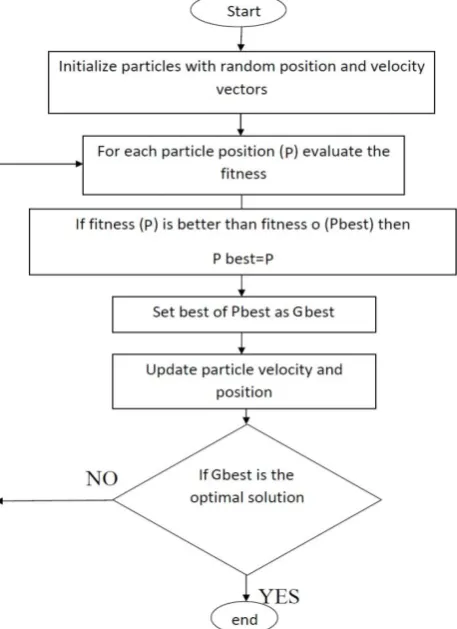
The steps of PSO algorithm are as shown below:
Step 1. Select suitable value of various parameter of PSO.
Step 2. Initialize particles with random velocity and position in the search space. Step 3. Evaluate the fitness of each particle, using its current position.
Step 4. Compare the fitness of each particle with its Pbest. If the present value is better than the Pbest, then set the current value as the Pbest of particle i.
Step 5. Identify the best among Pbest of particles and then set it as a Gbest of the swarm. Step 6. Update the velocity and position of each particle according to the equation (5) and (6). Step 7. Repeat from step 3 to step 6 until convergence.
The above steps can be summarized in the flowchart of figure 2.
ISSN (Print) : 2320 – 3765 ISSN (Online): 2278 – 8875
I
nternational
J
ournal of
A
dvanced
R
esearch in
E
lectrical,
E
lectronics and
I
nstrumentation
E
ngineering
(An ISO 3297: 2007 Certified Organization)
Vol. 4, Issue 4, April 2015
IV. RESULT AND DISCUSSIONS
To verify the feasibility of PSO technique, two different cases were studied. In first case three unit system was considered while in the other case six unit system was considered. In both cases, ELD problem is solved with and without transmission losses. The B-loss coefficient matrix has been used for calculation of transmission loss. In this paper, ELD problem is solved by two methods. One is lambda iteration method and other is particle swarm optimization (PSO). Results obtained from PSO method are compared with the traditional lambda iteration method. All the calculation and programming has been done in MATLAB environment.
The PSO parameters used in this problem are Number of particles = 60
Inertia weight factor 𝑤 calculated by equation (7), where 𝑤𝑚𝑎 𝑥 = 0.9 and 𝑤𝑚𝑖𝑛 = 0.4.
Acceleration constant 𝑐1= 2 and 𝑐2= 2.
Case Study-1: 3-units system
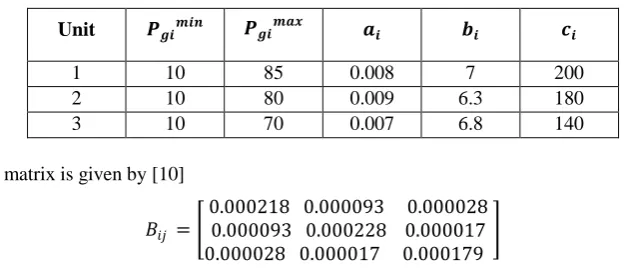
In this case, three unit thermal power plant is considered which is solved for two different cases with and without losses. The cost coefficients and generator power limit are shown by table 1 [10].
Table 1. Generating Unit Capacity And Cost-Coefficients For Three Unit System
Unit 𝑷𝒈𝒊𝒎𝒊𝒏 𝑷𝒈𝒊𝒎𝒂𝒙 𝒂𝒊 𝒃𝒊 𝒄𝒊
1 10 85 0.008 7 200
2 10 80 0.009 6.3 180
3 10 70 0.007 6.8 140
The loss coefficient matrix is given by [10]
𝐵𝑖𝑗 =
0.000218 0.000093 0.000028 0.000093 0.000228 0.000017 0.000028 0.000017 0.000179
Table 2 and Table 3 present the results of ELD problem without transmission loss for 3-unit system using lambda iteration method and PSO method respectively. Both methods are tested for loads of 120 MW and 150MW. Comparison of result shows that solution quality of PSO is better than lambda iteration technique.
Table 2. Results Through Lambda Iteration Method (Without Loss)
S.No.
Load Demand
(MW)
𝑷𝒈𝟏
(MW)
𝑷𝒈𝟐
(MW)
𝑷𝒈𝟑
(MW)
Fuel Cost ($/hr)
1. 120 22.0625 58.5 39.5 1357.2
2. 150 31.9375 67.2778 50.7857 1579.71
Table 3. Results Through PSO Method (Without Loss)
S.No.
Load Demand
(MW)
𝑷𝒈𝟏
(MW)
𝑷𝒈𝟐
(MW)
𝑷𝒈𝟑
(MW)
Fuel Cost ($/hr)
ISSN (Print) : 2320 – 3765 ISSN (Online): 2278 – 8875
I
nternational
J
ournal of
A
dvanced
R
esearch in
E
lectrical,
E
lectronics and
I
nstrumentation
E
ngineering
(An ISO 3297: 2007 Certified Organization)
Vol. 4, Issue 4, April 2015
Table 4 and Table 5 present the results of ELD problem with transmission loss for 3-unit system using lambda iteration method and PSO method respectively. Both methods are tested for loads of 120MW and 150MW. Comparison of result shows that solution quality of PSO is better than lambda iteration technique.
Table 4. Results Through Lambda Iteration Method (With Loss)
S.No.
Load Demand
(MW)
𝑷𝒈𝟏
(MW)
𝑷𝒈𝟐
(MW)
𝑷𝒈𝟑
(MW)
𝑷𝑳
(MW)
Fuel Cost ($/hr)
1. 120 19.6325 59.7948 42.1983 1.5685 1368.81
2. 150 29.4433 68.6345 54.3407 2.38387 1598.02
Table 5. Results Through PSO Method (With Loss)
S.No.
Load Demand
(MW)
𝑷𝒈𝟏
(MW)
𝑷𝒈𝟐
(MW)
𝑷𝒈𝟑
(MW)
𝑷𝑳
(MW)
Fuel Cost ($/hr)
1. 120 25.1615 55.3214 41.0485 1.53137 1368.19
2. 150 35.3084 64.3204 52.7259 2.35464 1597.58
Case Study-2: 6-units system
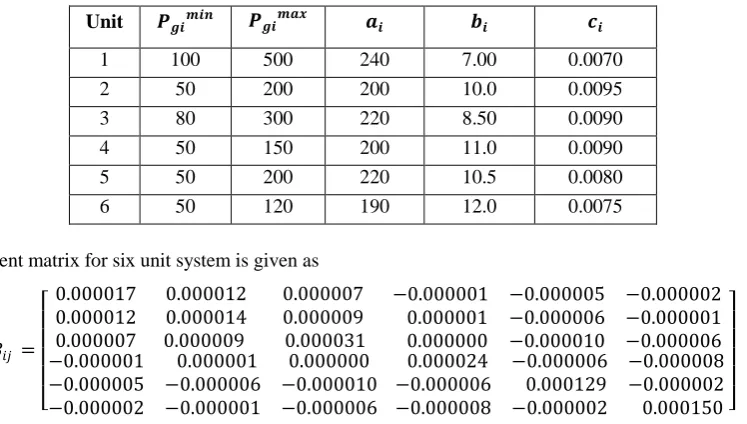
In this case, six unit thermal power plant is considered which is solved for two different cases with and without losses. The cost coefficients and generator power limit are shown by table 6 [10].
Table 6. Generating Unit Capacity And Cost-Coefficients For Six Unit System
Unit 𝑷𝒈𝒊𝒎𝒊𝒏 𝑷𝒈𝒊𝒎𝒂𝒙 𝒂𝒊 𝒃𝒊 𝒄𝒊
1 100 500 240 7.00 0.0070
2 50 200 200 10.0 0.0095
3 80 300 220 8.50 0.0090
4 50 150 200 11.0 0.0090
5 50 200 220 10.5 0.0080
6 50 120 190 12.0 0.0075
The B-coefficient matrix for six unit system is given as
𝐵𝑖𝑗 =
0.000017 0.000012 0.000007
0.000012 0.000014 0.000009
0.000007 0.000009 0.000031
−0.000001 −0.000005 −0.000002
0.000001 −0.000006 −0.000001
0.000000 −0.000010 −0.000006
−0.000001 0.000001 0.000000
−0.000005 −0.000006 −0.000010
−0.000002 −0.000001 −0.000006
0.000024 −0.000006 −0.000008
−0.000006 0.000129 −0.000002
−0.000008 −0.000002 0.000150
ISSN (Print) : 2320 – 3765 ISSN (Online): 2278 – 8875
I
nternational
J
ournal of
A
dvanced
R
esearch in
E
lectrical,
E
lectronics and
I
nstrumentation
E
ngineering
(An ISO 3297: 2007 Certified Organization)
Vol. 4, Issue 4, April 2015
Table 7. Results Through Lambda Iteration Method (Without Loss)
S.No. Load Demand (MW) 𝑷𝒈𝟏 (MW) 𝑷𝒈𝟐 (MW) 𝑷𝒈𝟑 (MW) 𝑷𝒈𝟒 (MW) 𝑷𝒈𝟓 (MW) 𝑷𝒈𝟔 (MW) Fuel Cost ($/hr)
1. 600 271.879 50 128.128 50 50 50 7187.41
2. 1263 446.707 171.258 264.106 125.217 172.119 83.5933 15275.9
Table 8. Results Through PSO Method (Without Loss)
S.No. Load Demand (MW) 𝑷𝒈𝟏 (MW) 𝑷𝒈𝟐 (MW) 𝑷𝒈𝟑 (MW) 𝑷𝒈𝟒 (MW) 𝑷𝒈𝟓 (MW) 𝑷𝒈𝟔 (MW) Fuel Cost ($/hr)
1. 600 271.875 50 128.125 50 50 50 7187.34
2. 1263 446.707 171.258 264.106 125.217 172.119 83.5935 15275.9
Table 9 and Table 10 show results of six unit system with loss by lambda iteration method and PSO method respectively. Comparison of result shows that solution quality of PSO is better than lambda iteration technique.
Table 9. Results of Lambda Iteration Method (With Loss)
S.No. Load
D
emand (MW) 𝑷𝒈𝟏 (MW) 𝑷𝒈𝟐 (MW) 𝑷𝒈𝟑 (MW) 𝑷𝒈𝟒 (MW) 𝑷𝒈𝟓 (MW) 𝑷𝒈𝟔 (MW) 𝑷𝑳 (MW) Fuel Cost ($/hr)1. 600 273.492 50 129.595 50 50 50 2.98958 7220.73
2. 1263 447.122 173.22 263.962 139.093 165.617 86.6583 12.4204 15446.1
Table 10. Results of PSO Method (With Loss)
S.No. Load
D
emand (MW) 𝑷𝒈𝟏 (MW) 𝑷𝒈𝟐 (MW) 𝑷𝒈𝟑 (MW) 𝑷𝒈𝟒 (MW) 𝑷𝒈𝟓 (MW) 𝑷𝒈𝟔 (MW) 𝑷𝑳 (MW) Fuel Cost ($/hr)1. 600 273.135 50 129.853 50 50 50 2.98837 7219.67
2. 1263 452.268 182.651 267.523 136.175 155.992 80.8023 12.4104 15445.2
V. CONCLUSION
In this paper, the economic load dispatch problem is solved by most popular classical technique lambda iteration method and PSO method. Two test units three unit system and six unit system are solved for two different cases. In first case ELD problem has been solved by considering generator constraints without transmission loss and in second case ELD problem has been solved by considering generator constraints with transmission loss. The results obtained by PSO method are nearly equal to the results of lambda iteration technique. The comparison of above results shows that the solution quality of particle swarm optimization (PSO) is much better than the conventional lambda iteration method. Hence the PSO method is more reliable than the lambda iteration method.
REFERENCES
ISSN (Print) : 2320 – 3765 ISSN (Online): 2278 – 8875
I
nternational
J
ournal of
A
dvanced
R
esearch in
E
lectrical,
E
lectronics and
I
nstrumentation
E
ngineering
(An ISO 3297: 2007 Certified Organization)
Vol. 4, Issue 4, April 2015
[3] Rasoul Rahmani, Mohd Fauzi Othman, Rubiyah Yusof, Marzuki Khalid, “Solving Economic Dispatch Problam Using Particle Swarm Optimization By An Evolutionary Technique For Intializing Particles,” Journal of Theoretical and Applied Information Technology, vol. 46, no. 2, pp. 526-536, Dec. 2012.
[4] A. Bakirtzis, V. Petridis, and S. Kazarlis, “Genetic Algorithm Solution to the Economic Dispatch Problem,” Proc. Inst. Elect. Eng.–Gen., Transm. Dist., vol. 141, no. 4, pp. 377–382, July 1994.
[5] Jong-Bae Park, Ki-Song Lee, Joong-Rin Shin, and Kwang Y. Lee, “A Particle Swarm Optimization for Economic Dispatch With Nonsmooth Cost Functions,” vol. 20, no. 1, pp. 34-42, Feb. 2005.
[6] Zwe-Lee Gaing, “Particle Swarm Optimization to Solving the Economic Dispatch Considering the Generator Constraints,” IEEE Trans. On Power Systems, vol.18, no. 3, pp. 1187-1195, Aug. 2003.
[7] M. Sudhakaran, P. Ajay - D - Vimal Raj and T.G. Palanivelu “Application of Particle Swarm Optimization for Economic Load Dispatch Problems” International Conference on Intelligent System Applications to Power Systems, pp. 668-673, 2007.
[8] Hardiansyah, Junaidi, Yohannes MS “Solving Economic Load Dispatch Problem Using Particle Swarm Optimization Technique,” I.J. Intelligent System and Application, pp. 12-18, 2012.
[9] Abolfazl Zaraki, Mohd Fauzi Bin Othman, “Implementing Particle Swarm Optimization to Solve Economic Load Dispatch,” International Conference of Soft Computing and Pattern Recognition, pp. 60-65, 2009.
[10] Revathy K, Nithiyanandham, “Economic Dispatch Using Particle Swarm Optimization,” International Journal of Advanced Research in Electrical, Electronics and Instrumentation Engineering, vol. 3, Special Issue 4, pp. 59-66, May 2014.