Modulation of Functional Properties of
Whey Proteins by Microparticulation
Muditha Dissanayake
B.Sc. (Hon) Chemistry, M.Sc.
School of Biomedical and Health Sciences,
Faculty of Health, Engineering and Science
Victoria University
Submitted in fulfilment of the requirements of the degree of
Doctor of Philosophy
To my beloved parents, Rohan, Sanjitha and
I. Abstract
Heat-induced destabilisation (denaturation) of whey proteins (WP) is one of the major problems limiting their application in food products. As a means of modification, and, thereby improvement of the WP functionality, microparticulation of WP using combined heat and high pressure shearing achieved by microfluidization (MFZ) has been proposed and assessed in this thesis.
Initially, different commercially available whey protein concentrate (WPC) powders were analysed to gain a general understanding of the interrelationship between their chemical composition and functional properties. Proximate analysis, protein type using SDS-PAGE, particle size (HPLC and particle size analysis), heat induced denaturation (DSC) and analysis of selected functional properties confirmed that they have substantial differences in composition and functionality.
protein, w/w) as a foundation for devising a more feasible pathway to produce MWP powders with comparatively reduced particle size. WP dispersions were subjected to a heat treatment at 140°C for kinetic studies, thermal analysis with DSC, rheological studies and heat-induced gelation. The denaturation of β-Lg appeared to follow the first order reaction kinetics. Also, WP were more stable against heat induced denaturation at acidic pH. The heat induced gels formed at low pH possessed weak and brittle characteristics likely resulting from overall positive charge of WP at acidic pH with enhanced inter-molecular repulsive electrostatic interactions and the inhibition or suppression of thiol group activity.
Based on the kinetic studies and the results of fundamental WP interactions using chemical blockers, MWP powders were produced at pH 3, acidified with either citric or lactic acid to create a WP gel network with relatively weaker molecular linkages which would be easily dispersed by mechanical forces used during MFZ. As expected, the particle size of denatured MWP was substantially reduced to an average ~100 nm, producing nano-particles together with micro particles which was a 100 fold reduction compared to the average particle size of MWP produced at neutral pH. In addition, the heat stability of these powders was also substantially increased as revealed by heat coagulation time with > 3 min. These powders also had different physical functionalities from native WP including higher viscosity, improved surface and colloidal properties. Additionally, the effect of high pressure shearing on different functional properties of MWP varied with acidulant selection, depending on their relative thermal stability at low pH. At low pH, combination of heat and high pressure shearing produced WP micro-aggregates with improved colloidal stability which was not achieved by microparticulation of denatured WP at neutral pH, in addition to substantially enhanced heat stability of these powders.
even revealed by reduced turbidity of the samples. Further, turbidity, gel colour, PAGE, surface hydrophobicity and viscosity measurements also indicated that the shear forces may change the direction and extent of heat-induced WP denaturation and aggregation.
II. Declaration
“I, Muditha Dissanayake, declare that the PhD thesis entitled “Modulation of Functional Properties of Whey Proteins by Microparticulation” is no more than 100,000 words in length including quotes and exclusive of tables, figures, appendices, bibliography, references and footnotes. This thesis contains no material that has been submitted previously, in whole or in part, for the award of any other academic degree or diploma. Except where otherwise indicated, this thesis is my own work”.
Signature: Date:
III. Acknowledgements
I wish to express my deep appreciation to my supervisor, Associate Professor Todor Vasiljevic for helping me to maintain focus and direction through out the research. If not for the unspeakable help, guidance, advice and encouragement given to me by him my task would have been much more tedious and difficult. His appreciation of my overall effort and his confidence and determination on the ultimate target contributed immensely for me to go ahead in a positive mind. I am proud and privileged to be supervised by a scholar of his calibre. Thank you very much.
This research was supported by an Australian Post Graduate Research Award granted to me by the Victoria University, Melbourne, Australia. I am thankful to them.
The Warrnambool Cheese and Butter Factory deserves my thank for providing required raw materials needed for the research.
I thank Professor Gwen Jones, Victoria University, Werribee and Professor Allan L. Kelly, School of Food and Nutritional Sciences, University College Cork, Cork, Ireland for their valuable comments.
I would also like to thank Dairy innovation Australia Ltd for partial financial support. I am grateful to Dr. Tim Wooster from Food Science (Melbourne, Australia) for the technical assistance provided at the initial stage of the research.
Dr. Osaana Donko, Dr. Marlen Cran and Dr. Lidia Ong participated in many useful discussions providing helpful advice and technical support on numerous occasions. My sincere thanks to them.
A big ‘thank you’ to my fellow colleagues, Dhanusha Kalinga, Zeinab Ahamed, Kasup Munaweera, Veeranie Ariyadasa, Laxminarayan Prasad, Ria Aprianita, Debashree Lala, Khaled Elfahri, Rabia Ashraf, Archana Kolasani, Drs. Nayana and Ajith Bandara, Rupika Lianaarachchi, Latha Ramchandran, Shruti Harnal, Umi Purwandari, Thuy Pam, Aida Zilic and all others for their support, solidarity and friendship.
The valuable contribution made by Samantha Liyanarachchi, Chathuri Piyadasa, Gaurang Patel, Bhumitang Patel, Rohit Chauhan and Uday Raj Koni in this project is appreciated and gratefully acknowledged. My special thanks to Madhavi Gunaratne for helping me to compile the final format of the thesis.
My beloved parents and two brothers pushed me forward giving me the necessary moral courage to face challenges smilingly. Although we are far apart physically I always felt they are with me. Their sweet memory is an inspiration to me. I am grateful to them for everything they did to help me.
IV. List of Publications and Awards
Refereed publications:
Dissanayake, M., Kelly, A. L., Vasiljevic, T. (2010). Gelling properties of microparticulated whey proteins. Journal of Agriculture and Food Chemistry, 58 (11), 6825-6832.
Dissanayake, M.; Vasiljevic, T. (2009). Functional properties of whey proteins affected by heat treatment and hydrodynamic high pressure shearing. Journal of Dairy Science. 92, 1387-1397.
Dissanayake, M.; Vasiljevic, T. (2009). Composition and functionality of whey protein concentrates available on the Australian market. Australian Journal of Dairy Technology. 64, 164-170.
Conference proceedings:
Dissanayake, M., Vasiljevic, T. (2008). Functional properties of whey proteins affected by heat and high pressure shearing. ADSA Annual Meeting. July 7 – 11, 2008, Indianapolis, Indiana, Journal of Dairy Science Vol. 91, E-Suppl. 1 , 511.
Dissanayake, M., Vasiljevic, T. (2009). Gelling properties of microparticulated whey proteins. Abstract 251-07, IFT Annual Meeting and Food Expo, 06-09 June 2009, Anaheim/OC, CA.
Dissanayake, M. (2009), Gelling properties of microparticulated whey protein concentrates, Post Graduate Research Seminar, Faculty of Health, Engineering and Science, Victoria University.
Dissanayake, M. (2009), Whey Proteins - Variation and Modulation, ISI Activities, Institute of Sustainability and Innovation, Victoria University, Werribee.
Manuscripts in preparation:
Dissanayake, M., Vasiljevic, T. (2010). Kinetics of whey protein denaturation as a function of pH and protein concentration. Journal of Food Science.
Dissanayake, M., Liyanaarachchi, S., Vasiljevic, T. (2010). Functional properties of whey proteins microparticulated at low pH, Journal of Agricultural and Food Chemistry.
Dissanayake, M., Vasiljevic, T. (2010). Effect of simultaneous heating and shearing on conformational changes of whey proteins. Journal of Agricultural and Food Chemistry.
Awards:
Table of Contents
Abstract iii Declaration vi Acknowledgements vii
List of Publications and Awards ix
Table of Contents xi
List of Figures xvii
List of Tables xxv
1 Introduction 27
1.1 Background 27
1.2 Research Objectives 30
1.3 Thesis Outline 31
2 Literature Review 33
2.1 Milk and milk proteins 33
2.2 Whey proteins 36
2.2.1 β-lactoglobulin 36 2.2.2 α-lactalbumin 38
2.2.3 Bovine serum albumin 39
2.2.4 Physiological importance of whey proteins 39 2.2.5 Whey proteins in food systems as a functional ingredient 41
2.3 Commercial whey protein products 41
2.4 Functional behaviour of whey proteins 44 2.4.1 Solubility and protein water interactions 44
2.4.2 Viscosity 46
2.4.3 Foaming and emulsifying 46
2.4.4 Gelation 47
2.5.1 A general description of proteins and their physicochemical
characteristics 53
2.6 Protein denaturation kinetics and environmental effects in whey
protein aggregation 56
2.6.1 Effect of temperature and holding time on the extent of whey
protein aggregation 60
2.6.2 Effect of protein concentration on whey protein aggregation 61 2.6.3 Effect of pH on whey protein aggregation 61 2.6.4 Effect of ionic environment on whey protein aggregation 63 2.6.5 Other factors affecting denaturation and aggregation of whey
proteins 64 2.7 Modification of whey protein functionality 65 2.7.1 Microparticulation of whey proteins 66
2.7.2 Microfluidization 67
2.7.3 Effect of dynamic high pressure shearing on whey proteins 69
2.8 Shearing of whey proteins 70
3 Composition and functionality of commercial whey protein
concentrates available on the Australian market 74
3.1 Introduction 74
3.2 Materials and methods 75
3.2.1 Materials and proximate composition 75 3.2.2 Particle size distribution 76 3.2.3 Sodium dodecyl sulphate polyacrylamide gel electrophoresis
(SDS PAGE) 76
3.2.4 Size exclusion high performance liquid chromatography
(SE-HPLC) 77
3.2.5 Differential scanning calorimetry (DSC) 78 3.2.6 Functional properties of whey proteins: solubility, heat stability,
emulsifying properties and foaming properties 78 3.2.7 Preparation of heat induced WPC gels 83
3.2.8 Firmness of WPC gels 83
3.2.9 Rheological properties 84
3.2.10 Water holding capacity (WHC) of gels 84
3.2.11 Statistical analysis 85
3.3.1 Proximate composition 85
3.3.2 Particle size distribution, SDS PAGE and SE-HPLC analysis 87 3.3.3 Functional properties of WPCs: solubility, emulsifying properties
and foaming behaviour 88
3.3.4Viscosity of WPC dispersion 95
3.3.5 Gelling characteristics 95
3.3.6 Thermal properties of WPCs 100
3.4 Conclusions 102
4Functional properties of whey proteins affected by heat treatment and
hydrodynamic high pressure shearing 104
4.1 Introduction 104
4.2 Materials and methods 108
4.2.1 Materials and proximate composition 108
4.2.2 Treatment of samples 108
4.2.3 Particle size distribution 109 4.2.4 Size exclusion high performance liquid chromatography (SE-
HPLC), sodium dodecyl sulphate polyacrylamide gel electrophoresis (SDS PAGE), differential scanning calorimetry (DSC)
109 4.2.5 Functional properties of treated whey proteins: solubility, heat
stability, emulsifying activity index (EAI) and emulsion stability index (ESI), foam formation
110
4.2.6 Preparation of heat-induced gels 110 4.2.7 Preparation of cold-set gels 111 4.2.8 Flow behaviour of microparticulated whey protein dispersions 111 4.2.9 Viscoelastic properties of heat and cold-set gels 112 4.2.10 Polyacrylamide Gel Electrophoresis (PAGE) 112 4.2.11 Gel permeability, water-holding capacity and colour of gels 113
4.2.12 Statistical analysis 114
4.3 Results and discussion 114
4.3.1 Effect of microfluidization and heat treatment/microfluidization on whey proteins
stability, emulsifying activity index (EAI) and emulsion stability,
foaming capacity and foam stability 122 4.3.3 Flow behaviour of whey protein dispersions 126
4.3.4 Heat-induced gelation 130
4.3.5 Cold gelation 132
4.3.6 Electrophoretic analysis 134
4.3.7 Water-holding capacity, permeability and surface reflectance 139
4.4 Conclusions 143
5 Kinetics of whey protein denaturation as a function of pH and protein
concentration 146
5.1 Introduction 146
5.2 Materials and methods 148
5.2.1 Materials and proximate composition 148
5.2.2 Sample preparation 149
5.2.3 Heat treatment and analysis of physical properties 151 5.2.4 Flow and viscoelastic behaviour of WP dispersions 152 5.2.5 Capillary electrophoresis 152
5.2.6 Statistical analysis 154
5.3 Results and discussion 154
5.3.1 Heat-induced changes in solubility of WP dispersions 154 5.3.2 Heat-induced changes in turbidity of WP dispersions 158
5.3.3 Kinetics of WP denaturation 161
5.3.4 Thermal behaviour of WP dispersions as determined by DSC 168
5.3.5 Electrophoretic analysis 171
5.3.6 Flow behaviour of WP samples 174 5.3.7Viscoelastic properties of whey protein dispersions during heat-
induced gelation 178
5.4 Conclusions 181
6 Physical functionalities of microparticulated whey proteins obtained at
low pH adjusted by selected acidulants 184
6.1 Introductions 184
6.2 Materials and methods 185
6.2.2 Heat treatment of WP retentates 187
6.2.3 Sample analysis 187
6.2.4 Production of MWP powders and sample preparation for analysis 188
6.2.5 Sample analysis 190
6.2.6 Statistical analysis 191
6.3 Results and discussion 192
6.3.1 Electrophoretic analysis of heated WP in the presence of chemical
blockers 192
6.3.2 Turbidity of heated WP in the presence of chemical blockers 197 6.3.3 Thermal analysis of WP dispersions 198 6.3.4 Electrophoretic analysis of MWP at low pH 201
6.3.5 Thermal analysis of MWP at low pH 204
6.3.6 Particle size distribution pattern of MWP at low pH 205 6.3.7 Effects of microparticulation at low pH on selected functional
properties (solubility, heat stability, emulsifying capacity) of
MWP powders 206
6.3.8 Flow behaviour of WP dispersions 212 6.3.9 Gelling properties of MWP 215
6.4 Conclusions 220
7 Role of shear during heat induced whey protein aggregation 223
7.1 Introduction 223
7.2 Material and methods 225
7.2.1 Sample preparation and treatment 225
7.2.2 Sample analysis 226
7.2.3 Electrophoretic analysis (PAGE) 228 7.2.4 Fourier Transform Infrared Spectroscopy (FTIR) 228
7.2.5 Statistical analysis 229
7.3 Results and discussion 229
7.3.1 Fourier Transform Infrared Spectroscopy (FTIR) 229
7.3.2 Electrophoretic analysis (PAGE) 239 7.3.3 Apparent viscosity during continuous shearing and heat induced
7.3.5 Colour of gels 252
7.3.6 Hydrophobicity 254
7.4 Conclusions 258
8 Conclusions and scope for the future work 261
8.1 Conclusions 261
8.2 Scope for the future work 264
List of Figures
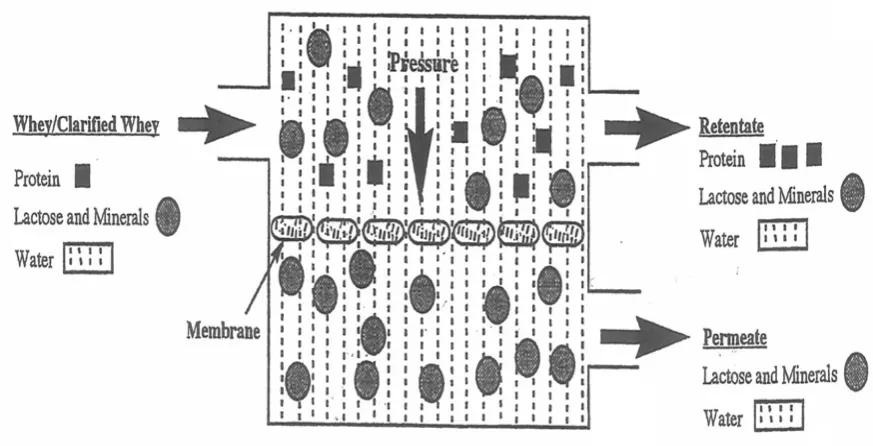
Figure 2.1 Principle of Ultrafiltration ……….. 42
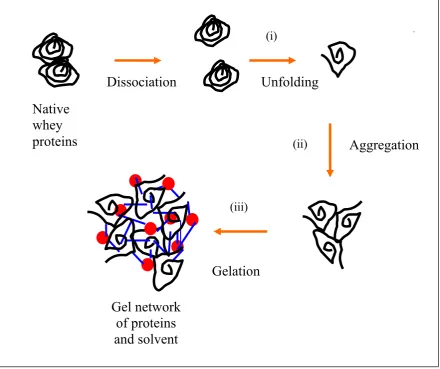
Figure 2.2 Physicochemical changes that take place during formation of
viscoelastic gel network during heating of native whey proteins with simultaneous occurrence of steps (i), (ii) and (iii) ………. 49
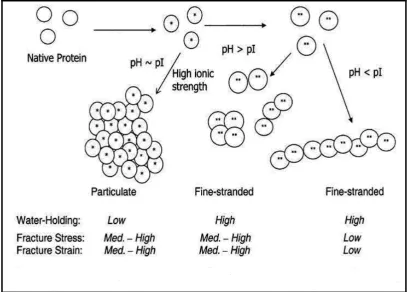
Figure 2.3 Model of globular protein gelation depicting changes from native protein
to slightly unfolded (.) and more extensively unfolded (..) states, and resultant gel types ... 50
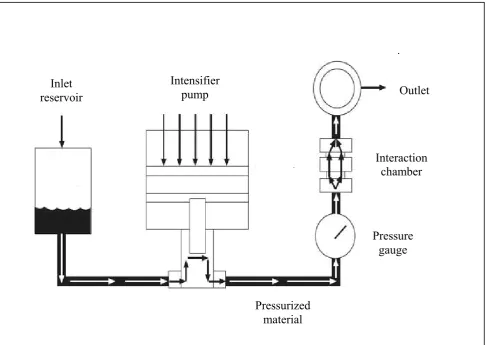
Figure 2.4 Principle of operation of a microfluidizer ……….. 68
Figure 3.1 The reducing (A) and non-reducing (B) SDS-PAGE of 8 commercial
WPC samples. Molecular weight markers (MW Markers); β-lactoglobulin (β- Lg); α-lactalbumin (α- Lactalbumin); 8 whey protein concentrates (WPC A - H) ……….. 90
Figure 3.2 Proportion of major proteins present in 8 commercial WPC samples
(WPC A - H) as detected by size exclusion HPLC. Different letters indicate significant difference (p<0.05) among samples within a particular protein type ……. 91
Figure 3.3 Apparent viscosity of 12% (w/w) protein dispersions at 20°C prepared
from 8 commercial WPC samples. Curves present averages of at least 4 (n≥4) independent observations ………. 97
Figure 3.4 Behaviour of phase shift (tan δ=G”/G’) of commercial WPC samples
during heating from 20 to 90°C at applied strain of 1% and frequency of 1 Hz. Curves present averages of at least 4 (n≥4) independent observations ……….... 99
Figure 4.1 Effects of heating and microfluidization on extent of whey protein
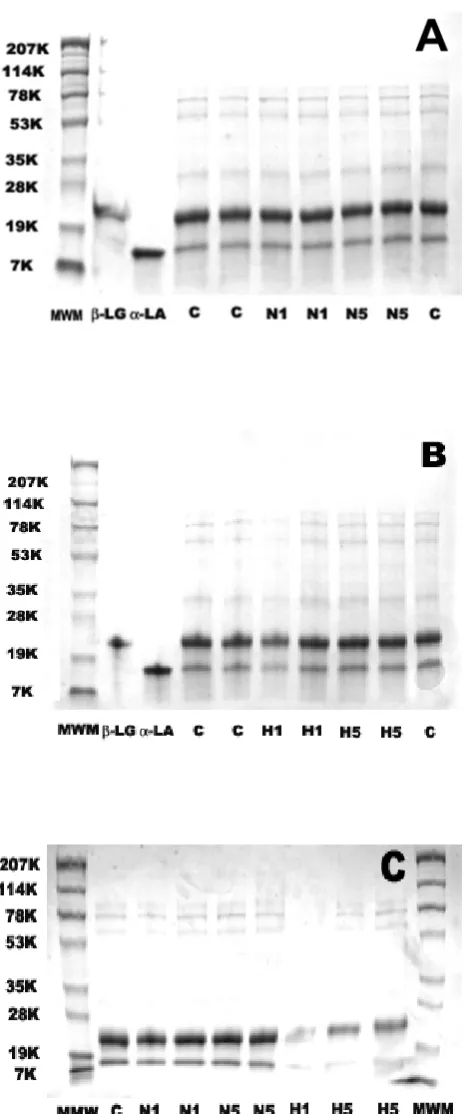
denaturation observed by reducing (A & B) and non-reducing (C) SDS-PAGE: Molecular weight standards (MWM); β-LG; α-LA; Control (C); Native, 1 pass (N1); Native, 5 passes (N5); Denatured, 1 pass (H1); Denatured, 5 passes (H5) …… 117
Figure 4.2 Particle size distribution pattern of WP as affected by heat treatment and
microfluidization: Control; Native, 1 pass (N1); Native, 5 passes (N5); Denatured, 1 pass (H1); Denatured, 5 passes (H5) ………... 119
Figure 4.3 SE-HPLC profiles of native and treated whey protein preparations.
Native control (C); Native 1 pass (N1); Native 5 passes (N5); Heat treated, 1 pass (H1); Heat treated, 5 passes (H5) ……… 120
Figure 4.4 DSC thermograms of 12% (w/w) whey protein dispersions: Control;
Native, 1 pass (N1); Native, 5 passes (N5); Denatured, 1 pass (H1); Denatured, 5 passes (H5) ………... 121
Figure 4.5 Apparent viscosity of 12% (w/w) WP dispersions at 20°C during a
controlled shear rate sweep (0.1 - 100 s-1). N1 = native, 1 pass; N5 = native, 5 passes; H1 = denatured, 1 pass; H5 = denatured, 5 passes ……….. 129
Figure 4.6 Changes in storage modulus (G’) of 12% (w/w) native (N) or denatured
(H) WP dispersions microparticulated by either 1 or 5 MFZ passes, during heating (20 - 90°C), holding (90°C / 10 min), cooling (90 - 4°C) and aging (4°C/approx 60 min) at constant strain (1%) and frequency (1 Hz) ……….. 131
Figure 4.7 Changes of storage modulus (G’) during cold (GDL, salt) gelation of
Figure 4.8 Viscoelastic properties, expressed as storage modulus (G’), of 12%
(w/w) denatured WP preparations microparticulated by 1 MFZ pass (A) or 5 MFZ passes (B) obtained by a frequency sweep (1 – 10 Hz) at a constant strain (1%) and 20°C ………... 135
Figure 4.9 Electrophoretograms of WP dispersions analyzed by Native PAGE (A),
with or without Tween 20 and SDS-PAGE (reducing or non-reducing) (B); (C - native control; N1 - native, 1 MFZ pass; N5 – native, 5 MFZ passes) after heat-induced gelation. Control was untreated native powder which was not gelled ……… 137
Figure 4.10 Non-reducing (A) and reducing (B) SDS-PAGE patterns of WP
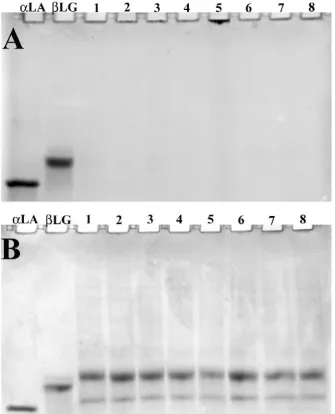
dispersions (H1- heat treated, 1 MFZ pass; H5 - heat treated, 5 MFZ passes) after cold-set gelation. Lanes: α-LA – α-lactalbumin standard; β-LG – β-lactoglobulin standard; 1 - H1 + GDL; 2 - H1 + 0.1 M NaCl; 3 - H1 + 0.5 M NaCl; 4 - H1 + GDL + 0.1 M NaCl; 5 - H5 + GDL, 6 - H5 + 0.1 M NaCl; 7 - H5 + 0.5 M NaCl; 8 - H5 + GDL + 0.1 M NaCl ………... 138
Figure 4.11 Changes in storage modulus (G’) during cold gelation of 12% (w/w)
denatured WP preparations (H1 and H5) with GDL or 0.1 M NaCl, and in the presence of SDS or NEM at constant strain (1%) and frequency (1 Hz) …………... 140
Figure 5.1 Heat-induced changes in solubility of 10% (A), 17.5% (B) or 25% (C)
(w/w protein) WP dispersions at pH 4, 5 or 6, heated at 140°C for up to 20 sec …… 157
Figure 5.2 Heat-induced changes in turbidity of 10% (A), 17.5% (B) and 25% (C)
(w/w %protein) WP dispersions at pH 4, 5 or 6 and heated at 140°C for up to 20 sec 160
Figure 5.3 A representative CE chromatogram showing major whey proteins; Peaks
with the migration times of 11.9 min, 12.6 min and 13.7 min representing α-La, β-Lg and BSA respectively………... 162
Figure 5.4 Kinetics of heat-induced β-Lg denaturation at 140° C of 10% (A), 17.5%
Figure 5.5 The rate constant (1/s) obtained by data fitting to the first order decay
model as affected by protein concentration (10, 17.5 or 25% w/w) and pH during heat-induced β-Lg denaturation. The values above the bars* indicate the correlation coefficients obtained by data fitting to the first order decay model ………. 166
Figure 5.6 Reducing SDS-PAGE patterns of remaining WP after heat treatment of
10% (A), 17.5% (B) and 25% (C) (w/w %protein) WP dispersions at 140° C. The pH of these dispersions was adjusted to pH 4, 5 or 6 prior to heating. Lanes from left to right: molecular weight marker; α-lactalbumin standard; β-lactoglobulin standard; 1 – 5, dispersions heated for 0, 5, 10, 15 or 20 s respectively... 172
Figure 5.7 Apparent viscosity of 10% (A), 17.5% (B) and ~25% (C) (%w/w
protein) WP dispersions at pH 4, 5 or 6 during a controlled shear rate sweep (0.1 - 100 s-1) at 20°C ………... 176
Figure 5.8 Storage modulus (G’) of 10% (A), 17.5% (B) and 25% (C) (%w/w
protein) WP dispersions at pH 4, 5 or 6 during heating (20 - 90°C), holding (90°C / 10 min), cooling (90 - 4°C) and aging (4°C/approx 4 hr) at a constant strain (1%) and frequency (1 Hz)………... 179
Figure 6.1 Experimental design for obtaining MWP at low pH (MFZ –
microfluidization)……….. 189
Figure 6.2 Native PAGE patterns of WP (7% protein w/w) in water (pH not
adjusted) (A), citric acid (B) or lactic acid at pH 3 (C) after heating at 140°C for 30 s. Lanes from left to right: Lane 1 – WP dispersion with no chemical, lane 2– 5, WP dispersions with Tween 20, SDS, NEM and DTT, respectively………... 194
Figure 6.3 Non-reducing SDS PAGE patterns of WP (7% protein w/w) in water (pH
Figure 6.4 Reducing SDS PAGE patterns of WP (7% protein w/w) in water (pH not
adjusted) (A), citric acid (B) or lactic acid at pH 3 (C) after heating at 140°C for 30 s. Lanes from left to right: Lane 1 – WP dispersion with no chemical, lane 2– 5, WP dispersions with Tween 20, SDS, NEM and DTT, respectively... 195
Figure 6.5 Heat-induced changes in turbidity of 7% (w/w) WP dispersions at pH ~
6 in water or at pH 3 in citric acid or lactic acid without a chemical blocker (Control), or in the presence of Tween 20, SDS, NEM and DTT after heat-treating at 140° C for 30 s………... 199
Figure 6.6 Native (A), SDS non-reducing (B) and SDS-reducing PAGE (C) patterns
of WP powders produced by spray drying of 7% (w/w) WP dispersions in citric or lactic acid at pH 3 after subjecting to different treatments as follows. Lanes from left to right: β-Lg standard, α-La standard, Lanes 1: untreated control; 2 - citric acid acidified control; 3 - citric acid acidified and microfluidized; 4 - citric acid acidified, heated and microfluidized; 5 - lactic acid acidified control; 6 - lactic acid acidified and microfluidized; lactic acid acidified, heated and microfluidized (HTM-LA) respectively ………...……….. 203
Figure 6.7 DSC thermograms of 12% (w/w) whey protein dispersions prepared
from MWP and the controls. Legend: untreated control (Control); citric acid acidified control (Control-CA); citric acid acidified and microfluidized (M-CA); citric acid acidified, heated and microfluidized (HTM-CA); lactic acid acidified control (Control-LA); lactic acid acidified and microfluidized (L-CA); lactic acid acidified, heated and microfluidized (HTM-LA)... 207
Figure 6.8 Particle size distribution pattern of MWP obtained by different treatment
Figure 6.9 Apparent viscosity of 12% (w/w) WP dispersions prepared by addition
of untreated control (Control); citric acid acidified control (Control-CA); citric acid acidified and microfluidized (M-CA); citric acid acidified, heated and microfluidized (HTM-CA); lactic acid acidified control (Control-LA); lactic acid acidified and microfluidized (L-CA); lactic acid acidified, heated and microfluidized (HTM-LA) to water and adjusting to pH 7. A shear rate control sweep (0.1 - 100 s-1) was conducted at 20°C ……… 214
Figure 6.10 Changes in storage modulus (G’) of 12% (w/w) WP dispersions during
heating (20 - 90°C) and holding (90°C / 10 min) at constant strain (1%) and frequency (1 Hz). Legend: untreated control (Control); citric acid acidified control (Control-CA); citric acid acidified and microfluidized (M-CA); citric acid acidified, heated and microfluidized (HTM-CA); lactic acid acidified control (Control-LA); lactic acid acidified and microfluidized (L-CA); lactic acid acidified, heated and microfluidized (HTM-LA) ………... 216
Figure 6.11 Changes of storage modulus (G’) during acid induced gelation of 12%
(w/w) WP dispersions by addition with 2% GDL. Legend: untreated control (Control); citric acid acidified control (Control-CA); citric acid acidified and microfluidized (M-CA); citric acid acidified, heated and microfluidized (HTM-CA); lactic acid acidified control (Control-LA); lactic acid acidified and microfluidized (L-CA); lactic acid acidified, heated and microfluidized (HTM-LA). Measurements were performed at 20°C at constant strain (1%) and frequency (1 Hz) ………...
217
Figure 6.12 Changes of storage modulus (G’) during salt induced gelation of 12%
Figure 7.1 Deconvoluted IR spectra of non-treated WP control samples containing
5, 10, 17.5 or 25% (w/w) protein at pH 3, 5 or 7……….... 230
Figure 7.2 Deconvoluted IR spectra of sheared heat-induced WP gels at pH 3,
containing 5 or 17.5% (w/w) protein and sheared at the rates of 100 s-1, 500 s-1 or 1000 s-1……….. 233
Figure 7.3 Deconvoluted IR spectra of sheared heat-induced WP gels at pH 5,
containing 5 or 17.5% (w/w) protein and sheared at the rates of 100 s-1 , 500 s-1 or
1000 s-1………. 235
Figure 7.4 Deconvoluted IR spectra of sheared heat-induced WP gels at pH 7;
containing 5 or 17.5% (w/w) protein and sheared at the rates of 100 s-1., 500 s-1.or
1000 s-1………. 237
Figure 7.5 Native PAGE electrophoregrams of WP dispersions prepared at different
pH and protein concentrations and simultaneously heated and sheared. Captions: pH 3 - lanes 1, 2, 3; pH 5 - lanes 4, 5, 6; pH 7 – lanes 7, 8, 9. The heating regime included heating from 20°C to 90°C, holding at 90°C and cooling from 90°C to 25°C with simultaneous shearing at 100 s-1 (lanes - 1, 4, 7), 500 s-1 (lanes - 2, 5, 8) or 1000 s-1 ( lanes – 3, 6, 9). The protein concentration was adjusted at 5 (A), 10 (B), 17.5 (C) or 25% (D) (w/w) protein. Lanes C1, C2 and C3 in the native PAGE gel D represent the untreated controls at pH 3, 5 and 7, respectively ……….. 240
Figure 7.6 Non-reducing SDS PAGE electrophoregrams of WP dispersions
Figure 7.7 Evolution of apparent viscosity of WP dispersions prepared at 5 (A), 10
(B), 17.5 (C) or 25% (D) (w/w) proteins, respectively, and pH 3, 5 or 7 during simultaneous heating/cooling regime (from 20°C to 90°C, holding at 90°C, cooling from 90°C to 25°C) and shearing (at 100, 500 or 1000 s-1) ………... 245
Figure 7.8 Turbidity of WP dispersions containing 5 (A), 10 (B), 17.5 (C) or 25%
(D) (w/w) protein, prepared at pH 3, 5 or 7 and treated by heating from 20 to 90°C, holding at 90°C and cooling from 90 to 25°C and simultaneous shearing at 100, 500 or 1000 s-1………. 250
Figure 7.9 Lightness of WP dispersions containing 5 (A), 10 (B), 17.5 (C) or 25%
(D) (w/w) protein, prepared at pH 3, 5 or 7 and treated by heating from 20 to 90°C, holding at 90°C and cooling from 90 to 25°C and simultaneous shearing at 100, 500
or 1000 s-1 ……… 253
Figure 7.10 Hydrophobicity of WP dispersions containing 5 (A), 10 (B), 17.5 (C) or
List of Tables
Table 2.1 Physical and chemical properties of caseins and whey proteins ……….. 35 Table 3.1 Proximate composition of commercial whey protein concentrates …….. 86 Table 3.2 Colloidal, interfacial and gelling properties of commercial whey protein
concentrates ……….. 92
Table 3.3 Thermal properties of whey protein concentrates ……… 101
Table 4.1 Compositional analysis of whey protein retentates and permeates …….. 116 Table 4.2 Colloidal and interfacial properties of different whey protein
preparations produced using heat and high pressure shearing ………... 123
Table 4.3 Rheological parameters of whey protein dispersions obtained by fitting
the experimental data to Power Law and Herschel-Bulkley models ………. 128
Table 4.4 Physical characteristics of heat-set gels ……… 141
Table 5.1 Proximate composition of WP retentates and permeates ………... 150 Table 5.2 Thermal properties of WP samples with adjusted protein concentration
and pH ……….. 169
Table 5.3 Rheological parameters of whey protein dispersions, containing 10,
17.5 or 25% (w/w) proteins, obtained by fitting the experimental data to Power Law model ………... 175
Table 6.1 Thermal analysis of WP dispersions containing 7% (w/w protein) at pH
~ 6 (not adjusted, aqueous medium) or pH 3 adjusted with citric or lactic acid and in the presence of chemical blockers ………. 200
Table 6.2 Colloidal and interfacial properties of microparticulated WP powders
1 Introduction
1.1 Background
Whey proteins (WP) comprise one of the two major protein components of cow’s milk (20%), the other component being the caseins (80%). They are not aggregating upon acidification or renneting of milk and are soluble in their native form almost independent of pH (Fox and McSweeney, 2003). WP are primarily a mixture of beta lactoglobulin (β-Lg), alpha lactalbumin (α-La), bovine serum albumin (BSA) and immunoglobulins (Ig) (Verheul et al., 1998). They can be isolated from whey, the natural by-product of cheese and casein manufacture and in their native form they exist as compact, globular proteins. Commercially different types of WP powders are available. The most important products are whey protein concentrates (WPC) and whey protein isolates (WPI). WPC contains more than 35% protein, low levels of fat and cholesterol and typically a greater amount of bioactive compounds and lactose. WPI contains more than 90% of protein and have lower levels of fat and lactose and bioactive compounds as well (Fox and McSweeney, 2003; Hettiarachchy and Ziegler, 1994; Huppertz et al., 2005).
and processed meats, salad dressings, artificial coffee creams, soups and various other dairy products (Onwalata and Tomasula, 2004; Fitzsimons, et al., 2007). High solubility of WP over a wide range of pH (Zhu and Damodaran, 1994) is an added advantage for the exploitation of their other functionalities such as foaming, emulsifying, gelling, heat coagulation and water binding over various types of food products. In addition, WP, being excellent foaming and emulsifying agents, have an ability to form cohesive and viscoelastic films by polymerization mainly via disulfide bonds and hydrophobic interactions (Monahan et al., 1993; Lee et al., 1992; Bouaouina et al., 2006). Also, ability of WP to form heat- and cold-set stable gels to perform as a matrix for holding other components of a food is very useful in food formulations and product development (Matsudomi et al., 1993; Resch et al., 2004).This is in addition to the superior nutritional benefits obtain from WP compared to pre-gelatinized starch and hydrocolloids, which also do water holding and increasing viscosity (Resch et al., 2005).
groups (Lee et al., 1992). The rates and pathways of these physicochemical reactions are determined by the factors intrinsic to protein and extrinsic environmental factors such as protein concentration, pH, temperature, ionic strength and solvent condition (Brandenberg et al., 1992; Iordache and Jelen, 2003; Marangoni et al., 2000). Thus, in order to fully utilize their functional properties in different food systems they need to be recovered in their native, undenatured state and subsequently incorporated in a food matrix. Therefore, the knowledge of WP behaviour, particularly, the mechanisms of heat-induced unfolding, aggregation and gelation in different environmental conditions is important in conducting successful alternations which lead to grasp the maximum advantage of this excellent food ingredient. (Verheul et al., 1998; Onwalata et al., 2004; Matsudomi et al., 1993; Iordache and Jelen, 2003). Unfortunately, existing extraction methods are also poorly up-scaled limiting the application of whey proteins. But it is rather imperative to the industry in improving functionality of whey proteins by applying different conventional approaches in order to avoid heat instabilities. On the other hand, whey proteins may be stabilized by primary denaturation followed by colloidalization (Onwulata et al., 2004). The physico-chemical properties of individual proteins present in WP as well as the intrinsic (food properties) and extrinsic (environment) conditions, including pH, temperature, ionic strength, solvent polarity and type, govern the overall whey protein functionality and influence the formation of primary particles, affecting the final particle size, morphology, surface properties and different interactions between individual protein particles as well as contacting biopolymers, thus contributing the applicability in various food systems.
gels leading to modulated functionalities. Also, by controlling the extent of shear as well as kinetics of denaturation and aggregation of WP using different environmental conditions may likely lead to more heat stable and functionally more applicable microparticulated whey protein (MWP) preparations.
1.2 Research objectives
The main objective of this study is to establish a novel processing method that may lead into production of WP based ingredients with different functionalities. The proposed process involves the combined application of the heat and high pressure shearing, all of which should induce conformational changes of heat unstable WP.
The current research is more specifically aimed at:
1. Assessing the effects of complete protein denaturation and the extent of high pressure shearing on colloidal, surface and rheological properties of newly formed MWP;
2. Examining the reaction kinetics of whey protein denaturation as a function of pH and protein concentration;
1.3 Thesis outline
2 Literature Review
2.1 Milk and milk proteins
Milk nourishes people of all ages and lands from newborn infant to the old and infirm. It is a secretion of mammalian females, providing all the nutrients to the young. Milk is a very complex liquid containing numerous types of molecules. It is mainly an aqueous solution of lactose, inorganic and organic salts, and dispersed colloidal particles of milk proteins and larger emulsified lipid globules. Proteins and peptides, for example, immunoglobulins, metal-binding proteins and enzymes, growth factors, hormones and antibacterial agents and some oligosaccharides present in milk deliver important physiological and protective functions (Fox and McSweeney, 2003; Thompson, et al., 2009). Bovine milk and the dairy products play an important role in human nutrition. The average composition of main components of bovine milk is: 87.1% water, 4.6% lactose, 3.3% milk proteins and 4% milk fat (Walstra et al., 2006).
Proteins are the major constituent of human diet for supporting their growth and well being. Among dietary proteins, milk proteins are most likely the best researched and described (Fox and McSweeney, 2003). Milk proteins can generally be classified into two types as caseins and whey proteins based on their solubility at pH 4.6 (Huppertz et al., 2005), where caseins are insoluble and, consequently coagulated, and the whey proteins remain soluble. Out of total milk protein content, caseins present about 80% and remaining 20% are the whey proteins.
not be coagulated when heated at 100ºC for 24 hours or at 140ºC for up to 20 – 25 min (Fox and McSweeney, 2003), whey proteins are very heat sensitive. Caseins are phosphorylated and the degree of phosphorylation varies among the individual caseins imparting them molecular charges and thereby hydration, solubility, heat stability and metal binding, especially in this instance, Ca ions. As a result, high levels of calcium phosphate are available in milk in a soluble form. Additionally, under natural conditions and in a stable colloidal suspension of surrounding water-based liquid, the casein micelles are not aggregating as a result of an inter-micellar steric and electrostatic repulsion provided by the protruding polyelectrolyte region of κ-casein from the micellar surface. Although whey proteins are not phosphorelated, they are richer in sulphur content (1.7%) compared to caseins with ~ 0.8% sulphur. Caseins lack α- and β- sheets, which is related to their higher levels of proline content compared to more structured whey proteins (Fox and McSweeney, 2003).
Table 2.1 Physical and chemical properties of caseins and whey proteins (Adapted from Fox and McSweeney, 2003)
Property Caseins Whey proteins
Protein type α-casein
β-casein
κ-casein
α-lactalbumin (α-La)
β-lactoglobulin (β-Lg)
Bovine serum albumin (BSA) Immunoglobulins
Proteose peptones Physical state in
milk Large colloidal aggregates as micelles Monomers quaternary structures or small Molecular weight Casein micelle - ~108 Da α-La - ~14 kDa
β-Lg - ~18 kDa BSA - ~66 kDa Isoelectric point pH ~ 4.6 pH ~ 5
Solubility at pH ~
4.6 Insoluble Soluble
Heat stability Very heat stable; withstand heat at 140°C up to 20-25 min
Completely denatured at 90°C for 10 min
Amino acid composition
Contain high levels of proline imparting lack of α- and -β structures; Phosphorylated resulting in high solubility, hydration, heat stability, carry high Ca2+;
Low in sulphur (0.8%) and mainly contained by methionine residues, little cysteine/cystine, lack intramolecular disulfide bonds
Highly structured Not phosphorylated
Rich in sulphur (1.7%) and contained by cysteine and/or cystine,
Number of intra molecular disulfide bonds and thiol (SH) groups respectively:
α-La – 4, no SH groups
Whey is the liquid remaining after almost complete casein removal from milk, thus it is the natural by-product of cheese and casein manufacture. The estimated world’s whey protein production exceeds 0.5 million tonnes annually (Thompson, et al., 2009). The composition of whey usually varies depending on the method of casein separation. The whey resulting from rennet coagulated casein or rennet type Cheddar or Swiss cheese manufacturing is known as sweet whey (pH > 5.6). It contains a higher lactose content than acid whey which is obtained from the manufacture of acid casein brought about by addition of either lactic or mineral acid. It also contains a higher mineral/ash content comparatively. In general, whey is a dilute, greenish yellow, translucent liquid with average of 93% water, 0.6% proteins termed as whey proteins, ~ 5% lactose, ~ 0.02% fat and ~ 0.6% minerals, vitamins and some other several constituents at trace levels (Foegeding et al., 2002: Fox and McSweeney, 2003). Whey has now been recognized as a valuable source of essential amino acids, however, until recently the disposal of whey was one of the major environmental problems.
2.2 Whey proteins
Whey proteins (WP) are mainly a mixture of β-lactoglobulin (β-Lg), α -lactalbumin (α-La), bovine serum albumin (BSA), immunoglobulins (Ig), proteose peptones and some other minor proteins including lactoperoxidase, lysosome and lactoferrin (Verheul et al., 1998; Fitzsimons et al., 2006; Anfinsen, 1967).
Some of the important physical and chemical properties of the main whey proteins are listed below.
2.2.1 β-lactoglobulin
sequence of β-Lg is as follows. Asp (10), Asn (5), Thr (8), Ser (7), Glu (16), Gln (9), Pro (8), Gly (4), Ala (15), Cys (5), Val (9), Met (4), Ile (10), Leu (22), Tyr (4), Phe (4), Lys (15), His (2), Trp (2) and Arg (3) (Morr and Ha, 1993). Its isoelectric point is ~ pH 5.2. It represents ~ 50% of total whey proteins and also ~ 12% of total milk proteins. There are ten genetic variants of bovine β-Lg known so far (Fox and McSweeney, 2003), however, the two common variants with equal frequency are β-Lg -A and -B which differ from each other only in two amino acids (A/B sequence differences are Asp64/Gly64 and Val118/Ala118) (de Wit, 2009; Hinrichs and Rademacher, 2004). But this slight difference has given them a significant difference in their solubility (de Wit, 2009). The next important variant is the variant C, recognizes in Jersey cows. Depending on the positioning of different amino acids and salt bridges on the protein, the heat stability of these
β-Lg genetic variants differs. For example, at low temperatures, variant A is less stable than variant C as opposed to stability at higher temperatures, at which variant A is more stable than variants B and C due to its better hydrophobic packing (de la Fuente et al., 2002).
between pH ~3 and ~7.5 (Manderson et al., 1998) and, as a result, at natural pH they exist as stable non-covalent dimers at room temperature but beyond that temperature they dissociate to monomers (Croguennec, et al., 2004).
2.2.2 α-lactalbumin
separation of lobes, assist positioning a buried solvent molecule near the Ca-binding site and affect inter- and intra-lobe hydrogen bonding, facilitating unfolding (Chrysina, 2000). However, the Ca affinity of α–La decreases at pH < ~ 5 since the Asp residues get protonated which results in low heat stability or denaturation at lower temperatures and inability to re-nature on cooling as well (Fox and McSweeney, 2003).
2.2.3 Bovine serum albumin
BSA consists of 582 amino acid residues with a molecular weight of ~ 66 Da (Morr and Ha, 1993). The amino acid sequence of BSA is, Asp (39), Asn (12), Asx (3), Thr (34), Ser (28), Glu (59), Gln (19), Glx (1), Pro (28), Gly (16), Ala (46), Cys (35), Val (36), Met (4), Ile (14), Leu (61), Tyr (19), Phe (27), Lys (59), His (17), Trp (2) and Arg (23) (Morr and Ha, 1993). The isoelectric pH of BSA is ~ 5.3 (Damodaran et al., 2008). It has a multi-domain (three) structure with complex ligand binding ability and specified by an oblate shape. The domains are stabilized by a number of disulfide bonds (Considine et al., 2007). It has 17 intramolecular disulfide bonds and one free thiol group at Cys34 residue (Thompson, et al., 2009). It does not contain any β-sheet, instead it is composed of mainly helix, turn and extended chains (Considine et al., 2007). The C-terminal region of the molecule is more compact than the N-C-terminal region and the different domains show differences in hydrophobicity, net charge and ligand-binding properties (Morr and Ha, 1993). BSA is a quite recognizable transport protein for insoluble fatty acids in the circulatory system (Juliette, et al., 1995).
2.2.4 Physiological importance of whey proteins
2.2.5 Whey proteins in food systems as a functional ingredient
Along with physiological benefits, WP possess inherent excellent functional properties and desirable sensory characteristics enabling them to be used in numerous food applications including sport beverages, liquid meat replacements, baked products and processed meats, pasta, salad dressings, spreads and dips, artificial coffee creams, soups, ice cream, confectionary, infant foods and various other dairy products (Onwalata and Tomasula, 2004; Fitzsimons et al., 2006). In order for them to be used in these applications, WP should be extracted from whey using different fractionation methods, mainly membrane processing.
2.3 Commercial whey protein products
WPC is prepared by means of ultrafiltration/diafiltration of whey to remove mainly water, lactose and minerals as a result of selective separation of whey proteins under mild processing conditions (temperature and pH). Ultrafiltration of whey usually results in retentates of ~ 24% total solids and diafiltration gives retentates of a higher total solid content ~ 28% with comparatively higher protein to total solids ratio (Fox and McSweeney, 2003). In WPI production, additional ion exchange chromatographic or microfiltration methods are employed. After further concentration, retentates of these whey proteins are spray dried to produce WPC or WPI powders (Fox and McSweeney, 2003; Morr and Ha, 1993). The membrane technology, including ultrafiltration, diafiltration and ion-exchange adsorption used in these processes has become very useful in the production of different whey protein products with varied composition and excellent functionalities (Damodaran et al., 2008).
Qian, 2008). This is mostly a result of lipid oxidation. The free radicals and numerous other organic volatile substances released from lipid oxidation may further damage the quality of the powders, by catalysing the secondary Maillard browning reaction between proteins and lactose (Morr and Ha, 1993). Further, the inconsistency in flavour of WP products and also the influence of off flavours on the finished product may limit whey ingredient applications in dairy and non-dairy foods (Whetstine et al., 2003).
2.4 Functional behaviour of whey proteins
The functionality of WP depends on the physicochemical properties of their three-dimensional protein structure including, size, shape, amino acid composition and sequence, net charge, ratio of hydrophobicity to hydrophilicity, molecular flexibility and rigidity which is on the other hand governed by the external environmental factors, such as protein concentration, pH, temperature, ionic strength, the type of ions present and the influence of other available food components (Damodaran et al., 2008; de la Fuente et al., 2002). Although, WP functionality mainly depends on the behaviour of β-Lg, the most abundant protein in whey (Verheul et al., 1998), the overall functionality entirely depends on the combination of the properties of all other components present in the whey protein product. For instance, β-Lg has excellent gelling, foaming and emulsifying properties while α-La exhibits good emulsifying properties, but its gelling ability is poor (Pearce and Kinsella, 1978).
2.4.1 Solubility and protein water interactions
2.4.2 Viscosity
The viscosity of a substance relates to its resistance to flow under an applied force (Fox and McSweeney, 2003). This property is also related to the consumer perception of some liquid and semi-solid type foods such as beverages, gravies, soups and sauces. The thickening ability of WP is a very useful functional property regarding these food products and the awareness of the viscous behaviour is practically important in relation to processing, designing and development of food products as well as processing conditions (Huang and Kinsella, 1986). The very dilute solutions of whey proteins behave as Newtonian fluids, while the flow is pseudoplastic at higher concentrations. For example, β-Lg increases the viscosity with shearing time and at very high concentrations (~ 40%, w/w) this protein shows time-dependent shear thinning behaviour probably due to partial denaturation of proteins (Fox and McSweeney, 2003). The molecular properties of proteins including the size and shape as well as protein-solvent interactions, hydrodynamic volume and the molecular flexibility in the hydrated state affect the viscosity (Genovese et al., 2007). The denatured dispersions of randomly coiled molecules show greater viscosity than do solutions of compact folded globular molecules of the same molecular weight (Damodaran et al., 2008).
2.4.3 Foaming and emulsifying
the foam yield stress of whey protein products can be modified (Foegeding et al., 2002). Sulfhydryl groups, which are more active at pH 7, contribute to molecular flexibility while disulfide bridges contribute to rigidity. Molecular flexibility enhances emulsion and foam formation by increasing the rate of unfolding at the interface and allowing more favourable alignment of polar and non polar groups in their preferred phase (Klemaszewski and Kinsella, 1991). At pH 7, whey proteins have a net negative charge, but at pH 8 possibly due to oxidation of thiol group, they easily form disulfide bonds. Proteins at an appropriate pH with increased net negative charge repulse each other creating a barrier to the close approach of droplets, thereby retarding the rate of coalescence and resulting in more stable emulsions (Klemaszewski and Kinsella, 1991). Previous studies have revealed that there is an improved overrun and increased stability of foams at pH 7 when heated to 55ºC (Phillips et al., 1990). At higher temperatures, however, foaming and emulsifying characteristics may be impaired due to protein aggregation, which decreases the availability of proteins to form films and emulsions (Phillips et al., 1990). Furthermore, since WP are even soluble at their isoelectric points (pH ~ 5), they exhibit superior foaming properties having better protein-protein interactions to form stable foams around that pH. In addition, the
β-Lg B variant appeared to adsorb more rapidly at interfaces than variant A although β-Lg A and B variants vary by only two amino acids (Foegeding et al., 2002).
2.4.4 Gelation
(Matsudomi et al., 1993; Resch et al., 2004). Compared to pre-gelatinized starches and hydrocolloids, which also have the capacity of water holding and increasing viscosity, whey proteins have added superior nutritional benefits (Resch et al., 2005). Thermal gelation involves initial unfolding and subsequent aggregation of proteins depending on the balance of attractive and repulsive forces (Hudson et al., 2000). The irreversible unfolding of whey proteins occur at temperatures > 60ºC (Considine et al., 2007). The process involves a series of physicochemical reactions such as dissociation, denaturation and exposure of hydrophobic residues and resulting polymerization via formation of intermolecular disulfide bonds, hydrophobic, hydrogen and ionic bonds (Brandenberg et al., 1992).
A proper balance of protein-protein as well as protein-water interactions fundamentally controls gelation mechanism and the gel appearance. If the protein-protein interactions are much greater than the protein-protein-water interactions mostly a precipitate is formed. On the contrary, if protein-solvent interactions predominate the system would not gel. Another vital factor for the formation of a self-stranded gel network is the protein concentration. The least concentration end point (LCE) is the minimum protein concentration required to form such a network at given conditions (Gosal and Ross-Murphy, 2000; Damodaran et al., 2008). The physical characteristics of these gels can be altered by manipulating protein concentration, ionic strength, heating time and temperature, solvent condition and quality and addition of other macromolecules or filler particles (Verheul et al., 1998).
Figure 2.2 Physicochemical changes that take place during formation of viscoelastic gel network during heating of native whey proteins with simultaneous occurrence of steps (i), (ii) and (iii) (Based on Alting, 2003).
Dissociation
Unfolding
Gel network
of proteins
and solvent
(i)
(ii)
(iii)
Aggregation
Gelation
Native
In addition, the optimum pH for gel formation is about 7-8 for most proteins (Dickinson, 2005; Verheul et al., 1998; Damodaran et al., 2008). The translucent gels, formed primarily by hydrogen bonding, hold more water than coagulum or particulate gels and show less syneresis. In these gels, water is hydrogen bonded to carbonyl and N-H groups of the peptide bonds and water may exist as a hydrogen bonding cross linker between C=O and N-H groups of peptide segments probably restricting the flowability of water (Damodaran et al., 2008). Furthermore, a number of hydrophobic residues in the protein also determine the type of forming gel. The general trend is that the proteins with more than 31.5 mole percentage of hydrophobic residues form coagulum type gels while those with less than 31.5 mol%, usually form translucent gels in the aqueous medium (Damodaran et al., 2008).
The cold-set whey protein gelation is also useful as a novel and alternative method in formulating food products with modified functionalities (Marangoni et al., 2000). It is mostly important in preparations of heat-sensitive food products with delicate texture and flavour (Thompson et al., 2009). In comparison with heat-induced gelation, where the processes of denaturation, aggregation and gelation steps simultaneously occur, the cold gelation occurs in two separate steps as denaturation (i) and activation of proteins and gelation (ii) (Alting, 2003) as shown bellow.
Native
whey
proteins
Denaturation
& activation
Whey
protein gel
network
Usually, the activation of protein molecules is achieved by heat-denaturation, at a protein concentration below the critical gelation concentration, and at a low ionic strength and/or far from the isoelectric point (normally at neutral pH). Consequently proteins undergo structural rearrangements, including unfolding and conversion into small soluble aggregates. Also, upon cooling, they remain soluble without gelling. Strong electrostatic repulsions between proteins and negligible salting-out effects prevent gelation of the proteins. The gelation is then accomplished at cold-set conditions by changing the solvent quality with addition of salts or adjustment of pH to screen repulsive forces or by bringing the pH towards the isoelectric point, respectively (Thompson et al, 2009; Alting et al., 2000; Marangoni et al., 2000). However, the direct addition of salt or acid does not yield a viscoelastic protein network.
The salts such as sodium chloride or calcium chloride can be added to enhance protein aggregation via screening the dispersed repulsive charges and, in the case of divalent ions, the formation of additional salt bridges between negatively charged groups on proteins (Marangoni et al., 2000). For example, when the gels are formed with CaCl2 rather than NaCl, more rigid network is created due to ability of Ca2+ to more effectively screen charges than NaCl and, also, to form ion-bridges by linking negative charges on proteins (Foegeding et al., 2002). The fine stranded, transparent gels are formed by addition of relatively small amounts of salts while turbid and particulate gels are formed due to addition of relatively large amounts of salts (Alting et al., 2003).
contain larger aggregates and are likely to be stronger and more deformable (Cavallieri and Cunha, 2008). In addition, the amount of GDL required to achieve a certain pH value depends on the protein concentration (Alting et al., 2002).
2.5.1 A general description of proteins and their physicochemical characteristics
The basic structural unit of proteins is an amino acid which contains an α-carbon atom covalently attached to a hydrogen atom, an amino group, a carboxyl group and a side chain, R group. Proteins inherit acidic and basic properties due to acidic carboxyl groups and basic amino groups; as a result, at neutral pH, they act as ampholytes. In addition, physicochemical properties, the extent of hydrogen bonding and the reactivity of proteins are mostly determined by the different R groups attached to the amino acids (Petsko and Ringe, 2004).
structures of single protein molecule which is folded or compacted to achieve a minimum possible level of free energy via involvement of all types of molecular interactions. For example, globular proteins are folded in such a way to bury most of the hydrophobic residues in the interior of the protein structure and away from the water environment with most of the hydrophilic residues at the protein-water interface (Damodaran et al., 2008; Nolting, 2006). However, this relocation of hydrophobic and hydrophilic residues is frequently done partially due to steric effect and the ratio of polar and apolar groups on the surface is extremely important for the physicochemical properties of the protein. It has been recognized that globular proteins generally contain a large number of hydrophobic residues and that nature is more prominent in larger globular proteins than the smaller molecules (Damodaran et al., 2008). Apart from one tertiary structure, there may be a few individual tertiary structures, found in a polypeptide chain, which are referred to as the protein domains (Damodaran et al., 2008). The quaternary structure of proteins is formed when more than one polypeptide chain are spatially arranged to a protein complex. The quaternary structures are generally called oligomers and may be homogeneous or heterogeneous dimers, trimers, tetramers or larger forms mainly created by non-covalent interactions. The proteins with more than 30% of hydrophobic groups have a greater potential to form oligomeric structures to minimize the free energy since they cannot bury all the hydrophobic residues inside their core. For example, β-Lg which contains 32 mol% of hydrophobic amino acids and exists as a monomer at pH less than 3.5 and greater than pH 7.5, a dimer between pH 5 and 7.5 and as an octomer between pH 3 and 5 (Damodaran et al., 2008; Fox and McSweeney, 2003).
Waals forces are important as main contributors to the stabilization of globular proteins, followed by hydrogen bonds and thirdly, hydrophobic interactions of non-polar residues (Nolting, 2006). In order to have a stable folded protein conformation all molecular interactions have to overcompensatethe destabilizing contributions from hydration of polar residues and the gain in configurational entropy upon unfolding (Nolting, 2006). Although the polypeptide chain is folded to be energetically stabilized, it always avoids the deformation of bond lengths and bond angles. The contribution of the sum of van der Waals interactions, hydrogen bonds formed between the reactive groups of the peptide chain such as, peptide groups, carboxyl groups and side chain phenolic, amide, histidine, and covalent disulfide bonds are significant to the stability of protein folding. But the hydrophobic interactions among apolar groups are the major driving force in protein folding (Damodaran et al., 2008; Fox and McSweeney, 2003).
2.5.2 Protein denaturation
2.6 Protein denaturation kinetics and environmental effects in
whey protein aggregation
‘molten globule’ state has been suggested to be unique intermediate state with a partially folded conformation, having some similarity to, yet being distinct from, both the native and fully unfolded state (Fox and McSweeney, 2003). α-La has a well characterized molten globule structure (de la Fuente et al., 2002). The protein aggregation is mainly a result of different molecular interactions such as hydrophobic via newly exposed apolar groups, electrostatic, disulfide and hydrogen bonding and van der Walls forces among proteins (Lee et al., 1992; Damodaran et al., 2008). The rates and pathways of these physicochemical reactions are determined by the factors as previously described else where, temperature and heating time, the protein concentration, α-La/β-Lg ratio, pH, ionic strength and solvent condition and the influence of other surrounding molecules (Brandenberg et al., 1992; Iordache and Jelen, 2003; Marangoni et al., 2000; Rabiey and Britten, 2009).
The unfolding of globular whey proteins is an endothermic heat process and can be monitored by differential scanning calorimetry (DSC) since it directly provides the enthalpy changes and temperature data associated with the unfolding transition (Paulsson and Dejmek, 1990). The endothermic peak temperature is the transition midpoint where the concentration of native and denatured state is equal and it is commonly considered as the denaturation temperature (Td). The denaturation
conformational entropy, which favour the unfolded state, ultimately determine the denaturation temperature of proteins (Damodaran et al., 2008).
As far as aggregation of β-Lg is concerned at neutral pH, the conformational changes of the tertiary structure of β-Lg in aqueous solution vary reversibly at temperatures < ~ 65°C (Considine et al., 2007). However, with sufficient enough heating (at 65°C), the process of unfolding, exposure and activation of free sulfhydryl groups and the formation of related intermediate aggregates takes place due to initiation of inter- and intra-molecular thiol/disulfide exchange reactions or sulfhydryl oxidation (de la Fuente et al., 2002). Normally, this process is much more evident at relatively low temperatures (de la Fuente et al., 2002) than at higher temperatures and simultaneously, at low temperatures, the non-covalent interactions play a minor role (Considine et al., 2007). The pattern of initiation, propagation and termination of sulfhydryl/disulfide exchange chain reactions somewhat resemble the polymer radical chemistry reactions (Roefs and de Kruif, 1994).
Cys160-Cys66 disulfide bond and the free thiol in the native protein is present after the heat treatment. Also, Cys66 and Cys160 are hardly involved in the formation of disulfide bonded dimer of β-Lg molecules through a disulfide bond interchange reaction (Considine et al., 2007). In addition, ionic interactions, hydrogen bonding and calcium bridges are also equally important during protein aggregation (Brandenberg et al., 1992; Patel and Kilara, 1990; Fetahagic et al., 2002). The disulfide bonded heat induced gels have a rubbery nature which is indicated by high fracture strain (Havea, et al., 2009).
The behaviour of an individual protein during unfolding and aggregation is different when there are other proteins present in the medium. For instance, α –La has the least effect on heat-induced aggregation and sulfhydryl/disulfide interchange apparently due to absence of free thiol group, but it disappears rather more rapidly than β-Lg in whey protein mixtures (Zue and Damodaran, 1994). In the presence of either β-Lg or BSA which contain free thiol groups, α –La aggregates readily forming a mixture of homopolymer as well as heteropolymers of both proteins (Havea et al., 2001). The denatured α–La reacts with denatured β -Lg very efficiently and the rate of aggregation of α–La is higher an order of magnitude in the presence of β-Lg (Considine et al., 2007). However, in a heated whey protein mixture, the aggregation of α–La is more effectively catalysed by BSA via the activated thiol group than β-Lg since BSA starts unfolding and aggregating before β-Lg. Furthermore BSA and α–La denature at almost similar temperatures with BSA start to aggregate at a lower temperature than β-Lg. The aggregation rate of β-Lg is several times higher in the presence of BSA than alone. On the other hand, BSA appears unaffected in the presence of β-Lg (de la Fuente et al., 2002; Considine et al., 2007).
ability to form inter-molecular disulfide bonds to a certain extent since it limits the mobility of denatured molecules and thus reduces the probability of meeting each other (Havea et al., 2009). In the heated α–La/β-Lg mixtures, α–La provides a greater contribution to non-covalent aggregation than β-Lg (de la Fuente et al., 2002). The degree of non-covalent interactions is directly proportional to the brittleness and stiffness of whey protein gels (Havea et al., 2004).
2.6.1 Effect of temperature and holding time on the extent of whey protein aggregation
2.6.2 Effect of protein concentration on whey protein aggregation
Protein concentration also has a significant effect on heat induced unfolding and aggregation of WP. While the protein unfolding appeared unaffected by protein concentration, the aggregation step appears to be highly dependent on the concentration, particularly, the monomer forms. At low protein concentrations, such as 3, 4 or 6 % (w/w) and low ionic strength, the denaturation step is slower than aggregation step (Fitzsimons, et al., 2007). By simultaneous increase of both temperature and protein concentration, the creation of multimeric species is facilitated. In addition, high protein concentrations produce higher molecular weight aggregates (de la Fuente et al., 2002).
2.6.3 Effect of pH on whey protein aggregation
Fuente et al., 2002). The reactivity and availability of the thiol groups greatly depend on the pH. For instance, at pH 8, the thiol group is readily available for further reactions and, also, in the pH range between 6.4 and 8, intermolecular disulfide bonds play an important role in protein aggregation. Moreover, the denaturation temperature of β-Lg decreases as pH is increased from 5.5 to 6.5 at low ionic strength. When pH is increased from 6 to 7.5 in the presence of 0.5 M NaCl, the rate of protein aggregation increases with simultaneous increase of G’ and reduced permeability of resulting gels (Xiong et al., 1993; Foegeding et al., 2002). Furthermore, at pH 6, where non-covalent interactions are prominently involved in whey protein aggregation, the thiol/disulfide exchange reactions appear to play a part in the process. However, at very acidic pH, WP contain an overall positive charge and thiol/disulphide interchange reactions are unlikely to take place because of the impaired reactivity of the thiol groups. Under these conditions, although, unfolding readily occurs, the electrostatic interactions between monomers are totally repulsive. However the aggregation can be promoted by addition of salts to screen these charges. When whey proteins are heated at very acidic pH, large and elongated fibrillar aggregates are formed, yet, depending on the ionic strength (de la Fuente et al., 2002).
2.6.4 Effect of ionic environment on whey protein aggregation
(Baier and McClements, 2001). Infact, the gelling ability of proteins decreases in the presence of sucrose at low concentrations. This may be due to an increase in continuous phase viscosity, which decreases the frequency of collision of protein molecules. As a result, the intermolecular interactions of proteins are weakened. This influence of sugar molecules occurs apparently due to prevention of the formation of non-covalent bonds rather than disulfide bonds. At high sucrose concentrations (> 10 wt%), on the other hand, the protein-protein interactions are thermodynamically preferred over protein-solvent interactions (Foegeding et al., 2002). Also, sugars protect proteins from unfolding and subsequent aggregation under pressure leading to preferential hydration of the protein (He et al., 2006).
2.6.5 Other factors affecting denaturation and aggregation of whey proteins
In the process of protein denaturation in aqueous medium, the hydration and partial penetration of water into surface cavities of proteins lead to swelling of proteins which facilitate the protein flexibility and mobility. During heating, the water molecules easily gain access to salt bridges and peptide hydrogen bonds in this more fragile structure resulting in decreasing the denaturation temperature of proteins (Fujitha and Noda, 1981). In addition, the hydration of hydrophobic residues after their exposure to water results in the decrease of partial molar volume of a protein and it affects the thermodynamic stability of a protein and thus becomes a key factor in determining protein unfolding and stability (Considine et al., 2007).