Multi-Key Searchable Encryption, Revisited
Ariel Hamlin∗ abhi shelat† Mor Weiss‡ Daniel Wichs§
May 31, 2018
Abstract
We consider a setting where users store their encrypted documents on a remote server and can selectively share documents with each other. A user should be able to perform keyword searches over all the documents she has access to, including the ones that others shared with her. The contents of the documents, and the search queries, should remain private from the server.
This setting was considered by Popa et al. (NSDI ’14) who developed a new cryptographic primitive calledMulti-Key Searchable Encryption (MKSE), together with an instantiation and an implementation within a system called Mylar, to address this goal. Unfortunately, Grubbs et al. (CCS ’16) showed that the proposed MKSE definition fails to provide basic security guarantees, and that the Mylar system is susceptible to simple attacks. Most notably, if a malicious Alice colludes with the server and shares a document with an honest Bob then the privacy of all of Bob’s search queries is lost.
In this work we revisit the notion of MKSE and propose a new strengthened definition that rules out the above attacks. We then construct MKSE schemes meeting our definition. We first give a simple and efficient construction using only pseudorandom functions. This construction achieves our strong security definition at the cost of increasing the server storage overhead relative to Mylar, essentially replicating the document each time it is shared. We also show that high server storage overhead is not inherent, by giving an alternate (albeit impractical) construction that manages to avoid it using obfuscation.
∗
Northeastern University College of Computer and Information Science. [email protected] †
Northeastern University College of Computer and Information Science. [email protected] ‡
Northeastern University College of Computer and Information Science. [email protected] §
Contents
1 Introduction 3
1.1 Our Contribution . . . 4
1.2 Related Work . . . 7
2 Preliminaries 8 3 Defining Multi-Key Searchable Encryption 8 4 MKSE with Fast Search 10 5 MKSE with Short Share Keys 13 5.1 MKSE from Differing-Inputs Obfuscation . . . 13
5.2 MKSE from Public-Coin Differing-Inputs Obfuscation . . . 19
5.2.1 Dual-Mode Signatures . . . 20
5.2.2 The MKSE Scheme . . . 26
6 Extensions and Open Problems 29
1
Introduction
Searchable (symmetric) encryption (SSE) [SWP00,Goh03, CM05, CGKO06] allows a user to out-source her encrypted documents to a remote server. Later, she (or someone she authorizes) can send the server encrypted keyword search queries and receive the set of (encrypted) documents matching her keyword. Ideally, even a compromised server would not learn anything about the user’s data or her queries. This functionality can in theory be achieved using techniques such as Oblivious RAM and Fully Homomorphic Encryption, but the efficiency overhead makes the resultant schemes largely impractical.
To allow for more practical schemes, SSE relaxes the ideal security requirement and allows the server to learn some leakage—namely the access pattern of which documents are returned by each query. The initial SSE definitions failed to capture natural attacks, and were revised by several follow-up works culminating in the work of Curtmula et al. [CGKO06], who gave meaningful definitions that captured the intuitive security goal. There are now constructions of SSE schemes that meet this definition and are simple, practically efficient, and updatable [KPR12,SPS14,CJJ+14]. We also note that there have been several works [NKW15,KKNO16,ZKP16] showing that the leakage provided by SSE can already be too damaging to give meaningful security guarantees in some contexts. Despite such attacks, it seems that in many cases SSE can provide meaningful security for certain data sets, even if it is imperfect.
One benefit of outsourcing data to the cloud is that it allows users to easily share data with each other. Therefore, it is natural to consider a setting where a large group of users store their individual documents, encrypted under their own keys, on a remote cloud server, where each document can be shared with an arbitrary subset of other users. As with SSE, a user should be able to perform keyword search queries over all of the documents she has access to, including both her own documents and the ones shared with her. A trivial solution is to have each user generate a new SSE key for each set of documents she wishes to share, and provide this key to the authorized group of users. However, this solution has two main drawbacks: the user must maintain many keys (one for each set of documents shared with her), and the query size scales with the number of documents that have been shared with the user. These limitations are undesirable in many realistic scenarios, since a user may have tens of thousands of document sets shared with her.
To avoid these drawbacks, Popa et al. [PZ13,PSV+14] introduced the notion ofMulti-Key Search-able Encryption (MKSE) to specifically address the query size problem. They provided a formal definition of MKSE along with a construction using bilinear maps, and an implementation of their scheme within a framework called Mylar for building secure web-applications over encrypted data. As part of the framework, they provide a number of prototype applications, including a chat room and a medical application.
The MKSE definition of [PZ13,PSV+14] aimed at capturing the following intuitive security guar-antee: the scheme hides the content ofboth queries and stored documents, and the only information leaked is whether a given query matched any of the keywords in a given document. This should hold even when a subset of corrupted users colludes with the server. However, Grubbs et al. [GMN+16] showed that Mylar does not achieve this goal, and suffers from several serious security deficiencies, far beyond the limited leakage inherent in SSE. While some of these issues only apply to the particular design choices of Mylar and its applications, others are more general problems with the proposed MKSE definition. Recently, Van Rompay et al. [RM ¨O17] designed a different attack that pointed to another problem with the proposed MKSE definition. All these deficiencies remain present in follow up works that build on top of the MKSE definition of [PZ13,PSV+14], such as the work of Kiayias
Separating Data and Query Privacy. The first issue with the MKSE definition is that it
separately defines data privacy and query privacy, although it is intuitively clear that data and query privacy are inherently intertwined. Indeed, the server learns which documents are returned in response to a query, so knowing the contents of these documents leaks information about the contents of the query, and vice versa. Therefore, the two properties cannot be meaningfully defined in isolation. This observation has already been made in the context of single-key SSE by Curtmula et al. [CGKO06], who showed that earlier definitions that separated data and query privacy did not meaningfully rule out trivially insecure schemes. The work of [GMN+16] gives analogous examples
in the context of MKSE, showing that there are trivially insecure schemes which satisfy the proposed definition.
Malicious Users Sharing Data. The second issue with the MKSE definition is more subtle. If an honest user Alice shares her document with a malicious user Mallory, then clearly privacy of her document is inherently lost. This limitation is intuitive, and users know they should not share their data with people they do not trust. But if Mallory shares her document with an honest Bob, one does not (and should not) expect Bob’s security to be compromised. Unfortunately, [GMN+16] show that the proposed MKSE notion of [PZ13,PSV+14] does not guarantee any privacy for Bob’s search queries in this scenario. In particular, the security game designed to capture query privacy in this setting [PZ13, Def. 5.6] explicitly prevents the adversary from sharing documents with the honest user (whose queries the adversary is trying to learn). Not only is this issue overlooked in the definition, but it is actually inherent to the proposed MKSE syntax, so every construction which realizes this syntax (e.g., the follow-up works of [KOR+16] and [Tan14])necessarily inherits this flaw. According to the original MKSE definition, when Mallory shares a document with Bob, ashare key
∆ is generated. The share key ∆ does not depend on Mallory’s set, and allowsany query under Bob’s key to be transformed into a query under Mallory’s key. Therefore, a malicious server, colluding with Mallory, can use ∆ to transform every query Bob makes into a query under Mallory’s key, and the transformed query can then be executed offline against a set of single-word documents containing the full dictionary. Thus, if Mallory shares a document with Bob, the server can (through this offline dictionary attack) recoverall keywords Bob searched for.
Searching by Comparing Queries and Encrypted Keywords. The third issue is that the MKSE definition implicitly restricts the algorithmic structure of the scheme to encrypt each keyword in the document separately, and search in a document by comparing the given query to each of the encrypted keywords. Thus, a “hit” reveals not only that the query appears in the document, but also which (encrypted) keyword it matched. Van Rompay et al. [RM ¨O17] show that this allows the server to compare queries issued by different users (even if both users are honest), and encrypted keywords from different documents (when they match the same keyword token).
1.1 Our Contribution
overhead to be linear in the number of users the document is shared with.
We initially conjectured that such overhead is inherent to achieving our stronger MKSE definition. However, we show that proving such a conjecture will be quite challenging, since it will require ruling out the existence of certain program obfuscators. Concretely, in Section 5, we construct an MKSE scheme that uses obfuscation (specifically, public-coin differing-input obfuscation [IPS15]) and requires per-document server storage that is roughly the document size plus the number of users it is shared with (The scheme has constant query size and polynomial time search.) We view our construction as providing evidence that a more efficient construction may possibly achieve the stronger MKSE notion with optimal server storage overhead.
Overview of Our MKSE Definition. We consider users that can take on two types of roles: data owners and queriers. Data owners have a document they wish to share with some subset of the users. Each document has its own associateddata key Kd, where the data owner “encrypts” the document using this key, and uploads the encrypted document to the server. Each user has aquery keyKu that it uses to issue search queries. When a data owner shares a document d with a user u they create a share key ∆u,d which depends on the keys Ku, Kd, as well as the encrypted document, and store ∆u,d on the server. When a querier wants to search for some keyword, he “encrypts” the keyword using his query keyKu, and sends the resulting encrypted query to the server. For each documentd
that was shared with the user u, the server uses the share key ∆u,d to execute the encrypted query over the encrypted document, and learns if the keyword is contained in that document. This allows the server to return all relevant documents the querier has access to and which contain the keyword. The main syntactic difference between our notion, and the MKSE notion used in Mylar, is in how the share key ∆u,d is generated. As noted above, the share key in Mylar depends only on the keys
Ku, Kd, whereas in our notion it also depends on the encrypted document. By tying the share key to the document, we can ensure that each query can only be executed onthe specific documents that were shared with the querier, rather than on arbitrary documents,even if the server has the key Kd. To define security, we consider a share graph between data owners (documents) and queriers, representing who shares data with whom, where some subset of data owners are malicious and collude with the server. The desired security guarantee is that the server learns nothing about the contents of the documents belonging to the honest data owners, or the keywords being queried, beyond the
access pattern of which documents are returned by each query (i.e., out of the documents shared with the querier, which ones contain the queried keyword). We provide anindistinguishability-based
definition where the adversary chooses the documents and data keys belonging to the malicious data owners, and two potential values (a “left” and a “right” value) for each query and each document belonging to an honest data owner. The left and right values must lead to the same access pattern, and repeated queries must appear in the same locations in both query sequences. The adversary then gets all encrypted documents, share keys, and encrypted queries, and should not be able to distinguish whether these were created using the left or right values.
NKW15,PW16,KKNO16,ZKP16,GSB+17]. In the multi-key setting this might be amplified since, whenever malicious data owners share documents with honest querier, the adversary already knows (and even chooses) the contents of these documents and hence can learn more information by seeing which of these documents match the query. For example, if the shared documents correspond to every individual word in a dictionary, then by seeing which document matches a given query the contents of the query are completely revealed. However, this is not a very natural scenario, and in many settings it is reasonable to believe that leaking the access pattern alone may not reveal significant information about the query. Furthermore, users can perform sanity checks on the documents shared with them to test how much leakage the server will get on their queries, and refuse to accept shared documents if they lead to too much leakage. Understanding when access pattern leakage is acceptable and when it is not is a fascinating and important direction for future study.
One implementation concern in the above notion of MKSE comes from how the share key ∆u,d is generated, since it relies on knowledge of both the data-owner’s key Kd for the document being shared, the user’s querier key Ku, and the encrypted document itself. We envision that the data owner simply sends the data keyKdto the querier via a secure channel. The querier then downloads the encrypted document from the server, generates ∆u,d, and uploads it to the server. Note that the querier can also check at this point that the document was encrypted correctly, and therefore in the security definition we always assume that documents are encrypted honestly.
Finally, our default definition is selective, meaning the adversary specifies the entire share graph, the data, and the queries ahead of time. We can also consider adaptive security for SSE (a notion introduced by [CGKO06] in the single-user setting) in which the adversary generates queries on the fly during the course of the attack. Furthermore, our definition isindistinguishability based, where one could also consider asimulation-based version (as introduced in the single-user setting by [CGKO06]) in which the simulator, given the share graph, document sizes, which queries correspond to the same keywords, and the access patters, produces the encrypted documents and queries. We discuss these alternate variants in Section 6, and note that our PRF-based construction described below satisfies the strongest security notion (adaptive, simulation-based) when the PRF is instantiated in the random-oracle model.
Overview of the PRF-based Construction. We provide a simple and efficient MKSE scheme based only on the existence of one-way functions. As noted above, each share key ∆u,d contains a copy of the document, which allows Search to use only this value (and not the encrypted document). If ∆u,d is “allowed” to encode the entire document, a natural approach is to assign to each querier a PRF keyKu for a PRFF, and store in ∆
u,d the images ofF(Ku,·) on all keywords in the document. However, this construction is fundamentally insecure, since the share keys themselves leak information,even if the querier never makes any queries, andeven if all data owners are honest. More specifically, consider the case of two honest data owners that share their documents with an honest querier. Then the two share keys reveal the number of keywords that appear in both documents. This is because the token associated with each keyword depends only on the keyword and the querier key, and not on the document.
To solve this issue we use another layer of PRF images, where the first layer generates PRF keys for a second layer that will be applied to a document-specific random identifier. Concretely, when generating ∆u,d, we assign a random value r to the document. For every keyword w in the document, we generate a (second layer) PRF key kw = F(Ku, w), and compute a token tw for w
no information about their intersection.)
To search for keyword w in her documents, the querier sends the query kw = F(Ku, w) to the server. Searching for kw in a document with ∆u,d = (r, D0) (where D0 is a hash table of tokens) is performed by searching the hash table D0 on the key F(kw, r). This query reveals no information aboutw. Notice that the scheme uses the encrypted document only to generate ∆u,d, so the document can simply be encrypted with its own unique symmetric encryption key.
1.2 Related Work
Single User Schemes. First introduced by Song et al. [SWP00], the notion of (single user) Search-able Encryption has been extensively studied in the last decade (see [BHJP14,FVY+17] for a survey of many of these works). The first works (e.g., [SWP00,Goh03,CM05]) constructed schemes under several (simulation-based or indistinguishability-based) security definitions. These definitions sepa-rated the properties of query and data privacy, and were shown by [CGKO06] to be insecure (by a fairly simple attack). Curtmola et al. [CGKO06] also presented a unified definition that combined both properties.
Multi-User Schemes. In this model multiple users can issue queries to a single dataset which is encrypted under a single key that is known to all users. Consequently, most works in this set-ting focus on access control, and efficient revocation of querying privileges. Following the work of [CGKO06], who provided the first definitions and constructions, there have been three main approaches to enforcing access control across the documents: traditional access control mecha-nisms [DRD11, ZNS11, LLC+12], broadcast encryption [CGKO06, LWC+13], and attribute-based encryption [CLH+14,LCL+14].
We emphasize that in the multi-user setting, there is a single dataset owned by a single data owner, so using such schemes in settings with multiple data owners would require instantiating the scheme separately for each dataset, and thus the query size would belinear in the number of datasets shared with the querier. This should be contrasted with the multi-key setting which is the focus of this work, in which users can search over multiple datasets by issuing a single query whose size is
independent of the number of datasets being searched.
Multi-Key Schemes. In this setting multiple users share data encrypted under their own keys, and search across the data shared with them by issuing a single query whose size is independent of the number of shared datasets. First introduced by Popa et al. [PSV+14], follow-up works that build on [PSV+14] focused on optimizing server storage, and eliminating the trusted party needed to distribute data and querier keys [KOR+16]; mitigating attacks in which a malicious data owner shares a dictionary dataset with the querier, by having the querier explicitly determine which data owners are allowed to share data with her [Tan14]1; and constructing schemes that are secure in restricted security models when honest data owners only share their documents with honest queriers, or when a single data owner has not shared his dataset with anyone else [Tan14] (in both models, the server might be corrupted). We note that since these works use the syntax of [PSV+14] (in particular, share keys are generated independently of the shared set), the aforementioned attacks of [GMN+16] apply to these works as well.
Other Related Models. The notion of Key Aggregate Searchable Encryption (KASE), introduced by [CLW16], considers a data owner who has several documents, each encrypted under a unique key. This allows data owners to share different subsets of their documents with different users. The goal
1
is to grant search access to a subset of documents by providing one aggregate key whose length is independent of the number of documents (whereas in a naive solution, the key size would scale with the number of documents), and the querier issues one query for every subset of documents shared under the aggregate key (whereas in the MKSE setting, the user issuesa single query,regardless of the number of documents shared with her). Thus, this model is fundamentally different from MKSE (as pointed out in [CLW16]). We note that the construction of [CLW16] is vulnerable to dictionary attacks (as shown by [KOR+16]).
2
Preliminaries
In the following, λ denotes a security parameter, and negl(λ) denotes a function that is negligible in λ. We use ≈ to denote computational indistinguishability, and S \T to denote the difference between sets S, T. We use Pr [E : E1,· · ·, En] to denote the probability of event E given events
E1,· · · , En. For strings x = x1· · ·xn, y = y1· · ·ym, x◦y denotes their concatenation, i.e., x◦y =
x1· · ·xny1· · ·ym. We use standard cryptographic definitions of one-way functions (OWFs), one-way permutations (OWPs), collision resistant hash functions (CRHFs), pseudorandom functions (PRFs), and existentially-unforgeable signature schemes (see, e.g., [Gol01,Gol04]).
3
Defining Multi-Key Searchable Encryption
In this section we define the notion ofMulti-Key Searchable Encryption(MKSE) schemes. Intuitively, an MKSE scheme allows data owners to share their documents with queriers who can later query these documents under their own keying material, while preserving bothdata andquery privacy. In the definition, documents are represented assets of keywords, so searching in a document translates to checking set membership; see the discussion following the definition.
Definition 3.1 (Multi-key Searchable Encryption). We say that a tuple (DataKeyGen,QueryKeyGen,ProcessSet,Share,Query,Search) of PPT algorithms is a Multi-key Searchable Encryption (MKSE) scheme for a universeU, if the following holds.
• Syntax:
– DataKeyGen takes as input the security parameter 1λ, and outputs a data key K.
– QueryKeyGentakes as input the security parameter 1λ, and outputs a query keyKu.
– ProcessSettakes as input a data key K and a setS, and outputs a processed set T.
– Sharetakes as input a data keyK, a query keyKu, and a processed setT, and generates a user-specific share key ∆.
– Querytakes as input an element w∈ U and a query keyKu, and outputs a queryq.
– Search takes as input a user-specific share key ∆, a query q, and a processed set T, and outputsb∈ {0,1}.
• Correctness: For every security parameter λ∈N, data set S ⊆ U, and elementw∈ U:
Pr
Search(∆, q, T) =b :
K ←DataKeyGen 1λ
Ku ←QueryKeyGen 1λ
T ←ProcessSet(K, S) ∆ ←Share(K, Ku, T)
q ←Query(Ku, w)
≥1−negl(λ)
• Security: Every PPT adversaryAhas only anegl(λ) advantage in the following security game with a challenger C:
1. Asends to C:
– A set Q={1, . . . , m} of queriers, a set D={1, . . . , n} of data owners, and a subset
Dc⊆ D of corrupted data owners.
– For everyi∈ Dc, a data keyKi.
– For every i∈ D, two sets Si0, S1i ⊆ U, where Si0 =
Si1
fori /∈ Dc, and Si0 =Si1 for
i∈ Dc.
– A bipartite share graphG= (Q,D, E).
– For every j ∈ Q, two sequences of keywords w0j,1, . . . , wj,k0
j
and wj,11, . . . , wj,k1
j
(for somekj ∈N), such that:
∗ For every i ∈ D, if (j, i) ∈E then for every 1≤ l ≤ kj, wj,l0 ∈ Si0 if and only if
wj,l1 ∈Si1.
∗ For every 1≤l < k≤kj,w0j,l =w0j,k if and only if w1j,l =w1j,k. 2. C performs the following:
– Chooses a random bitb← {0,1}.
– For each querierj∈ Q, generates Kju ←QueryKeyGen 1λ.
– For each data owneri∈ D \ Dc, generates Ki←DataKeyGen 1λ
.
– For each setSb
i, i∈ D, generates Ti ←ProcessSet Ki, Sib
.
– For each edge (j, i)∈E, generates ∆j,i←Share
Ki, Kju, Ti
.
– For each querier j and keyword wbj,l,1 ≤ l ≤ kj, generates a query qj,l ← Query
Kju, wj,lb
.
– Sends{Ti}i∈D,{∆j,i}(j,i)∈E, and qj,1,· · · , qj,kj
j∈Q toA.
3. A outputs a guessb0, and its advantage isAdvA 1λ= 12−Pr [b=b0].
Discussion. In Definition3.1,sets of keywords are shared with queriers, and share keys are gener-ated by an honest party. Such schemes can be easily adapted to the setting in whichdocuments are shared between users: each document dis associated with the setS of keywords it contains; and an encryption ofdis stored alongside the processed set TS. Searching for keywords indis performed by searching for the keyword inS, where if the search outputs 1 then the encryption ofdis returned to the querier. Moreover, a trusted party is not needed to generate the share keys: we envision that each user will generate her own share keys whenever a document is shared with her. More specifically, when a data owner ishares a document di with a querier j, the data owner will send his data key
Ki to the querier via a secure channel. The querier will then download the processed setTi and the encryption ofdifrom the server, and generate ∆j,i herself. This use case also clarifies our assumption that sets are honestly processed: jcan verify thatTi was honestly generated by processingSi (which can be extracted from di) using Ki, and comparing to Ti. (Without loss of generality, ProcessSet is deterministic since any randomness can be provided inKi.)
Notice that in our definition, the share key is (syntactically) “tied” to the set for which it was generated (Sharedepends not only on the data and query keys, but also on the processed set). This should be contrasted with the syntax used in [PZ13,PSV+14] in which the algorithm generating the share keys depends only on the data and query keys. Consequently, resultant schemes inherently
discussed in the introduction). Indeed, when ∆ is independent of the set then a malicious server colluding with the data owner can use the data key K to encryptany setS of his choosing (in par-ticular, a dictionary), then use ∆ to search for the query inS. SinceK was generated independently of the set, the correctness of the scheme guarantees that the output of search will be correct, and so the server can recover the queried keyword.
Similar to previous works in the field, our definition allows for some information leakage. Specifi-cally, since the adversary is restricted to choosing sets and queries for whichw0j,l ∈Si0 ⇔w1j,l∈Si1for every (j, i)∈E (see the first sub-bullet in the last bullet in Step1of the security game), the scheme leaks the access pattern of which subset of documents is returned in response to each query. Addi-tionally, since we require that repeated queries appear in the same locations in both query sequences (see the second sub-bullet in the last bullet in Step1of the security game), if a querier makes repeated queries then this might be leaked to the server. Finally, we note that our definition is selective: the adversary is required to specify in advance the sets, queries, and share graph. Possible extensions and generalizations include adaptive security, where the adversary can adaptively choose sets and queries, add edges to the share graph, and corrupt data owners; and simulation-based security, which guarantees that the view of every PPT adversary can be simulated given only the aforementioned leakage (namely, the access patterns and the sizes of the sets). We elaborate on these alternative definitions in Section 6.
4
MKSE with Fast Search
In this section we describe our MKSE scheme based on PRFs. Concretely, we will prove the following theorem.
Theorem 4.1 (MKSE (Sublinear Search)). Assume that OWFs exists. Then there exists a secure MKSE scheme in which searching for keywords in a setS takespoly(λ)time, where λis the security parameter.
Moreover, data and query keys, as well as queries, have length poly(λ), and for a set S, its processed version and share keys have size |S| ·poly(λ).
We first describe our construction, then analyze its properties.
Construction 1(MKSE (Sublinear Search)). The construction uses a PRFF, and a symmetric-key encryption scheme (KeyGen,Enc,Dec), as building blocks.
• DataKeyGen 1λ outputs a symmetric key KSE←KeyGen 1λ.
• QueryKeyGen 1λ outputs a uniformly random PRF keyKPRF← {0,1}λ.
• ProcessSet(KSE,S) outputs EncKSE(S).
• Share(KSE, KPRF, T =EncKSE(S)) operates as follows:
– Generates a uniformly random stringr ← {0,1}λ.
– DecryptsS ←DecKSE(T).
– Initializes D=∅. For each keyword wi ∈ S, computes ki0 =FKPRF(wi) and di =Fk0i(r), and addsdi toD.
– Insert Dinto a perfect hash table [FKS82] to obtain D0.
• Query(KPRF, w) outputsFKPRF(w).
• Search(∆ = (r, D0), q, T) operates as follows:
– Computesd0 =Fq(r).
– Performs a hash table query on D0 ford0, and outputs 1 if and only ifd0 was found.
Remark 4.2. One can think of the share keys {∆j,i}i associated with querier j as the encrypted documents in a specific single-user searchable encryption scheme, and the scheme of Construction 1
can in fact be instantiated based on any dynamic single-user searchable encryption scheme instead of the double-layer PRF.2 More specifically, in this case QueryKeyGen would generate a key for the single-user scheme; Sharewould use the data key to decryptT, then encrypt it using the encryption algorithm of the single-user scheme; and Search would run the single-user search algorithm. We note that the underlying single-user scheme has to be dynamic since sharing documents translates to adding a new document in the single-user scheme.
The next claim states that Construction 1is secure, and summarizes its parameters.
Claim 4.3. Assume that Construction 1 is instantiated with a PRF F, and a secure symmetric encryption scheme, then it is a secure MKSE scheme.
Moreover, data and query keys have length poly(λ), and for a set S the processed set has size |S| ·poly(λ). Furthermore, searching in a set S takes timepoly(λ) and queries have size poly(λ).
Proof. The correctness of the scheme follows directly from the correctness of the underling primitives, and its complexity follows directly from the construction and from the following theorem due to Fredman et al [FKS82].
Theorem 4.4 (Perfect hashing [FKS82]). Given a set D of n keys from a universe U, there exists a method that runs in expected O(n) time and constructs a lookup table D0 of size O(n) such that membership queries (i.e., given x∈ U, determine ifx∈S) can be answered in constant time.
We now argue that the scheme is secure.
For every i∈ D, let Si0, Si1 be the sets A chose for data owner i, and let W0
j,Wj1 be the sets of queriesAchose for querierj∈ Q. LetF1denote the PRF called inQueryand to computeki0 inShare, and letF2 be the PRF invoked to computedi inShare. Letview0,view1 denote the view ofAin the security game whenb= 0,1 (respectively). We show that view0 ≈view1 using a sequence of hybrid distributions, and conclude that A has only anegl(λ) advantage in the security game. As the data keys, and encrypted sets, of corrupted data owners are identically distributed in both views (because
Si0 = Si1 for every i ∈ Dc), we can fix these values into view0,view1, and all hybrid distributions, without decreasing the computational distance. Moreover, if F is sufficiently expanding then with overwhelming probability, all images of the formFK1 (w), andFk20
i(r) (for query keysK, keywordsw,
set identifiers r, andki0) are distinct, so it suffices to bound the computational distance conditioned on this event. We now define the hybrids.
For b ∈ {0,1}, let Hb
0 be the distribution obtained from viewb by replacing F1 with a random function R. (We think ofR as taking two inputs, the first being a querier index. Thus, R defines a family {Rj}j of functions, as does F1.) That is, for all queriers j, and wl ∈ Wjb, we have q
0
j,l =
R(j, wi) (the tag is used to denote queries inHb
0; queries in viewb are untagged). Thenviewb ≈ Hb0 follows from the pseudorandomness of F by a standard hybrid arguments in which we replace the invocations ofF1 (used to generate the queries and share keys) of one querier at a time.
2
We now defineHb
1 to be identical toHb0, except thatF2 is replaced with the random functionR (notice that here, the first input of R corresponds to a query q0), and the keyword tokens in every share key ∆j,i are generated as follows. For every wl ∈ Sib ∩ Wjb, the corresponding token di,j,l is computed asF2
q0
j,l
(r) (i.e., identically to how it is generated inHb
0; this is needed sinceqj,l0 appears in
Hb
1 and so consistency of these tokens with F2 can be efficiently checked). For every wl ∈Sib\ Wjb,
d0i,j,l is chosen randomly subject to the constraint that d0i,j,l ∈/
Fq20
j,l0
(r) : wl0 ∈ Wb j
. (This can be
efficiently achieved by re-sampling, assumingF is sufficiently stretching.) All values in ∆j,i are then hashed.
To show that Hb
0 ≈ Hb1, we first define an intermediate hybrid Hb,? in which for every querier
j, every data owner i, and every keyword wl ∈ Sib \ Wjb, the token d0i,j,l in ∆j,i is replaced with
a random value, subject to the constraint that it is not in
Fq20
j,l0
(r) : wl0 ∈ Wb j
, where r is the
random identifier associated with ∆j,i. ThenHb0 ≈ Hb,? follows from the pseudorandomness of F by a standard hybrid argument in which we replace the tokens one at a time (and use the assumption that all images of F are unique).
To show that Hb
1 ≈ Hb,?, we define a series of sub-hybrids, replacing F2 with a random function for a single query of a single querier at a time. (Notice that each distinct keyword queried by each querier represents a unique key for F2 in all share keys associated with that querier.) Concretely, denote m = |Q|, and for every j ∈ Q, let lj denote the number of distinct keywords in Wjb. For every 1≤j≤m and 0≤l≤lj, define Hb,j,l to be the distribution obtained fromHb,? by generating the queries of the first j−1 queriers, and the queries corresponding to all occurrences of the first l
distinct keywords queried by querierj, withR(instead ofF2), and generating the keyword tokens in share keys accordingly. Then Hb,1,0 =Hb,?, and Hb,m,lm =Hb
1. For every 1≤j≤m and 1≤l≤lj,
Hb,j,l ≈ Hb,j,l−1 by the pseudorandomness ofF2. Moreover,Hb,j,0 =Hb,j−1,lj−1 for every 1< j ≤m,
soHb,1,0 ≈ Hb,m,lm (since m=poly(λ), andl
j =poly(λ) for everyj∈ Q). Finally, letHb
2 be identical toHb1 except that the encrypted sets of all honest data ownersi /∈ Dc encrypt ~0 (instead of Sib). Then Hb
1 ≈ H2b follows from the security of the encryption scheme by a standard hybrid argument in which the encrypted sets are replaced one at a time. Notice that
H0
2 =H12 and so view0≈view1.
Remark 4.5. Notice thatHb
2 depends only on the share graph, the sets of corrupted data owners, thesizes of sets of honest data owners, the pattern of repeated queries, and the access patterns; and can be efficiently generated given these values. This implies that the view of every PPT adversary can be efficiently simulated given only these values, namely, Construction1 is simulation-secure (as defined in Section 6).
The proof of Theorem 4.1now follows as a corollary from Claim4.3.
Proof of Theorem 4.1. We instantiate Construction1 with any sufficiently stretching PRF (e.g.,F :
5
MKSE with Short Share Keys
In this section we describe an MKSE scheme with short share keys which employs a program obfus-cator as a building block. We first show (Section5.1) a scheme based on differing-inputs obfuscation (diO), then show (Section 5.2) that a slightly modified construction can be based on public-coin
differing-inputs obfuscation (pc-diO). We note that though there is evidence that diO for general circuits might not exist [GGHW14, BSW16], no such implausibility results are known for pc-diO. The relevant definitions appear in Appendix A.
5.1 MKSE from Differing-Inputs Obfuscation
We construct a secure MKSE scheme which employs a diO obfuscator for Turing Machines (TMs). Concretely, we prove the following for a universe U of size|U | ≤poly 2λ:
Theorem 5.1(MKSE (Short Share Keys)). Assume that CRHFs, and diO for TMs with polynomial blowup, exist. Then there exists a secure MKSE in which share keys have size poly(λ), where λ is a security parameter. Moreover, data and query keys, as well as queries, have length poly(λ), and given a set S, its processed version has size |S| ·poly(λ), and searching in it takes poly(λ,|S|) time.
The high-level idea of the constructions is to encrypt sets under their data key, and queries under the query key of the querier, using a standard (symmetric) encryption scheme. The share key will be an obfuscation of a program that has both keys hard-wired into it, and thus allows for searching (even though queries and sets are encrypted under different keys) by decrypting the ciphertexts and comparing the underlying keywords. However, to make this rough intuition work, we need to handle a few subtleties.
First, to obtain security, the program should take the entire set as input. Otherwise (i.e., if it operates on a single set element at a time), its output would reveal not only whether the queried keyword appears in the set, but alsowhere it appears. To see why this violates security, consider the case in which the same setSiis shared with two different queriersjandj0: the additional information of where in the set a query appears allows the server to check whether j and j0 queried the same keyword (even when j, j0 and data owner iare all honest). Notice that since the program takes the entire set as input, it cannot be represented as a circuit (since then share keys will not have sublinear size). Therefore, we implement the program as a TM, and use an obfuscator for TMs.
Second, as noted in the introduction, share keys should only allow searching for keywords in the sets for which they were generated. That is, a share key ∆j,i between querier j and data owner i
should be “tied” to the setSiofi. We achieve this by hard-wiring a hashh(Si) ofSiinto the program
Pj,i obfuscated in ∆j,i, where Pj,i checks that its input set is consistent with the hash. Notice that the hard-wired hash prevents us from using an indistinguishability obfuscator [BGI+01]. Indeed, ifi
is honest then in the security game (Definition3.1), the adversary chooses a pair Si0, Si1 of (possibly different) sets for i, and ∆j,i has eitherh Si0
(in the game withb= 0) or h Si1
(in the game with
b= 1) hard-wired into it. In particular, the underlying programs are not functionally equivalent, so we cannot rely on indistinguishability obfuscation, and need to use a stronger primitive. Concretely, our constructions rely on the existence of a diO, or a pc-diO, obfusctor. We proceed to describe the diO-based construction (the pc-diO-based construction is described in Section5.2).
are differing-inputs even given the entire view of the adversary, and allows us to rely on diO security. (Roughly, a pair of programs are differing-inputs if it is infeasible for a PPT algorithm to find an input on which their outputs differ, see Definition A.1in AppendixA.)
Remark 5.2. We note that if one is willing to change the MKSE syntax, allowing the server to return
encrypted answers which the querier then decrypts, then a scheme with similar complexity could be constructed from Fully Homomorphic Encryption (using Oblivious RAM or Private Information Retrieval). However, following previous works in the field [PSV+14,KOR+16,GMN+16] we focus on the setting in which the server gets the answers in the clear (and queriers do not need to decrypt). This may be crucial in some situations, e.g., when huge documents are associated with small keyword sets. In a solution based on Fully Homomorphic Encryption, the computation of a search is proportional to the total size of all the huge documents, while in our obfuscation-based MKSE scheme the work is proportional to the total number ofkeywords, and the size of thereturned documents.
We now describe our MKSE scheme. As will become evident from the security proof, due to the technicalities of using diO security we will need a special type of encryption (which, nonetheless, can be constructed from any standard encryption scheme) that we calldouble encryption. It is similar to the encryption scheme used in the “2-key trick” of Naor and Yung [NY90] (to convert a CPA-secure encryption scheme into a CCA-secure one), except it does not use a non-interactive zero-knowledge proof to prove that ciphertexts encrypt the same value.
Definition 5.3 (Double encryption). Let λ ∈ N be a security parameter. Given a symmet-ric encryption scheme (KeyGen,Enc,Dec), we define a double symmetric encryption scheme E2 =
KeyGen2,Enc2,Dec2 as follows:
• KeyGen2, on input 1λ, generates KL ← KeyGen 1λ
and KR ← KeyGen 1λ
, and outputs K= (KL,KR).
• Enc2, on input a keyK = (KL,KR) and a messagem, computes cL ← Enc(KL, m) and cR ← Enc(KR, m), and outputsc= (cL, cR).
• Dec2, on input a key K= (KL,KR) and a ciphertextc= (cL, cR), outputsDec(KL, cL). (Notice that decryption disregards the “right” component of c.)
We are now ready to describe our MKSE scheme.
Construction 2 (MKSE (Short Share Keys)). The MKSE uses the following building blocks:
• an obfuscatorO,
• a hash functionh,
• a double symmetric encryption scheme (KeyGen,Enc,Dec), and
• a signature scheme (KeyGens,Sign,Ver),
and is defined as follows:
• DataKeyGen 1λ generates a random encryption keyK←KeyGen 1λ and outputs K.
• QueryKeyGen 1λ generates a random encryption key Ku ← KeyGen 1λ, and a random
signing and verification key pair (sku,vku)←KeyGens 1λ
, and outputs Ku = (Ku,sku,vku).
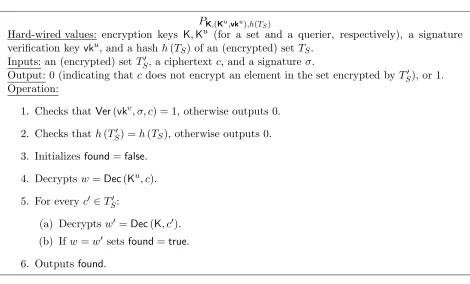
• ProcessSet(K,S) encrypts each element s ∈ S as c(s) ← Enc(K, s), and outputs
PK,(Ku,vku),h(TS)
Hard-wired values: encryption keys K,Ku (for a set and a querier, respectively), a signature verification keyvku, and a hash h(TS) of an (encrypted) set TS.
Inputs: an (encrypted) setTS0, a ciphertext c, and a signatureσ.
Output: 0 (indicating thatc does not encrypt an element in the set encrypted byTS0), or 1. Operation:
1. Checks thatVer(vkv, σ, c) = 1, otherwise outputs 0.
2. Checks thath(TS0) =h(TS), otherwise outputs 0.
3. Initializesfound=false.
4. Decryptsw=Dec(Ku, c).
5. For everyc0 ∈TS0:
(a) Decrypts w0 =Dec(K, c0).
(b) If w=w0 setsfound=true.
6. Outputsfound.
Figure 1: ProgramPK,(Ku,vku),h(T
S)used to generate share keys in Construction 2
• Share(K, Ku= (Ku,sku,vku), T
S) generates Pe ← O PK,(Ku,vku),h(T S)
where PK,(Ku,vku),h(T S)
is the TM defined in Figure1, and outputs ∆ =Pe.
• Query(Ku = (Ku,sku,vku), w) generates c← Enc(Ku, w) and σ ← Sign(sku, c), and outputs (c, σ).
• Search(∆, q, TS) outputs ∆ (TS, q).
The following claim states that if the obfuscator O used in Construction 2 is a secure diO ob-fuscator, and all other building blocks are secure, then Construction 2 is an MKSE scheme (as in Definition3.1).
Claim 5.4 (MKSE (Short Share Keys)). Assume that Construction 2 is instantiated with:
• a secure diO obfuscator O for TMs,
• a family of collision-resistent hash functions h,
• a double symmetric encryption scheme KeyGen2,Enc2,Dec2, and
• an existentially-unforgeable signature scheme,
then Construction 2 is a secure MKSE.
Moreover, if the encryption and signature schemes have poly(λ)-length keys, and incur apoly(λ)
overhead, then data and query keys, as well as queries, have length poly(λ), and for a set S, its corresponding processed set has size |S| ·poly(λ). Furthermore, if: (1) evaluating h on length-n
inputs takes HT (n) time, and outputs a hash of length H`(n); and (2) there exist functions s, TO :
takesTO(TIME(M, n))time, where TIME(M, n) is the running time ofM on length-n inputs; then runningSearchon a set S takesTO(HT (|S| ·poly(λ)) +|S| ·poly(λ))time, and share keys have size s(H`(|S| ·poly(λ))·poly(λ)).
Remark 5.5. We note that the security of Construction2does not require the diO obfuscator to be secure with relation toarbitraryauxiliary inputs, but rather it is only required to guarantee security against a specific class of auxiliary inputs, as specified in the proof of Claim 5.4.
Proof of Claim 5.4. The correctness of the scheme follows directly from the correctness of the un-derlying primitives. We now argue that the scheme is secure.
Let Abe a PPT adversary in the security game of Definition3.1, letKi be the data keyAchose for data owner i, and let W0,W1 be the sets of queries A chose (for all other values chosen by A, we use the notation of Definition 3.1). We proceed through a sequence of hybrids. Recall that the view ofAin the security game consists of the encrypted sets TSb
i for everyi∈ D, queriesq for every
w∈ Wb, and for every edge (j, i)∈E, the obfuscated program ∆
j,i. In particular, since the keys, and encrypted sets, of corrupted data owners are identically distributed when b= 0,1 (because S0
i =Si1 for everyi∈ Dc, and they are encrypted using the same keys), we can fix these values into all hybrid distributions, without decreasing the computational distance. Moreover, we assume without loss of generality that all data keysKi chosen byA are valid keys. We now define the hybrids.
view0 : view0 is the view ofA in the security game withb= 0.
H0: In hybrid H0, the keys K = (KL,KR),Ku = (KuL,KuR) in every obfuscated program
PK,(Ku,vku),h(T
S0) are replaced with the keys K 0 =K
L, ~0
,Ku0 =KuL, ~0.
H0 ≈ view0 by the diO security of O (and a standard hybrid argument (over all obfuscated programs inview0,H0), because the TMs in each of the share keys ∆j,iinview0,H0are differing-inputs. Indeed, they are actually functionally equivalent (givenanyauxiliary input), sinceDec2 completely disregards the right ciphertext, and so replacing the right secret key with the all-0 string does not affect functionality.
H1: In hybrid H1, the encrypted set Ti of every honest data owner i /∈ Dc is generated as the encryption of S0
i, Si1
withEncL (see Definition5.7 below) instead of Enc2. (Notice that this also affects the share keys.)
To prove that H0 ≈ H1, we will use the following lemma.
Lemma 5.6. Let ? ∈ {L, R}. For every pair (mL, mR) of messages, the following distributions
are computationally indistinguishable, when E2,E? use the same underlying encryption scheme E= (KeyGen,Enc,Dec).
• D1: generateK= (KL,KR)←KeyGen2 1λ
and c←Enc2(K, m?), and output(K?, c).
• D2: generateK= (KL,KR)←KeyGen? 1λ
and c←Enc?(K,(mL, mR)), and output(K?, c).
Proof. We prove the lemma for the case ?=L (the case?=R is similar) by showing that indistin-guishability follows from the security of the underlying scheme E. Given a distinguisher Dbetween
D1,D2, we construct a distinguisher D0 (that has mL hard-wired into it) between encryptions ac-cording to E of mL, mR. Given a ciphertext c, D0 operates as follows: generates K0 ← KeyGen 1λ
, computes c0←Enc K0, mL
By a standard hybrid argument, Lemma 5.6 implies that polynomially many ciphertexts (gen-erated either by E2 or byEL, with the same or different keys), together with the keys of the “left” component, are computationally indistinguishable.
We proveH0≈ H1 by reducing any distinguisherDbetweenH0,H1 to a distinguisherD0between encryptions generated according toELorE2. We hard-wire intoD0 the querier keys and their queries,
as well as the keys and encrypted sets of corrupted data owners, and the share keys associated with them. (This is possible because the encryption and signing keys of queriers, and their queries, are identically distributed in H0,H1, and independent of the encrypted sets; and since the share keys ∆j,i fori∈ Dc depend only on the keys of data owneri, querier j, and the encrypted set Ti, which are identically distributed in both hybrids.) D0 operates as follows: given a sequence of ciphertexts (the encrypted sets of honest data owners), and the keys corresponding to the ciphertexts in the left components, D0 honestly generates the hashes of encrypted sets of honest data owners, and uses the hard-wired querier keys, together with the keys for the left component in the ciphertexts of honest data owners, to generate the share keys between queriers and honest data owners. (Notice that since we have removed the key of the right component in ciphertexts of honest data owners, these are not needed to generate the share keys.) The values obtained in this way are distributed identically to
H0 (if the input ciphertexts were generated withE2) orH1 (if they were generated with EL), so D0 has the same distinguishing advantage as D.
We now define the next hybrids.
H2: In hybrid H2 the queries w0
j,1,· · · , w0j,kj
of every querier j ∈ Q are generated using EncL
with messagew0j,l, w1j,l,1≤l≤kj, instead ofEnc2.
H1 ≈ H2 by a similar argument to the one used to showH0 ≈ H1, and since repeated queries appear in the same locations in both query sequences.
H3: In hybridH3, the generation of share keys ∆j,iis modified as follows: (1) the hard-wired keys are
~0,KR,i,~0,Ku R,j
, where (KL,i,KR,i), KuL,i,KuR,j
are the encryption keys of data owner
iand querier j, respectively; and (2) the program P usesDecR(instead of Dec2) to decryptc, and the elements of TS0.
H3 ≈ H2 by the diO security of O, as we now show. Let d denote the number of share keys available to the adversary (i.e., d =|E|), and order them in some arbitrary way: ∆1,· · · ,∆d. We define a sequence of hybridsH0,· · · ,Hd, where inHl, the firstlshare keys are generated as inH
3(we denote these keys by ∆0k), and all other share keys are generated as inH2. We show thatHl≈ Hl−1 for every 1≤l≤d, and conclude thatH2 =H0 ≈ Hd=H3.
Fix some 1 ≤ l∗ ≤ d, and let (j, i) be the edge for which ∆l∗ was generated. We fix all the keywords W0,W1, and the sets S0
i0, Si10 for i0 ∈ D, into Hl ∗
,Hl∗−1
(this is possible because these values are identical in both hybrids). We additionally fix the keys of every querier j0, j0 6= j and data owner i0, i0 6=i, the queries that querier j0 makes, the processed setsTi0, i0 6=i, and share keys ∆j0,i0,∆0
j0,i0 (this is possible because these values are identically distributed in both hybrids). We now argue that ∆0j,i,∆j,i sampled inHl
∗
,Hl∗−1 (respectively) form a differing-sinputs family of TMs with respect to the auxiliary informationauxavailable toA(and soHl∗
≈ Hl∗−1
keysKi,Kuj (but not the secret signing key skuj), since these appear in either P orP0. We show that Dsucceeds in finding a differing input only with negligible probability.
Consider first the inputs (forP, P0) available toDinaux, i.e., the encrypted setTi (which encrypts the elements ofSi0 in the left components, and the elements ofSi1 in the right components; this holds even if i ∈ Dc since in that case Si0 = Si1), and the queries of querier j. For every such query q there exists a pair (wL, wR) of keywords such that q is of the formq= (c= (cL, cR), σ) wherec? ← Enc Ku?,j, m?
, ? ∈ {L, R}, σ ← Sign skuj, c
, and wL ∈Si0 ⇔ wR ∈ Si1. (Here, (KeyGen,Enc,Dec) is the encryption scheme used as a building block in the double encryption scheme.) In particular,
P(q, Ti) =P0(q, Ti) since the checks in Steps (1)-(2) succeed in both cases, and Steps (4)-(5) return the same outcome (P searches forwLinSi0, since it decrypts usingDec
2, whereasP0searches forw
Rin
Si1, since it decrypts withDecRand the right component ofTiencryptsSi1; andwL∈Si0 ⇔wR∈Si1). In particular, both programs have the same running time in this case.
Next, we claim that for every other possible input (T0, c0, σ0) thatDchooses (and does not appear in aux), P(T0, c0, σ0) = P0(T0, c0, σ0) = 0 except with negligible probability. Indeed, if c0 is not
an encryption of a pair
w0j,l, w1j,l
of keywords for some 1 ≤l ≤kj (i.e., for some pair of keyword queries of querierj) then by the existential unforgeability of the signature scheme, with overwhelming probabilityσ0 is not a valid signature forc0, so the check in Step (1) fails in both P, P0 (in particular, both programs have the same running time in this case). Moreover, if T0 6=Ti then by the collision resistance of h, with overwhelming probability h(T0) 6= h(Ti), so the check in Step (2) fails (and again, P, P0 have the same running time). Therefore,P, P0 are differing inputs with relation to the auxiliary information aux.
We now define the final set of hybrids.
H4: In hybrid H4, the queries
wj,11,· · · , w1j,k
j
of every querier j∈ Q are generated usingEnc2
with message
w1j,l, w1j,l
,1≤l≤kj, instead ofEncL with message
wj,l0 , w1j,l
,1≤l≤kj.
H3≈ H4 by a similar argument to the one used to proveH1 ≈ H2.
H5: In hybrid H5, the encrypted set Ti of every honest data owner i /∈ Dc is generated as the encryption of S1i, Si1
withEnc2 instead of with EncL.
H4≈ H5 by a similar argument to the one used to proveH0 ≈ H1.
H6: In hybrid H6, the obfuscated program for every edge (j, i) ∈E is generated as follows: (1) the hard-wired keys are K = (KL,i,KR,i),K = KuL,j,KuR,j
, instead of K0 = ~0,KR,i
,Ku0 =
~0,Ku R,j
; and (2)Dec2 is used for decryption (instead of DecR).
H6 ≈ H5 by the diO security of O, using a standard hybrid argument in which the obfuscated programs are replaced one at a time. When replacing the program for edge (j, i) fromP0(inH5) toP
(inH6), the PPTD(which should find a differing input) is given (as part of the auxiliary information aux) the setsSi10, i0 ∈ D; the keywords inW1 and the corresponding queries; the encryption keys of all data owners i0, i0 6=iand querierj0, j0 6=j; the signing and verification keys of all queriers j0, j06=j; and all encrypted sets Ti0, i0 ∈ D. Also, from P, P0 the distinguisher learns the encryption keys Ki,Kuj, and the verification keyvkuj. We show that except with negligible probability,Dfails to find a differing input (the argument is similar to that used to proveH3 ≈ H2).
other possible input (T0, c0, σ0) thatDchooses,P(T0, c0, σ0) =P0(T0, c0, σ0) = 0 except with negligible
probability: if c0 is not an encryption of
wj,l1 , w1j,l
for some 1 ≤ l ≤ kj then with overwhelming probabilityσ0is not a valid signature onc0 (by the existential unforgeability of the signature scheme); whereas ifT0 6=Ti then with overwhelming probabilityh(T0)6=h(Ti) (by the collision resistance of
h). Consequently, H5≈ H6. SinceH6 is the view ofAin the security game withb= 1, we conclude that Ahas only negligible advantage in the security game.
Finally, we analyze the complexity of the scheme. Data and query keys, which are simply encryp-tion and signing keys, have sizepoly(λ). Queries are ciphertext for length-O(λ) keywords (since the universe is at most of size 2λ), together with signatures on these ciphertexts. Similarly, a processed set consists of encryptions of each of its keywords, so its size is|S|·poly(λ). Regarding share keys, the TM has sizeH`(|S| ·poly(λ))·poly(λ) (since|h(TS)| ≤H`(|S| ·poly(λ))), and so by the assumption on the blowup caused by obfuscation, share keys have sizes(H`(|S| ·poly(λ))·poly(λ)). Finally,Search consists of running the obfuscated TM, which requires computing the hash (HT (|S| ·poly(λ)) time), and performingO(|S|) operations, each takingpoly(λ) time, soTIME(M,|S|) =HT(|S| ·poly(λ)) +
|S| ·poly(λ), and consequently the running time isTO(HT(|S| ·poly(λ)) +|S| ·poly(λ)).
The following encryption scheme was used to prove Claim 5.4:
Definition 5.7. Given a symmetric encryption scheme (KeyGen,Enc,Dec), and?∈ {L, R}, we define an encryption schemeE? = (KeyGen?,Enc?,Dec?) as follows:
• KeyGen? operates as KeyGen2 from Definition 5.3. That is, on input 1λ it generates KL ← KeyGen 1λ and KR←KeyGen 1λ
, and outputs K= (KL,KR).
• Enc?, on input a keyK= (KL,KR) and a messagem= (mL, mR), computescL←Enc(KL, mL) and cR←Enc(KR, mR), and outputsc= (cL, cR).
• Dec?, on input a key K= (KL,KR) and a ciphertextc= (cL, cR), outputsDec(K?, c?).
The proof of Theorem 5.1now follows as a corollary from Claim5.4.
Proof of Theorem 5.1. We instantiate Construction 2 with the double encryption scheme of Defini-tion5.3, based on the encryption scheme whose existence follows from the existence of a CRHF; the hash function with a Merkle Hash Tree (MHT) hash based on the CRHF; and instantiate O with the diO obfuscator. Then the security of the scheme, as well as the length of data and query keys, queries, and processed sets, follow directly from Claim 5.4. Regarding share keys, the MHT has poly(λ)-length outputs, and O causes only a polynomial blowup, so by Claim 5.4, share keys have length poly(λ). Finally, generating the MHT for a set of size s takes time s·poly(λ), and so the runtime ofSearch ispoly(λ,|S|).
5.2 MKSE from Public-Coin Differing-Inputs Obfuscation
In this section we show that a slight modification of Construction2is secure assuming the underlying obfuscator is a pc-diO obfuscator for TMs. More specifically, we only need to use a signature scheme with some “special” properties. Concretely, we prove the following for a universe U of size|U | ≤poly 2λ
:
The reason we need to change the MKSE scheme outlined in Section 5.1 is that it cannot use a pc-diO obfuscator. (Roughly speaking, pc-diO guarantees indistinguishability of the obfuscated programs only as long as it is infeasible for a PPT adversary to find an input on which they differ, even given the randomness used to sample the programs; see DefinitionA.4in AppendixA.) Indeed, for every querier j and data owner i, the randomness used to sample the program Pj,i (i.e., the program obfuscated in the share key ∆j,i) includes the signing key of querier j. This allows one to sign arbitrary messages, meaning the obfuscated programs in the security game whenb = 0 and
b = 1 are not differing-inputs. (The program Pj,i for querier j and data owner i contains h Si0
whenb= 0, andh Si1 whenb= 1, so a differing input would be a query on any keyword contained in one and not the other. The query can be efficiently generated since the encryption and signing keys appear in the randomness used to sample Pj,i.)
To overcome this issue, we introduce (Section5.2.1) a new signature primitive which we call dual-mode signatures. Roughly, a dual-mode signature scheme is an existentially-unforgeable signature scheme associated with an additional SpecialGen algorithm that given a list of messages, generates “fake” signatures on these messages, and a “fake” verification key under which they can be verified. These “fake” signatures and key are computationally indistinguishable from honestly generated sig-natures and verification key, and the “fake” verification key cannot be used to successfully sign other messages, even given the randomness used to generate the “special mode” verification key and sig-natures. (This rules out the trivial construction in which SpecialGensimply runs the key generation and signing algorithms.)
One can think of the SpecialGen algorithm as a way of “puncturing” the signing key from the procedure that generates the verification key and signatures. We use this viewpoint to prove (Sec-tion 5.2.2) security based on pc-diO security and dual-mode signatures: we first replace the actual verification key used inPj,i, and the signatures in the queries ofj, with ones generated bySpecialGen; and then use pc-diO security to replace the obfuscated program from one containing h Si0 to one containingh Si1
. (Notice that now the randomness used to samplePj,idoesnot contain the signing key, so one cannot sign queries that j did not issue.)
5.2.1 Dual-Mode Signatures
We now formally define the notion of dual-mode signatures, and construct such signatures based on OWPs and CRHFs.
Definition 5.9 (Dual-mode signature scheme). We say that an existentially-unforgeable signature scheme (KeyGen,Sign,Ver) is adual-mode signature schemeif there exists a PPT algorithmSpecialGen such that the following holds.
• Special mode generation. SpecialGen, on input a security parameter 1λ, an input length 1n, and a non-empty multi-set m1,· · · , mk(λ) of length-n messages (for some k(λ) =poly(λ)), outputs a verification key vk, and a set of signatures σ1,· · ·, σk(λ) .
• Standard and special modes are indistinguishable. For every k(λ) = poly(λ), every input lengthn∈N, and every non-empty multi-setm1,· · · , mk(λ) of length-nmessages, the following distributions are computationally indistinguishable:
– Dstandard 1λ: generate (sk,vk) ← KeyGen 1λ,1n; for every 1 ≤ i ≤ k(λ), compute
σi ←Sign(sk, mi); output vk,
σ1,· · · , σk(λ) .
– Dspecial 1λ
: run vk,
σ1,· · · , σk(λ) ← SpecialGen 1λ,1n,
• Special mode cannot sign additional messages. For every input length n=poly(λ), and polynomial-time forger A= (A1,A2), the following probability is negligible inλ:
Pr
m /∈M∧Ver(vk, σ, m) = 1 :
M =
m1,· · ·, m|M| ,St
← A1 1λ
vk,σ1,· · ·, σ|M| ←SpecialGen 1λ,1n, M;r
(σ, m)← A2 St, vk,
σ1,· · ·, σ|M| , r
whereM is a multi-set.
Notice that A2 cannot forge signatures,even given the randomness used to generate the “special
mode” verification key and signatures. This rules out the trivial construction in which SpecialGen simply emulatesDstandard.
Remark 5.10. The indistinguishability of standard and special modes property guarantees that special-mode verification keys are indistinguishable from standard-mode verification keys (regardless of the messages for which the special-mode verification key was generated).
We construct dual-mode signatures from OWPs and CRHFs in two steps. We first construct a one-time dual-mode signature scheme, in which SpecialGen works only for a single message, and security holds only for A1 that chooses a singleton M. These one-time signatures are based on Lamport’s one-time signatures [Lam79]. Then, we show a general transformation from one-time to multi-time dual-mode signatures.
Construction 3 (One-time dual-mode signatures). The scheme uses a family P =
Pλ :{0,1}λ → {0,1}λ of OWPs, and a hash function h : {0,1}∗ → {0,1}κ (for some κ ∈ N),
and consists of the following algorithms:
• KeyGenon input a security parameter 1λ, and an input length 1n, picksxib ∈R{0,1}λ for every
b∈ {0,1},1≤i≤κ, computes yib=Pλ xbi
, and outputs
sk=
n
xbi
o
b∈{0,1},1≤i≤κ,vk=
n
ybi
o
b∈{0,1},1≤i≤κ
.
• Sign on input a signing key sk = xbi b∈{0,1},1≤i≤κ, and a message m = m1· · ·mn ∈ {0,1}n, computes z=h(m), and outputsσ = (xzi
i )1≤i≤κ.
• Veron input a verification keyvk=
yb
i b∈{0,1},1≤i≤κ, a signatureσ = (x
0
i)1≤i≤κ, and a message
m = m1· · ·mn ∈ {0,1}n, computes z = h(m), and outputs 1 if and only if Pλ(x0i) = y zi
i for every 1≤i≤κ.
• SpecialGen on input a security parameter 1λ, an input length 1n, and a message m =
m1· · ·mn ∈ {0,1}n, operates as follows: computes z = h(m), then for every 1 ≤ i ≤ κ, picks xzi
i ∈R {0,1}λ, computes yizi = Pλ xbi
, and picks y¯zi
i ∈R {0,1}λ; and outputs
vk=
ybi b∈{0,1},1≤i≤κ, σ= (xzi
i )1≤i≤κ
.
We note that our construction uses a OWP, whereas standard Lamport signatures can use any
OWF. A permutation is needed to guarantee that the special and standard modes are indistinguish-able. Next, we prove that Construction 3is a one-time dual-mode signature scheme.
Proof. We show that Construction3 has the appropriate properties. To obtainpoly(λ)-length keys, we can instantiate the construction with any family of polynomially-secure CRHFs, and obtain keys of lengthpoly(λ) using a MHT (if hash functions in the family are not sufficiently compressing). We now discuss the properties of the scheme.
Existential unforgeability. (KeyGen,Sign,Ver) is Lamport’s one-time signature scheme [Lam79] and so it is existentially unforgeable.
Standard and special modes are indistinguishable. The only difference betweenDstandard
and Dspecial for a message m ∈ {0,1}n is in the values yz¯i
i , for z = h(m), that appear in the verification key (all other values are identically distributed in both distributions): in Dstandardthese are the images (underPλ) of random values, whereas inDspecial these are random values. But since
Pλ is a permutation, the images of random values are themselves random, so Dstandard≈ Dspecial.
Special mode cannot sign additional messages. This follows from the security of the OWP. LetA= (A1,A2) be a polynomial-time forger in Definition 5.9such that
Pr
m
0 6=m∧Ver vk, σ0, m0
= 1 :
(m,St)← A1 1λ
(vk, σ)←SpecialGen 1λ,1n,{m};r
(σ0, m0)← A2(St,(vk, σ), r)
=(λ).
We construct an adversaryA0 that succeeds in invertingPλ with probability (κλ)·(1−negl(λ)), and conclude from the one-wayness ofPλ that(λ) =negl(λ) (sinceκ=poly(λ)). A0 operates as follows: it runs A1 to obtain a message m∈ {0,1}n to sign, and a state St. Athen chooses i∗ ∈
R[κ]. Given a challengey(the image underPλ of a randomx),Agenerates the verification keyvk, and signature
σ onm, by emulatingSpecialGenwith the following modification: it setsyz¯i∗
i∗ =y(instead of picking it at random), where z=h(m). Letr denote the random bits which A0 used to emulate SpecialGen
(i.e., the bits used to sample thexzi
i ’s and they ¯ zi
i ’s), together with the valuey (which are the random bits that would give y¯zi∗
i∗ the value y). Then A0 runs A2 with input
St,
vk,{xzi
i }1≤i≤κ
, r
, and
obtains a message m0, and a purported signature σ0 = {x0i}1≤i≤κ. A0 outputs x0i∗ as the pre-image of y. We claim that Pr [Pλ(x0i∗) =y] ≥ (κλ) ·(1−negl(λ)). Notice first that the input to A2 is identically distributed to its view in the forging game. Indeed, the only difference is in the choice of
y¯zi∗
i∗ : in the forging game it is chosen uniformly at random, whereasA0 sets it to be the image of a random value, but since Pλ is a permutation, it is also randomly distributed. Moreover, if m6=m0 then except with negligible probability,h(m)6=h(m0), from the collision-resistance ofh. Therefore,
Pr
Pλ x0i∗
=y
= Pr
Ver vk, σ0, m0
= 1∧m0 6=m ·Pr
h(m)i∗6=h m0
i∗|m6=m
0
≥(λ)· 1
κ(1−negl(λ))
(where the rightmost inequality holds becausei∗ is random and unknown toA2).
We now describe a transformation from one-time dual-mode signature schemes to (multi-time) dual-mode signature schemes which, combined with Construction3, gives a construction of a (multi-use) dual-mode signature scheme. The high-level idea of the transformation is to use the hash-tree construction of Naor and Yung [NY89], extending it to also support special-mode generation.
Construction 4 (Dual-mode signature scheme). The dual-mode signature scheme (KeyGen,Sign,Ver,SpecialGen) uses a one-time dual-mode signature scheme
KeyGen1,Sign1,Ver1,SpecialGen1
where for every n = poly(λ), KeyGen1 1λ,1n